

Note: This article contains affiliate links. If you click on these links and make a purchase, I may earn a small commission at no extra cost to you. This helps support my research and content. Read my full affiliate disclosure here.
Ant infestations in living spaces are both a nuisance and a hygiene concern. Choosing the right ant bait for home use matters because baits work slowly through worker ants to eliminate nests, and the wrong product or placement can leave you chasing trails instead of solving the problem. This guide covers seven shortlisted ant baits that suit indoor situations, with attention to how fast they stop foraging, where to place them safely, and what to expect from results. We evaluated formulations, bait delivery formats, and safety features most relevant to households with pets, kids, and food prep areas. Read on to understand the tradeoffs and practical steps for using ant bait indoors before the product list.
Top Picks at a Glance
| Best Overall The best all-around choice for most situations | Catchmaster Defiant Liquid Ant Bait Starter Kit (1 Liquid Bait + 4 Refillable Stations) |  |
| Best Quality Built to a higher standard if you want something more solid | Syngenta Advion Ant Gel Bait, 30 g |  |
| Best Value The sweet spot between price and what you get | TERRO Multi-Surface Liquid Ant Baits, 4-Pack |  |
| Best Budget The cheapest option that still gets the job done reliably | Combat Max Ant Killing Bait Stations, 6 Count |  |
| Highest Rated A top-rated pick with lots of positive feedback | ROUTADE 48-Pack Slow-Acting Ant Gel Bait Stations |  |
| Most Popular A crowd favorite that many people choose with confidence | TERRO Liquid Ant Killer Bait Stations, 12-Pack (T300B) |  |
| Best Seller A high-volume bestseller chosen again and again | Raid Ant Killer Baits, 8 Count (Child-Resistant) |  |
Catchmaster Defiant Liquid Ant Bait Starter Kit (1 Liquid Bait + 4 Refillable Stations)

| Unit Count | 4 Count |
|---|---|
| Included Components | Sodium Tetraborate Decahydrate (Borax) 5.4%, Other Ingredients: 94.6% |
| Target Species | Ant |
| Number of Pieces | 5 |
| Recommended Uses For Product | Indoor Ant Control, Outdoor Ant Control, Reducing and Removing Entire Ant Colonies |
The Defiant Liquid Ant Bait Starter Kit is a performance-focused ant control system that uses a sugar-attractive liquid bait workers carry back to the colony to eliminate the queen and nest. You pour a few drops of the ready-to-use bait into the included stations, place them near ant trails or hotspots, and monitor activity through the clear stations. The kit is designed for repeated use: stations are refillable and stackable for use in dustier or high-traffic spots, and the 3.38 oz bait bottle is described as roughly a one-year supply for an average home. Practical benefits include targeted placement indoors and outdoors, discreet clear housings to watch bait levels, and a formulation intended to be slow-acting so ants transfer the bait through the colony. Important limitations are that it is not labeled for carpenter, fire, or pharaoh ants and results depend on worker ants finding and carrying bait back to the nest which can take up to three weeks for full colony elimination.
Best for: Buyers who prioritize effective colony-level control of sugar-attracted ants and want a reusable, monitored baiting system they can place indoors and near entry points outdoors.
Less Ideal for: Those facing infestations of carpenter, fire, or pharaoh ants or people who need immediate knockdown of visible ants should consider other targeted treatments.
- Ready-to-use liquid bait that workers can carry back to the colony for whole-nest control
- Refillable, stackable stations let you reuse traps season after season and adapt placement
- Clear stations allow easy monitoring of ant activity and bait level
- Includes multiple stations for placement around indoor and outdoor hotspots
- Not effective against carpenter, fire, or pharaoh ants
- Elimination depends on ants finding and transporting bait so results can take up to three weeks
Verdict: Choose this kit if you want a reusable, monitored liquid-bait system built to eliminate sugar-attracted ant colonies rather than just repel or kill individual workers.
Syngenta Advion Ant Gel Bait, 30 g

| Item Form | Gel |
|---|---|
| Target Species | Insects |
| Active Ingredients | Indoxacarb |
Advion Ant Gel is a concentrated, professional-style ant bait formulated around indoxacarb and a highly palatable gel matrix to lure foraging ants and carry toxicant back to the colony. You apply small dabs of the translucent, nonstaining gel in ant trails, near nesting sites, or in voids where ants forage; workers feed on the gel and transfer it through trophallaxis, which helps suppress entire colonies rather than just worker ants. The formulation is touted for lasting integrity with low odor and high attractiveness to sweet-feeding species, so you do not need frequent reapplication in protected spots. Because it is a targeted bait rather than a broadcast insecticide, it is practical for spot treatments in kitchens, pantries, and around baseboards as well as sheltered outdoor locations. Important limits are that it is a bait product requiring worker-mediated distribution so results are not instant and indoor use requires keeping it away from children and pets.
Best for: Buyers who prioritize effective colony-level control and want a concentrated, professional-style bait for spot treatments inside homes or in sheltered outdoor locations.
Less Ideal for: People needing immediate knockdown of visible ants or those who require a product for widespread outdoor perimeter treatments should consider different control methods.
- Contains indoxacarb, a potent active ingredient with a unique mode of action
- Highly palatable, translucent gel that attracts sweet-feeding ants
- Maintains formulation integrity for extended periods in sheltered application sites
- Suitable for indoor and sheltered outdoor spot treatments
- Relies on worker feeding and transfer so colony elimination can take several days to weeks
- Not intended for broad outdoor broadcast use or exposed wet areas
Verdict: Choose Advion Ant Gel when you want a high-performance, worker-transferred bait that targets colonies rather than just knocking down visible ants.
TERRO Multi-Surface Liquid Ant Baits, 4-Pack

| Included Components | 4 ant bait stations plus adhesive strips |
|---|---|
| Target Species | Ant |
| Material Type | Plastic |
| Active Ingredient | Sodium Tetraborate Decahydrate (Borax) 5.40% |
The TERRO Multi-Surface Liquid Ant Baits are prefilled bait stations designed for indoor ant control. You remove the tab and either lay them flat or stick them to walls, kick plates, or under cabinets with the included adhesive strips, placing them along ant trails and entry points. The sweet liquid attracts foraging ants, which carry the borax-based bait back to the colony so it can spread and reduce the nest over a 2 to 4 week period. Notable features are the multi-surface design for discreet placement, included adhesive strips, and a ready-to-use format that needs no mixing or mess. In practice you will often see more ants initially as they discover the bait, then a steady decline in activity within days and more complete control in weeks. Limitations are that results are not instantaneous, bait must be replaced when depleted, and stations need to be positioned where ants are active but out of reach of children and pets for safety.
Best for: Buyers who want a low-effort, practical solution for indoor ant problems and prefer products that can be placed discreetly in targeted spots around the home.
Less Ideal for: People needing immediate knockdown of large visible infestations or those who cannot safely place baits away from children and pets should consider other control methods.
- Multi-surface design lets you place baits flat or adhered to walls and under cabinets
- Prefilled, ready-to-use stations require no mixing or setup
- Slow-acting borax formulation spreads through the colony for deeper control
- Includes adhesive strips for discreet placement out of the way
- Control takes days to weeks and stations must be monitored and replaced when empty
- Contains borax so placements must be kept away from children and pets
Verdict: An easy, ready-to-use bait station that lets you discreetly target ant trails and work toward colony-level control with minimal effort.
Combat Max Ant Killing Bait Stations, 6 Count

| Active ingredient | Fipronil 0.01% |
|---|---|
| Units included | 6 bait stations |
| Intended use | Indoor and outdoor |
| Protection duration | Up to 3 months per station |
Combat Max Ant Killing Bait Stations are compact, child-resistant plastic stations prefilled with a Fipronil-based bait intended for indoor and outdoor use. You place the stations along ant trails or near entry points and foraging ants enter, feed, and carry the bait back to the nest where it works to eliminate the queen and other colony members. The package includes six stations, each designed to provide up to three months of protection, and the odorless, fuss-free formula means they can sit in kitchens, bathrooms, and living areas without noticeable fumes. Practical benefits include no-mess setup, a discreet low-profile housing that fits under sinks and behind appliances, and a bait attractive to multiple common ant species. Limitations are that results depend on ants finding and accepting the bait and that replacement every three months is recommended to maintain effectiveness. As with any insecticide, keep stations out of reach of children and pets and follow label directions for safe placement and disposal.
Best for: Buyers who want a practical, low-effort indoor ant solution they can place and forget for weeks at a time; good for homeowners prioritizing convenience and discreet placement.
Less Ideal for: People who need immediate knockdown of visible ants by contact spray or who prefer non-chemical control methods; not suitable where children or pets may repeatedly access bait despite child-resistant design.
- Ready-to-use, no activation or messy application required
- Child-resistant, low-profile plastic housing suitable for tight spaces
- Uses Fipronil for fast-acting control that targets the colony via forager transfer
- Odorless and vapor-free formula safe for use in living areas when used as directed
- Effectiveness depends on ants locating and accepting the bait so placement matters
- Requires replacing stations approximately every three months to maintain control
Verdict: A convenient, ready-to-use bait station pack that reliably targets entire ant colonies with minimal setup for buyers who prioritize low-effort indoor control.
ROUTADE 48-Pack Slow-Acting Ant Gel Bait Stations

| Unit Count | 48 Count |
|---|---|
| Item Form | Gel |
| Target Species | Ants |
| Included Components | Ant gel bait |
This 48-pack of ROUTADE slow-acting ant gel bait stations is built for systematic, long-term ant control in and around the kitchen. Each station contains a gel formula that worker ants consume and carry back to the nest, which helps reduce the entire colony rather than only visible foragers. The product is supplied in ready-to-use stations with adhesive tape so you can place them along baseboards, in cabinets, near sinks, and on entry thresholds without messy sprays or frequent repositioning. The large pack lets you deploy multiple stations in high-traffic areas and replace them over time for continuous coverage. Because the formula is slow-acting, it is effective against a range of common household species including carpenter ants and sugar ants, but it requires several days to weeks to knock down a colony and will not give instant removal of visible ants. Also the stations are small and contain gel rather than a tamper-resistant hard block, so keep them away from children and pets. For someone wanting a low-maintenance, colony-focused approach to kitchen ant problems, this kit makes it easy to set and forget while the bait works.
Best for: Homeowners who prioritize reliable, long-term elimination of ant colonies in kitchens and want a low-maintenance bait they can deploy across multiple hotspots.
Less Ideal for: People who need an immediate knockdown of visible ants or who require childproof solid bait stations should consider alternatives.
- Slow-acting gel designed for worker ants to carry bait back to the nest for colony-level control
- Ready-to-use bait stations with adhesive for easy placement along baseboards and in cabinets
- 48-count pack provides broad coverage around a kitchen and enough replacements for extended use
- Versatile for indoor and outdoor placement to block entry points and high-traffic ant routes
- Slow-acting formula takes days to weeks to eliminate a colony so visible results are not immediate
- Gel in small stations may require careful placement to keep away from children and pets
Verdict: A practical, deploy-and-forget gel bait kit for reliable colony-level control of kitchen ant infestations.
TERRO Liquid Ant Killer Bait Stations, 12-Pack (T300B)

| Unit Count | 12 Count |
|---|---|
| Item Form | Liquid |
| Target Species | Insects |
| Active Ingredients | Sodium Tetraborate Decahydrate (Borax), 5.40% |
Terro Liquid Ant Killer bait stations are prefilled, single-use traps designed for indoor control of common sugar-loving ants. You place the small stations along baseboards, in corners, under appliances, or on countertops where you see ant activity. Worker ants are drawn to the sweet liquid, feed on it, and take it back to the nest so the borax-based active ingredient can eliminate the colony over days to weeks. The product is easy to use with no mixing or setup and the 12-pack gives coverage for several rooms. Because the bait is contained inside a low-profile plastic station, it reduces incidental contact risk compared with loose sprays or powders and lasts for weeks while ants continue to visit. Limitations are that the formula targets sugar-preferring species so very protein- or grease-attracted ants may ignore it, and control can take 2 to 4 weeks for larger infestations. Also stations should be placed away from pets and children despite the contained design since the bait contains borax.
Best for: Homeowners who prioritize an easy, low-hassle indoor solution and want a bait that works at the colony level with minimal hands-on pest handling.
Less Ideal for: People who need immediate knockdown of ants or who have pets or children that frequently access treated areas and cannot reliably keep them away from placed stations.
- Ready-to-use stations require no mixing or setup
- Designed to be carried back to the nest for colony-level control
- Low-profile enclosed bait reduces messy exposure compared with loose liquids or sprays
- 12 stations provide coverage for multiple rooms or hotspots
- Formulation is sugar-based so less effective on ants that prefer protein or grease
- Control can take 2–4 weeks for large or established colonies
Verdict: A simple, low-contact indoor bait system that reliably reduces sugar-loving ant infestations by getting worker ants to carry borax back to the colony.
Raid Ant Killer Baits, 8 Count (Child-Resistant)
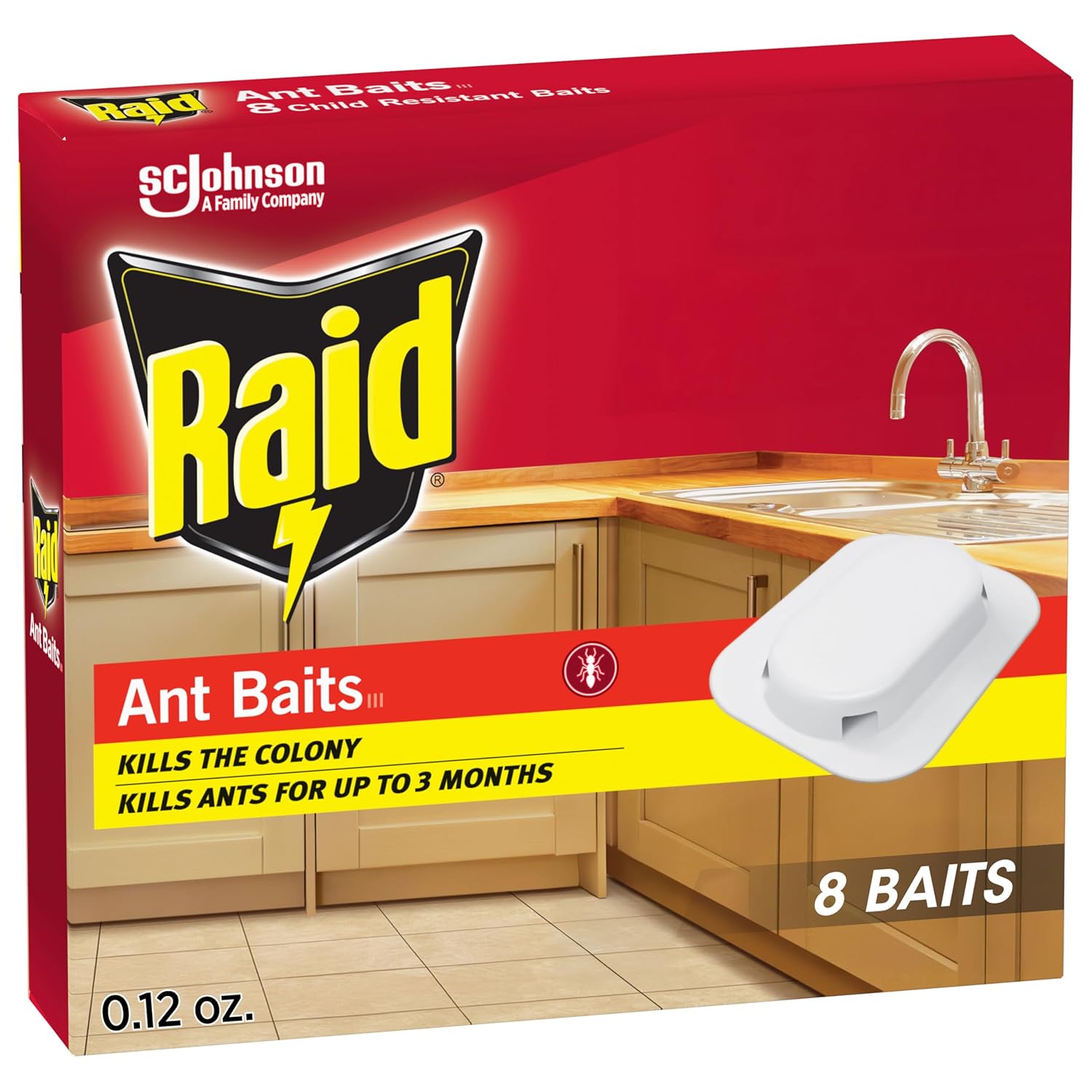
| Package quantity | 8 Count |
|---|---|
| Child safety | Child-resistant |
| Intended use | Indoor |
| Effect duration | Up to 3 months |
These Raid Ant Killer Baits are small, ready-to-use indoor stations that dispense an attractive liquid bait ants carry back to the colony, which can eliminate the nest over time. You place the bait along walls, in corners, and near entry points where small ants forage; after ants feed, the active ingredient is shared with other colony members, including the queen, and protection can last for weeks. The child-resistant design reduces accidental access in homes with children while the compact stations are low-profile and easy to position. Because they are prefilled and disposable, there is no mixing or measuring, which makes them convenient for quick treatment in kitchens, pantries, and baseboards. Limitations are that the product is for indoor use only and may be less effective if competing food sources are left available or if multiple heavy infestations require broader perimeter treatment. For someone looking for a simple, no-fuss bait to try first, these are a practical option.
Best for: Budget-minded homeowners or renters who want an easy, low-effort indoor solution to control small ant trails and try baiting before calling for broader treatments.
Less Ideal for: People needing immediate knockdown for very large or outdoor ant colonies or those who prefer non-chemical mechanical control methods.
- Ready-to-use prefilled bait stations that require no setup
- Child-resistant design reduces accidental access
- Bait formula is transferred through the colony to target the queen
- Compact, low-profile stations are easy to place along walls and entry points
- Intended for indoor use only, not suited for outdoor colony control
- May be less effective if other food sources are available or in very large infestations
Verdict: A low-cost, no-fuss indoor bait station that effectively targets small ant colonies by having foragers carry bait back to the nest.
Choosing the Right Ant Bait for Home: Key Factors to Consider
Bait Formulation and Attractiveness
Different ant species prefer different food sources, so bait formulation directly affects how quickly worker ants accept a bait. Sugar-based gels attract sugar-loving ants commonly found in kitchens, while protein- or grease-targeted baits work better for species that scavenge proteins. Matching the bait type to the likely food preference increases the chance that foragers will take the bait back to the nest.
For indoor use you also want a formulation that stays palatable on the tray or station. Gels and contained liquid baits reduce drying and contamination compared with exposed granules. A more attractive bait shortens the time to reduction in visible trails and increases the probability of colony-level control rather than just local forager suppression.
Delivery Format and Placement Safety
How the bait is presented affects both safety and effectiveness. Tamper-resistant bait stations confine the active ingredient away from pets and children and make placement near baseboards and entry points straightforward. Syringes or squeeze tubes are useful for targeted placement in cracks and around appliances but require careful handling to avoid contact.
For homes with curious pets or toddlers, enclosed stations or small prefilled trays are preferable. Consider where ants forage: along counters, inside cabinets, or near windows. Proper placement near active trails and entry points is often more important than volume of bait used.
Active Ingredient and Mode of Action
The active ingredient determines how the bait works and how quickly you will see results. Slow-acting toxicants allow worker ants to carry bait into the nest and feed other colony members, which is necessary for reducing the entire colony population. Fast-acting contact killers may reduce visible ants quickly but often fail to eliminate the nest.
Read labels to understand if a bait relies on ingestion and transfer or on contact activity. For indoor use, also consider any restrictions or required protective steps listed on the product label. Knowing the mode of action helps set realistic expectations for timing and follow-up treatments.
Longevity and Environmental Stability
A bait that dries out or becomes contaminated with food residues will lose attractiveness. Indoors, baits exposed to air, steam from cooking, or frequent cleaning may deteriorate faster. Prefilled stations, sealed gels, or bait cards with protective covers maintain their efficacy longer.
Choose products designed for the typical microclimate of placement. In kitchens near sinks and cooktops, a bait that resists moisture is preferable. Longevity reduces the need for frequent replacement and improves the chances of colony-level control because more foragers encounter bait over time.
Label Clarity and Usage Instructions
Clear application instructions affect both safety and success. Good labels indicate where to place baits, how much to use, how often to check and replace them, and what to avoid (for example, not applying baits directly on food prep surfaces). Instructions that match typical indoor scenarios make it easier to follow effective placement and limit accidental exposure.
Look for guidance on what to do when visible trails disappear or when ant activity shifts. Labels that specify setbacks from children and pet-accessible areas and that explain expected timelines help you plan follow-up inspections and additional placements.
How Ant Baits Work Indoors
Ant bait relies on worker ants finding an attractive food source, consuming it, and carrying it back to the nest where the toxicant can pass to other colony members. For home use this means the goal is colony suppression, not merely killing visible foragers. That process can take several days to a few weeks depending on species, colony size, and bait attractiveness.
- Workers must accept the bait over other food sources for transfer to occur
- Slow-acting toxicants increase the chance that the bait will reach brood and queens
- Placement along active foraging trails near baseboards, cabinets, and entry points boosts uptake
Identifying Where to Place Baits
Observe ant activity at different times of day to find concentrated trails and entry routes. Indoors, ants often follow grout lines, baseboards, and the seams of cabinets. Place baits slightly ahead of the leading edge of activity so foragers encounter them on the way to the nest rather than past it.
- Avoid placing baits on damp surfaces or directly on food prep counters
- Use enclosed stations near wall junctions and along observed trails
- Check placements daily for the first week to confirm uptake
Safe Use Around Pets and Children
If you have pets or small children, prioritize enclosed bait stations and keep them in locations that animals cannot reach. Even with tamper-resistant designs, avoid placing stations on low shelves or in play areas. For granular or spray-compatible indoor treatments, follow label guidance about access restrictions and reentry times.
- Prefer enclosed, lockable stations when pets roam freely indoors
- Keep pets away from treated areas until the product label allows reentry
- Store unused bait in a secure container out of reach and sight
When to Expect Results and What to Do Next
Visible reduction in ant trails can appear within a few days with aggressive uptake, but complete colony elimination may take several weeks. If activity shifts or trails move, reposition bait stations where the new activity is concentrated. Avoid removing bait at the first sign of fewer ants-continued bait presence often finishes suppression of the nest.
- Continue baiting for at least one week after trails disappear
- Inspect possible nest sites if ants persist, such as wall voids or appliance cavities
- If no uptake occurs within 48 hours, try a different bait formulation or placement strategy
Combining Baits With Non-Chemical Controls
Baits work best when combined with good sanitation and exclusion. Seal cracks and gaps around doors, windows, plumbing penetrations, and baseboards to reduce reinfestation. Keep food sealed and clean up crumbs promptly to increase the relative attractiveness of the bait. Non-chemical measures lower the population pressure and reduce the need for repeated treatments. However, exclusion and sanitation rarely eliminate a nest on their own once foraging is established; baits remain the primary tool for colony-level suppression indoors.
- Caulk gaps and install weatherstripping at likely entry points
- Store pantry goods in sealed containers
- Maintain regular cleaning of counter tops and floors to favor bait uptake
How We Chose the Best Ant Bait for Home
We prioritized real-world household concerns when selecting these ant baits. First, bait effectiveness against common indoor species was a primary filter, focusing on formulations known to attract worker ants and transfer toxicant back to the nest. Second, indoor safety was essential: we favored bait formats and labels designed for use around food prep areas, children, and pets, and that offered clear placement guidance. Third, ease of use influenced selection: bait stations or ready-to-use gels that require minimal handling rate higher than loose granular mixes. Fourth, longevity and stability were considered so a bait stays attractive long enough for workers to find it. Fifth, clarity of label instructions and containment features were assessed to reduce accidental exposure. We excluded outdoor-only products, broadcast granular treatments not intended for indoor use, and anything requiring professional licensing. Together these filters produced a list aimed at homeowners seeking practical, safe, and effective indoor ant control options. The scoring criteria reflect these editorial priorities and the dimensions gardeners and homeowners commonly consider.
FAQ
How long does indoor ant baiting usually take to work?
It often takes several days to see reduced trails and up to a few weeks for colony-level suppression. Timing depends on species, how attractive the bait is, and whether worker ants can reliably carry bait to the nest.
Is it safe to use ant bait around pets?
Many enclosed bait stations are designed to limit access by pets, but you should still follow label instructions and place stations out of reach. For households with very curious animals, prefer tamper-resistant stations and monitor them regularly.
Can I use outdoor ant bait indoors?
You should not use products labeled for outdoor-only use inside the home. Indoor formulations and delivery formats are designed with different exposure considerations and placement guidance appropriate for living spaces.
What if the ants ignore the bait?
If there is no uptake within 48 hours, try moving the bait closer to active trails, switch bait formulation to match the ants' food preference, or improve bait stability by using enclosed stations. Also reduce competing food sources by cleaning surfaces.
Should I remove bait once I stop seeing ants?
Keep baits in place for at least one week after trails disappear to allow remaining workers to find and transfer bait. Removing bait too soon can leave survivors that reestablish foraging.
Do I need to seal entry points before baiting?
You do not need to seal every entry before starting baiting, but exclusion helps long-term control. Seal gaps after you see reduced activity to make reinfestation less likely and to limit new foragers from finding untreated pathways.
Final Verdict
Prioritize bait formulation and safe delivery when choosing ant bait for home use. Match the bait type to the likely food preference of the ants, place enclosed stations along active trails, and allow time for slow-acting toxicants to reach the nest. Balance quick visible knockdown with colony-level control by choosing baits that remain attractive and stable indoors. With proper placement, continued monitoring, and complementary sanitation and exclusion, you can confidently reduce indoor ant populations and limit recurrence.
