

Note: This article contains affiliate links. If you click on these links and make a purchase, I may earn a small commission at no extra cost to you. This helps support my research and content. Read my full affiliate disclosure here.
When a queen survives, a treated trail is only a temporary fix. Picking an ant bait designed to reach and eliminate the queen changes the result from short-term cleanup to long-term colony control. You need a product that attracts foragers, transfers poison back to the nest, and keeps activity long enough for the bait to reach brood and queen. This guide covers the top shortlisted ant baits for killing queens and controlling colonies in both indoor and outdoor situations. We evaluate attraction strength, residual activity, placement flexibility, and safety considerations so you can choose the right option for your situation.
Top Picks at a Glance
| Best Overall The best all-around choice for most situations | Syngenta Advion Ant Gel (4 Tubes, 30 g each) |  |
| Best Quality Built to a higher standard if you want something more solid | Catchmaster Defiant Liquid Ant Bait Starter Kit (1 Liquid Bait + 4 Refillable Stations) |  |
| Best Value The sweet spot between price and what you get | Raid Max Liquid Ant Killer Baits, 12-Count |  |
| Best Budget The cheapest option that still gets the job done reliably | Hot Shot MaxAttrax Ant Bait, 4 Child-Resistant Bait Stations |  |
| Highest Rated A top-rated pick with lots of positive feedback | TERRO Ultra Complete Kill Ant Baits, 6 Dual-Formula Bait Stations |  |
| Most Popular A crowd favorite that many people choose with confidence | TERRO Liquid Ant Killer Bait Stations, 12-Pack (T300B) |  |
| Best Seller A high-volume bestseller chosen again and again | Ortho Orthene Fire Ant Killer, 12 oz (2-Pack) |  |
Syngenta Advion Ant Gel (4 Tubes, 30 g each)

| Unit Count | 4.23 Ounce |
|---|---|
| Included Components | 4 Tubes x 30-Grams, 1 Plunger and 2 Tips |
| Item Form | Gel |
| Active Ingredients | 0.05% indoxacarb |
| Target Species | Insects |
Advion Ant Gel is a user-friendly gel bait intended to control common household and structural ant species by exploiting worker foraging behavior. You apply small spots or short lines of the odorless gel along active trails, in cracks and crevices, and near entry points; foraging workers consume the bait and carry it back to the nest where it is shared, helping to eliminate the queen and other nestmates. The kit ships with four 30 g tubes plus an applicator plunger and tips for precise placement, which makes targeting tight spaces straightforward. Its non-repellent formula with 0.05% indoxacarb is formulated to be attractive to a range of species including Argentine and carpenter ants, and it is labeled for both indoor and outdoor use. Limitations to note are that it is a chemical bait so safety precautions are needed around children and pets and efficacy depends on ants accepting the bait matrix versus other available food sources.
Best for: Homeowners and renters who want a targeted, easy-to-apply solution to eliminate established ant infestations and prefer a bait that works via worker-mediated transfer to treat whole colonies.
Less Ideal for: People seeking non-chemical or immediate-contact kill methods or those who need a one-time spray rather than ongoing baiting strategies should consider other options.
- Non-repellent gel formulation designed for worker ants to feed and transfer bait to the colony
- Includes four 30 g tubes plus a plunger and application tips for precise placement
- Labelled for both indoor and outdoor use, suitable for common pest species
- Odorless formula that is easy to place along trails, cracks, and crevices
- Contains a chemical active ingredient so it must be kept away from children and pets
- Effectiveness depends on ants preferring the bait over other available food sources
Verdict: Choose Advion Ant Gel when you want a precise, bait-based solution that encourages workers to carry poison back to the nest for colony-level control.
Catchmaster Defiant Liquid Ant Bait Starter Kit (1 Liquid Bait + 4 Refillable Stations)

| Unit Count | 4 Count |
|---|---|
| Included Components | Sodium Tetraborate Decahydrate (Borax) 5.4%, Other Ingredients: 94.6% |
| Target Species | Ant |
| Number of Pieces | 5 |
| Recommended Uses For Product | Indoor Ant Control, Outdoor Ant Control, Reducing and Removing Entire Ant Colonies |
The Defiant Liquid Ant Bait Starter Kit is a performance-focused ant control system that uses a sugar-attractive liquid bait workers carry back to the colony to eliminate the queen and nest. You pour a few drops of the ready-to-use bait into the included stations, place them near ant trails or hotspots, and monitor activity through the clear stations. The kit is designed for repeated use: stations are refillable and stackable for use in dustier or high-traffic spots, and the 3.38 oz bait bottle is described as roughly a one-year supply for an average home. Practical benefits include targeted placement indoors and outdoors, discreet clear housings to watch bait levels, and a formulation intended to be slow-acting so ants transfer the bait through the colony. Important limitations are that it is not labeled for carpenter, fire, or pharaoh ants and results depend on worker ants finding and carrying bait back to the nest which can take up to three weeks for full colony elimination.
Best for: Buyers who prioritize effective colony-level control of sugar-attracted ants and want a reusable, monitored baiting system they can place indoors and near entry points outdoors.
Less Ideal for: Those facing infestations of carpenter, fire, or pharaoh ants or people who need immediate knockdown of visible ants should consider other targeted treatments.
- Ready-to-use liquid bait that workers can carry back to the colony for whole-nest control
- Refillable, stackable stations let you reuse traps season after season and adapt placement
- Clear stations allow easy monitoring of ant activity and bait level
- Includes multiple stations for placement around indoor and outdoor hotspots
- Not effective against carpenter, fire, or pharaoh ants
- Elimination depends on ants finding and transporting bait so results can take up to three weeks
Verdict: Choose this kit if you want a reusable, monitored liquid-bait system built to eliminate sugar-attracted ant colonies rather than just repel or kill individual workers.
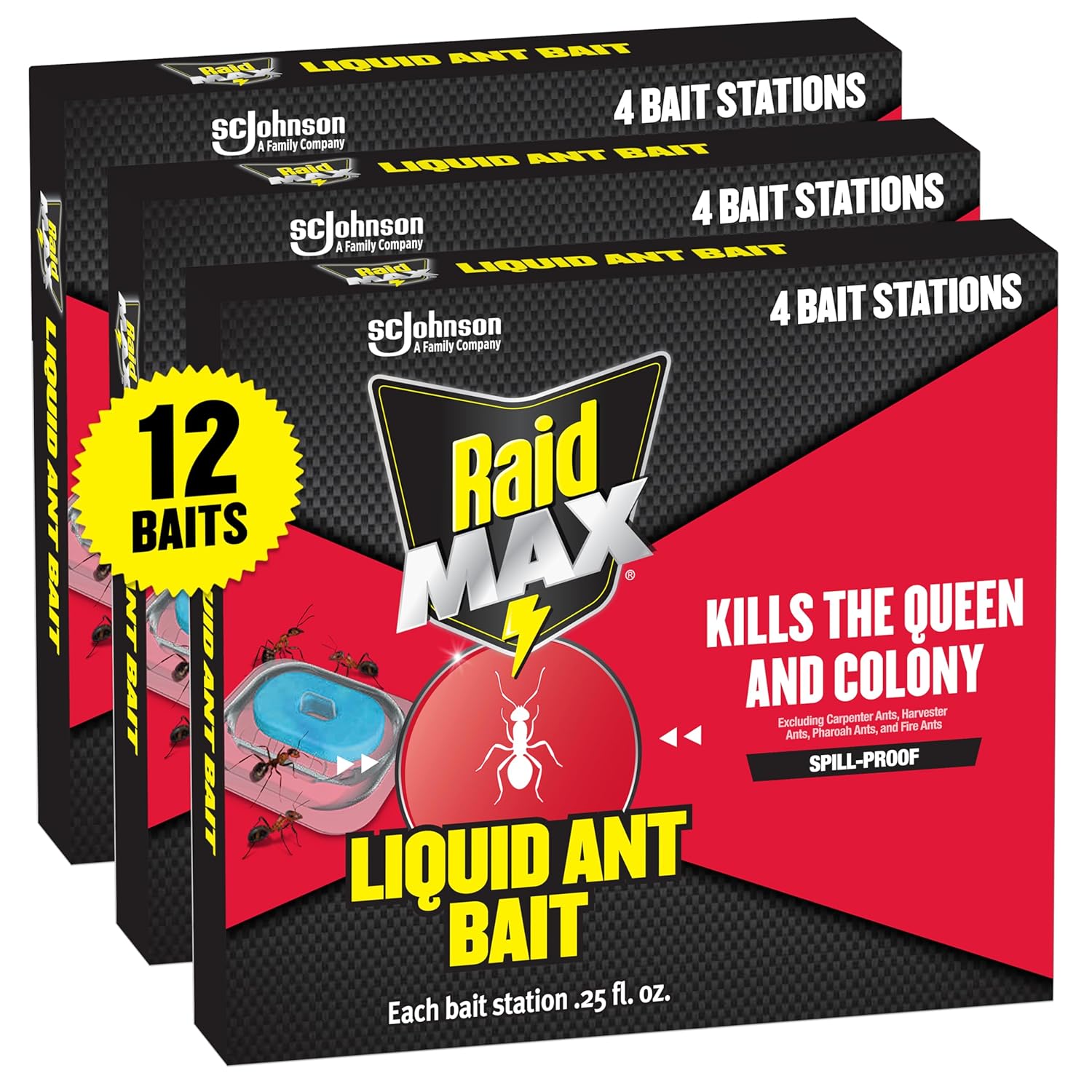
Raid Max Liquid Ant Killer Baits, 12-Count
| Unit Count | 12 Count |
|---|---|
| Item Form | Liquid Bait |
| Target Species | Insects |
| Active Ingredients | Spinosad |
Raid Max Liquid Ant Killer comes as ready-to-use, spill‑proof bait stations that are placed where you see ants to be carried back to the nest and shared with the colony. Typical use is simple: peel the activation film, set the station along baseboards, near trash, or at entry points, and replace multiple stations for larger infestations. The product targets many common ant species and uses spinosad as the active ingredient, which helps kill workers and the queen when ants feed and share the liquid. Practical benefits include easy placement, no mixing or spraying, and suitability for both indoor and outdoor spots where you want discrete control. Limitations: it does not work on fire ants, carpenter ants, harvester ants, or pharaoh ants, and effectiveness depends on ants finding and consuming the bait so very dry, hot, or heavily baited areas may reduce uptake. Also stations should be kept away from children and pets and monitored until activity stops.
Best for: Buyers who want a low‑effort, discrete ant control method to treat visible ant trails and likely colony locations around a home and yard. Ideal for people who prefer bait stations over sprays and who will monitor and replace stations as needed.
Less Ideal for: Those dealing primarily with fire ants, carpenter ants, or other excluded species or users who need immediate knockdown of large outdoor mounds should look for alternatives.
- Ready-to-use prefilled stations require no mixing or setup
- Works indoors and outdoors for flexible placement
- Spinosad-based liquid is carried back to colony to target queen and larvae
- Comes in a 12-count pack for coverage of multiple hotspots
- Not effective against fire ants, carpenter ants, harvester ants, or pharaoh ants
- Performance depends on ants choosing the bait so very large or competing food sources can slow results
Verdict: A convenient, ready-to-use liquid bait pack that kills common household ant colonies by being carried back to the nest, making it a practical choice for routine outdoor and indoor ant control.
Hot Shot MaxAttrax Ant Bait, 4 Child-Resistant Bait Stations

| Unit Count | 4 Count |
|---|---|
| Target Species | Insects |
| Active Ingredient | Indoxacarb (0.05%) |
| Indoor/Outdoor Use | Safe for use indoors or outdoors |
Hot Shot MaxAttrax Ant Bait is a simple, ready-to-use solution for household ant infestations that comes as four sealed, child-resistant bait stations. You place the stations along ant trails, in cabinets, under sinks or around the outside perimeter where ants travel. The active ingredient Indoxacarb is delivered in an attractive bait matrix that claims to begin working within 24 hours and to eliminate the queen and colony over time. The stations are convenient because they leave no mess and are labeled for both indoor and outdoor use, and the design offers up to three months of protection per station. Practical benefits include easy placement, low maintenance and clear instructions for reapplication when bait is spent. Limitations are that effectiveness depends on ants finding the bait and feeding behavior, heavy infestations may need additional placements or repeated treatment, and the product contains an active insecticide so stations should be placed out of reach of children and pets.
Best for: Buyers looking for an affordable, no-fuss way to target household ant colonies with a product they can place and forget for weeks.
Less Ideal for: People needing an immediate visible reduction of large outdoor infestations or who prefer non-chemical or DIY baiting approaches should consider other options.
- Child-resistant sealed stations designed for indoor and outdoor placement
- Contains Indoxacarb active ingredient that targets ants and is marketed to kill the queen
- Ready-to-use bait requires no mixing or cleanup
- Stations can provide up to three months of protection per placement
- Performance depends on ants being attracted to and consuming the bait
- May require multiple stations or repeat applications for severe infestations
Verdict: A budget-friendly, easy-to-place bait station set designed to attract ants and eliminate the queen for extended indoor and outdoor control.
TERRO Ultra Complete Kill Ant Baits, 6 Dual-Formula Bait Stations

| Unit Count | 6 Count |
|---|---|
| Included Components | 4 Bait Stations |
| Target Species | Ant |
TERRO Ultra Complete Kill Ant Baits use a dual-formula design—liquid sugar in the top chamber and a protein paste in the bottom—to appeal to ants in different feeding cycles and life stages. You simply open a station and place it near ant trails, baseboards, counters, or other indoor hotspots; worker ants feed on the baits and carry the active ingredient back to the nest, which helps eliminate the queen and colony over time. The product is sold as a 6-count pack of ready-to-use stations and is intended for common indoor species such as pavement, odorous house, and little black ants. In practice you may see increased ant activity initially as more workers are drawn to the bait, but reductions are typically noticeable within days and full control can take a few weeks. The stations are convenient for indoor placement and can remain effective for weeks while visited, but they are not labeled for fire ants, pharaoh ants, carpenter ants, or harvester ants and will not address outdoor mound-only infestations.
Best for: Buyers who prioritize a dependable, low-effort indoor solution for common household ant sightings and want a product that targets the colony rather than only the visible workers.
Less Ideal for: Those dealing primarily with outdoor mound infestations or with specialist ant species that the formula does not cover should consider targeted outdoor treatments or professional pest control.
- Dual bait formula (liquid sugar plus protein paste) attracts ants with different dietary needs
- Ready-to-use stations require no mixing or setup for quick placement
- Designed to be carried back to the nest to reach the queen and reduce the entire colony
- Compact stations suitable for indoor use along baseboards, counters, and corners
- Not effective against fire ants, pharaoh ants, carpenter ants, or harvester ants
Verdict: Use TERRO Ultra when you want a reliable, ready-to-use indoor bait that targets the whole ant colony by offering both sugar and protein attractants.
TERRO Liquid Ant Killer Bait Stations, 12-Pack (T300B)

| Unit Count | 12 Count |
|---|---|
| Item Form | Liquid |
| Target Species | Insects |
| Active Ingredients | Sodium Tetraborate Decahydrate (Borax), 5.40% |
Terro Liquid Ant Killer bait stations are prefilled, single-use traps designed for indoor control of common sugar-loving ants. You place the small stations along baseboards, in corners, under appliances, or on countertops where you see ant activity. Worker ants are drawn to the sweet liquid, feed on it, and take it back to the nest so the borax-based active ingredient can eliminate the colony over days to weeks. The product is easy to use with no mixing or setup and the 12-pack gives coverage for several rooms. Because the bait is contained inside a low-profile plastic station, it reduces incidental contact risk compared with loose sprays or powders and lasts for weeks while ants continue to visit. Limitations are that the formula targets sugar-preferring species so very protein- or grease-attracted ants may ignore it, and control can take 2 to 4 weeks for larger infestations. Also stations should be placed away from pets and children despite the contained design since the bait contains borax.
Best for: Homeowners who prioritize an easy, low-hassle indoor solution and want a bait that works at the colony level with minimal hands-on pest handling.
Less Ideal for: People who need immediate knockdown of ants or who have pets or children that frequently access treated areas and cannot reliably keep them away from placed stations.
- Ready-to-use stations require no mixing or setup
- Designed to be carried back to the nest for colony-level control
- Low-profile enclosed bait reduces messy exposure compared with loose liquids or sprays
- 12 stations provide coverage for multiple rooms or hotspots
- Formulation is sugar-based so less effective on ants that prefer protein or grease
- Control can take 2–4 weeks for large or established colonies
Verdict: A simple, low-contact indoor bait system that reliably reduces sugar-loving ant infestations by getting worker ants to carry borax back to the colony.
Ortho Orthene Fire Ant Killer, 12 oz (2-Pack)

| Unit Count | 24 Ounce |
|---|---|
| Item Form | Granules |
| Target Species | Insects |
| Active Ingredients | Acephate |
Ortho Orthene Fire Ant Killer is a ready-to-use granular mound treatment intended for spot control of fire ant colonies in lawns and landscape areas. You apply the powder directly over active mounds while ants are foraging and leave the mound undisturbed; the formula begins killing ants within about 60 minutes and is formulated to eliminate the queen and collapse the colony over several days. The product comes as two 12 oz. bottles, enough to treat many mounds without measuring or mixing, and is presented as step one in a broader Ortho two-step system for longer protection. Practical benefits include fast knockdown of visible mounds, simple application with no watering required, and clear manufacturer guidance on timing and post-application precautions. Important limitations are that it is a spot treatment rather than a broadcast preventive solution and it requires correct timing and dry conditions to work as directed, so it is not a one-time lawn-wide fix for future mound formation.
Best for: Buyers who want a proven, fast-acting spot treatment to remove existing fire ant mounds and prefer products with clear manufacturer guidance and broad user approval.
Less Ideal for: Homeowners seeking a single product to provide lawn-wide, long-term prevention of new mounds or users who need an immediate broadcast protection solution.
- Begins eliminating fire ants within about 60 minutes after application
- Designed to kill the queen and destroy the mound rather than just repel workers
- Simple, no-mix dry powder that is sprinkled directly over mounds
- Two 12 oz. bottles provide enough product to treat many individual mounds
- Formulated as a spot mound treatment and not intended for lawn-wide long-term prevention
- Requires application when ants are active and the treated area remains dry for best results
Verdict: A straightforward, fast-working mound treatment that reliably knocks down fire ant colonies when applied correctly.
Choosing the Right Ant Bait to Kill Queen: Key Factors to Consider
Bait Attractiveness and Food Preference
Different ant species prefer different food types during various seasons. Sugar-feeding species will ignore a protein bait and vice versa, so matching bait flavor and texture to local ant preferences improves uptake. Observe what workers carry back to the nest or set out a small passive test bait to see which food type draws the most traffic.
Bait attractiveness affects how quickly foragers discover the product and whether they recruit nestmates. Faster discovery shortens the time needed for colony-level effects, while poor attraction can leave the queen untouched.
Active Ingredient and Transfer Mechanics
Not every toxicant transmits well through trophallaxis or cuticular contact. Some act fast and kill the forager before transfer occurs, while others are slow-acting and designed to move through social feeding. For colony elimination you want a formulation that allows foragers to return and share the bait with larvae and the queen.
Consider the mode of action described on the label and how it aligns with your control goal. Slow-acting metabolic toxicants often offer better colony-level control than immediate-contact poisons that only reduce visible workers.
Residual Activity and Replenishment Frequency
Bait that remains palatable and biologically active for several days gives more opportunity for sustained transfer to the nest. Weather and exposure will shorten that window outdoors, while indoor placements usually last longer. Products that dry out quickly or crystallize lose effectiveness.
Plan to check and refresh baits on a schedule that matches the product's stability. Regular monitoring ensures foragers are still feeding and helps you detect when to replace depleted or contaminated bait.
Placement Options and Station Design
How and where you place bait determines whether foragers can find it and whether children or pets might access it. Enclosed stations protect bait from rain and non-target contact, while open gels or granules may be easier for ants to access but risk disturbance.
Select placements along active trails, near entry points, or close to nest openings when known. Stations that allow multiple entry points and are easy to position under eaves, behind appliances, or along foundations improve real-world effectiveness.
Environmental Durability and Weather Tolerance
Outdoor infestations expose bait to sun, heat, humidity, and rain. A bait that melts, runs, or loses palatability in heat will fail to reach the queen. Look for formulations or stations designed to remain stable in expected local conditions.
If you live in a hot or humid area, favor products tested for those conditions or use protected placements. Durability matters because repeated reapplications add labor and reduce the chance of complete colony control.
Safety Around People, Pets, and Beneficial Insects
Ant control often happens where people and pets live, so read label restrictions about indoor use, child-safe station design, and pet exposure. Ant baits that are contained inside tamper-resistant stations reduce accidental ingestion risks.
Also consider impact on non-target beneficial insects. Baits placed near flowering plants could attract pollinators, so avoid open bait on blossoms and follow label guidance to minimize unintended effects.
Identifying Where the Queen Is Likely Located
Queens are usually deep inside established nests, in protected soil pockets, under pavement, inside wall voids, or beneath landscape features. Foraging trails and the direction workers travel point toward nest entrances. Follow heavily trafficked lines at night or early morning when ants are most active to locate likely nest zones.
Targeting bait placement toward the nest entrance or along primary runways increases the chance that foragers will pick up enough bait to carry back. If you cannot find the nest, focus on areas of consistent high activity such as along foundations, in mulch beds, or near food and water sources.
- Watch trails for at least 10 to 15 minutes to identify direction of travel.
- Check under rocks, logs, pavers, and planters for nest openings.
- Avoid disturbing suspected nest sites before bait placement so foragers do not abandon the colony.
Indoor Placement Strategies
Inside the home, place bait near baseboards, behind appliances, under sinks, and along windows where ants enter. Use tamper-resistant stations to keep bait out of reach of children and pets. Avoid placing bait directly on food-contact surfaces and follow label spacing guidance to maintain safety.
Replace stations when they are consumed or visibly contaminated. If ant activity shifts after initial placement, move stations along the trail but keep them discreet to avoid inadvertent removal or disturbance.
- Start with a cluster of stations at entry points and expand placement toward interior hotspots.
- Keep bait accessible to ants but hidden from household traffic.
Outdoor Use and Weather-Proofing
Outdoors, choose sheltered placements under eaves, inside weatherproof stations, or under rocks and logs to protect bait from rain and direct sun. Soil and mulch can wick away liquid formulations, so enclosed stations or granular baits designed for outdoor use hold up better in exposed beds.
Be mindful of non-target animals and avoid placing baits where wildlife or pollinators will have access. Re-check stations after heavy rain and replace any bait that has been washed out or contaminated.
- Use multiple stations around the perimeter of structures and near known nest sites.
- Inspect stations weekly during active seasons and after storms.
When to Expect Results and How to Monitor
Because effective colony control depends on transfer to the queen, expect a multi-day to multi-week timeline before seeing collapse of the infestation. You should see reduced trail traffic as the colony declines, but a quick drop in workers does not guarantee the queen is dead.
Monitor bait consumption daily at first, then every few days as activity drops. Keep a log of placements, amounts consumed, and changes in worker counts to determine if additional stations or a different formulation are needed.
- Initial attraction may take a day or two; sustained feeding over several days increases success.
- If no feeding is observed after 48 hours, consider a different bait flavor or placement.
Integrating Sanitation and Exclusion
Mechanical control through baiting works best when combined with sanitation and exclusion measures. Remove accessible food and water sources, seal gaps and cracks where ants enter, and store food in sealed containers to reduce alternative food that competes with baits.
Use landscape practices that reduce nest-friendly conditions near the building, such as trimming mulch depth, relocating woodpiles, and avoiding overwatering. These steps do not replace baiting but reduce recolonization pressure and provide longer-lasting control.
- Keep kitchen counters clean and rinse recyclables before storing.
- Seal foundation cracks and repair damaged door sweeps to limit entry points.
How We Chose the Best Ant Bait to Kill Queen
We focused on attributes that actually determine whether a bait will suppress a colony and reach the queen rather than just reduce visible workers. Key evaluation criteria included bait attractiveness to common house and yard ant species, how well the active ingredient transfers between foragers and nestmates, the residual window during which ants continue to feed, and practical placement options for indoor and outdoor settings. We also considered formulation stability under heat or humidity, label directions and safety guidance for use around people and pets, and ease of monitoring and replenishing bait stations. Exclusions included contact-only sprays, repellent products that drive colonies deeper, and products lacking clear transfer or residual data. The selected baits aim to balance lure appeal with transmission potential, operational resilience in real gardens and homes, and safe, labeled use patterns.
FAQ
How long does it take for ant bait to affect the queen?
It often takes days to weeks because foragers must find the bait, feed, and transfer it through the colony. Slow-acting toxicants usually need repeated feeding cycles to reach and impact the queen.
Can I use indoor bait stations outdoors?
Indoor-only formulations and stations may not hold up to rain, heat, or dirt. Use baits and stations labeled for outdoor use or place indoor stations in fully sheltered locations to prevent degradation.
Will baiting eliminate multiple nests on my property?
Baiting can suppress multiple nearby nests if foragers from each nest feed on placed bait. However, separate colonies may require additional stations and monitoring to ensure all active nests are targeted.
What if ants ignore the bait?
Ants may ignore bait because of species-specific food preferences, seasonal diet shifts, or competing food sources. Try a different bait formulation, move placement to a heavier traffic area, or reduce alternative foods before retrying.
Are ant baits safe around pets and kids?
Many baits are designed for use in tamper-resistant stations to reduce risk, but you should always follow label instructions. Keep stations out of reach and supervise areas where pets and children play until baits are removed.
Do weather and temperature affect bait performance?
Yes. High heat, heavy rain, and humidity can reduce palatability or wash away bait. Choose formulations and protected placements appropriate for local conditions and check stations more often during extreme weather.
Final Verdict
Choosing an ant bait to kill the queen requires balancing attraction, transferability, and durability in the conditions where you will use it. Prioritize baits that match local ant feeding preferences and that allow for slow transfer back to the nest, then place them where foragers consistently travel and the bait will stay protected. Monitor consumption and adjust placement or formulation if feeding stops. With the right baiting strategy and complementary sanitation and exclusion, you can move from temporary suppression toward lasting colony control.
