

Note: This article contains affiliate links. If you click on these links and make a purchase, I may earn a small commission at no extra cost to you. This helps support my research and content. Read my full affiliate disclosure here.
Picking the right garden spreader under $100 matters because a low-cost tool can still determine how evenly fertilizer, seed, or granular amendments are applied across lawns and beds. A well-matched spreader saves product, reduces patchy growth, and cuts the time you spend going back over missed spots. This guide covers seven shortlisted spreaders that perform reliably within a budget, evaluated for hopper capacity, spread pattern control, durability, and ease of use. Below you will find clear notes on what each spreader does well and why it made our list, plus practical buying advice so you can choose the model that fits your yard size and application style.
Top Picks at a Glance
| Best Overall The best all-around choice for most situations | YITAMOTOR 60 lb Walk-Behind Broadcast Spreader |  |
| Best Quality Built to a higher standard if you want something more solid | SOLO 421S 20 lb Portable Chest-Mount Spreader |  |
| Best Value The sweet spot between price and what you get | VEVOR 60 lb Push Broadcast Spreader with Pneumatic Wheels |  |
| Best Budget The cheapest option that still gets the job done reliably | CHAPIN 8740A 64 oz Hand Shaker Spreader |  |
| Highest Rated A top-rated pick with lots of positive feedback | PYRGON 20V Cordless Seed and Fertilizer Spreader with 2 Batteries |  |
| Most Popular A crowd favorite that many people choose with confidence | Scotts Whirl Hand-Powered Spreader |  |
| Best Seller A high-volume bestseller chosen again and again | Spot Spreader Hand Spreader Shaker (Up to 80 oz) |  |
YITAMOTOR 60 lb Walk-Behind Broadcast Spreader

| Capacity | 60 lbs / 20L |
|---|---|
| Tire size | 9 inches solid |
| Flow control | 10 settings |
| Frame | Powder-coated steel |
The YITAMOTOR 60 lb walk-behind broadcast spreader is a straightforward push spreader designed for routine lawn care tasks like fertilizing, seeding, and de-icing. It sits on oversized 9-inch solid tires and a wide-set frame for stable, easy pushing across uneven turf and paved surfaces. The 20L hopper holds up to 60 pounds, so you cover large areas without frequent refills, and a 10-position flow control with an anti-clumping agitator helps deliver a more even spread of fine seed or larger pellets. Construction mixes powder-coated steel and a polypropylene hopper for corrosion resistance, and the enclosed gearbox reduces the chance of jams. Assembly is tool-free for quick setup. Limitations to note are its manual push design, which requires physical effort on large or hilly properties, and the lack of advanced calibration markings for specific product labels, so you may need to test settings for exact application rates. For everyday homeowners who want a durable, no-frills spreader, it handles the basics well.
Best for: Homeowners who want a reliable, low-maintenance spreader for routine fertilizing, seeding, and de-icing across medium to large yards and value durability and simple controls.
Less Ideal for: This is not the best choice for users who need motorized or tow-behind capacity for very large acreage or who require factory-calibrated settings for commercial precision.
- Large 60 lb / 20L hopper reduces refill frequency for medium to large lawns
- 10-setting flow control and anti-clumping agitator improve even distribution
- 9-inch solid tires and wide frame provide stable, all-terrain maneuvering
- Durable powder-coated steel frame and polypropylene hopper resist corrosion
- Enclosed gearbox design helps prevent jams from soil or granules
- Manual push operation can be tiring on very large or steep properties
- No precise calibration chart for product-specific application rates
Verdict: A durable, easy-to-use push spreader that covers large lawns without frequent refills and delivers reliable, all-season performance.
SOLO 421S 20 lb Portable Chest-Mount Spreader

| Capacity | 20 lbs |
|---|---|
| Drive | Crank/gear drive |
| Controls | Fingertip flow and direction levers |
| Hopper material | Polyethylene |
The SOLO 421S is a purpose-built chest-mounted spreader for precision broadcast application on uneven or confined terrain. You carry it on a padded cross-shoulder strap while a crank-driven, gear-driven impeller disperses material; fingertip levers let you adjust flow rate, volume, and direction for accurate placement. The 20-pound polyethylene hopper and agitator handle everything from fine seeds to rock salt without frequent refills, and the twist-on cap prevents spills when loading or transporting. Stainless steel components and a fully enclosed, lubricated gearbox reduce clogging and extend service life for frequent use. Because it is chest-mounted rather than wheeled, it excels in beds, islands, and slopes where maneuverability matters, but you will be carrying the load rather than pushing it, which can be tiring over long distances. Setup and cleaning are straightforward, and the unit is versatile across seasons for seed, fertilizer, ice melt, and absorbents.
Best for: Buyers who prioritize precise, efficient application in beds, islands, slopes, or other confined or uneven areas and want a durable tool that gives fine control over spread patterns.
Less Ideal for: People who need to cover very large, flat lawns quickly or who prefer a push-or tow-style spreader to avoid carrying the material on their body.
- 20 lb hopper reduces refill frequency for larger jobs
- Fingertip controls for precise flow, volume, and spread direction
- Durable polyethylene body with stainless steel parts and enclosed lubricated gearbox
- Agitator and impeller design prevents clogs and promotes even distribution
- Chest-mounted design requires carrying the full load which can be tiring for long jobs
- Not suited for very large lawns where wheeled tow-behind or walk-behind spreaders are faster
Verdict: Choose the SOLO 421S when you need a durable, highly controllable handheld spreader for precise application in tight or uneven areas.
VEVOR 60 lb Push Broadcast Spreader with Pneumatic Wheels

| Load capacity | 60LB |
|---|---|
| Wheels | 8-inch pneumatic |
| Frame | Powder-coated steel |
This VEVOR push broadcast spreader is built for straightforward, frequent lawn jobs where speed and coverage matter. It holds up to 60 pounds of seed or fertilizer in a plastic hopper mounted on a powder-coated steel frame and rolls on 8-inch pneumatic tires for easier movement across grass, gravel, and uneven ground. The unit offers multiple adjustable settings and a disc-style pellet controller to fine-tune spread width and flow, which helps achieve even coverage and reduces missed strips. Assembly is tool-free and quick, and the large hopper cuts down on how often you need to refill during a typical yard run. Practical buyers will appreciate the rugged frame and all-terrain wheels for year-round tasks from seeding to fertilizing. Limitations to note are that the spreader is a push model without motorized assistance, so it requires physical effort on larger properties, and the plastic hopper, while durable, is not as impact-resistant as metal for heavy-duty farm use.
Best for: Homeowners who want a reliable, no-frills spreader to speed up regular seeding and fertilizing on small to medium lawns while keeping setup and maintenance simple.
Less Ideal for: People who need a motorized or tow-behind spreader for large acreage or commercial operations should look at heavier duty or powered models.
- Large 60 lb hopper reduces refill frequency for medium-sized lawns
- Adjustable spread settings and disc pellet controller for precise coverage
- 8-inch pneumatic wheels ease movement over uneven terrain
- Powder-coated steel frame offers corrosion resistance for outdoor use
- Manual push design can be tiring on larger properties
- Plastic hopper is less impact-resistant than an all-steel construction
Verdict: Choose this spreader if you want a durable, large-capacity push unit that delivers controlled, even coverage for routine lawn seeding and fertilizing.
CHAPIN 8740A 64 oz Hand Shaker Spreader

| Capacity | 1.8 kg |
|---|
The CHAPIN 8740A is a straightforward hand shaker that makes targeted spreading tasks quick and low-effort. Fill the 64-ounce poly bottle through a wide screw-top, select one of three lid openings by twisting for fine, medium, or wide flow, and apply product with one hand while walking small areas like sidewalks, steps, lawn patches or garden beds. The large handle and glove-friendly design make scooping and pouring easier in cold weather. Because it uses no motors or complex parts it is extremely durable and inexpensive to maintain, and it can stand upright on a shelf even with material inside. The trade-offs are its manual operation and limited reach compared with broadcast or wheeled push spreaders, so it is best for spot jobs rather than treating an entire lawn. Plastic construction keeps it lightweight but means it is less robust than metal tools for heavy-duty commercial use.
Best for: Small‑scale homeowners or renters who need an affordable, no-fuss tool for spot seeding, fertilizing, or deicing around walkways and small lawn areas.
Less Ideal for: Those who need to cover large lawns, commercial properties, or want a precise motorized broadcast spreader for even whole‑lawn applications.
- High 64-ounce capacity reduces refills for small jobs
- Three twist-select lid openings for fine, medium and wide distribution
- Large, glove-friendly handle that is easy to scoop and operate one-handed
- Simple, no-maintenance plastic design that stores upright with contents inside
- Manual operation limits speed and is inefficient for large yards
- Plastic construction is less durable under heavy commercial use
Verdict: A cheap, durable hand shaker perfect for budget-minded gardeners who need an easy, no-frills tool for spot spreading tasks.
PYRGON 20V Cordless Seed and Fertilizer Spreader with 2 Batteries

| Power | 20V |
|---|---|
| Batteries included | 2×2.0Ah |
| Flow settings | 8 levels |
| Max throw distance | 16 ft |
The PYRGON 20V cordless spreader is a battery-powered handheld tool intended to replace multiple small spreaders for routine lawn care. It ships with two 2.0Ah batteries so you can work longer without pausing to recharge, and the lightweight ergonomic body and squeeze-trigger let you operate it one-handed around beds, walkways, and small to medium lawns. Key features include an 8-level flow control for fine to coarse materials, six adjustable spreading angles for targeted application, and a claimed throw distance up to 16 feet to cover ground quickly. In practice the variable flow and angle settings make it easy to dial in even coverage for grass seed or fertilizer and to avoid overspreading on hard surfaces. Maintenance is straightforward but it is not waterproof, so you need to wipe it clean and store it dry between uses. The motor can handle both light seeds and heavier pellets, but battery run time will govern how much area you can cover per charge. For reliable, seasonal use plan to keep batteries charged during the off-season to retain capacity.
Best for: Gardeners who prioritize a dependable, easy-to-use spreader for regular seasonal tasks and want precise control without switching multiple tools.
Less Ideal for: Large-property owners who need long continuous runtime or commercial contractors who require heavy-duty, weatherproof walk-behind spreaders.
- Includes two 2.0Ah batteries for extended runtime between charges
- Eight flow levels and six spreading angles provide precise control over application
- Lightweight ergonomic design enables comfortable one-handed operation
- Capable of spreading a wide range of materials year-round, from seed to ice melt
- Not waterproof and requires careful cleaning and dry storage after use
- Actual coverage per charge depends on battery life and may limit large-area use
Verdict: A reliable, compact cordless spreader that delivers precise, one-handed spreading for homeowners who want dependable seasonal performance.
Scotts Whirl Hand-Powered Spreader

| Material Type | Metal, Plastic |
|---|---|
| Handle Material | Rubber |
| Capacity Coverage | Up to 1,500 sq. ft. |
| Additional Features | Adjustable Arm Support, Smooth Even Coverage |
The Scotts Whirl is a compact, hand-powered spreader built for small lawns and spot treatments. It comes ready to use and is designed to distribute grass seed, granular fertilizer, ice melt, or salt with an agitator that promotes smooth, even coverage. Its adjustable arm support and light weight make it comfortable for short jobs like overseeding patches, treating narrow strips, or spreading ice melt on walkways. Because it is hand-held and intended for up to 1,500 square feet, it delivers control and reduced waste compared with tossing product by hand. The main limitation is capacity and speed: for larger lawns you will need a wheeled spreader or multiple refills, and fine-tuning the setting for very light seed rates can take a few test passes. Materials are basic metal and plastic with a rubber handle, so it is practical for seasonal use rather than heavy commercial work.
Best for: Homeowners with small lawns or those who need precise control for patch seeding, fertilizing, or winter ice-melting, who prioritize reliability and simplicity over high capacity.
Less Ideal for: Owners of medium to large lawns who need fast coverage or professional users who require higher durability and throughput.
- Compact handheld design ideal for small yards and spot treatments
- Engineered to deliver smooth, even product coverage across application area
- Adjustable arm support increases comfort during use
- Ready to use out of the box with simple hand-powered operation
- Limited capacity suitable only up to about 1,500 sq. ft., requiring frequent refills for larger lawns
- Not ideal for high-volume or commercial spreading tasks
Verdict: A simple, reliable handheld spreader that gives risk-averse homeowners controlled, even application for small lawns and spot jobs.
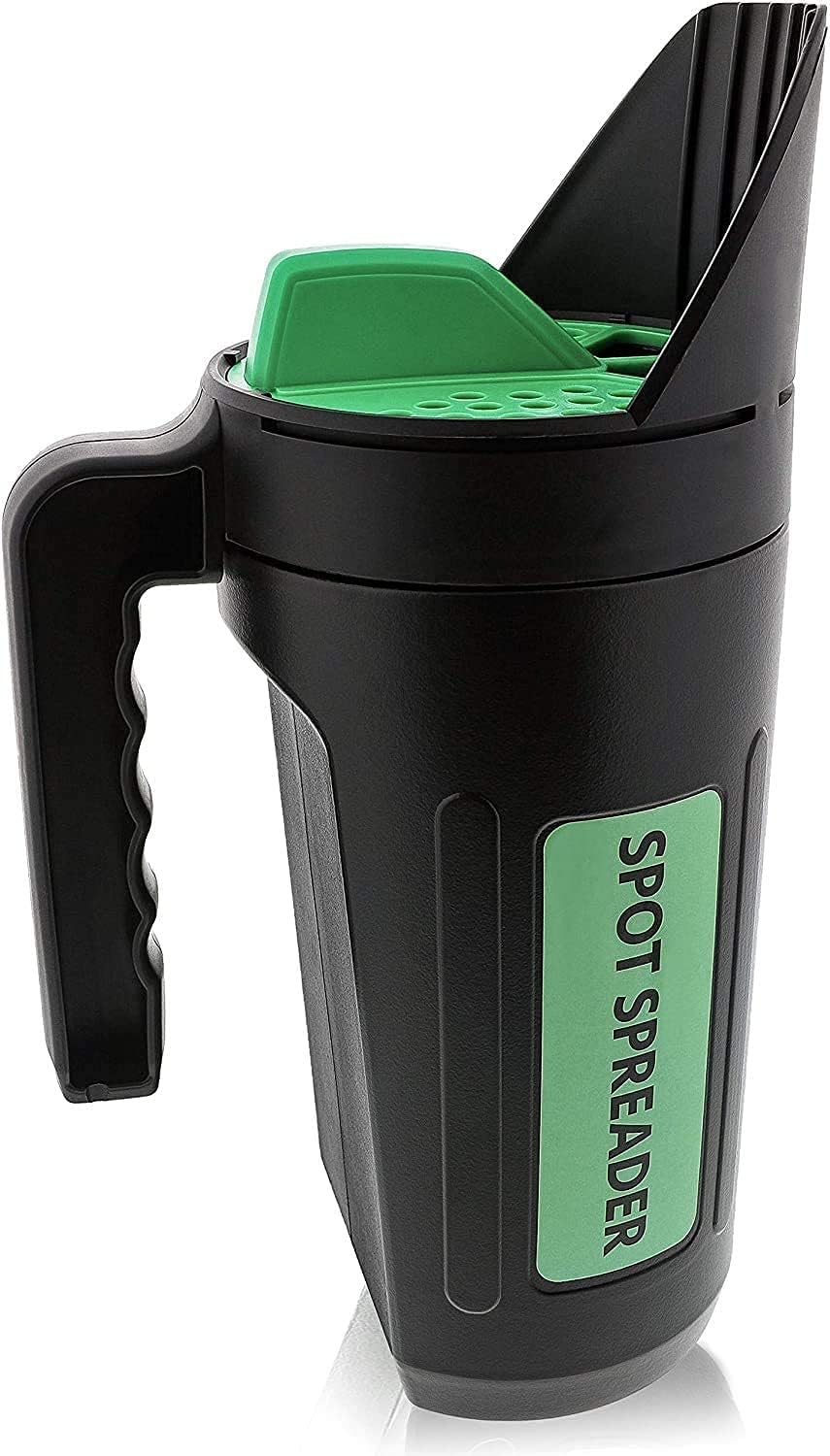
Spot Spreader Hand Spreader Shaker (Up to 80 oz)
| Unit Count | 80 Ounce |
|---|---|
| Indoor Outdoor Usage | Outdoor |
| Item Type Name | Hand Spreader Shaker |
| Material Features | Organic |
The Spot Spreader hand spreader is a simple, grab-and-go shaker for small to medium outdoor spreading tasks. You fill the 80 oz screw-top container from a bag, select one of the multiple opening sizes, and walk along beds, lawns, or hard surfaces to broadcast seed, salt, de-icer, or granular fertilizer. Its lightweight, one-piece design and carry handle make it easy to hold and control for short jobs, and the adjustable openings let you match flow to different materials. Because it is handheld, it avoids the overspray and drift you can get from crank or tow-behind spreaders and works well for sidewalks, driveways, and patch seeding. Limitations are obvious: it is best for modest areas since manual shaking and walking are required, and very fine powders or very large pellets may require patience to achieve an even spread. Construction is described as commercial grade, but heavy continuous use over large properties will still be slower than powered or larger-capacity models.
Best for: Buyers who want a low-effort, no-frills tool for treating walkways, driveways, and small lawn patches and prefer straightforward, reliable gear over complex or powered equipment.
Less Ideal for: People who need to cover large lawns, commercial properties, or who prefer mechanized spreaders for speed and consistent wide-area coverage.
- Multiple adjustable openings to handle different granular sizes
- Large 80 oz capacity reduces refills for small jobs
- Lightweight and easy to carry for short tasks
- Simple screw-top fill and one-piece design for straightforward use and storage
- Handheld operation makes it slow for large lawns or commercial areas
- Manual shaking can lead to uneven coverage with very fine or very coarse materials
Verdict: A compact, easy-to-use handheld spreader that reliably handles spot salting and small seeding or fertilizing jobs without fuss.
Choosing the Right Garden Spreader: Key Factors to Consider
Hopper Size and Refill Frequency
Hopper capacity dictates how often you stop to refill, which directly affects how quickly you can treat a medium or large lawn. A larger hopper reduces interruptions but adds weight when full, so balance capacity with the physical effort you can handle.
For small yards, a compact hopper keeps the spreader lighter and easier to store. For larger lawns, look for a model with a wider opening and a capacity that matches the area you plan to cover in a single pass to avoid frequent refills that slow your work.
Spread Pattern Accuracy and Adjustability
Accurate spread pattern and adjustable settings let you control application rate and width so material lands where it is needed. Look for clear calibration markings or a simple rate dial that matches common product recommendations for seed, fertilizer, and ice melt.
A spreader with consistent lateral distribution reduces overlaps and bare spots. Adjustable deflectors or drop controls help when working near beds, fences, or garden features where you need narrower, targeted application.
Durability and Material Resistance
Materials and build quality determine how a budget spreader weathers wet storage, corrosion, and repeated use. Plastic hoppers are light and affordable but can crack under UV exposure or heavy impact; rust-resistant frames and stainless or coated hardware extend useful life.
Inspect fasteners, axle mounting points, and wheel construction for robustness. A model that tolerates occasional knocks, partial exposure to fertilizer, and winter storage will deliver better long-term value even at a lower upfront cost.
Ease of Use and Maneuverability
Ergonomics matter because pushing or towing a loaded spreader across uneven turf can be tiring. Consider handle height and grip comfort, wheel size and tread for traction, and how easily the spreader turns around obstacles.
Lightweight units are easier to push but may track poorly on rough ground. Larger pneumatic or semi-pneumatic tires smooth motion and improve control across slopes or thick turf, while compact wheels work well on flat lawns and driveways.
Calibration, Rate Control, and Compatibility
Not all granular products behave the same. Reliable calibration and clearly labeled rate settings let you match the spreader to manufacturer instructions for seed, fertilizer, or de-icing salt. Compatibility with a range of granule sizes prevents clogging and ensures the flow is even.
A spreader that accepts simple, verifiable calibration tests helps you confirm actual output in controlled runs, avoiding guesswork and wasted material.
Storage, Maintenance, and Clean-Up
How easy the spreader is to clean and store will influence how often you actually use and maintain it. Simple disassembly for rinsing and removable parts reduce buildup of sticky fertilizer residues. Space-efficient folding or compact footprints make off-season storage easier in a shed or garage.
Consider whether replacement parts like axles, wheels, or agitators are commonly available. A design that simplifies routine maintenance will stay functional longer and reduce long-term hassles.
Best Spreaders for Small Lawns and Container Gardens
Smaller lawns and container gardens benefit from compact spreaders that prioritize control over raw capacity. A modest hopper and a precise rate dial let you apply seed or fertilizer without overspill onto walkways or plant beds. Lightweight designs are easy to carry and store in limited space.
When treating raised beds or a series of containers, consider a spreader with a narrow spread width or a drop-only mode. This gives you the accuracy needed to avoid drifting product into adjacent plantings.
- Look for models with a drop-plate option for spot applications
- Choose smaller wheels for flat, even surfaces to keep unit compact
- Prefer simple dials with clear markings for small-quantity work
What Works for Medium to Large Lawns
For medium and larger lawns you will appreciate a larger hopper and better traction. A model that balances capacity with maneuverability reduces the number of refills and the time spent walking back and forth. Wider spread patterns cover more ground per pass and help create uniform turf density.
Prioritize spreaders with robust wheel construction and an easy-to-read calibration system so you can maintain even application across the full area.
- Choose bigger hopper capacity to cut refill frequency
- Look for wheels that handle rougher turf
- Verify calibration for both seed and fertilizer rates
Using a Spreader Near Garden Beds and Borders
Working close to beds requires tighter control. Adjustable deflectors, narrow spray options, or drop-only settings let you protect nearby plantings while ensuring the lawn gets the correct amount of product. Walk a test line before applying to check how far material drifts.
Practice overlapping passes minimally and watch for wind that can carry light seed. Handheld applicators or targeted drop settings are often best for narrow strips and edging.
- Test spread width on a small area before treating sensitive borders
- Use deflectors or narrow settings to avoid drifting into beds
- Avoid spreading on windy days or use a drop mode for accuracy
Maintenance Tips to Prolong Spreader Life
Rinse out the hopper and agitator after each use to remove corrosive fertilizer residues. Allow parts to dry completely before storage to reduce rust and prevent frozen mechanisms in winter climates. Lubricate moving parts periodically if the design calls for it.
Store the spreader in a dry, sheltered place and elevate it off damp concrete floors when possible. Replace worn tires or axles promptly to keep calibration accurate and handling predictable.
- Flush the hopper and run clean sand through the mechanism to clear residues
- Check and tighten fasteners after the first few uses
- Keep a small kit of replacement hardware for common wear points
Practical Calibration Checks You Can Do at Home
Verify actual spread rate by measuring a known area and applying a set quantity of material over it, then weighing the remaining product. This test helps confirm that the spreader settings match recommended application rates for your fertilizer or seed. Repeat the test for different settings to map output per pass.
Simple calibration avoids under- or over-application and saves product. Perform a short trial run on a driveway or lawn strip to visually inspect pattern uniformity before treating the whole yard.
- Measure a marked strip and apply a set amount to calculate output per 1000 square feet
- Repeat tests on both flat and slightly sloped surfaces to check consistency
- Record effective settings for common products you use so you can repeat them
How We Chose the Best Garden Spreader
We focused on real-world gardener needs for a reliable spreader under $100 and applied concrete filters to narrow the field. Primary evaluation criteria were hopper capacity and refill ergonomics for ease of use during typical yard tasks. Spread pattern control and calibration mattered because even small differences affect product waste and turf results. Build durability and corrosion resistance were scored to predict season-to-season life in outdoor conditions. Mobility and handling were assessed to judge how comfortable a spreader is across varied terrain and near beds. Finally, clean-up and maintenance requirements were considered so a tool does not become a seasonal burden. We excluded heavy commercial units and specialty applicators outside the budget scope. Products lacking basic calibration or with clearly fragile materials were filtered out. The final selection emphasizes practical performance metrics gardeners can verify in specification sheets and user experience reports, matching the scoring dimensions listed on this page.
FAQ
Can I use a lawn spreader for seed and fertilizer interchangeably?
Often you can, but it depends on granule size and the spreader's calibration range. Test the flow and pattern with a small run and adjust the rate dial as needed. For very coarse materials, a drop-only setting or different aperture may be required.
How do I prevent corrosion when storing a spreader between seasons?
Rinse out all fertilizer residue, dry the spreader thoroughly, and store it in a dry, sheltered spot. Applying light lubricant to metal pivots and covering the unit prevents moisture contact and extends service life.
Is a tow-behind spreader worth it for a small yard?
Usually not. Tow-behind spreaders add capacity but are heavier and harder to maneuver in tight spaces. For small yards a push or hand-held model often provides better control and easier storage.
How often should I calibrate my spreader?
Calibrate at least once per season and whenever you change products or settings. Terrain and wear can subtly alter output, so occasional checks keep application rates accurate.
Will wheel size affect spreader performance on slopes?
Yes. Larger wheels with some tread provide better traction and smoother motion on slopes. Small plastic wheels can slip or bounce on uneven ground, reducing consistency.
Final Verdict
Choosing a garden spreader under $100 is about balancing capacity, control, and durability for the size of space you maintain. Small yards benefit from compact, precise units while larger lawns need bigger hoppers and better wheels. Prioritize spread pattern adjustability and easy calibration to ensure materials are applied evenly. Focus on build materials and maintenance ease to extend the life of a budget spreader. With attention to the tradeoffs above, you can pick a model that delivers consistent, efficient coverage without overspending.
