

Note: This article contains affiliate links. If you click on these links and make a purchase, I may earn a small commission at no extra cost to you. This helps support my research and content. Read my full affiliate disclosure here.
If you maintain a compact yard, the right garden spreader makes fertilizer, seed, and soil amendments faster and less messy. A unit sized for small lawns reduces overspray along edges, avoids repeated passes, and helps you apply materials evenly without wasting product. This guide covers six top-rated garden spreaders for small lawns shortlisted for their handling, hopper capacity, and spread control. We evaluate how each option behaves in real garden conditions and explain the practical tradeoffs that matter for small-plot lawn care.
Top Picks at a Glance
| Best Overall The best all-around choice for most situations | Yhtpouqe Handheld Spreader for Seed, Fertilizer and Ice Melt (80 oz) |  |
| Best Value The sweet spot between price and what you get | Zenport S-205 Adjustable Handheld Garden Spreader |  |
| Best Budget The cheapest option that still gets the job done reliably | CHAPIN 8740A 64 oz Hand Shaker Spreader |  |
| Highest Rated A top-rated pick with lots of positive feedback | Scotts Whirl Hand-Powered Spreader |  |
| Most Popular A crowd favorite that many people choose with confidence | Scotts Turf Builder EdgeGuard Mini Broadcast Spreader |  |
| Best Seller A high-volume bestseller chosen again and again | Jonathan Green Hand Broadcast Lawn Spreader (Covers up to 1,500 sq ft) |  |
Yhtpouqe Handheld Spreader for Seed, Fertilizer and Ice Melt (80 oz)

| Capacity | 80 oz |
|---|---|
| Adjustable openings | Small, medium, large |
| Includes | Scooping tool and gloves |
| Manufacturer | Yhtpouqe |
The Yhtpouqe handheld spreader is a simple, one-handed tool for applying lawn seed, granular fertilizer, and winter salt to paths and driveways. You fill the 80-ounce hopper with the included scoop, set the lid to small, medium, or large openings, and squeeze while walking to lay down an even, controlled stream of material. The ergonomic handle and low weight make it easy to use for short-to-moderate jobs without straining the wrist, and the screw-top lid helps keep contents dry during storage. Practical benefits include fewer refills thanks to the larger capacity and better control over particle flow because of the three opening sizes. Limitations are its manual, walk-behind operation which is best for small lawns, patches, or sidewalks rather than whole-acre applications, and the plastic construction that, while lightweight, will not match the durability of heavy-duty metal spreaders under very frequent commercial use.
Best for: Homeowners who need a versatile, easy-to-use spreader for spot seeding, routine fertilizing, and occasional winter de-icing around small to medium yards and walkways.
Less Ideal for: People who need to cover large properties quickly or professionals who require industrial-grade, high-durability equipment.
- Generous 80-ounce (2.5 L) hopper reduces refill frequency for small- to medium-sized jobs
- Three adjustable opening sizes let you match flow to seeds, fertilizer granules, or rock salt
- Lightweight, ergonomic handle designed for comfortable one-handed operation
- Includes scoop and a pair of gloves for easier filling and cleaner handling
- Manual hand operation is slow for large lawns or commercial tasks
- Plastic construction may wear faster than metal spreaders with heavy use
Verdict: A practical, lightweight handheld spreader that delivers controlled, seasonal spreading for homeowners who want an easy all‑around tool for seed, fertilizer, and ice melt.
Zenport S-205 Adjustable Handheld Garden Spreader
| Liquid Volume | 1.5 liters |
|---|---|
| Item Form | Granules |
| Specific Uses For Product | Spreading seeds, fertilizer, salt, de-icing |
| Target Species | Lawn Grass |
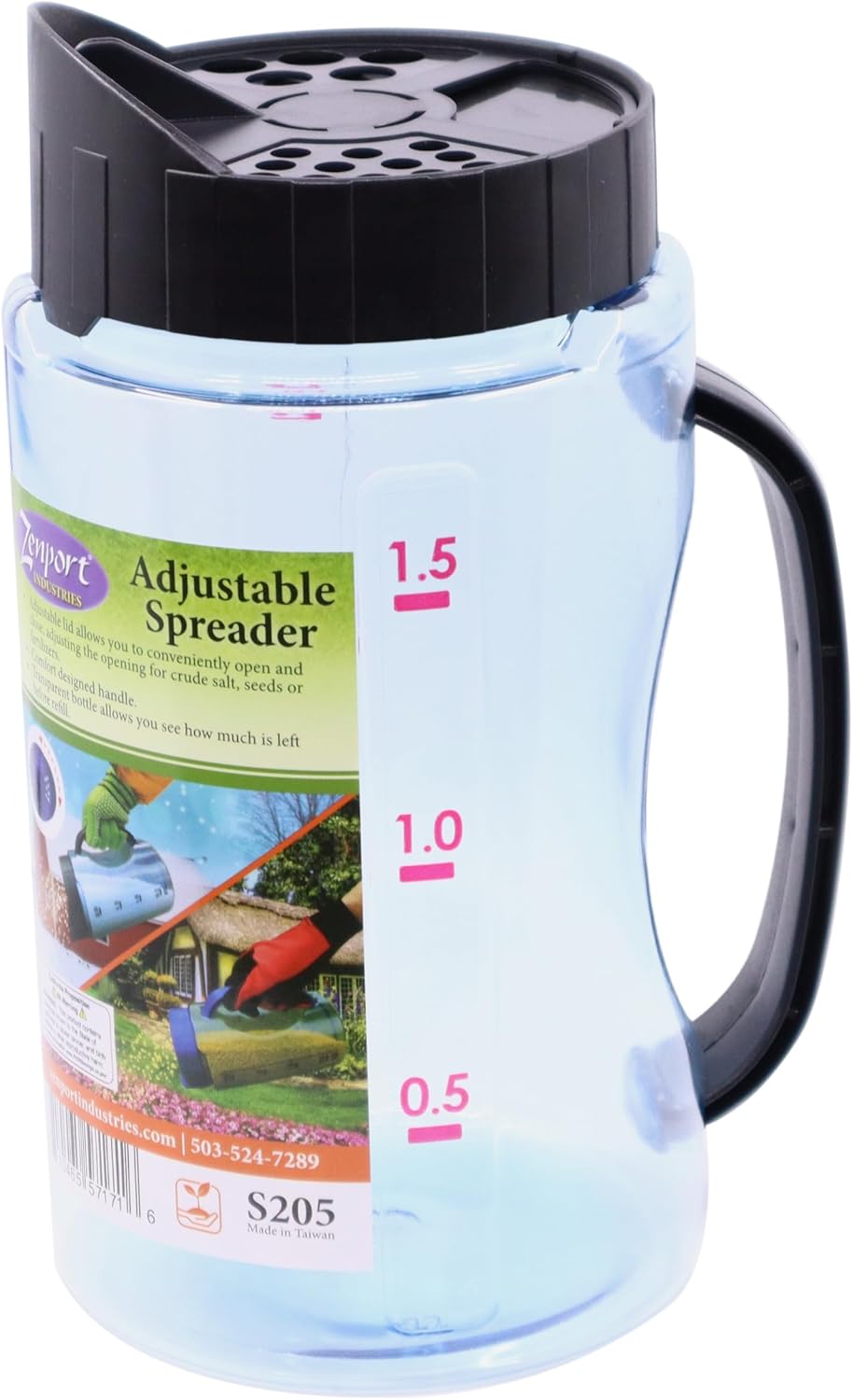
The Zenport S-205 is a handheld adjustable spreader designed for homeowners who need precise, small-area application. It uses a 1.5 liter transparent container so you can watch material levels while you walk, and a four-position lid (closed, small, medium, wide) to control flow for seeds, fertilizer, salt, or ice melt. The contoured ergonomic handle makes it comfortable to hold and helps steady application along edges, flower beds, sidewalks, and compact lawns where a push spreader would be overkill. Because it is lightweight and easy to maneuver, it is well suited to spot treatments and routine maintenance without tiring your hand. The main limitation is capacity and speed: the small hopper means more frequent refills and it is not intended for treating large lawns quickly. It also lacks ground-driven dispersion, so achieving absolutely even coverage over larger areas takes more careful walking technique. For targeted, controlled applications on small properties this spreader delivers predictable results with minimal fuss.
Best for: Homeowners with small lawns or garden beds who prioritize precise, controlled application and ease of use for routine spot treatments.
Less Ideal for: People who need to cover large lawns quickly or want a hands-free ground-driven spreader for high-volume applications.
- Adjustable four-position lid gives simple, reliable control over material flow
- Transparent 1.5 L container lets you monitor levels and avoid over-application
- Ergonomic contoured handle improves comfort and steadiness during use
- Lightweight, compact design is easy to maneuver in tight spaces and store
- Small hopper requires frequent refills for larger jobs
- Not suitable for quickly covering medium to large lawns due to handheld design
Verdict: A precise, easy-to-handle handheld spreader that excels for targeted applications and small lawns.
CHAPIN 8740A 64 oz Hand Shaker Spreader

| Capacity | 1.8 kg |
|---|
The CHAPIN 8740A is a straightforward hand shaker that makes targeted spreading tasks quick and low-effort. Fill the 64-ounce poly bottle through a wide screw-top, select one of three lid openings by twisting for fine, medium, or wide flow, and apply product with one hand while walking small areas like sidewalks, steps, lawn patches or garden beds. The large handle and glove-friendly design make scooping and pouring easier in cold weather. Because it uses no motors or complex parts it is extremely durable and inexpensive to maintain, and it can stand upright on a shelf even with material inside. The trade-offs are its manual operation and limited reach compared with broadcast or wheeled push spreaders, so it is best for spot jobs rather than treating an entire lawn. Plastic construction keeps it lightweight but means it is less robust than metal tools for heavy-duty commercial use.
Best for: Small‑scale homeowners or renters who need an affordable, no-fuss tool for spot seeding, fertilizing, or deicing around walkways and small lawn areas.
Less Ideal for: Those who need to cover large lawns, commercial properties, or want a precise motorized broadcast spreader for even whole‑lawn applications.
- High 64-ounce capacity reduces refills for small jobs
- Three twist-select lid openings for fine, medium and wide distribution
- Large, glove-friendly handle that is easy to scoop and operate one-handed
- Simple, no-maintenance plastic design that stores upright with contents inside
- Manual operation limits speed and is inefficient for large yards
- Plastic construction is less durable under heavy commercial use
Verdict: A cheap, durable hand shaker perfect for budget-minded gardeners who need an easy, no-frills tool for spot spreading tasks.
Scotts Whirl Hand-Powered Spreader

| Material Type | Metal, Plastic |
|---|---|
| Handle Material | Rubber |
| Capacity Coverage | Up to 1,500 sq. ft. |
| Additional Features | Adjustable Arm Support, Smooth Even Coverage |
The Scotts Whirl is a compact, hand-powered spreader built for small lawns and spot treatments. It comes ready to use and is designed to distribute grass seed, granular fertilizer, ice melt, or salt with an agitator that promotes smooth, even coverage. Its adjustable arm support and light weight make it comfortable for short jobs like overseeding patches, treating narrow strips, or spreading ice melt on walkways. Because it is hand-held and intended for up to 1,500 square feet, it delivers control and reduced waste compared with tossing product by hand. The main limitation is capacity and speed: for larger lawns you will need a wheeled spreader or multiple refills, and fine-tuning the setting for very light seed rates can take a few test passes. Materials are basic metal and plastic with a rubber handle, so it is practical for seasonal use rather than heavy commercial work.
Best for: Homeowners with small lawns or those who need precise control for patch seeding, fertilizing, or winter ice-melting, who prioritize reliability and simplicity over high capacity.
Less Ideal for: Owners of medium to large lawns who need fast coverage or professional users who require higher durability and throughput.
- Compact handheld design ideal for small yards and spot treatments
- Engineered to deliver smooth, even product coverage across application area
- Adjustable arm support increases comfort during use
- Ready to use out of the box with simple hand-powered operation
- Limited capacity suitable only up to about 1,500 sq. ft., requiring frequent refills for larger lawns
- Not ideal for high-volume or commercial spreading tasks
Verdict: A simple, reliable handheld spreader that gives risk-averse homeowners controlled, even application for small lawns and spot jobs.
Scotts Turf Builder EdgeGuard Mini Broadcast Spreader
| Capacity | Up to 5,000 sq. ft. |
|---|---|
| Usage | Applies fertilizer, seed, granular weed control, salt, ice melt |
| Features | EdgeGuard side shield; dual-bladed agitator; fold-down handle |
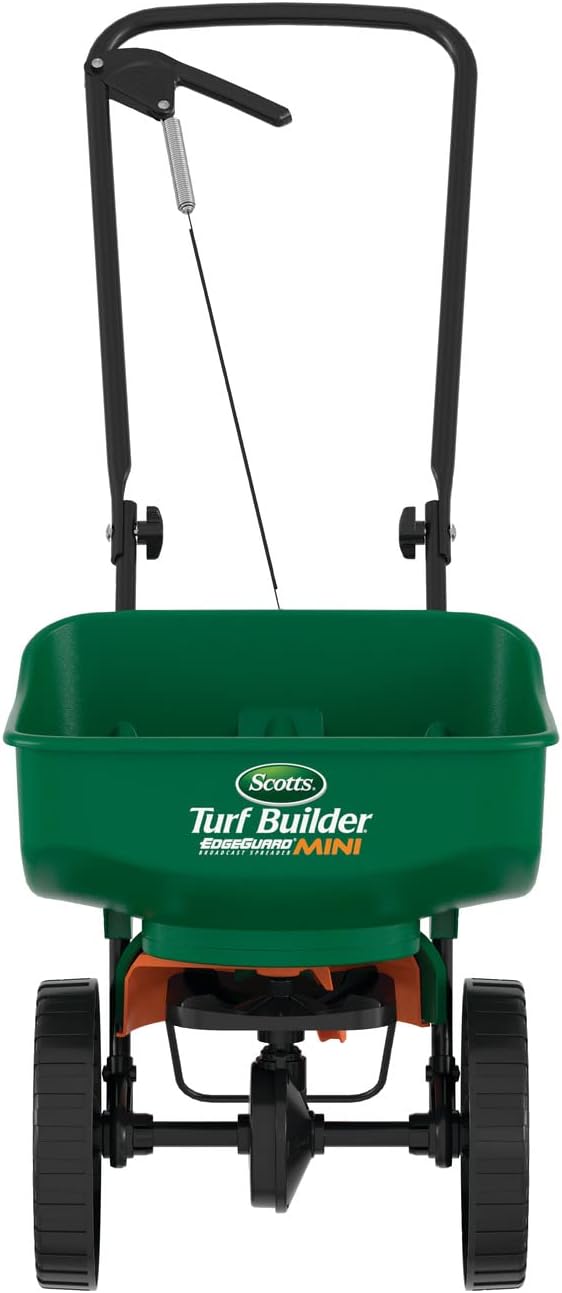
The Scotts Turf Builder EdgeGuard Mini is a ready-to-use broadcast spreader aimed at smaller lawns and targeted spot work. It comes pre-calibrated so you set the dial to the recommended setting, pour in fertilizer, seed, ice melt, or granular weed control, and walk the lawn for even coverage. The hopper and dual-bladed agitator are redesigned to funnel product smoothly and reduce clogging, while open-spoke wheels and a fold-down handle make it easy to maneuver and store. Scotts' EdgeGuard feature blocks product on the right side of the pattern, which helps avoid deposits on sidewalks and landscape beds when edging. Capacity is geared to yards up to about 5,000 sq ft, so it handles typical small properties without being bulky. The main limitations are its smaller coverage area and basic mechanical design compared with larger, more precise spreaders, so it may require more passes on bigger lawns and offers fewer fine-control adjustments for professional users.
Best for: Buyers who want a simple, reliable spreader for small to medium yards and who prioritize ease of use and avoiding overspread onto hard surfaces.
Less Ideal for: Professional landscapers or owners of large properties who need higher capacity and finer control should consider larger commercial-style spreaders.
- Pre-calibrated and ready to use for quick setup
- EdgeGuard side shield reduces product on driveways and sidewalks
- Redesigned hopper and dual-blade agitator for consistent flow
- Fold-down handle and compact size for easy storage and maneuvering
- Smaller capacity suited for lawns up to about 5,000 sq ft so larger lawns need more refills or a larger spreader
- Limited fine adjustment compared with premium or professional models
Verdict: A user-friendly mini broadcast spreader that delivers even coverage for small lawns while keeping product off sidewalks and driveways.
Jonathan Green Hand Broadcast Lawn Spreader (Covers up to 1,500 sq ft)

| Material Type | Plastic |
|---|---|
| Handle Material | Plastic |
| Coverage | Up to 1,500 sq ft |
| Capacity | Holds up to 5 lb |
The Jonathan Green hand broadcast spreader is a simple, lightweight handheld tool designed for spot seeding and small-area applications up to about 1,500 square feet. You load up to 5 pounds of material, set the hand crank, and walk a short swath while the crank distributes product across a roughly 10-foot broadcast width. It is most often used to reseed bare patches, apply fertilizer to small lawns, or spread ice melt on steps and sidewalks. Notable features include an ergonomic handle intended to rest on the forearm for comfortable operation and a plastic construction that keeps the unit light and easy to carry. Practical benefits are straightforward control of coverage in tight areas, easy storage, and no setup or mixing required. Important limitations are the small hopper capacity and lightweight plastic build, which mean it is not suited for treating large lawns or heavy commercial use and requires refilling for bigger jobs.
Best for: Homeowners with small yards who want a no-fuss tool for reseeding bare spots, fertilizing patches, or treating sidewalks and driveways without buying a large tow-behind spreader.
Less Ideal for: People who need to cover medium to large lawns or professional landscapers who require larger capacity and more durable construction.
- Compact, handheld design good for spot seeding and small lawns
- Ergonomic handle that lets the operator support weight on the forearm for comfort
- Covers up to 1,500 sq ft with a 10 ft broadcast width for efficient small-area work
- Lightweight plastic construction makes it easy to carry and store
- Small 5 lb capacity requires frequent refills for larger areas
- Plastic construction is less durable for heavy or commercial use
Verdict: A lightweight, easy-to-use handheld spreader that makes spot seeding and small-lawn care quick and comfortable.
Choosing the Right Garden Spreader for Small Lawns: Key Factors to Consider
Spread Pattern and Accuracy
How evenly a spreader distributes seed or fertilizer has a direct effect on lawn appearance and material use. On small lawns a narrow, consistent pattern reduces overlap and limits product landing on flower beds or hard surfaces.
Look for models with adjustable deflectors, close calibration marks, and documented spread widths at low application rates. Poorly shaped patterns or uneven throws will force extra passes and can create striping or thin spots that are obvious in compact yards.
Hopper Capacity and Refill Convenience
Hopper size balances how often you need to refill against the weight you must push or pull. For small lawns, overly large hoppers add unnecessary bulk and make the spreader harder to handle, while tiny hoppers mean frequent stops to refill.
Consider how the hopper opens and whether it has wide, accessible tops for pouring. Removable liners or easy-clean geometries cut the time spent cleaning between products. Also note how the weight distributes over the axle; a low center of gravity improves handling on short runs.
Metering Control Precision
Precise metering matters more than maximum output on a small lawn because you usually apply lower rates. A spreader with fine increments and a responsive control lever lets you dial in small doses without guessing.
Reliable on/off mechanisms prevent accidental over-application when crossing driveways or edging. Clear markings that match common fertilizer or seed charts simplify setup and reduce the risk of mistakes that could harm turf or plants nearby.
Maneuverability and Handling
Small lawns often include tight corners, garden beds, and narrow walkways. A spreader that is nimble, with a tight turning radius and comfortable handle, will allow you to work efficiently without damaging borders.
Wheel size and tread pattern affect traction and pushing effort on short distances. Lightweight frames with well-placed grips reduce fatigue during frequent stops and starts typical on compact properties.
Durability and Materials
Even on a small lawn, the spreader should withstand seasonal storage, exposure to fertilizers, and occasional rough handling. Corrosion-resistant materials, sturdy axles, and reinforced plastic or metal hoppers extend service life.
Check for replaceable parts and simple hub or axle designs so maintenance remains straightforward. The longer a unit lasts without warping or seizing, the better the long-term convenience for small-plot gardeners.
Setting Application Rates for Small Areas
Apply lower rates more slowly and walk methodically to avoid streaks on compact lawns. Use the spreader's lowest recommended settings and overlap passes slightly to achieve uniform coverage without double dosing.
Many gardeners use a tray test on a short run to verify spread width and rate before treating the whole lawn. Mark a measured strip and walk at your normal pace, then inspect the distribution and adjust the control if needed.
- Test a short measured strip before full application
- Walk at a consistent speed to match calibration
- Reduce hopper feed when working near edges and beds
Working Around Garden Beds and Hardscapes
Protect flower beds and paved areas by stopping feed before crossing non-turf surfaces and using a handheld scoop for spot treatments near edges. Some spreaders include deflectors or attachments that narrow the pattern for edging; these are valuable on small properties.
When edging, approach borders from the turf side and overlap the final pass toward the lawn rather than throwing material toward beds. Clean any stray granules promptly to prevent plant damage.
- Use deflectors or narrow-setting for edges
- Stop feed briefly when crossing paths
- Carry a small brush or broom for quick cleanup
Storage and Winter Care for Compact Garages
Small-plot gardeners often store tools in limited spaces, so look for models with detachable handles or compact footprints. Empty the hopper completely and rinse, then dry before storage to prevent corrosion and clumping.
If you must store indoors with other garden supplies, keep seed and fertilizer sealed separately and avoid placing heavy items on top of the spreader to protect calibration components.
- Empty and dry hopper before storage
- Foldable handles save space
- Keep spreader away from corrosive materials
Using Spreaders for Multiple Materials
Not all spreaders handle both seed and fertilizers equally well. Heavier, damp materials can clump and require different settings than dry, free-flowing granules. Adjust the metering and test on a short strip when switching product types.
Rinse the hopper between materials to avoid cross-contamination, especially if using lime or herbicide-containing products. Some gardeners reserve one unit for seed and another for fertilizer to simplify setup and prevent residue issues.
- Test before switching materials
- Rinse hopper between product types
- Use different settings for heavy or damp granules
How We Chose the Best Garden Spreader for Small Lawns
We focused on characteristics that affect performance in small lawns and tight spaces. Key evaluation criteria included spread pattern and accuracy to measure how consistently material is distributed across short runs and narrow swaths; hopper capacity and refill convenience to balance fewer refills with manageable weight; feed and metering control for precise, low-rate applications; maneuverability and turning radius so the spreader handles edging and obstacles easily; construction and axle durability for reliable use across seasons; and clean-up and storage features to minimize mess and space needs. We excluded large broadcast-style units and heavy tow-behind models that are impractical on small properties. We also filtered out spreaders lacking variable metering or clear calibration marks because precise rate control matters most on small lawns. Final selections reflect tools that combine controllable spread width, practical capacity, and easy handling for typical small-lot tasks.
FAQ
What spreader type works best for a small lawn?
Push-plate or small broadcast spreaders with adjustable narrow settings often suit small lawns because they offer better control and are easier to maneuver. Walk-behind drop spreaders can be accurate but require more careful lining up for edges.
How do I calibrate my spreader for a small area?
Measure a short strip, apply material at the intended setting while walking your normal pace, then collect and weigh the dispersed product to confirm the application rate. Adjust the metering until the measured rate matches the recommended amount.
Can I use the same spreader for seed and fertilizer?
Often yes, but you should clean the hopper between materials and test settings whenever you switch. Some materials behave differently, so recalibration and a rinse help avoid contamination and uneven application.
How often should I refill the hopper on a typical small lawn?
Refill frequency depends on hopper size and the product rate, but on a small lawn expect multiple refills with compact hoppers. Choose a capacity that minimizes stops without making the unit awkward to push.
Will wheel size affect performance on short runs?
Yes. Larger wheels roll more easily over uneven turf and reduce push effort, but very large wheels can increase the turning radius. A balanced wheel size with good tread is usually best for maneuvering on small lawns.
Final Verdict
Prioritize spread pattern control, metering precision, and maneuverability when choosing a garden spreader for small lawns. Those factors matter more than maximum capacity because accuracy, ease of edging, and simple handling determine how tidy and efficient your applications will be. Decide whether you prefer fewer refills from a larger hopper or easier pushing with a lighter unit, and verify spread width with a short test run before treating the whole plot. With attention to these tradeoffs, you can choose a spreader that keeps a small lawn looking even without creating extra work.
