

Note: This article contains affiliate links. If you click on these links and make a purchase, I may earn a small commission at no extra cost to you. This helps support my research and content. Read my full affiliate disclosure here.
If you prefer to avoid synthetic herbicides, choosing the right natural weed killer makes a big difference in how quickly you clear beds and how safe the result is for surrounding plants, pets, and soil life. You want options that actually wilt and kill unwanted broadleaf weeds and grasses without leaving long-lasting chemical residues or harming desirable vegetation. This guide covers seven carefully shortlisted natural weed killers suited to home gardens, patios, and vegetable plots. We evaluated candidates on practical criteria gardeners care about, including contact kill speed and selectivity, persistence in soil, and application safety. Read on to understand the tradeoffs so you can match a product to your garden tasks and timing.
Top Picks at a Glance
| Best Overall The best all-around choice for most situations | Natural Elements 30% Vinegar Concentrate, 1 Gallon |  |
| Best Quality Built to a higher standard if you want something more solid | Natures Wisdom 20% Vinegar Weed & Grass Killer, 1 Gallon |  |
| Best Value The sweet spot between price and what you get | Spruce 64 oz Snap & Spray Ready-to-Use Weed and Grass Killer Refill |  |
| Best Budget The cheapest option that still gets the job done reliably | Neudorff Weed & Grass Killer Ready-to-Use Spray, 32 oz |  |
| Highest Rated A top-rated pick with lots of positive feedback | Natural Elements 30% Vinegar Concentrate (4 × 1 Gallon) |  |
| Most Popular A crowd favorite that many people choose with confidence | Natural Elements Ready-to-Use Natural Weed Killer (1 Gallon) |  |
| Best Seller A high-volume bestseller chosen again and again | Ortho GroundClear Weed & Grass Killer with Comfort Wand, 1 gal. |  |
Natural Elements 30% Vinegar Concentrate, 1 Gallon

| Concentration | 30% vinegar |
|---|---|
| Volume | 1 gallon |
| Material Feature | Biodegradable |
This is a high-strength 30% vinegar concentrate sold in a one-gallon container and intended for heavy-duty cleaning and outdoor uses. Mixed with water to desired dilution, it tackles scale, rust stains, soap scum, grout and outdoor grime that ordinary household vinegar struggles with. For gardeners looking for a nonselective natural weed killer, the product can be applied full strength or at concentrated mixes onto visible weeds and unwanted growth, and it also lowers soil pH where needed for specific tasks. Notable features include its high acidity for faster breakdown of deposits and a dilution chart to adjust strength for different jobs. Because it is biodegradable it is a practical alternative to synthetic chemicals for many cleaning and maintenance tasks. Important limitations are its nonselective effect on plants so careful spot application is required, and the high acidity means protective gear and cautious handling are necessary to avoid skin or respiratory irritation and to prevent damage to desirable plants, surfaces, or masonry when used at full strength.
Best for: Gardeners and homeowners who want a powerful, natural option for spot-treating weeds and heavy outdoor cleaning and who are comfortable diluting and applying a concentrated product safely.
Less Ideal for: People who need a selective weed solution for lawns or ornamental beds where surrounding plants must be preserved, or those unwilling to handle a strong acid safely.
- High 30% acidity provides stronger cleaning and faster plant desiccation than household vinegar
- Versatile for many tasks including removing scale, rust, soap scum, and spot weed control
- Comes as a concentrated one-gallon supply so you can dilute for different uses
- Biodegradable alternative to harsher synthetic cleaners or herbicides
- Nonselective and will damage desirable plants and some surfaces if misapplied
- Requires careful handling and protective equipment due to high acidity
Verdict: Choose this 30% vinegar concentrate if you want a strong, biodegradable, multipurpose solution for spot weed control and heavy outdoor cleaning.
Natures Wisdom 20% Vinegar Weed & Grass Killer, 1 Gallon

| Liquid Volume | 1 gallons |
|---|---|
| Item Form | Liquid |
| Active Ingredients | Herbicide, vinegar |
| Coverage | 1 gallon |
This 1 gallon bottle of Natures Wisdom 20% Vinegar Herbicide is a ready-to-use, non-glyphosate option for spot-treating unwanted weeds and grasses. It delivers a concentrated acetic acid formula intended to brown and desiccate foliage within hours and usually shows full effect in under 24 hours when applied in direct sunlight. Typical use is direct spraying with a single-nozzle sprayer or hand-gun applicator without dilution, making it straightforward for driveways, sidewalks, garden beds, and small agricultural patches. The product is certified organic and formulated from ethanol distilled from USA-grown corn, so it breaks down quickly in soil and avoids persistent chemical residues. It works well on a wide list of annual and perennial broadleaf weeds and many grasses, though tough perennial roots may require repeat applications. Users should avoid contact with desirable plants and follow safety guidance because the 20% acetic acid is harsh on skin and foliage. For someone prioritizing strong, fast performance from an organic herbicide, this is a practical, effective choice for spot control.
Best for: Buyers who want a fast-acting, organic alternative to synthetic herbicides for targeted spot treatments and who prioritize visible performance over convenience of broad broadcast use.
Less Ideal for: Those needing a long-term soil residual or a broadcast herbicide for very large lawns and fields should consider other solutions.
- High-strength 20% acetic acid formula acts quickly to desiccate foliage within hours
- Certified organic and glyphosate-free, formulated from USA-grown corn ethanol
- Ready-to-use liquid that requires no dilution for direct spot spraying
- Effective on a broad list of annual and perennial broadleaf weeds and many grasses
- May require repeated applications for deep-rooted perennial weeds
- Harsh on skin and non-target plants so careful application and PPE are required
Verdict: If you want a fast, organic spot-treatment that visibly kills weeds within a day without using glyphosate, this 20% vinegar formula delivers strong performance.
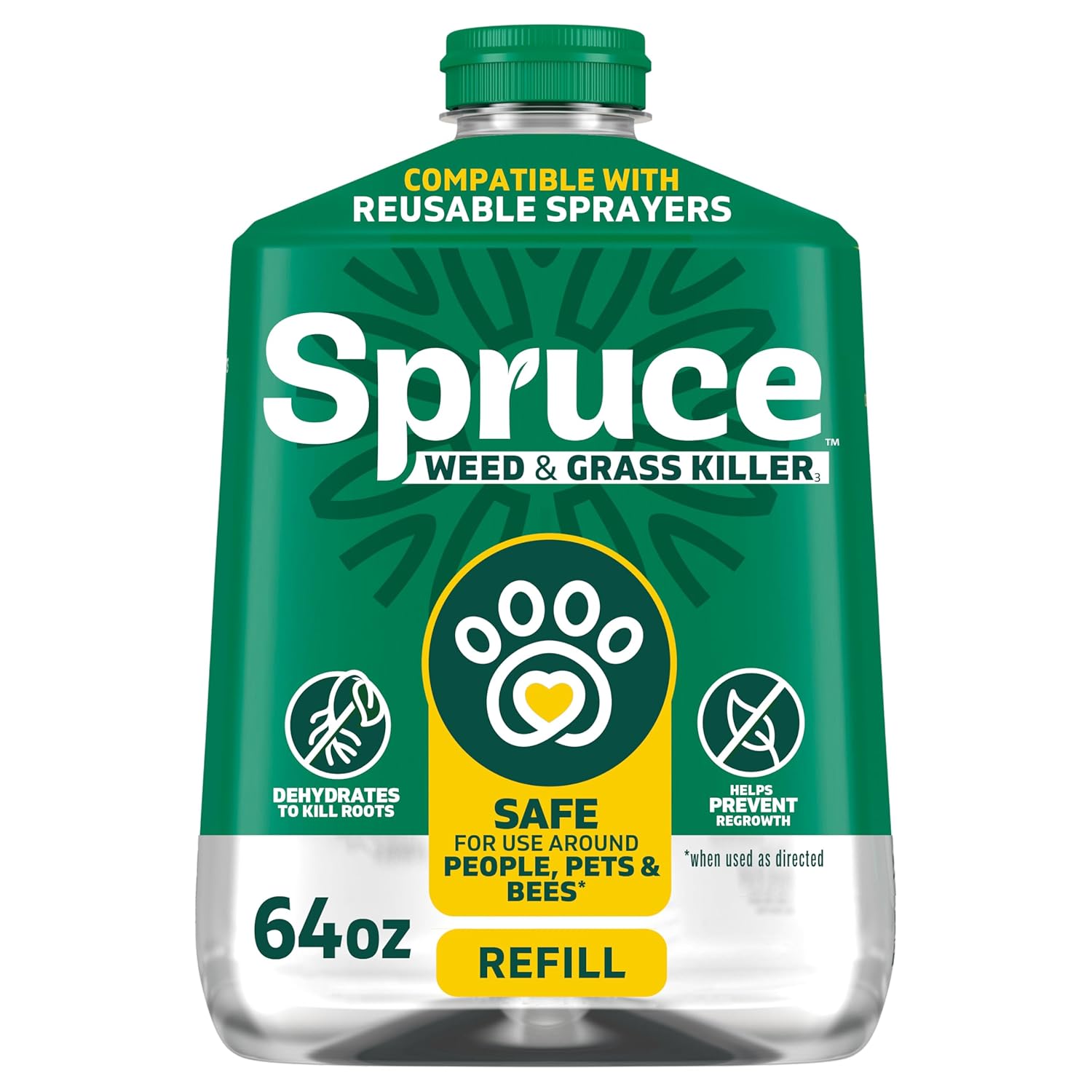
Spruce 64 oz Snap & Spray Ready-to-Use Weed and Grass Killer Refill
| Unit Count | 64 Fluid Ounces |
|---|---|
| Coverage | 1 bottle treats up to 400 weeds |
| Item Form | Spray |
| Active Ingredients | Sodium Lauryl Sulfate, Geraniol, Cornmint Oil |
This 64 oz Spruce refill is designed to snap into the brand's Snap & Spray wand so you can skip mixing and pouring and get straight to spot treatments. It works on contact by dehydrating plant tissue and lists active ingredients like geraniol and cornmint oil rather than synthetic herbicides, making it suitable for use around driveways, pavers, mulch beds, and garden edges when applied as directed. The label claims visible leaf darkening or wilting within an hour and complete death by 24 hours, and the solution becomes rainproof within ten minutes which helps with short windows of good weather. Practical benefits include easy handling with the refill system and coverage rated to treat up to about 400 weeds per bottle. Limitations are that it is non-selective so it can damage desirable plants and should not be used on lawns, and efficacy on tough, deep-rooted perennial weeds may require repeat applications or a different control method for full eradication.
Best for: Buyers who want a low-fuss, natural-ingredient spot weed killer for hardscapes and beds and value ease of use and quick visible results.
Less Ideal for: People needing a selective lawn herbicide or a single-application solution for very persistent, deeply rooted perennials should look elsewhere.
- Ready-to-use refill eliminates mixing and reduces spill risk
- Plant-based actives for a less synthetic formulation
- Quick visible results within about an hour and rainproof in 10 minutes
- Designed to pair with a precision snap-and-spray wand for targeted spot treatment
- Non-selective formula that will harm desirable plants if contacted
- May require repeat treatments on large or deep-rooted perennial weeds
Verdict: If you want an easy, ready-to-use, plant-based refill for fast spot treatment of weeds on driveways, pavers, and beds, this bottle is a practical, low-fuss choice.
Neudorff Weed & Grass Killer Ready-to-Use Spray, 32 oz

| Unit Count | 32 Fluid Ounces |
|---|---|
| Item Form | Liquid |
| Coverage | non-selective broad spectrum coverage |
| Active Ingredients | Ammoniated soap of fatty acid and Maleic hydrazide |
This Neudorff ready-to-use spray is a fast-acting, non-selective weed killer formulated to wilt foliage quickly and reduce regrowth by acting systemically to the root. You apply it by spraying foliage until wet for spot or area treatments around patios, driveways, sidewalks, and landscape beds where you do not want plants to regrow. The formula combines ammoniated fatty acids, which disrupt plant cell membranes for rapid burn-down, with maleic hydrazide, a growth regulator that helps prevent re-sprouting for up to several weeks. Notable practical benefits are short wait times to see results, rainfast protection after about three hours, and guidance that treated areas can be resown after five days. Important limitations are that it is non-selective so it will damage any desirable plants it contacts, it is not labeled for use in California and Hawaii, and protective clothing is recommended during application. For small-plot spot treatments and preparatory weed control where a quick, root-affecting, non-residual solution is wanted, this product performs as described.
Best for: Gardeners who need an inexpensive, easy-to-use, fast-acting spot or area weed treatment for hard surfaces and landscape prep and prioritize quick, measurable results over selective control.
Less Ideal for: People looking to selectively remove weeds from mixed beds with nearby desirable plants or those who need a product approved for use in California or Hawaii should consider alternatives.
- Fast visible wilting typically within an hour for young actively growing weeds
- Contains a growth regulator (maleic hydrazide) to reduce regrowth for weeks
- Rainfast after about three hours so treatment holds up to light weather
- Ready-to-use spray requires no mixing and is easy to apply for spot treatments
- Non-selective formula will harm any desirable plants it contacts
- Not labeled for use in California and Hawaii
Verdict: A practical, ready-to-use natural-leaning weed spray for budget-minded gardeners who want fast visible control and reduced regrowth.
Natural Elements 30% Vinegar Concentrate (4 × 1 Gallon)

| Units | 512 Fluid Ounces |
|---|---|
| Manufacturer | Natural Elements |
| Units_per_pack | 4 × 1 Gallon |
This 30% vinegar concentrate is a much stronger, industrial-strength alternative to typical 5% household vinegar designed for heavy cleaning and gardening tasks. Buyers dilute it to desired strengths for uses such as spot weed control, removing mineral and rust deposits, stripping soap scum, cleaning grout and patios, and acidifying soil or water. The product comes in multiple one-gallon bottles so you can mix small batches in spray bottles or larger volumes for pressure sprayers. Notable features include a clear dilution chart and broad applicability across indoor and outdoor chores, and the concentrated formula reduces the need to buy many single-use cleaners. Important limitations are that the high acidity requires careful handling, protective gear, and responsible application around desirable plants and surfaces because it will damage vegetation and some finishes; it is not an herbicide with selective action so repeat applications or mechanical removal may still be needed for deep-rooted weeds.
Best for: Gardeners and homeowners who prioritize a reliable, concentrated solution for heavy-duty cleaning and nonselective weed control and who plan to dilute and store batches safely.
Less Ideal for: People who need a selective herbicide or who prefer ready-to-use, low-acidity cleaners for routine household cleaning.
- Very high 30% acidity makes it effective at breaking down scale, rust, and organic residues
- Sold in multiple one-gallon containers for batch mixing and extended supply
- Dilutable for multiple strengths so you can tailor concentration to the task
- Versatile for indoor cleaning and outdoor uses including nonselective weed control
- Requires careful handling and protective equipment due to its strong acidity
- Nonselective: will harm any plant it contacts and can damage some surfaces if used full strength
Verdict: Buy this concentrate if you want a dependable, high-strength vinegar for powerful nonselective weed control and heavy-duty cleaning when diluted and handled safely.
Natural Elements Ready-to-Use Natural Weed Killer (1 Gallon)

| Unit Count | 128 Fluid Ounces |
|---|---|
| Item Form | Spray |
| Coverage | Most broadleaf weeds and grasses |
| Active Ingredients | Sodium Chloride, Salt Water, Commercial Vinegar, Soap |
Natural Elements Ready-to-Use Natural Weed Killer is a vinegar- and salt-based spray sold in a one-gallon container for spot-treating weeds on hardscape and non-turf areas. It is applied by spraying weeds until wet; plants typically wilt and die after exposure. The formula lists sodium chloride, commercial vinegar, and soap as active ingredients, so it works best on exposed broadleaf weeds, grasses, moss, and algae where contact kills foliage. Being a non-synthetic, FIFRA 25(b) exempt formula, it is presented as pet- and family-friendly once the treated area has dried, and it requires no mixing or special equipment. Important limitations are that it is non-selective and will damage or kill desirable plants and grass if oversprayed and that repeat applications may be needed for stubborn or deeply rooted weeds. For use around driveways, patios, gravel, and fence lines it is convenient and low-hassle, but it is not a residual systemic herbicide and will not provide long-term soil activity against regrowth.
Best for: Buyers who want a low-fuss, naturally derived spray to quickly remove visible weeds on driveways, patios, and mulched beds while prioritizing familiar, less synthetic ingredients and documented user experience.
Less Ideal for: Gardeners who need selective lawn-safe control or a long-lasting systemic solution for deeply rooted weeds should choose a different product.
- Ready-to-use gallon size requires no mixing and covers large areas
- Uses familiar, non-synthetic ingredients (vinegar, salt, soap)
- Suitable for hardscapes, gravel, and fence lines where contact control is needed
- Pet- and people-friendly once dry according to the product information
- Non-selective contact formula will kill desirable vegetation if oversprayed
- Does not act systemically so persistent or deep-rooted weeds may need multiple treatments
Verdict: A convenient one-gallon, ready-to-use natural spray that quickly kills visible weeds on hardscape and non-turf areas using familiar vinegar-and-salt ingredients.
Ortho GroundClear Weed & Grass Killer with Comfort Wand, 1 gal.

| Item Form | Spray |
|---|---|
| Coverage | 5120 square feet |
| Liquid Volume | 128 fluid ounces |
| Active Ingredients | Ammonium Nonanoate |
Ortho GroundClear is a one-gallon, ready-to-use weed and grass spray formulated with ammonium nonanoate and labeled OMRI for organic use. It is designed for spot treatment on hardscapes and landscape beds to kill common weeds such as dandelions, chickweed, crabgrass and moss. The included Comfort Wand makes precise application easy so you can target individual weeds while avoiding desirable plants. The formula shows visible browning within 15 minutes and becomes rainproof about two hours after drying, which helps protect your application from light rain. It is best used when weeds are small and actively growing and may require repeat treatments on established or perennial weeds. Practical limitations include the need to avoid contact with wanted vegetation and to keep people and pets away until sprays dry. For gardeners who want a fast, visibly effective, OMRI-listed spot treatment, this product balances convenience with predictable results, though it is not intended for broadcast use on lawns or for eliminating deeply rooted perennials in a single application.
Best for: Home gardeners who prefer low-risk, OMRI-listed herbicide options and want a convenient ready-to-spray solution for spot-treating weeds on patios, driveways, and landscape beds.
Less Ideal for: Gardeners seeking a lawn-wide systemic solution or a single-application fix for deep perennial roots should consider other products or mechanical removal methods.
- OMRI listed active ingredient suitable for organic-minded landscapes
- Ready-to-use formulation with included Comfort Wand for accurate spot application
- Fast visible results in about 15 minutes and rainproof two hours after drying
- Covers up to 5120 square feet from a single container according to the label
- Not labeled for use as a lawn broadcast treatment and may require multiple applications on perennial or well-established weeds
- Requires caution to avoid contact with desirable plants and to keep people and pets out of the area until dry
Verdict: A convenient OMRI-listed ready-to-use spray that delivers fast, targeted weed control for patios and landscape beds.
Choosing the Right Natural Weed Killer: Key Factors to Consider
Contact Kill Speed
How fast a natural weed killer visibly wilts and kills foliage affects how soon you can replant, clean up, or mow. Many natural actives work by burning leaf tissues on contact rather than translocating to roots, so they often show quick aboveground browning but may need repeat treatments to exhaust root reserves.
Faster contact kill reduces the time weeds compete with desired plants and cuts down on seed set. However, rapid foliar burn can also stress nearby desirable plants if spray drifts or puddles, so understanding application timing and technique is critical for minimizing collateral damage.
Selectivity Near Desirable Plants
Selectivity refers to how safely you can use the product near ornamentals, vegetables, or seeded lawns. Pure contact products are generally nonselective on any leaves they touch, so precision matters: spot-spraying, shielded wands, or applying on calm days reduces off-target damage.
Some natural formulations include additives that improve sticking to target foliage or reduce run-off. When planning treatments in mixed beds, choose products with clear guidance for protecting desirable plants and that allow mechanical shielding or directed application to limit contact with nearby stems and leaves.
Soil Persistence
One appeal of natural weed killers is minimal long-term soil residues, but persistence varies by active ingredient. Rapidly biodegradable actives break down in hours to days, which is good for replanting and soil health. Others may leave short-lived effects that suppress seed germination for a limited time.
Gardeners who want to plant immediately after treatment should check the label for replanting intervals. For vegetable plots, low soil persistence means less risk to crop seedlings, while in paved areas you may prefer longer-lasting suppression achieved by repeat contact treatments rather than a persistent chemical barrier.
Ease Of Application
Practical application factors include whether the product comes ready-to-use or as a concentrate, compatibility with common sprayers, and whether it needs agitation or mixing with adjuvants. Ready-to-use sprays are convenient for small patches, while concentrates give better coverage for larger beds but require measuring and mixing.
Also consider nozzle options, tank-cleaning needs to avoid contaminating later applications, and how forgiving the product is if you accidentally overspray. Clear label instructions and predictable spray behavior reduce mistakes and make regular maintenance faster.
Safety For People, Pets, And Beneficials
Natural does not automatically mean harmless. Some botanical acids can irritate skin, eyes, or respiratory tracts on contact. Look for products with straightforward PPE recommendations and guidance on re-entry intervals for children and pets.
Protecting beneficial insects and soil organisms is also important. Choose application timing to avoid flowering periods, and favor products that break down quickly so soil microbial communities recover rapidly. Labels that provide clear cleanup procedures and accidental-exposure steps improve safe use in family gardens.
Effect On Regrowth And Seedlings
Because many natural weed killers are contact-only, they may not reliably kill established perennial weeds from the root. Expect regrowth from deep-rooted species unless you combine treatments with mechanical removal.
For seedling control, contact actives are usually effective at low weed sizes. Timing treatments to target young seedlings reduces the number of applications needed. When planning long-term control, consider integrating cultural practices such as mulching and hand-pulling alongside chemical contact tools.
When To Use Natural Weed Control
Natural weed killers work best for spot treatment, clearing cracks in hardscapes, and managing young annual weeds in beds and borders. Use them when you need quick top-growth suppression or when soil persistence from synthetic herbicides is unacceptable.
Apply on calm, dry days with temperatures in the moderate range. Avoid treating when rain is expected within 24 hours unless the product label indicates rainfastness, because wash-off reduces effectiveness and increases runoff risk.
- Ideal for annual seedlings and small broadleaf weeds
- Useful around patios and driveways for visible weed removal
- Less reliable alone for established perennials with deep roots
Application Techniques That Reduce Risk
Precision application cuts collateral damage. Use shielded spray wands or wrap a piece of cardboard behind the spray to protect desirable plants when treating weedy patches in mixed beds. Hold the nozzle close to the target and apply short bursts rather than sweeping sprays.
If replanting is planned, water and lightly cultivate only after the product has fully dried and label replanting intervals have elapsed. Clean sprayer equipment thoroughly between different garden tasks to prevent cross-contamination.
- Spot-spray small patches; avoid broadcast sprays over planted areas
- Apply in early morning or late afternoon to reduce volatilization
- Wear recommended protective gear and keep pets away until treated areas are dry
Integrating Natural Products Into a Weed Management Plan
Natural weed killers are a tool, not a stand-alone strategy. Combine them with mulches, hand-weeding, and smothering techniques to reduce seed bank inputs and prevent re-establishment. Regular monitoring and treating weeds while small reduces labor and chemical use over time.
For perennial weeds, use chemical contact treatments to weaken aboveground growth, then follow up with digging or other removal methods for the root system. In high-traffic areas, repeat short contact treatments can keep regrowth in check without persistent soil residues.
- Use as a spot-control method within an integrated system
- Pair with mulching to reduce new germination
- Follow up on tough perennials with mechanical removal
Environmental Considerations
Choose formulations with rapid biodegradability to limit impacts on soil and nearby water bodies. Avoid applying to saturated soil or steep slopes where runoff could carry active ingredients into storm drains.
Time applications to avoid pollinator activity. Even natural actives can reduce nectar availability or harm non-target insects if sprayed directly on blooms, so treat early or late in the day when pollinators are less active.
- Avoid spraying during rain or high-wind conditions
- Keep products away from drains and waterways
- Do not apply to flowering plants or when pollinators are active
Preparing For Replanting And Soil Health
If you plan to replant a treated area, check the product's stated replant interval. Many natural contact actives allow replanting within a short window because they do not persist, but following label guidance protects tender seedlings.
To support soil health after treatment, add organic matter and consider light cultivation to encourage microbial breakdown of any residues. Avoid overuse of any herbicidal product to let beneficial soil organisms recover quickly.
- Confirm replant intervals before sowing seeds or transplanting seedlings
- Incorporate compost to restore organic matter after repeated treatments
- Rotate control methods to reduce reliance on chemical approaches
How We Chose the Best Natural Weed Killer
We focused on products formulated from botanical acids, soaps, oils, or other naturally derived active ingredients that are commonly used by home gardeners. Selection filters prioritized demonstrated contact activity against both broadleaf weeds and small annual grasses, documented guidance for use near ornamentals, and clear instructions that reduce drift and runoff. We also favored products with guidance for repeat applications and measurable effects within days. Editorial evaluation emphasized real-garden factors: how quickly foliage wilts, how selectively the spray spares adjacent plants when applied carefully, residual activity in the topsoil, and practical safety for pets and children when label directions are followed. Products lacking clear application windows, vague safety directions, or ingredients inconsistent with natural-product expectations were excluded. We excluded synthetic herbicides and any formulations that rely on long-term synthetic residues rather than immediate contact control. The final shortlist balances speed, usability, and minimum soil persistence so gardeners can choose what fits a planted bed, vegetable garden, paved area, or spot treatment need. Our scoring criteria reflect those dimensions and guided the picks included here.
FAQ
Are natural weed killers safe to use around vegetable beds?
Often they can be used near vegetables if you apply carefully and follow label replanting intervals. Use spot applications and avoid contact with crop foliage. Allow treated areas to dry completely before allowing children or pets back into the space.
Do natural weed killers kill roots or just the leaves?
Usually they act on foliage and cause aboveground desiccation, so they may not reliably kill deep roots. Repeat treatments or mechanical removal are often necessary for perennial species with established root systems.
How soon after applying can I plant new seedlings?
That depends on the formulation, but many natural contact products allow replanting within a short window, sometimes within a few days. Check the product guidance for specific replant intervals and ensure the treated surface is dry and free of visible residue.
Will natural weed killers harm bees and other pollinators?
They can harm pollinators if sprayed directly onto blooms. To reduce risk, avoid treating flowering plants, apply in early morning or late evening, and choose application times when pollinators are less active.
Can I use natural weed killers on cracks in driveways and patios?
Yes. Natural contact products are suitable for hardscapes where you want quick visible removal without leaving long soil residues. Apply carefully to avoid run-off and follow instructions for reapplication if regrowth occurs.
How often will I need to reapply natural weed control?
Reapplication frequency depends on weed species and size. Annual seedlings often die after one or two treatments, while perennial weeds may require repeated applications plus mechanical removal to address root systems.
Final Verdict
Natural weed killers are effective tools for spot control, young seedlings, and areas where minimal soil persistence is a priority. Prioritize products that balance quick contact kill with clear safety guidance so you can protect desirable plants and pollinators. Match the product choice to the task: use precise, low-drift application methods in mixed beds, reserve repeated treatments or mechanical removal for persistent perennials, and coordinate timing with mulching and cultural controls for the best long-term results.
