

Note: This article contains affiliate links. If you click on these links and make a purchase, I may earn a small commission at no extra cost to you. This helps support my research and content. Read my full affiliate disclosure here.
If you manage a large lawn, acreage, or multiple beds, a tow garden spreader saves time and reduces trips with a tractor or mower. Choosing the right tow spreader matters because hopper capacity, frame strength, and the calibration system determine how evenly seed, fertilizer, or salt is distributed and how long the unit lasts under load. This guide covers seven carefully shortlisted tow garden spreaders that suit common garden tasks, and it explains the practical tradeoffs that affect everyday use. Evaluation focuses on hopper and frame durability plus tow performance and metering accuracy to help you pick the best fit for your landscape.
Top Picks at a Glance
| Best Overall The best all-around choice for most situations | Brinly BS26BH Tow-Behind Broadcast Spreader, 125 lb. Capacity |  |
| Best Quality Built to a higher standard if you want something more solid | Agri-Fab 45-0288 175 lb Tow-Behind Drop Spreader, 42" Spread |  |
| Best Value The sweet spot between price and what you get | GarveeLife Tow-Behind Broadcast Spreader, 130 lb Capacity |  |
| Best Budget The cheapest option that still gets the job done reliably | Takywep 80 lb Tow-Behind Broadcast Spreader with 10" Pneumatic Tires |  |
| Highest Rated A top-rated pick with lots of positive feedback | John Deere 130-lb Tow-Behind Lawn Spreader |  |
| Most Popular A crowd favorite that many people choose with confidence | Agri-Fab 130 lb Pull-Behind Broadcast Spreader (Model 45-0463) |  |
| Best Seller A high-volume bestseller chosen again and again | Agri-Fab 185 lb Tow-Behind Broadcast Spreader (45-0547) |  |
Brinly BS26BH Tow-Behind Broadcast Spreader, 125 lb. Capacity

| Hopper capacity | 125 lb (2.5 cu ft) |
|---|---|
| Frame finish | Powder-coat steel |
| Gears | Enclosed glass-filled nylon |
| Hardware | Stainless steel interior |
The Brinly BS26BH is a tow-behind broadcast spreader built for homeowners who need to cover half-acre lawns and larger without constant refills. It uses a large rust-resistant polyethylene hopper that holds up to 125 pounds (2.5 cu ft) of seed, fertilizer, ice melt or sand, and an Autoflow system that stops material flow when the tow vehicle stops to prevent overapplication. The tubular steel frame and stainless-steel hardware plus enclosed glass-filled nylon gears are designed to resist corrosion from fertilizers and wet conditions. Directional spread pattern control and simple calibration dials let you tune distribution for different particle sizes, which helps produce even, stripe-free coverage. Assembly is straightforward with pictorial instructions and a typical build time under 30 minutes. The spreader is practical for routine fertilizing, overseeding, pest treatments and winter ice control, but its tow-behind design requires a mower or tractor with a hitch and enough power to pull a loaded hopper. For homeowners with medium to large lawns who want a durable, low-maintenance unit that balances capacity and control, this model is a sensible choice.
Best for: Homeowners with medium to large yards who want a durable, higher-capacity tow-behind spreader to handle seasonal fertilizing, seeding, and ice-melt applications with minimal refills.
Less Ideal for: People with very small lawns, condo owners, or those who lack a compatible hitch-equipped mower should look at push or walk-behind models instead.
- Large 125 lb. polyethylene hopper reduces refilling for half-acre and larger lawns
- Autoflow system stops material flow when the tow vehicle stops to prevent overapplication
- Corrosion-resistant hardware, stainless steel internals, and enclosed nylon gears for longer life
- Directional spread pattern control and easy calibration dials for more uniform coverage
- Quick assembly with pictorial manual and available instructional video
- Requires a mower or tractor with a tow hitch and adequate towing capacity
- Heavier loaded weight may be difficult to maneuver without proper tow vehicle
Verdict: A rugged, higher-capacity tow-behind spreader that delivers controlled, stripe-free applications for medium to large lawns.
Agri-Fab 45-0288 175 lb Tow-Behind Drop Spreader, 42" Spread

| Capacity | 175 pounds |
|---|---|
| Spread width | 42" controlled spread width |
| Coverage | Approximately 40,000 sq ft |
| Wheels | 12" x 3.5" pneumatic tires |
| Construction | Poly hopper with galvanized steel agitator |
The Agri-Fab 45-0288 is a tow-behind drop spreader made to cover roughly one acre per fill and simplify large-lawn maintenance. It is typically hitched to a lawn or garden tractor and used for spreading seed, fertilizer, ice melt, or salt across lawns and driveways; the on/off control is accessible from the tractor seat for convenient operation. Notable features include a rustproof poly hopper with a 175 lb (17 gallon) capacity that reduces refill interruptions, a 42 inch controlled spread width for precise placement, and 12" pneumatic tires that help with smooth towing over uneven turf. Construction uses galvanized steel components for the agitator and an alloy frame to stand up to regular outdoor use. Expect straightforward assembly and durable year-round performance, though this model requires a tractor or tow vehicle and is sized for larger properties rather than small yards. It does not include integrated spiking or powered agitation, so very heavy or damp materials may need checking for flow consistency.
Best for: Buyers who manage medium to large lawns and prioritize reliable, proven equipment that reduces time spent refilling and gives consistent, precise drop spreading when towed behind a tractor.
Less Ideal for: Homeowners with small yards, those who need a push spreader, or anyone wanting built-in spiking or powered agitation should consider other options.
- Large 175 lb (17 gallon) hopper reduces frequency of refills for acre-sized jobs
- 42 inch controlled spread width delivers more precise material placement
- Rustproof poly hopper and galvanized components resist corrosion for longer life
- On/off control accessible from the tractor seat makes operation convenient while towing
- Requires a tow vehicle such as a garden tractor, so not suitable for walk-behind use
- No powered agitation or spiker attachment included which can limit flow with damp or clumping materials
Verdict: Choose this Agri-Fab tow-behind drop spreader when you need a durable, high-capacity unit that delivers precise, acre-sized coverage with minimal refills.
GarveeLife Tow-Behind Broadcast Spreader, 130 lb Capacity

| Capacity | 130 lbs |
|---|---|
| Tire type | 10" pneumatic tires |
| Frame | Powder-coated steel |
The GarveeLife tow-behind broadcast spreader is a straightforward, work-focused machine for covering medium to large lawns and driveways. It mounts to a lawn tractor, ATV, or UTV via a durable tow bar and uses a powder-coated steel frame and rust-resistant poly hopper to resist corrosion in seasonal outdoor use. The adjustable flow handle and spreader plate let you control material output and achieve even coverage up to about 10 feet wide, making it usable for seed, fertilizer, ice melt, and sand. Ten-inch pneumatic tires give good traction and a smoother roll across uneven turf or gravel. Practical additions like a waterproof cover and sieve help keep materials dry and prevent clumping. Downsides are that it is a simple mechanical spreader without powered agitation, so very wet or compacted material may still clog, and assembly or hitching can take a little time for first-time users. For routine lawn maintenance and winter deicing this spreader performs the basic tasks reliably.
Best for: Buyers who want a practical, no-frills tow-behind spreader to cover medium to large lawns and driveways efficiently and reduce repeated trips to refill.
Less Ideal for: People who need a motorized or high-capacity commercial spreader for continuous heavy use or those who only have a small hand-push spreader need.
- Rust-resistant poly hopper and powder-coated steel frame resist corrosion for seasonal outdoor use
- Adjustable flow control and spreader plate deliver even distribution up to about 10 feet wide
- 10" pneumatic tires provide stable rolling and traction over uneven turf and gravel
- Large 130 lb capacity hopper reduces refill trips for larger yards
- No powered agitation system, so very wet or compacted materials can clog
- Requires hitching and some initial assembly which may be awkward for a single user
Verdict: A durable, easy-to-use tow-behind spreader that handles seed, fertilizer, and ice melt for homeowners who want efficient coverage without fancy electronics.
Takywep 80 lb Tow-Behind Broadcast Spreader with 10" Pneumatic Tires

| Hopper capacity | 80 lb (30 L) |
|---|---|
| Tire size | 10 in pneumatic |
| Frame material | Powder-coated carbon steel |
| Compatible tow | Riding mowers, ATVs, UTVs via pin-style hitch |
| Control | Adjustable rate-control lever |
The Takywep 80 lb tow-behind broadcast spreader is a basic, workmanlike machine for seeding, fertilizing, and winter de-icing on medium to large lawns. It mounts to riding mowers, ATVs, UTVs, and similar equipment using a pin-style hitch and rolls on large 10-inch pneumatic tires that handle uneven turf and light mud with less slipping. The rust-resistant poly hopper holds 80 pounds of granular material to reduce refills, and an accessible rate-control lever lets you dial coverage from light seed to heavier fertilizer or ice melt. A powder-coated carbon steel frame provides structural strength for regular seasonal use. Expect straightforward setup and operation but limited refinement: the unit is utilitarian rather than precision-engineered, and assembly and parts fit may require basic mechanical patience. For homeowners who want a simple tow-behind spreader that covers ground quickly without specialty features, this model delivers reliable performance for routine lawn and winter maintenance.
Best for: Buyers who want an affordable, no-frills tow-behind spreader to cover medium to large lawns quickly and handle seasonal seeding, fertilizing, and de-icing while keeping costs down.
Less Ideal for: Professional contractors or users who need precise commercial-grade calibration, premium fit and finish, or advanced spread pattern controls should consider higher-end models.
- Large 80 lb poly hopper reduces frequency of refills for bigger jobs
- 10" pneumatic tires improve traction and roll smoothly over uneven ground
- Adjustable rate-control lever for quick changes between seed, fertilizer, and ice melt
- Powder-coated carbon steel frame resists weather and adds durability
- Basic design with limited refinement in fit and finish compared with higher-end models
- Tow hitch and assembly may require time and basic tools to install properly
Verdict: A straightforward, budget-friendly tow-behind spreader that covers large lawns efficiently with a high-capacity hopper and all-terrain tires.
John Deere 130-lb Tow-Behind Lawn Spreader

| Capacity | 130 lb |
|---|---|
| Operation Mode | Manual |
| Number of Positions | 5 |
| Material Type | Polyethylene |
This John Deere tow-behind spreader is a simple, rugged option for homeowners who want a reliable way to broadcast seed, fertilizer, or ice melt across a yard. It mounts behind a riding mower or ATV and holds up to 130 pounds so you can cover larger areas without frequent refills. The polyethylene hopper resists rust and is low maintenance, while five adjustable flow positions let you control application rate for different materials. Setup and operation are straightforward since it is manually operated and does not require power. Expect consistent performance on flat to gently rolling terrain, though very precise small-area work will still need follow-up by hand. The unit is not feature-heavy so it trades advanced calibration or hopper agitation systems for simplicity and durability. For those who prioritize long-term dependable use with minimal upkeep, this model delivers straightforward spreading at a workmanlike level.
Best for: Buyers who want a no-frills, durable tow-behind spreader for routine lawn or driveway applications and value long-term reliability over bells and whistles.
Less Ideal for: Not a great choice for users needing precise micro-application, electronic controls, or frequent spreading of clumping damp materials; commercial contractors needing heavy-duty agitation may prefer a more robust model.
- Sturdy 130 lb capacity reduces refill frequency for medium to large lawns
- Polyethylene hopper resists rust and simplifies maintenance
- Five-position flow control allows basic adjustment of application rate
- Tow-behind design pairs with a riding mower or ATV to speed up large jobs
- Manual operation lacks powered agitation for very coarse or damp materials
- No advanced calibration features for pinpoint application rates
Verdict: Choose this John Deere tow-behind spreader if you want a simple, durable 130 lb unit that reliably covers medium to large lawns with minimal maintenance.
Agri-Fab 130 lb Pull-Behind Broadcast Spreader (Model 45-0463)
| Weight Capacity Maximum | 130 pounds |
|---|---|
| Spread Width | 10-12 ft |
| Tire Type | Pneumatic |
| Material Type | Alloy Steel, Polypropylene (PP), Rubber |
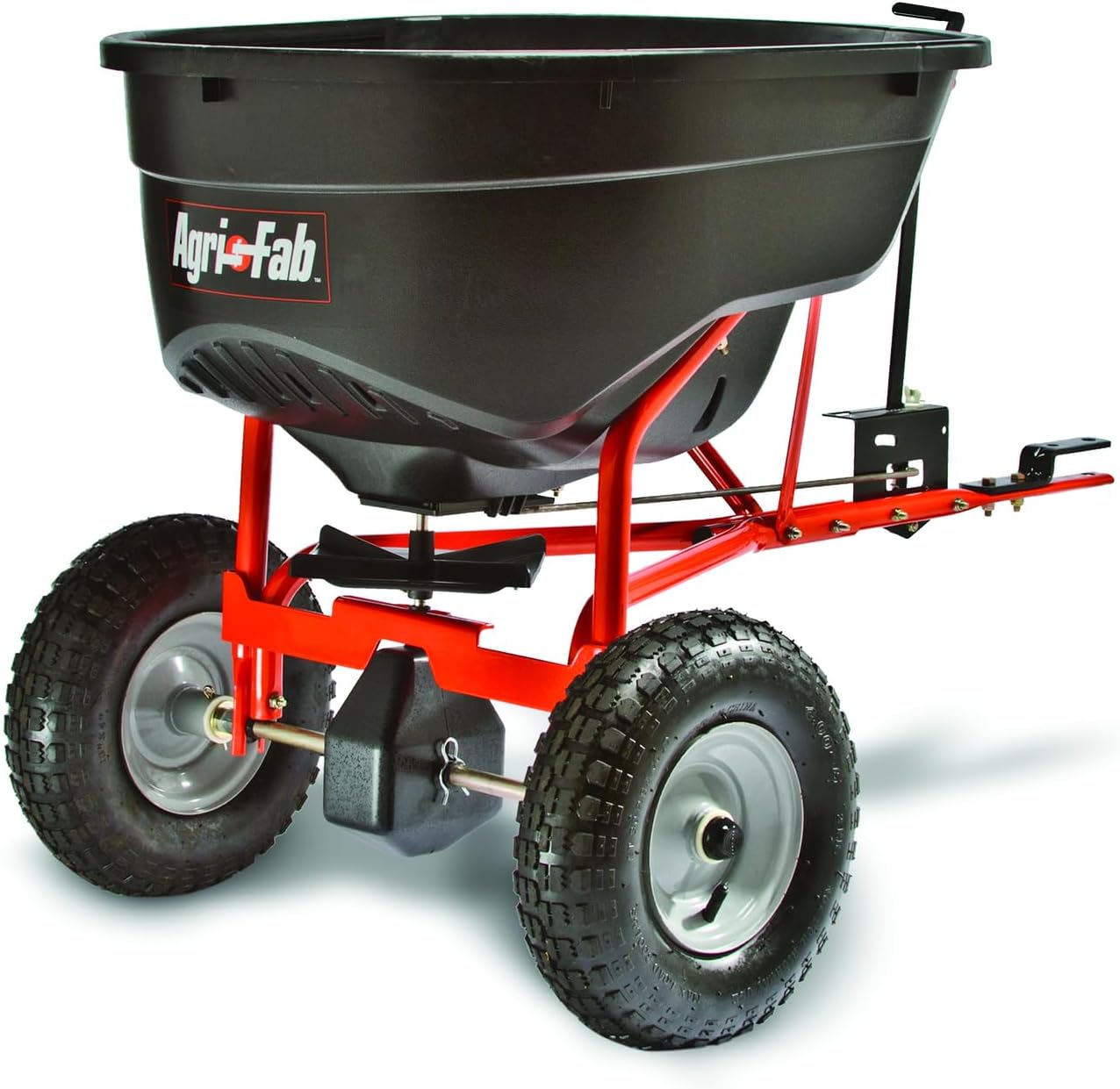
The Agri-Fab 130 lb pull-behind broadcast spreader is built for straightforward, dependable lawn care on larger yards. It mounts to most riding mowers with a universal hitch and holds up to 130 pounds, letting you cover roughly half an acre per fill to reduce interruptions. The wide 10 to 12 foot spread pattern and enclosed gear box promote more even dispersal and protect internal parts from dirt and moisture. A simple steel-rod flow control is reachable from the tractor seat so you can change application rates without stopping. The construction combines a poly hopper with alloy steel frame tubing and pneumatic tires for durability and smoother towing over uneven ground. Expect easy seasonal use for grass seed, fertilizer, granular lawn treatments, and salt. The main limitations are that it is a basic broadcast design, so very precise banding or ultra-fine calibration for specialty seed mixes may require additional passes or a different spreader type, and some assembly is required before first use.
Best for: Homeowners or property managers who want a reliable, no-nonsense tow-behind spreader to cover medium to large lawns efficiently and with minimal fuss.
Less Ideal for: Gardeners who need highly precise application patterns or small-plot users who prefer a handheld or walk-behind drop spreader for tight spaces.
- Large 130 lb hopper covers up to about 25,000 sq ft per fill to reduce refills on bigger lawns
- Universal hitch fits most riding mowers and lawn tractors for quick hookup
- Wide 10–12 ft spread width delivers even coverage with fewer passes
- Enclosed gear housing and steel frame improve durability and protect moving parts
- Seat-accessible steel-rod flow control lets you change settings without dismounting
- Broadcast design is less suited to precision banding or very narrow applications
- Requires assembly before first use
Verdict: A durable, easy-to-use tow-behind spreader that reliably covers larger lawns with fewer refills and minimal operator adjustments.
Agri-Fab 185 lb Tow-Behind Broadcast Spreader (45-0547)

| Weight capacity maximum | 185 pounds |
|---|---|
| Spread width | Up to 12 ft |
| Tire type | Pneumatic Tires |
| Material type | Metal, Polypropylene (PP) |
The Agri-Fab 185 lb tow-behind broadcast spreader is designed to handle larger lawn jobs without frequent refills. You hitch it to a riding mower or ATV, load seed, fertilizer, salt, sand or ice melt into the rustproof poly hopper, set the flow with the seat-accessible on/off rod, and tow across the lawn for up to 12 ft of broadcast coverage. Heat-treated steel gears and a poly spreader plate aim to give durable, consistent operation while 13 x 5 in pneumatic turf tires smooth towing over uneven ground. The large 185 lb capacity is useful for roughly one acre per fill, cutting the number of passes and time spent refilling. Expect some assembly out of the box and basic maintenance of the gearbox and tires for long life. The spread pattern is broad but broadcast spreaders are inherently less precise than drop-style units, so careful calibration is needed for even application of granular products. Overall it is a practical, heavy-duty option for routine lawn and property maintenance when you need to cover medium to large areas efficiently.
Best for: Buyers who need a robust, low-maintenance spreader to cover medium to large lawns quickly and prefer convenience features like seat-mounted flow control.
Less Ideal for: Not the best choice for small lawns or applications that require very precise, spot-by-spot granular placement or very lightweight, occasional use.
- Large 185 lb hopper reduces frequency of refills for up to about one acre of coverage
- On/off flow control reachable from the mower seat for convenient operation
- Rustproof polypropylene hopper and spreader plate resist corrosion for year-round use
- Heat-treated steel gears and pneumatic turf tires improve durability and smooth towing over uneven terrain
- Broadcast spread pattern is less precise than a drop spreader so calibration and overlap are required
- Some assembly required before first use
Verdict: Choose this Agri-Fab model when you want a heavy-duty tow-behind spreader that covers up to an acre per fill and simplifies larger lawn jobs with seat-mounted control.
Choosing the Right Tow Garden Spreader: Key Factors to Consider
Hopper Capacity and Construction
Hopper size determines how often you stop to refill when treating large areas. For lawns and acreage, a larger hopper cuts work time but increases tongue weight and stress on the frame and hitch. Material matters too. Plastic hoppers resist rust and are lighter but can crack under impact or prolonged UV exposure. Metal hoppers handle abrasion from gritty products better but need corrosion protection and occasional touch-up. Consider how the hopper interfaces with the spreader frame and whether a built-in agitator or vibratory system prevents bridging with damp or coarse materials.
Frame, Axle, and Wheel Durability
The frame and axle carry the entire load and determine how the spreader behaves when towed over uneven ground. Larger hoppers require heavier-gauge steel or reinforced tubing to avoid bending or wobble during turns. Axle diameter, bearing type, and wheel size influence rolling resistance and ground clearance. Pneumatic tires smooth towing over rough turf but require maintenance; solid tires avoid flats but transmit more vibration to the frame. Pay attention to weld quality and whether critical joints are gusseted or reinforced, because repairs are harder if the main frame is compromised.
Tow Interface and On-Tow Stability
How the spreader connects to your tractor or mower will dictate ease of use. A universal three-point hitch is common on small tractors, while pin-style tow hitches fit many lawn tractors. The spreader's pivot and hitch height should keep the hopper level during normal towing; too low or too high a tongue angle alters spread pattern and strains the chassis. Stability while turning and during speed changes depends on center of gravity and axle placement. Look for features that let you adjust hitch height or add weight distribution to keep the load steady.
Metering System and Spread Pattern Control
Accurate, repeatable metering is essential for applying seed, fertilizer, or ice melt at the intended rate. Meter types range from simple drop-gate systems to geared agitator plates that meter granules more evenly. Adjustable openings with clear settings make calibration faster in the field. The spreader's deflector design and spinner size control lateral distribution. A good system will allow narrow, medium, and wide patterns and be easy to fine-tune without tools. Consider how the spreader handles different granule sizes and whether it includes a calibration chart or testing cup.
Serviceability and Replacement Parts
Tow spreaders live outside and are exposed to corrosive products and grit. Easy access to wear parts like gears, bushings, and spinners shortens downtime. Check whether common replacements such as gate seals, bearings, and tires are simple to remove and fit. A modular design with bolted panels and standardized fasteners makes field repairs easier. Also consider whether the manufacturer or aftermarket offers replacement parts that match common wear items so you can keep the unit running without fabricating components.
Best Uses by Garden Size and Task
Not all tow spreaders are optimal for every task. For large lawns and small acreage, prioritize higher-capacity hoppers and stronger axles so you can cover acres without repeated refills. For garden beds and spot seeding, a smaller hopper with finer metering control can prevent over-application.
Different materials demand different handling. Fertilizers and pelletized lime flow differently than small grass seeds or ice-melt granules. Choose a spreader with adjustable metering and a pattern control that suits the most common materials you will use.
- Large lawn maintenance: large hopper, pneumatic tires, durable axle
- Spot seeding and bed work: fine metering, narrower spread pattern
- Seasonal salt and ice management: corrosion-resistant surfaces and replaceable spinner plates
Calibration Tips for Consistent Results
Calibrating a tow spreader before each job avoids waste and uneven coverage. Use a small test strip and measure product applied over a known area to confirm the setting. Adjust the gate or gear ratio and repeat until the output matches the recommended application rate for the material.
Record settings that worked for common tasks and conditions so you can replicate them later. Ground speed matters: faster towing increases spread width but reduces applied rate per pass unless you compensate with a higher metering setting.
- Always test with the actual material you will use
- Measure applied weight over a set area to calculate rate
- Keep a simple log of settings vs ground speed for common tasks
Mounting, Storage, and Winter Care
Proper mounting ensures geometry that keeps the hopper level and prevents undue stress on the hitch and frame. If hitch height is mismatched, use adjustable mounts or shims rather than forcing a misaligned connection.
When not in use, empty the hopper and clean residual product from spinners and gates. Moisture and corrosive fertilizers accelerate deterioration. Store the spreader under cover or indoors if possible. Before winter storage, lubricate moving parts and inspect seals to avoid frozen components.
- Empty and brush out hopper after use
- Lubricate linkages and check bearings annually
- Store on blocks to relieve tire and axle load during long storage
Common Upgrades and Useful Accessories
Several accessories can make a tow spreader more versatile. A weather cover protects the hopper from UV and moisture. A mesh screen over the hopper keeps clumps and foreign debris out of the metering system. Adding a remote gate control lets you open and close the gate from the tractor seat for spot work and edge control.
Upgrading tires to larger or turf-friendly designs reduces ground compaction and improves ride quality. Replacement spinner plates or hardened agitator shafts extend service life when you frequently apply abrasive materials.
- Hopper covers and mesh screens
- Remote or hydraulic gate actuators
- Upgraded tires and reinforced spindles
Safety Considerations While Towing
Tow spreaders change vehicle handling and braking distances when fully loaded. Keep load within the rated hitch capacity and avoid sudden turns at speed to reduce the risk of tipping or overloading the hitch. Be mindful of clearance when reversing or making tight maneuvers.
Avoid towing over fragile turf at high speeds to minimize rutting. Use slower speeds in soft or wet conditions and make multiple light passes rather than attempting to apply more material at once, which can cause uneven distribution and increased turf damage.
- Check hitch rating and do not exceed tongue weight limits
- Reduce speed on slopes and wet ground
- Make wide, gradual turns when towing a full hopper
How We Chose the Best Tow Garden Spreader
We focused on features that affect long-term performance and day-to-day handling in larger gardens and small acreage. Primary evaluation criteria included hopper material and capacity because these determine how much product you can carry and how resistant the container is to abrasion and corrosion. Frame and axle construction were assessed for load-bearing strength and resistance to bending under repeated towing. Tow performance and hitch compatibility were judged on how easily units attach to common garden tractors and how stable they remain while moving at typical mowing speeds. Metering accuracy and adjustability were evaluated for how well spread patterns can be tuned to different granular products. Finally, serviceability and parts availability were considered so simple repairs and wear parts are accessible. We excluded compact push or walk-behind spreaders and any unit clearly designed only for cold-weather road use. We also excluded spreaders lacking basic calibration controls or with obvious structural weak points. The final list highlights models that balance capacity, durable construction, consistent metering, and practical tow handling suited to gardens, lawns, and small acreage tasks.
FAQ
How do I calculate the right application rate for my spreader?
Measure the material delivered over a defined area during a test pass, then scale that measurement to the recommended rate on the product label. Repeat tests at the ground speed and metering setting you plan to use to ensure the numbers match real-world conditions.
Can I use a tow spreader for both seed and fertilizer?
Often yes, but check that the metering system handles different granule sizes and that you thoroughly clean the hopper between materials to prevent cross-contamination. Some spreaders have settings and charts to help switch between common materials.
What maintenance keeps a tow spreader running reliably?
Regularly clean abrasive residues from the hopper and spinner, inspect bearings and bushings, lubricate moving parts, and replace worn seals. Tighten fasteners and check welds or reinforcement plates after heavy seasons.
Is a metal hopper better than plastic for heavy-duty work?
It depends. Metal hoppers resist abrasion from coarse materials better but need corrosion protection and more maintenance. High-density plastics resist rust and are lighter but can be more vulnerable to impact and UV-related deterioration.
How important are tire type and size on a tow spreader?
Very important. Larger pneumatic tires smooth towing and reduce compaction on turf, while solid tires are maintenance-free but transmit more vibration. Tire choice affects clearance and how the spreader handles uneven ground.
Final Verdict
For gardeners and property managers working lawns, acreage, or multiple beds, prioritize hopper capacity and a robust frame to reduce refill frequency and resist wear. Metering accuracy and tow stability are the other key tradeoffs: better metering saves material and produces more uniform results, while a well-matched hitch and axle layout preserve handling and safety. Balance these factors against how often you will use the spreader and what materials you will apply, and choose the combination of capacity, durability, and calibration control that fits your routine and terrain.
