

Note: This article contains affiliate links. If you click on these links and make a purchase, I may earn a small commission at no extra cost to you. This helps support my research and content. Read my full affiliate disclosure here.
Choosing the right Lawn Weed and Feed garden spreader makes a big difference in how uniformly treatment reaches your turf and how much time you spend reworking missed areas. Whether you treat a small city lawn or several acres, a spreader that meters granules precisely and resists clogging keeps application rates consistent and reduces grass stress. This guide highlights seven shortlisted Lawn Weed and Feed garden spreaders suited to a range of yard sizes and application styles. We evaluated each option on practical garden performance like spread pattern, hopper handling, and adjustment controls so you can pick the tool that matches your lawn size and schedule.
Top Picks at a Glance
| Best Overall The best all-around choice for most situations | John Deere 130 lb Push Broadcast Spreader |  |
| Best Quality Built to a higher standard if you want something more solid | Scotts Turf Builder EdgeGuard DLX Broadcast Spreader |  |
| Best Value The sweet spot between price and what you get | Amazon Basics Broadcast Fertilizer Spreader, Multi-Gear, 5000 sq ft Coverage |  |
| Best Budget The cheapest option that still gets the job done reliably | CHAPIN 8740A 64 oz Hand Shaker Spreader |  |
| Highest Rated A top-rated pick with lots of positive feedback | The Andersons Pacer Pro Walk-Behind Broadcast Spreader (80 lb Hopper) |  |
| Most Popular A crowd favorite that many people choose with confidence | Scotts Whirl Hand-Powered Spreader |  |
| Best Seller A high-volume bestseller chosen again and again | Scotts Turf Builder EdgeGuard Mini Broadcast Spreader |  |
John Deere 130 lb Push Broadcast Spreader

| Capacity | 130 lbs. |
|---|---|
| Approximate coverage | Up to 25,000 sq ft |
| Spread width | 10 – 12 ft |
| Wheels | 13" x 4" pneumatic tires |
This John Deere push broadcast spreader is built for larger lawns and frequent use. The 130 lb rust-proof poly hopper lets you cover roughly half an acre between refills, while the broadcast plate delivers a 10 to 12 ft spread that speeds application and reduces passes. Control is simple: a direct rod gate and adjustable flow stop let you dial output for seed, fertilizer, weed control products, or ice melt so you get more even coverage and less waste. Durability is focused on practical longevity rather than lightweight portability — heat-treated steel gears are enclosed to resist corrosive materials and large turf-tread pneumatic tires make it easy to push across uneven turf. Assembly is required and the unit is substantial to maneuver compared with compact hand spreaders, but that heft contributes to stability and capacity. For performance-focused gardeners with mid-size to large lawns, it reduces refill frequency and produces consistent spreading; casual users with very small yards may find it larger than necessary.
Best for: Gardeners and property owners who prioritize efficient, consistent coverage across mid-size to large lawns and want a durable spreader that reduces refill interruptions.
Less Ideal for: People with very small yards, limited storage space, or who need a lightweight, highly portable seed spreader.
- Large 130 lb poly hopper reduces refills for up to 25,000 sq ft of coverage
- Wide 10–12 ft broadcast spread speeds application and improves uniformity
- Direct rod control and adjustable flow stop for precise output with different materials
- Enclosed heat-treated steel gears and turf-tread pneumatic tires improve durability and maneuverability
- Substantial size and weight make it less convenient for very small yards or frequent transport
- Some assembly required before first use
Verdict: Choose this spreader if you need high-capacity, consistent broadcast coverage for mid-size to large lawns without frequent refilling.
Scotts Turf Builder EdgeGuard DLX Broadcast Spreader

| Brand | Scotts |
|---|---|
| Item Type | EdgeGuard DLX Broadcast Spreader |
| Additional Features | EdgeGuard Technology, Pre-calibrated |
| Capacity Coverage | Up to 15,000 sq. ft. |
The Scotts Turf Builder EdgeGuard DLX is a straightforward broadcast spreader for homeowners who need even coverage across medium to large lawns. It arrives pre‑calibrated and uses a curved hopper with a dual‑bladed agitator to keep granular seed and fertilizer flowing smoothly while the EdgeGuard side shield blocks product from driveways, flower beds, and sidewalks. Settings are matched to Scotts product recommendations so setup is quick: pick the dial setting, pour in the product, and walk at a steady pace. The large capacity covers up to 15,000 sq. ft. per fill, and the robust hopper and agitator help prevent clumping with common lawn products. Downsides are that it is a broadcast spreader, so fine tuning application rate beyond the preset settings is limited and it requires steady walking speed for uniform results. It is also a single‑model design without specialty attachments for precision corridors or narrow strips. For routine seeding, fertilizing, or winter ice melt, it delivers consistent, reliable performance for the typical homeowner.
Best for: Homeowners who want a reliable, easy-to-use spreader for regular seeding, fertilizing, and winter salt tasks and who value convenience and consistent coverage across medium to large lawns.
Less Ideal for: Users who need highly precise application rates, professional landscapers, or those who work mainly in very tight or narrow planting areas.
- Pre-calibrated dial matched to Scotts product settings for quick setup
- EdgeGuard side shield prevents spread onto sidewalks, driveways, and beds
- Curved hopper and dual-bladed agitator reduce clumping and ensure smooth flow
- Large capacity covers up to 15,000 sq. ft. per fill for fewer refills
- Limited fine-tune control beyond preset calibration for precise application
- Not optimized for very narrow strips or beds where a drop spreader is better
Verdict: A user-friendly, pre-calibrated broadcast spreader that delivers consistent coverage and protects borders, making it a strong all-round choice for home lawn care.
Amazon Basics Broadcast Fertilizer Spreader, Multi-Gear, 5000 sq ft Coverage

| Coverage per load | 5000 square feet |
|---|---|
| Hopper volume | 0.5 cubic feet |
| Item weight | 8.86 pounds |
| Construction | Steel frame with plastic hopper |
| Operation | Multi-gear precision control |
This Amazon Basics broadcast spreader is a straightforward, value-focused tool for treating small to medium lawns. It features a plastic hopper on a steel frame and a multi-gear control that lets you adjust the opening for different granular materials including seed, fertilizer, salt, and ice melt. Use it for one-pass coverage up to about 5,000 square feet per fill; the pre-installed release cable and simple assembly mean you can get working quickly. The steel frame provides durability for seasonal outdoor use while the plastic bin keeps weight down and resists corrosion. Because it is a broadcast model, it throws material over a wide swath which speeds coverage but requires careful overlap management to avoid uneven application. The unit is best for homeowners who want a reliable, no-frills spreader for routine lawn feeding and winter deicing. If you need pinpoint placement, heavy-duty commercial capacity, or advanced calibration markings for very precise application rates, you will likely want a different style of spreader.
Best for: A practical homeowner who wants a durable, easy-to-use spreader to speed routine fertilizing and occasional ice-melt work without overcomplicating setup or operation.
Less Ideal for: Not a great fit for contractors or landscapers who need high-capacity commercial equipment or for gardeners who require exact, spot-specific placement.
- Multi-gear control for adjustable flow and material types
- Covers up to 5,000 sq ft per load for efficient one-pass work
- Steel frame with plastic hopper resists seasonal wear
- Easy assembly with release cable pre-installed
- Suitable for spread of seed, fertilizer, salt, and ice melt
- Broadcast pattern can make precise, narrow placement difficult
- Less suitable for very large or commercial lawns due to single-load capacity
Verdict: A durable, no-frills broadcast spreader that efficiently treats medium lawns and simplifies routine fertilizing and deicing tasks.
CHAPIN 8740A 64 oz Hand Shaker Spreader

| Capacity | 1.8 kg |
|---|
The CHAPIN 8740A is a straightforward hand shaker that makes targeted spreading tasks quick and low-effort. Fill the 64-ounce poly bottle through a wide screw-top, select one of three lid openings by twisting for fine, medium, or wide flow, and apply product with one hand while walking small areas like sidewalks, steps, lawn patches or garden beds. The large handle and glove-friendly design make scooping and pouring easier in cold weather. Because it uses no motors or complex parts it is extremely durable and inexpensive to maintain, and it can stand upright on a shelf even with material inside. The trade-offs are its manual operation and limited reach compared with broadcast or wheeled push spreaders, so it is best for spot jobs rather than treating an entire lawn. Plastic construction keeps it lightweight but means it is less robust than metal tools for heavy-duty commercial use.
Best for: Small‑scale homeowners or renters who need an affordable, no-fuss tool for spot seeding, fertilizing, or deicing around walkways and small lawn areas.
Less Ideal for: Those who need to cover large lawns, commercial properties, or want a precise motorized broadcast spreader for even whole‑lawn applications.
- High 64-ounce capacity reduces refills for small jobs
- Three twist-select lid openings for fine, medium and wide distribution
- Large, glove-friendly handle that is easy to scoop and operate one-handed
- Simple, no-maintenance plastic design that stores upright with contents inside
- Manual operation limits speed and is inefficient for large yards
- Plastic construction is less durable under heavy commercial use
Verdict: A cheap, durable hand shaker perfect for budget-minded gardeners who need an easy, no-frills tool for spot spreading tasks.
The Andersons Pacer Pro Walk-Behind Broadcast Spreader (80 lb Hopper)

| Hopper capacity | 80 lb |
|---|---|
| Tires | 12-inch pneumatic |
| Agitator | Spider agitator |
| Application control | Adjustable drop rate with 3-hole shut-off |
| Frame finish | Powder-coated frame |
The Andersons Pacer Pro is a heavy-duty broadcast spreader built to deliver consistent, reliable coverage for lawn care and winter tasks. It uses a spider agitator and dual material plates to keep fertilizer, seed, and salt flowing evenly, while the three-hole drop shut-off and adjustable drop rate let you dial in application without constant tweaks. The 80-pound hopper and included cover reduce refill frequency and protect materials from moisture, and the 12-inch knobby pneumatic tires give good traction and weight distribution across uneven terrain. The frame is powder-coated for corrosion resistance and the unit ships partially assembled, though you will need to finish setup and calibrate it before first use. If you expect pro-level consistency and year-round versatility, this spreader performs well, but it is a large, purpose-built tool better suited to medium to large lawns than tight, highly landscaped yards.
Best for: Buyers who prioritize dependable, pro-level spreading performance for medium to large lawns and need a durable, year-round tool for fertilizer, seed, and salt applications.
Less Ideal for: Not the best choice for owners of small, tightly planted yards or those who need a compact, lightweight spreader for occasional use.
- Large 80 lb hopper reduces refill frequency and includes a cover to protect materials
- Spider agitator and dual material plates promote consistent, even flow of fertilizer, seed, and salt
- Adjustable drop rate and three-hole shut-off allow precise application control
- 12-inch knobby pneumatic tires provide traction and smoother handling on uneven ground
- Arrives only partially assembled and requires calibration before first use
- Size and capacity make it less convenient for very small or highly detailed lawns
Verdict: Choose the Pacer Pro if you want a rugged, professional-grade spreader that delivers consistent, reliable applications across medium to large lawns.
Scotts Whirl Hand-Powered Spreader

| Material Type | Metal, Plastic |
|---|---|
| Handle Material | Rubber |
| Capacity Coverage | Up to 1,500 sq. ft. |
| Additional Features | Adjustable Arm Support, Smooth Even Coverage |
The Scotts Whirl is a compact, hand-powered spreader built for small lawns and spot treatments. It comes ready to use and is designed to distribute grass seed, granular fertilizer, ice melt, or salt with an agitator that promotes smooth, even coverage. Its adjustable arm support and light weight make it comfortable for short jobs like overseeding patches, treating narrow strips, or spreading ice melt on walkways. Because it is hand-held and intended for up to 1,500 square feet, it delivers control and reduced waste compared with tossing product by hand. The main limitation is capacity and speed: for larger lawns you will need a wheeled spreader or multiple refills, and fine-tuning the setting for very light seed rates can take a few test passes. Materials are basic metal and plastic with a rubber handle, so it is practical for seasonal use rather than heavy commercial work.
Best for: Homeowners with small lawns or those who need precise control for patch seeding, fertilizing, or winter ice-melting, who prioritize reliability and simplicity over high capacity.
Less Ideal for: Owners of medium to large lawns who need fast coverage or professional users who require higher durability and throughput.
- Compact handheld design ideal for small yards and spot treatments
- Engineered to deliver smooth, even product coverage across application area
- Adjustable arm support increases comfort during use
- Ready to use out of the box with simple hand-powered operation
- Limited capacity suitable only up to about 1,500 sq. ft., requiring frequent refills for larger lawns
- Not ideal for high-volume or commercial spreading tasks
Verdict: A simple, reliable handheld spreader that gives risk-averse homeowners controlled, even application for small lawns and spot jobs.
Scotts Turf Builder EdgeGuard Mini Broadcast Spreader
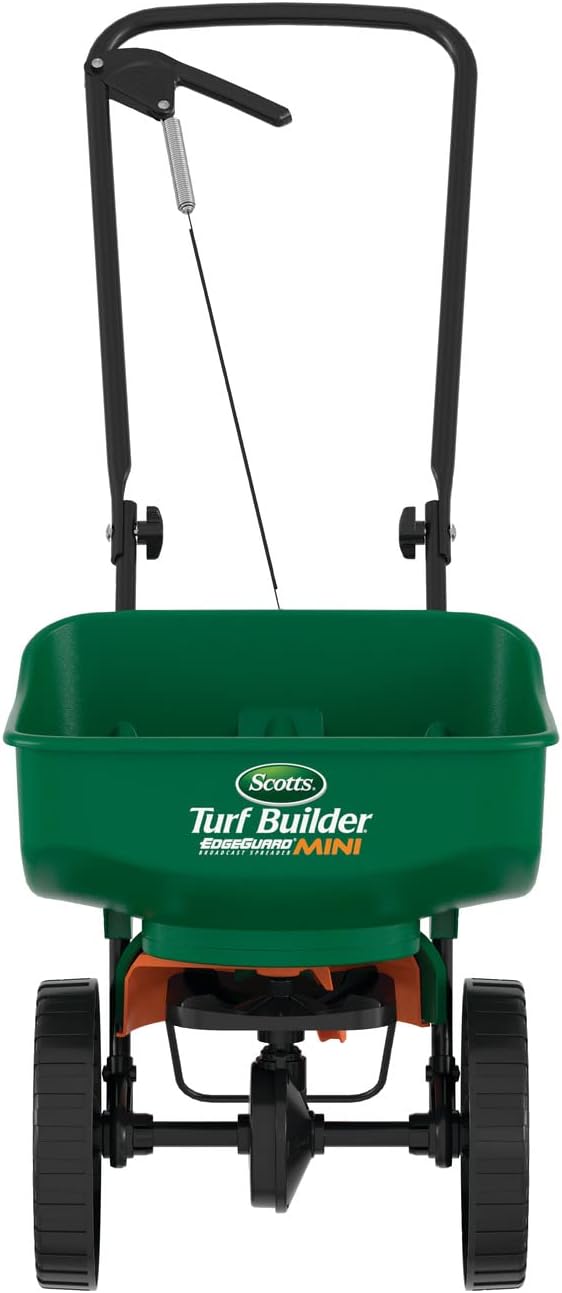
| Capacity | Up to 5,000 sq. ft. |
|---|---|
| Usage | Applies fertilizer, seed, granular weed control, salt, ice melt |
| Features | EdgeGuard side shield; dual-bladed agitator; fold-down handle |
The Scotts Turf Builder EdgeGuard Mini is a ready-to-use broadcast spreader aimed at smaller lawns and targeted spot work. It comes pre-calibrated so you set the dial to the recommended setting, pour in fertilizer, seed, ice melt, or granular weed control, and walk the lawn for even coverage. The hopper and dual-bladed agitator are redesigned to funnel product smoothly and reduce clogging, while open-spoke wheels and a fold-down handle make it easy to maneuver and store. Scotts' EdgeGuard feature blocks product on the right side of the pattern, which helps avoid deposits on sidewalks and landscape beds when edging. Capacity is geared to yards up to about 5,000 sq ft, so it handles typical small properties without being bulky. The main limitations are its smaller coverage area and basic mechanical design compared with larger, more precise spreaders, so it may require more passes on bigger lawns and offers fewer fine-control adjustments for professional users.
Best for: Buyers who want a simple, reliable spreader for small to medium yards and who prioritize ease of use and avoiding overspread onto hard surfaces.
Less Ideal for: Professional landscapers or owners of large properties who need higher capacity and finer control should consider larger commercial-style spreaders.
- Pre-calibrated and ready to use for quick setup
- EdgeGuard side shield reduces product on driveways and sidewalks
- Redesigned hopper and dual-blade agitator for consistent flow
- Fold-down handle and compact size for easy storage and maneuvering
- Smaller capacity suited for lawns up to about 5,000 sq ft so larger lawns need more refills or a larger spreader
- Limited fine adjustment compared with premium or professional models
Verdict: A user-friendly mini broadcast spreader that delivers even coverage for small lawns while keeping product off sidewalks and driveways.
Choosing the Right Lawn Weed and Feed Garden Spreader: Key Factors to Consider
Spread Pattern Consistency
How uniformly granules are distributed matters because uneven coverage leaves patches that either remain untreated or receive double application. Walk-behind spreaders that broadcast too wide without even overlap create streaks at the edges while narrow patterns increase pass count and time.
Look for spreaders with controlled broadcast geometry or adjustable cones that allow you to narrow or widen the pattern to match buffer strips, borders, and obstructions. A consistent pattern reduces rework and helps maintain the correct product application rate across the lawn.
Hopper Capacity and Refill Ease
Hopper size determines how often you stop to refill, which directly affects efficiency on larger lawns. Too-small hoppers increase interruption and can lead to inconsistent application as operators rush to finish passes.
Also evaluate the hopper opening shape and whether the design resists bridging of damp or irregular granules. Wide, tapered openings and integrated agitators reduce clogs and make refills faster, which is especially useful when applying heavier weed-and-feed granules.
Adjustment Precision and Calibration
Different weed-and-feed products recommend specific spreader settings. A precise, repeatable adjustment mechanism lets you match those recommendations so you apply the correct rate. Coarse or ambiguous setting markings make it hard to calibrate, leading to over- or under-application.
Choose a spreader with clear, numerical settings and a mechanism that locks in place. Being able to fine-tune output helps when treating mixed lawn zones or when following a product label that lists narrow application windows.
Build Durability and Weather Resistance
Spreaders are stored in sheds and used in dirty, wet conditions. Components that corrode or crack shorten a tool's useful life. Durable materials for the hopper, frame, and agitation parts mean fewer failures during the season.
Consider UV-stable plastics, rust-resistant metals, and sealed or protected linkages. Durable construction also preserves calibration-bent axles or loose mounts change distribution patterns and require repair or replacement.
Towing Stability and Wheel Design
Wheel diameter, tread, and axle mounting affect how steadily a spreader tracks across uneven lawns. Small wheels sink or trip on rough turf and make output inconsistent because the gearbox speed varies with wheel slip.
Larger, pneumatic or treaded wheels roll more smoothly and maintain steady feed rates. Sturdy axle mounts reduce wobble and help the operator maintain straight passes, which matters for even product distribution along borders and stripes.
Clog Resistance and Agitation System
Granular weed-and-feed formulations often differ in size and flow characteristics; some bind together when moist. A spreader with an effective agitation system or anti-bridging hopper shape reduces jams and keeps application steady.
Active agitators, sloped hopper walls, or integrated scrapers at the discharge point help granules flow even when humidity is high. Reliable agitation saves time and prevents pauses that can create overlapping passes or untreated lines.
Matching Spreader Style to Lawn Size
Different spreader styles suit different property sizes. For small urban lawns a handheld or compact walk-behind model can be nimble and fast to store. Mid-size yards often benefit from moderate hopper capacity and wider broadcast patterns to limit the number of passes.
For larger properties, tow-behind or higher-capacity walk-behind spreaders save time by covering more ground with fewer refills. When choosing for a larger area, balance hopper capacity against the machine weight and how easy it is to calibrate while it is loaded.
- Small lawns: prioritize maneuverability and easy storage.
- Medium lawns: balance capacity with adjustable spread width.
- Large lawns: larger hoppers and stable towing deliver efficiency.
Calibrating Your Spreader Before Application
Calibration ensures you apply the product rate listed on the weed-and-feed label. Start by checking the manufacturer setting ranges, then perform a small test run over a measured distance and collect the granules to confirm output. Adjust settings incrementally until the measured amount matches the label rate.
Repeat calibration if you change ground speed, hopper fill level, or granule type. Small changes in wheel rotation speed or granule size can change output, so periodic checks during a single job help maintain accuracy.
- Measure a test strip and collect granules for accurate calibration.
- Recalibrate when switching products or when hopper level changes significantly.
Handling Borders, Lawns with Obstacles, and Tight Corners
Edges, flower beds, and driveways require special handling to prevent drift and accidental product placement. Narrow the spread pattern when you approach borders and make overlapping passes at a controlled pace to avoid streaks. Some spreaders include a drop-shield or side deflector to limit broadcast spread near sensitive areas.
When working around obstacles, plan a route that reduces abrupt turns and lets you keep a constant ground speed. For tight corners, stop the broadcast and apply carefully by hand or with a focused setting to avoid product landing on hard surfaces where it can wash away.
- Use narrowed settings or deflectors near garden beds.
- Maintain steady walking speed for consistent output near obstacles.
Maintaining and Storing Lawn Spreader Equipment
After use, empty any remaining granules and brush the hopper and discharge area to remove dust and residue. Moisture left in contact with fertilizer can corrode metal parts or cake inside the hopper. Rinse lightly if needed, but allow full drying before storage.
Store the spreader in a dry, sheltered spot out of direct sunlight if possible. Periodically inspect linkages, the agitator, and wheels for wear, and re-torque fasteners to keep calibration stable across seasons.
- Empty and clean hopper after each use.
- Dry before storing to prevent corrosion and caking.
- Check fasteners and moving parts seasonally.
Environmentally Mindful Application Practices
Avoid applying weed-and-feed products directly before heavy rain, steep slopes, or near storm drains to reduce runoff risk. Targeted application and correct rates protect waterways and reduce the amount of product used overall.
Use spreader settings that minimize off-target distribution and consider trimming grass height and mowing patterns to improve uptake so you need fewer repeat applications.
- Check weather forecasts and avoid applications before heavy rain.
- Reduce drift near water features and paved areas with deflectors.
How We Chose the Best Lawn Weed and Feed Garden Spreader
We focused on practical, garden-centered attributes that determine whether a spreader will deliver weed-and-feed granules cleanly and consistently across a lawn. Key evaluation criteria included spread pattern consistency to measure how evenly granules land across a walk, hopper capacity and refill convenience for uninterrupted work, and adjustment precision for matching manufacturer application rates. We also looked at material durability and resistance to common garden stresses like moisture and abrasion, plus axle and wheel design that affect towing stability and calibration retention on uneven turf. Products were excluded if they lacked meaningful adjustment settings for granular fertilizers or if the hopper and agitation design encouraged bridging and clogging. We avoided items that are functionally single-use or that require aftermarket modifications to meet standard application rates. The final list emphasizes spreaders that balance dependable distribution, easy calibration, and build features that hold up to typical lawn-care seasons.
FAQ
How often should I calibrate my spreader?
Calibrate before each full application and after any setting changes, product switches, or significant changes in hopper fill level. Rechecking mid-job is wise for long runs or when using unfamiliar granules.
Can I use one spreader for different granular lawn products?
Often you can, but different granules flow differently. Clean the hopper between products and recalibrate for each product to match the recommended application rate and prevent cross-contamination.
What ground speed should I maintain while applying weed-and-feed?
Maintain a steady, comfortable walking pace so wheel rotations and feed rates remain uniform. Too fast a pace reduces applied grams per square meter while too slow can overapply unless you adjust the setting accordingly.
Is it necessary to empty the hopper after each use?
It is recommended to empty the hopper to prevent moisture caking and corrosion risks. If you must store product in the spreader, keep it dry and cover the hopper to limit humidity exposure.
How do I avoid streaks along the edges of my lawn?
Narrow the spread pattern near edges, use a deflector if available, and overlap passes slightly. Walk a consistent line and avoid sudden speed changes when entering or leaving the border area.
Final Verdict
Pick a spreader that matches your lawn size and the typical granule types you use. Prioritize even spread pattern, reliable adjustment settings, and a hopper that resists bridging to reduce rework and maintain correct application rates. Balance capacity against maneuverability so you do fewer refills without compromising calibration. Ultimately, focus on devices that make calibration and maintenance straightforward. That approach delivers consistent coverage, reduces waste, and helps your lawn respond predictably to weed-and-feed treatments.
