

Note: This article contains affiliate links. If you click on these links and make a purchase, I may earn a small commission at no extra cost to you. This helps support my research and content. Read my full affiliate disclosure here.
Picking the right circular garden sprinkler affects how evenly your lawn, flower beds, or vegetable patch gets water and how much time you spend babysitting irrigation. The right sprinkler delivers a consistent arc, lets you set radius and pattern quickly, and holds up to repeated outdoor use. This guide shortlists seven top circular garden sprinklers suited for typical yards and small-acreage plots. We evaluate each on spray control, build durability, ease of setup, and watering efficiency so you can decide which type will fit your planting layout and watering schedule. Read on to compare the features that matter in real garden conditions.
Top Picks at a Glance
| Best Overall The best all-around choice for most situations | Orbit H2O-Six Gear-Drive Sprinkler on Metal T-Spike |  |
| Best Quality Built to a higher standard if you want something more solid | Orbit 3-Arm Metal Lawn and Garden Sprinkler with Wheeled Base |  |
| Best Value The sweet spot between price and what you get | Rocky Mountain Goods Rotary Circle Sprinkler (plastic) |  |
| Best Budget The cheapest option that still gets the job done reliably | SYOOY 360° Metal Spot Sprinkler (Circular) |  |
| Highest Rated A top-rated pick with lots of positive feedback | QWORK 2-Pack 360° Metal Spot Sprinkler |  |
| Most Popular A crowd favorite that many people choose with confidence | Kadaon 360° Rotating Lawn Sprinkler |  |
| Best Seller A high-volume bestseller chosen again and again | Joeys Garden 360° Rotary Lawn Sprinkler with Weighted Base |  |
Orbit H2O-Six Gear-Drive Sprinkler on Metal T-Spike

| Maximum Pressure | 65 psi |
|---|---|
| Material Type | Metal, Plastic |
| Included Components | Sprinkler only |
| Number of Packs | 1 |
The Orbit H2O-Six Gear-Drive Sprinkler is a practical spike-mounted sprinkler built for covering large lawns and landscaped areas. It connects to a standard hose and stakes into the ground on a metal T-spike for a stable, ready-to-use setup. The sprinkler offers six selectable spray patterns and an adjustable collar plus a four-position diffuser so you can fine-tune arc and distance from partial coverage to a full 80-foot diameter circle. The gear-drive head runs quietly and the flow-through outlet lets you daisy-chain additional sprinklers for even wider coverage. Construction mixes metal and durable plastic for reliable outdoor use, and the head adjustments require no tools which makes repositioning and pattern changes fast. It does rely on water pressure rather than a timer or automation, so you will need to manage watering schedule externally and performance depends on your home supply pressure. For homeowners who want a dependable, low-maintenance sprinkler for large areas, this model delivers predictable coverage and straightforward controls.
Best for: Homeowners who want a reliable, easy-to-use sprinkler to cover large lawns and landscaped zones without complicated setup or frequent maintenance.
Less Ideal for: People who need automated timing, smart controls, or precise micro-irrigation for small planting beds should consider alternatives tailored to those needs.
- Six spray patterns and adjustable collar provide flexible arc and distance control
- Gear-drive head operates quietly for low-noise watering
- Metal T-spike offers stable, tool-free setup and easy repositioning
- Flow-through outlet allows connecting multiple sprinklers to extend coverage
- No built-in timer or automation so scheduling must be handled separately
- Performance depends on household water pressure and may not reach advertised radius if pressure is low
Verdict: A straightforward, durable gear-drive spike sprinkler that delivers flexible, quiet coverage for large lawns when you want a low-maintenance, dependable solution.
Orbit 3-Arm Metal Lawn and Garden Sprinkler with Wheeled Base

| Material Type | Metal |
|---|---|
| Maximum Flow Rate | 1 liters per minute |
| Item Type Name | Metal 3-Arm Sprinkler with Wheeled Base |
The Orbit 3-arm metal sprinkler is a simple, durable option for watering small yards, gardens, and flowerbeds. It uses three spinning arms to create a gentle, rotating spray that can cover up to about a 24 to 50 foot diameter depending on water pressure and nozzle adjustments, giving even, full-circle coverage without blasting delicate plants. The wheeled base makes it easy to move the sprinkler between zones and position it precisely, and the swivel hose connector simplifies hookup. Construction from metal with a corrosion-resistant finish helps it tolerate outdoor use season to season. Adjustments via deflectors and diffuser screws allow you to fine tune spray distance and pattern for efficient coverage. The unit is straightforward to use and low maintenance, but it lacks advanced features like timers, variable speed controls, or a tripod for uneven terrain, so it works best as a manual, portable solution rather than part of an automated irrigation system.
Best for: Homeowners with a small yard or garden who want a robust, easy-to-move sprinkler that delivers even, gentle coverage and straightforward manual control.
Less Ideal for: People who want an automated, programmable irrigation setup or need heavy-duty coverage for large lawns should consider systems with timers or larger rotor heads.
- Durable metal construction with corrosion-resistant finish for season-to-season use
- Three-arm rotary spray produces gentle, even full-circle watering suitable for plants and lawns
- Wheeled base allows quick repositioning across a small yard without lifting
- Adjustable deflector and diffuser screws let you control spray distance and pattern
- No built-in timer or automation features so watering must be scheduled manually
- Not designed for very large lawns or precise sector watering without additional accessories
Verdict: A tough, easy-to-move metal rotary sprinkler that provides gentle, even coverage ideal for small yards and garden beds.
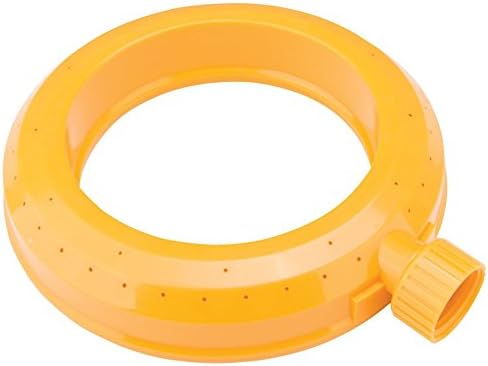
Rocky Mountain Goods Rotary Circle Sprinkler (plastic)
| Material Type | Plastic |
|---|---|
| Maximum Flow Rate | 2 gpm |
| Style Name | Rotary |
This rotary circle sprinkler is a basic, budget-friendly option for watering new sod and medium-sized lawns. Made from high-impact plastic, it is lightweight and easy to move so you can position it where young grass needs the most attention. The sprinkler throws water up to about 30 feet across, producing a fixed, consistent spray pattern that helps establish even moisture without complicated settings. It is rated to run with both low and high household water pressure and has a modest maximum flow rate of 2 gpm, which helps keep water use reasonable. Because it is a straightforward rotary head with no adjustable diffusers or multiple spray modes, you trade advanced customization for simplicity and reliability. Expect good performance for regular coverage on a budget, but plan to reposition it for irregular lawn shapes or to avoid overwatering in one spot.
Best for: Homeowners laying or caring for new sod who want an inexpensive, no-frills sprinkler that is easy to move and use regularly.
Less Ideal for: People with large or unusually shaped lawns who need adjustable spray patterns or automated coverage should consider more versatile sprinkler heads or timed systems.
- Covers up to 30 foot diameter suitable for establishing new sod
- High-impact plastic resists outdoor wear while keeping cost low
- Works with low and high household water pressure for flexible use
- Fixed spray style with no adjustable patterns limits fine-tuning of coverage
Verdict: A low-cost, easy-to-use rotary sprinkler that reliably wets new sod across a roughly 30-foot area without fuss.
SYOOY 360° Metal Spot Sprinkler (Circular)

| Material Type | Metal |
|---|---|
| Maximum Pressure | 71.12 psi |
| Inlet Connection Size | 0.75 inches |
| Coverage | Up to 30ft diameter |
The SYOOY 360° metal spot sprinkler is a compact, all‑metal sprinkler head that converts a standard garden hose into a fountain‑style 360‑degree emitter for spot watering. You set it in the lawn or garden and control coverage by water pressure and placement rather than fiddly adjustments. Built from zinc alloy, it is more durable than plastic heads and intended for outdoor exposure. It produces an even, circular spray that is well suited to patchy turf, new seed, flower beds, and patios where you need gentle, water‑saving coverage. Installation is straightforward: attach the 0.75‑inch inlet to a standard hose and vary pressure to change radius. Limitations include no sector adjustment or pattern control and reliance on water pressure to set range, so it is not ideal for irregularly shaped beds or precision irrigation. Also it is a single head best used for small to medium areas rather than replacing a multi‑zone sprinkler system.
Best for: Buyers who want a low‑cost, durable, easy‑to‑use sprinkler for spot watering small lawns, seed patches, patios, or garden beds and prefer simple setup over adjustable features.
Less Ideal for: People needing precision watering for irregularly shaped beds, multi‑zone irrigation, or long‑distance coverage should consider adjustable or pop‑up sprinkler options.
- Heavy‑duty metal construction for better outdoor durability than plastic heads
- 360° circular spray provides even, fountain‑like watering for small patches
- Simple hose connection and no complex adjustments make setup fast
- Water‑saving gentle spray suitable for new seed and sensitive plants
- No adjustable spray sector or pattern control for irregular areas
- Range depends entirely on water pressure so coverage can vary
Verdict: A rugged, budget‑friendly metal spot sprinkler that delivers simple, even 360° watering for small lawns and garden patches.
QWORK 2-Pack 360° Metal Spot Sprinkler

| Material Type | Metal |
|---|---|
| Number of Packs | 2 |
| Maximum Pressure | 80 psi |
| Coverage Area | Up to 30 feet diameter |
This QWORK two-pack of metal 360-degree spot sprinklers is built for straightforward, reliable watering of small lawns and garden beds. Each unit screws onto a standard garden hose and delivers a circular spray pattern that can reach up to about 30 feet across depending on your water pressure. The heavy-duty metal construction and polished finish give these heads a durable feel that stands up to frequent outdoor use better than many plastic alternatives. Flow is adjustable through pressure control rather than complex dials, so setup is simple and predictable for routine irrigation tasks. Because they are basic mechanical sprinklers with no timers or oscillating parts, they are low maintenance and less likely to fail season after season. Limitations include dependence on consistent water pressure for full coverage and a less precise spray adjustment compared with multi-setting plastic sprinklers, so you may need to test placement and pressure to avoid overwatering close plants. For a no-fuss, long-lasting solution to water small lawns or grouped planting areas, these perform well.
Best for: Homeowners who prioritize dependable, low-maintenance watering for small lawns or grouped garden beds and want a durable metal sprinkler they can set-and-forget.
Less Ideal for: Gardeners who need programmable timing, precise spray patterns for delicate plants, or coverage across irregularly shaped large lawns should look for automated or multi-pattern systems instead.
- Heavy-duty metal construction for greater durability than typical plastic heads
- 360-degree circular pattern offers wide, even coverage up to about 30 feet
- Simple hose-thread hookup works with standard garden hoses for easy installation
- Two-pack provides coverage for multiple zones or a spare replacement
- Coverage and spray intensity depend heavily on household water pressure
- Limited fine-tune spray control compared with multi-pattern sprinklers
Verdict: A rugged, low-maintenance metal spot sprinkler pair that reliably covers small lawns when you need straightforward, durable irrigation.
Kadaon 360° Rotating Lawn Sprinkler

| Material Type | Acrylonitrile Butadiene Styrene Plastic |
|---|---|
| Maximum Pressure | 60 psi |
| Maximum Flow Rate | 5 liters per minute |
| Inlet Connection Size | 4 inches |
This compact Kadaon rotating sprinkler uses a three-arm ABS plastic head to deliver adjustable 360 degree coverage for lawns, vegetable beds, and playtime with kids. It connects to a standard 3/4-inch garden hose thread and is plug-and-play; tightening the inlet gives a secure connection and you can change nozzle patterns and arm angle to vary water density and range. At typical household pressures it claims to cover roughly a 24 to 49 foot diameter depending on pressure and nozzle setting, so it is useful for watering medium patches without constant repositioning. The lightweight plastic body keeps cost and maintenance low, but it also means the unit can shift or tip on uneven ground and will not be as durable as metal sprinklers. Performance is pressure-dependent, so results vary by your faucet pressure and pipe setup. For buyers who want an inexpensive, easy-to-install circular sprinkler for routine watering or casual lawn play, this delivers straightforward functionality, while those needing heavy-duty longevity or professional irrigation control should look elsewhere.
Best for: Buyers who want a simple, low-cost circular sprinkler to water small to medium lawns or garden beds and who value ease of setup and straightforward operation backed by common user experience.
Less Ideal for: People seeking a heavy-duty, professional-grade irrigation head or precise programmable watering for large landscapes should consider more robust or automated systems.
- 360 degree rotating head with adjustable nozzle patterns for varied water density and coverage
- Standard 3/4-inch hose inlet for direct, adapter-free connection to common garden hoses
- Lightweight ABS construction makes it inexpensive and low maintenance
- Designed to cover medium areas at normal household pressures, reducing the need to move the sprinkler frequently
- Plastic construction is less durable and can move or tip on uneven ground
- Effective range and uniformity depend strongly on household water pressure
Verdict: A budget-friendly, easy-to-install rotating sprinkler that delivers adjustable circular coverage for small to medium lawns and casual use.
Joeys Garden 360° Rotary Lawn Sprinkler with Weighted Base

| Material Type | Plastic |
|---|---|
| Maximum Pressure | 80 psi |
| Inlet Connection Size | 0.5 inches |
| Number of Packs | 1 |
This Joeys Garden rotary sprinkler spins three adjustable arms through a true 360 degree rotation to deliver even coverage across round or irregular lawns. It connects to a standard garden hose with a screw-on 0.5 inch inlet and is built from ABS plastic with a weighted base so it stays put on grass, patio, or gravel even at higher household water pressures. The spray arms are adjustable for range and pattern and you can daisy-chain multiple units to cover larger properties. Typical use is simple: attach to a hose, set arm angles for desired reach, and place in the center of the area to avoid dry strips common with oscillating heads. Practical benefits include easy, tool-free setup, steady placement without staking, and scalable coverage by linking units. Limitations are that plastic construction may not match metal units for extreme longevity and performance depends on sufficient home water pressure for maximum distance.
Best for: Buyers who want a reliable, easy-to-use sprinkler that delivers even coverage and can be expanded across larger lawns without complicated setup.
Less Ideal for: Those seeking a heavy-duty commercial-grade metal sprinkler or users with very low water pressure who need specialized low-pressure irrigation solutions.
- True 360° rotary action for even coverage with fewer dry strips
- Weighted base helps unit remain stable on grass, patio, or gravel
- Standard screw-on 0.5 inch hose connection for tool-free setup
- Adjustable arms let you control spray distance and pattern
- Can be daisy-chained to expand coverage for larger areas
- Plastic ABS construction is less durable than metal alternatives
- Performance relies on steady household water pressure for best range
Verdict: A simple, stable rotary sprinkler that delivers consistent 360° coverage and is easy to set up and expand for larger yards.
Choosing the Right Circular Garden Sprinkler: Key Factors to Consider
Spray Pattern and Arc Consistency
How a sprinkler distributes water across its circular sweep directly affects plant health and lawn uniformity. Look for models that maintain a consistent arc at different water pressures so the outer edge does not get underwatered while the center is overwatered.
Arc consistency also reduces the need to move the sprinkler frequently and minimizes wet spots that invite fungal problems. For mixed plantings, the ability to narrow or widen the arc helps avoid spraying non-target areas like paths or patios.
Radius and Flow Adjustability
A circular sprinkler should let you change the spray radius and flow without complicated tools. Being able to dial back the radius is useful for small lawns or raised beds, while full reach is helpful for larger areas. Some designs use a flow control knob, others adjust via lever or nozzle settings.
Adjustability matters because household water pressure fluctuates. A sprinkler that performs well across a range of flows will give predictable coverage whether you are using a timed faucet or a low-pressure system.
Material Quality and Weather Resistance
Materials determine how long a sprinkler survives outdoor exposure. All-plastic units are lightweight and inexpensive but can become brittle in strong sun and cold. Metal components in high-wear areas, like the nozzle or connector, extend life if they are corrosion-resistant.
Seals and moving parts should tolerate sand and calcium buildup common in garden water supplies. A unit with replaceable nozzles or a simple maintenance path will last longer in real garden use.
Stability and Mounting Options
A sprinkler that tips or shifts will create uneven coverage and waste water. Look for stable bases or stakes that hold the head steady on turf, compacted soil, or loose mulch. Some circular sprinkler heads have low profiles for lawn use, while others include spikes for flower beds.
Consider how you plan to move or store the sprinkler. A compact, stake-mounted design is easy to reposition, while a broader base performs better on uneven ground. Mount compatibility with standard hose fittings avoids extra adapters.
Clog Resistance and Maintenance
Garden water often carries sediment that can block nozzles. Sprinklers that have larger or easily cleanable openings, integrated filters, or simple disassembly reduce downtime. Regular flushes are part of good maintenance, but designs that tolerate occasional grit will save time.
Ease of access to the nozzle and simple replacement parts make seasonal cleaning straightforward. Consider whether the sprinkler needs tools to service or if basic hand maintenance will suffice.
Coverage Efficiency and Water Use
Efficient distribution reduces runoff, puddling, and water waste. Circular sprinklers that deliver evenly spaced droplets and avoid heavy jets cut water use while delivering adequate soil infiltration. Spray height and droplet size affect evaporation loss on hot, windy days.
For water-restricted areas, choose a model that can operate effectively at lower flows and still produce uniform coverage. Timers and controllers are separate tools, but a sprinkler that behaves predictably with reduced flow is essential for efficient irrigation.
Matching Sprinkler Reach to Garden Layout
Measure the longest radius you need before choosing a sprinkler. A sprinkler that covers too large an area forces you to overlap passes or reduce flow, which can create uneven moisture levels. Map plant beds, lawn edges, and paths to identify where partial arcs or adjustable stops are necessary.
Think about fixed obstacles such as trees, sheds, or patios. Some circular heads allow stop points so you can avoid spraying impervious surfaces. If you have narrow strips of grass, consider using smaller radius settings or repositioning more frequently to prevent overspray.
- Sketch the area and mark the maximum radius needed
- Note obstacles that require partial arcs
- Plan overlap to avoid dry spots without excessive double-watering
Pressure Considerations and Practical Flow Tips
Household water pressure has a big effect on how the sprinkler performs. If your pressure is low, you may not reach the advertised radius and the pattern can become spotty. A flow control or adjustable nozzle helps compensate for these differences without constant supervision.
If you have multiple valves or other irrigation devices on the same line, run the sprinkler alone during a test to get a true sense of its reach. Small adjustments to the faucet or a pressure regulator can bring a marginal head into useful range.
- Test sprinkler alone to establish baseline radius
- Use flow control to fine-tune reach at the faucet or head
- Consider a pressure regulator if pressure swings are common
Seasonal Care and Winter Storage
Empty and dry the sprinkler before storing for winter to prevent freeze damage. Disassemble any removable nozzles and store small parts in a labeled bag. Clean out sediment from the base and connectors to prevent corrosion and blockages next season.
During the watering season, check for wear on moving parts and replace worn seals. Lubricate pivot points if recommended by the manufacturer to keep the arc smooth and predictable.
- Flush and dry before winter storage
- Store small parts together and label them
- Inspect seals and pivot points annually
Best Practices for Even Watering
Avoid running any single sprinkler for too long on one spot if that creates visible runoff. Shorter cycles with multiple passes often improve infiltration, especially on compacted soils. Rotate sprinkler positions to average out minor inconsistencies in pattern.
Combine the sprinkler with soil moisture checks. A simple screwdriver test or a moisture meter will tell you whether coverage is adequate at root depth rather than relying on surface wetness alone.
- Use multiple short cycles instead of one long soak
- Rotate positions for even coverage
- Check soil moisture at root depth
Integrating With Timers and Automated Systems
Circular sprinklers work well with basic timers, but automation highlights the need for reliable radius control. When a timer runs a sprinkler unattended, any mismatch between the set radius and the area will be multiplied over days and weeks. Confirm settings manually before leaving the system automated.
If you plan to automate, test cycles during different times of day. Morning watering reduces evaporation losses and gives a consistent baseline for performance comparisons.
- Confirm manual settings before automating
- Prefer morning runs to reduce evaporation
- Monitor initial automated cycles and adjust as needed
How We Chose the Best Circular Garden Sprinkler
We focused on features that matter when you need reliable circular irrigation across lawns, beds, and informal planting areas. Primary evaluation criteria were spray pattern control, build materials and durability, adjustable radius and flow range, ease of setup and adjustment, and water efficiency in typical home garden conditions. Each product had to demonstrate clear radius adjustment and consistent arc delivery across multiple flow rates to be considered. We excluded specialty or institutional irrigation gear designed for commercial farms, permanently installed in-ground systems, and devices that only produce non-rotary or mist-only outputs. We also excluded items that require proprietary mounts or adapters that limit compatibility with standard hose fittings. Our editorial filters emphasized real-world gardener concerns: how reliably a sprinkler holds its set arc, whether it resists clogging and weathering, and how simple it is to tune radius and pattern without tools. Warranty and manufacturer materials information were considered where available but only as supporting context rather than decisive proof of performance.
FAQ
How do I choose the right radius for a circular sprinkler?
Measure the distance from the water source to the farthest point you want watered, then pick a sprinkler that can cover that radius or slightly more. If your layout has obstacles, choose one with adjustable stops so you can limit overspray.
Will low water pressure affect a circular sprinkler?
Yes. Low pressure reduces reach and can break up the spray pattern. Choose a sprinkler that performs acceptably at lower flow rates or install a flow control to tune the radius for your available pressure.
How often should I clean my sprinkler nozzles?
Clean nozzles at least once per season and more often if your water has visible sediment. Regularly flushing the hose before connecting also reduces debris buildup and helps maintain even coverage.
Can a circular sprinkler be used on mulched beds?
Yes, but watch for splash and displacement of mulch from strong jets. Use a lower flow or narrower radius to reduce soil disturbance and avoid spraying directly onto plant crowns.
Is a spike-mounted sprinkler better than a base-mounted one?
It depends on the surface. Spike-mounted heads are easier to position in beds and hold steady in soft ground. Broad base-mounted units are more stable on turf and uneven surfaces. Choose based on where you will use the sprinkler most.
How do I prevent runoff when using a circular sprinkler?
Use shorter watering cycles and allow time for infiltration between passes. Reduce flow or lower the spray height to improve droplet penetration into the soil and avoid creating puddles on slopes or compacted areas.
Final Verdict
When choosing a circular garden sprinkler, prioritize consistent spray pattern control and the ability to adjust radius for your specific planting layout. Durable materials and simple maintenance are next in importance because they determine how the sprinkler performs season after season. Balance reach against stability and water efficiency: a model that you can tune to your water pressure and garden shape will save time and reduce waste. Use the evaluation criteria above to match a sprinkler to your routine and landscape so you can water effectively with minimal fuss.
