

Note: This article contains affiliate links. If you click on these links and make a purchase, I may earn a small commission at no extra cost to you. This helps support my research and content. Read my full affiliate disclosure here.
Water runs downhill, and on a slope that simple fact changes how you irrigate. Choosing the right garden sprinkler for sloped lawn affects how evenly water soaks in, how much runoff you cause, and how healthy the turf and plants stay. In this guide we shortlisted six top-rated options designed to manage spray control, coverage, and efficiency on inclines. Below you will find a practical look at features that matter for sloped sites, how the shortlisted sprinklers perform on spray pattern and water delivery, and the tradeoffs to expect when minimizing runoff versus maximizing coverage.
Top Picks at a Glance
| Best Overall The best all-around choice for most situations | Orbit Tripod Zinc Impact Sprinkler (56667) |  |
| Best Quality Built to a higher standard if you want something more solid | Hourleey Brass Impact Sprinkler with Adjustable Tripod Base |  |
| Best Value The sweet spot between price and what you get | Melnor MiniMax Turbo Oscillating Sprinkler with Metal Spike |  |
| Highest Rated A top-rated pick with lots of positive feedback | NexLogi Heavy-Duty Pulsating Impact Lawn Sprinkler (Metal Base) |  |
| Most Popular A crowd favorite that many people choose with confidence | Eden Weighted Essential Oscillating Sprinkler with Quick Connect Starter Set |  |
| Best Seller A high-volume bestseller chosen again and again | Aqua Joe Indestructible Metal Base Oscillating Sprinkler with 16 Clog-Resistant Nozzles |  |
Orbit Tripod Zinc Impact Sprinkler (56667)

| Material Type | Zinc |
|---|---|
| Maximum Pressure | 80 psi |
| Maximum Flow Rate | 1.8 gpm |
The Orbit Tripod Zinc Impact Sprinkler is a robust, elevated sprinkler built to cover wide lawns with a rotating impact head and adjustable tripod. You connect a standard garden hose, set the tripod height and spray arc, and the zinc impact head delivers a steady rotating spray that can reach long distances for up to a 90-foot diameter. Notable features include a clog-resistant impact mechanism that tolerates dirty or reclaimed water, a high-pressure nozzle for extended range, and an anti-backsplash arm and deflector for tuning spray pattern from partial to full circle. The all-metal zinc construction and adjustable 22 to 48 inch tripod make it stable and durable for repeated seasonal use. Limitations to consider are its single-stream flow rate, which is geared to long reach rather than fine misting or water conservation on small plots, and the tripod adds weight and footprint compared with compact ground sprinklers, so it is less convenient for frequent repositioning.
Best for: Homeowners with medium to large lawns who prioritize reliable, long-range coverage and durable construction for seasonal irrigation and minimal maintenance.
Less Ideal for: People with small yards, container gardens, or who need a low-flow or fine-misting sprinkler for delicate plants should choose a more compact, water-efficient option.
- Durable all-metal zinc impact head and tripod for long-term outdoor use
- Adjustable tripod height and spray arc for elevated, customizable coverage
- Clog-resistant impact design suitable for dirty or reclaimed water
- High-pressure nozzle capable of covering up to a 90-foot diameter
- Single high-flow nozzle favors long-range coverage over water-efficient fine spray
- Heavier and bulkier than low-profile ground or plastic sprinklers, making frequent moves more effort
Verdict: Choose this tripod impact sprinkler when you need durable, adjustable elevated coverage to water large lawns reliably and with long reach.
Hourleey Brass Impact Sprinkler with Adjustable Tripod Base

| Coverage radius | 20-35 FT |
|---|---|
| Connector | 3/4 inch US standard |
| Rotation | 0-360 degree |
| Max water pressure | 80 PSI |
This Hourleey impact sprinkler pairs a heavy brass sprinkler head with an adjustable tripod base to deliver flexible, reliable irrigation for lawns and garden beds. The head rotates freely from 0 to 360 degrees and has multiple nozzle adjustments to control spray distance and pattern, which makes it useful for spot watering or covering larger areas up to roughly a 20–35 foot radius depending on water pressure. The tripod extends from about 16 to 27 inches and locks in place, so you can raise the spray above low plants or lower it for shrubs and flower beds. A rubber filter O-ring helps keep debris out of the nozzle and the 3/4 inch standard connector fits most US garden hoses for quick setup. Construction uses brass for the head and alloy components for the stand, which improves corrosion resistance versus typical plastic sprinklers. The unit is practical for routine lawn watering but depends on your household water pressure for maximum reach and uses some plastic parts at the tripod joints that are less heavy duty than the brass head.
Best for: A homeowner who wants a reliable, easy-to-use sprinkler for regular lawn and garden watering and prefers durable metal components over all-plastic designs.
Less Ideal for: Gardeners who need precise low-pressure irrigation solutions or those seeking a fully commercial-grade metal stand for heavy daily use.
- Brass impact head offers durability and better corrosion resistance than plastic heads
- Adjustable 0–360 degree rotation and multiple nozzle settings for customizable coverage
- Tripod height adjusts to position spray above plants or lower for targeted watering
- 3/4 inch standard hose connector and rubber filter O-ring reduce nozzle clogging
- Spray distance depends heavily on water pressure and may not reach the advertised maximum with low household pressure
- Some tripod components use plastic or alloy parts that are less robust than the brass head
Verdict: A sturdy brass-headed impact sprinkler on an adjustable tripod that gives dependable, customizable coverage for typical home lawns and gardens.
Melnor MiniMax Turbo Oscillating Sprinkler with Metal Spike

| Maximum Flow Rate | 15 gpm |
|---|---|
| Material Type | Plastic |
| Coverage | 4,000 sq. ft. |
| Features | Dirt-Resistant Drive, 360° Adjustability, QuickConnect Set |
The Melnor MiniMax Turbo is a compact oscillating sprinkler built to give the control of a larger unit in a smaller footprint. It mounts on a metal step spike so you can position it quickly in new sod or garden beds and adjust width, range, and flow to match the area you need to keep moist. The sprinkler covers up to 4,000 sq. ft. and includes a 360 degree top that lets you redirect spray without moving the spike. Practical features include a dirt-resistant drive that tolerates grit in well water and a flow-through base so multiple units can be linked for continuous coverage. The QuickConnect starter set makes swapping hoses and tools fast. Expect reliable, customizable watering for establishing new sod, but be aware the unit is plastic-bodied so long-term durability will depend on care and storage; it also lacks fine mist settings for very delicate seedlings. For homeowners who want precise coverage and easy repositioning, this delivers sensible performance without unnecessary complexity.
Best for: Homeowners who want efficient, adjustable coverage to establish new sod and prefer tools that are easy to position and tune for different lawn shapes.
Less Ideal for: Gardeners needing a gentle mist for very young seedlings or those seeking an all-metal, heavy-duty permanent fixture for commercial use.
- Adjustable width, range, and flow for tailored watering of new sod
- Covers up to 4,000 sq. ft. so fewer units are needed for medium lawns
- Metal step spike holds the sprinkler steady in turf and beds
- Dirt-resistant drive keeps it operating reliably with gritty water
- Flo-through base and QuickConnect make linking and swapping hoses easy
- Primarily plastic construction that can degrade if left in sun or freezing conditions
- No very fine mist option for extremely delicate seedings or seedlings
Verdict: Choose this sprinkler if you want precise, adjustable coverage to get new sod established with minimal repositioning and easy hose hookups.
NexLogi Heavy-Duty Pulsating Impact Lawn Sprinkler (Metal Base)

| Maximum Pressure | 80 psi |
|---|---|
| Inlet Connection Size | 0.75 inches |
| Maximum Coverage | Up to 4,500 square feet |
The NexLogi heavy-duty pulsating impact sprinkler is a metal-built sprinkler for large lawns and gardens that delivers long-range, consistent coverage. It connects to any standard 3/4" garden hose and runs between about 20 and 80 PSI, using a brass nozzle and zinc-alloy head and base to resist rust and damage in outdoor conditions. You control the spray pattern with the flip clip and adjustable rings to set partial arcs or full 360° rotation, and a deflector shield plus diffuser screw fine-tunes distance and creates gentler spray for delicate plants. In practice it is best used on larger turf areas, vegetable plots, or broad flowerbeds where reliable, far-reaching distribution matters; the design minimizes leaks with a rubber gasket and is straightforward to set up. Limitations are that it is a mechanical, non-timed device so it requires a separate timer or manual control, and placement on uneven ground may need a stable mount to keep the head level for even coverage.
Best for: Gardeners who prioritize a durable, reliable sprinkler for large lawns or acreage and want a mechanical, adjustable head that holds up to regular outdoor use.
Less Ideal for: People who need smart controls, built-in scheduling, or a compact sprinkler for small patios and container gardens should consider other options.
- All-metal construction (brass nozzle and zinc-alloy head/base) for corrosion and impact resistance
- Adjustable spray angle from 20° to full 360° for targeted or full-lawn coverage
- Works with standard 3/4" garden hoses and includes rubber gasket for a leak-resistant connection
- Designed for long-range coverage up to 4,500 square feet at suitable pressure
- No built-in timer or automated scheduling; requires external timer or manual operation
- Performance depends on water pressure and even ground placement for uniform coverage
Verdict: Buy this if you need a rugged, metal pulsating sprinkler that reliably covers large lawns with adjustable long-range spray.
Eden Weighted Essential Oscillating Sprinkler with Quick Connect Starter Set

| Maximum Pressure | 60 psi |
|---|---|
| Maximum Flow Rate | 30 gpm |
| Nozzle Count | 16 precision nozzles |
| Coverage | Up to 3,600 sq. ft. |
The Eden Weighted Essential Oscillating Sprinkler delivers steady, even watering across mid‑to‑large lawns and garden beds up to about 3,600 square feet. It mounts on a weighted base so it stays put while a sealed turbo drive motor oscillates a bar with 16 precision nozzles for consistent spray distribution. Sliding range tabs let you limit how wide the spray is, and a built‑in nozzle cleaning tool helps clear clogs without disassembly. The included quick connect starter set and stainless steel filter washers simplify hookups and let you swap tools without shutting off the water. In practice this model is quiet, simple to position, and keeps water patterns uniform on level turf. Expect best results on relatively flat lawns where the coverage matches the stated footprint; very large properties will need multiple units or a different sprinkler type to avoid gaps. The unit is plastic, so durability under heavy seasonal use may lag behind metal alternatives, but the design and filters reduce maintenance and leaks for routine garden watering needs.
Best for: Buyers who want a reliable, easy‑to‑use sprinkler that produces uniform coverage for medium to large lawns and value social proof and low maintenance features when choosing a dependable product.
Less Ideal for: Not a great choice for very large estates or professional irrigation needs where metal, higher‑capacity, or multi‑zone systems are preferred.
- Even coverage from 16 precision nozzles for consistent watering patterns
- Weighted base provides stability during operation
- Adjustable range tabs allow precise area control to target lawns or beds
- Quick connect starter set and stainless steel filters simplify hookups and reduce leaks
- Built‑in nozzle cleaning tool makes maintenance fast and simple
- Plastic construction may wear faster than metal sprinklers under heavy seasonal use
- Coverage limited to about 3,600 sq. ft., so large properties may need multiple units
Verdict: A user‑friendly oscillating sprinkler that combines even coverage, a stable weighted base, and quick‑connect hookups for dependable mid‑sized lawn watering.
Aqua Joe Indestructible Metal Base Oscillating Sprinkler with 16 Clog-Resistant Nozzles
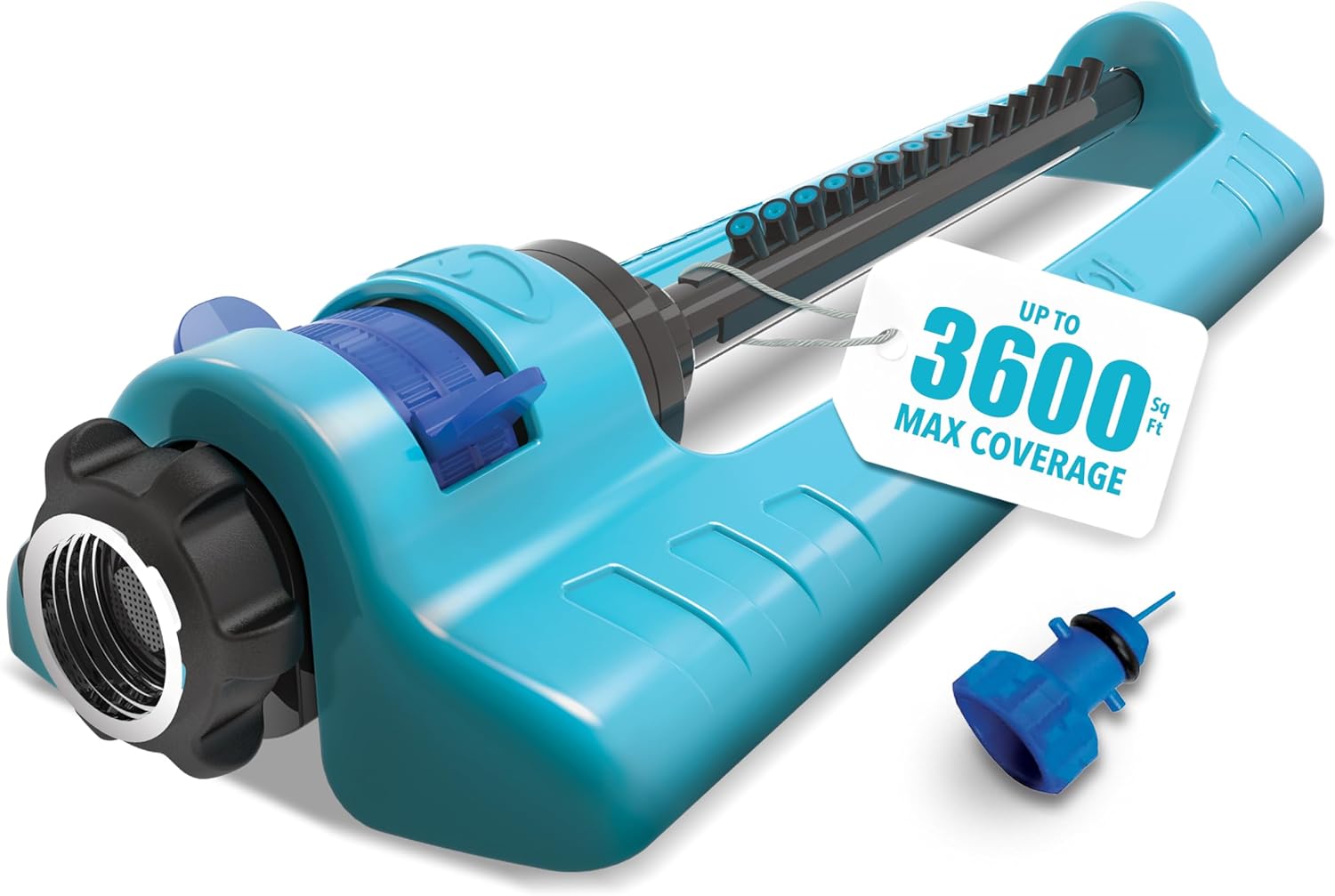
| Material Type | Metal |
|---|---|
| Maximum Pressure | 120 psi |
| Maximum Flow Rate | 6.65 gpm |
| Number of Nozzles | 16 |
| Coverage | Up to 3,600 sq ft |
This Aqua Joe oscillating sprinkler is a straightforward, durable option for watering medium to large lawns. It connects to a standard garden hose and the sealed turbo gear-driven unit powers a 16-nozzle bar that you can adjust for width and range, making it easy to target flower beds or sweep a broad lawn. The extra-large solid metal base gives the unit good stability on uneven ground and the built-in clean-out tool helps clear nozzle clogs without disassembly. Practical benefits include predictable, even coverage across up to roughly 3,600 square feet and a design meant to stand up to regular seasonal use. Limitations to note are that it is a manual, stationary sprinkler so it does not rotate or move on its own beyond the oscillation, and setup requires positioning and occasional adjustment to avoid overspray near sidewalks or flowerbeds. For most homeowners wanting a reliable, no-frills portable sprinkler, this model strikes a sensible balance of durability and performance.
Best for: Homeowners who want a dependable, no-fuss portable sprinkler that balances durability and flexible coverage for medium to large yards.
Less Ideal for: People seeking automated moving sprinklers, programmable timers, or very small container gardens where a compact rotary or drip system would be more appropriate.
- Solid metal base provides strong stability and durability in the yard
- 16 clog-resistant nozzles with built-in clean-out tool for consistent spray
- Sealed turbo gear-driven unit offers reliable performance season after season
- Adjustable width and range allow targeted coverage up to 3,600 sq ft
- Oscillating motion is fixed and does not self-translate to cover irregular shapes
- Requires manual positioning and adjustments to avoid overspray
Verdict: A durable, easy-to-use oscillating sprinkler that delivers reliable, adjustable coverage for most medium to large lawns.
Choosing the Right Garden Sprinkler for Sloped Lawn: Key Factors to Consider
Spray Pattern and Arc Adjustability
How you shape the spray matters more on a slope than on flat ground. Adjustable arcs let you avoid sending water straight down the incline where it will run off and collect at the bottom. Short, targeted arcs or sector control enable you to water uphill and level spots separately from steep sections.
Look for heads that allow fine control of the spray angle and distance. Being able to tighten the arc to a half-circle or a quarter-circle prevents overspray into paths and drainage channels, which reduces erosion and wasted water.
Flow Rate and Application Speed
Application rate determines whether water soaks in or flows off the slope. Slow, low-flow settings increase infiltration time and reduce runoff, particularly on compacted or clayey soils common in sloped yards. Adjustable flow valves or pulse settings help tailor application to soil type and incline steepness.
Consider sprinklers that let you reduce output without sacrificing droplet size. Smaller droplets risk drifting, but very large droplets can compact soil. The best choices offer a balance that allows slow, steady application for better absorption on slopes.
Anchor and Stability Options
Sprinkler heads that shift position will change coverage and create wet spots that promote erosion. On uneven ground, stake-mounted or weighted-base designs keep the device level and in the intended spot. Some units include ground spikes or tripod legs to brace against soft or rocky soil.
Evaluate how easy the unit is to reposition while still providing firm support. If you need seasonal adjustments, choose a design that installs and removes without disturbing turf or soil structure.
Coverage Pattern and Zone Overlap
Even coverage on a slope often requires different overlap strategies than on flat lawns. Because water trends downhill, overlap patterns should favor the upper edge of a zone and step downslope in stages to avoid pooling. Sprinklers with predictable, consistent throw distances make planning zones easier.
Think about how many devices you will need to prevent dry spots uphill and saturated areas downhill. Choosing heads with consistent distance and directionality reduces the number of adjustments during setup.
Materials, Corrosion Resistance, and Weathering
Sloped areas can retain moisture longer and experience more surface runoff contact. Materials that resist rust and UV degradation last longer in these conditions. Brass fittings, stainless fasteners, and UV-stable plastics reduce the chance of leaks or broken adjustments mid-season.
Inspect seals and moving parts for simple maintenance access. Parts that are easy to clean or replace extend effective life without requiring permanent alterations to irrigation infrastructure.
Ease of Setup and Adjustments
A sprinkler that is quick to position and tune will save time, especially when testing multiple placements on a slope. Color-coded adjustment points, simple flow controls, and clear distance markings speed the dialing-in process. If you plan to change settings with the season, look for tools-free adjustment features.
Ease of swapping between spray patterns or connecting to timers and hoses reduces barriers to experimenting with lower flow runs and staggered watering that help slopes absorb water effectively.
Planning Zones on a Sloped Lawn
Start by mapping the slope in segments by grade and soil type rather than treating the entire area as one zone. Small changes in incline or turf density can require different application rates. Place devices to favor the upper edge of each segment so water soaks into the higher ground before moving downhill.
Use short test runs to observe how much water infiltrates versus how much runs off. That observational step informs whether to slow application, add more fixtures with shorter throw, or change spray patterns for specific subzones.
- Mark high, mid, and low points and test each separately
- Plan for slightly greater overlap uphill to ensure infiltration
- Avoid pointing sprays directly down steep fall-line slopes
Techniques to Reduce Runoff
Stagger watering cycles on slopes to allow infiltration between shorter runs rather than one long application. Shorter, repeated cycles let the soil absorb more water and reduce surface flow.
Complement sprinkling with soil improvements like adding organic matter or aeration to increase infiltration. Even the best sprinkler setup benefits from soil that can accept water rather than shed it.
- Run two or three short cycles with rest periods in between
- Use lower pressure or flow settings during initial runs
- Combine sprinkling with selective hand-watering in problem spots
Best Placement Practices
Place sprinkler heads on contours where possible so the spray spreads across the slope rather than down it. Positioning at terrace edges or near flat pockets minimizes direct downhill spray paths.
Secure bases and check alignment after heavy rain or foot traffic. Small shifts can change coverage dramatically on a slope, so inspect and readjust early in the season and after extreme weather.
- Avoid placing heads at the topmost ridge if it directs water straight down
- Anchor tripods or stakes firmly in compacted soil for stability
- Reassess placement after the first few irrigation cycles
Integrating Sprinklers with Timers and Watering Schedules
Timers let you automate shorter cycles that cut runoff. Program multiple short runs for a single zone with gaps long enough to allow infiltration. Smart controllers that adjust based on weather are helpful but not necessary if you manually stagger cycles.
Tune schedules seasonally: cooler months need less frequent watering, while dry spells may require slightly longer or more frequent short runs. Monitor soil moisture rather than relying solely on fixed weekly schedules.
- Prefer multiple short cycles over one long soak on steep areas
- Adjust evening or morning times to reduce evaporation and wind drift
- Use soil moisture checks to refine run length
Maintaining Sprinklers on Uneven Ground
Routine checks prevent misalignment and leaks that create concentrated wet spots. Inspect seals and fittings for wear and clear debris from nozzles to maintain consistent spray patterns. On slopes, small clogs have outsized effects on coverage.
Keep spare gaskets and simple tools on hand for quick field repairs. Replace worn stakes or degraded anchors before they fail mid-season to avoid surprises during hot weather.
- Clean nozzles and screens at the start of each season
- Check anchor points after storms or heavy use
- Lubricate moving parts if the design recommends it
How We Chose the Best Garden Sprinkler for Sloped Lawn
We focused on attributes that directly affect irrigation on slopes rather than general lawn sprinkler marketing claims. Selection criteria included adjustable spray control and pattern versatility to limit overspray on downslope areas, water output control to slow application rate and improve infiltration on inclined soils, and head stability or anchoring to maintain consistent coverage on uneven ground. Durability and corrosion resistance were assessed because slope installations often require longer-term exposure to moisture and weather. Ease of setup and adjustment mattered for gardeners who need to fine-tune placement and run times on variable terrain. Finally we looked at compatibility with common hose and timer fittings so units fit into typical backyard irrigation systems. We excluded products that only function well on flat lawns, devices that require complex permanent plumbing changes, and heads with no meaningful control over spray arc or flow rate. The final list emphasizes practical performance metrics that matter on slopes: adjustable spray pattern, flow rate control, terrain stability, material durability, and ease of placement and tuning.
FAQ
Can I use a standard rotary or impact sprinkler on a steep slope?
You can use standard sprinklers, but they often need careful adjustment. Standard heads that lack fine arc and flow control tend to overspray downhill and create runoff. If you use them, dial down flow and run multiple short cycles to improve infiltration.
How many short cycles should I run instead of one long watering?
Usually two to three short cycles with 10 to 30 minute gaps is a good starting point. The exact number depends on soil type and slope steepness; sandy soils absorb faster, while clay soils need longer soak times between cycles.
Will lowering water pressure help prevent runoff on slopes?
Lowering pressure reduces throw and can improve infiltration by applying water more slowly. Too low pressure may create uneven coverage or large droplets that compact soil, so aim for a balance and test with short runs to confirm results.
Are popup sprinklers a good option for sloped lawns?
Popup sprinklers can work on gentle slopes when they offer adjustable arcs and flow control, and when their mounts remain level. On steeper or irregular slopes, stake-mounted or tripod units that can be precisely angled often perform better.
How should I handle runoff that still occurs despite adjustments?
Address runoff by breaking the zone into smaller sections, slowing application rates, and improving soil infiltration with aeration and organic matter. Adding terraces, swales, or small diversion channels can also redirect excess water away from vulnerable areas.
Does soil type change which sprinkler features I should prioritize?
Yes. Clay soils need slower application rates and better flow control to avoid pooling, while sandy soils require less overlap and absorb quicker. Choose sprinkler features that let you fine-tune flow and duration to match the soil's infiltration capacity.
Final Verdict
On sloped lawns the priority is managing application rate and direction so water soaks in where you need it instead of running downhill. Focus first on spray pattern control and flow adjustability, then secure placement and durable materials to maintain consistent coverage. Expect to trade off coverage area per head for finer control; using more heads with shorter throw often yields better results than trying to water large swaths from a single device. With the right balance of control, stability, and scheduling you can reduce runoff, protect turf health, and make irrigation on slopes reliable without major landscape changes.
