

Note: This article contains affiliate links. If you click on these links and make a purchase, I may earn a small commission at no extra cost to you. This helps support my research and content. Read my full affiliate disclosure here.
Choosing the right Benchmark leaf blower matters because yard cleanup is repetitive work that benefits from predictable power and comfortable handling. The wrong blower can leave wet leaves, strain your hands, or require multiple passes. This guide looks at shortlisted options that represent the best in this category, focusing on how they behave in real yards, patios, and driveways. We evaluate core priorities like airflow output, weight and ergonomics, and build durability so you can match a blower to the size and conditions of your outdoor space. Read on for practical guidance to narrow to the right blower for your cleanup needs.
Top Picks at a Glance
| Best Overall The best all-around choice for most situations | EGO POWER+ LB7654 765 CFM Cordless Handheld Leaf Blower with 5.0Ah Battery and Charger |  |
| Best Quality Built to a higher standard if you want something more solid | EGO Power+ LB8803-2 Cordless Handheld Leaf Blower with Two 56V 4.0Ah Batteries |  |
| Best Value The sweet spot between price and what you get | YOOVL Cordless Leaf Blower with Two 20V 5.2Ah Batteries and Charger |  |
| Best Budget The cheapest option that still gets the job done reliably | XIAOLANG CP-BF12 Cordless Handheld Turbo Leaf Blower with Two 4.0Ah Batteries |  |
| Highest Rated A top-rated pick with lots of positive feedback | NEO-TEC NTEB260 25.4cc Handheld Gas Leaf Blower |  |
| Most Popular A crowd favorite that many people choose with confidence | VIBOGEN HG0645 21V Cordless Handheld Leaf Blower with Dual 4.0Ah Batteries |  |
| Best Seller A high-volume bestseller chosen again and again | BLACK+DECKER LB700 7-Amp Corded Handheld Leaf Blower |  |
EGO POWER+ LB7654 765 CFM Cordless Handheld Leaf Blower with 5.0Ah Battery and Charger

| Power Source | Battery Powered |
|---|---|
| Voltage | 56 volts |
| Air Flow Capacity | 765 cfm |
| Noise Level | 64 db |
| Included Components | Blower, 5.0Ah battery, 320W charger, tapered and spread nozzles |
The EGO POWER+ LB7654 is a performance-focused cordless handheld blower built to replace small gas units for routine yard cleanup. It uses a brushless motor and turbine fan design to produce up to 765 CFM and airspeeds to 200 MPH, with a variable-speed dial for precise control and a turbo mode for heavy debris. It ships with a 56V 5.0Ah ARC lithium battery and a 320W charger, which EGO rates for long runtimes so you can clear driveways, lawns, and patios in one session without swapping packs. Notable practical benefits are the included tapered and spread nozzles for concentrated or wide airflow, relatively quiet operation compared with gas blowers, and brushless efficiency that reduces vibration. Important limitations are the handheld format, which concentrates weight in one hand during extended use, and that highest turbo output will drain the battery faster than midrange speeds. The blower is well suited to homeowners who want near-gas power without fumes and who value adjustable control for different cleanup tasks.
Best for: Buyers who prioritize power and runtime in a cordless handheld blower and want a gas-level performance replacement for routine yard cleanup.
Less Ideal for: Users who need a lightweight blower for very short tasks or who prefer backpack blowers for large properties and long continuous use.
- High maximum airflow (765 CFM) and up to 200 MPH airspeed for moving heavy, wet debris
- Variable speed dial plus turbo mode for matching power to the task
- Includes 56V 5.0Ah battery and 320W charger for long single-charge runtime
- Brushless motor for lower vibration, improved efficiency, and longer motor life
- Comes with tapered and spread nozzles to focus or widen airflow for different jobs
- Handheld design can feel tiring during long sessions compared with backpack models
- Turbo mode significantly reduces battery runtime compared with midrange settings
Verdict: Choose the LB7654 when you want near-gas blowing power and long cordless runtime in a single handheld unit.
EGO Power+ LB8803-2 Cordless Handheld Leaf Blower with Two 56V 4.0Ah Batteries

| Maximum Air Flow | 880 CFM |
|---|---|
| Maximum Air Speed | 200 MPH |
| Battery Included | Two 56V 4.0Ah ARC Lithium |
| Runtime with Included Battery | Up to 90 minutes |
| Power Source | Battery Powered |
The EGO Power+ LB8803-2 is a cordless handheld leaf blower built for heavy clearing tasks where speed and runtime matter. It produces up to 880 CFM and airspeeds to 200 MPH, with a variable speed trigger and cruise lock that let you dial in power from light sweeping to full turbo for wet leaves, caked grass, and small debris. Two included 56V 4.0Ah ARC Lithium batteries and a 320W charger provide up to 90 minutes of runtime, so you can finish medium to large yards without swapping packs. The blower uses turbine fan engineering and a brushless motor for gas-like performance while staying quieter and easier to maintain. A digital display shows battery charge and performance status, and the carbon fiber body improves balance and portability. The unit comes with tapered and spread nozzles for focused or wide airflow. Expect a premium, heavier-duty cordless experience, but note that peak performance and turbo mode will drain batteries faster and the unit is larger than entry-level blowers, which may matter for very small yards or occasional spot-cleaning.
Best for: Buyers who prioritize strong cordless performance and extended runtime for tackling medium to large yards and heavy debris, and who want a gas‑level clearing capability without fumes or extra maintenance.
Less Ideal for: Casual users with very small yards or infrequent light cleanup who prefer a smaller, less expensive blower or only occasional use.
- Very high airflow up to 880 CFM and up to 200 MPH for moving heavy, wet debris
- Includes two 56V 4.0Ah batteries and charger for long run times up to 90 minutes
- Variable speed trigger with cruise lock and turbo mode for precise control and peak power
- Brushless motor and turbine fan design deliver gas‑comparable performance with less noise and maintenance
- Digital display and carbon fiber body improve usability and balance during extended use
- Turbo and high‑power use reduce runtime significantly compared with lower settings
Verdict: If you need near‑gas power and long cordless runtime for heavy yard cleanup, this EGO blower delivers the performance and battery life to get the job done.
YOOVL Cordless Leaf Blower with Two 20V 5.2Ah Batteries and Charger

| Power Source | Battery Powered |
|---|---|
| Voltage | 20 volts |
| Form Factor | Handheld |
| Included Components | Battery, Charger, Extension Nozzle, Leaf Blower, User Manual |
The YOOVL cordless leaf blower is a compact handheld unit designed for routine yard cleanup and light seasonal tasks. It includes two 20V 5.2Ah batteries and a fast charger so you can swap batteries and run for extended sessions without pausing to recharge. The motor claims up to 650 CFM and three speed modes let you choose low for dust and fine debris, medium for everyday leaves, and high for heavier piles or light snow. The blower ships with an extension nozzle and an adjustable shoulder strap to improve reach and reduce arm fatigue during longer jobs. As a plastic-bodied, battery-powered tool it is quiet compared with gas models and easy to maneuver around driveways, patios, and tight garden beds. Limitations to consider are that actual runtime depends on fan speed and conditions, and a plastic housing means buyers should avoid heavy-duty commercial use. For homeowners who want a portable, easy-to-use blower for regular property upkeep, this model balances performance and convenience well.
Best for: Homeowners looking for a versatile, easy-to-use cordless blower for regular yard maintenance, patios, driveways, and occasional light snow clearing.
Less Ideal for: Landscaping professionals or users who need a heavy-duty blower for continuous, intensive commercial work should consider more powerful gas or pro-grade cordless models.
- Comes with two 20V 5.2Ah batteries and a fast charger for extended run time and quick swapping
- Three speed modes up to 650 CFM let you match airflow to tasks from dust to light snow
- Lightweight handheld design with adjustable shoulder strap reduces arm fatigue
- Includes extension nozzle for better reach and more focused airflow
- Plastic construction is not intended for heavy commercial or rugged use
- Actual runtime will vary by speed and may be limited on the highest setting
Verdict: A practical, cordless mini blower that balances usable power, battery runtime, and portability for everyday homeowner cleanup tasks.
XIAOLANG CP-BF12 Cordless Handheld Turbo Leaf Blower with Two 4.0Ah Batteries

| Power Source | Battery Powered |
|---|---|
| Voltage | 21 volts |
| Form Factor | Handheld |
| Wattage | 66 watt-hours |
The XIAOLANG CP-BF12 is a compact cordless leaf blower built around a high-speed brushless turbine motor and a dual-battery kit. It is typically used for quick cleanup tasks around patios, decks, walkways, and light snow removal where a powerful, concentrated air stream is helpful. Notable features include a claimed ultra-high RPM turbo motor, stepless variable speed trigger for precise control, and two 4.0Ah batteries plus a rapid charger for extended runtime and quick swap-and-go operation. In practice the blower’s lightweight balance reduces wrist fatigue during short to moderate sessions, and the variable trigger makes it easy to dial down airflow for delicate areas. Important limitations are that performance claims such as the very high RPM are manufacturer statements and actual clearing power will depend on battery charge and nozzle technique, and the small handheld form is best suited to light-to-moderate debris rather than heavy commercial clearing. For buyers prioritizing an affordable cordless kit with extra battery runtime, this model delivers convenience and portability with practical everyday utility.
Best for: Best for budget-minded homeowners who want a portable, easy-to-use cordless blower for routine patio and yard tidying and occasional light snow clearing.
Less Ideal for: Not a good fit for landscapers or users who need sustained heavy-duty blowing power for large properties or wet, compacted debris.
- Includes two 4.0Ah batteries and a fast charger for extended runtime and swap-and-go convenience
- Stepless variable speed trigger lets you fine-tune airflow for delicate beds or heavier debris
- Very lightweight and balanced design reduces wrist fatigue during use
- Handheld, compact form is better for light-to-moderate debris and smaller yards than heavy-duty clearing
- Manufacturer performance figures are promotional and actual output will vary with battery condition
Verdict: If you want an affordable, lightweight cordless blower with extra batteries for longer chores, this dual-battery kit offers strong convenience for everyday yard cleanup.
NEO-TEC NTEB260 25.4cc Handheld Gas Leaf Blower

| Power Source | Gas Powered |
|---|---|
| Form Factor | Handheld |
| Noise Level | 95 db |
| Maximum Speed | 7000 rpm |
| Wattage | 1000 watts |
The NEO-TEC NTEB260 is a compact gas-powered handheld blower designed for routine yard cleanup. Its 25.4cc two-cycle engine delivers about 432 CFM at speeds up to 180 MPH, which is enough to move leaves, grass clippings, dirt and light snow from patios, driveways and lawns. The unit emphasizes ease of use with a simple pull-start, a low-vibration ergonomic housing and a one-handed 10 lb design that makes longer sessions less tiring. Practical benefits include strong single-pass clearing on small to medium properties and portability without needing a battery recharge. Expect typical gas-blower maintenance such as mixing fuel, occasional spark plug and air filter care, and some noise at the rated 95 dB level so hearing protection is advisable. For heavier commercial tasks the power and runtime will be more limited than backpack or larger two-stroke models, and emissions and fuel handling are inherent to gas machines. For homeowners who want straightforward, portable power for seasonal leaf and debris control, this is a sensible choice.
Best for: Homeowners who want a practical, no-frills handheld gas blower for routine yard and driveway cleanup and value portability and easy operation over maximum commercial power.
Less Ideal for: Large properties or professional landscapers who need extended runtime and higher sustained power should consider backpack or higher-displacement models.
- Powerful for its size at 432 CFM and 180 MPH for effective leaf and debris clearing
- Lightweight one-handed design (about 10 lb) reduces fatigue during longer jobs
- Low-vibration ergonomic housing and simple pull-start make it user-friendly
- Portable gas operation avoids battery charging and works until you run out of fuel
- Produces 95 dB of noise so hearing protection is recommended
- Requires regular gas engine maintenance and fuel mixing typical of two-cycle blowers
Verdict: A lightweight, easy-to-use gas blower that delivers strong single-pass clearing for homeowners who prioritize portable, reliable performance.
VIBOGEN HG0645 21V Cordless Handheld Leaf Blower with Dual 4.0Ah Batteries
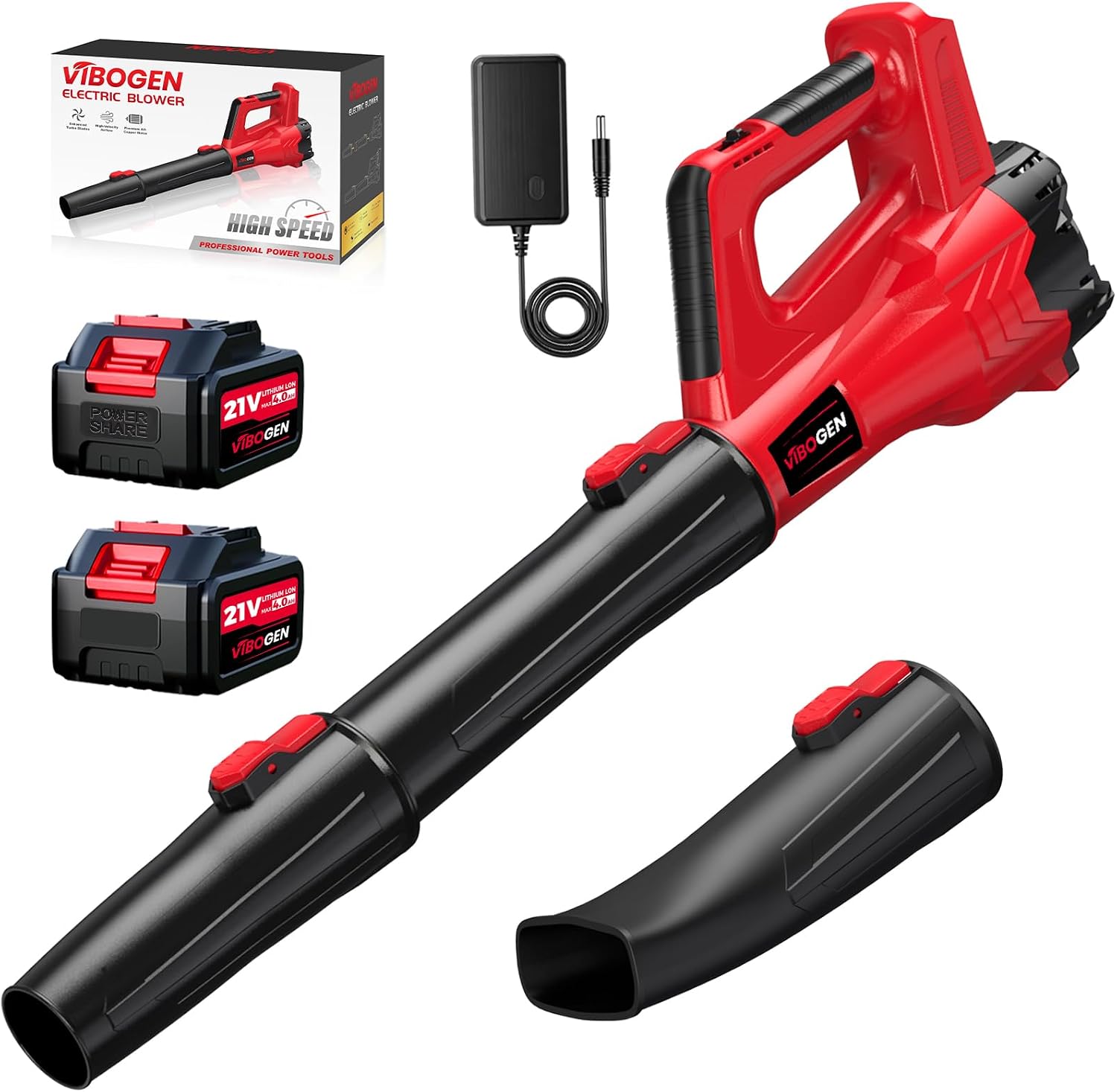
| Power Source | Battery Powered |
|---|---|
| Voltage | 21 volts_of_direct_current |
| Air Flow Capacity | 420 cfm |
| Noise Level | 75 db |
| Included Components | Battery, Charger, Extension Nozzle |
The VIBOGEN HG0645 is a compact cordless blower built for routine residential cleanup. It produces up to 420 CFM and 150 MPH, and offers two speed settings so you can switch between gentle dusting and stronger leaf removal. The kit includes two 21V 4.0Ah batteries and a charger, which extends runtime compared with single-battery kits and reduces interruptions during medium-length jobs. At roughly 2.7 pounds (tool only) it is easy to hold and maneuver around patios, driveways, decks, and cars, and the interchangeable round and flat nozzles help concentrate or widen airflow depending on the task. Noise is moderate at 75 dB on the specification sheet, so it is suitable for neighborhood use when used with hearing protection. Practical limits are runtime for heavy, prolonged clearing and performance on wet, matted leaves or large volumes—this unit is optimized for light-to-moderate residential use rather than commercial properties. Build materials are standard plastic, so treat the blower accordingly and store indoors when not in use.
Best for: A homeowner who wants a lightweight, easy-to-use cordless blower for regular yard maintenance and values reliability supported by many positive user reviews.
Less Ideal for: Landscapers or property owners with large lawns and frequent heavy blow-off needs should look at backpack or higher-capacity commercial blowers instead.
- Strong airflow for a handheld cordless unit at 420 CFM and 150 MPH for quick clearing of leaves and debris
- Two 21V 4.0Ah batteries included to extend runtime and reduce mid-job interruptions
- Lightweight handheld design that reduces arm fatigue for quick cleanup jobs
- Two speed settings and interchangeable nozzles provide flexibility for dusting or concentrated leaf removal
- Not designed for heavy commercial use or prolonged clearing of large yards
- Plastic construction requires careful storage to avoid weather damage
Verdict: A lightweight, easy-to-handle cordless blower with dual batteries and strong airflow that fits everyday residential cleanup needs.
BLACK+DECKER LB700 7-Amp Corded Handheld Leaf Blower

| Power Source | Corded Electric |
|---|---|
| Form Factor | Handheld |
| Air Flow Capacity | 180 cfm |
| Speed | 180 miles_per_hour |
| Included Components | (1) LB700 blower, (1) Blow tube |
The BLACK+DECKER LB700 is a compact, corded handheld leaf blower built for fast, one-handed cleanup around yards, driveways, and patios. Its 7-amp motor produces air speeds up to 180 mph and an airflow rating of 180 cfm, which powers away leaves, small twigs, and grass clippings without dragging out larger equipment. At about 4.4 pounds the unit is easy to maneuver for extended periods and the included blow tube focuses airflow for more effective clearing. Built-in cord retention helps avoid accidental unplugging during use. The corded design means continuous runtime and steady power but requires access to an outlet or extension cord and limits mobility compared with battery models. The blower is best for homeowners who want a reliable, lightweight tool for routine debris removal rather than heavy-duty property maintenance. Controls are straightforward and the simple construction keeps maintenance minimal, though users seeking variable speed or vacuum/mulch features will need a different model.
Best for: Buyers who prioritize a proven, easy-to-use blower for routine cleanup and want a lightweight tool backed by many user experiences and reliable performance.
Less Ideal for: Large properties or users who need cordless mobility, adjustable speeds, or a vacuum/mulch combination in a single machine.
- Lightweight 4.4 lb design makes one-handed use and longer sessions comfortable
- 7-amp motor with up to 180 mph and 180 cfm moves leaves and debris quickly
- Cord retention prevents accidental unplugging during use
- Simple, no-frills operation with minimal maintenance
- Corded power limits range and requires an extension cord for larger yards
- No variable speed control or vacuum/mulching function
Verdict: A light, well‑known corded blower that delivers strong airflow for fast, no‑frills yard cleanup.
Choosing the Right Benchmark Leaf Blower: Key Factors to Consider
Airflow and Throat Speed
Airflow, usually expressed in cubic feet per minute and peak air speed, directly affects how quickly a blower moves wet or compacted debris. Higher airflow helps clear wide lawns and heavy leaf loads faster, but throat speed and nozzle shape determine how efficiently that airflow translates to movement at ground level.
Consider the type of debris in your yard. Lightweight dry leaves need less concentrated speed and more volume, while wet leaves, pine needles, and small twigs benefit from higher throat speed. For driveways and tight spaces a focused nozzle can be more effective than raw CFM alone.
Ergonomics and Operator Comfort
Weight distribution, handle shape, and vibration control matter because you will likely use the blower for extended stretches. A well-balanced model reduces shoulder and wrist strain and makes directional control easier when switching between sweeping and spot-blowing.
Look at trigger feel, secondary handles, and whether the unit allows multiple grip positions for different tasks. Features like padded grips, anti-vibration mounts, and adjustable straps for backpack styles change how long you can work comfortably.
Power Source and Runtime Considerations
Battery, corded electric, and gas power each bring tradeoffs. Cordless battery models are quieter and easier to start, but you must match battery capacity and real-world runtime to the size of the job. Gas models offer long runtime and immediate power for heavy-duty clearing but require fuel handling and more routine maintenance.
Think about access to outlets, how large your typical cleanup area is, and whether you already have batteries or a power platform that could be shared across tools. Runtime estimates are helpful but verify expected performance under load rather than idle claims.
Durability and Weather Resistance
Leaf blowers live outside and see dirt, moisture, and rough handling. Materials, sealing around switches and motor housings, and the quality of fasteners affect how long a blower remains reliable. Metal reinforcements at stress points and well-sealed battery compartments extend service life.
If you work in wet climates or near salty air, prioritize corrosion-resistant components and easily replaceable wear parts. Consider how easy it is to dry and store the unit after wet use to avoid long-term damage.
Noise, Vibration, and Local Restrictions
Noise levels can determine when and where you can run a blower, especially in neighborhood settings or during restricted hours. Lower sound output also reduces fatigue and hearing risk, particularly for frequent use.
Vibration control matters for hand and arm comfort. Even a powerful blower can be pleasant to use if vibration is damped at the handle. Check local ordinances about allowable decibel levels and consider battery options if quiet operation is important.
Maintenance and Serviceability
Routine upkeep-cleaning intake screens, replacing spark plugs, swapping batteries, and clearing clogged nozzles-should be straightforward. Units that require special tools or hard-to-find parts increase the time and cost of ownership.
Evaluate how accessible filters and service points are, whether you can perform common tasks without a shop, and how widely available replacement parts and standard consumables are in your area.
Matching Blower Type to Yard Size
Small patios, balconies, and tight garden beds do well with compact, low-noise options that prioritize maneuverability and a focused nozzle. For compact spaces you may prefer a lighter electric or battery blower that lets you work quietly without dragging an extension cord across planting areas.
- Small spaces: choose low weight and narrow nozzles for precision.
- Medium lawns: balance airflow and runtime to avoid repeated passes.
- Large properties: prioritize sustained airflow and easy refueling or spare batteries.
Using Nozzles and Attachments Effectively
Nozzle shape and available attachments change the blower from a sweeping tool to a precise blower or vacuum. A tapered nozzle increases throat speed for stubborn debris, while a wide-flat nozzle moves more volume for general cleanup. Some attachments convert the unit for mulching or vacuuming, useful for bagging leaves but often at the expense of added weight and complexity.
- Tapered nozzles for wet leaves and concentrated clearing.
- Wide nozzles for rapid leaf movement across lawns.
- Mulch or vacuum attachments for bagging, understand tradeoffs in weight.
Battery Management and Charging Tips
If you choose a battery-powered unit, manage runtime with a simple rotation strategy: use one battery while keeping a spare charged. Batteries last longest when stored in a cool, dry place and at partial charge for long-term storage. Fast chargers are convenient but can heat batteries; a charger with temperature protection extends battery life.
- Store batteries away from extreme heat or cold.
- Rotate batteries for continuous work on larger tasks.
- Follow manufacturer guidance on charging cycles when available.
Noise Reduction Strategies
Even with a quieter unit, you can reduce perceived noise by timing work to mid-day when background noise masks blower sound, using lower power settings for light debris, and maintaining the unit to avoid unnecessary vibration. For neighborhoods with strict quiet hours, battery models often offer acceptable alternatives that still move reasonable volumes of leaves.
- Use low-power settings for light tasks to cut noise.
- Keep an eye on loose parts that increase vibration and sound.
- Opt for mufflers or dampers only if compatible with your unit.
Storing and Winterizing Your Blower
Clean out intake screens and nozzle debris before storage to prevent pests and moisture build-up. For gas units, drain the fuel or add a stabilizer to avoid gum deposits in the fuel system. Remove batteries for winter storage and keep them at recommended charge levels in a cool, dry place.
- Empty or stabilize fuel for long-term storage.
- Clean and dry components to avoid corrosion.
- Store batteries separately at recommended charge levels.
How We Chose the Best Benchmark Leaf Blower
Our shortlist focuses on models that deliver dependable performance in typical yard and property tasks. We prioritized measurable, gardener-relevant specifications and real-world handling rather than marketing claims. Key evaluation criteria included sustained airflow and nozzle efficiency, because actual clearing speed depends on consistent CFM and MPH under load; motor or engine durability and materials, since full-season use exposes components to dust and moisture; ergonomics and vibration control, which determine usable runtime before fatigue; and maintenance accessibility, covering how easily filters, spark plugs, batteries, or brush assemblies can be serviced. We also considered battery runtime and charging for cordless models and fuel efficiency and starting reliability for gas units, so the picks work across common setups. Units that required unusual maintenance, used proprietary parts that are hard to replace, or had poor user-serviceability were excluded. The result is a group chosen for predictable clearing performance, comfortable handling, and reasonable upkeep in everyday garden and yard conditions.
FAQ
How do I know what airflow I need for my yard?
Airflow needs depend on debris type and area size. For mostly dry leaves on a small lawn, moderate airflow with a steady throat speed is sufficient. For wet leaves, compact debris, or large properties, aim for higher airflow and consider a focused nozzle for concentrated clearing.
Are battery blowers powerful enough for heavy leaf loads?
Battery blowers have advanced and many handle common backyard loads well, but runtime and peak output vary. For repeated heavy-duty clearing or long runtimes without swapping batteries, gas or higher-capacity battery platforms may be more reliable.
What maintenance do gas blowers require that electric ones do not?
Gas blowers need routine fuel system care, spark plug checks, and occasional carburetor attention. They also require seasonal draining or stabilizing of fuel. Electric and battery units avoid fuel maintenance but require attention to batteries and electrical connections.
Can I use a blower around garden beds without damaging plants?
Yes, by using lower settings and keeping the nozzle at a higher angle you reduce soil disturbance. Use a wider nozzle to spread airflow and avoid concentrating force near shallow-rooted plants. Work carefully near mulched beds to prevent blowing away desired materials.
How loud are leaf blowers and can I reduce their impact?
Noise varies by power source and design. Battery models are generally quieter. You can reduce noise by choosing lower power settings for light tasks, maintaining the unit to remove loose panels, and working during times when ambient noise masks the blower.
When should I replace a blower rather than repair it?
Consider replacement when major components like motors, housings, or battery platforms fail and repairs cost close to or more than a new unit. Frequent breakdowns, obsolete parts, or poor availability of replacement components are signs replacement is more practical.
Final Verdict
Prioritize the features that match how and where you work. Airflow and nozzle efficiency determine how fast debris moves, while ergonomics and noise affect how long you can work comfortably. Think about power source, maintenance needs, and storage before deciding. Focus on predictable clearing performance and ease of use rather than chasing peak numbers. Choose the blower type and features that reduce strain and fit the scale of your yard so cleanup becomes quicker and less tiring.
