

Note: This article contains affiliate links. If you click on these links and make a purchase, I may earn a small commission at no extra cost to you. This helps support my research and content. Read my full affiliate disclosure here.
If you care for roughly an acre of lawn, driveway, and perimeter plantings, the right leaf blower makes seasonal cleanup faster and less physically demanding. For a property this size you need tools that deliver sustained airflow, durable construction, and comfortable handling so you can cover wide areas without constant refueling or fatigue. This guide shortlists the top options for a 1 acre yard and explains the features that matter in real garden use. We evaluate sustained air volume, runtime or fuel endurance, ergonomic design, and maintenance requirements to help you pick a blower that suits your mowing, gutter, and leaf-management routine.
Top Picks at a Glance
| Best Overall The best all-around choice for most situations | Husqvarna 350BT 50.2-cc Gas Backpack Leaf Blower |  |
| Best Quality Built to a higher standard if you want something more solid | Husqvarna 580BTS III 75.6cc Gas Backpack Leaf Blower |  |
| Best Budget The cheapest option that still gets the job done reliably | HTK 63CC Gas Backpack Leaf Blower |  |
| Highest Rated A top-rated pick with lots of positive feedback | ECHO PB-9010T X Series 79.9cc Backpack Gas Blower |  |
| Most Popular A crowd favorite that many people choose with confidence | EGO POWER+ LB7654 765 CFM Cordless Handheld Leaf Blower with 5.0Ah Battery and Charger |  |
Husqvarna 350BT 50.2-cc Gas Backpack Leaf Blower

| Power Source | Gas Powered |
|---|---|
| Form Factor | Backpack |
| Air Flow Capacity | 692.17 cfm |
| Maximum Speed | 180 miles_per_hour |
| Additional Features | Anti-Vibration |
The Husqvarna 350BT is a purpose-built backpack leaf blower for regular yard cleanup on medium to large properties. Its 50.2-cc X-Torq two-cycle engine produces up to 180 MPH and about 692 CFM, giving it the power to move leaves, grass clippings and light debris quickly. The unit uses a padded ergonomic harness, hip belt and weight-leveling system so you can run it for extended periods with less strain, and LowVib technology reduces felt vibration. Practical features include an air purge for easier starting, tube-mounted throttle and cruise control for steady operation. The blower favors dependable, proven gas power over quieter electric alternatives, so you should expect regular fuel mixing, periodic two-cycle maintenance and typical engine noise. For buyers who prioritize robust clearing performance and an established brand, the 350BT balances power and operator comfort, but it is not the quietest or lowest-maintenance option available.
Best for: A cautious buyer who wants a reliable, proven gas backpack blower for regular yard maintenance and values operator comfort during longer jobs.
Less Ideal for: Those who need a near-silent, low-maintenance solution or who prefer cordless electric operation for small urban yards.
- Strong clearing power (around 692 CFM and 180 MPH) suitable for medium to large yards
- Ergonomic harness with padded straps and hip belt reduces operator fatigue during long runs
- LowVib technology and weight-leveling harness for improved comfort and control
- Air purge system and tube-mounted throttle with cruise control make starting and steady operation easier
- Gas two-cycle engine requires fuel mixing and routine maintenance
- Significant engine noise compared with battery-powered blowers
Verdict: Choose the Husqvarna 350BT if you want a comfortable, dependable gas backpack blower that delivers professional-level clearing power for medium to large properties.
Husqvarna 580BTS III 75.6cc Gas Backpack Leaf Blower

| Max air flow at nozzle | 1000 CFM |
|---|---|
| Max air speed | 220 MPH |
| Max blow force | 47 N |
| Engine displacement | 75.6 CC |
| Engine cycle | 2-Cycle |
The Husqvarna 580BTS III is a commercial-style backpack blower built to move large volumes of debris quickly. It pairs a 75.6 cc two-stroke X-TORQ engine with an efficient fan to produce up to 1000 CFM and 47 N of blow force, making it well suited to clearing heavy leaves, grass clippings, and wet debris across large properties. The ventilated, load-reducing harness and padded hip belt improve weight distribution so operators can work longer with less fatigue, and the tube-mounted throttle gives straightforward control while walking. A larger fuel tank reduces refueling stops during long shifts and the two-stage commercial air filter helps protect the engine in dusty conditions. Expect loud operation typical of powerful gas blowers and plan for regular 2-stroke maintenance and fuel mixing. This unit favors contractors or experienced homeowners who need sustained power and durability rather than occasional light-use tasks.
Best for: Buyers who need a rugged, high-output blower for frequent or large-area clearing—commercial landscapers and homeowners with extensive properties who prioritize performance and uptime.
Less Ideal for: Those with small yards, infrequent need for a blower, or who prefer quieter, low-maintenance electric models should consider smaller or battery-powered alternatives.
- Very high airflow and blow force suitable for commercial clearing (1000 CFM, 47 N)
- Ergonomic ventilated backpack harness and padded hip belt reduce operator fatigue
- Large fuel tank supports longer run times between refuels
- Tube-mounted throttle and adjustable speed give straightforward control during use
- Commercial two-stage air filter for better engine protection in dusty conditions
- High noise and typical 2-stroke maintenance requirements
- Backpack format and power are oversized for small yards or occasional light use
Verdict: Choose the 580BTS III when you need professional-level blowing power and endurance for large or frequent cleanup jobs.
HTK 63CC Gas Backpack Leaf Blower

| Power Source | Gas Powered |
|---|---|
| Form Factor | Backpack |
| Air Flow Capacity | 665 cfm |
| Maximum Speed | 205 miles_per_hour |
| Noise Level | 71 db |
The HTK 63CC backpack leaf blower is built for large yards and demanding cleanup, offering a 63cc two-stroke engine that produces up to 665 CFM and 205 MPH air speed. It is carried on a padded harness that spreads weight across the back and shoulders and includes low-vibration features to reduce fatigue during longer sessions. The blower uses an air-purge start and oversized, intuitive controls that make starting and throttle adjustments straightforward, and cruise control holds a steady output without constant trigger pressure. A 1.7 L fuel tank supports extended runtime between refills, and the manufacturer lists a relatively low 71 dB operating level for a gas unit. Practical limitations to consider are the typical maintenance demands of a two-stroke gas engine and the need to handle fuel and exhaust; it is louder and heavier than cordless electric models and requires periodic tuning and fuel mixing. For someone managing large properties who prioritizes raw blowing power and continuous run time, this unit gives pronounced performance and operator-focused controls.
Best for: Buyers who maintain large yards or estates and need sustained, commercial-style blowing power with operator comfort during long cleanup sessions.
Less Ideal for: People with small yards, tight storage space, or a strong preference for low-maintenance, emission-free tools should consider lighter cordless or electric models instead.
- High air volume (665 CFM) and peak air speed (205 MPH) for moving heavy, wet debris
- Padded ergonomic backpack harness and low-vibration design reduce operator fatigue
- Air-purge start plus oversized controls and cruise control for easier starting and steady operation
- 1.7 L fuel tank supports longer runtime for large properties
- Two-stroke gas engine requires fuel mixing and routine maintenance
- Heavier and louder than typical cordless electric blowers despite a stated 71 dB level
Verdict: If you need continuous, commercial-grade blowing power for large properties, this HTK backpack blower pairs high airflow with operator-focused features to get the job done.
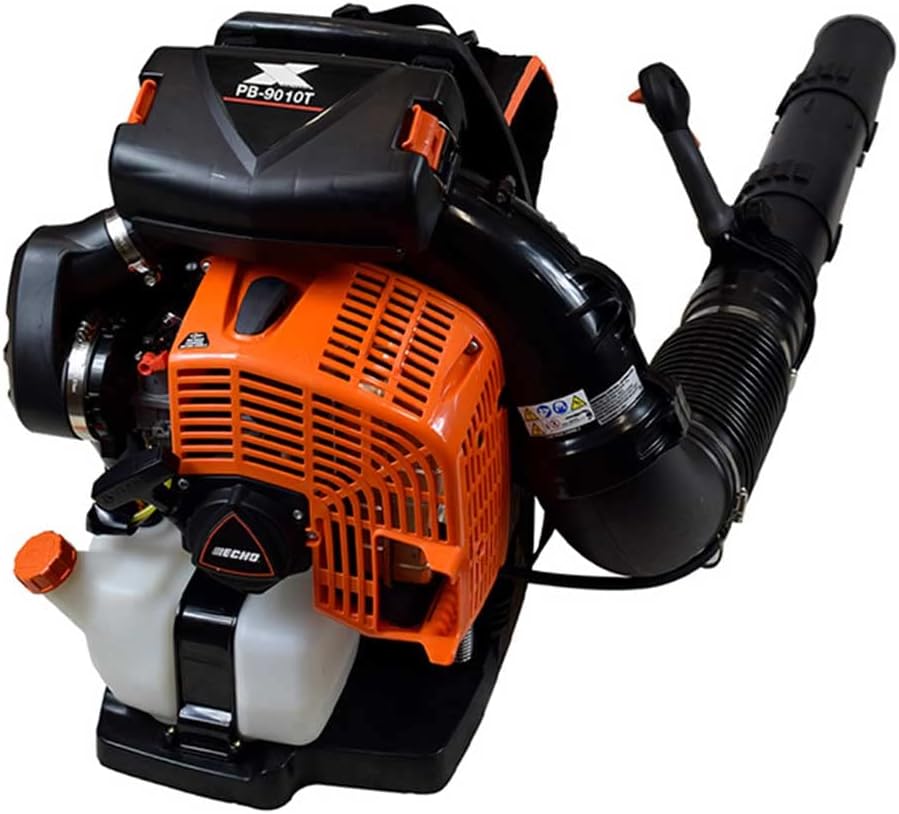
ECHO PB-9010T X Series 79.9cc Backpack Gas Blower
| Power Source | gasoline-powered |
|---|---|
| Form Factor | Backpack |
| Additional Features | Throttle Lock |
| Noise Level | 48 db |
| Maximum Speed | 220 miles_per_hour |
The ECHO PB-9010T X Series is a professional-style backpack blower built for heavy yard work and extended runs. Its 79.9 cc two-stroke engine produces up to 220 mph airspeed and a high airflow so you can move large piles of leaves, debris, and grass clippings quickly. The backpack form factor distributes the engine weight across the shoulders and hips for longer use than handheld units, and the tube-mounted throttle plus throttle lock help maintain a steady output during repetitive jobs. Practical benefits include strong clearing power for lawns, driveways, and beds and a design aimed at home users who need commercial-level performance. Limitations are the usual ones for gas backpack blowers: it requires fuel mixing and periodic engine maintenance, it is heavier and louder than electric alternatives, and it may be overkill for very small yards or infrequent light tasks.
Best for: Homeowners who need a reliable, high-power blower for frequent or large-area cleanup and who prioritize continuous performance over minimal maintenance.
Less Ideal for: Casual users with small yards, those who prefer low-maintenance electric equipment, or anyone seeking the quietest option for noise-sensitive neighborhoods.
- High reported maximum speed of 220 mph for strong clearing power
- Backpack form factor for longer, more comfortable operation than handheld blowers
- Tube-mounted throttle with throttle lock for steady speed control during extended use
- Gasoline power allows untethered operation and sustained output for large properties
- Requires fuel mixing and routine engine maintenance inherent to two-stroke gas engines
- Heavier and louder than electric or battery backpack models
- Likely more power than needed for very small yards or occasional use
Verdict: Buy this if you want a dependable, high-speed gas backpack blower that handles large yards and frequent heavy-duty cleanup.
EGO POWER+ LB7654 765 CFM Cordless Handheld Leaf Blower with 5.0Ah Battery and Charger

| Power Source | Battery Powered |
|---|---|
| Voltage | 56 volts |
| Air Flow Capacity | 765 cfm |
| Noise Level | 64 db |
| Included Components | Blower, 5.0Ah battery, 320W charger, tapered and spread nozzles |
The EGO POWER+ LB7654 is a performance-focused cordless handheld blower built to replace small gas units for routine yard cleanup. It uses a brushless motor and turbine fan design to produce up to 765 CFM and airspeeds to 200 MPH, with a variable-speed dial for precise control and a turbo mode for heavy debris. It ships with a 56V 5.0Ah ARC lithium battery and a 320W charger, which EGO rates for long runtimes so you can clear driveways, lawns, and patios in one session without swapping packs. Notable practical benefits are the included tapered and spread nozzles for concentrated or wide airflow, relatively quiet operation compared with gas blowers, and brushless efficiency that reduces vibration. Important limitations are the handheld format, which concentrates weight in one hand during extended use, and that highest turbo output will drain the battery faster than midrange speeds. The blower is well suited to homeowners who want near-gas power without fumes and who value adjustable control for different cleanup tasks.
Best for: Buyers who prioritize power and runtime in a cordless handheld blower and want a gas-level performance replacement for routine yard cleanup.
Less Ideal for: Users who need a lightweight blower for very short tasks or who prefer backpack blowers for large properties and long continuous use.
- High maximum airflow (765 CFM) and up to 200 MPH airspeed for moving heavy, wet debris
- Variable speed dial plus turbo mode for matching power to the task
- Includes 56V 5.0Ah battery and 320W charger for long single-charge runtime
- Brushless motor for lower vibration, improved efficiency, and longer motor life
- Comes with tapered and spread nozzles to focus or widen airflow for different jobs
- Handheld design can feel tiring during long sessions compared with backpack models
- Turbo mode significantly reduces battery runtime compared with midrange settings
Verdict: Choose the LB7654 when you want near-gas blowing power and long cordless runtime in a single handheld unit.
Choosing the Right Leaf Blower for 1 Acre Yard: Key Factors to Consider
Sustained Airflow and Airspeed
For a 1 acre yard you need a blower that delivers sustained cubic feet per minute alongside usable airspeed. High CFM moves large volumes of leaves and fine debris across open lawn and through shrub beds. Airspeed helps when leaves are wet or matted, but speed alone without volume will scatter material without clearing it.
Sustained output matters because you will be running the blower long enough for short gusts to be inefficient. Look for specifications and real-world descriptions indicating continuous airflow under load rather than peak numbers that drop quickly.
Runtime, Power Source, and Refueling Ease
How long a unit runs on a single fuel tank or battery charge is a primary operational consideration for acre-sized properties. Gas models with larger tanks or two-stroke engines often cover longer continuous use, while battery systems vary by battery capacity and whether multiple batteries are practical to swap in the field.
Also evaluate refueling or recharge logistics. Changing batteries is faster than refilling gasoline for many users, but battery runtime may require carrying spare packs. For gas units, easy access to the tank and predictable fuel consumption matter when you need uninterrupted work.
Comfort, Weight Distribution, and Vibration
Extended use across lawns, driveways, and beds requires a blower that is comfortable to hold and easy to direct. Weight matters, but how that weight is balanced affects fatigue more. Backpack blowers spread load across the hips and shoulders, reducing arm strain during long sessions, while handheld units concentrate weight in the arms and wrists.
Vibration and handle ergonomics influence how long you can work without discomfort. Consider padded handles, anti-vibration mounts, and reachable controls so you can modulate speed or throttle without changing grip and posture repeatedly.
Noise Output and Local Considerations
Noise level affects when you can operate the blower and how neighbors will react. Some municipalities or homeowner associations restrict hours or types of equipment. Gas two-stroke engines tend to be louder than modern battery-powered blowers, and the sound profile differs between handheld and backpack units.
Balance your need for power with acceptable noise. If you must work early or late, quieter electric systems or low-noise modes are important even if they slightly reduce clearing speed.
Durability, Serviceability, and Seasonal Maintenance
Acre-sized properties subject equipment to frequent use, debris ingestion, and weather exposure. Choose a blower with robust housing, easily replaceable wear parts, and straightforward access to the air intake and spark or motor components for seasonal checks.
Consider warranty coverage and whether routine items like spark plugs, filters, or batteries are common, easy to replace, and affordable. Machines that are simpler to service will spend more time working and less time in the shop.
Accessory Options and Versatility
Attachments, variable-speed control, and nozzle choices make a blower more useful across tasks from leaf clearing to light snow management and gutter cleaning. A variable-speed throttle helps conserve fuel or battery while providing power when you need it.
Assess whether the blower supports extension tubes, vacuum or mulching kits, and shoulder straps or harnesses. Versatile machines can reduce the number of tools you need for property upkeep.
Gas Versus Battery for an Acre
Both gas and battery options can handle large yards, but the tradeoffs are different in practice. Gas blowers typically provide longer continuous run time per tank and strong airflow for wet or compacted leaves. Battery blowers offer quieter operation, lower routine maintenance, and instant throttle response with no mixing of fuel.
Think about how you work: if you need uninterrupted clearing across long runs and do not want to swap batteries often, larger gas models or backpack systems may be preferable. If noise, emissions, and low maintenance are priorities and you can plan around battery swaps or use higher-capacity packs, modern battery blowers can be very effective for much of the season.
- Gas: longer single-run endurance, consistent power, higher maintenance and noise
- Battery: quieter, lower maintenance, may require extra batteries for full-plot work
Backpack and Handheld Use Cases
Backpack blowers transfer weight to the torso and hips and are ideal when clearing large open areas or deep piles over extended periods. Their higher power ratings and larger motors suit sustained workloads and reduce arm fatigue. Handheld models are lighter and easier for brief tasks, tight spaces, and spot cleanup around beds and walkways.
Match the form factor to your workflow. If you regularly clear wide swaths or manage multiple properties, a backpack blower will save time and energy. For occasional touch-ups, a handheld blower with good balance might be enough.
- Backpack: best for long sessions and heavy debris
- Handheld: best for quick jobs and maneuverability
Techniques for Efficient Large-Lot Blowing
Work in planned passes rather than chasing individual leaves. Start at a high point and push material downhill or toward a collection zone so wind and slope assist your work. Use wider sweeping motions at lower speeds to move large volumes, and reserve high-speed bursts for stubborn, wet spots.
Use the right nozzle and angle. A flat or tapered nozzle increases reach and concentrates airflow for moving piles, while wider nozzles are better for sweeping broad areas. Keep the blower close enough to the ground to engage debris but high enough to avoid sucking dust and small stones.
- Plan passes that use terrain and wind
- Adjust nozzle choice and angle for task
Seasonal Storage and Winter Care
Proper end-of-season care extends the life of any blower used on a 1 acre yard. For gas units, drain fuel or add a stabilizer and run the carburetor dry to avoid varnish. Remove debris from the intake and cooling fins, and check spark plugs before storing.
For battery systems, store batteries at partial charge in a cool, dry place and inspect contacts for corrosion. Clean any leaf dust from vents and tubes. Regular cleaning and light lubrication of moving parts will reduce wear and keep the blower ready for spring work.
- Drain or stabilize fuel for gas units
- Store batteries at recommended charge levels
Safety Practices for Large-Area Blowing
Wear eye and ear protection when operating high-power blowers, and consider a dust mask if conditions are dry. Clear the work area of loose objects that could become projectiles, and be mindful of bystanders and pets. Use lower speeds near buildings and windows to limit dust intrusion.
When blowing near roads or neighbors, control debris direction and timing of work to reduce nuisance. For steep slopes, maintain secure footing and avoid overreaching with the blower to reduce the risk of a fall.
- Use eye, ear, and dust protection
- Control debris direction and avoid crowds
How We Chose the Best Leaf Blower for 1 Acre Yard
We shortlisted blowers that match the practical needs of a 1 acre yard by applying specific, garden-focused filters. Primary evaluation looked at sustained airflow and airspeed because larger properties need persistent power to move dense or wet leaves rather than short gusts. We also weighed runtime or fuel capacity to ensure a single tank or battery charge can cover large swaths without frequent stops. Ergonomics and vibration levels were reviewed to reduce operator fatigue during extended jobs. Durability of key components, ease of routine maintenance, and availability of serviceable parts were included to keep machines working season after season. Noise output and emissions were considered for properties near neighbors and local regulations. We excluded small handheld units designed only for light patio work and tiny batteries or tanks that cannot realistically cover an acre. The result is a list focused on blowers that balance sustained clearing power, endurance, comfort, and long-term reliability.
FAQ
How much power do I need to clear an acre of wet leaves?
Wet leaves need both high airflow and good airspeed because moisture makes them heavy. Aim for blowers with sustained CFM ratings and higher MPH values or consider backpack units designed for heavy-duty clearing. In many cases a professional-grade handheld will struggle with consistently wet material.
Can battery blowers handle a full acre without swapping batteries?
It depends on battery capacity and the specific workload. Some high-capacity battery systems can cover large areas on a single charge, but typical consumer batteries often require at least one spare pack for uninterrupted work. Plan for swapping or recharging if your workflow cannot pause.
Are backpack blowers worth the extra weight for residential use?
Yes when you regularly clear large areas or work for extended periods. Backpack blowers distribute weight and reduce arm fatigue, making sustained work more comfortable. For occasional touch-ups, the increased power may not justify the bulk.
How should I maintain a gas blower used on an acre property?
Perform routine checks including air filter cleaning, spark plug inspection, and fuel system maintenance. Use fresh fuel or stabilizer, keep the intake free from debris, and follow seasonal service intervals. Regular maintenance prevents power loss and reduces the chance of mid-season breakdowns.
What noise levels should I expect from different blower types?
Gas blowers generally produce the highest noise levels, especially backpack two-stroke models. Battery blowers run quieter and often have lower decibel ratings, but power and noise vary by design. Check noise specifications and consider quieter options if you work near neighbors or need early morning access.
Final Verdict
For a one-acre property prioritize sustained airflow and sufficient runtime so you can clear large swaths without constant stops. Balance power with ergonomics: backpack units offer endurance and lower arm fatigue, while handheld models are lighter and more maneuverable for small tasks. Also factor in noise limits, maintenance commitments, and accessory needs when choosing a blower. Focus on the tradeoffs that matter for your routine. If you value long continuous operation, choose endurance and serviceability. If neighbor-friendly operation and low upkeep are more important, prioritize quieter battery systems and plan battery logistics accordingly.
