

Note: This article contains affiliate links. If you click on these links and make a purchase, I may earn a small commission at no extra cost to you. This helps support my research and content. Read my full affiliate disclosure here.
If your yard uses rocks, gravel, or crushed stone instead of mulch, the wrong leaf blower can scatter material, raise dust, or fail to reach tight crevices. Choosing a leaf blower that balances steady high airflow with controllable speed and good nozzle options matters for keeping rock beds tidy without damaging edging or plants. This guide shortlists the top options for rock landscapes and explains the practical tradeoffs you will face in the yard. We evaluated the shortlisted leaf blowers across airflow, control, durability, and ergonomics so you can pick the blower that matches your maintenance habits and landscape size. Below are the top picks and the criteria we used to rank them, followed by buying guidance for rock-specific tasks.
Top Picks at a Glance
| Best Quality Built to a higher standard if you want something more solid | EGO POWER+ LB6151 Cordless 56V Leaf Blower Kit (615 CFM) with 2.5Ah Battery |  |
| Best Value The sweet spot between price and what you get | Greenworks 40V Brushless Axial Leaf Blower with 4.0Ah Battery and Charger |  |
| Best Budget The cheapest option that still gets the job done reliably | Sun Joe SBJ597E Corded Electric Leaf Blower, 6‑Amp 155 MPH |  |
| Highest Rated A top-rated pick with lots of positive feedback | NEO-TEC NTEB260 25.4cc Handheld Gas Leaf Blower |  |
| Most Popular A crowd favorite that many people choose with confidence | BLACK+DECKER LB700 7-Amp Corded Handheld Leaf Blower |  |
| Best Seller A high-volume bestseller chosen again and again | VIBOGEN HG0645 21V Cordless Handheld Leaf Blower with Dual 4.0Ah Batteries |  |
EGO POWER+ LB6151 Cordless 56V Leaf Blower Kit (615 CFM) with 2.5Ah Battery

| Power Source | Battery Powered |
|---|---|
| Voltage | 56 volts |
| Air Flow Capacity | 615 cfm |
| Noise Level | 71 db |
| Additional Features | Interchangeable Nozzle Connection |
The EGO POWER+ LB6151 is a battery-powered handheld leaf blower designed for strong, quiet yard cleanup without the fuss of gas. It uses a 56V brushless motor and turbine-style fan to produce up to 615 CFM and speeds around 170 MPH, with a variable-speed dial for fine control and a turbo button for short bursts of maximum power. The kit includes a 2.5Ah ARC Lithium battery and charger, and the battery is compatible with other EGO 56V tools so you can share power between machines. Practical benefits include low vibration, relatively quiet operation for a powerful blower, and up to roughly 75 minutes of runtime on the included battery for routine cleanup. The unit is lightweight and ergonomic for handheld work and comes with a tapered nozzle for concentrated airflow. Limitations are that the included 2.5Ah battery gives shorter high-power runtimes than larger batteries and you may need a higher-capacity battery for extended heavy-duty work, and turbo mode is best used in short bursts rather than continuous operation.
Best for: Buyers who prioritize powerful, gas-comparable performance in a cordless handheld blower and want the flexibility to control airflow for different cleanup tasks while using a common battery platform.
Less Ideal for: Users who need long continuous runtime for large properties without swapping batteries or who prefer backpack-style blowers for extended heavy work.
- High airflow (615 CFM) with a turbo button for moving heavy or wet debris
- Brushless motor for lower vibration and improved longevity
- Variable-speed dial for precise control across light and heavier jobs
- Includes a 56V 2.5Ah battery and charger that work across EGO 56V tools
- Included 2.5Ah battery offers limited runtime at high power compared with larger batteries
- Turbo mode is designed for short bursts and is not suited for continuous heavy use
Verdict: If you want near-gas power from a quiet cordless blower that pairs with EGO 56V batteries, this kit delivers strong, controllable performance in a handheld package.
Greenworks 40V Brushless Axial Leaf Blower with 4.0Ah Battery and Charger

| Power Source | Battery Powered |
|---|---|
| Voltage | 40 volts |
| Air Flow Capacity | 550 cfm |
| Noise Level | 78 db |
The Greenworks 40V brushless axial leaf blower is a cordless, handheld tool built for everyday yard cleanup and tougher storm-duty tasks. It produces up to 130 MPH wind speed and 550 CFM airflow, and offers a Turbo boost for blasting wet, matted leaves, gravel, or debris. The included 4.0Ah battery provides roughly 20 minutes of continuous runtime and is compatible with many other Greenworks 40V tools, so the same battery can power trimmers or small mowers. Practical features include an ergonomic, ultralight design with cruise control for reduced arm fatigue and a tapered nozzle for more focused airflow. Its brushless motor runs at about 78 dB, noticeably quieter than gas blowers, and requires less maintenance. Limitations to keep in mind are the modest runtime on a single battery charge for large properties and that peak Turbo runs will shorten that runtime further. For multi-hour or heavy commercial use you will likely want spare batteries or a higher-capacity system.
Best for: Buyers who want a quiet, low-maintenance cordless blower that handles regular yard work and occasional heavy cleanup while fitting into a shared battery ecosystem.
Less Ideal for: Commercial users or homeowners with very large properties who need long continuous runtime without carrying spare batteries should consider higher-capacity or gas-powered options.
- High airflow and speed (550 CFM, 130 MPH) clears wet and compacted debris quickly
- Brushless motor runs quieter at about 78 dB and needs less maintenance than gas engines
- Includes 4.0Ah battery and charger and is compatible with 75+ Greenworks 40V tools
- Ergonomic, lightweight design with cruise control reduces operator fatigue for single-handed use
- Approximately 20 minutes of continuous runtime on the included 4.0Ah battery may be short for large yards
- Turbo mode significantly reduces battery life when used frequently
Verdict: A quiet, powerful cordless blower that balances strong wet-leaf performance and portability while tying into a shared 40V battery system.
Sun Joe SBJ597E Corded Electric Leaf Blower, 6‑Amp 155 MPH

| Power Source | Corded Electric |
|---|---|
| Voltage | 120 volts |
| Form Factor | Handheld |
| Noise Level | 45 db |
| Speed | 155 miles_per_hour |
The Sun Joe SBJ597E is a simple, no-frills corded leaf blower aimed at routine yard tidy‑ups. Its 6‑amp motor produces up to 155 MPH and 260 CFM, which is strong enough to move leaves, grass clippings, and light debris from patios, driveways, decks, and around landscaping beds. The blower is very light at about 3.9 pounds and has a slim handheld form that makes one‑handed use and storage easy. Because it is corded electric you get consistent power without gas maintenance or battery recharge cycles, though you are limited by cord reach. Notable features include a quiet 45 dB reported noise level and a compact profile that tucks onto a shelf or in a shed. It is best for homeowners who need an affordable blower for weekly or seasonal cleanup rather than commercial tasks; larger piles or heavy, wet material will require multiple passes or heavier equipment. The unit’s plastic construction keeps weight and cost down but also means it is not built for heavy professional use.
Best for: Ideal for budget-minded homeowners who want a reliable, lightweight blower for routine cleanup of patios, driveways, and small yards and who prioritize low operating fuss over maximum range.
Less Ideal for: Not a good fit for users who need cordless convenience, long reach without extension cords, or a commercial‑grade blower for heavy, wet debris.
- Compact, lightweight design for easy one‑handed use and storage
- Corded electric power gives consistent performance without fuel or batteries
- 155 MPH and 260 CFM output handles typical leaves and light yard debris
- Reported low noise level suitable for neighborhood use
- Cord limits range compared with cordless models so an extension is often needed
- Plastic construction is lightweight but less durable for heavy commercial use
Verdict: A very affordable, lightweight corded blower that delivers solid daily performance for small to medium residential cleanup.
NEO-TEC NTEB260 25.4cc Handheld Gas Leaf Blower

| Power Source | Gas Powered |
|---|---|
| Form Factor | Handheld |
| Noise Level | 95 db |
| Maximum Speed | 7000 rpm |
| Wattage | 1000 watts |
The NEO-TEC NTEB260 is a compact gas-powered handheld blower designed for routine yard cleanup. Its 25.4cc two-cycle engine delivers about 432 CFM at speeds up to 180 MPH, which is enough to move leaves, grass clippings, dirt and light snow from patios, driveways and lawns. The unit emphasizes ease of use with a simple pull-start, a low-vibration ergonomic housing and a one-handed 10 lb design that makes longer sessions less tiring. Practical benefits include strong single-pass clearing on small to medium properties and portability without needing a battery recharge. Expect typical gas-blower maintenance such as mixing fuel, occasional spark plug and air filter care, and some noise at the rated 95 dB level so hearing protection is advisable. For heavier commercial tasks the power and runtime will be more limited than backpack or larger two-stroke models, and emissions and fuel handling are inherent to gas machines. For homeowners who want straightforward, portable power for seasonal leaf and debris control, this is a sensible choice.
Best for: Homeowners who want a practical, no-frills handheld gas blower for routine yard and driveway cleanup and value portability and easy operation over maximum commercial power.
Less Ideal for: Large properties or professional landscapers who need extended runtime and higher sustained power should consider backpack or higher-displacement models.
- Powerful for its size at 432 CFM and 180 MPH for effective leaf and debris clearing
- Lightweight one-handed design (about 10 lb) reduces fatigue during longer jobs
- Low-vibration ergonomic housing and simple pull-start make it user-friendly
- Portable gas operation avoids battery charging and works until you run out of fuel
- Produces 95 dB of noise so hearing protection is recommended
- Requires regular gas engine maintenance and fuel mixing typical of two-cycle blowers
Verdict: A lightweight, easy-to-use gas blower that delivers strong single-pass clearing for homeowners who prioritize portable, reliable performance.
BLACK+DECKER LB700 7-Amp Corded Handheld Leaf Blower

| Power Source | Corded Electric |
|---|---|
| Form Factor | Handheld |
| Air Flow Capacity | 180 cfm |
| Speed | 180 miles_per_hour |
| Included Components | (1) LB700 blower, (1) Blow tube |
The BLACK+DECKER LB700 is a compact, corded handheld leaf blower built for fast, one-handed cleanup around yards, driveways, and patios. Its 7-amp motor produces air speeds up to 180 mph and an airflow rating of 180 cfm, which powers away leaves, small twigs, and grass clippings without dragging out larger equipment. At about 4.4 pounds the unit is easy to maneuver for extended periods and the included blow tube focuses airflow for more effective clearing. Built-in cord retention helps avoid accidental unplugging during use. The corded design means continuous runtime and steady power but requires access to an outlet or extension cord and limits mobility compared with battery models. The blower is best for homeowners who want a reliable, lightweight tool for routine debris removal rather than heavy-duty property maintenance. Controls are straightforward and the simple construction keeps maintenance minimal, though users seeking variable speed or vacuum/mulch features will need a different model.
Best for: Buyers who prioritize a proven, easy-to-use blower for routine cleanup and want a lightweight tool backed by many user experiences and reliable performance.
Less Ideal for: Large properties or users who need cordless mobility, adjustable speeds, or a vacuum/mulch combination in a single machine.
- Lightweight 4.4 lb design makes one-handed use and longer sessions comfortable
- 7-amp motor with up to 180 mph and 180 cfm moves leaves and debris quickly
- Cord retention prevents accidental unplugging during use
- Simple, no-frills operation with minimal maintenance
- Corded power limits range and requires an extension cord for larger yards
- No variable speed control or vacuum/mulching function
Verdict: A light, well‑known corded blower that delivers strong airflow for fast, no‑frills yard cleanup.
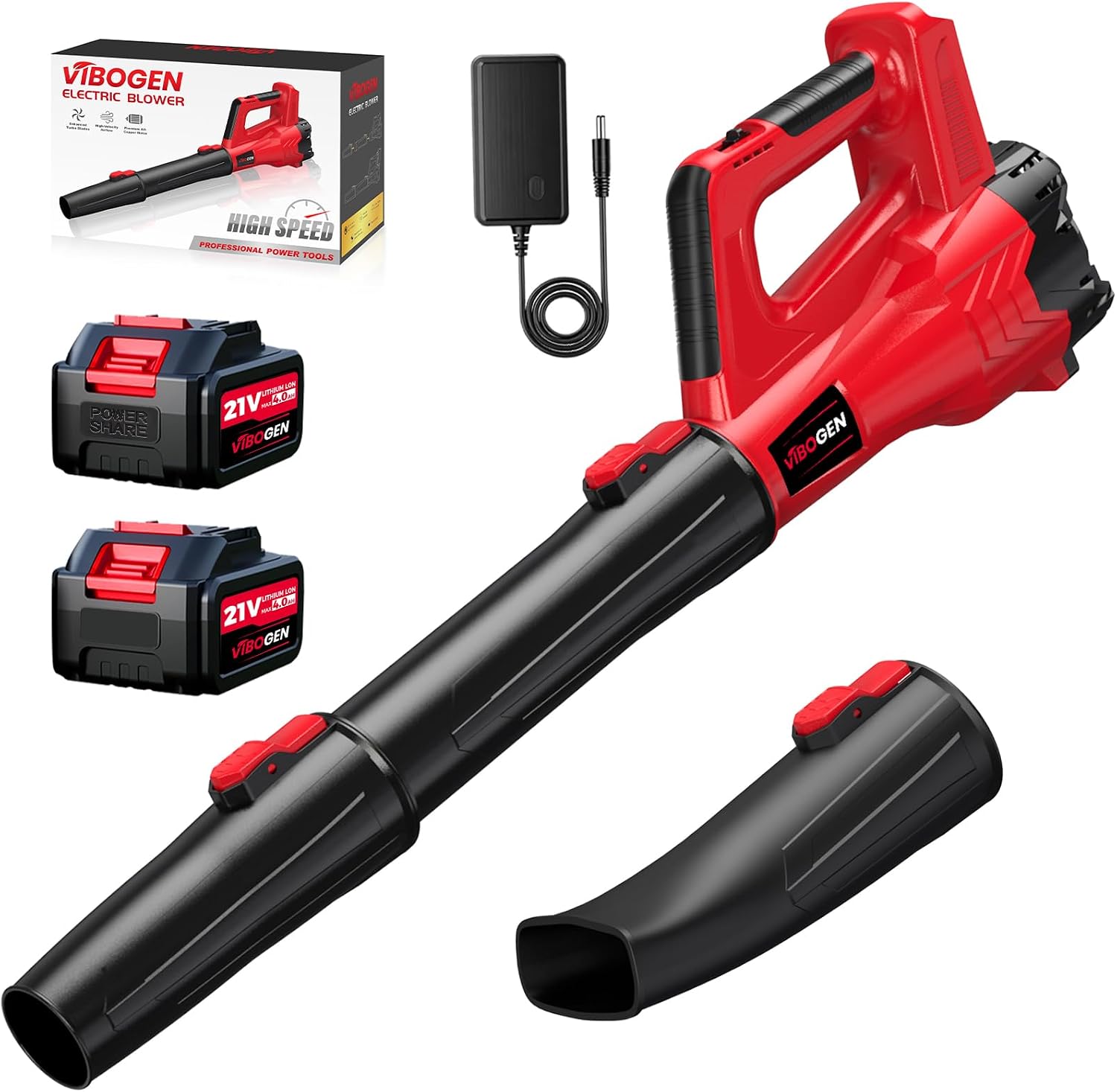
VIBOGEN HG0645 21V Cordless Handheld Leaf Blower with Dual 4.0Ah Batteries
| Power Source | Battery Powered |
|---|---|
| Voltage | 21 volts_of_direct_current |
| Air Flow Capacity | 420 cfm |
| Noise Level | 75 db |
| Included Components | Battery, Charger, Extension Nozzle |
The VIBOGEN HG0645 is a compact cordless blower built for routine residential cleanup. It produces up to 420 CFM and 150 MPH, and offers two speed settings so you can switch between gentle dusting and stronger leaf removal. The kit includes two 21V 4.0Ah batteries and a charger, which extends runtime compared with single-battery kits and reduces interruptions during medium-length jobs. At roughly 2.7 pounds (tool only) it is easy to hold and maneuver around patios, driveways, decks, and cars, and the interchangeable round and flat nozzles help concentrate or widen airflow depending on the task. Noise is moderate at 75 dB on the specification sheet, so it is suitable for neighborhood use when used with hearing protection. Practical limits are runtime for heavy, prolonged clearing and performance on wet, matted leaves or large volumes—this unit is optimized for light-to-moderate residential use rather than commercial properties. Build materials are standard plastic, so treat the blower accordingly and store indoors when not in use.
Best for: A homeowner who wants a lightweight, easy-to-use cordless blower for regular yard maintenance and values reliability supported by many positive user reviews.
Less Ideal for: Landscapers or property owners with large lawns and frequent heavy blow-off needs should look at backpack or higher-capacity commercial blowers instead.
- Strong airflow for a handheld cordless unit at 420 CFM and 150 MPH for quick clearing of leaves and debris
- Two 21V 4.0Ah batteries included to extend runtime and reduce mid-job interruptions
- Lightweight handheld design that reduces arm fatigue for quick cleanup jobs
- Two speed settings and interchangeable nozzles provide flexibility for dusting or concentrated leaf removal
- Not designed for heavy commercial use or prolonged clearing of large yards
- Plastic construction requires careful storage to avoid weather damage
Verdict: A lightweight, easy-to-handle cordless blower with dual batteries and strong airflow that fits everyday residential cleanup needs.
Choosing the Right Leaf Blower for Rock Landscape: Key Factors to Consider
Airflow Power and Speed Control
Airflow strength determines whether you move leaves and debris or also displace the decorative rock itself. High peak CFM can clear large piles quickly, but without variable speed you risk blowing gravel out of beds and across paths. Look for models with smooth throttle response and multiple speed settings so you can dial down for delicate edging or increase for heavy wet leaves.
Speed control also lets you switch between sweeping wide areas and concentrating air to clear between rocks and in crevices. A blower that offers a trigger plus a cruise or lock mode can reduce hand fatigue during longer tasks while maintaining a chosen airflow setting.
Nozzle Type and Reach
Nozzle design affects how air is delivered. Narrow, concentrator-style tips boost velocity for getting into tight seams between rocks, while wider flat nozzles move larger volumes across open beds. Interchangeable or telescoping tubes are helpful when you need both approaches in one session.
Sufficient reach is important to avoid kneeling or stepping directly onto rock beds. A longer tube helps you work from stable ground and reduces the chance of accidentally kicking loose stones while moving around the bed.
Dust Control and Particle Management
Loose rock surfaces produce dust when blasted with high-speed air. Excess dust is not only messy but can coat nearby plants and create respiratory irritation. Some blowers have lower-velocity modes, diffuser attachments, or accessory vacuum functions that reduce dust clouding.
When working on rock landscapes, plan to use lower speeds and sweep in the direction away from plantings to minimize dust transfer. Consider masks or eye protection for windy conditions and choose a blower with finer speed modulation to keep dust under control.
Durability and Abrasion Resistance
Working around rocks exposes the blower to grit and sharp edges that can abrade housings, tubes, and fan components. Models built with tougher plastics, reinforced tube ends, and sealed motors or gear housings will last longer under these conditions.
Check for replaceable nozzles and serviceable parts because even durable machines will need wear items swapped out sooner when used on abrasive surfaces. Construction quality also affects vibration and the risk of cracks from occasional impacts with hard stone.
Power Source and Runtime
Corded, battery, and gas options all work on rock landscapes, but each has tradeoffs. Corded units provide consistent power but limit range. Battery blowers are lighter and quieter with no fumes, but runtime matters if you have extensive beds. Gas blowers deliver longer continuous run times and higher peak power but are heavier and louder.
Estimate how long a typical session takes for your property and pick a power source that gives you continuous coverage. For battery models, consider battery capacity and the availability of spare packs; for gas models, factor in fuel tank size and ease of refueling.
Ergonomics and Handling
Repeatedly moving a blower around rock beds can strain your shoulders and back if the weight and balance are poor. Look for blowers with comfortable handles, well-placed controls, and options for shoulder straps or vibration dampening.
Lightweight designs reduce fatigue and make it easier to hold lower speeds for dust control. Balance the need for power with a form factor you can comfortably use for the duration of typical cleanup sessions.
Techniques for Clearing Gravel and River Rock
Start by loosening accumulated leaves with low-speed, wide sweeps that move organic debris toward a collection zone without kicking stones. Once material is in a pile, switch to a higher-velocity nozzle or shorter tube to blast leaves from between rocks into a container or tarp.
Work with the wind when possible and sweep in shallow passes. For small crevices use a concentrator tip and point the nozzle just above the surface rather than directly at the rock to reduce displacement. Use a rake or brush for compacted debris before using a blower to cut down on dust.
- Begin at lower speeds to test how much rock shifts
- Use a tarp or bin to catch piled leaves before disposal
- Avoid blasting toward plant beds to limit dust transfer
Accessory Options That Make a Difference
Interchangeable nozzles, extension tubes, and flat-to-cone adapters increase a blower's usefulness around varied rock features. A narrow nozzle helps in tight joints, while a flared nozzle covers a broader swath on open beds.
Look for shoulder straps, vacuum kits, or mulching attachments if you need to collect and reduce leaf volume. These accessories can change a standard blower into a more versatile maintenance tool for different seasons.
- Nozzle kits for focused versus broad airflow
- Shoulder straps to reduce hand fatigue
- Vacuum/mulch attachments for collection and disposal
Maintenance Tips for Longevity
Keep intake and exhaust vents free of grit buildup and inspect tubes and nozzles for wear after working on abrasive surfaces. Clean air inlets regularly and replace or tighten any fasteners that loosen from vibration.
Store batteries in a cool dry place and follow manufacturer guidance for long-term storage. For gas units, run the tank low and add fuel stabilizer if storing over winter to prevent carburetor issues. Replace worn nozzles before cracks allow stones to enter the housing.
- Inspect and clean vents after each use
- Replace worn nozzles and seals promptly
- Follow battery care recommendations for longevity
Safety Practices When Working with Rock Beds
Wear eye protection and a dust mask when blowing dry, loose surfaces. Rocks and gravel can ricochet under high-velocity airflow, so avoid aiming the nozzle toward people, pets, or fragile plants.
Be mindful of nearby footing and edges. Clearing while standing on stable ground reduces the chance of slipping on loose rock. Pause if gusts pick up or if nearby landscaping would be harmed by drifting debris.
- Use PPE: eye protection and a dust mask
- Work from stable, clear ground where possible
- Keep bystanders and pets well away during operation
When a Blower Alone Is Not Enough
Some situations require combining tools: a stiff broom or leaf rake can remove compacted wet leaves that a blower only scatters. For very fine dust or particles stuck between stones, a shop vacuum or wet-dry vac with gentle suction can pick up what blowing cannot.
Consider periodic manual maintenance to reset edging and redistribute rocks after seasons with heavy debris or wind. Mechanical edging can prevent rocks from migrating onto walkways during routine blow-outs.
- Use a broom or rake for compacted or wet debris
- Vacuum fine dust after initial blowing
- Periodic manual resetting of edging helps long-term appearance
How We Chose the Best Leaf Blower for Rock Landscape
We focused on features that matter specifically when cleaning gravel, river rock, and crushed-stone beds. Key evaluation criteria included measured airflow and speed control to move leaves without displacing decorative rock, nozzle and attachment versatility for concentrated or wide streams, and dust-control behavior in loose surfaces. Durability and material construction were assessed because abrasive particles and constant use near rough edges accelerate wear. We also judged ergonomics and weight for comfortable, repetitive use across a yard and battery runtime or fuel capacity for typical rock-bed sizes. Other filters removed certain items from consideration: units lacking adjustable speed, designs without targeted nozzle options, or blowers known to produce excessive backsplash that scatters rock. We excluded specialty tools meant only for pavement sweeping or snow clearing, since their design priorities differ from rock-bed maintenance. The final selections balance usable power with control features and build quality. Our scoring emphasized controllable airflow, nozzle adaptability, durability against abrasion, and user comfort to reflect real gardener needs for rock landscapes.
FAQ
Will a high-powered blower move my decorative rocks?
Often yes. High-powered units can displace small gravel and lighter stones. Use lower speed settings, a wider nozzle, or work in shallower passes to reduce rock movement.
Are battery blowers adequate for large rock landscapes?
It depends on battery capacity and runtime. Modern battery blowers can handle moderate-sized rock beds, but for very large areas you may need spare batteries or a gas unit for continuous operation.
How do I reduce dust when blowing gravel beds?
Use lower speeds, sweep with the wind, and keep the nozzle slightly above the surface. Wearing a dust mask and using a vacuum for final pickup helps control airborne particles.
Can I use a blower to clean between tightly packed stones?
Yes, with a narrow concentrator nozzle and controlled airflow you can dislodge leaves and debris from joints. Avoid blasting directly into joints at full power to prevent loosening small stones.
What maintenance matters most after working on rock beds?
Inspect and clean intake vents, check nozzles and tubes for abrasion, and replace worn parts. For battery models, follow recommended charging and storage practices to preserve capacity.
Final Verdict
For rock landscapes, prioritize controllable airflow, nozzle versatility, and abrasion-resistant construction. Balance the need for power against dust generation and the risk of moving decorative stones. Choose a blower with adjustable speeds and the right nozzle options, and pair it with safe techniques and basic maintenance to keep rock beds tidy without creating extra work. That approach gives you efficient results and longer equipment life.
