

Note: This article contains affiliate links. If you click on these links and make a purchase, I may earn a small commission at no extra cost to you. This helps support my research and content. Read my full affiliate disclosure here.
When you are applying weed-and-feed products, consistent coverage and precise flow control matter more than raw capacity. The wrong spreader can leave streaks, burn patches, or waste product. This guide looks at seven top garden spreaders for weed and feed built to give reliable distribution, adjustable rates, and handling suited to small lawns, larger yards, and spot treatments. The shortlisted options below were selected for how they handle granular and coated weed-and-feed formulas, hopper layout, and operator control. We explain the evaluation criteria and the practical tradeoffs so you can pick the spreader that fits how you work in the yard.
Top Picks at a Glance
| Best Overall The best all-around choice for most situations | Scotts Turf Builder EdgeGuard DLX Broadcast Spreader |  |
| Best Quality Built to a higher standard if you want something more solid | Agri-Fab 45-0614 130 lb. Push Broadcast Spreader |  |
| Best Value The sweet spot between price and what you get | VEVOR 15 lb Broadcast Push Spreader with 9.8 ft Spread Width |  |
| Best Budget The cheapest option that still gets the job done reliably | CHAPIN 8740A 64 oz Hand Shaker Spreader |  |
| Highest Rated A top-rated pick with lots of positive feedback | The Andersons Pacer Pro Walk-Behind Broadcast Spreader (80 lb Hopper) |  |
| Most Popular A crowd favorite that many people choose with confidence | Scotts Whirl Hand-Powered Handheld Spreader |  |
| Best Seller A high-volume bestseller chosen again and again | Scotts Turf Builder EdgeGuard Mini Broadcast Spreader |  |
Scotts Turf Builder EdgeGuard DLX Broadcast Spreader

| Brand | Scotts |
|---|---|
| Item Type | EdgeGuard DLX Broadcast Spreader |
| Additional Features | EdgeGuard Technology, Pre-calibrated |
| Capacity Coverage | Up to 15,000 sq. ft. |
The Scotts Turf Builder EdgeGuard DLX is a straightforward broadcast spreader for homeowners who need even coverage across medium to large lawns. It arrives pre‑calibrated and uses a curved hopper with a dual‑bladed agitator to keep granular seed and fertilizer flowing smoothly while the EdgeGuard side shield blocks product from driveways, flower beds, and sidewalks. Settings are matched to Scotts product recommendations so setup is quick: pick the dial setting, pour in the product, and walk at a steady pace. The large capacity covers up to 15,000 sq. ft. per fill, and the robust hopper and agitator help prevent clumping with common lawn products. Downsides are that it is a broadcast spreader, so fine tuning application rate beyond the preset settings is limited and it requires steady walking speed for uniform results. It is also a single‑model design without specialty attachments for precision corridors or narrow strips. For routine seeding, fertilizing, or winter ice melt, it delivers consistent, reliable performance for the typical homeowner.
Best for: Homeowners who want a reliable, easy-to-use spreader for regular seeding, fertilizing, and winter salt tasks and who value convenience and consistent coverage across medium to large lawns.
Less Ideal for: Users who need highly precise application rates, professional landscapers, or those who work mainly in very tight or narrow planting areas.
- Pre-calibrated dial matched to Scotts product settings for quick setup
- EdgeGuard side shield prevents spread onto sidewalks, driveways, and beds
- Curved hopper and dual-bladed agitator reduce clumping and ensure smooth flow
- Large capacity covers up to 15,000 sq. ft. per fill for fewer refills
- Limited fine-tune control beyond preset calibration for precise application
- Not optimized for very narrow strips or beds where a drop spreader is better
Verdict: A user-friendly, pre-calibrated broadcast spreader that delivers consistent coverage and protects borders, making it a strong all-round choice for home lawn care.
Agri-Fab 45-0614 130 lb. Push Broadcast Spreader

| Hopper capacity | 130 lbs. |
|---|---|
| Coverage | About 1/2 acre (25,000 sq. ft.) |
| Spread width | 10-12 ft. |
| Wheels | 13" x 4" pneumatic tires |
The Agri-Fab 45-0614 is a robust push broadcast spreader built for routine lawn-care tasks across larger properties. Its 130 lb. hopper holds enough material to cover about half an acre, and the 10 to 12 foot spread width moves product quickly so you make fewer passes. The spreader uses a simple direct rod flow control lever for on-the-go rate adjustment and rides on 13 x 4 inch pneumatic tires that smooth rolling over typical turf. Practical details like a large hopper and wide spread pattern mean less refilling and faster application for fertilizer or seed, and the unit is engineered for season-to-season durability rather than light use. Expect basic assembly and manual push operation rather than motorized convenience, and accuracy at very low application rates can be less precise than a drop-style spreader. This is a work-focused tool that favors capacity and throughput for commercial or high-output residential use over fine-grain metering for small ornamental beds.
Best for: Best for buyers who need a durable, high-capacity spreader to cover large lawns or commercial turf quickly and who prioritize throughput and fewer refills over fingertip precision.
Less Ideal for: Not a good fit for gardeners who need very precise application on small ornamental beds or those who prefer motorized or tow-behind powered spreaders.
- Large 130 lb. hopper reduces refills for mid-to-large properties
- 10–12 ft. spread width covers wide swaths quickly
- Direct rod flow control allows real-time adjustment while walking
- Pneumatic 13 x 4 in. tires provide smoother rolling over uneven turf
- Built for multi-season durability rather than disposable construction
- Manual push design requires operator effort on very large sites
- Not intended for precise low-rate applications where spot accuracy matters
Verdict: Choose this Agri-Fab if you want a tough, high-capacity push spreader that speeds fertilizer and seed application across large lawns.
VEVOR 15 lb Broadcast Push Spreader with 9.8 ft Spread Width

| Spreading width | 9.8 ft |
|---|---|
| Hopper capacity | 15 lbs |
| Settings | 30 adjustable settings |
| Tire size | 10 in |
The VEVOR push broadcast spreader is a no-frills tool for homeowners who want accurate, low-effort fertilizer and seed application. It spreads material up to about 9.8 feet wide with 30 adjustable settings so you can dial in coverage for grass seed, granular fertilizer, or ice melt. The 15 lb hopper and detachable handle make filling and storage simple, while the powder-coated steel frame and UV-resistant plastic hopper resist rust and weathering for seasonal use. Large 10 inch tires provide smooth rolling across turf, gravel, and light snow, and key parts arrive preassembled so setup is quick. Expect good control on small to medium lawns and straightforward maintenance, but this unit is built for lighter loads and homeowner use rather than heavy commercial work. If you need very large-capacity or motorized spreading, a tow-behind or larger pro model will be more efficient. For typical lawn fertilizer, seed, and seasonal treatments this spreader balances precision, portability, and cost-effectiveness.
Best for: Homeowners who want a practical, easy-to-use spreader to efficiently apply seed and granular fertilizer across small to medium lawns and prefer compact storage and simple setup.
Less Ideal for: Users who manage large properties, commercial landscapes, or who need motorized or tow-behind high-capacity spreading should consider larger professional models instead.
- Adjustable 30-setting spread control for precise coverage
- 9.8 ft broadcast width speeds up passes on small to medium lawns
- Powder-coated steel frame and UV-resistant hopper improve durability in outdoor conditions
- Large 10 inch tires roll smoothly over grass, gravel, and light snow
- Detachable handle and preassembled components simplify setup and storage
- 15 lb hopper is relatively small for very large yards requiring frequent refills
- Not designed for heavy commercial use or tow-behind capacity
Verdict: A compact, budget-friendly push spreader that delivers adjustable, reliable coverage for routine lawn seeding and fertilizing on small to medium yards.
CHAPIN 8740A 64 oz Hand Shaker Spreader

| Capacity | 1.8 kg |
|---|
The CHAPIN 8740A is a straightforward hand shaker that makes targeted spreading tasks quick and low-effort. Fill the 64-ounce poly bottle through a wide screw-top, select one of three lid openings by twisting for fine, medium, or wide flow, and apply product with one hand while walking small areas like sidewalks, steps, lawn patches or garden beds. The large handle and glove-friendly design make scooping and pouring easier in cold weather. Because it uses no motors or complex parts it is extremely durable and inexpensive to maintain, and it can stand upright on a shelf even with material inside. The trade-offs are its manual operation and limited reach compared with broadcast or wheeled push spreaders, so it is best for spot jobs rather than treating an entire lawn. Plastic construction keeps it lightweight but means it is less robust than metal tools for heavy-duty commercial use.
Best for: Small‑scale homeowners or renters who need an affordable, no-fuss tool for spot seeding, fertilizing, or deicing around walkways and small lawn areas.
Less Ideal for: Those who need to cover large lawns, commercial properties, or want a precise motorized broadcast spreader for even whole‑lawn applications.
- High 64-ounce capacity reduces refills for small jobs
- Three twist-select lid openings for fine, medium and wide distribution
- Large, glove-friendly handle that is easy to scoop and operate one-handed
- Simple, no-maintenance plastic design that stores upright with contents inside
- Manual operation limits speed and is inefficient for large yards
- Plastic construction is less durable under heavy commercial use
Verdict: A cheap, durable hand shaker perfect for budget-minded gardeners who need an easy, no-frills tool for spot spreading tasks.
The Andersons Pacer Pro Walk-Behind Broadcast Spreader (80 lb Hopper)

| Hopper capacity | 80 lb |
|---|---|
| Tires | 12-inch pneumatic |
| Agitator | Spider agitator |
| Application control | Adjustable drop rate with 3-hole shut-off |
| Frame finish | Powder-coated frame |
The Andersons Pacer Pro is a heavy-duty broadcast spreader built to deliver consistent, reliable coverage for lawn care and winter tasks. It uses a spider agitator and dual material plates to keep fertilizer, seed, and salt flowing evenly, while the three-hole drop shut-off and adjustable drop rate let you dial in application without constant tweaks. The 80-pound hopper and included cover reduce refill frequency and protect materials from moisture, and the 12-inch knobby pneumatic tires give good traction and weight distribution across uneven terrain. The frame is powder-coated for corrosion resistance and the unit ships partially assembled, though you will need to finish setup and calibrate it before first use. If you expect pro-level consistency and year-round versatility, this spreader performs well, but it is a large, purpose-built tool better suited to medium to large lawns than tight, highly landscaped yards.
Best for: Buyers who prioritize dependable, pro-level spreading performance for medium to large lawns and need a durable, year-round tool for fertilizer, seed, and salt applications.
Less Ideal for: Not the best choice for owners of small, tightly planted yards or those who need a compact, lightweight spreader for occasional use.
- Large 80 lb hopper reduces refill frequency and includes a cover to protect materials
- Spider agitator and dual material plates promote consistent, even flow of fertilizer, seed, and salt
- Adjustable drop rate and three-hole shut-off allow precise application control
- 12-inch knobby pneumatic tires provide traction and smoother handling on uneven ground
- Arrives only partially assembled and requires calibration before first use
- Size and capacity make it less convenient for very small or highly detailed lawns
Verdict: Choose the Pacer Pro if you want a rugged, professional-grade spreader that delivers consistent, reliable applications across medium to large lawns.
Scotts Whirl Hand-Powered Handheld Spreader

| Material Type | Poly |
|---|---|
| Capacity coverage | Up to 1,500 sq. ft. |
| Included Components | Scotts – 71060 |
The Scotts Whirl is a simple, hand-powered spreader designed for small yards and spot treatments. It delivers smooth, even coverage of grass seed, fertilizer, salt, or ice melt by turning a small spreader wheel as you walk. Its ergonomic, adjustable arm support makes repeated passes more comfortable than basic handheld scoops, and the unit arrives fully assembled so you can use it right away. With a capacity rated up to 1,500 square feet it is best for modest lawns, beds, and patch repairs rather than large properties. Construction is lightweight poly, which keeps it easy to carry and maneuver but means it is not as rugged as metal commercial units. The straightforward mechanical design keeps maintenance trivial and there are no batteries or power hooks to worry about. If you want a low-cost, low-effort tool to improve distribution and avoid clumping during seeding or fertilizing, this does the job well, but those needing heavy-duty durability or very large coverage will want a larger tow-behind or broadcast spreader.
Best for: Buyers who want a practical, no-frills tool to improve distribution for routine lawn care on small to medium yards and value ease of use and low maintenance.
Less Ideal for: Homeowners with large lawns, commercial landscapers, or anyone needing a heavy-duty, high-capacity spreader should consider larger tow-behind or broadcast models.
- Provides smooth, even coverage for seed, fertilizer, salt, and ice melt
- Ergonomic adjustable arm support for more comfortable use during extended passes
- Lightweight poly construction makes it easy to carry and maneuver
- Comes fully assembled so it is ready to use out of the box
- Poly construction is less durable than metal alternatives for heavy or commercial use
- Capacity is limited to small lawns and spot treatments, not appropriate for large properties
Verdict: A lightweight, ready-to-use handheld spreader that delivers even coverage for small lawns and routine spot treatments.
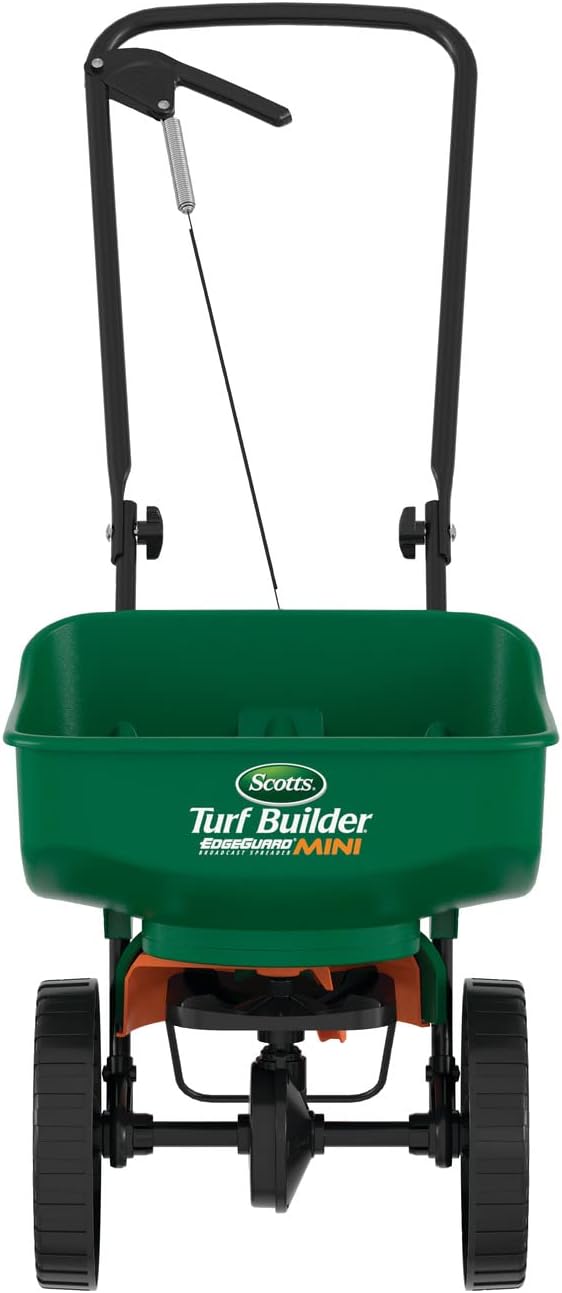
Scotts Turf Builder EdgeGuard Mini Broadcast Spreader
| Capacity | Up to 5,000 sq. ft. |
|---|---|
| Usage | Applies fertilizer, seed, granular weed control, salt, ice melt |
| Features | EdgeGuard side shield; dual-bladed agitator; fold-down handle |
The Scotts Turf Builder EdgeGuard Mini is a ready-to-use broadcast spreader aimed at smaller lawns and targeted spot work. It comes pre-calibrated so you set the dial to the recommended setting, pour in fertilizer, seed, ice melt, or granular weed control, and walk the lawn for even coverage. The hopper and dual-bladed agitator are redesigned to funnel product smoothly and reduce clogging, while open-spoke wheels and a fold-down handle make it easy to maneuver and store. Scotts' EdgeGuard feature blocks product on the right side of the pattern, which helps avoid deposits on sidewalks and landscape beds when edging. Capacity is geared to yards up to about 5,000 sq ft, so it handles typical small properties without being bulky. The main limitations are its smaller coverage area and basic mechanical design compared with larger, more precise spreaders, so it may require more passes on bigger lawns and offers fewer fine-control adjustments for professional users.
Best for: Buyers who want a simple, reliable spreader for small to medium yards and who prioritize ease of use and avoiding overspread onto hard surfaces.
Less Ideal for: Professional landscapers or owners of large properties who need higher capacity and finer control should consider larger commercial-style spreaders.
- Pre-calibrated and ready to use for quick setup
- EdgeGuard side shield reduces product on driveways and sidewalks
- Redesigned hopper and dual-blade agitator for consistent flow
- Fold-down handle and compact size for easy storage and maneuvering
- Smaller capacity suited for lawns up to about 5,000 sq ft so larger lawns need more refills or a larger spreader
- Limited fine adjustment compared with premium or professional models
Verdict: A user-friendly mini broadcast spreader that delivers even coverage for small lawns while keeping product off sidewalks and driveways.
Choosing the Right Garden Spreader for Weed and Feed: Key Factors to Consider
Spread Consistency
Even distribution is the core requirement when applying weed-and-feed. Uneven spread creates darker or lighter strips where weeds can persist or turf can be damaged. Evaluate how the device distributes granules across the full swath width and whether it demonstrates overlap forgiveness when you vary walking speed.
Consistent spread reduces the need for repeat passes and lowers the risk of hot spots from concentrated product. Look for designs that guide material away from the operator and maintain a steady pattern whether you are using fine, free-flowing granules or slightly coated formulations.
Flow Control Precision
Precise rate adjustment matters because weed-and-feed labels specify application rates per area. A spreader with fine, repeatable increments helps you match those rates without guesswork. Consider how easy it is to change settings in the field and whether the mechanism resists clogging or accidental movement.
Flow precision also affects waste. Over-application burns grass and wastes product. Under-application reduces efficacy. The best units let you set and verify the opening size and hold it steady through repeated refills.
Hopper Usability and Maintenance
Hopper shape, fill port size, and material affect how fast you can refill and how easily you can clean the spreader after using weed-and-feed. A wide-mouth hopper reduces spills and makes measuring straightforward. Smooth, corrosion-resistant materials prevent product sticking and make rinsing simpler.
Maintenance matters because residues left in the hopper can react or clog later. Consider models with easily removable hoppers or wide access for brushing and rinsing. A secure cover or lid helps keep moisture out when you store leftover product between uses.
Handling and Maneuverability
How a spreader rolls and feels determines how steady your application will be. Larger wheels and good gearing smooth out inconsistent walking cadence and maintain a constant feed rate. Handle height, grip comfort, and turning radius affect operator fatigue, especially on larger lawns or uneven terrain.
Balance the need for a compact unit that stores easily against a model with longer wheelbase and bigger wheels if your yard has slopes or thicker turf. A stable unit reduces accidental changes in spread width when you navigate corners or obstacles.
Capacity and Refill Frequency
Hopper capacity dictates how often you must stop to refill during a treatment. Larger capacity reduces interruptions but increases weight to push and can make a unit bulkier to store. Match capacity to typical job size: a small lawn benefits from a compact hopper, while an acre requires a larger reservoir.
Also consider how refill frequency affects accuracy. Frequent refills increase the chance of spilled product and inconsistent application if settings are altered during topping up. Choose a capacity that balances convenience and manageable weight.
Compatibility With Product Types
Weed-and-feed formulas can vary in granule size and coating. A spreader that handles both fine and coarse granules without clogging is more versatile. Check whether the feed mechanism tolerates coated slow-release granules and whether the spread pattern remains consistent across product types.
Compatibility also extends to specialized lawn treatments like selective herbicide blends. Using the correct spread pattern and rate for the specific formulation helps avoid off-target damage and improves weed control outcomes.
Preparing the Lawn Before Application
Timing and surface preparation affect how well weed-and-feed works. Mow to the recommended height and remove clippings if they are dense; a clean, uniform surface helps granules reach the soil rather than sitting on thatch. Moisture conditions matter too: many products require dry turf at application and light irrigation afterward to activate the fertilizer component.
Plan your workflow so you can maintain a steady walk speed and consistent overlap. Mark edges or use landmarks to keep parallel passes even. Avoid windy days that scatter granules and reduce accuracy.
- Mow and clear debris before treating
- Apply during calm, dry conditions
- Plan straight, even passes to maintain uniform coverage
Safe Handling and Storage of Weed-and-Feed
Weed-and-feed products contain active ingredients that require care during handling and storage. Use gloves when filling and avoid inhaling dust. Keep pets and children off treated areas until the product has been watered-in or as the label specifies.
Store unused product in a cool, dry place in its original container, away from moisture and direct sunlight. Rinse and dry the spreader hopper after use to prevent residue buildup that can lead to corrosion or clogs.
- Wear protective gloves and avoid direct contact
- Keep treated areas off-limits until safe per label
- Rinse equipment and store in a dry place
Common Spread Patterns and Overlap Techniques
Different spreaders produce different swath shapes. Walk-behind units often give broad, even patterns while drop-style spreaders produce a narrower line. Understand your spreader's pattern and plan overlap to avoid both gaps and double applications.
A consistent walking pace and slightly overlapping passes typically yield the best result. For narrow swath tools, use straighter lines and smaller overlap increments. Track where you started and ended to avoid re-treating the same area accidentally.
- Identify your unit's swath width before full application
- Use slight overlaps to eliminate gaps without double dosing
- Maintain steady walking speed for repeatable coverage
Cleaning and Winterizing Your Spreader
After applying weed-and-feed, clean the hopper and feed mechanism thoroughly. Use a brush and water to remove granules, then allow the spreader to dry fully. Leaving residues can damage components or cause future clogging.
Before storing for winter, check moving parts for corrosion and apply a light lubricant to metal linkages if recommended. Store the spreader in a sheltered, dry spot to preserve plastics and metal finishes.
- Rinse and brush the hopper after each use
- Dry completely to prevent corrosion
- Lubricate moving parts and store sheltered
Adjusting for Lawn Size and Complexity
Match the spreader type and capacity to the size and layout of your lawn. Small, fenced yards and tight spaces benefit from compact units that are easy to maneuver. Larger, open lawns favor units with wider swaths and larger hoppers to cut application time.
For yards with many flower beds, trees, or landscaping features, choose a spreader that allows rapid shutoff or easy re-direction to avoid drift onto non-target plants.
- Compact units for tight or landscaped yards
- Larger hoppers for open, expansive lawns
- Choose shutoff control for precise bordering
How We Chose the Best Garden Spreader for Weed and Feed
We focused on features that directly affect how well a spreader applies weed-and-feed products in a real yard. Important evaluation criteria included spread consistency, which measures how evenly granules are delivered across walk lines and swaths; flow control precision for matching manufacturer label rates without under- or over-applying; and hopper design for ease of pouring, cleaning, and preventing product bridging. We also looked at operational comfort and handling for realistic use. That included wheel size and gearing for steady motion over different turf types, plus chassis durability and corrosion resistance since many weed-and-feed products are chemically active. Coverage capacity and refill frequency were considered to match small to mid-size lawns without frequent stops. Exclusions: we excluded devices intended only for liquids, handheld shaker-style applicators that lack controlled spread patterns, and products without adjustable rate settings. The final list emphasizes spreaders that balance accuracy, durability, and gardener ergonomics.
FAQ
How do I set the correct spread rate for a weed-and-feed product?
Follow the product label to determine the rate per 1,000 square feet and then match that to the spreader's setting table. If your spreader lacks a direct chart, start at a conservative setting and test on a small area; adjust incrementally while measuring area and product used.
Can I use the same spreader for both fertilizer-only granules and weed-and-feed?
Often you can, but check that the feed mechanism handles the granule size and coating of each product. Clean the hopper between different products to prevent chemical interaction and to maintain consistent flow characteristics.
What walking speed should I maintain while spreading?
A steady, moderate walking pace is best because changes in speed alter the amount of product deposited per area. Use landmarks or a metronomic pace to keep your cadence even during each pass.
How soon after applying weed-and-feed can I water the lawn?
Watering instructions vary by product, but many labels recommend a light irrigation after application to activate herbicide and fertilizer components. Wait the time specified on the product label and avoid heavy watering that could cause runoff.
How do I avoid applying weed-and-feed near flower beds or water features?
Shut off the spreader or use a drop-style applicator for tight borders, and always keep a buffer zone between treated turf and desirable plants or water. Sweep up any visible granules from hard surfaces and avoid application on slopes that drain toward water features.
Final Verdict
Choosing the right garden spreader for weed-and-feed hinges on balancing accuracy, capacity, and ease of use. Prioritize a unit with precise flow control and reliable spread consistency if you want evenly treated turf without hot spots. Consider hopper size and handling to match the scale of your lawn and reduce refill interruptions. Your final choice should reflect the product types you use, the shape and size of your yard, and how much time you want to spend refilling and maintaining equipment. Focus on controllable tradeoffs-accuracy versus capacity and maneuverability versus simplicity-to pick a spreader that makes weed-and-feed applications predictable and effective.
