

Note: This article contains affiliate links. If you click on these links and make a purchase, I may earn a small commission at no extra cost to you. This helps support my research and content. Read my full affiliate disclosure here.
When you need to treat larger beds, shrubs, or a small acre, a powered garden sprayer speeds the job and reduces strain compared with manual pumps. The right powered sprayer delivers consistent spray patterns, reliable flow, and enough runtime to complete your planned tasks without repeated refills. This guide covers our seven shortlisted powered garden sprayers suited to home and small-acreage use. We evaluated factors gardeners care about most – tank size, spray control and nozzle options, battery or motor reliability, and ease of maintenance – so you can pick the unit that best fits how you work in the garden.
Top Picks at a Glance
| Best Overall The best all-around choice for most situations | PetraTools HD2000-S 2-Gallon Battery-Powered Garden Sprayer |  |
| Best Quality Built to a higher standard if you want something more solid | Field King 190515 Professional 4‑Gallon Battery Backpack Sprayer |  |
| Best Value The sweet spot between price and what you get | SideKing 2‑Gallon Battery Powered Garden Sprayer with Telescopic Wand and 4 Nozzles |  |
| Best Budget The cheapest option that still gets the job done reliably | SYITCUN 1.35 Gal Battery-Powered Garden Sprayer with 3 Nozzles |  |
| Highest Rated A top-rated pick with lots of positive feedback | Funnywhale Battery-Powered Backpack Sprayer (Compatible with DEWALT 20V) |  |
| Most Popular A crowd favorite that many people choose with confidence | Scotts 2 Gallon Lithium‑Ion Battery Powered Pump Zero Sprayer |  |
| Best Seller A high-volume bestseller chosen again and again | PetraTools HD4000 Battery-Powered 4‑Gallon Backpack Sprayer |  |
PetraTools HD2000-S 2-Gallon Battery-Powered Garden Sprayer
| Tank Volume | 2 gallons |
|---|---|
| Power Source | Battery Powered |
| Hose Length | 48 inches |
| Maximum Pressure | 80 psi |
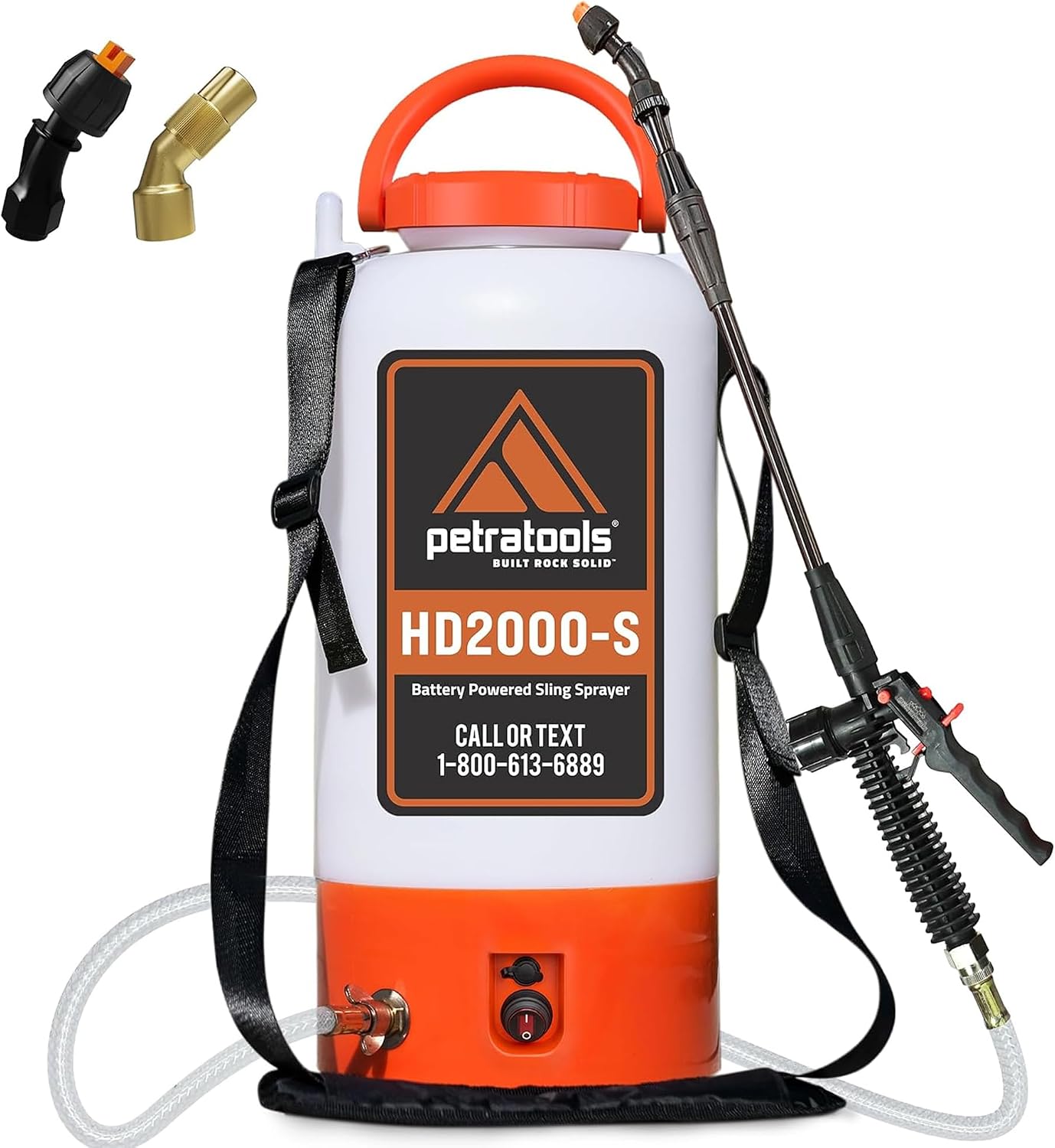
The PetraTools HD2000-S is a battery-powered 2-gallon garden sprayer built to replace manual pumping for routine lawn and garden tasks. It includes a 12V rechargeable battery and charger that the manufacturer says provides up to two hours of runtime, letting you spray continuously for fences, beds, and around ornamental plantings without repeated effort. The sprayer comes with a 4 foot hose, an extendable wand and two interchangeable nozzles (brass adjustable and fan tip) so you can switch between mist and stream patterns for targeted spot treatment or broader coverage. The shoulder strap and ergonomic handle make it easier to carry when full, and metal hose fittings and an HDPE tank reduce the chance of leaks and chemical-wear issues. Limitations to note are the modest 2-gallon capacity, which means more refills on larger properties, and the specified maximum pressure of 80 psi which is adequate for typical garden chemicals but not for high-pressure commercial tasks.
Best for: Gardeners who want to eliminate hand pumping and finish routine fertilizing, weed control, and pest treatments more efficiently while minimizing physical effort.
Less Ideal for: People managing very large properties or commercial landscaping jobs that need longer runtime, larger capacity, or higher spray pressure.
- Battery-powered operation provides up to two hours of continuous spraying so no manual pumping is required
- Includes rechargeable 12V battery and charger for out-of-box use
- Two nozzles (adjustable brass and fan tip) offer mist and stream patterns for versatile application
- Metal hose fittings and HDPE tank construction reduce leak risk and chemical wear
- 2-gallon tank requires frequent refills on larger lawns
- Maximum 80 psi limits use to typical garden applications rather than heavy-duty commercial spraying
Verdict: If you want a cordless sprayer that removes manual pumping and gives adjustable spray patterns for small to medium yards, this 2-gallon PetraTools unit is a practical, ready-to-use choice.
Field King 190515 Professional 4‑Gallon Battery Backpack Sprayer

| Tank Volume | 4 gallons |
|---|---|
| Power Source | Battery Powered |
| Maximum Pressure | 40 psi |
| Hose Length | 50 inches |
The Field King 190515 is a battery-powered backpack sprayer built for repeated, medium‑to‑large spraying tasks like herbicide application, pest control, and foliar feeding. It uses an 18V 2.1 Ah lithium-ion battery that claims about four hours of run time or up to 50 gallons per charge and stores the battery in a protected compartment. The unit has a powder-coated steel frame, a fully padded harness with waist and chest straps for extended use, and a lockable professional shut-off to reduce hand fatigue. A triple filtration system and Viton seals improve chemical resistance and durability, and the kit includes an adjustable brass nozzle plus low/high-volume and foaming nozzles for different coverage needs. Maximum preset pressure is 40 psi, which suits most landscape sprays but limits very high-pressure tasks. The sprayer is not intended for wettable powders and its weight when full makes it more suitable for users who need performance and durability rather than an ultralight option.
Best for: Serious gardeners, landscapers, and property owners who prioritize continuous cordless performance and durability for repeated herbicide, insecticide, or fungicide applications.
Less Ideal for: Casual users who only need occasional light spraying or those who require ultralight equipment for long hikes and remote sites.
- Battery provides cordless operation with up to four hours runtime per charge for lengthy jobs
- Multiple nozzle options including adjustable brass and flat fan nozzles for versatile spray patterns
- Fully padded harness and waist/chest straps for all‑day comfort during professional use
- Viton seals, triple filtration, and a powder‑coated steel frame for chemical resistance and durability
- Not designed for wettable powders so solid formulations cannot be used
- Preset maximum pressure of 40 psi may not suit tasks that require higher-pressure output
Verdict: Choose this sprayer when you need a durable, professional cordless backpack that delivers long runtime and versatile nozzle options for demanding garden and landscape spraying.
SideKing 2‑Gallon Battery Powered Garden Sprayer with Telescopic Wand and 4 Nozzles

| Tank Volume | 2 gallons |
|---|---|
| Hose Length | 63 inches |
| Power Source | Battery Powered |
| Maximum Pressure | 60 psi |
The SideKing 2‑gallon battery sprayer replaces manual pumping with a self‑priming motor and three adjustable pressure levels so you can switch between gentle misting, general fertilizing, and a strong jet for weeds or stains. It is typically used for weed control, lawn and garden treatments, disinfecting, and light home cleaning. Notable features include a 23.6‑inch telescopic stainless wand for reaching high or deep spots, four interchangeable nozzles for different spray patterns, a 2000mAh battery with a handle LED indicator, and a shoulder strap to ease carrying during longer jobs. In practice the variable pressure and nozzle set make it efficient for covering turf and targeting individual plants while reducing wasted chemical. The 2‑gallon HDPE tank resists fertilizers and herbicides and the wide mouth simplifies refills. Limits to expect are the finite 3‑hour runtime on a single charge for heavy continuous use and the battery and motor add weight compared with simple handheld sprayers, so it is best for users who value time savings over minimal hardware.
Best for: Gardeners who prioritize finishing yard and treatment tasks quickly and efficiently and want a powered sprayer that reduces physical strain while offering adjustable coverage.
Less Ideal for: People who only need a compact sprayer for occasional spot treatments or who prefer the lightest possible handheld option.
- Automatic motorized pumping removes manual effort and speeds up large jobs
- Three pressure settings let you match spray intensity to delicate plants or stubborn weeds
- Includes telescopic stainless wand and four nozzle types for precise and versatile coverage
- LED battery indicator and 2000mAh battery provide up to about three hours of runtime per charge
- Battery and motor make it heavier than basic pump sprayers for extended handheld use
- Continuous heavy spraying can exhaust the battery sooner than lighter intermittent tasks
Verdict: If you want to cut pumping time and handle yard spraying for an average lawn with adjustable pressure and reach, this battery sprayer delivers practical, time‑saving performance.
SYITCUN 1.35 Gal Battery-Powered Garden Sprayer with 3 Nozzles
| Tank Volume | 1.35 gallons |
|---|---|
| Power Source | Battery Powered |
| Material Type | Plastic |
| Included Components | Nozzle, Shoulder Strap |
| Style Name | Handheld |
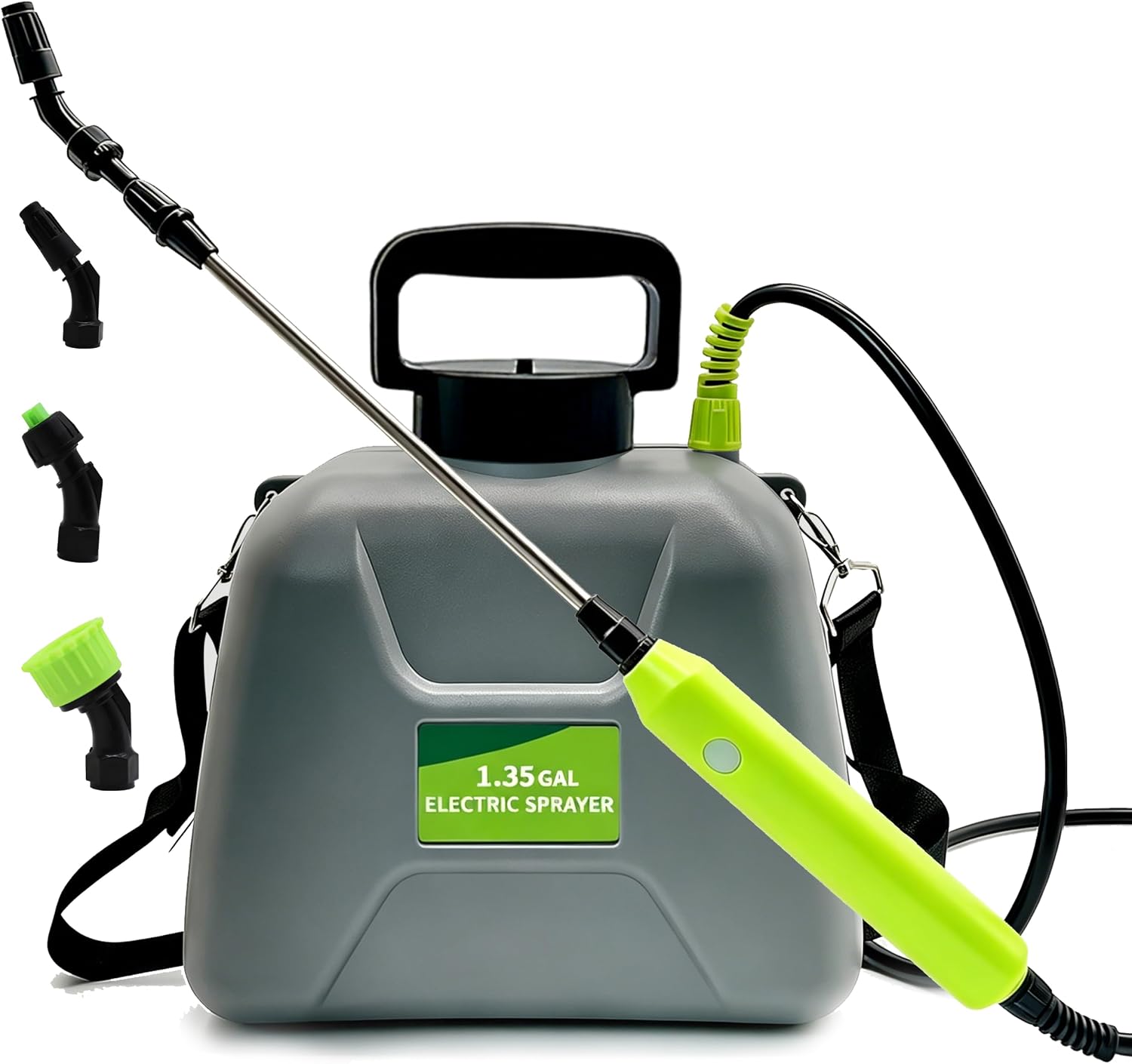
This SYITCUN battery-powered sprayer removes the need to pump by using a 2200mAh battery to produce steady pressure for about 2.5 to 3 hours per charge. It is designed for everyday yard tasks: fill the 1.35 gallon tank to water beds, apply liquid fertilizer or herbicide, and switch between three included nozzles for misting, broad spray, or a focused jet. The wide tank opening and built-in filter make filling and cleaning straightforward, and the adjustable shoulder strap helps distribute weight for longer jobs. Practical touches include a water-resistant handle, easy on/off trigger, and a leak-tested design when connections are tightened. Expect the unit to be most useful for small to medium lawns and routine maintenance; it is not a commercial machine and run time and spray power depend on battery charge and nozzle selection. Regular rinsing after use is required to avoid nozzle clogging and maintain reliable performance over time.
Best for: Good for budget-minded homeowners who want an easy, cordless sprayer for regular watering, fertilizing, and spot weed control around a small to medium yard.
Less Ideal for: Not a great fit for commercial landscapers or large acreage where longer run time, higher pressure, or heavier-duty construction is required.
- Battery-powered for continuous spray without manual pumping
- 1.35 gallon tank covers most medium lawns in one fill
- Three interchangeable nozzles for mist, fan, and jet applications
- Wide opening and built-in filter simplify filling and cleaning
- Adjustable shoulder strap and lightweight construction make it easy to carry
- Not intended for heavy commercial use or very large properties
- Performance and run time depend on battery charge and may decline over time
Verdict: A simple, affordable battery sprayer that saves time and effort for routine garden tasks on small to medium yards.
Funnywhale Battery-Powered Backpack Sprayer (Compatible with DEWALT 20V)

| Tank Volume | 4 gallons |
|---|---|
| Power Source | Battery Powered |
| Maximum Pressure | 120 psi |
| Material Type | Acrylonitrile Butadiene Styrene (ABS) |
This Funnywhale backpack sprayer is a cordless, battery-powered unit designed for routine garden and lawn spraying. It accepts a DEWALT 20V battery (battery not included) and runs a pump that can reach up to 120 psi, letting you switch between fine mist and higher-pressure streams. The 4.2 gallon tank and clear scale make refilling and level checks straightforward, and the padded shoulder straps plus waist support help distribute weight during longer jobs. The kit includes six nozzles, a fiberglass wand and a telescoping stainless wand for reaching borders or taller plants, so you can handle watering, light pesticide application, and cleaning tasks. Practical limitations are that the battery and charger are not supplied and the product description notes the pressure knob behavior is linked to the power switch, which may be confusing at first. Construction from ABS plastic keeps the unit lightweight but means you should avoid highly corrosive chemicals. For everyday garden and lawn work this sprayer is a convenient, mobile option if you already own a compatible 20V battery.
Best for: Gardeners and homeowners who prioritize a dependable, cordless sprayer for routine watering, herbicide or detergent application and already own or plan to use a compatible 20V battery.
Less Ideal for: People who need a complete kit with battery and charger included or those who regularly apply highly corrosive chemicals should consider other options.
- Compatible with common DEWALT 20V batteries for cordless operation
- 4.2 gallon tank reduces refill frequency for medium-sized yards
- Up to 120 psi allows both fine misting and stronger spray patterns
- Includes six nozzles plus two wands for versatile spraying tasks
- Padded shoulder straps and waist support improve comfort during use
- Battery and charger are not included
- ABS construction and component choices suggest avoiding strong corrosives
- Pressure adjustment behavior is tied to power switch and may be unintuitive
Verdict: A practical cordless backpack sprayer for reliable, mid-size garden and lawn jobs when paired with a DEWALT 20V battery you already own.
Scotts 2 Gallon Lithium‑Ion Battery Powered Pump Zero Sprayer
| Tank Volume | 2 gallons |
|---|---|
| Power Source | Battery Powered |
| Maximum Pressure | 21 psi |
| Hose Length | 21 inches |
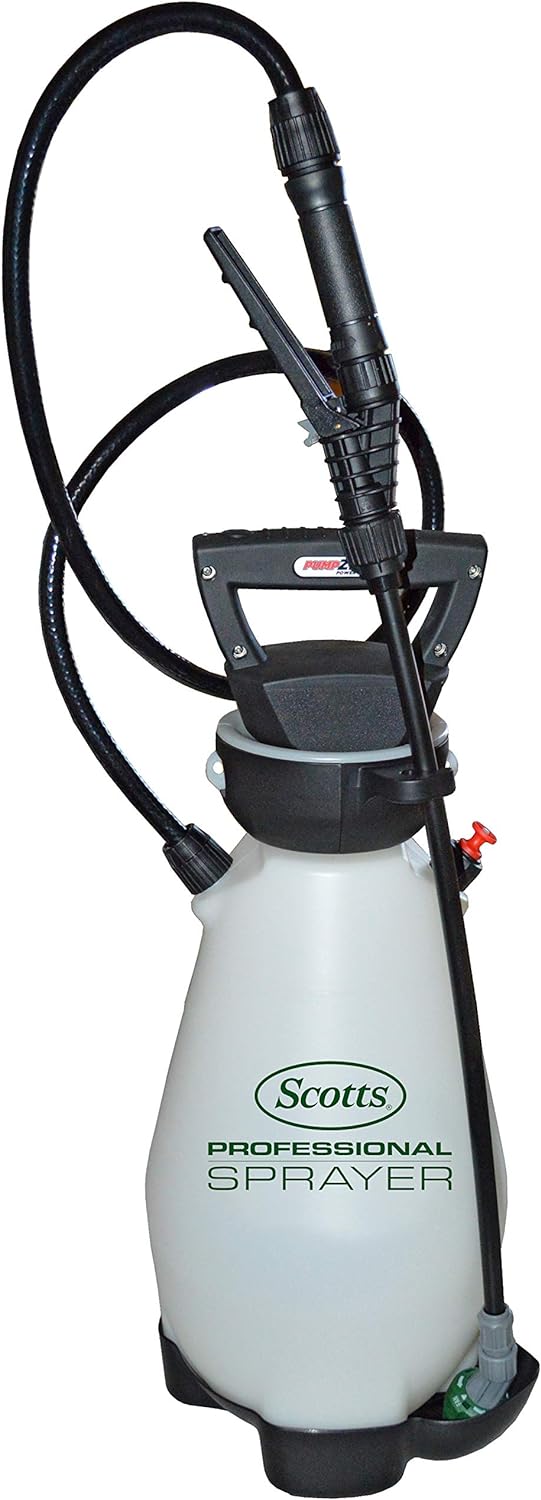
The Scotts 2‑gallon Pump Zero sprayer replaces hand pumping with an internal lithium‑ion battery and electric air compressor pump to deliver consistent pressure for lawn and garden tasks. You fill the tank with a water‑soluble solution, charge the battery, then use the wand and three‑way nozzle (fan, stream, cone) to cover large surfaces, spot treat weeds, or water plants. Notable features include a lockable commercial‑grade shutoff to reduce hand fatigue, Viton seals for chemical resistance, an in‑line filter, a pressure relief valve for safe opening, and a 21‑inch wand for reach. The unit is built for convenience: the pump reportedly runs multiple tanks per charge and the tank shape and nozzle storage help with stability and transport. Important trade‑offs are the 2‑gallon capacity, which limits continuous runtime for large properties, and the reliance on battery charge versus a manual backup. For homeowners who value consistent spray patterns and less physical effort, it streamlines routine spraying; for heavy commercial use you may want a larger capacity or a spare charged unit.
Best for: Home gardeners who want a cordless sprayer that reduces physical pumping and delivers predictable spray performance for routine weed control, pest treatment, fertilizing, and spot watering.
Less Ideal for: Landscape professionals or users who need long continuous run time and larger tank capacity for treating multiple acres without frequent refills or spare batteries.
- Battery powered pump removes need for manual pumping and delivers consistent pressure
- Three‑way adjustable nozzle (fan, stream, cone) for versatile coverage
- Viton seals and nickel‑plated brass poppet improve chemical resistance and durability
- Lockable commercial‑grade shutoff reduces hand fatigue and allows continuous spraying
- 2‑gallon tank limits continuous coverage on larger properties
- No manual pump backup if battery runs out during use
Verdict: For homeowners who want a no‑pump, cordless sprayer that delivers consistent, adjustable spray patterns for routine garden tasks, this Scotts model is a practical, low‑effort choice.
PetraTools HD4000 Battery-Powered 4‑Gallon Backpack Sprayer

| Tank Volume | 4 gallons |
|---|---|
| Power Source | Battery Powered |
| Maximum Pressure | 90 psi |
| Hose Length | 48 inches |
The PetraTools HD4000 is a battery-powered backpack sprayer designed to replace hand-pumping for medium to large yards and professional-style jobs. It holds 4 gallons and runs on a 12V8AH battery that the manufacturer says delivers long runtime and can pump roughly 200+ gallons per charge, so you can cover large areas without frequent recharging. The unit includes six interchangeable nozzles and an adjustable pressure range up to 90 PSI, which makes it useful for misting, targeted spot treatment, and stronger stream applications for weed or pest control. Practical touches include a translucent tank with gallon markings, a wide-mouth lid for easy filling and cleaning, a screen filter to reduce clogs, and double-padded straps plus a back pad to reduce fatigue during extended use. Important limitations are its filled weight (backpack sprayers get heavy when full) and that optimal performance depends on following proper mixing and nozzle selection; heavier chemicals may require slower application. The HD4000 is a solid choice when you want cordless convenience and adjustable output for varied garden tasks.
Best for: Buyers who want a cordless, no-pump sprayer that balances runtime, adjustable output, and comfort for regular lawn, garden, or small professional jobs.
Less Ideal for: People who need an ultralight solution for very small gardens or who cannot manage carrying a filled 4‑gallon pack should consider smaller sling or handheld sprayers.
- Battery-powered pump eliminates manual pumping for continuous spray
- Adjustable 40–90 PSI pressure and six nozzles let you match spray pattern to the task
- Long-run 12V8AH battery suited for covering larger lawns without frequent recharging
- Translucent tank with gallon markers and wide mouth make filling and monitoring simple
- Padded straps and back pad improve comfort during extended use
- Backpack will be heavy when the 4‑gallon tank is full
- Performance depends on correct nozzle and pressure choice for different chemicals
Verdict: Choose the HD4000 if you want cordless, long‑runtime spraying with adjustable pressure and multiple nozzles for versatile lawn and garden applications.
Choosing the Right Powered Garden Sprayer: Key Factors to Consider
Tank Capacity and Shape
Tank capacity determines how much area you can cover between refills. Larger tanks let you treat beds or multiple borders without stopping, but they increase weight and can make the sprayer harder to carry or mount. Tank shape matters too. Slim, contoured tanks sit closer to the back and are easier to carry as a backpack, while wider tanks lower the center of gravity for handheld rigs.
Consider what you usually treat. If you have scattered shrubs and small beds, a medium tank often balances capacity and comfort. For repeat passes over large plots, prioritize higher capacity but factor in how you will transport and lift the filled unit.
Spray Control and Nozzle Options
Precise spray control affects coverage uniformity and chemical use. Look for adjustable pressure controls or multiple nozzle fittings so you can switch between a fine mist for foliar feeding and a coarse fan for spot treatments. Nozzles that are easy to swap without tools speed workflow when you move between tasks.
Mismatch between nozzle type and pressure can cause drift or wasted product. A sprayer that offers both adjustable flow and nozzle variety will adapt to seedlings, established plants, and targeted pest control with less mess and better coverage.
Power Source and Runtime
Powered garden sprayers use either battery motors or small electric motors driven by an AC source. Battery units offer portability and are useful where extension cords are impractical. Consider expected runtime per charge and whether spare batteries or fast charging are options. Motor-driven models can provide continuous operation but need a nearby power source or a generator.
Power delivery affects spray consistency under load. A motor that maintains pressure when the nozzle demand changes gives smoother coverage. Also check how long the unit runs at typical pressure settings you plan to use rather than peak numbers that may not reflect real tasks.
Durability and Chemical Resistance
Garden chemicals and fertilizer solutions can degrade weak materials. Tanks, seals, hoses, and fittings should be made of corrosion-resistant plastics or coated metals to withstand repeated exposure. UV-resistant finishes help where storage is outdoors or in bright sheds to reduce brittleness and cracking over time.
Inspect how easy it is to inspect seals and whether replacement parts are standard. A unit that leaves you performing frequent emergency repairs increases long-term cost and downtime.
Ergonomics and Weight Distribution
How a sprayer carries and handles determines how long you can use it without fatigue. Backpack-style powered sprayers should have padded shoulder straps and a supportive back panel that spreads weight across the hips and shoulders. Handheld and wheeled units must place controls within easy reach so you do not strain while walking borders.
Balance is critical when tanks are partially full. A well-designed shape reduces sloshing and shifting that cause discomfort or uneven spray. Consider how the filled weight matches your physical capability and whether you can transfer it easily around the yard.
Serviceability and Ease of Cleaning
Routine cleaning prevents clogging and chemical buildup. Look for tank openings large enough for hand access or a cleaning brush and hose connector points that make flushing simple. Removable filters and nozzles that disassemble without tools speed maintenance.
Serviceability also includes how straightforward it is to replace worn seals, batteries, or pumps. Units designed with common fasteners and available spare parts reduce long-term headaches and keep your sprayer ready when pests or diseases demand timely treatment.
When to Choose Battery-Powered Vs. Corded
Battery-powered sprayers shine when you need freedom of movement and there is no easy access to mains power. They are convenient for remote corners, community plots, and greenhouse benches where cords would tangle or restrict movement. Consider how long a single charge lasts at your typical pressure and whether carrying a spare battery fits your workflow.
Corded electric sprayers can be preferable for long, uninterrupted sessions where a reliable, constant power supply eliminates downtime for charging. They also tend to be lighter because they do not carry battery weight. Evaluate whether you will need extension cords and if the area you treat safely accommodates them.
- Battery units: portable, limited runtime, useful where cords are impractical
- Corded units: continuous operation, lighter carry weight, need safe cord management
Nozzle Types and Spray Patterns Explained
Nozzles determine the droplet size and pattern of delivery. Flat fan nozzles give broad, even coverage for foliar feeding and herbicide application. Cone nozzles can create finer sprays for thorough leaf coverage. For spot treatments, adjustable stream nozzles or turbo tips let you target problem areas without wasting product.
Match nozzle choice to task and weather. Fine droplets drift more easily on windy days, so save those for calm conditions or enclosed spaces. Coarser patterns resist drift but may not coat undersides of leaves as thoroughly.
- Flat fan for broadcast coverage
- Cone nozzles for fine foliar application
- Stream nozzles for targeted spot work
Maintaining Your Powered Sprayer for Long Life
Flush the tank and lines after each use, especially when applying fertilizers or stronger chemicals. A thorough rinse prevents residue buildup that clogs nozzles and degrades seals. Remove and clean filters regularly and inspect hoses for soft spots or cracking.
Store the unit dry and protected from direct sunlight to prevent UV damage. In winterize-prone climates, remove batteries for indoor storage and run a mild antifreeze solution through pumps if the manufacturer suggests it. Replace wear items on a schedule based on use frequency rather than waiting for failure.
- Flush tank and lines after use
- Clean or replace filters regularly
- Store dry and protect from UV
Safety and Chemical Handling Best Practices
Always follow label directions for any product you spray. Use appropriate personal protective equipment, such as gloves, eye protection, and a mask when required. Be mindful of drift and avoid spraying on windy days to protect nearby plants, pollinators, and water sources.
Measure chemicals carefully and mix in a well-ventilated area. Mark sprayer tanks with the solution name and date if you keep multiple mixtures on hand. Keep a clean water source nearby for rinsing skin or equipment in case of accidental exposure.
- Wear PPE recommended on chemical labels
- Avoid spraying in wind to reduce drift
- Rinse equipment and skin promptly after exposure
Accessories That Improve Efficiency
Useful accessories include spare nozzle sets for quick task changes, inline filters to protect pumps, and hose reels for corded models to keep work areas tidy. A shoulder strap or hip belt can make a heavy backpack sprayer more comfortable on long runs.
Consider a small toolkit with common replacement O-rings and hose clamps so you can field-repair minor leaks. For battery models, a fast charger or an extra battery can double your working time without retreating to recharge.
- Spare nozzles and inline filters
- Comfort straps or hip belts
- Field repair kit and spare battery or charger
How We Chose the Best Powered Garden Sprayer
We shortlisted units that perform well in real garden conditions and stay practical for home and small-acreage users. Our editorial filters emphasized functional, testable characteristics that affect daily use and long-term ownership. Primary evaluation criteria included tank capacity and refill practicality, because capacity dictates how much area you can cover before stopping. We assessed spray control and nozzle versatility to ensure even coverage across seedlings, leafy shrubs, and hard-to-reach spots. Power source reliability and runtime were examined to compare battery endurance or motor performance under load. Build quality and corrosion resistance were considered for units that will see chemical exposure and outdoor storage. Finally, serviceability and ease of cleaning were used to judge how simple routine maintenance and winterizing will be. We excluded products that are clearly designed only for ultra-light indoor use or heavy commercial application outside the small-acreage scope. Units without accessible spare parts, poor user documentation, or clearly inadequate chemical resistance were not considered. The result is a group of powered garden sprayers that match homeowner and hobby-farm needs while varying by capacity, ergonomics, and spray control.
FAQ
How often should I clean the sprayer after use?
You should rinse and flush the tank, hose, and nozzles after every use, especially when switching chemical types. Regular cleaning prevents clogs, chemical buildup, and seal degradation.
Can I use the same sprayer for fertilizers and pesticides?
Often you can, but it depends on the chemicals. Thorough cleaning between uses is essential. For strong chemicals or residual herbicides, consider dedicating a unit or using extra-careful cleaning to avoid cross-contamination.
What runtime should I expect from a battery sprayer?
Runtime varies by battery capacity and operating pressure. Typical consumer battery sprayers run long enough for most home tasks on a full charge, but heavy continuous use will shorten runtime. Plan for spare battery capacity if you regularly cover large areas.
Are replacement parts widely available for powered sprayers?
Availability varies by design, but many common parts like nozzles, seals, and filters are standard sizes and replaceable. Choose units with accessible parts and clear maintenance documentation to reduce downtime.
How do I prevent drift when spraying?
Use coarser droplet settings or lower pressure for windy conditions, spray during calm parts of the day, and select nozzles that produce larger droplets. Also maintain a safe distance from sensitive plants and water sources.
Is it better to use a backpack or handheld powered sprayer?
It depends on the task and your comfort. Backpacks distribute weight for longer sessions and larger areas. Handhelds are lighter and fine for quick spot treatments or small beds. Choose based on how much area you typically cover.
Final Verdict
Powered garden sprayers simplify larger jobs by delivering consistent coverage with less physical strain. When choosing, weigh the tradeoffs between tank capacity and portability, and prioritize reliable spray control and corrosion-resistant components for long-term use. Focus on the features that match how you garden: choose higher capacity and comfortable ergonomics for extended runs, or prioritize lighter, battery-powered models for scattered tasks and mobility. With those tradeoffs in mind, you can select a powered sprayer that balances coverage, runtime, and serviceability for dependable season-after-season performance.
