

Note: This article contains affiliate links. If you click on these links and make a purchase, I may earn a small commission at no extra cost to you. This helps support my research and content. Read my full affiliate disclosure here.
If you want reliable compost without complicated steps, an easy compost bin streamlines kitchen-to-garden recycling so you can feed beds and containers with less fuss. The right bin reduces odors, encourages fast decomposition, and fits into the space you have whether that is a small balcony, a suburban yard, or a shed. This guide covers seven shortlisted Easy Compost Bins chosen for real-world garden use and compares how they handle aeration, moisture control, and maintenance. Read on for practical notes on setup, ongoing care, and which features will save you time in the garden.
Top Picks at a Glance
| Best Overall The best all-around choice for most situations | Nazhura Dual-Chamber 43 Gallon Compost Tumbler Bin |  |
| Best Quality Built to a higher standard if you want something more solid | Miracle-Gro Dual Chamber Compost Tumbler (2 × 18.5 gal) |  |
| Best Value The sweet spot between price and what you get | VIVOSUN Outdoor Tumbling Composter, Dual-Chamber 43 Gallon |  |
| Best Budget The cheapest option that still gets the job done reliably | Kichly 0.8‑Gallon Indoor Compost Bin with Lid and Wall-Mount Holder |  |
| Highest Rated A top-rated pick with lots of positive feedback | RED FACTOR Stainless Steel Kitchen Compost Bin with Dual Carbon Filters (1.3 gal) |  |
| Most Popular A crowd favorite that many people choose with confidence | Utopia Kitchen Countertop Compost Bin, 1.3 Gallon Stainless Steel |  |
| Best Seller A high-volume bestseller chosen again and again | GEOBIN Backyard Compost Bin, Expandable Plastic Composter |  |
Nazhura Dual-Chamber 43 Gallon Compost Tumbler Bin

| Capacity | 43 gallons |
|---|---|
| Material Type | Plastic and Galvanized Steel |
| Manufacturer Warranty Description | 1 Year |
The Nazhura dual-chamber compost tumbler is a practical outdoor bin that speeds up backyard composting by combining insulated rotating chambers with internal mixing when turned. You load kitchen scraps and yard waste into either chamber, let material heat and break down, then rotate the tumbler occasionally to aerate and mix the pile; one chamber can be active while the other finishes so you can compost continuously. Notable features include the side-by-side dual chambers for staggered batches, a slide-open access door for easy removal of finished compost, and construction using plastic with galvanized steel supports for weather resistance. In practice the unit makes managing smaller household volumes straightforward and keeps material off the ground to reduce pests and mess. Limitations are its 43 gallon capacity, which suits small to medium households but may require more frequent emptying for heavy gardeners, and the plastic body means very hot internal temperatures are harder to maintain than in larger insulated systems. Assembly and periodic turning are required to get the fastest results.
Best for: Gardeners who want a tidy, space-efficient way to turn household scraps into usable compost on an ongoing schedule and who value ease of use and continuous batches.
Less Ideal for: People with very large yards, frequent high-volume green waste, or those who need professional-scale hot composting results should consider larger or purpose-built insulated systems instead.
- Dual-chamber design allows continuous composting by loading one side while the other finishes
- Rotating tumbler and internal mixing accelerate decomposition compared with static bins
- Slide-open access door makes removing finished compost quick and tidy
- Plastic body with galvanized steel support resists outdoor weathering and reduces direct contact with pests
- 43 gallon capacity may be small for large yards or heavy kitchen waste producers
- Plastic construction limits maximum internal heat compared with larger insulated or insulated-metal systems
Verdict: A compact, easy-to-use dual-chamber tumbler that lets practical gardeners run continuous small-batch composting with minimal mess and effort.
Miracle-Gro Dual Chamber Compost Tumbler (2 × 18.5 gal)

| Capacity | 37 gallons |
|---|---|
| Material Type | Alloy Steel (frame) and UV-protected plastic (barrel) |
This dual-chamber Miracle-Gro tumbler is a user-friendly solution for gardeners who want a steady supply of finished compost without manual turning. Each chamber holds 18.5 gallons, so you can load one side while the other finishes curing; the barrel rotates on a galvanized steel frame for easy turning and faster aeration. The molded, UV-protected plastic and side-locking seals are designed to resist weather and help keep pests out, and the maker claims finished compost in roughly 4 to 6 weeks under good conditions. Typical use is adding balanced green and brown materials, rotating the tumbler every few days, then unlocking the sliding door to remove cured compost. Practical benefits include reduced physical labor compared with pile turning and a continuous workflow from dual chambers. Limitations to note are modest total capacity for very large gardens and reliance on correct moisture and feedstock balance to hit the faster decomposition times; very cold winters will slow processing. Assembly and placement on a level spot are important for smooth rotation.
Best for: Gardeners who value steady, low-effort compost production backed by a well-known brand and want the assurance of a proven dual-chamber system for regular use.
Less Ideal for: People needing very large-volume commercial composting or those who prefer an open windrow or in-ground hot compost system for maximum throughput.
- Dual-chamber design lets you add fresh material while another batch cures for continuous compost supply
- Rotating barrel on a galvanized steel frame makes aeration easy with minimal physical effort
- UV-protected plastic and tight side locks help resist weather and reduce pest access
- Produces finished compost relatively quickly when fed and moistened correctly
- 37-gallon combined capacity may be small for very large or heavy-production gardens
- Performance depends on proper moisture, material mix, and ambient temperature to reach claimed speed
Verdict: Choose this dual-chamber tumbler if you want a simple, low-labor way to produce a steady stream of finished garden compost with reliable pest protection.
VIVOSUN Outdoor Tumbling Composter, Dual-Chamber 43 Gallon
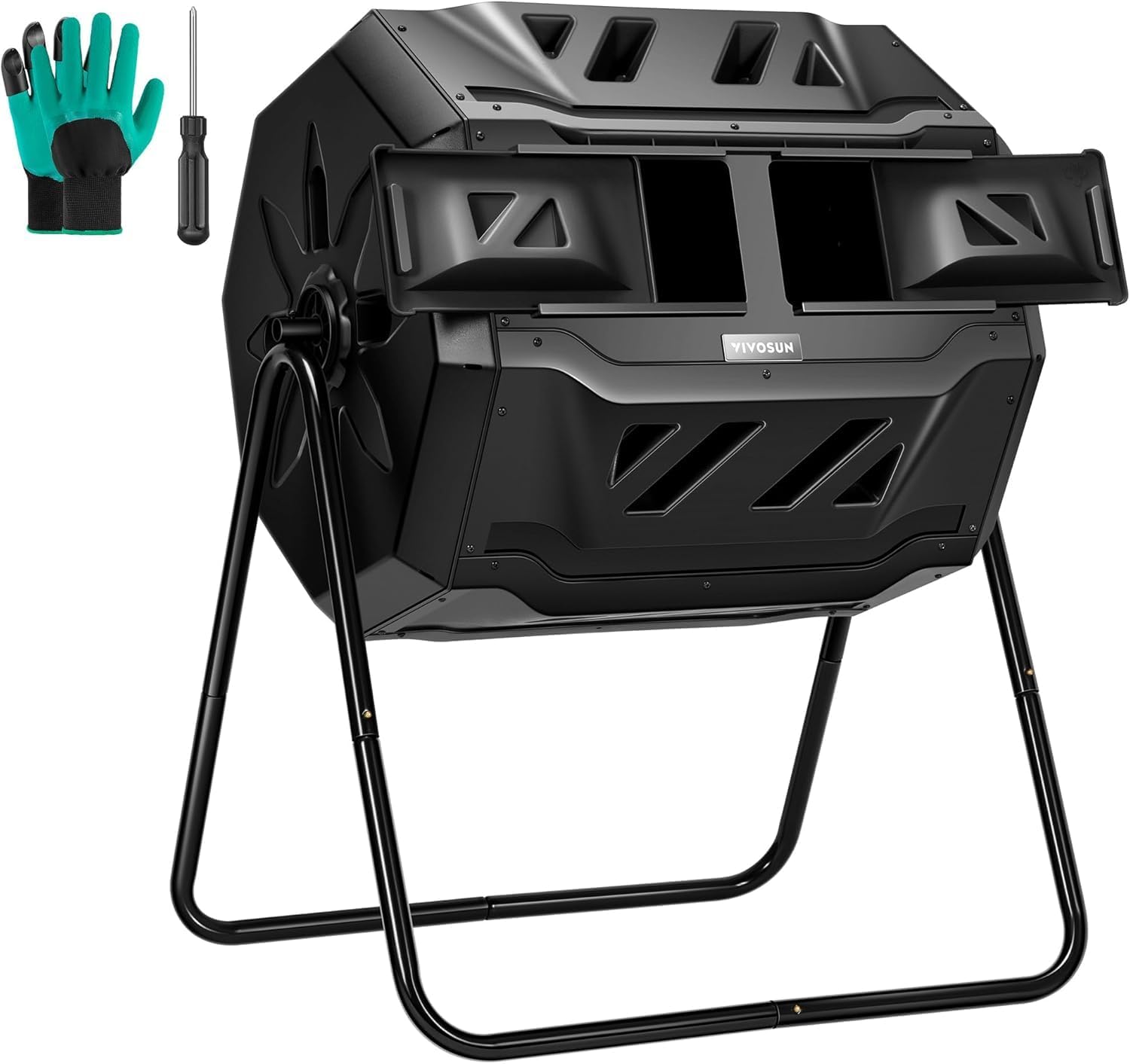
| Material Type | galvanized steel |
|---|---|
| Capacity | 43 gallons |
This VIVOSUN tumbling composter is a practical backyard unit built around two rotating chambers so you can add fresh waste to one side while the other finishes breaking down. The 360 degree tumbling design with deep internal fins makes turning the pile simple and helps break up clumps without digging. Ventilation slots around the drum promote airflow for aerobic decomposition, and the metal frame with a PP plastic barrel is designed to resist corrosion and outdoor weathering. It comes with waterproof garden gloves and small digging claws to make loading and aerating easier. At 43 gallons it is sized for a family garden or vegetable patch but is compact enough for a patio or small yard. Limitations to note are that it requires occasional manual turning to maintain activity and that the plastic drum means it will warm less in cold climates than insulated models, so composting speed will vary by season. Assembly and placement on a level spot are also important for smooth rotation.
Best for: Gardeners who want a hands-on, efficient system to produce regular batches of compost without digging a pile and who prioritize continuous output and easy turning.
Less Ideal for: People who need a completely hands-off hot composter or who compost only very large volumes; those in very cold climates seeking year-round rapid breakdown should consider insulated or electric options.
- Dual chambers let you load new material while another batch finishes, ensuring continuous compost production
- 360 degree tumbling with deep fins makes mixing and aeration easy without manual digging
- Galvanized steel frame and PP plastic barrel designed for outdoor durability and corrosion resistance
- Ventilation slots support aerobic breakdown for faster, less smelly composting
- Plastic drum offers less insulation than insulated or fully metal units, slowing composting in cold weather
- Requires manual turning and regular management to maintain heat and moisture for fast results
Verdict: If you want steady, manageable batches of compost with easy tumbling and continuous use, this dual-chamber VIVOSUN tumbler delivers practical, durable performance.
Kichly 0.8‑Gallon Indoor Compost Bin with Lid and Wall-Mount Holder

| Capacity | 0.8 gallons |
|---|---|
| Material Type | PVC, Polypropylene (PP) |
| Item Weight | 9.44 ounces |
This compact Kichly compost bin is designed for simple, everyday kitchen scrap collection. It holds about 0.8 gallons, so it is best for small households or single cooks who want a tidy place for peels, coffee grounds, and other food waste. You can leave it on the countertop or use the included holder and adhesive hook to hang it under a cabinet or on a wall, which saves counter space and keeps scraps out of the way. The polypropylene interior and lightweight construction make it easy to empty and rinse, and the covered lid helps contain odors between trips to an outdoor composter or municipal pickup. Because of its small capacity the bin needs frequent emptying if you cook a lot, and it is not suitable as a full composting system on its own. The straightforward plastic construction is practical but not insulated or carbon-filtered, so odor control depends on regular cleaning and prompt emptying.
Best for: Budget-minded cooks or individuals living in small apartments who need an inexpensive, space-saving container to collect daily food scraps before transferring them to a larger composter or collection service.
Less Ideal for: Families or households that generate a lot of kitchen waste or users seeking a self-contained indoor composting system with active odor filtration.
- Compact 0.8‑gallon capacity fits small kitchens and takes little counter space
- Can be wall‑mounted with included holder and adhesive hook to free up counters
- Lightweight polypropylene construction is easy to lift, empty, and rinse
- Covered lid helps contain food scraps and reduce occasional odors
- Small capacity requires frequent emptying for households that generate more scraps
- No built‑in charcoal filter or insulation for long‑term odor control
Verdict: A no‑frills, affordable countertop or wall‑mount compost bin that keeps small amounts of kitchen scraps contained and is easy to clean.
RED FACTOR Stainless Steel Kitchen Compost Bin with Dual Carbon Filters (1.3 gal)

| Capacity | 5 liters |
|---|---|
| Material Type | Stainless Steel |
| Filter | Double active carbon filters |
| Included | Spare active carbon filter |
This RED FACTOR kitchen compost bin is built for everyday countertop use: you toss fruit and vegetable scraps, coffee grounds, eggshells and tea bags into the 1.3 gallon pail and empty it weekly into an outdoor pile or larger compost system. The stainless steel single-sheet body resists rust and is easy to wipe clean while the soft-grip handle makes carrying the bin to an outdoor compost heap straightforward. A notable feature is the lid’s dual active-carbon filters plus ventilated lid design, which help neutralize smells and reduce fruit flies so the bin can live in the kitchen even in warm weather. The package includes a spare filter which lowers short-term maintenance. Limitations are the small capacity, which means frequent emptying for larger households, and the filters will need replacing periodically if odors develop. The bin is not dishwasher-safe, so cleaning requires hand washing.
Best for: Buyers who want a reliable, low-maintenance countertop compost solution that controls kitchen odors and is easy to carry to an outdoor compost pile.
Less Ideal for: People who need a higher-capacity indoor system for large families or users who prefer fully hands-off, machine-washable containers.
- Stainless steel single-sheet construction resists rust and is easy to clean
- Dual active-carbon filters plus ventilated lid reduce odors and fruit flies
- Compact 1.3 gallon capacity fits on kitchen countertops and saves trips outside
- Includes a spare filter so you can keep using the odor control system right away
- Small capacity requires frequent emptying for multi-person households
- Not dishwasher-safe so cleaning is manual
Verdict: A dependable, stylish stainless steel countertop compost pail with dual carbon filters that keeps kitchen scraps odor-controlled and easy to manage.
Utopia Kitchen Countertop Compost Bin, 1.3 Gallon Stainless Steel

| Capacity | 4.92 liters |
|---|---|
| Material Type | Stainless Steel |
| Item Highlight | Odorless countertop compost bin with charcoal filter |
| Item Type Name | Kitchen Compost Bin for Kitchen Countertop – 1.3 |
This stainless steel countertop compost bin is designed for everyday kitchen use as a small, tidy container for food scraps until they move to an outdoor pile or municipal collection. It holds roughly 1.3 gallons, enough to collect a week of typical household fruit and vegetable peelings or coffee grounds for one to two people. The cylindrical stainless steel body looks neat on a counter and resists chips or cracks that plastic bins can show. A tight-fitting lid and replaceable charcoal filter reduce odors so you can keep the bin in the kitchen without noticeable smells for several days. Cleaning is straightforward: line with paper or rinse with mild soap as needed. The main limitations are capacity and active composting functions; this is a holding bin not a hot composter, so you still need to empty it regularly and manage moisture by draining liquids or using absorbent liners. If you need a larger or processing-capable unit this will not replace that role, but as a clean, low-maintenance countertop catcher it performs well.
Best for: Buyers who want a low-maintenance, odor-controlled way to collect daily kitchen scraps on the counter and prefer a durable, attractive container over hidden plastic buckets.
Less Ideal for: Households that generate large volumes of food waste or want a single device that actively processes compost rather than temporarily storing scraps.
- Stainless steel construction resists scratching and looks tidy on a countertop
- Charcoal filter and tight lid help control odors for several days
- Compact 1.3 gallon capacity fits small kitchens and does not take much prep-space
- Easy to clean by rinsing or lining with paper to absorb liquids
- Small capacity requires frequent emptying for larger households
- Does not accelerate decomposition or perform active composting
Verdict: A compact, durable countertop catcher with a charcoal filter that keeps kitchen scraps contained and largely odor-free for users who want simple, low-effort indoor compost storage.
GEOBIN Backyard Compost Bin, Expandable Plastic Composter

| Capacity | 216 gallons |
|---|---|
| Material Type | Plastic |
| Shape | Cylindrical |
The GEOBIN Backyard Compost Bin is a lightweight, cylindrical plastic composter designed for straightforward backyard use. It assembles quickly with a few closure keys and expands to increase capacity, so you can start with a small footprint and add volume as your kitchen scraps and yard waste grow. The open-structure design gives excellent ventilation, which helps speed up decomposition when you layer greens and browns and turn the pile occasionally. Because it is low-tech and portable, it is easy to move, empty, or reassemble if you relocate it in the yard. The practical benefits are its affordability, ease of setup, and versatility for beginners and experienced gardeners who want a no-fuss system. Limitations are that it is a basic ring-style bin with no insulated walls or built-in access door, so it will not retain heat as well as tumblers or insulated bins and requires manual turning and occasional maintenance to keep the process active.
Best for: Budget-conscious gardeners who want a low-cost, low-effort way to compost yard trimmings and kitchen scraps without complicated setup.
Less Ideal for: People who need fast, high-temperature composting or a bin with a convenient bottom access door for frequent harvests should consider other designs.
- Expandable capacity up to 216 gallons (listed) to handle increasing compost volume
- Very easy assembly with simple closure keys
- Lightweight and portable for repositioning or storage
- Good ventilation that helps organic material break down faster
- No insulated walls or built-in access door for easy compost removal
- Basic plastic construction offers less heat retention than enclosed designs
Verdict: A very affordable, easy-to-assemble composter that gives budget gardeners a simple, expandable solution for backyard composting.
Choosing the Right Easy Compost Bin: Key Factors to Consider
Aeration and Ventilation
Good airflow keeps microbes active and prevents anaerobic pockets that cause foul smells. Look for bins with vents, perforations, or passive airflow channels that let oxygen reach the pile without requiring constant turning.
Aeration affects how frequently you will need to mix the contents. A design that encourages even ventilation reduces labor and helps materials break down faster, which is especially valuable if you are composting kitchen scraps and want steady throughput.
Moisture Management
Moisture balance is key: too dry and decomposition slows, too wet and the bin becomes smelly and can attract pests. Bins that include drainage, absorbent liners, or simple lids help you control moisture during rainy seasons and when adding wet food waste.
Consider how easy it is to check and adjust moisture. Models that allow partial opening or have removable trays make it simpler to add dry carbon materials like shredded paper or to drain excess liquid.
Ease of Maintenance and Access
Maintenance time determines whether you will keep composting. Choose a bin with accessible openings for turning, harvesting finished compost, and cleaning. Simple mechanisms for aeration or tumbling cut down on elbow grease and make the process repeatable for busy gardeners.
Also account for how easy it is to empty and manage the finished compost. Bins with bottom access or modular parts that detach for cleaning reduce the chance of buildup and make annual deep cleaning practical.
Size, Footprint, and Placement Options
The amount of organic waste you produce and available outdoor space dictate the bin size you need. Small balconies and patios require compact designs, while family gardens may want larger capacity to avoid frequent emptying.
Think about placement relative to sun and rain. Some materials tolerate sun exposure better than others, and roofed or sheltered locations reduce rainwater infiltration. Mobility also matters if you might move the bin seasonally or store it over winter.
Pest and Rodent Resistance
Kitchen scraps can attract unwanted animals. Secure lids, raised bases, tight seams, and fine-mesh vents help keep pests out. Consider how the bin sits on the ground and whether it has features that prevent digging or scavenging.
Good pest resistance reduces the need for frequent vigilance and protects neighborhood hygiene, which is particularly important when composting meat-free household food waste in urban or suburban settings.
Durability and Weather Resistance
Compost bins sit outdoors and face sun, rain, freezing, and thawing. Durable materials and sturdy construction lengthen service life and prevent warping or cracking that can compromise seals and pest protection.
Check for UV-stabilized plastics, rust-resistant hardware, or rot-resistant composites. Longevity lowers the chance you will need to replace the bin after a few seasons and ensures consistent compost production year to year.
Setting Up an Easy Compost Bin
Pick a level spot with decent drainage and some protection from driving rain. If you are on a balcony, a corner against a wall reduces wind and keeps odors contained. For ground placement, put the bin on soil or coarse gravel so worms and microbes can move between the pile and the ground.
Start with a base layer of bulky carbon material like twigs or coarse brown yard debris to create air channels. Alternate layers of greens and browns and roughly chop large items to speed breakdown. Regularly monitoring moisture and adding dry bedding when things get too wet will keep the process steady.
- Place on soil or breathable surface to encourage organisms to enter
- Begin with a coarse base to maintain airflow
- Chop large scraps and balance green and brown inputs
Simple Daily and Weekly Routines
You do not need to tend an Easy Compost Bin every day, but light weekly checks keep things healthy. Open the lid, check moisture by squeezing a handful of material, and add dry carbon if it feels soggy. If the design has a tumbling mechanism, a quick rotation once or twice a week is usually sufficient.
Empty any liquid collection trays regularly and move finished compost out through the access hatch when it is dark and crumbly. Keeping a small caddy for kitchen scraps makes adding material fast and reduces the temptation to toss noncompostables.
- Weekly moisture check and light mixing
- Empty leachate trays when present
- Harvest finished compost through bottom access
Troubleshooting Common Problems
If the bin smells sour, it is usually too wet or anaerobic. Open vents, add dry carbon, and mix the contents to reintroduce oxygen. If pests appear, inspect seals and close gaps, remove attractants, and consider moving the bin to a more secure location.
Slow decomposition often means pieces are too large or the carbon-to-nitrogen ratio is off. Chop materials, add green waste like grass clippings, or increase aeration. For freezing conditions, decomposition slows naturally; insulating the bin or moving it to a sheltered spot helps maintain microbial activity.
- Smell indicates excess moisture or lack of oxygen
- Pests point to gaps or food exposure
- Slow breakdown can be remedied by chopping and aerating
Using Finished Compost in Small Gardens
Finished compost should be dark, crumbly, and earthy. Use it as a top dressing for containers, blend it into potting mixes at low rates for seedlings, or work it lightly into garden beds to improve soil structure and water retention.
Apply a thin mulch of finished compost around perennials or mix a portion into the planting hole for transplants. Because Easy Compost Bins often produce smaller batches, plan application around seasonal planting to make the most of each harvest.
- Top dress containers and beds for steady nutrient release
- Blend into potting mix for seed starting at low rates
- Use with seasonal timing to match compost production
Composting Etiquette for Neighbors and Shared Spaces
When composting in dense neighborhoods or shared yards, be mindful of odors, pests, and visual impact. Keep lids secure, manage moisture proactively, and harvest often so the bin does not become an eyesore.
Label the bin for shared use and provide simple instructions if others will add scraps. Being consistent about what goes in the bin reduces contamination and keeps the system running smoothly for everyone involved.
- Secure lids and control moisture to limit odors
- Provide clear guidance for shared-use situations
- Harvest regularly to prevent overflow and eyesores
How We Chose the Best Easy Compost Bin
We selected entries that make composting straightforward for home gardeners and require minimal daily attention. Key evaluation criteria included airflow and aeration design, because oxygen access drives healthy decomposition; moisture management, since excess wetness causes odors and mess; ease of turning or mixing, which affects how often you must intervene; footprint and placement flexibility for small patios and yards; construction durability to stand up to seasons and repeated use; and pest resistance for kitchens and outdoor locations. We prioritized designs that reduce common hassles: frequent manual turning, complicated assembly, or constant monitoring. Exclusions included large-scale hot composting systems intended for farms, multi-bin systems that demand active management, and DIY-only solutions that require extensive assembly. The final list emphasizes approachable units that beginners can install and maintain while still producing finished compost in a reasonable timeframe.
FAQ
Can an Easy Compost Bin handle just kitchen scraps?
Yes, many easy bins are designed for kitchen scraps, provided you balance those wet greens with dry browns like shredded paper or dry leaves. Avoid adding large bones, dairy, or fatty foods that attract pests and slow decomposition.
How often should I turn or rotate the contents?
It depends on the design. Passive bins with good airflow may need only occasional mixing every few weeks, while tumblers usually benefit from a quick turn once or twice a week to speed breakdown.
Will a compact bin produce enough compost for container gardens?
A compact bin can supply a steady trickle of finished compost suitable for top dressing containers and small beds. If you need larger quantities, stagger batches or supplement with store-bought amendments.
How do I stop fruit flies and small insects?
Fruit flies often indicate exposed wet food. Bury fresh scraps under dry brown material, keep the bin sealed, and avoid leaving uncovered scraps in warm conditions. Using a lid and fine-mesh ventilation can reduce insect access.
Can I compost in winter?
Composting continues in winter but slows as microbes become less active. Insulating the bin, keeping a larger mass, or moving the bin to a sheltered spot will help maintain some decomposition through cold months.
Final Verdict
An Easy Compost Bin makes home composting practical by reducing the work required to turn waste into soil amendment. Prioritize features that match your space and routine: good airflow and simple moisture control for low effort, accessible access points to harvest and clean, and secure construction to keep pests out. Weigh the tradeoffs between capacity and footprint so the bin fits naturally into your garden habits. With the right simple system, you can recycle kitchen and yard waste reliably and improve soil health without a big time commitment.
