

Note: This article contains affiliate links. If you click on these links and make a purchase, I may earn a small commission at no extra cost to you. This helps support my research and content. Read my full affiliate disclosure here.
For growers pushing plants toward heavy flowering or fruiting, the right high pressure sodium grow light makes a big difference in yield and canopy development. You want even, penetrating light across dense canopies without overheating the tent or greenhouse. This guide covers six shortlisted high pressure sodium options chosen for their lamp output, ballast control, and thermal behavior so you can match a fixture to your space and plants. Below we explain the factors that matter in real indoor gardens, how we evaluated units, and what tradeoffs to expect between output, heat, and control before the product summaries.
Top Picks at a Glance
| Best Overall The best all-around choice for most situations | Eye Hortilux 1000W Super HPS Grow Bulb (LI0009GS) |  |
| Best Quality Built to a higher standard if you want something more solid | Hortilux Eye Super HPS 600W Grow Lamp (Enhanced Spectrum) |  |
| Best Value The sweet spot between price and what you get | Plantmax 1000W High Pressure Sodium (HPS) Grow Bulb |  |
| Best Budget The cheapest option that still gets the job done reliably | Growlite 1000W HPS Real Red Grow Lamp (E39, 2000K, 1400 µmol/s PPF) |  |
| Highest Rated A top-rated pick with lots of positive feedback | Hortilux Eyehortilux Super HPS 1000W Grow Bulb |  |
| Most Popular A crowd favorite that many people choose with confidence | Eye Hortilux Enhanced Spectrum 1000W Super HPS Grow Bulb |  |
Eye Hortilux 1000W Super HPS Grow Bulb (LI0009GS)

| Light Type | HPS |
|---|---|
| Wattage | 1000 watts |
| Indoor Outdoor Usage | Indoor |
| Color Rendering Index | 80 |
The Eye Hortilux 1000W Super HPS is a high-output indoor grow bulb designed for serious hobbyists and small commercial setups that use 1000W HPS ballasts. It produces a fuller spectrum than standard HPS lamps, with the manufacturer claiming roughly 25% more energy in the violet, blue, and green bands, which can improve flowering and overall plant vigor under high-intensity lighting. The lamp is described as energy efficient for its class and meets EPA TCLP criteria indicating non-hazardous disposal. Installation is straightforward on any compatible 1000W HPS ballast and the tubular form factor fits common fixtures. Expect strong light penetration suited to dense canopies, but also high heat and significant power draw typical of 1000W fixtures, so adequate ventilation and cooling are required. There is no integral ballast or advanced dimming built in, so pair this bulb with appropriate ballast and controllers for schedule and intensity control. For growers wanting a powerful, proven HPS source, this bulb delivers classic HPS performance with improved spectral balance.
Best for: Growers who want a powerful, traditional HPS solution with improved spectral output for flowering and dense canopy penetration and who already use or plan to use 1000W HPS ballasts.
Less Ideal for: Small-scale or energy-conservative growers who prefer low-heat LED solutions or integrated fixtures with built-in controls should look elsewhere.
- Higher output in violet, blue, and green wavelengths compared with standard HPS bulbs
- Designed to work on any 1000W HPS ballast for easy compatibility
- Meets EPA TCLP criteria indicating non-hazardous disposal
- Tubular shape fits common HPS fixtures and offers strong canopy penetration
- Operates at 1000 watts so it produces substantial heat and high power consumption
- No integrated ballast or advanced dimming and control features
Verdict: If you need a high-intensity 1000W HPS bulb with improved blue and green output for stronger flowering, this is a dependable choice for growers using compatible ballasts.
Hortilux Eye Super HPS 600W Grow Lamp (Enhanced Spectrum)

| Light Type | HPS |
|---|---|
| Wattage | 600 watts |
| Color Temperature | 6500 Kelvin |
| White Brightness | 37500 lumens |
| Color Rendering Index | 80 |
The Hortilux Eye Super HPS 600W is a high-output grow lamp intended for indoor horticulture where strong flowering and fruiting light intensity matter. It installs like a standard HPS reflector lamp and is typically used in dedicated grow fixtures to replace or upgrade conventional HPS bulbs. Notable features include an enhanced spectrum that delivers about 17% more total energy and a higher share of violet, blue, and green wavelengths compared with standard HPS, plus 37,500 lumens of white brightness and a CRI of 80 for truer color rendering. Practical benefits are increased photosynthetic energy and stronger canopy development during bloom cycles, and the lamp meets TCLP criteria and is advertised as lead-free with reduced mercury content. Important limitations are the high 600 W power draw and heat output that require adequate ventilation and a compatible ballast or fixture, and the HPS spectrum still favors the red/orange range compared with full-spectrum LED alternatives that offer lower operating temperatures and greater energy efficiency.
Best for: Growers who prioritize maximum light output and proven HPS performance for heavy-flowering indoor setups and who already manage ventilation and high-power ballasts.
Less Ideal for: Casual hobbyists or growers with small spaces who want lower energy use or simpler, cooler-running full-spectrum LED options.
- Enhanced spectrum produces more total energy and increased blue/green output than standard HPS bulbs
- High luminous output suitable for large canopy coverage at flowering
- Meets TCLP criteria and contains reduced mercury compared with older HPS designs
- High 600-watt consumption generates significant heat and requires robust ventilation and a matching ballast
- Not as energy efficient as modern full-spectrum LED grow lights
Verdict: Choose this 600W Hortilux Super HPS when you need maximum proven HPS light intensity and an enhanced spectrum to push larger yields in a well-ventilated indoor flowering setup.
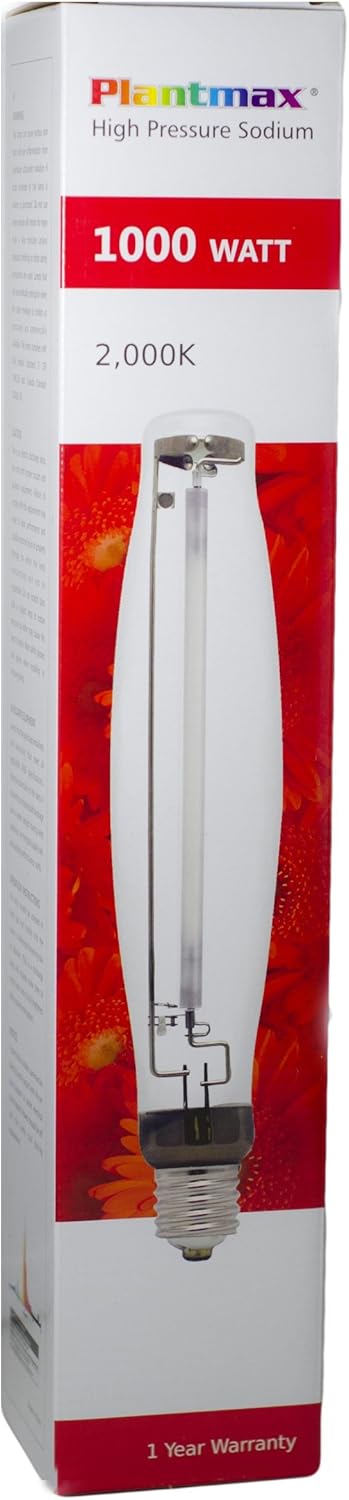
Plantmax 1000W High Pressure Sodium (HPS) Grow Bulb
| Light Type | HPS |
|---|---|
| Wattage | 1000 watts |
| Color Temperature | 2000 Kelvin |
| Light Source Operating Life | 24000 hours |
| Light Output Maximum | 140000 lumens |
The Plantmax 1000W HPS bulb is a high-output grow lamp intended for flowering and fruiting stages in indoor gardens and greenhouses. It delivers an initial 140,000 lumens from a 2000 K HPS spectrum that the manufacturer says is adjusted with extra blue to support fruiting. Typical use is in reflector fixtures with appropriate ballasts and ventilation to handle the heat and power draw; it is not a plug-and-play household lamp. Notable features include a long rated operating life of 24,000 hours and very high light output appropriate for large tents or dedicated rooms. Practical benefits are strong canopy penetration and proven effectiveness for boosting flower development when paired with compatible HID ballasts and reflectors. Important limitations are the high power consumption and heat output that require stable electrical supply, ballast compatibility, and good exhaust to avoid heat stress. The bulb also uses traditional HPS spectrum characteristics rather than full-spectrum LEDs, so growers prioritizing lower energy use or cooler operation may prefer alternative lamp types.
Best for: Buyers who want a proven, high-intensity HPS solution for dedicated flowering spaces and who prioritize reliable, established HID performance over the lowest possible energy use.
Less Ideal for: Casual or small-space growers who need a low-heat, energy-efficient light or those without compatible ballasts and ventilation setups.
- Very high initial lumen output for deep canopy penetration
- Rated 24,000 hours operating life for long service between replacements
- Designed spectrum optimized for flowering and fruiting
- Standard 1000W HPS format fits existing HID ballasts and reflectors
- High power draw and heat output require robust ballast and ventilation
- Not a full-spectrum LED alternative so energy efficiency is lower
Verdict: If you need maximum flower-stage light intensity in an established HID setup, this 1000W Plantmax HPS bulb delivers powerful, long-lived output.
Growlite 1000W HPS Real Red Grow Lamp (E39, 2000K, 1400 µmol/s PPF)

| Light Type | HPS |
|---|---|
| Wattage | 1000 watts |
| Bulb Base | E39 |
| Color Temperature | 2000 Kelvin |
| Light Source Operating Life | 20000 hours |
This Growlite 1000W HPS Real Red lamp is a high-output single-ended bulb aimed at indoor flowering and high-intensity commercial or hobby grows. It installs in standard E39 mogul fixtures and is ANSI S52 compatible for use with 250V ballasts. The lamp emphasizes deep red and far-red output at a 2000K color temperature and delivers a claimed 1400 µmol/s PPF, which helps promote flowering and bud development when used during bloom cycles. It runs cooler than typical double-ended HPS options and is rated for open or enclosed fixtures, making it flexible for common grow setups. Practical benefits include easy retrofit into existing mogul sockets and a long operating life rating of 20,000 hours with recommended annual replacement for peak performance. Limitations are its high power draw and heat output compared with LED alternatives and the need for a suitable 1000W ballast and appropriate ventilation, which add operating cost and setup complexity for budget-focused growers.
Best for: Growers upgrading or maintaining HPS-based flowering rigs who prioritize bloom intensity and want an easy drop-in bulb for standard mogul fixtures while keeping purchase cost low.
Less Ideal for: Anyone focused on lowest long-term operating cost, minimal heat, or plug-and-play simplicity who should consider modern LED fixtures instead.
- High PPF output targeted to flowering (1,400 µmol/s) for strong bloom performance
- ANSI S52 compatibility and E39 mogul base for easy installation in standard fixtures
- Rated for open or enclosed fixtures so it fits a range of common grow setups
- Long rated operating life (20,000 hours) for extended service between replacements
- Consumes 1000 watts so operating electricity and cooling costs are high
- Requires a compatible 1000W ballast and adequate ventilation to manage heat
Verdict: If you need a budget-friendly, high-output HPS bulb to boost flowering in existing mogul fixtures, this 1000W Growlite lamp is a straightforward, powerful choice.
Hortilux Eyehortilux Super HPS 1000W Grow Bulb

| Light Type | HPS |
|---|---|
| Wattage | 1000 watts |
| Voltage | 120 volts |
| Color Rendering Index | 100 |
| Indoor Outdoor Usage | Indoor |
The Hortilux Eyehortilux Super HPS 1000W is a performance-oriented grow lamp designed for serious indoor growers who need high output across the plant production cycle. It installs like a standard 1000W HPS lamp and is typically used in large grow rooms or commercial tents where a single high-output source is required. Notable features include a broadened HPS spectrum that adds roughly 25% more energy in the violet, blue, and green bands and about 17% more total energy than standard HPS bulbs, plus reduced mercury content. In practice that means stronger vegetative response and fuller color coverage during flowering compared with conventional HPS, while maintaining the high lumen output growers expect from a 1000W lamp. The bulb is indoor-rated, operates on 120V fixtures designed for 1000W bulbs, and is supplied as a single lamp. Limitations are typical for HPS technology: high power consumption and heat output require appropriate ballasts, cooling, and ventilation, and the bulb does not replace narrow-spectrum LED systems if you prioritize lower energy use or lower running temperatures.
Best for: Growers focused on maximum light output and spectrum fidelity for large indoor setups or commercial tents who prioritize established HPS performance over energy efficiency.
Less Ideal for: Home growers or hobbyists who need lower power consumption, quieter cooling, or simpler plug-and-play fixtures should consider modern LED options instead.
- Enhanced spectrum adds extra violet, blue, and green energy for improved plant development
- High 1000W output suitable for large grow rooms and commercial setups
- Manufactured and tested to horticultural standards for consistent performance
- Contains less mercury than standard HPS lamps
- Consumes 1000 watts and produces significant heat, requiring robust cooling and ventilation
- Requires compatible HPS ballast and fixtures rather than plug-and-play LED drivers
Verdict: This 1000W Hortilux HPS bulb is the pick for growers who want maximum proven HPS output with an expanded spectrum to boost plant performance in large indoor grows.
Eye Hortilux Enhanced Spectrum 1000W Super HPS Grow Bulb

| Light Type | HPS |
|---|---|
| Wattage | 1000 watts |
| Bulb Base | E26 |
| Color Temperature | 3000 Kelvin |
| Indoor Outdoor Usage | Indoor |
The Eye Hortilux 1000W Super HPS grow bulb is built to replace standard HPS lamps with a stronger spectral output in the violet, blue and green bands, which the manufacturer says supports plants through all growth stages. It fits an E26 base and is intended for indoor horticulture setups that already use high-wattage HPS fixtures and ballasts. Notable features include an enhanced spectrum design that claims about 25% more energy in the cooler wavelengths than standard HPS and EPA-compliant EN designation for non-hazardous disposal. In practice this bulb is straightforward to install in compatible sockets and delivers the intense light output growers expect from a 1000W HPS lamp, making it useful for flowering and large canopy applications where penetration and yield matter. Downsides are the inherent heat and power draw of a 1000W HPS lamp and the need for an appropriate ballast and ventilation; it is not a low-energy or plug-and-play LED alternative. For growers prioritizing proven HPS performance and spectral tweaks, this is a direct upgrade option; those seeking quieter, cooler, or lower-power systems should consider other technologies.
Best for: Growers who need proven, high-intensity HPS performance for large indoor flowering spaces and who prioritize spectral improvements over lower power draw. Ideal for users who value established product reputation and measurable performance gains.
Less Ideal for: Small-space growers, hobbyists prioritizing low energy use, or anyone without a compatible 1000W HPS ballast and adequate cooling should consider alternatives.
- Enhanced spectrum delivers more energy in violet, blue and green wavelengths than standard HPS
- Provides full 1000W HPS light output suitable for flowering and large canopy penetration
- E26 base fits standard HPS fixtures and the lamp carries an EN designation for non-hazardous disposal
- High power consumption and heat output require compatible ballast and robust ventilation
- Not a low-energy LED option so operating costs and cooling needs are higher
Verdict: Choose this bulb when you want a high-intensity 1000W HPS lamp with a stronger blue/green spectrum for serious indoor flowering and canopy penetration.
Choosing the Right High Pressure Sodium Grow Light: Key Factors to Consider
Light Output and Spectral Balance
How many usable photons the lamp delivers and where those photons fall on the spectrum matter most for flowering and fruit set. High Pressure Sodium bulbs concentrate energy in the red and orange bands where flowering responds, producing strong bud development and stretch. When evaluating output, compare luminous flux and photosynthetic photon flux density figures for the canopy height you plan to run to predict real plant response.
Keep in mind that raw wattage only tells part of the story. Ballast efficiency and lamp age affect delivered light, so consider both rated output and expected lumen or PPFD decline over the lamp lifetime.
Heat Output and Thermal Management
HPS fixtures produce substantial infrared and convective heat. That heat can stress plants if fixtures are too close or ventilation is limited, but it can also help in cool rooms. Assess how much radiant heat the lamp emits and whether the fixture has integrated cooling, reflective design, or airflow paths to reduce hotspotting.
Know your grow space ventilation capacity and how much extra cooling the lamp will require. In tents and small rooms, higher wattage HPS units often demand additional exhaust or air movement to maintain safe canopy temperatures.
Ballast Quality and Control
The ballast regulates current to the HPS lamp and affects startup, dimming behavior, and lamp longevity. Electronic ballasts that support multiple wattage settings or smooth dimming give more flexibility for vegetative versus flowering phases. Check whether the ballast is compatible with the lamp wattage, offers soft start to extend lamp life, and provides stable output under continuous duty.
Poor-quality ballasts can cause flicker, reduced lamp life, or unreliable power draw, which impacts both plant performance and safety.
Coverage Pattern and Mounting Height
How the reflector directs light determines how even the canopy receives PPFD. Wide, shallow reflectors spread light across a larger area at higher mounting heights, while narrow reflectors concentrate intensity beneath the lamp. Consider how large your canopy is and the mounting height you can accommodate to choose a reflector geometry that minimizes hot spots and dark edges.
Also evaluate the ease of mounting and adjustment. Secure hang points and simple height adjustments let you fine-tune distance as plants grow.
Lamp Life, Relamping Cost, and Maintenance
HPS lamps have finite service lives and gradually lose output. Calculate expected lamp life in operating hours and how often you will need to relamp based on your schedule. Factor in the cost and availability of replacement bulbs and the ease of swapping them in the fixture.
Regular cleaning of reflectors and lamp surfaces also affects light delivery. Choose fixtures that allow straightforward access for cleaning and lamp replacement to keep long-term performance predictable.
Electrical Safety and Build Durability
Because HPS fixtures run at high temperatures and require reliable electrical connections, build quality and safety certifications are critical. Look for robust housings, secure wiring, strain reliefs, and clear thermal ratings. Durable hardware and corrosion-resistant materials matter in humid grow-room environments.
Also check that mounting hardware and canopy attachments are rated for the fixture weight. Faulty or flimsy fittings can create hazards and jeopardize plant crops.
When High Pressure Sodium Makes Sense
High Pressure Sodium lights remain a good fit when you need red-rich output that promotes flowering and bud density. They are particularly effective in dedicated flowering rooms or tents where growers want strong canopy penetration without relying solely on supplemental LEDs.
HPS fixtures pair well with aggressive pruning and training, as their penetration helps shaded buds develop. They are also useful in cooler climates where the extra radiant heat reduces the need for supplemental heating during blooming cycles.
- Best for dense canopies and flowering-heavy cycles
- Useful in cooler rooms because of beneficial radiant heat
- Requires attentive ventilation and temperature control
Balancing Heat and Ventilation
Plan heat management before installing HPS fixtures. Measure the room or tent's air exchange rate and compare it to the lamp wattage to determine whether your exhaust and intake can keep canopy temperatures in the desired range.
Use oscillating fans to disrupt thermal boundary layers around foliage and move heat away from plant crowns. In sealed environments, add supplemental chilling or reduce lamp run hours during peak heat to avoid stress.
- Match exhaust capacity to total lamp wattage in the room
- Place circulation fans to move air across the canopy, not directly at plants
- Monitor leaf temperature, not just ambient air temperature
Mixing HPS with Other Light Sources
Some growers use HPS for bloom-phase supplementation while retaining LEDs for spectrum control and lower heat during veg. If you mix sources, ensure total PPFD and spectral balance are appropriate and that mounting heights account for different beam angles.
Hybrid setups can reduce overall heat load while preserving the red boost HPS provides during flowering. Be mindful of fixture placement to avoid overlapping hotspots and to achieve smooth canopy coverage.
- Use HPS primarily for red-rich bloom supplementation
- Adjust mounting heights to unify canopy PPFD
- Stagger on/off cycles only if intentional for photoperiod control
Installation and Ongoing Care
Securely mount fixtures at rated hang points and check wiring connections regularly. Clean reflectors and lamp envelopes on a schedule because dust and residue quickly reduce delivered light.
Track lamp hours and replace bulbs before output drops significantly. Also inspect ballasts and cooling components for dust buildup or degraded performance to avoid sudden failures during critical flowering weeks.
- Keep a maintenance log of lamp hours and cleaning dates
- Inspect electrical connections and mounting hardware monthly
- Replace bulbs proactively according to manufacturer hour ratings
Managing Light Distance and Plant Stretch
HPS lamps encourage stretch when plants are too close because of intense midrange energy. Maintain recommended mounting distances for the wattage you run and raise fixtures as plants grow to control internode length.
If stretch becomes an issue, use training methods like topping or low-stress training to keep canopy even without moving lamps excessively close.
- Follow recommended minimum distances for each wattage class
- Employ pruning and training to control vertical growth
- Monitor internodes and adjust light height proactively
How We Chose the Best High Pressure Sodium Grow Light
We shortlisted High Pressure Sodium grow lights based on criteria that reflect how these fixtures behave in an indoor grow environment. Key evaluation points included luminous output and spectral balance for flowering, ballast compatibility and dimming range, lamp life and relamping cost, thermal output and fixture cooling, beam distribution across a typical canopy, and mechanical build quality for safe, continuous operation. Products were included only if they met minimum safety and compatibility standards for indoor horticultural use and offered documented lamp and ballast specifications. We excluded fixtures without clear thermal ratings, uncertified electrical components, or inadequate mounting hardware. Our process favored items that give predictable canopy penetration, allow practical mounting heights, and manage heat so growers can maintain target temperature and humidity. The final selections balance raw light power with practical in-room control.
FAQ
How close should I hang a high pressure sodium lamp to my canopy?
Recommended distances depend on wattage and reflector type. Generally, higher wattage lamps need more clearance to avoid heat stress. Monitor leaf temperature and watch for signs of bleaching or curling, then incrementally raise the fixture until conditions stabilize.
Can I run HPS lights in a small tent without extra cooling?
It often depends on total wattage and ventilation. Small tents with high-wattage HPS fixtures usually require additional exhaust or intake air to keep canopy temperatures safe. Low-wattage HPS and strong circulation fans can sometimes work without heavy cooling, but monitor conditions closely.
How often should I replace HPS bulbs for consistent performance?
HPS lamps lose output gradually, so many growers plan relamping by hour ratings rather than waiting for failure. Typical replacement intervals depend on usage hours and desired light consistency. Replace bulbs once PPFD drops enough to affect flowering goals.
Are electronic ballasts necessary for HPS fixtures?
Electronic ballasts offer more stable output, quieter operation, and often dimming features compared with older magnetic units. They are not strictly required, but they provide better control and can extend lamp life when used correctly.
Will HPS lights increase humidity in my grow room?
HPS fixtures produce heat that can lower relative humidity by increasing evaporation, but they do not add moisture directly. However, heating can change ventilation needs and indirectly affect humidity control, so adjust humidification and exhaust accordingly.
Final Verdict
Choose a High Pressure Sodium grow light by matching its output and reflector pattern to your canopy size, and by planning for the heat it will add to the room. Prioritize fixtures with reliable ballasts and sensible mounting hardware if you expect continuous flowering cycles. Accept tradeoffs between intense red-rich output and additional ventilation needs. If you manage heat and relamping proactively, HPS remains a practical choice for growers focused on maximizing bloom-phase performance.
