

Note: This article contains affiliate links. If you click on these links and make a purchase, I may earn a small commission at no extra cost to you. This helps support my research and content. Read my full affiliate disclosure here.
If you are growing cannabis indoors, choosing the right Hps grow light for weed shapes plant vigor, bud density, and canopy uniformity. The wrong lamp can cook plants, underpower a canopy, or force costly ventilation upgrades. This guide looks at six top Hps grow lights for weed that suit common home and small-scale setups. We shortlisted lights based on real grow needs: usable light output, spectrum and flowering performance, heat and ballast management, and fixture durability. Below we explain the practical tradeoffs so you can match a light to your tent size, ventilation, and crop goals.
Top Picks at a Glance
| Best Quality Built to a higher standard if you want something more solid | Hortilux Eye Super HPS 600W Enhanced Spectrum Grow Lamp |  |
| Best Value The sweet spot between price and what you get | GRUOTVSZAK HPS 1000W E39 Grow Light Bulb 2‑Pack |  |
| Best Budget The cheapest option that still gets the job done reliably | Vegelumax 400W HPS Grow Light Bulb (E39, 2100K) |  |
| Highest Rated A top-rated pick with lots of positive feedback | Hortilux Eyehortilux Super HPS 1000W Grow Bulb |  |
| Most Popular A crowd favorite that many people choose with confidence | Plantmax 1000W High Pressure Sodium (HPS) Grow Bulb |  |
| Best Seller A high-volume bestseller chosen again and again | PROTOPIA 1000W HPS Grow Light Bulb (E39, 2000K) |  |
Hortilux Eye Super HPS 600W Enhanced Spectrum Grow Lamp

| Light Type | HPS |
|---|---|
| Wattage | 600 watts |
| Color Temperature | 6500 Kelvin |
| White Brightness | 37500 lumens |
| Color Rendering Index | 80 |
The Hortilux Eye Super HPS 600W Enhanced Spectrum lamp is a high-output indoor grow bulb designed to push vigorous vegetative and flowering growth under HPS systems. It produces very high lumen output and is engineered to deliver roughly 17 percent more total energy and 25 percent more energy in the violet, blue, and green bands than standard HPS bulbs, which helps plants develop stronger foliage and denser buds when used with appropriate ballast and reflectors. The lamp runs on typical mains voltages and accepts common GU10-style fittings used in horticultural fixtures. Practical benefits include a proven HPS spectral profile that favors yield-oriented growers and a color rendering index around 80 to help assess plant condition visually. Limitations are its high 600 W power draw, which increases heat and electricity needs and requires good ventilation and a compatible ballast and fixture; it is not a full-spectrum LED replacement and needs the rest of a lighting system to be effective. Suitable disposal and handling are important because the lamp contains mercury and lead-free claims that affect waste classification.
Best for: Growers focused on maximizing yield and light-driven performance who run dedicated HPS fixtures and can manage heat and electrical demand.
Less Ideal for: Casual or small-space growers who prioritize low energy use, minimal heat, or turnkey LED solutions should consider lower-wattage or LED alternatives.
- High 600 W output provides intense light ideal for maximizing yield in flowering and late-stage growth
- Enhanced spectrum delivers more energy in blue and green bands compared with standard HPS for improved plant development
- High lumen output (listed at 37,500 lumens) gives strong canopy penetration under reflectors
- Designed to meet TCLP criteria and marketed as lead free with reduced mercury compared with older HPS lamps
- Consumes significant power and generates substantial heat, requiring robust ventilation and cooling
- Requires compatible ballast and fixture and is not a plug-and-play LED substitute
- Contains hazardous components that require proper disposal despite reduced mercury claims
Verdict: If you run a dedicated HPS setup and prioritize maximum light intensity and an enhanced spectrum for larger yields, this 600 W Hortilux lamp is built for performance.
GRUOTVSZAK HPS 1000W E39 Grow Light Bulb 2‑Pack

| Light Type | HPS |
|---|---|
| Wattage | 1000 watts |
| Bulb Base | E39 |
| Light Source Operating Life | 24000 hours |
| Indoor Outdoor Usage | Indoor |
These GRUOTVSZAK HPS 1000W bulbs are high‑output sodium lamps intended for the flowering stage of indoor grows. Each T‑shaped bulb uses an E39 base and is rated at 1000 watts with a strong yellow/red output profile that prioritizes PAR in the red spectrum for bloom development. They arrive as a two‑pack and are compatible with common electronic and magnetic ballasts, so installation is straightforward in fixtures built for E39 HPS lamps. Notable specs: very high lumen and PPF claims and a long rated life (about 24,000 hours) with most useful output maintained for thousands of hours. In practice these deliver intense, concentrated light suited to mature plants but produce substantial heat and require appropriate ballasts, reflectors, ventilation, and safety precautions. Warm up time is several minutes and bulbs should not be restruck immediately. If you need dependable, traditional HPS bloom power and are prepared to manage heat and energy use, these perform as expected; for lower heat or energy budgets consider LED alternatives.
Best for: Growers who prioritize proven, high‑intensity bloom lighting and want a traditional HPS solution that integrates with existing E39 ballast setups. Suitable for mainstream users who prefer established technology and predictable performance.
Less Ideal for: People working in small, poorly ventilated spaces or those who need low energy consumption or instant on/off control should consider modern LED fixtures instead.
- Very high claimed light output and PAR focused toward red spectrum for flowering
- E39 base and stated compatibility with electronic and magnetic ballasts for easy installation
- Long rated operating life (24,000 hours) for extended use before replacement
- High power draw and significant heat output require robust ventilation and appropriate fixtures
- Warm up and restrike time means bulbs are not instant on/off like LEDs
Verdict: Choose this two‑pack if you want traditional, high‑intensity HPS bloom power that integrates with standard E39 ballasts for dependable flowering performance.
Vegelumax 400W HPS Grow Light Bulb (E39, 2100K)

| Light Type | HPS |
|---|---|
| Wattage | 400 watts |
| Bulb Base | E39 |
| Color Temperature | 2100 Kelvin |
| Light Source Operating Life | 20000 hours |
This Vegelumax 400W HPS bulb is built for indoor horticulture, delivering a high red and orange output optimized for flowering and fruiting. It is typically used in professional or hobby grow tents and greenhouses on fixtures with an E39 socket and either electronic or magnetic ballasts. Notable features include a high initial lumen rating (about 55,000 lumens), a warm 2100K color temperature focused on photosynthetically active radiation, and a rated life of around 20,000 hours with low lumen depreciation early in the life cycle. The practical benefits are strong PAR-heavy light for bloom stages and compatibility with common HPS ballast setups, which makes it easy to swap into existing HPS systems. Expect a brief warm-up period of a few minutes to reach full brightness and follow the guidance to wait before restriking the lamp. Trade-offs are the high power draw and heat output typical of 400W HPS bulbs and the requirement for an E39 single-ended fixture, which means it is best for growers who already run ballast-based HPS systems rather than those seeking lower-heat LED alternatives.
Best for: Growers on a budget who already use ballast-based HPS systems and want a high-output bulb to boost bloom-stage performance without switching to LED technology.
Less Ideal for: Those building new low-heat LED rigs or growers who prioritize maximum energy efficiency and lower ambient heat should consider LED alternatives.
- High PAR-focused spectrum (2100K) tailored to flowering and fruiting
- Very bright output rated at 55,000 lumens for strong canopy penetration
- Long rated operating life around 20,000 hours with low early lumen loss
- Compatible with electronic and magnetic ballasts and standard E39 sockets
- High 400W power consumption produces significant heat and energy cost
- Requires E39 single-ended fixtures so it is not plug-and-play with all lamp holders
Verdict: If you run ballast-based HPS fixtures and want an inexpensive, high-PAR bulb for stronger flowering and fruiting, this 400W Vegelumax lamp delivers the output you need without forcing a system change.
Hortilux Eyehortilux Super HPS 1000W Grow Bulb

| Light Type | HPS |
|---|---|
| Wattage | 1000 watts |
| Voltage | 120 volts |
| Color Rendering Index | 100 |
| Indoor Outdoor Usage | Indoor |
The Hortilux Eyehortilux Super HPS 1000W is a performance-oriented grow lamp designed for serious indoor growers who need high output across the plant production cycle. It installs like a standard 1000W HPS lamp and is typically used in large grow rooms or commercial tents where a single high-output source is required. Notable features include a broadened HPS spectrum that adds roughly 25% more energy in the violet, blue, and green bands and about 17% more total energy than standard HPS bulbs, plus reduced mercury content. In practice that means stronger vegetative response and fuller color coverage during flowering compared with conventional HPS, while maintaining the high lumen output growers expect from a 1000W lamp. The bulb is indoor-rated, operates on 120V fixtures designed for 1000W bulbs, and is supplied as a single lamp. Limitations are typical for HPS technology: high power consumption and heat output require appropriate ballasts, cooling, and ventilation, and the bulb does not replace narrow-spectrum LED systems if you prioritize lower energy use or lower running temperatures.
Best for: Growers focused on maximum light output and spectrum fidelity for large indoor setups or commercial tents who prioritize established HPS performance over energy efficiency.
Less Ideal for: Home growers or hobbyists who need lower power consumption, quieter cooling, or simpler plug-and-play fixtures should consider modern LED options instead.
- Enhanced spectrum adds extra violet, blue, and green energy for improved plant development
- High 1000W output suitable for large grow rooms and commercial setups
- Manufactured and tested to horticultural standards for consistent performance
- Contains less mercury than standard HPS lamps
- Consumes 1000 watts and produces significant heat, requiring robust cooling and ventilation
- Requires compatible HPS ballast and fixtures rather than plug-and-play LED drivers
Verdict: This 1000W Hortilux HPS bulb is the pick for growers who want maximum proven HPS output with an expanded spectrum to boost plant performance in large indoor grows.
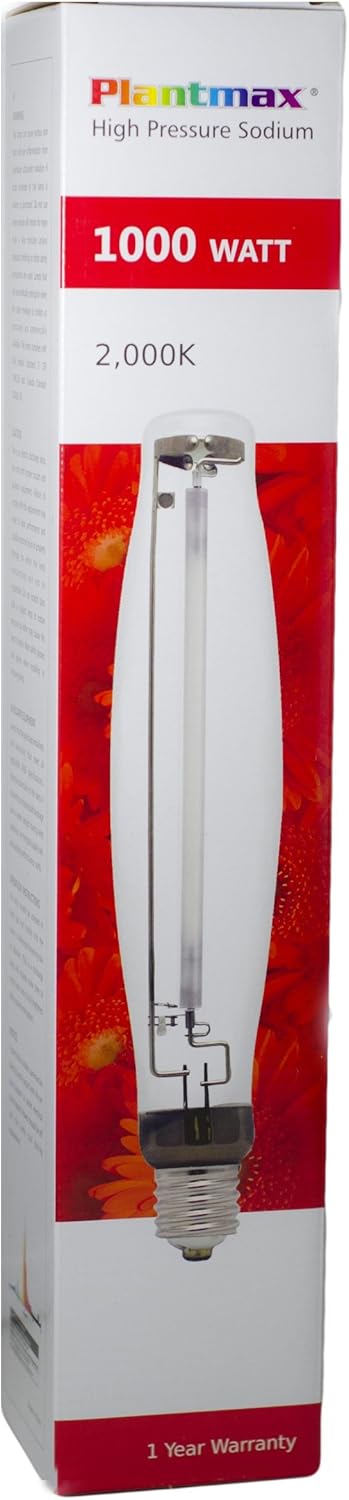
Plantmax 1000W High Pressure Sodium (HPS) Grow Bulb
| Light Type | HPS |
|---|---|
| Wattage | 1000 watts |
| Color Temperature | 2000 Kelvin |
| Light Source Operating Life | 24000 hours |
| Light Output Maximum | 140000 lumens |
The Plantmax 1000W HPS bulb is a high-output grow lamp intended for flowering and fruiting stages in indoor gardens and greenhouses. It delivers an initial 140,000 lumens from a 2000 K HPS spectrum that the manufacturer says is adjusted with extra blue to support fruiting. Typical use is in reflector fixtures with appropriate ballasts and ventilation to handle the heat and power draw; it is not a plug-and-play household lamp. Notable features include a long rated operating life of 24,000 hours and very high light output appropriate for large tents or dedicated rooms. Practical benefits are strong canopy penetration and proven effectiveness for boosting flower development when paired with compatible HID ballasts and reflectors. Important limitations are the high power consumption and heat output that require stable electrical supply, ballast compatibility, and good exhaust to avoid heat stress. The bulb also uses traditional HPS spectrum characteristics rather than full-spectrum LEDs, so growers prioritizing lower energy use or cooler operation may prefer alternative lamp types.
Best for: Buyers who want a proven, high-intensity HPS solution for dedicated flowering spaces and who prioritize reliable, established HID performance over the lowest possible energy use.
Less Ideal for: Casual or small-space growers who need a low-heat, energy-efficient light or those without compatible ballasts and ventilation setups.
- Very high initial lumen output for deep canopy penetration
- Rated 24,000 hours operating life for long service between replacements
- Designed spectrum optimized for flowering and fruiting
- Standard 1000W HPS format fits existing HID ballasts and reflectors
- High power draw and heat output require robust ballast and ventilation
- Not a full-spectrum LED alternative so energy efficiency is lower
Verdict: If you need maximum flower-stage light intensity in an established HID setup, this 1000W Plantmax HPS bulb delivers powerful, long-lived output.
PROTOPIA 1000W HPS Grow Light Bulb (E39, 2000K)

| Wattage | 1000 watts |
|---|---|
| Bulb Base | E39 |
| Color Temperature | 2000 Kelvin |
| Light Output Maximum | 146000 lumens |
| Photon flux | 1850 μmol/s |
The PROTOPIA 1000W HPS bulb is a classic high-output lamp aimed at flowering rooms and greenhouse applications. It delivers an intense warm-spectrum light (around 2000K) with very high lumen and photon flux for driving bloom and fruiting. Typical use is screw-in installation into an E39 fixture with a ballast rated for 1000W HPS; growers use it for full-cycle or flower-stage lighting where enhanced red and far-red output speeds flowering and can increase yields. Notable features include an advertised 146,000 lumens, 1850 μmol/s photon flux, and a claimed long usable life with over 90% lumen maintenance at 5,000 hours. Practical benefits are strong penetration and proven HPS spectrum that many growers trust for maximizing flower development. Limitations are the classic HPS trade-offs: low CRI, heavy heat output and the need for compatible 220–240V ballasts and fixtures, and it lacks integrated modern controls or spectral tuning. For growers on a tight budget who want a traditional high-output flowering lamp this performs predictably, but it is not a plug-and-play LED replacement and requires proper ventilation and ballast infrastructure.
Best for: Growers who prioritize low upfront cost and proven HPS performance for flowering rooms and greenhouse setups and who already have compatible ballast and ventilation in place.
Less Ideal for: Those wanting energy-efficient, low-heat, or tunable spectrum solutions should consider modern LED alternatives instead.
- High photon flux (listed at about 1850 μmol/s) suitable for strong flowering and fruiting
- Very high lumen output (146000 lm) for deep canopy penetration
- Classic HPS spectrum with enhanced red and far-red to promote flowering
- Maintains over 90% initial lumen output after 5,000 hours according to the manufacturer
- Requires a compatible 1000W ballast and high-voltage (220–240V) fixtures
- Produces significant heat and needs adequate ventilation and cooling
- Low color rendering index (CRI ~25) and no spectral control compared with LEDs
Verdict: A budget-friendly, high-output HPS bulb that reliably boosts flowering and yield for growers with existing 1000W ballast and ventilation setups.
Choosing the Right Hps Grow Light for Weed: Key Factors to Consider
Light Output and Canopy Coverage
How much light a fixture delivers to the canopy directly affects bud set and density. For flowering cannabis under Hps, focus on usable light at canopy height rather than raw bulb wattage. A high-wattage lamp poorly reflected or mounted too high will deliver less usable photon density than a well-shaded, properly positioned fixture.
Consider the shape of the light footprint and how many fixtures you will need to cover the intended footprint without big hotspots or dark areas. Matching lamp lumen output and reflector design to the canopy size reduces stretch and uneven flowering.
Heat Output and Ventilation Requirements
Hps lamps produce significant heat, which influences how close you can hang a light to buds and whether you must upgrade ventilation. Excessive heat can cause leaf burn, hermaphroditism, or slowed trichome development, especially during the final weeks of flower.
Assess expected lamp surface temperature, ballast location, and whether the fixture supports integrated cooling or ducted reflectors. A fixture that concentrates heat over the canopy will demand stronger exhaust and possibly AC in small indoor spaces, so factor ventilation capacity into the purchase decision.
Ballast Type and Electrical Compatibility
The ballast controls lamp ignition and running characteristics. Magnetic ballasts are simple and durable but heavier and less efficient. Electronic ballasts run cooler, often support dimming, and can extend lamp life when matched correctly. Choose a ballast type that fits your electrical setup and desired control features.
Confirm that voltage, amperage, and dimming compatibility work with your circuit and controllers. Overloading a circuit or using an incompatible dimmer can cause instability and shorten ballast or lamp life.
Reflector Design and Light Directionality
A reflector channels light toward the canopy; its shape and interior finish determine how evenly light is distributed. Parabolic and wing-style reflectors give different footprints and work better in certain layouts. A narrow reflector increases intensity at the center but creates falloff at the edges, while a wide reflector provides more uniform coverage across multiple plants.
Reflector materials and surface finish affect long-term reflectivity. Cheaper finishes can degrade or corrode over time, reducing usable output. Look for designs that make it easy to replace bulbs and access the reflector for cleaning.
Fixture Build Quality and Serviceability
Fixtures that are robustly built survive the humidity cycles and occasional knocks common in grow rooms. Metal housings, secure lamp holders, and protected wiring reduce the risk of failure mid-cycle. Serviceability matters: fixtures with accessible ballasts and standard lamp fittings are easier to repair or replace without disturbing plants.
Also consider mounting hardware quality. Reliable hangers and adjustable chains prevent accidental falls that can damage plants and lights. Small details like gasketed connections and strain reliefs matter over multiple grow cycles.
Size of Grow Space and Number of Fixtures
Scale changes the math. A single fixture that works well for a 2 x 2 foot tent will not cover a 4 x 4 foot canopy adequately. Decide how many fixtures you need based on the canopy area and the desired light intensity in micromoles or lumens per square foot.
Factor in layout constraints, such as plant height, vertical training plans, and access for maintenance. Multiple smaller fixtures can give more even coverage and redundancy compared with one large lamp, but they increase complexity in mounting and electrical routing.
Matching Hps Power to Growing Goals
Different growers use Hps lights for different reasons: maximum flower intensity, budget-friendly fixtures, or compatibility with existing setups. Decide whether your priority is peak output for larger yields or a more manageable heat footprint for small rooms.
For small tents you may prioritize lower-wattage lamps with tight reflectors to concentrate light without overheating. For larger canopies, higher-wattage fixtures or multiple lamps spaced evenly give better uniformity and reduce shaded zones.
- Lower wattage: easier to manage heat, good for single-plant tents
- Higher wattage: more output per fixture, needs stronger ventilation
- Multiple fixtures: uniform coverage and redundancy
Controlling Heat Without Killing Light Intensity
Managing the heat from an Hps lamp is often more important than chasing raw wattage. Use reflective ducting, inline fans, or air-cooled reflectors to move hot air away from the canopy while retaining light intensity.
Temperature swings during lights-on periods stress plants. Keep canopy temperature stable by balancing intake and exhaust, and consider circulating air at the canopy to remove micro-hotspots.
- Air-cooled reflectors attach to ducting to remove heat
- Positive airflow across the canopy limits leaf burn
- Aim for consistent day/night temperature differentials
Practical Lighting Layout Tips
Plan fixture spacing based on the reflector footprint and the hanging height you expect to maintain. Start with a mock layout before installation to visualize overlap and hotspots.
When using multiple fixtures, stagger them slightly to even out intense centers and edge dropoffs. Keep a safe buffer around tent walls to allow for airflow and maintenance access.
- Measure reflector footprint at intended hang height
- Stagger fixtures to avoid strong central hotspots
- Leave clearance for ventilation and plant access
Maintenance and Lamp Replacement
Hps lamps gradually lose output and shift spectrum with age. Keep a replacement lamp schedule and log burn hours to avoid sudden drops in flowering performance. Regularly clean reflectors and lenses to preserve usable light.
Inspect ballast ventilation and wiring each season. A dusty ballast runs hotter and shortens component life, so periodic cleaning and tightening of connections extend reliability.
- Track lamp hours and replace before output drops significantly
- Clean reflectors and lamp glass regularly
- Check ballast ventilation and wiring annually
Integrating Hps With Other Light Types
Some growers use Hps during full flower and supplement with other light sources during veg or to adjust spectrum. When combining light types, aim for complementary spectral balance and compatible light schedules.
Pay attention to control systems and timers so that different fixtures switch cleanly without causing electrical surges or stress to the plants during transitions.
- Use complementary spectra for veg and flower stages
- Ensure timers and controllers handle aggregated load
- Avoid rapid changes in light intensity during the dark period
How We Chose the Best Hps Grow Light for Weed
We focused on criteria that matter to growers using Hps fixtures for cannabis flowering. Light output and usable spectrum were primary filters because Hps systems differ in effective lumens and how they drive bud development. Heat management and ballast design were next, since Hps lamps run hot and ventilation needs are an immediate cost and space consideration. Durability and serviceability were weighed to avoid fixtures that fail mid-cycle or require difficult lamp changes. Electrical efficiency and compatibility with common dimmers or controllers were included so a light integrates with typical home setups. Products that lacked clear technical specs, used unverified ballast claims, or were designed only for decorative horticulture were excluded. We also filtered out fixtures without replaceable lamps or accessible ballasts, because those limit long-term value in a flowering-focused grow. The final list balances usable light per square foot, predictable heat output, and practical durability for growers aiming for consistent flowering results.
FAQ
How close should Hps lights be hung from cannabis canopy?
Recommended distance depends on lamp wattage and reflector type. Lower-wattage fixtures can hang closer without causing heat stress, while higher-wattage lamps need more clearance. Monitor leaf tips for burn and use an IR thermometer to check canopy temperature.
Can I use an air-cooled reflector to reduce heat?
Yes. Air-cooled reflectors duct hot air away from the canopy and help maintain higher light intensity near plants. They require adequate inline fans and ducting sized for the expected airflow.
How often should Hps bulbs be replaced during flower cycles?
Bulbs lose output gradually, so many growers replace Hps lamps every season or after a set number of burn hours. Replacement timing depends on intensity needs and observed plant response rather than a fixed calendar interval.
Are electronic ballasts better than magnetic for Hps setups?
Electronic ballasts are typically more efficient and run cooler, and many support dimming functions. Magnetic ballasts are simpler and durable. The best choice depends on whether you need dimming, your electrical setup, and heat priorities.
Will Hps lights increase my ventilation or cooling costs?
Often they will. Hps fixtures produce more heat than many modern LEDs, so expect higher ventilation and possibly cooling demands. Plan for adequate exhaust capacity and consider heat removal when sizing HVAC.
Final Verdict
Prioritize matching usable light output and heat management to your specific grow space when choosing an Hps grow light for weed. Reflector design, ballast type, and fixture serviceability determine how easily a light integrates with your ventilation and training methods. Tradeoffs exist between higher single-fixture output and the extra ventilation that output demands, so choose based on canopy size and your willingness to manage heat. Focus on predictable light delivery and accessible maintenance features to get reliable flower performance over multiple cycles. When in doubt, pick a configuration that gives even coverage and manageable heat rather than chasing maximum wattage alone.
