

Note: This article contains affiliate links. If you click on these links and make a purchase, I may earn a small commission at no extra cost to you. This helps support my research and content. Read my full affiliate disclosure here.
If you grow flowering plants indoors or in a small greenhouse, the right Hps Mh grow light determines how well plants set buds, how compact they stay, and how much heat you must manage. You want equipment that delivers the red punch for bloom, the blue tones for vegetative growth, and predictable heat so you can control canopy temperatures. This guide covers seven shortlisted Hps Mh grow lights that are well suited to the typical indoor grower. We evaluate each entry for light spectrum balance, heat output and management, build and electrical safety, and ease of setup so you can pick the best fit for your space and workflow.
Top Picks at a Glance
| Best Overall The best all-around choice for most situations | Hortilux Eyehortilux Super HPS 1000W Grow Bulb |  |
| Best Quality Built to a higher standard if you want something more solid | Plantmax EnergyStation 1000W Digital Dimmable HPS/MH Ballast |  |
| Best Value The sweet spot between price and what you get | PROTOPIA 1000W HPS Grow Light Bulb (E39, 2000K) |  |
| Best Budget The cheapest option that still gets the job done reliably | LEDwholesalers 400W High Pressure Sodium (HPS) Grow Light Bulb with E39 Base |  |
| Highest Rated A top-rated pick with lots of positive feedback | DL Wholesale 6" Air-Cooled Cool Tube Reflector for MH and HPS (250–1000W) |  |
| Most Popular A crowd favorite that many people choose with confidence | GRUOTVSZAK HPS 1000W E39 Grow Light Bulb 2‑Pack |  |
| Best Seller A high-volume bestseller chosen again and again | Plantmax 1000W High Pressure Sodium (HPS) Grow Bulb |  |
Hortilux Eyehortilux Super HPS 1000W Grow Bulb

| Light Type | HPS |
|---|---|
| Wattage | 1000 watts |
| Voltage | 120 volts |
| Color Rendering Index | 100 |
| Indoor Outdoor Usage | Indoor |
The Hortilux Eyehortilux Super HPS 1000W is a performance-oriented grow lamp designed for serious indoor growers who need high output across the plant production cycle. It installs like a standard 1000W HPS lamp and is typically used in large grow rooms or commercial tents where a single high-output source is required. Notable features include a broadened HPS spectrum that adds roughly 25% more energy in the violet, blue, and green bands and about 17% more total energy than standard HPS bulbs, plus reduced mercury content. In practice that means stronger vegetative response and fuller color coverage during flowering compared with conventional HPS, while maintaining the high lumen output growers expect from a 1000W lamp. The bulb is indoor-rated, operates on 120V fixtures designed for 1000W bulbs, and is supplied as a single lamp. Limitations are typical for HPS technology: high power consumption and heat output require appropriate ballasts, cooling, and ventilation, and the bulb does not replace narrow-spectrum LED systems if you prioritize lower energy use or lower running temperatures.
Best for: Growers focused on maximum light output and spectrum fidelity for large indoor setups or commercial tents who prioritize established HPS performance over energy efficiency.
Less Ideal for: Home growers or hobbyists who need lower power consumption, quieter cooling, or simpler plug-and-play fixtures should consider modern LED options instead.
- Enhanced spectrum adds extra violet, blue, and green energy for improved plant development
- High 1000W output suitable for large grow rooms and commercial setups
- Manufactured and tested to horticultural standards for consistent performance
- Contains less mercury than standard HPS lamps
- Consumes 1000 watts and produces significant heat, requiring robust cooling and ventilation
- Requires compatible HPS ballast and fixtures rather than plug-and-play LED drivers
Verdict: This 1000W Hortilux HPS bulb is the pick for growers who want maximum proven HPS output with an expanded spectrum to boost plant performance in large indoor grows.
Plantmax EnergyStation 1000W Digital Dimmable HPS/MH Ballast

| Light Source | HPS, MH |
|---|---|
| Wattage | 1000 watts |
| Control Method | Remote |
| Voltage | 240 volts |
| Safety Listings | UL, cUL |
The Plantmax EnergyStation is a digital 1000W ballast designed for indoor HPS and MH grow setups where stable ignition and thermal management matter. It is typically suspended above a grow area and paired with a reflector and E26-base lamp to provide full-power or reduced output at 50, 75, or 100 percent via the included remote. Notable features include an internal cooling fan with finned housing to lower operating temperature, multiple safety protections (end-of-lamp-life, ignition failure, short and open circuit protection), and UL/cUL listing. In practice that means reliable, fast starts, quieter temperature control than basic magnetic ballasts, and safer shutdowns if a lamp fails. Trade-offs are that it is an AC, non-water-resistant unit intended for indoor suspended installs and uses a single light output channel rather than multi-lamp zoning. The ballast’s dimming and robust protections make it well suited to growers seeking consistent performance and simplified control, while installers should plan for dry, ventilated mounting and confirm electrical compatibility before installation.
Best for: Growers focused on consistent lamp performance and safety who need a reliable 1000W digital ballast with dimming and protections for indoor HPS/MH setups.
Less Ideal for: People who need outdoor, waterproof equipment or multi-lamp control and zoning should consider other solutions designed for wet locations or multi-channel setups.
- Supports both HPS and MH lamps for flexible lamp choices
- Dimmable to 50%, 75%, and 100% for feeding and bloom cycle control
- Built-in cooling fan and finned design to reduce operating temperature
- Multiple protective features including end-of-lamp-life, ignition failure, short and open circuit protection
- UL and cUL listed for added safety compliance
- Not water resistant so must be used in dry, indoor environments
- Single-channel output limits use to one lamp per unit
Verdict: Choose this ballast if you want a 1000W digital HPS/MH unit with dimming and robust safety protections for reliable indoor performance.
PROTOPIA 1000W HPS Grow Light Bulb (E39, 2000K)

| Wattage | 1000 watts |
|---|---|
| Bulb Base | E39 |
| Color Temperature | 2000 Kelvin |
| Light Output Maximum | 146000 lumens |
| Photon flux | 1850 μmol/s |
The PROTOPIA 1000W HPS bulb is a classic high-output lamp aimed at flowering rooms and greenhouse applications. It delivers an intense warm-spectrum light (around 2000K) with very high lumen and photon flux for driving bloom and fruiting. Typical use is screw-in installation into an E39 fixture with a ballast rated for 1000W HPS; growers use it for full-cycle or flower-stage lighting where enhanced red and far-red output speeds flowering and can increase yields. Notable features include an advertised 146,000 lumens, 1850 μmol/s photon flux, and a claimed long usable life with over 90% lumen maintenance at 5,000 hours. Practical benefits are strong penetration and proven HPS spectrum that many growers trust for maximizing flower development. Limitations are the classic HPS trade-offs: low CRI, heavy heat output and the need for compatible 220–240V ballasts and fixtures, and it lacks integrated modern controls or spectral tuning. For growers on a tight budget who want a traditional high-output flowering lamp this performs predictably, but it is not a plug-and-play LED replacement and requires proper ventilation and ballast infrastructure.
Best for: Growers who prioritize low upfront cost and proven HPS performance for flowering rooms and greenhouse setups and who already have compatible ballast and ventilation in place.
Less Ideal for: Those wanting energy-efficient, low-heat, or tunable spectrum solutions should consider modern LED alternatives instead.
- High photon flux (listed at about 1850 μmol/s) suitable for strong flowering and fruiting
- Very high lumen output (146000 lm) for deep canopy penetration
- Classic HPS spectrum with enhanced red and far-red to promote flowering
- Maintains over 90% initial lumen output after 5,000 hours according to the manufacturer
- Requires a compatible 1000W ballast and high-voltage (220–240V) fixtures
- Produces significant heat and needs adequate ventilation and cooling
- Low color rendering index (CRI ~25) and no spectral control compared with LEDs
Verdict: A budget-friendly, high-output HPS bulb that reliably boosts flowering and yield for growers with existing 1000W ballast and ventilation setups.
LEDwholesalers 400W High Pressure Sodium (HPS) Grow Light Bulb with E39 Base

| Light Type | HPS |
|---|---|
| Wattage | 400 watts |
| Bulb Base | E39 |
| Indoor Outdoor Usage | Outdoor |
This 400W HPS bulb is aimed at growers who need strong red and orange-spectrum output for flowering and fruiting. It screws into a standard E39 mogul socket and is compatible with both magnetic and many electronic ballasts, so it can be used in existing HPS setups or paired with compatible fixtures. The bulb produces deep red/orange light that penetrates haze well, which helps stimulate bud and flower development in dense canopies and outdoor foggy conditions. Practical benefits include a high power level for larger tents or small rooms and a familiar tubular HPS form factor that fits common reflectors. Limitations are the inherent heat and power draw of a 400W HPS lamp and the need for proper ballast compatibility and ventilation; it is not as energy efficient as modern LED solutions and requires ballast and venting planning. For budget-focused growers seeking raw flowering output from proven HPS technology, this bulb is a straightforward, no-frills option.
Best for: Growers on a tight budget who prioritize proven HPS flowering performance and want a powerful bulb that fits standard mogul fixtures.
Less Ideal for: Growers prioritizing energy efficiency, low heat, or plug-and-play LED convenience should consider LED fixtures instead.
- Strong 400W output suitable for flowering and fruiting stages
- E39 mogul base fits common HPS fixtures and reflectors
- Works with magnetic and many electronic ballasts for easy integration
- Red/orange spectrum provides good canopy penetration and bud stimulation
- Consumes significant power and produces substantial heat compared with LED alternatives
- Requires compatible ballast and adequate ventilation to avoid performance or safety issues
Verdict: If you need an affordable, high-output HPS bulb to boost flowering in an existing mogul-socket setup, this 400W HPS is a practical choice.
DL Wholesale 6" Air-Cooled Cool Tube Reflector for MH and HPS (250–1000W)

| Light Type | HPS |
|---|---|
| Additional Features | Air-Cooled |
| Wattage | 250 watts |
| Indoor Outdoor Usage | Indoor |
| Material Type | Aluminum, Glass |
This DL Wholesale 6" air-cooled cool tube reflector is a straightforward, ready-to-use fixture for hobby or small commercial grow setups that need reliable HID performance. It accepts metal halide and high-pressure sodium lamps from 250W up to 1000W and ships preassembled with a lamp socket and a 15-foot power cord for quick installation. The Pyrex glass cool tube and internal reflective aluminum help keep the bulb and canopy temperatures lower while producing an even light spread, which is useful in tents or crowded rooms. Its compact, lightweight design supports horizontal or vertical mounting to fit tight spaces. Because it is a passive reflector with integrated air-cooling rather than a full hood or ballast system, you still need a compatible ballast and ducting for active temperature control and ventilation. The unit does not include a lamp, so budget for a quality MH or HPS bulb separately. For growers prioritizing simple, durable fixtures that reduce heat transfer and provide predictable light distribution, this cool tube is a practical choice.
Best for: Growers who want a durable, no-frills HID reflector that lowers heat transfer and delivers consistent light in small tents or compact grow rooms.
Less Ideal for: Indoor gardeners looking for an all-in-one fixture with an integrated ballast or LED alternatives; those needing fully active cooling without adding ducting and fans should look elsewhere.
- Compatible with MH and HPS bulbs from 250W to 1000W for flexible lamp choices
- Built-in Pyrex glass cool tube helps reduce canopy temperature and protects the bulb
- Internal reflective aluminum provides uniform light distribution over the canopy
- Preassembled with socket and 15-foot power cord for quick plug-and-play setup
- Does not include a bulb or ballast, so additional components are required
- Air-cooling is passive and benefits from external ducting and fans for full temperature control
Verdict: Choose this cool tube when you need a compact, dependable HID reflector that reduces heat at the canopy and provides even light distribution for reliable flowering performance.
GRUOTVSZAK HPS 1000W E39 Grow Light Bulb 2‑Pack

| Light Type | HPS |
|---|---|
| Wattage | 1000 watts |
| Bulb Base | E39 |
| Light Source Operating Life | 24000 hours |
| Indoor Outdoor Usage | Indoor |
These GRUOTVSZAK HPS 1000W bulbs are high‑output sodium lamps intended for the flowering stage of indoor grows. Each T‑shaped bulb uses an E39 base and is rated at 1000 watts with a strong yellow/red output profile that prioritizes PAR in the red spectrum for bloom development. They arrive as a two‑pack and are compatible with common electronic and magnetic ballasts, so installation is straightforward in fixtures built for E39 HPS lamps. Notable specs: very high lumen and PPF claims and a long rated life (about 24,000 hours) with most useful output maintained for thousands of hours. In practice these deliver intense, concentrated light suited to mature plants but produce substantial heat and require appropriate ballasts, reflectors, ventilation, and safety precautions. Warm up time is several minutes and bulbs should not be restruck immediately. If you need dependable, traditional HPS bloom power and are prepared to manage heat and energy use, these perform as expected; for lower heat or energy budgets consider LED alternatives.
Best for: Growers who prioritize proven, high‑intensity bloom lighting and want a traditional HPS solution that integrates with existing E39 ballast setups. Suitable for mainstream users who prefer established technology and predictable performance.
Less Ideal for: People working in small, poorly ventilated spaces or those who need low energy consumption or instant on/off control should consider modern LED fixtures instead.
- Very high claimed light output and PAR focused toward red spectrum for flowering
- E39 base and stated compatibility with electronic and magnetic ballasts for easy installation
- Long rated operating life (24,000 hours) for extended use before replacement
- High power draw and significant heat output require robust ventilation and appropriate fixtures
- Warm up and restrike time means bulbs are not instant on/off like LEDs
Verdict: Choose this two‑pack if you want traditional, high‑intensity HPS bloom power that integrates with standard E39 ballasts for dependable flowering performance.
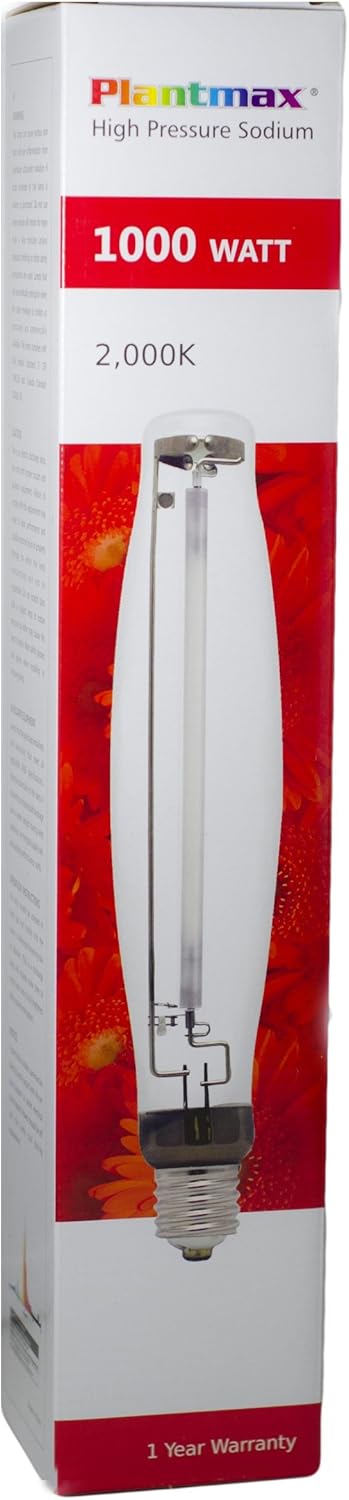
Plantmax 1000W High Pressure Sodium (HPS) Grow Bulb
| Light Type | HPS |
|---|---|
| Wattage | 1000 watts |
| Color Temperature | 2000 Kelvin |
| Light Source Operating Life | 24000 hours |
| Light Output Maximum | 140000 lumens |
The Plantmax 1000W HPS bulb is a high-output grow lamp intended for flowering and fruiting stages in indoor gardens and greenhouses. It delivers an initial 140,000 lumens from a 2000 K HPS spectrum that the manufacturer says is adjusted with extra blue to support fruiting. Typical use is in reflector fixtures with appropriate ballasts and ventilation to handle the heat and power draw; it is not a plug-and-play household lamp. Notable features include a long rated operating life of 24,000 hours and very high light output appropriate for large tents or dedicated rooms. Practical benefits are strong canopy penetration and proven effectiveness for boosting flower development when paired with compatible HID ballasts and reflectors. Important limitations are the high power consumption and heat output that require stable electrical supply, ballast compatibility, and good exhaust to avoid heat stress. The bulb also uses traditional HPS spectrum characteristics rather than full-spectrum LEDs, so growers prioritizing lower energy use or cooler operation may prefer alternative lamp types.
Best for: Buyers who want a proven, high-intensity HPS solution for dedicated flowering spaces and who prioritize reliable, established HID performance over the lowest possible energy use.
Less Ideal for: Casual or small-space growers who need a low-heat, energy-efficient light or those without compatible ballasts and ventilation setups.
- Very high initial lumen output for deep canopy penetration
- Rated 24,000 hours operating life for long service between replacements
- Designed spectrum optimized for flowering and fruiting
- Standard 1000W HPS format fits existing HID ballasts and reflectors
- High power draw and heat output require robust ballast and ventilation
- Not a full-spectrum LED alternative so energy efficiency is lower
Verdict: If you need maximum flower-stage light intensity in an established HID setup, this 1000W Plantmax HPS bulb delivers powerful, long-lived output.
Choosing the Right Hps Mh Grow Light: Key Factors to Consider
Spectrum and Lamp Type
Spectrum determines how a plant uses light at different growth stages. HPS bulbs deliver strong red and orange wavelengths that promote flowering and fruiting, while MH bulbs provide more blue-rich light useful during vegetative growth. Choosing a fixture or bulb pair that lets you switch or balance those spectrums will let you tailor light quality to each phase.
Growers should check the published spectral output rather than marketing language. Some fixtures offer mixed or switching options that simplify seasonal changes without rewiring. If you run both vegetative and bloom cycles in the same space, being able to swap or toggle between MH and HPS will improve plant shape and yield over a single-spectrum approach.
Heat Output and Canopy Control
HPS and MH systems generate substantial radiant heat compared with many LED alternatives. Heat affects canopy temperature, transpiration rates, and spacing between lights and plants. Consider the fixture's passive cooling features, reflector design, and whether you need forced ventilation to keep canopy temperatures within the ideal range for your crop.
In small rooms, excess heat can stress plants or force extra ventilation, increasing electricity costs and complexity. Proper placement, distance charts from the manufacturer, and reflective hood design all influence how heat distributes across the canopy. Factor in your available vertical clearance and any nearby sensitive plants when planning placement.
Ballast Efficiency and Electrical Safety
The ballast controls lamp start-up, run stability, and overall system efficiency. A stable, well-engineered ballast reduces flicker, extends lamp life, and avoids harmful voltage spikes. Electronic ballasts are generally lighter and run cooler than older magnetic types, but compatibility with the chosen lamp and the ability to handle dimming or pulse-start operations matters.
Electrical safety is critical in humid or dense plant environments. Look for clearly marked grounding, thermal cutoff protection, and robust connectors. Poorly made wiring or unshielded components increase the risk of failure in aggressive indoor conditions, so prioritize fixtures that document safety features and maintainable wiring layouts.
Canopy Spread and Beam Pattern
A reflector's shape and the lamp's beam angle determine usable coverage and uniformity. Wider spread hoods reduce hot spots and let you cover more plants with fewer fixtures, but they can also lead to less intensity per square foot if you do not account for distance. Narrower beam setups concentrate light for dense, high-intensity use under a small footprint.
Match the fixture footprint to your canopy layout. For multi-tier racks, tighter beams and focused reflectors work better. For single-layer benches, wider reflectors reduce overlap and simplify placement. Manufacturers sometimes provide charts for recommended hanging height and expected PPFD distribution; those charts are useful for planning.
Maintenance and Bulb Replacement
HPS and MH bulbs have finite lifespans and a gradual spectral shift as they age. Regular replacement preserves the spectral balance plants expect, which affects flowering and vigor. Consider how easy the fixture makes changing bulbs, whether spare bulbs are readily available, and whether ballast compatibility complicates swapping lamp types.
Ease of cleaning and access to ballast compartments matter in dusty or sticky greenhouse environments. Fixtures designed for straightforward maintenance reduce downtime and keep light output predictable through a season.
Physical Footprint and Mounting Flexibility
Space constraints drive mounting choices. Low-clearance rooms require compact hoods and attention to heat rise, while larger spaces let you hang fixtures higher for broader spread. Check mounting points, included hanging hardware, and whether the unit supports horizontal or vertical orientation.
Flexible mounting simplifies experimenting with different canopy densities and plant heights. Rigid or heavy fixtures may need reinforced supports, while lighter units can be adapted to movable racks or temporary setups.
Managing Heat Without Sacrificing Intensity
Heat is the tradeoff that most indoor growers face with HPS and MH systems. Use reflectors that direct light and vent heat away from the canopy to reduce hotspots. Combining the right hanging height with passive or active ventilation keeps leaf temperatures stable while preserving the intensity plants need for strong flowering.
If vertical clearance is limited, prioritize fixtures with better passive cooling and narrow reflectors that let you place lights a little higher. Where possible, route hot air out of the room or use inline fans to maintain a consistent environment without constantly raising light distance.
- Place thermometer probes at canopy height, not at the lamp level.
- Use reflective walls to recover stray photons while channeling heat toward exhaust points.
- Consider oscillating fans to equalize microclimates under the canopy.
Dimming, Timers, and Seasonal Control
Not all ballasts support dimming or automated scheduling. Dimming can reduce lamp stress during start-up or allow fine-tuning of intensity during different growth phases. Timers and controllers simplify photoperiod management so you can maintain consistent daylengths without manual intervention.
When planning automated setups, confirm ballast compatibility with dimmers and controllers. Pulse-start ballasts may require specific controllers. Reliable timers extend bulb life by ensuring clean on-off cycles and help replicate natural day lengths for photoperiod-sensitive plants.
- Use heavy-duty timers rated for your ballast load.
- Integrate dimming only if the ballast explicitly supports it.
- Plan photoperiods around your crop's flowering triggers.
Optimizing Layout for Maximum Coverage
Measure your bench or rack area and map out how many fixtures you need for even coverage. Overlap is better than gaps, but too much overlap wastes energy. Use manufacturer spread charts where available, and verify with a handheld light meter if you can.
For staggered canopies or mixed-height crops, consider adjustable hangers that let you fine-tune distances over different plant groups. Modular setups let you expand lighting as the garden grows rather than replacing entire fixtures.
- Sketch fixture placement before installation to avoid surprise shadows.
- Group similar-height plants together to simplify hanging heights.
- Use adjustable hangers to adapt to plant growth stages.
Bulb Aging and Replacement Schedule
HPS and MH bulbs slowly lose output and shift spectrum as hours accumulate. Create a replacement schedule based on operating hours rather than calendar time to keep light quality consistent. Track lamp hours and swap bulbs before they drop below the effective output for your crop stage.
Store spare bulbs in a clean, dry place and handle them with gloves to avoid oils on glass. Keep replacement ballasts and connectors accessible so maintenance is quick when a lamp fails unexpectedly.
- Log burn hours and retire bulbs according to manufacturer guidelines.
- Replace bulbs in matched pairs where fixtures use dual lamps to maintain uniformity.
- Inspect lamp sockets and wiring during each bulb change.
Ventilation and Airflow Integration
Pair fixtures with balanced airflow. Exhaust fans, intake vents, and circulation fans work together to remove heat without stressing plants. Place intake low and exhaust high to exploit natural convection when possible.
Avoid pointing exhaust directly at the canopy, which can create drafts and uneven cooling. Instead, design a flow path that draws warm air away from the hood and replaces it with conditioned room air.
- Match fan capacity to the heat load of your fixtures.
- Use ducting to move hot air outside or to a dedicated extraction area.
- Monitor humidity as you add ventilation; increased airflow can dry the canopy.
How We Chose the Best Hps Mh Grow Light
We selected products that suit small to medium indoor flowering gardens and compact greenhouse benches. Primary filters included verified spectral output and lamp type compatibility, reliable ballast performance, and physical footprint appropriate for common canopy sizes. We excluded fixtures intended solely for large commercial houses, retrofit-only lamps without suitable ballasts, and units lacking clear electrical safety information. Key evaluation dimensions were spectral coverage for both vegetative and bloom phases, ballast stability and efficiency, heat generation and dissipation, beam angle and usable canopy spread, build quality and mounting flexibility, and electrical safety features such as grounding and thermal protection. We also considered ease of replacement bulbs and accessory compatibility because growers often mix bulb types across a season. These criteria favor fixtures that deliver consistent light where plants need it, while minimizing thermal stress and installation headaches.
FAQ
How close should HPS or MH lights hang above the canopy?
Recommended height depends on wattage and reflector design; usually higher wattage needs more distance. Start with manufacturer height charts and adjust based on leaf temperature and stretch. Measure canopy temperature and watch for bleaching or stretching as signs to raise or lower lights.
Can I run MH for veg and HPS for bloom on the same ballast?
Some fixtures and ballasts are designed to accept both lamp types or to switch between them, while others are dedicated. Confirm ballast compatibility and socket type before attempting to use different lamps. Incorrect combinations can shorten lamp or ballast life.
How often should I replace HPS or MH bulbs?
Bulb life is measured in burn hours and spectral shift rather than simple calendar time. Many growers retire bulbs once they have reached the hours recommended by the manufacturer or when light meters show significant output loss. Tracking hours gives a predictable replacement schedule.
Will HPS or MH lighting raise my humidity?
Heat from fixtures can increase air temperature, which often lowers relative humidity if ventilation is adequate. However, inadequate ventilation combined with plant transpiration can create pockets of higher humidity. Balancing ventilation and heat load helps maintain stable humidity levels.
Are electronic ballasts better than magnetic ones?
Electronic ballasts are typically lighter, run cooler, and can be more efficient than magnetic ballasts. They may also support features like dimming and instant start. However, compatibility with specific lamp types and dimmers is important, so choose a ballast that matches your operational needs.
How do I manage light leaks and canopy uniformity?
Use reflective walls and proper hood placement to minimize leaks. Plan fixture spacing so coverage overlaps slightly, and use a light meter to check for hot and cold spots. Adjust hanging height and reflector angle until PPFD readings are acceptably uniform across the canopy.
Final Verdict
Choosing an Hps Mh grow light is about balancing spectral needs with manageable heat and reliable electrical performance. Prioritize fixtures that give you the spectrum flexibility you need for veg and bloom, paired with ballasts that offer stable, safe operation. Plan your layout to match canopy size, factor in ventilation and maintenance access, and keep a bulb replacement routine. With those priorities in place you can select a system that supports consistent flowering while keeping the grow environment safe and predictable.
