

Note: This article contains affiliate links. If you click on these links and make a purchase, I may earn a small commission at no extra cost to you. This helps support my research and content. Read my full affiliate disclosure here.
Picking the right LED grow light for a home setup affects plant health, electricity use, and how much space your light occupies. Whether you have a small windowsill herb station, a balcony box, or a dedicated indoor shelf, the fixture you choose will shape light intensity, spectrum, and heat management in real conditions. This guide highlights seven shortlisted LED grow lights selected specifically for homeowners. We focus on how lights perform in real indoor environments, covering spectrum control, energy efficiency, coverage patterns, and ease of installation so you can choose the best fit for your growing area and plant types.
Top Picks at a Glance
| Best Overall The best all-around choice for most situations | VIPARSPECTRA P700 70W Dimmable Full Spectrum LED Grow Light |  |
| Best Quality Built to a higher standard if you want something more solid | Spider Farmer SF1000 100W Full Spectrum LED Grow Light |  |
| Best Value The sweet spot between price and what you get | EWPJDK 84‑LED Clip Gooseneck Full Spectrum Grow Light with Timer |  |
| Best Budget The cheapest option that still gets the job done reliably | mfxmf A19 Full-Spectrum LED Grow Light Bulb, 9W (2-Pack) |  |
| Highest Rated A top-rated pick with lots of positive feedback | Hemonee 5-Head LED Grow Light with Adjustable Tripod Stand |  |
| Most Popular A crowd favorite that many people choose with confidence | GooingTop HY-021 6000K Full-Spectrum Clip Grow Light |  |
| Best Seller A high-volume bestseller chosen again and again | Briignite A19 Full Spectrum LED Grow Light Bulb (2-Pack) |  |
VIPARSPECTRA P700 70W Dimmable Full Spectrum LED Grow Light

| Light Output Maximum | 11000 lumens |
|---|---|
| Light Source Wattage | 70 watts |
| Mounting Type | Hanging Mount |
| Light Source Special Features | Dimmable |
| Number of Light Sources | 216 |
The VIPARSPECTRA P700 is a 70W full spectrum LED grow light built for seed starting and vegetative stages. It uses 216 diodes and a tuned mix of red and white LEDs to deliver high PAR output (advertised 11,000 lumens) across a small footprint roughly suited to a 2×2 ft veg area. The light is fanless and relies on large aluminum heat sinks to keep running temperatures low while the included 4-level dimmer lets you dial intensity for seedlings, clones, or mature veg. Setup is simple with hanging mount hardware included and the unit draws about 0.65 A at 120V so it runs far cooler and uses far less power than a comparable 150W HPS/MH system. For compact tents, shelves, or single-cabinet grows it offers a good balance of light output, spectrum, and efficiency. Limitations are its small coverage area and modest absolute wattage compared with larger fixtures, so gardeners with bigger canopies will want a higher-output model or multiple units.
Best for: Growers who want an efficient, low-heat fixture to run a single tent, shelf, or cabinet and who prioritize electricity savings and adjustable output for seedlings and veg.
Less Ideal for: Commercial growers or hobbyists running multi-plant canopies or larger tents who need wider coverage and higher total light output.
- Full spectrum diode layout optimized for seedlings and vegetative growth
- Low power draw (70W) with high reported lumen/PAR output for energy efficiency
- Fanless design with aluminum heat sinks for quiet, low-heat operation
- Integrated 4-level dimmer for easy intensity adjustment
- Coverage geared to a small 2×2 ft veg area so not ideal for larger grows
- Absolute wattage and diode count are modest compared with larger commercial fixtures
Verdict: A compact, energy-efficient full spectrum LED that delivers strong veg-stage light and adjustable intensity for small tents and cabinets.
Spider Farmer SF1000 100W Full Spectrum LED Grow Light

| Light Source Type | LED |
|---|---|
| Light Output Maximum | 10000 lumens |
| Light Source Wattage | 100 watts |
| Light Source Special Features | Dimmable |
| Specification Met | IP67 |
The Spider Farmer SF1000 is a compact 100W full spectrum LED grow light intended for 2×2 to 3×3 grow spaces and small tents. It uses a high diode count and upgraded LED chips to deliver broad-spectrum output that supports seedlings through flowering, with a dimmer knob to reduce intensity for early stages and ramp up for bloom. The fanless design and thick aluminum heatsink keep operation quiet while providing passive cooling, and the fixture meets IP67 for durable performance. Typical use is ceiling or tent mounting above individual plants or a small canopy where uniform coverage and deeper canopy penetration matter. Notable features include daisy-chain compatibility for linking multiple units under unified dimming, a 0–100% dimmable control, and a driver claimed to offer efficient power delivery. Practical benefits are even light distribution in a small footprint, predictable veg-to-flower capability, and near-silent operation. Limitations are inherent to its class: it is sized for small areas so you will need multiple units for larger tents, and the product description emphasizes specs from manufacturer tests rather than independent third-party PPFD maps.
Best for: Growers who want a quiet, compact full spectrum light for a small tent or single-plant setup and value adjustable intensity for each growth stage.
Less Ideal for: People running larger multi-plant rooms or commercial operations who need higher total output and broader single-fixture coverage.
- Full spectrum output suitable for all growth stages with added red and IR for flowering
- Dimmable 0–100% control lets you tailor light intensity to seedlings, veg, and bloom
- Fanless design with sturdy aluminum heatsink for quiet, low-maintenance operation
- Compact footprint ideal for 2×2 to 3×3 tents and small indoor setups
- Daisy-chain capable so multiple fixtures can be linked and dimmed together
- Coverage and power are intended for small grows so larger areas require multiple units
- Manufacturer gives efficiency and coverage figures without independent third-party PPFD charts
Verdict: A quiet, dimmable 100W full spectrum fixture that is a practical, balanced choice for hobbyists running 2×2 to 3×3 tents.
EWPJDK 84‑LED Clip Gooseneck Full Spectrum Grow Light with Timer

| Number of Light Sources | 84 |
|---|---|
| Wattage | 10 watts |
| Voltage | 5 volts_of_direct_current |
| Connectivity Technology | USB |
| Controller Type | Push Button, Timer Function |
This compact EWPJDK clip grow light is aimed at boosting light for desktop and small indoor plants. It plugs into USB power, clamps to shelves or desks with a strong padded clip and uses a flexible gooseneck so you can aim the 84 LEDs over seedlings, succulents or potted herbs. The lamp offers three spectra—white, red, and combined—and ten dimming steps, so you can match intensity to seedling, vegetative or flowering stages. A built‑in cycle memory timer (3/9/12 hours) automates daily schedules, which is handy if you forget to switch lights. At about 10 watts the light is low power and runs cool, making it safe for close placement to foliage. Limits to expect are the small coverage area and modest power, so it will not replace larger fixtures for multiple plants or wide trays. Also it is not water resistant so it should be kept away from humid setups and wet benches. For single pots, propagation trays and desk gardening it is a practical, easy to position option.
Best for: Gardeners who want a low‑effort, energy‑efficient solution for single pots, seedlings or a small windowsill and who value an easy to position, set‑and‑forget light.
Less Ideal for: Growers planning to light multiple plants, large trays, or a grow tent should choose a higher‑output panel or multiple fixtures instead.
- Flexible gooseneck and strong padded clamp make it easy to position and secure on desks or shelves
- Three light modes and 10 dim levels let you tailor spectrum and intensity to growth stages
- Built‑in memory timer with 3/9/12 hour cycles automates daily light schedules
- Low 10 watt draw and USB power keep energy use and heat minimal for close placement
- Small footprint and limited output mean it only covers a few small pots or seedlings
- Not water resistant so it cannot be used in humid or wet greenhouse benches
Verdict: A compact, low‑power clip grow light with adjustable spectrum and a memory timer that makes automated care simple for single pots and small seedlings.
mfxmf A19 Full-Spectrum LED Grow Light Bulb, 9W (2-Pack)

| Wattage | 9 watts |
|---|---|
| Bulb Base | E26 |
| Incandescent Equivalent Wattage | 100 watts |
| Light Color | Red/Blue |
| White Brightness | 1600 lumens |
These mfxmf A19 grow bulbs are straightforward plug-and-play LEDs that aim to replace a 100W incandescent while using only 9W each. Screw them into any standard E26 socket and position 2–4 feet above seedlings, herbs, or potted vegetables to provide a mix of red (630 nm) and blue (460 nm) wavelengths plus broad spectrum output for general growth. Notable features include 1600 lumens white-brightness equivalent, a claimed 20,000-hour life, and a plastic and aluminum cooling structure to manage heat during long runs. Because they are standard bulb shape and voltage compatible with household fixtures, they work well in small grow tents, windowsill setups, and kitchen herb stations without extra hardware. Limitations are typical for A19 bulbs: light is directional and less intense than purpose-built panel fixtures for dense canopies, and the plastic construction is not as rugged as commercial units. These are a practical, low-energy option when you need simple supplemental lighting or a budget first step into indoor growing.
Best for: Buyers who want an inexpensive, easy-to-install way to add supplemental or starter grow lighting for herbs, seedlings, and small indoor plants without changing fixtures.
Less Ideal for: Users planning a larger canopy, multi-tier grow tent, or high-light crops who need higher intensity, uniform coverage should choose purpose-built grow panels instead.
- Full-spectrum output with dedicated red and blue wavelengths suitable for all growth stages
- E26 A19 form factor installs in standard household sockets with no extra fixtures
- Low power draw at 9W while advertising a 100W incandescent equivalent for energy savings
- Claimed 20,000-hour lifetime and cooling elements to support longer continuous use
- Less concentrated light output than dedicated LED panels, so multiple bulbs needed for larger or dense plantings
- Plastic construction is less durable than metal-bodied professional grow lights
Verdict: A low-cost, easy-to-use full-spectrum bulb solution for beginners and anyone needing simple supplemental indoor lighting.
Hemonee 5-Head LED Grow Light with Adjustable Tripod Stand

| Spectral modes | Red+Blue, White, Mixed |
|---|---|
| Brightness levels | 10 levels (10%–100%) |
| Timer | 4/8/12 hour auto on/off |
| Control | Inline controller and RF remote (up to 30 m) |
This Hemonee 5-head LED grow light is designed to give houseplants reliable supplemental light without complicated setup. The five independent heads sit on flexible goosenecks and attach to a tripod that telescopes from about 15 to 63 inches, so you can aim light precisely at small seedlings or larger potted plants. It offers three spectrum modes (red+blue, white, and mixed) plus ten brightness steps and 4/8/12 hour timer settings, which makes matching light intensity and duration to different growth stages straightforward. Controls are available both on an inline panel and via an RF remote that works from across a house, and each head can be turned on separately for focused coverage. The unit uses an aviation-grade heat sink and aluminum housing for better heat dissipation, which helps maintain consistent output and reduces thermal stress on LEDs. Expect a quick two-minute assembly and a stable stand for indoor use. Limitations include a tripod-style footprint that may not fit very tight shelving and the lack of a wall- or hanging-mount option for overhead installs.
Best for: Homeowners who want a dependable, easy-to-use supplemental light for mixed indoor plant collections and who prioritize consistent output and simple scheduling.
Less Ideal for: Growers needing ceiling or shelf-mounted fixtures, those with very small crowded spaces, or users who require large-scale high-output lighting for dense crops.
- Five independently adjustable LED heads for targeted coverage
- Telescoping tripod and 360-degree goosenecks for flexible positioning
- Three spectrum modes plus 10 dimming levels to match growth stages
- Dual control with inline panel and RF remote plus programmable timers
- Aluminum housing and aviation-grade heat sink for improved heat dissipation
- Tripod design takes more floor space and is not suitable for tight shelving
- No dedicated hanging or clamp mount for overhead placement
Verdict: Buy this if you want a straightforward, dependable multi-head grow light with flexible positioning and programmable controls for consistent home plant care.
GooingTop HY-021 6000K Full-Spectrum Clip Grow Light
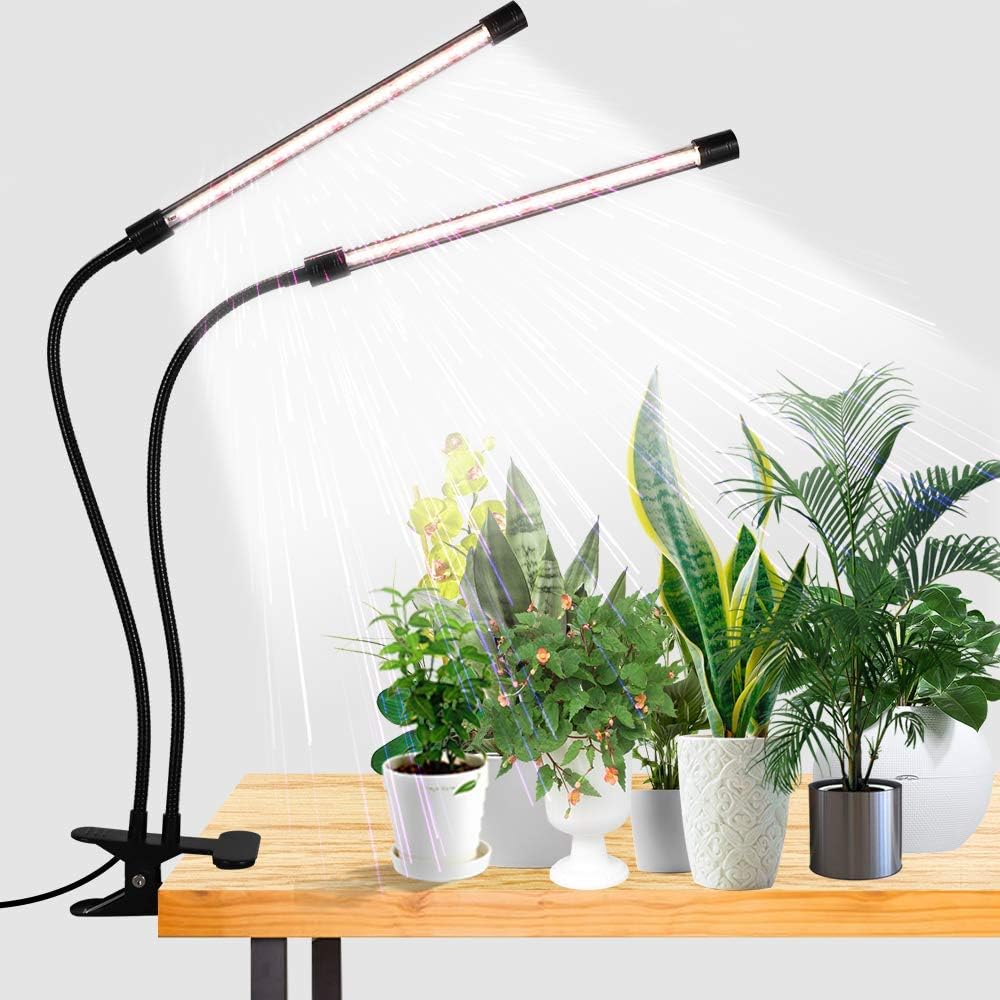
| Power Source | Corded Electric |
|---|---|
| Color Temperature | 6000 Kelvin |
| Light Output Maximum | 2500 lumens |
| Light Source Special Features | Dimmable |
| Number of Light Sources | 84 |
This GooingTop HY-021 is a compact clip-on grow light built for small houseplants, seedlings and shelf gardens. It uses 84 LEDs (white plus deep red) to deliver a 6000K full-spectrum output intended to mimic midday sun, with a high color-rendering output that also makes it pleasant as a reading lamp. Two flexible gooseneck heads and a strong clamp let you aim light precisely over pots and seed trays, while the attached remote provides 50%/100% dim levels and repeating timers at 4, 8 or 12 hours for hands-off scheduling. Practical benefits include low power draw (listed as roughly 10 W LED draw), a claimed 1 to 2 square meter coverage for seedlings, and an included timer that simplifies day/night cycles. Limitations are its design for small setups rather than large grow racks and the clip mounting limits placement compared with freestanding fixtures. The unit also relies on the corded remote instead of a smartphone app and the lifespan claim is typical of LEDs but not independently verifiable from the listing.
Best for: Buyers who want a simple, low-power, plug-and-play grow light to boost seedlings and a few houseplants on a desk or shelf and who value an easy-to-use timer and adjustable brightness.
Less Ideal for: Growers planning multi-shelf installations, larger vegetable grows, or who need networked or app-based control should consider larger bar lights or fixtures designed for commercial racks.
- Full-spectrum 6000K output with added 660 nm red LEDs to support vegetative growth and flowering
- Attached remote with dimming (50%/100%) and repeat timer settings (4/8/12 hours) for easy scheduling
- Flexible dual goosenecks and strong clamp enable precise positioning over small pots and seed trays
- High reported color rendering for comfortable viewing and accurate plant color assessment
- Low electrical draw around 10 W while covering small growing areas
- Clip-mount design and stated 1–2 m² coverage make it better suited to individual plants or small trays rather than large multi-shelf setups
- No smart app or wireless control option; remote is cord-attached which limits placement flexibility
Verdict: A compact, easy-to-use clip grow light that delivers full-spectrum light and convenient timer/dim controls for small indoor plant setups.
Briignite A19 Full Spectrum LED Grow Light Bulb (2-Pack)

| Light Type | LED |
|---|---|
| Additional Features | Full Spectrum |
| Bulb Base | E26 |
| Light Output Maximum | 1000 lumens |
| Light Source Operating Life | 30000 hours |
These Briignite A19 grow bulbs are full-spectrum LED replacements that screw into any standard E26 fixture to give indoor plants consistent, natural-looking light. Each bulb outputs about 1000 lumens at roughly 11 to 12 watts, so they act like a 60 to 100 watt incandescent while using far less energy, which is handy for running multiple bulbs on a budget. The 3500–4000K warm daylight color and high CRI make foliage colors appear normal rather than the purple hue of some grow lights, so they work well in living spaces and plant shelves. Built-in features include app control and push-button options and an advertised 25,000 to 30,000 hour operating life. Limitations to note are modest reported PPF compared with purpose-built high‑output grow fixtures and the 180 degree beam, which is better for general room lighting than targeted canopy penetration for dense or tall plants. For small collections, seed starting, or supplementing light in low-light rooms these bulbs are an economical, easy-to-install choice.
Best for: Houseplant owners who need an affordable, plug-and-play light to supplement natural light for a few pots, seedlings, or a small indoor garden while keeping energy costs low.
Less Ideal for: Growers aiming to flower large or dense canopy crops or outfitting multi-tiered grow racks will want higher‑PPF, purpose-built fixtures instead.
- Full spectrum output that looks like natural white light and preserves true foliage color
- Low power draw (around 11–12W) with 1000 lumens brightness for energy-efficient continuous use
- Standard E26 base fits common fixtures for tool-free installation
- High CRI of 90 helps accurate color rendering in living spaces
- Beam angle and lumen-focused design give less concentrated PAR/PPF than dedicated high‑output grow fixtures
- App and push-button controls are basic compared with advanced programmable controllers
Verdict: A low-cost, easy-to-install full-spectrum LED bulb that gives natural-looking light and energy savings for small indoor plant collections.
Choosing the Right LED Grow Light for Homeowners: Key Factors to Consider
Spectrum and Plant Stage Match
Light spectrum influences how plants allocate energy. Blue-rich spectrums support compact vegetative growth and stronger stems, while red-dominant output encourages flowering and fruiting. For homeowners growing mixed crops, the ability to adjust or choose a broad full spectrum helps seedlings, leafy greens, and flowering plants without swapping fixtures.
Some LEDs provide switchable modes or programmable spectrums. That flexibility matters when you want to run seedlings and flowering plants on the same shelf at different times. Consider what you grow most and prioritize fixtures whose spectrum aligns with those stages.
Energy Use and Efficiency
Electricity is an ongoing cost for indoor growing. Look beyond raw wattage to the fixture's efficiency, often expressed as micromoles per joule. Higher efficiency means more usable photosynthetic light per watt consumed, which reduces monthly running costs and heat output-important in small indoor rooms.
An efficient fixture also lets you run adequate light levels within household power limits. For homeowners concerned about bills or circuit loads, choose LEDs with proven efficacy figures and the ability to dim when full output is unnecessary.
Coverage Area and Light Intensity
A fixture's stated coverage can be misleading unless paired with usable PPFD numbers at realistic hanging heights. For home setups, measure the square footage or the number of pots you plan to light and check how evenly the beam spreads at the height you can accommodate.
Narrow, intense beams suit single plants or deep shelves, while wider arrays are better for multi-pot trays. Consider whether you need overlap between fixtures for even canopy light, as homeowners often mount lights nearer to ceilings than in grow tents.
Heat Output and Indoor Comfort
LEDs run cooler than older technologies, but some fixtures still produce enough heat to raise room temperature. In small living spaces, excess heat can stress plants and make the room uncomfortable. Good thermal design-efficient heat sinks, quality drivers, and optionally quiet fans-keeps fixtures stable during long light cycles.
Also consider noise from active cooling and whether you can provide ventilation. In a bedroom or living area, passive cooling is usually preferable for silent operation.
Size, Mounting, and Installation
Home installations are often constrained by ceiling height, shelving, or window placement. Compact designs and flexible mounting options let you adapt lights to different locations. Look for adjustable hangers, included rope ratchets, or mounting brackets that fit common shelf depths and tent sizes.
Ease of installation also includes cord length, plug type, and whether the fixture requires hardwiring. Homeowners generally prefer plug-and-play units with modest footprint and clear instructions.
Controls, Dimming, and Timers
Built-in dimming and simple timers make managing light schedules easier without extra equipment. For mixed plantings or staggered growth stages, the ability to reduce intensity or switch spectrums saves manual effort and reduces the need for additional hardware.
Check whether controls are intuitive and whether the fixture supports external controllers or standard timer plugs. Reliability and straightforward operation matter more in a home setting than advanced automation intended for commercial grows.
Matching Light to Your Growing Space
Assess the vertical and horizontal space you have before choosing a fixture. A wide, low-profile LED panel may work well on a shallow shelf, while a taller room can accommodate hanging bars that produce deeper penetration.
Think about how many plants you want under a single fixture. For a few potted herbs, a small full-spectrum panel will suffice. For multiple seedlings or a multi-tier shelf, plan for even overlap or multiple smaller fixtures to avoid hot spots.
- Measure available hang height to determine safe minimum distance from canopy
- Map pot arrangement to ensure even light distribution
- Account for future expansion when spacing fixtures
Practical Mounting and Placement Tips
Use adjustable hangers so you can raise lights as plants grow. Secure fasteners to stable supports and avoid relying on temporary fixtures that could sag over time. For balconies or window setups, aim for light placement that minimizes glare into living areas.
Place timers and dimmers in accessible locations so you can tweak schedules without disassembling the fixture. Keep cords tidy and follow local electrical safety guidance for any permanent installs.
- Position lights for the most sensitive plants first, then fill with less demanding ones
- Leave some margin from nearby combustible materials and maintain airflow
- Consider reflective surfaces or light-colored walls to boost usable light
Managing Heat and Ventilation in Small Homes
Monitor temperature near the canopy during long light cycles. Even moderate heat buildup can change watering needs and accelerate plant respiration. If heat becomes an issue, lower intensity, raise the fixture, or add passive ventilation.
For units with fans, check noise levels before permanent placement. In shared living spaces, a quieter, slightly larger passive-cooled fixture may be preferable to a compact noisy fan-cooled model.
- Use an inexpensive thermometer to track microclimate changes
- Open a window or use a small exhaust fan when necessary
- Avoid enclosing fixtures in small boxes without airflow
Light Schedules and Photoperiods for Common Houseplants
Different plants need different day lengths. Leafy greens often thrive under 14 to 18 hours of light, while many flowering species benefit from a reduced photoperiod during bloom. Match your timer settings to the species you grow rather than running lights at a single default for every plant.
When rotating plants through the same fixture, keep a simple chart of current schedules so you can revert to previous settings if a crop responds poorly to a change.
- Seedlings: 16-18 hours of light for steady growth
- Leafy greens: 14-18 hours depending on vigor desired
- Flowering plants: 12 hours light / 12 hours dark for many species
Maintenance and Long-Term Reliability
Check fixtures periodically for dust buildup on lenses and heat sinks. Dust reduces output and impairs cooling. A soft brush or low-pressure air will usually remove debris without damaging diodes.
Inspect power supplies and connections on a schedule. Loose plugs or frayed cords create safety hazards and can shorten the life of the driver. Plan for eventual replacement by choosing fixtures with replaceable drivers or well-documented specifications.
- Clean lenses every few months depending on environment
- Track total run-hours if the fixture specifies rated lifespan
- Keep spare mounting hardware and a basic toolkit handy
How We Chose the Best LED Grow Light for Homeowners
We assembled this list by applying practical, gardener-focused filters that reflect real home growing situations. Primary evaluation criteria included spectral quality because plant stage-specific light affects leaf development and flowering. Power efficiency and input wattage were measured to reflect expected electricity use for an indoor environment. Coverage pattern and usable PPFD at realistic hang heights determined how well a fixture will serve common home setups like shelves and small tents. Thermal management and user safety were checked to ensure long runtimes without overheating or contributing excess heat to a living space. Ease of installation, available mounting options, and control features such as dimming or veg/flower switches were also weighed because homeowners value simple setup and adaptability. We excluded commercial or industrial-grade fixtures meant for large-scale operations, as well as lights requiring complex ventilation or three-phase power. The final selections prioritize reasonable size, user-friendly controls, and predictable light behavior for small-to-medium indoor gardens.
FAQ
What wattage LED is best for a small indoor herb station?
It depends on the area and desired yields. For a small area of a few pots, a compact fixture with moderate wattage and good efficiency usually provides adequate light. Focus on usable PPFD at hang height rather than raw wattage to estimate performance.
How close should LED grow lights be to seedlings?
Seedlings prefer moderate intensity to avoid stretching. Many homeowners hang LEDs 12 to 24 inches above seedlings, adjusting based on manufacturer guidance and observed plant response. If leaves bleach or curl, raise the light or reduce intensity.
Do I need special ventilation for an LED setup in an apartment?
Often not, because LEDs produce less heat than older lamp types. However, in tight, enclosed spaces or with multiple fixtures, some ventilation helps control temperature and humidity. A small quiet fan or brief window airing usually suffices.
Are full-spectrum LEDs necessary for all plant types?
Full-spectrum LEDs provide balanced light for most stages and simplify setup. Some growers prefer targeted spectrums for specific stages, but for homeowners growing mixed plants, a quality full-spectrum fixture is usually the most practical choice.
How long do LED grow lights typically last in home use?
Many LEDs are rated for thousands of hours of use, often in the tens of thousands. Actual lifespan depends on driver quality, thermal management, and operating conditions. Regular cleaning and adequate ventilation extend useful life.
Can I use household timers with LED grow lights?
Yes, most plug-and-play LED fixtures work with standard mechanical or digital timers. For fixtures with built-in dimming or programmable controls, the internal settings are often more convenient than external timers.
Final Verdict
For homeowners, the best LED grow light balances usable spectrum, energy efficiency, and a coverage pattern that fits the available space. Prioritize fixtures that offer consistent PPFD at your planned hang height, reliable thermal design, and straightforward mounting and controls. Expect tradeoffs between compact size and uniform coverage. Choose the feature set that matches your plants and routine-simple dimming and full-spectrum output for mixed plantings, or higher intensity and tighter beam control for a single specimen. With those priorities clear, you can pick a light that performs well in a real indoor home environment.
