

Note: This article contains affiliate links. If you click on these links and make a purchase, I may earn a small commission at no extra cost to you. This helps support my research and content. Read my full affiliate disclosure here.
Picking the right starter grow light shapes how well your seeds sprout, how stocky seedlings stay, and how quickly young plants move into the next growth stage. You want equipment that produces the right spectrum, gives even coverage, and is easy to set up in a small space. This guide explains why those attributes matter in a real home, balcony, or spare-room growing setup and highlights seven shortlisted starter grow lights chosen for typical beginner needs. Read on for the setup and performance factors we used to assess each option and a clear look at tradeoffs between coverage, heat, and operating cost.
Top Picks at a Glance
| Best Overall The best all-around choice for most situations | VIPARSPECTRA P700 70W Dimmable Full Spectrum LED Grow Light |  |
| Best Quality Built to a higher standard if you want something more solid | VIVOSUN LumaLight 100W LED Full Spectrum Grow Light |  |
| Best Value The sweet spot between price and what you get | EWPJDK 84‑LED Clip Gooseneck Full Spectrum Grow Light with Timer |  |
| Best Budget The cheapest option that still gets the job done reliably | bseah Full Spectrum LED Grow Light for Indoor Plants (2-Tube, 10W) |  |
| Highest Rated A top-rated pick with lots of positive feedback | Barrina TX-L63 3ft LED Grow Light — 4‑Pack, 252W Full Spectrum |  |
| Most Popular A crowd favorite that many people choose with confidence | GooingTop HY-021 6000K Full-Spectrum Clip Grow Light |  |
| Best Seller A high-volume bestseller chosen again and again | Aokrean Halo Full-Spectrum LED Grow Light with Base (3-Pack) |  |
VIPARSPECTRA P700 70W Dimmable Full Spectrum LED Grow Light

| Light Output Maximum | 11000 lumens |
|---|---|
| Light Source Wattage | 70 watts |
| Mounting Type | Hanging Mount |
| Light Source Special Features | Dimmable |
| Number of Light Sources | 216 |
The VIPARSPECTRA P700 is a 70W full spectrum LED grow light built for seed starting and vegetative stages. It uses 216 diodes and a tuned mix of red and white LEDs to deliver high PAR output (advertised 11,000 lumens) across a small footprint roughly suited to a 2×2 ft veg area. The light is fanless and relies on large aluminum heat sinks to keep running temperatures low while the included 4-level dimmer lets you dial intensity for seedlings, clones, or mature veg. Setup is simple with hanging mount hardware included and the unit draws about 0.65 A at 120V so it runs far cooler and uses far less power than a comparable 150W HPS/MH system. For compact tents, shelves, or single-cabinet grows it offers a good balance of light output, spectrum, and efficiency. Limitations are its small coverage area and modest absolute wattage compared with larger fixtures, so gardeners with bigger canopies will want a higher-output model or multiple units.
Best for: Growers who want an efficient, low-heat fixture to run a single tent, shelf, or cabinet and who prioritize electricity savings and adjustable output for seedlings and veg.
Less Ideal for: Commercial growers or hobbyists running multi-plant canopies or larger tents who need wider coverage and higher total light output.
- Full spectrum diode layout optimized for seedlings and vegetative growth
- Low power draw (70W) with high reported lumen/PAR output for energy efficiency
- Fanless design with aluminum heat sinks for quiet, low-heat operation
- Integrated 4-level dimmer for easy intensity adjustment
- Coverage geared to a small 2×2 ft veg area so not ideal for larger grows
- Absolute wattage and diode count are modest compared with larger commercial fixtures
Verdict: A compact, energy-efficient full spectrum LED that delivers strong veg-stage light and adjustable intensity for small tents and cabinets.
VIVOSUN LumaLight 100W LED Full Spectrum Grow Light

| Wattage | 100 watts |
|---|---|
| Light Source Type | LED |
| Number of Light Sources | 336 |
| Is Waterproof | True |
| Control Method | Remote |
The VIVOSUN LumaLight 100W is a compact full-spectrum LED grow light intended for indoor gardens and patios. It uses a mix of white, blue, red and far-red diodes to support all growth stages from seedlings through flowering, and the array is arranged to deliver uniform intensity across the canopy. Typical use is hanging above a small grow area with the included rope hangers and adjusting intensity via the four-level dimming knob or remote/mobile control when paired with VIVOSUN accessories. Notable features include IP65 water and dust resistance for high-humidity setups, a low-heat design for closer placement to plants, and Bluetooth/remote control compatibility for easier scheduling. Practical benefits are even coverage for several small plants, lower heat stress, and long expected LED life. Limitations are its 100W power level, which is best for small tents or a few plants rather than larger grow rooms, and some advanced scheduling requires the separate GrowHub controller for full smart automation.
Best for: A practical home grower who wants a reliable, compact full-spectrum light for seedlings through flowering and values even coverage and low heat in a small tent or patio setup.
Less Ideal for: Large-scale growers or those outfitting multi-shelf systems who need higher wattage fixtures or broader coverage should consider more powerful models.
- Full-spectrum diode mix (white, blue, red, far-red) suitable for all growth stages
- Dimmable four-level control plus Bluetooth/remote connectivity for convenient intensity adjustments
- IP65 waterproof and dustproof rating allows use in humid or misted environments
- Low-heat design with aluminum body for efficient thermal management and longer LED life
- At 100 watts it is intended for small tents or modest plant counts and not optimized for larger grows
- Advanced smart scheduling requires purchasing the GrowHub controller separately
Verdict: A dependable, compact full-spectrum LED grow light that delivers even coverage and low heat for small indoor grows.
EWPJDK 84‑LED Clip Gooseneck Full Spectrum Grow Light with Timer

| Number of Light Sources | 84 |
|---|---|
| Wattage | 10 watts |
| Voltage | 5 volts_of_direct_current |
| Connectivity Technology | USB |
| Controller Type | Push Button, Timer Function |
This compact EWPJDK clip grow light is aimed at boosting light for desktop and small indoor plants. It plugs into USB power, clamps to shelves or desks with a strong padded clip and uses a flexible gooseneck so you can aim the 84 LEDs over seedlings, succulents or potted herbs. The lamp offers three spectra—white, red, and combined—and ten dimming steps, so you can match intensity to seedling, vegetative or flowering stages. A built‑in cycle memory timer (3/9/12 hours) automates daily schedules, which is handy if you forget to switch lights. At about 10 watts the light is low power and runs cool, making it safe for close placement to foliage. Limits to expect are the small coverage area and modest power, so it will not replace larger fixtures for multiple plants or wide trays. Also it is not water resistant so it should be kept away from humid setups and wet benches. For single pots, propagation trays and desk gardening it is a practical, easy to position option.
Best for: Gardeners who want a low‑effort, energy‑efficient solution for single pots, seedlings or a small windowsill and who value an easy to position, set‑and‑forget light.
Less Ideal for: Growers planning to light multiple plants, large trays, or a grow tent should choose a higher‑output panel or multiple fixtures instead.
- Flexible gooseneck and strong padded clamp make it easy to position and secure on desks or shelves
- Three light modes and 10 dim levels let you tailor spectrum and intensity to growth stages
- Built‑in memory timer with 3/9/12 hour cycles automates daily light schedules
- Low 10 watt draw and USB power keep energy use and heat minimal for close placement
- Small footprint and limited output mean it only covers a few small pots or seedlings
- Not water resistant so it cannot be used in humid or wet greenhouse benches
Verdict: A compact, low‑power clip grow light with adjustable spectrum and a memory timer that makes automated care simple for single pots and small seedlings.
bseah Full Spectrum LED Grow Light for Indoor Plants (2-Tube, 10W)

| Wattage | 10 watts |
|---|---|
| Power Source | DC 5V (USB) |
| Number of Light Sources | 2 |
| Control Method | Remote |
This bseah grow light is a tabletop LED lamp designed to help seedlings and young plants get steady light when natural sun is insufficient. It plugs into USB power and uses two tubes of yellow and white full-spectrum LEDs to support germination, vegetative growth, and flowering stages. The flexible metal gooseneck and non-slip base make it easy to position over a tray of seeds or a few small pots, while the remote and on-device controls offer three mode presets plus 10 dimming levels so you can lower intensity for delicate seedlings or boost it for heavier growth. The built-in 3/9/12 hour timer with memory simplifies daily schedules. Practical benefits include long LED life expectancy and a lightweight, desktop setup that fits on a windowsill or seed-starting bench. Limitations are the low 10 watt total output and single light head which mean coverage is limited to a small area and taller seedlings may need the lamp repositioned as they grow. For starting seeds you may need multiple units or supplemental light for larger trays.
Best for: Buyers who want an inexpensive, compact lamp to start small batches of seeds or care for a few seedlings on a windowsill and prefer a simple plug-and-play setup.
Less Ideal for: Gardeners who need to light large seed trays, multiple flats, or quickly grow taller seedlings should look for higher-output fixtures or expand with additional units.
- Full spectrum LED output suitable for seed germination through early growth
- Adjustable gooseneck and non-slip base for precise positioning over seedlings
- Ten dim levels and three mode presets let you tailor light intensity for stages
- Auto 3/9/12 hour timer with memory simplifies daily on/off scheduling
- USB power lets it run from common adapters, power banks, or a computer
- Only 10 watts and two tubes limit coverage to a small seed tray or a few pots
- Not waterproof so it must be kept away from wet benches or high-humidity setups
Verdict: A budget-friendly, easy-to-use USB grow lamp that works well for starting small batches of seeds and supporting early seedling growth.
Barrina TX-L63 3ft LED Grow Light — 4‑Pack, 252W Full Spectrum

| Light Source Type | LED |
|---|---|
| Light Output Maximum | 5100 lumens |
| Light Source Wattage | 252 watts |
| Mounting Type | Ceiling Mount |
| Number of Light Sources | 4 |
The Barrina TX-L63 is a practical starter kit of four 3 ft LED panels intended for seedlings and multi‑shelf setups. Each unit uses a full spectrum array (including red, blue and IR ranges) and the set draws 252W total while delivering high PPFD close to plants, so it accelerates germination and early vegetative growth when mounted 10–12 inches above foliage. Notable features include a mechanical 24‑hour timer with power‑off memory, linkable cords that let you daisy‑chain up to four fixtures, and a ventilated multi‑panel design for passive 360° heat dissipation. Benefits for beginners are straightforward: simple timer scheduling, broad coverage from the four panels, and a plug‑and‑play layout that replaces higher‑wattage traditional lights. Limitations to consider are that the lights are not dimmable, so tailoring intensity requires changing distance or fixture count, and the mechanical timer gives less precise programming than digital controllers. The polycarbonate housing is lightweight and practical for shelves and small greenhouses, making this a low‑fuss option for reliable early‑stage plant lighting.
Best for: Buyers who want a dependable, low‑maintenance starter lighting kit for seedlings or small multi‑tier grows and prefer simple set‑and‑forget operation over fiddly controls.
Less Ideal for: Growers who need fine intensity control, programmable light cycles, or large single‑canopy installations should consider adjustable or digital fixtures instead.
- Full spectrum output including red and blue bands suited for seedling through flowering stages
- Mechanical 24‑hour timer with memory simplifies set‑and‑forget lighting
- Linkable design and included cords let you expand coverage without extra wiring
- Ventilated multi‑panel layout promotes passive cooling and longer LED life
- No dimming control built in so intensity must be adjusted by distance or number of fixtures
- Mechanical timer is less flexible than digital timers for complex schedules
Verdict: A reliable, easy to use four‑pack grow light kit that delivers full spectrum coverage and simple timer control for beginner seedling and shelf grows.
GooingTop HY-021 6000K Full-Spectrum Clip Grow Light
| Power Source | Corded Electric |
|---|---|
| Color Temperature | 6000 Kelvin |
| Light Output Maximum | 2500 lumens |
| Light Source Special Features | Dimmable |
| Number of Light Sources | 84 |
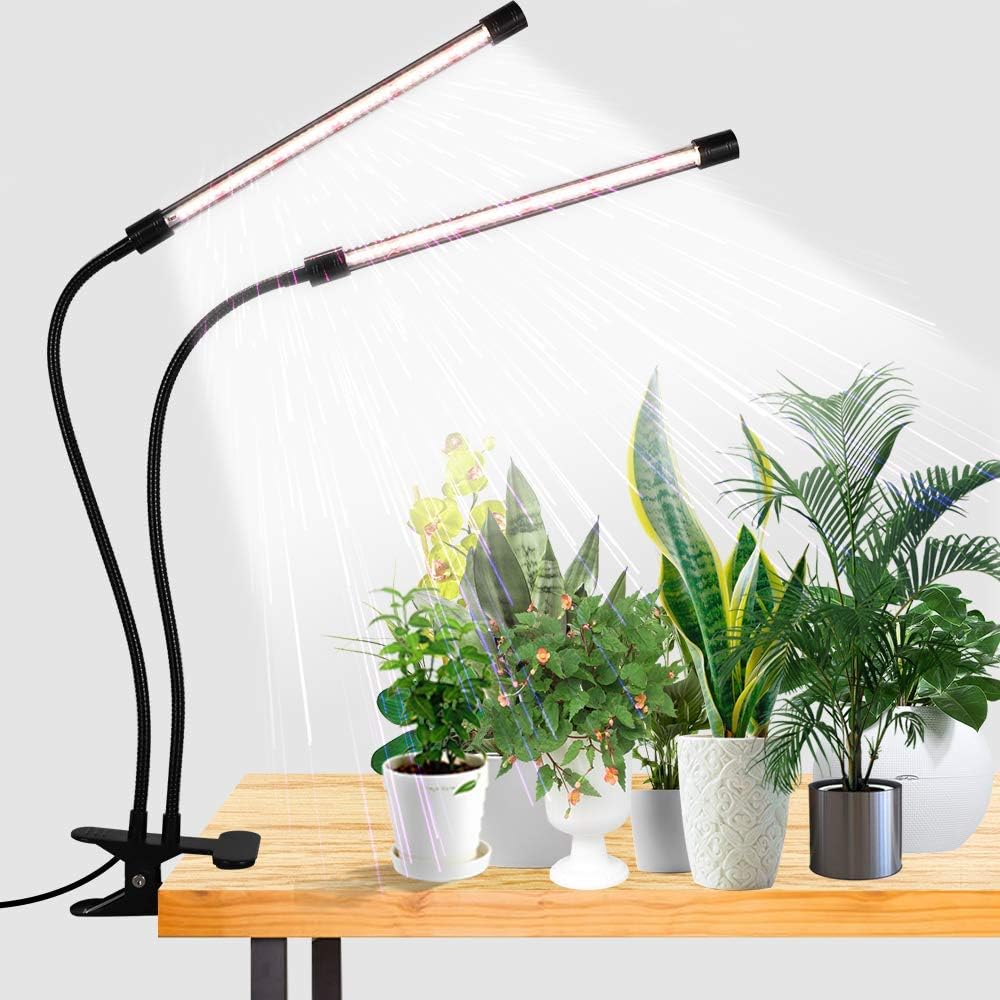
This GooingTop HY-021 is a compact clip-on grow light built for small houseplants, seedlings and shelf gardens. It uses 84 LEDs (white plus deep red) to deliver a 6000K full-spectrum output intended to mimic midday sun, with a high color-rendering output that also makes it pleasant as a reading lamp. Two flexible gooseneck heads and a strong clamp let you aim light precisely over pots and seed trays, while the attached remote provides 50%/100% dim levels and repeating timers at 4, 8 or 12 hours for hands-off scheduling. Practical benefits include low power draw (listed as roughly 10 W LED draw), a claimed 1 to 2 square meter coverage for seedlings, and an included timer that simplifies day/night cycles. Limitations are its design for small setups rather than large grow racks and the clip mounting limits placement compared with freestanding fixtures. The unit also relies on the corded remote instead of a smartphone app and the lifespan claim is typical of LEDs but not independently verifiable from the listing.
Best for: Buyers who want a simple, low-power, plug-and-play grow light to boost seedlings and a few houseplants on a desk or shelf and who value an easy-to-use timer and adjustable brightness.
Less Ideal for: Growers planning multi-shelf installations, larger vegetable grows, or who need networked or app-based control should consider larger bar lights or fixtures designed for commercial racks.
- Full-spectrum 6000K output with added 660 nm red LEDs to support vegetative growth and flowering
- Attached remote with dimming (50%/100%) and repeat timer settings (4/8/12 hours) for easy scheduling
- Flexible dual goosenecks and strong clamp enable precise positioning over small pots and seed trays
- High reported color rendering for comfortable viewing and accurate plant color assessment
- Low electrical draw around 10 W while covering small growing areas
- Clip-mount design and stated 1–2 m² coverage make it better suited to individual plants or small trays rather than large multi-shelf setups
- No smart app or wireless control option; remote is cord-attached which limits placement flexibility
Verdict: A compact, easy-to-use clip grow light that delivers full-spectrum light and convenient timer/dim controls for small indoor plant setups.
Aokrean Halo Full-Spectrum LED Grow Light with Base (3-Pack)

| Light Source Type | LED |
|---|---|
| Number of Light Sources | 48 |
| Wattage | 10 watts |
| Control Method | Touch |
| Power Source | Corded Electric |
This Aokrean Halo grow light is a small, versatile LED solution for indoor plants that offers a lot of convenience in a compact package. Each lamp uses 48 LEDs with a full-spectrum output and three lighting modes plus ten brightness levels, so it can be tuned for seedlings, vegetative growth, or supplemental light for potted houseplants. The lamp can be inserted into soil or mounted on the included base, and the telescoping pole adjusts up to about 26 inches to suit taller pots or change light intensity. Controls are touch-based and include a timer with preset cycles for automated daily on/off. Practical benefits include a neat decorative look, low power draw at 10 watts, and USB/Bluetooth connectivity for modern setups. Limitations are that the base requires the pot to help stabilize the stand and the unit is not water resistant, so it must stay dry and indoors. For balanced buyers looking for adaptable, easy-to-use grow lights for multiple indoor plants, this hits the mark.
Best for: Buyers who want a compact, adjustable grow light that works for seedlings and small to medium houseplants and who value easy controls and automated timers.
Less Ideal for: Growers needing heavy-duty, waterproof fixtures for greenhouse or outdoor use or those who require high-output lighting for large-scale indoor gardens.
- Full-spectrum LED array (48 LEDs) with three lighting modes and 10 brightness levels for flexible plant lighting
- Height-adjustable pole and dual mounting (insert in soil or use the base) to fit a range of pot sizes
- Touch controls with built-in timer options for automatic daily cycles
- Low power consumption (10 watts) and high efficiency for continuous use
- Base stability depends on placing a pot on it so it can be less secure with lighter containers
- Not water resistant so unsuitable for humid or outdoor environments
Verdict: Aokrean's Halo is a space-saving, full-spectrum grow light with adjustable height and timers that makes it easy to give small indoor plants the right light without complex setup.
Choosing the Right Starter Grow Light: Key Factors to Consider
Spectrum and PAR
A starter grow light should emit the wavelengths seedlings use most, primarily blue and some red. Blue light encourages compact, stocky seedling growth while red supports the first spurts of vegetative development. Photosynthetically active radiation (PAR) values tell you how much usable light the fixture delivers; higher PAR at the canopy means faster, more reliable early growth. For beginners, a balanced full-spectrum or a combined blue-red output simplifies decisions because it reduces the need for separate fixtures during the seedling stage.
Understanding spectrum matters because seedlings that receive too little blue light will stretch and become leggy, while too much red-heavy light can produce weak tissue if blue is absent. Look for fixtures that list spectrum bands or PAR maps so you can match output to common tray distances and plant types.
Coverage and Uniformity
Even light distribution across your seedling tray prevents uneven germination and variable stretch between plants. A fixture that produces a narrow, intense beam will create hot spots under the lamp and dim edges where seedlings will lean and compete for light. Fixtures with larger arrays or diffused lenses typically produce a flatter footprint, making them better for multi-cell trays and flat propagation benches.
Consider the canopy area you need to light. A small desktop tray requires different coverage than a 2 x 4 propagation mat. Check recommended hanging heights and manufacturer coverage diagrams when provided; real-world setups often need the fixture a few inches higher than specified to smooth out intensity differences.
Heat Output and Cooling
Heat from the fixture influences seedling microclimate and can dry media or stress delicate roots. Passive-cooled lights with aluminum heatsinks are quieter and lower maintenance, but they must still dissipate enough heat for continuous operation. Active cooling with fans can allow higher output in compact units, but fans add noise and another failure point. For small indoor spaces, lower heat output simplifies ventilation and reduces the risk of scorching or accelerated soil drying.
You should plan for the fixture's heat by leaving clearance above the canopy and monitoring tray temperature during the first runs. Some fixtures require extra distance to avoid creating overly warm pockets near the tallest seedlings.
Energy Use and Operating Cost
Starter grow lights are often left on for long periods during germination and early growth, so watts drawn and how efficiently those watts become usable plant light affects monthly power use. LED fixtures are generally more efficient than older fluorescent options, converting a larger share of electricity into PAR rather than waste heat. Consider the fixture's wattage, expected daily run hours, and whether the unit includes dimming or timers to reduce consumption when full intensity is unnecessary.
Budget-conscious gardeners should balance upfront cost with long-term electricity usage. An efficient unit may cost more to buy but save money over several growing cycles, especially when used year-round for multiple trays.
Mounting, Controls, and Usability
Beginners benefit from lights that are easy to hang, adjust, and operate. Built-in hangers, adjustable ratchets, or integrated mounting slots simplify positioning above trays. Intuitive controls such as simple dimmers, preset veg modes, or built-in timers reduce guesswork and keep light schedules consistent for germination and early growth. Units that require complex assembly or specialized drivers can delay setup and lead to incorrect placement.
Also consider warranty coverage, ease of replacing parts like fans or drivers, and whether the fixture includes clear documentation on recommended distances and schedules for seedling stages.
Setting Up a Starter Grow Light for Seedlings
Place the fixture at the manufacturer-recommended height for seedlings, then observe how seedlings respond over the first week. If stems are elongating quickly, raise the light slightly or increase blue-spectrum exposure. If leaves appear bleached or curled, move the fixture farther away to reduce intensity or heat stress.
Use adjustable hangers or ratchets so you can gradually raise the fixture as plants grow. For small trays, aim for even light across the surface by centering the fixture and checking corners for dimness. A simple handheld PAR meter helps but careful visual checks are usually sufficient for most beginners.
- Start with standard seedling cycle hours, then adjust based on plant response
- Check tray edges for stretching or uneven germination
- Keep a small fan in the room for air circulation if the fixture runs warm
Common Mistakes New Growers Make
Placing lights too high or too low is one of the most frequent errors. Too low increases heat stress and bleaching, while too high causes leggy seedlings. Many growers also forget to account for reflector or lens intensity differences when switching fixture types.
Another mistake is running lights at full blast continuously without timers, which can lead to wasted electricity and plant stress. Overrelying on a single narrow-spectrum light can produce weak seedlings that struggle later, so favor balanced spectrum or simple veg presets in starter fixtures.
- Avoid direct contact between hot fixtures and flammable materials
- Resist the urge to overwater seedlings that look leggy; adjust light first
- Use consistent on-off schedules to maintain predictable growth patterns
Seedling-Specific Light Schedules
For most vegetable and flower seedlings, 14 to 18 hours of light per day provides a balance between growth speed and energy use. Shorter cycles can slow development, while very long durations may reduce vigor for some species. Start with a moderate daily schedule and observe leaf expansion and stem thickness.
Using a simple timer reduces the need to manually switch lights and prevents inconsistent light periods that confuse seedlings. Gradually shorten or lengthen daily light hours when moving plants from seedling to vegetative stages to match their changing needs.
- 14 to 18 hours is a practical starting point for many common seedlings
- Adjust schedules slowly over several days to avoid shock
- Match light duration with ambient room temperature and humidity for best results
Small-Space and Balcony Considerations
In tight spaces, choose fixtures with lower heat output and compact footprints to avoid overheating small rooms or balconies. Look for models with passive cooling or low-noise fans so you can run them in living spaces without disturbance. Consider protective covers for fixtures used outdoors on sheltered balconies to keep moisture and dust out.
If you share a limited space with other household uses, plan mounting above work surfaces or in closets with proper ventilation. Reflective backboards or white walls near the tray can help improve light utilization without increasing fixture output.
- Prefer passive-cooled fixtures for noise-sensitive areas
- Allow clearance for airflow and occasional inspection
- Use reflective surfaces to boost effective coverage in small setups
When to Transition From Starter Lighting
Move plants to stronger or broader-spectrum lighting when true leaves are well developed and root systems are robust. At that point, you need more overall PAR to support faster vegetative growth and eventual flowering, depending on your crop. Transition gradually by increasing light intensity and duration to avoid shock.
If you grow transplants that will be hardened off outdoors, reduce intensity and increase airflow in the final days under starter lighting to prepare plants for sun and wind exposure.
- Look for multiple sets of healthy true leaves before upgrading
- Increase intensity in stages over several days
- Harden off seedlings before full outdoor exposure
How We Chose the Best Starter Grow Light
We focused on the features that matter most when someone is buying a starter grow light for beginning seedlings and young plants. Practical durability and build quality were assessed by looking for robust housings, reliable drivers, and warranty support that reduce early failure risk. Light output and spectrum were judged by whether the unit delivers usable PAR in the seedling and early-vegetative bands, including adequate blue light for compact growth and red for early development. Coverage and uniformity were evaluated to ensure even light across common small trays without hot spots that cause uneven stretch. Heat management and noise were considered because excess heat or loud fans make small indoor setups harder to maintain. Energy efficiency and expected operating cost were included to show real monthly running differences for continuous use. Ease of setup, mounting options, and simple control features were also applied since beginners benefit from fewer adjustments. We excluded purpose-specific units built only for large flowering cycles, high-intensity commercial fixtures, and products designed solely for decorative houseplants. The final selection favors units that balance usable spectrum, consistent coverage, manageable heat, and straightforward controls.
FAQ
How far should a starter grow light be from seedlings?
Distance depends on the fixture intensity and spectrum, but most starter units are mounted 6 to 18 inches above seedlings. Begin at the higher end if the fixture is powerful or produces noticeable heat, then lower it gradually while watching for stretch or leaf bleaching.
Are LEDs better than fluorescent lights for seedlings?
LEDs are typically more energy-efficient and produce less heat than traditional fluorescents. They also allow for targeted spectra that support compact early growth. Fluorescents can still work for small setups but generally use more power and may need replacement more often.
Do seedlings need a full-spectrum light?
Seedlings benefit from a broad spectrum that includes blue light to prevent stretching and some red for early development. Full-spectrum fixtures simplify management by covering the needed bands without requiring multiple fixtures.
Can I run a starter grow light 24 hours a day?
Running lights continuously is usually unnecessary and can stress some seedlings. Most species do well with 14 to 18 hours of light daily. A timer helps maintain consistent cycles and saves electricity.
Will a starter grow light heat up my room?
All fixtures produce some heat, but modern LED starter lights tend to run cool. Passive-cooled units generate less ambient warmth than fan-cooled or high-watt fixtures. Plan for ventilation if you run several units in a small room.
Final Verdict
For beginner indoor growers, prioritize a starter grow light that provides a useful PAR output and a spectrum leaning toward blue for compact seedlings while still offering some red for early development. Balance coverage and uniformity against heat generation and energy use so your small trays receive even light without creating difficult microclimates. Choose fixtures that are easy to hang and control, and plan gradual transitions as plants move into later growth stages. With those tradeoffs in mind, you can pick a starter light that minimizes troubleshooting and helps seedlings establish quickly.
