

Note: This article contains affiliate links. If you click on these links and make a purchase, I may earn a small commission at no extra cost to you. This helps support my research and content. Read my full affiliate disclosure here.
Picking the right universal hand saw changes routine garden repairs and small woodworking chores by making cuts cleaner, safer, and faster. You want a saw that behaves predictably on dry lumber, light greenwood, and occasional plastic or PVC without needing a specialized blade for every job. This guide covers five shortlisted universal hand saws that perform reliably across common outdoor and workshop uses. We evaluated each option for blade durability, cutting speed, and user comfort, plus how easy the saw is to control in awkward positions. The following sections explain what matters when choosing a universal hand saw and how we filtered candidates before the product summaries.
Top Picks at a Glance
| Best Overall The best all-around choice for most situations | Jorgensen 15-Inch Hand Saw with 8 TPI Black-Coated Blade |  |
| Best Quality Built to a higher standard if you want something more solid | IRWIN Marathon ProTouch 15-Inch Coarse-Cut Carpenter Saw |  |
| Best Value The sweet spot between price and what you get | CRAFTSMAN 20" Fine Finish Hand Saw (CMHT20881) |  |
| Best Budget The cheapest option that still gets the job done reliably | QYQRQF 14 in. Pro Hand Saw with Ergonomic Soft-Grip Handle |  |
| Highest Rated A top-rated pick with lots of positive feedback | Tempest 14" Pro Hand Saw with 65Mn Carbon Steel Blade and Protective Sleeve |  |
Jorgensen 15-Inch Hand Saw with 8 TPI Black-Coated Blade

| Number of Teeth | 8 |
|---|---|
| Blade Material | Alloy Steel |
| Handle Material | Aluminum |
| Surface Recommendation | Plastic,Wood |
The Jorgensen 15-inch hand saw is a straightforward, heavy-cut handsaw aimed at general woodworking and outdoor trimming tasks. Its 8 TPI triple-ground teeth deliver aggressive, fast cuts through dimensional lumber and framing stock, while the SK5 high-carbon steel blade holds an edge and resists bending under regular use. The black Teflon-like coating reduces friction and helps keep sap and debris from building up on the blade. The reinforced aluminum frame and TPE/ABS ergonomic grip make it comfortable to hold for extended sessions and the handle includes 45° and 90° angle guides useful for marking cuts. Practical uses include rip and cross cuts on rough lumber, pruning thick branches, and cutting PVC or trim where speed matters more than ultra-fine finish. Limitations are inherent to the coarse 8 TPI: it is not intended for fine finish work or precise joinery and will leave a rougher cut on delicate stock. Also, being a fixed non-folding saw it requires safe storage with the included edge protector.
Best for: A buyer who wants a reliable, fast-cutting handsaw for general carpentry, framing, and heavier trimming tasks and values durability and comfort during frequent use.
Less Ideal for: Not the best choice for woodworkers focused on fine finish work, delicate trimming, or precision joinery who need higher-tooth-count saws.
- Aggressive 8 TPI triple-ground teeth for fast, efficient cutting of rough lumber
- SK5 high-carbon steel blade offers good edge retention and resists bending
- Black low-friction coating reduces material buildup and helps corrosion resistance
- Ergonomic aluminum-framed handle with TPE/ABS grip and built-in angle guides
- Coarse 8 TPI tooth pattern produces a rougher finish not suited to fine joinery
- Fixed blade requires careful storage and is less portable than folding saws
Verdict: Choose this saw if you want a durable, comfortable hand saw that makes fast, aggressive cuts for general carpentry and trimming.
IRWIN Marathon ProTouch 15-Inch Coarse-Cut Carpenter Saw

| Blade Material | Alloy Steel |
|---|---|
| Number of Teeth | 14 |
| Blade Shape | Rectangular |
| Power Source | Hand powered |
The IRWIN Marathon ProTouch 15-inch carpenter saw is built for heavy-duty, performance-focused wood cutting. Its M2 tooth geometry and Tri-Ground teeth deliver fast, efficient cutting across and with the grain, while deep gullets clear chips quickly to maintain cutting speed. The tapered-pitch nose improves clearance and control when starting cuts and working near corners, and the thick-body blade adds rigidity for straighter strokes when ripping or crosscutting. The wood ProTouch handle is shaped for comfort during extended use but remains robust for jobsite wear. This saw is best used for framing, rough carpentry, and general-purpose wood cutting where speed and aggressive material removal matter more than super-fine finish. Limitations include a coarse 9-point tooth pattern that leaves a rougher cut compared with fine-tooth saws and a wooden handle that some users may find less ergonomic than modern composite grips.
Best for: Buyers who prioritize fast, aggressive cutting for framing, rough carpentry, or frequent jobsite use and want a reliable, high-performance hand saw.
Less Ideal for: People who need very fine, smooth finish cuts for trim, cabinetry, or finish carpentry should choose a finer-toothed saw designed for precision.
- Aggressive M2 and Tri-Ground teeth for fast cutting and efficient chip removal
- Deep gullets reduce clogging and keep the cut moving quickly
- Thick-body blade improves rigidity for straighter, controlled strokes
- Tapered-pitch nose aids clearance and starting cuts in tight spots
- Coarse 9-point tooth pattern produces a rougher finish not ideal for fine joinery
- Wooden handle offers durability but less modern ergonomic padding
Verdict: Choose this saw when you need a durable, high-performance carpenter saw that cuts fast and clears chips efficiently for rough and framing work.
CRAFTSMAN 20" Fine Finish Hand Saw (CMHT20881)

| Blade Length | 20 inches |
|---|---|
| Number of Teeth | 6 |
| Blade Material | High Speed Steel |
| Power Source | Manual Power |
| Handle Material | Composite Materials |
The CRAFTSMAN 20" Fine Finish hand saw is a straightforward wood-cutting tool designed for clean, fast cuts in panel and dimensional lumber. Its 20-inch high-speed steel blade with induction-hardened teeth delivers lasting sharpness and the six teeth per inch profile is tuned for smooth crosscuts and general carpentry tasks. The bi-material ergonomic handle gives good control and includes simple 45- and 90-degree references for square and miter work, which helps when cutting without a box or guide. Because the blade is rectangular and built for fine finish work, it performs best on wood, plywood, and laminate rather than heavy demolition. The saw is lightweight and easy to use for extended periods, making it suitable for finish carpentry, trimming, and DIY projects where a neat edge matters. It lacks specialized features like replaceable blades or extra teeth density for ultra-fine joinery, but as a durable, no-frills hand saw it balances performance and comfort for everyday woodworking tasks.
Best for: A practical homeowner or carpenter who wants a reliable, easy-to-use saw for general woodworking and finish cuts around the house.
Less Ideal for: Woodworkers who need ultra-fine joinery blades, frequent ripping, or modular saw systems with replaceable blades should consider more specialized saws.
- Durable high-speed steel blade with induction-hardened teeth for longer edge life
- Six TPI fine-finish tooth pattern for clean crosscuts in wood and panel materials
- Ergonomic bi-material handle that improves grip and control during cuts
- Lightweight design suitable for extended use and general carpentry
- Tooth count and blade design prioritize finish cuts over aggressive ripping or heavy demolition
- No replaceable blade option for specialized or worn-edge replacements
Verdict: Choose this saw if you need a durable, comfortable 20" hand saw that delivers clean, fast finish cuts for everyday woodworking.
QYQRQF 14 in. Pro Hand Saw with Ergonomic Soft-Grip Handle
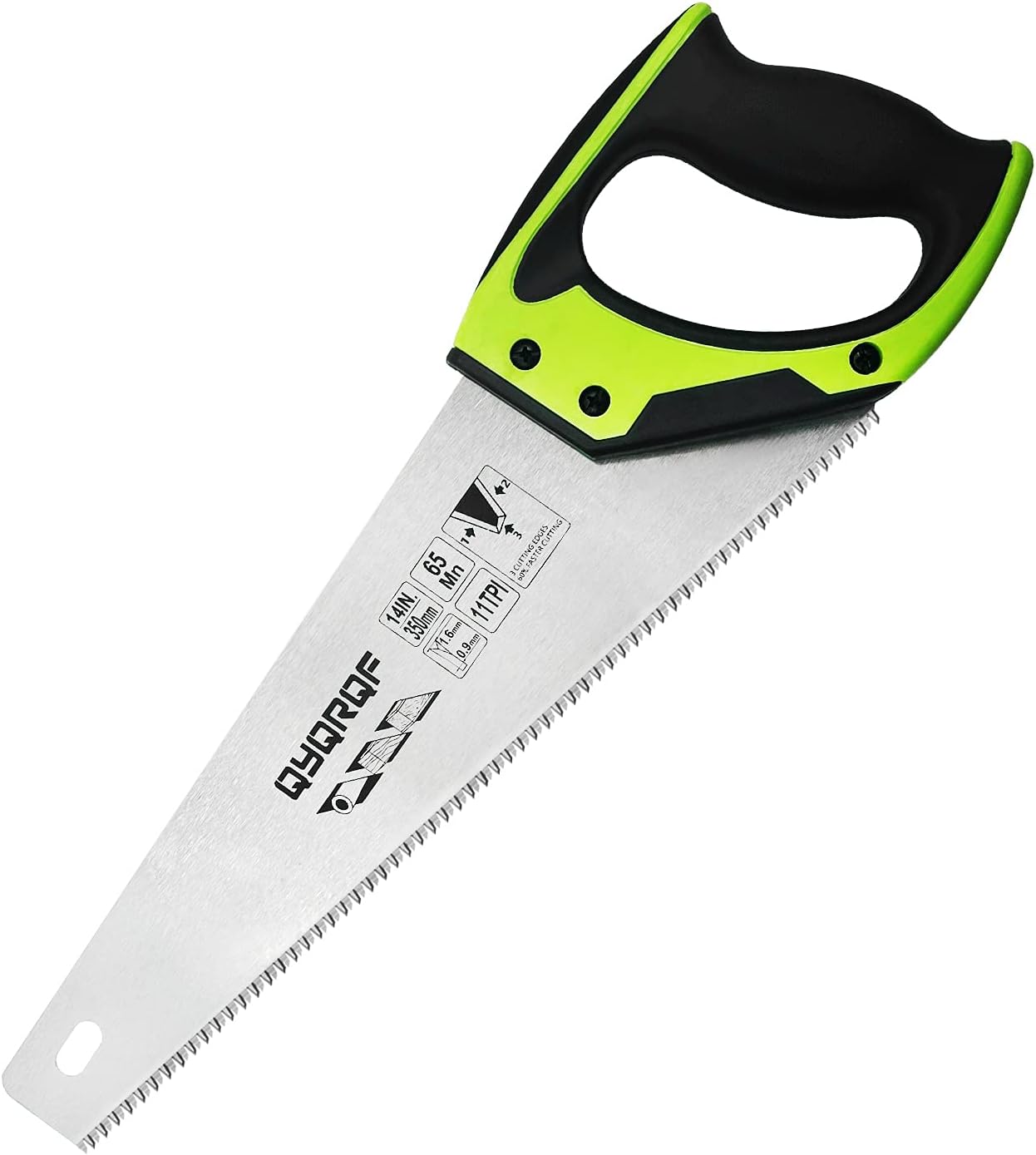
| Blade Material | Alloy Steel |
|---|---|
| Blade Length | 14 inches |
| Number of Teeth | 11 |
| Handle Material | Thermoplastic Elastomers |
This 14-inch pro hand saw is built for fast, accurate cuts in wood, plywood and PVC pipe. The 65Mn heat-treated alloy-steel blade with three-face grinding and deep gullets clears chips quickly, and the 11 TPI fine-cut tooth pattern makes controlled crosscuts and trim work straightforward. A low-friction coating helps the blade slide through material, while the thermoplastic elastomer soft-grip handle is shaped for comfort during repeated strokes and reduces hand fatigue. It ships with a protective sleeve and a hard case for safe storage. For someone focused on practical performance, the saw delivers durable sharpness and predictable cuts without power tools. Limitations are its manual speed compared with a power saw and that the 11 TPI is a compromise between fast ripping and very fine finishing, so you may need a different tooth count for very fine trim or rip work.
Best for: Buyers who prioritize efficient, reliable hand cutting for routine wood trimming and light carpentry and want a durable tool that reduces hand fatigue during regular use.
Less Ideal for: Users who need the fastest bulk ripping or ultra-fine finish cuts, or those who prefer powered saws for large projects.
- Heat-treated 65Mn alloy-steel blade for long-lasting edge retention
- Three-face grinding and deep gullets for faster chip removal and quicker cuts
- Low-friction coating reduces binding and improves stroke efficiency
- Ergonomic non-slip soft-grip handle reduces hand fatigue during extended use
- Manual saw cannot match the speed of powered cutting tools
- 11 TPI is a middle-ground tooth count and may not be ideal for very fine finish cuts or fast ripping
Verdict: A durable, comfortable 14-inch hand saw that speeds up manual cutting with a heat-treated blade and efficient tooth geometry, ideal for everyday wood and trim work.
Tempest 14" Pro Hand Saw with 65Mn Carbon Steel Blade and Protective Sleeve

| Blade Material | Carbon Steel |
|---|---|
| Blade Length | 14.5 inches |
| Blade Thickness | 0.9 mm |
| Teeth Per Inch | 11 TPI |
| Handle Material | Thermoplastic Elastomers |
The Tempest 14" Pro Hand Saw is a straightforward, heavy-duty handsaw aimed at dependable, everyday cutting tasks. Its 65Mn carbon steel blade at 0.9 mm thickness resists wobble and flex, so it stays straight under pressure and produces cleaner cuts in framing lumber, plywood, branches, drywall, and PVC pipe. The 11 TPI triple-ground teeth help the blade bite quickly and pull smooth strokes, reducing fatigue when you need to make repeated cuts. An ergonomic thermoplastic elastomer handle offers a secure, non-slip grip for wet or sweaty hands and the included protective sleeve keeps the teeth safe during storage and transport. The saw is best used for manual carpentry, pruning, and occasional repair jobs where a reliable, no-nonsense tool is preferred over a power saw. It is not specialized for fine joinery or precision cabinetry work where finer tooth counts or pull-stroke saws are typical. For gardeners and homeowners who want a durable all-purpose hand saw that cuts a wide range of common materials, this is a practical choice.
Best for: Buyers who prioritize a dependable, low-maintenance handsaw for general carpentry, pruning, and home repairs and who value a tool that stays rigid and cuts cleanly under regular use.
Less Ideal for: If you need ultra-fine, finish-grade cuts for cabinetry or high-volume repetitive cutting where a powered saw is required, choose a more specialized saw or a power tool instead.
- Thick 0.9 mm 65Mn carbon steel blade reduces wobble for straighter cuts
- 11 TPI triple-ground teeth deliver fast, smooth cutting across wood, drywall, and PVC
- Ergonomic non-slip TPR handle improves comfort and control during extended use
- Protective sleeve guards teeth during storage and transport
- 11 TPI is a compromise that may leave a coarse finish on fine woodworking
- Hand saw design limits speed and throughput compared with power tools
Verdict: A rugged, no-nonsense 14-inch handsaw built to deliver straight, reliable cuts for general-purpose yard and home projects.
Choosing the Right Universal Hand Saw: Key Factors to Consider
Blade Material and Hardness
The alloy and heat treatment of the blade determine how well the saw holds an edge and how resistant it is to chipping when cutting knots or slightly harder materials. Harder steel keeps teeth sharper longer but can be more brittle; a balanced hardness lets teeth stay sharp yet survive occasional impacts. For outdoor use, blades that accept easy resharpening help extend service life without replacement.
Hardness also affects tooth-setting behavior. Softer steel can be re-set and reshaped after knocks, while very hard blades may require professional sharpening if dulled. Choose a blade material suited to the mix of softwood, occasional hardwood, and non-wood materials you expect to cut.
Tooth Geometry and TPI
Tooth shape and teeth-per-inch (TPI) determine how the saw cuts different grain orientations and material thicknesses. Coarser teeth with lower TPI remove material quickly and are better for fast rough cuts in greenwood or softwood. Finer teeth with higher TPI give smoother finishes and handle thin stock or trim without tearout.
Universal saws typically use an intermediate tooth pattern or a hybrid rake that balances crosscut and rip cutting. Consider whether you need faster, rougher cuts for pruning and framing or cleaner finishes for trim and small craft projects. For mixed use, a mid-range TPI offers the best compromise.
Blade Length and Cut Capacity
Blade length affects how many teeth engage a cut and therefore influences control, stroke efficiency, and the maximum piece thickness you can cut in a single pass. Longer blades let you tackle wider boards and make smoother long strokes, but they are less handy in tight spaces and can be harder to start on small stock.
Think about the sizes you most often cut. A mid-length blade is versatile for both yard and workshop tasks, while a shorter blade makes maneuvering around plants or in cramped work areas easier. Match blade length to typical project dimensions for best results.
Handle Design and Vibration Control
A comfortable, well-shaped handle improves control and reduces hand fatigue during repetitive cuts. Look for ergonomic grips that align with your natural wrist posture and materials that reduce slipping when wet or sweaty. Vibration-damping features and a secure tang connection between handle and blade reduce chatter and improve cutting accuracy.
Handle geometry also affects safety. A snug fit that keeps your hand away from the cutting edge and a reliable fastening method for the blade are important when working in the garden where gloved hands and dirt are common.
Corrosion Resistance and Maintenance
Garden tools regularly see moisture and sap, so rust resistance matters for long-term performance. Coatings, stainless alloys, or protective finishes slow corrosion and reduce the need for aggressive cleaning. Routine maintenance like wiping sap, drying the blade, and occasional oiling preserves edge life and prevents pitting.
Also consider how easily teeth can be resharpened or blades replaced. Some universal saws are designed for straightforward blade swaps or have tooth profiles amenable to home sharpening, which keeps the tool serviceable for years.
Best Uses for a Universal Hand Saw
Universal hand saws bridge the gap between specialized pruning saws and fine woodcutting saws. They are useful for trimming small branches, cutting downed limbs into manageable pieces, resizing lumber for quick garden projects, and slicing through PVC or composite materials when precision is not the main concern.
Expect a universal saw to perform well on softwoods and greenwood, manage light hardwoods, and handle general repairs around sheds, planters, and raised beds. Use one when you need a single, transportable tool that can handle many light- to medium-duty cutting tasks.
- Trim small branches and remove deadwood
- Cut framing lumber and dimensional boards for garden builds
- Shape small trim pieces and garden stakes
- Cut lightweight plastic pipe and thin composite boards
Maintaining a Hand Saw for Outdoor Use
Regular maintenance keeps a universal hand saw cutting well and prevents premature failure. After each use, clear sap and debris from the blade with a rag and mild solvent if needed, then dry and lightly oil the surface to prevent rust. Store the saw in a dry place and use a blade sheath or rack to protect the teeth and prevent accidental nicks.
When the saw slows, inspect the teeth for missing or bent points. Minor dulling can be addressed with a file tuned to the existing tooth angle, while more severe damage may require professional sharpening or blade replacement. Maintain the handle fastenings and check for cracks or looseness that could affect safety.
- Wipe and oil blade after use
- File or resharpen teeth when cutting slows
- Keep a protective cover on the blade
- Inspect and tighten handle hardware periodically
Safe Cutting Techniques
Use proper body position and a stable stance when sawing. Support the workpiece so it does not pinch the blade mid-stroke, and start cuts with a few gentle scoring strokes to create a guide. Let the saw do the work; excessive force bends teeth and reduces control.
For branches and irregular shapes, work on the side that will fall or drop away first to avoid binding. Wear gloves and eye protection, and be mindful of where the blade will exit the cut to avoid damaging nearby plants or structures.
- Support work to avoid blade pinching
- Begin cuts with light scoring strokes
- Cut from the side that will relieve pressure first
- Use personal protective equipment
When to Replace or Upgrade a Saw
Replace the saw blade or the entire saw when tooth damage becomes widespread, or the blade is twisted or rust-pitted beyond easy repair. Frequent resharpening is fine, but repeated professional sharpening or blade swapping may indicate it is time for a replacement with a better material or coating.
Consider upgrading if you find yourself often cutting specialized materials or needing finer finishes. A universal saw is a compromise; when projects demand consistently smoother cuts or heavy-duty ripping, a dedicated crosscut, rip, or pruning saw will perform better.
- Replace if teeth are repeatedly chipped or missing
- Upgrade when specialized tasks outgrow the saw
- Change blades if rust or twisting impairs cutting
How We Chose the Best Universal Hand Saw
We focused on practical performance for gardeners and hobby woodworkers who need a single saw to handle a mix of tasks. Primary evaluation criteria were blade material and tooth geometry for cut quality and life; handle ergonomics and vibration control for extended use; blade length and tooth count for versatility across board sizes and greenwood; and ease of resharpening or replacing blades to extend service life. We also considered build durability and corrosion resistance because outdoor use exposes tools to moisture and dirt. We excluded specialty saws designed only for fine joinery, pruning, or masonry and any tools intended solely for power-saw replacement. Candidate saws had to be marketed as general-purpose or universal, have appropriate tooth patterns for cross- and rip-type cutting, and show straightforward maintenance options. Final selections balanced on-paper specs with common-sense features that affect typical garden and workshop tasks.
FAQ
Can a universal hand saw cut greenwood and dry lumber equally well?
A universal saw is designed to handle both, but it is a compromise. It will cut greenwood quickly and manage dry lumber, but it will not match the speed of a coarse pruning saw on thick green branches or the smoothness of a fine back saw on finished dry boards.
How often should I sharpen my universal hand saw?
Sharpening frequency depends on use. For occasional garden and workshop tasks, a light file every few months of regular use is typical. If you cut abrasive materials or hit nails, sharpen or replace teeth as soon as cutting performance drops.
Is it better to have a coated blade for outdoor use?
Coatings help resist rust and sap buildup, which is useful in outdoor conditions. While coatings do not prevent all corrosion, they reduce maintenance and extend the usable life of the blade when combined with proper cleaning and oiling.
What blade length is best for general garden and workshop use?
A mid-length blade tends to be most versatile, balancing control in tight garden spaces with enough reach for common lumber widths. Short blades are handier in confined spots, while longer blades are better for wide boards and smoother long cuts.
Can I use a universal hand saw to cut plastic pipe?
Yes, universal hand saws can handle thin plastic pipe or PVC for light repair work. Expect some burrs and a slightly rough edge; a quick sanding will usually clean it up. Thicker or heavily reinforced plastic may require a blade designed for plastics.
Final Verdict
When choosing a universal hand saw, prioritize blade material and tooth geometry that match the mix of tasks you perform most often. Comfortable handle design and corrosion resistance matter just as much for outdoor work because they affect control and longevity. Expect tradeoffs: universal saws are versatile but not specialized, so balance cut speed, finish quality, and maintenance needs against the range of jobs you face. With those priorities clear, you can pick a universal hand saw that does the job reliably in both garden and workshop settings.
