

Note: This article contains affiliate links. If you click on these links and make a purchase, I may earn a small commission at no extra cost to you. This helps support my research and content. Read my full affiliate disclosure here.
If you plan to convert lawn or a weedy patch into a productive bed, choosing the right mulch for sheet mulching matters more than you might think. The material you lay over your cardboard and compost layer controls how quickly weeds die, how fast organic matter becomes available to plants, and whether moisture stays put through dry spells. This guide covers the six shortlisted mulches suited to sheet mulching and explains the practical tradeoffs gardeners face. We evaluate decomposition behavior, weed suppression, moisture retention, and ease of handling so you can pick the material that fits your timeline and soil goals. Read on to see which mulch types match fast soil building, low-maintenance cover, or long-term weed control.
Top Picks at a Glance
| Best Overall The best all-around choice for most situations | Back to the Roots Organic Coconut Husk Mulch Block (Expands to 2 cu ft) |  |
| Best Quality Built to a higher standard if you want something more solid | Garden Elements 100% Natural Cocoa Bean Shell Mulch, 2 cu ft |  |
| Best Value The sweet spot between price and what you get | HealthiStraw FarmStraw Coarse-Cut 3 cu ft Compressed Wheat Straw Bedding |  |
| Best Budget The cheapest option that still gets the job done reliably | SuperMoss Coco Mulch Small Bale (200 cu in), Natural |  |
| Most Popular A crowd favorite that many people choose with confidence | Plantonix Coco Chips Mulch Brick (10 lb) – Compressed Coconut Husk Chips |  |
| Best Seller A high-volume bestseller chosen again and again | EZ-Straw Just Straw Small Bale (1 Cubic Foot) |  |
Back to the Roots Organic Coconut Husk Mulch Block (Expands to 2 cu ft)

| Item Highlight | Compressed 10 lb coco husk mulch expands to 58 qt; peat-free; OMRI Listed |
|---|---|
| Item Type Name | Mulch |
| Brand Name | Back to the Roots |
| Volume | 2 cubic feet |
This compressed coconut husk mulch block arrives as a compact 10 lb brick that expands to roughly 2 cubic feet after adding water, making it easy to store and handle compared with bulky bags. It is OMRI listed and peat free, so gardeners can use it in vegetable beds, flower borders, and raised planters without adding peat-based material. The coarse husk chips improve surface moisture retention and aeration on the soil, which helps reduce watering frequency and supports root health. Setup is simple: break the block apart, soak, let it fluff, then spread a shallow layer around plants. Because it is lightweight when dry and made from an upcycled byproduct of coconut processing, it is a sustainable alternative to some other mulches. Limitations to note are that coconut husk mulch can float or wash away on steep slopes and may need occasional top-ups as it slowly breaks down, and its coarser texture may not form as uniform a surface as shredded bark for ornamental beds.
Best for: Gardeners who want a compact, easy-to-store organic mulch that improves moisture retention and soil aeration in vegetable beds and raised planters while prioritizing sustainable materials.
Less Ideal for: People needing a heavy, erosion-resistant mulch for steep slopes or those who want a very fine, decorative mulch finish for formal ornamental beds.
- Expands from a compact 10 lb block to about 2 cubic feet, saving storage space
- OMRI listed and peat free for organic gardening use
- Improves moisture retention and soil aeration when applied to beds and raised planters
- Made from upcycled coconut husk, offering a more sustainable option than peat
- Coarse chips can be prone to washing away on steep or exposed slopes
- Breaks down over time and requires periodic replenishing in high-traffic beds
Verdict: A space-saving, OMRI-listed coconut husk mulch block that delivers sustainable moisture retention and aeration for productive garden beds.
Garden Elements 100% Natural Cocoa Bean Shell Mulch, 2 cu ft

| Indoor Outdoor Usage | Indoor, Outdoor |
|---|---|
| Other Special Features | Fragrant |
| Material Features | Organic |
| Unit Count | 1 Count |
| Plant or Animal Product Type | Theobroma cacao |
Garden Elements cocoa bean shell mulch is a decorative organic mulch made from the outer shells of cocoa beans and intended for indoor and outdoor use. Typical uses include top-dressing flower beds, around shrubs, and in container plantings where a refined appearance and a pleasant chocolate-like aroma are desired. The product helps conserve soil moisture and suppress weeds while gradually adding organic matter and nutrients to the soil as it breaks down. It is lightweight and easy to spread, which speeds application over larger beds or around small trees. Notable features are its natural dark brown color that resists fading and an NPK-like nutrient profile noted on the label. Important limitations are that cocoa mulch contains theobromine and caffeine, which are toxic to dogs, so it should not be used where pets may ingest it, and it can wash or compact in heavy rains more readily than heavier bark mulches. For trees, it performs well as a shallow decorative layer but should be kept away from direct contact with trunks and used with caution in pet households.
Best for: Gardeners who prioritize effective moisture retention and an attractive finished look around trees and beds and who do not have curious pets that might eat mulch.
Less Ideal for: Homes with dogs or areas prone to heavy runoff where a heavier, more erosion-resistant mulch would be safer and longer lasting.
- Lightweight and easy to spread, making installation quicker for larger beds
- Helps retain soil moisture and suppress weeds to reduce maintenance
- Natural dark brown color that provides a finished look and resists fading
- Organic material that breaks down to contribute nutrients to the soil
- Contains theobromine and caffeine which are toxic to dogs if ingested
- Can wash away or compact under heavy rain more easily than heavier wood mulches
Verdict: Choose this cocoa shell mulch if you want a lightweight, organic option that improves moisture retention and gives beds and young trees a neat, dark finish.
HealthiStraw FarmStraw Coarse-Cut 3 cu ft Compressed Wheat Straw Bedding
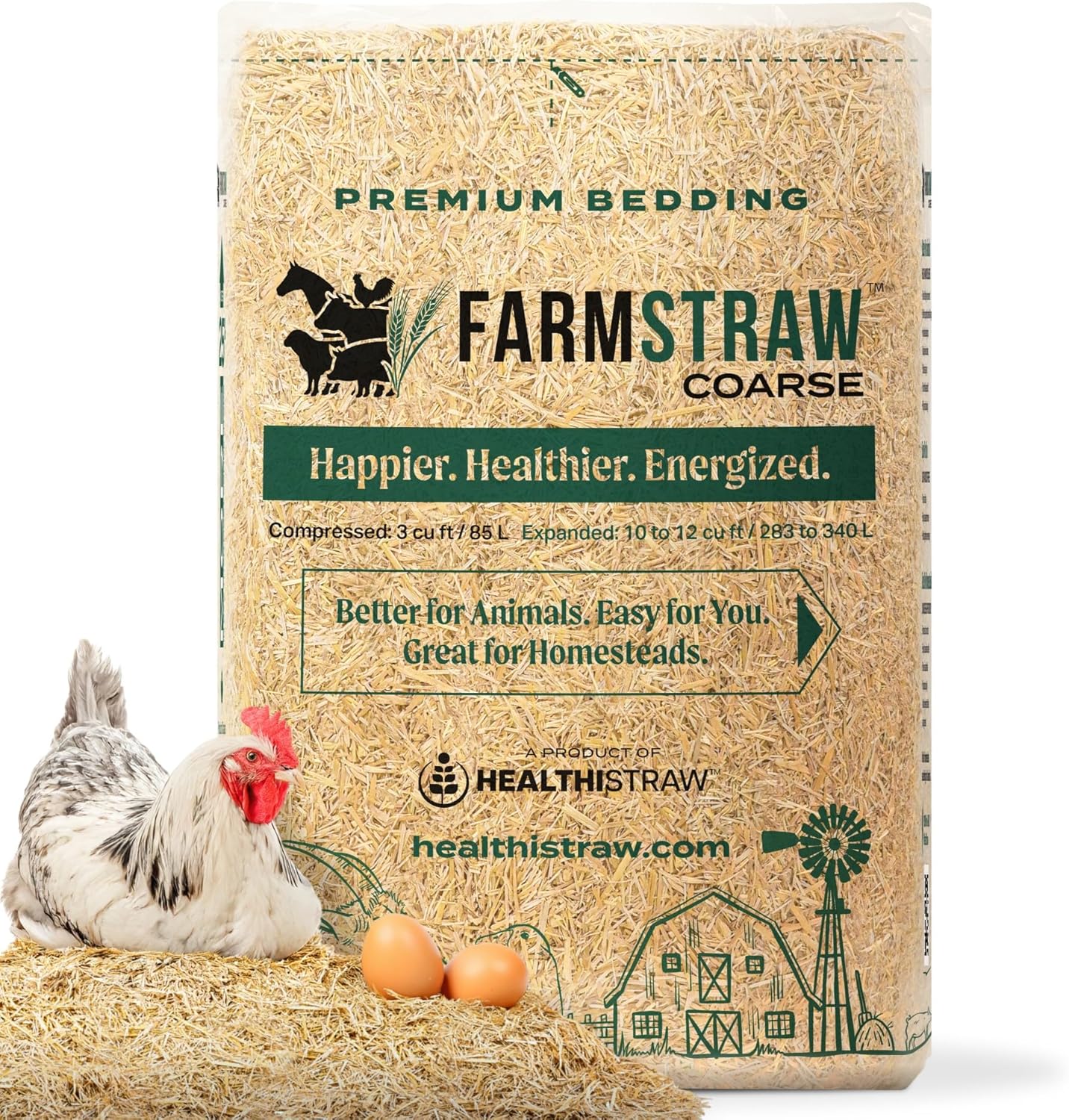
| Material Type | 100% Non-GMO Wheat Straw |
|---|---|
| Included Components | FarmStraw Fine Cut Chicken Bedding, 3 cu ft (25lb) |
| Specific Uses For Product | Chicken coops, nesting boxes, chick brooders, chicken runs and hen houses |
| Additional Features | Biodegradable, Eco-Friendly, Lightweight |
HealthiStraw FarmStraw is a compressed 3 cu ft bale of coarse 2–3 inch non-GMO wheat straw that expands to more than 10 cu ft for use as bedding and mulch in chicken coops, runs, and nesting boxes. The coarse cut produces a fluffy, insulative layer that cushions birds and helps protect eggs while wicking moisture and controlling odors by pulling dampness down into the straw. The product is cleaned to be low-dust, making it easier on flock respiratory health compared with dusty alternatives. It is lightweight to move when compressed and decomposes faster than wood-based bedding, so spent material can be composted to enrich garden soil. Important limitations are that a single 3 cu ft bale is modest coverage for larger runs and straw can mat in very wet climates, so occasional turning or replacement will be required to keep the run dry and clean. For run mulching, expect to top up periodically and monitor for compaction in high-traffic zones.
Best for: Buyers who want a practical, easy-to-store bedding and mulch that improves coop dryness and compostability while minimizing dust exposure for their flock. Good fit for owners who rotate and manage bedding regularly to optimize coop hygiene.
Less Ideal for: Not the best choice for owners who need a one-time, long-term ground cover for very large outdoor runs without regular maintenance or for extremely wet climates where straw will stay soggy.
- Expands from a compressed 3 cu ft bale to cover 10+ cu ft for easy storage and deployment
- Coarse 2–3 inch cut offers insulation and cushioning for birds and eggs
- Low-dust, all-natural cleaning process supports better respiratory conditions
- Wicks moisture and helps control odors by absorbing from the bottom up
- Biodegradable and decomposes faster than wood alternatives for composting use
- Single bale provides limited coverage for large runs so frequent top-ups may be needed
- Can compact or mat in persistently wet conditions requiring more maintenance
Verdict: A compact, low-dust wheat straw bale that expands into a fluffy, insulative bedding and mulch ideal for practical coop owners who prioritize dryness and easy composting.
SuperMoss Coco Mulch Small Bale (200 cu in), Natural

| Brand Name | SuperMoss |
|---|---|
| Number of Packs | 4 |
| Volume | 200 cubic inches |
| pH | 5.7 – 6.24 |
SuperMoss Coco Mulch is a small bale of coconut-based soil amendment marketed for garden beds and containers. It hydrates quickly and holds more water than many peat-based mixes, which helps keep roots moist in raised beds between waterings. Because it is pH neutral and free of common soil-borne diseases, it can be blended into existing bed soil or used as a top layer to improve aeration and crumb structure. The mini-sizes make it easy to carry and store, and the product is described as long lasting when kept dry. It is not a complete potting mix on its own for larger plantings, so plan to amend with compost or fertilizer for nutrients. Also handle with care to avoid dust inhalation during mixing. For gardeners looking for a renewable, tidy alternative to peat, this coco mulch is convenient and effective for improving moisture retention in raised beds and containers.
Best for: Gardeners who need an affordable, renewable amendment to improve moisture retention and aeration in raised beds or containers and prefer something easy to carry and store.
Less Ideal for: Large-scale vegetable growers or those who want an all-in-one potting mix without additional amendments should consider bulk coir or ready-mixed soils instead.
- High water retention compared with peat, reducing watering frequency
- pH neutral and free from common soil-borne diseases
- Compact, easy-to-store bale format suitable for small jobs and containers
- Improves aeration and root vigor when mixed into bed soil
- Not a complete, nutrient-rich potting mix and needs compost or fertilizer for feeding plants
- Small volume per bale may require multiple bales for larger raised beds
- Can produce dust during handling so light respiratory caution is advised
Verdict: A compact, renewable coco mulch that boosts moisture retention and aeration in raised beds and containers, ideal for budget-conscious gardeners who want a tidy, easy-to-store amendment.
Plantonix Coco Chips Mulch Brick (10 lb) – Compressed Coconut Husk Chips

| Unit Count | 160 Ounce |
|---|---|
| Item Type Name | Soil and Soil Amendments |
| Brand Name | plantonix |
| Volume | 15 gallons |
Plantonix Coco Chips arrive as a compact 10 pound brick that hydrates and expands into lightweight coconut husk chips for use as mulch, soil amendment, or terrarium bedding. You soak or wet the block to break it apart, then spread the chips over garden beds, containers, orchid pots, or raised beds to reduce evaporation and moderate soil temperature. The product is pre-screened, washed, and aged to remove dirt and rocks, and the low electrical conductivity and near-neutral pH make it safe to mix with potting mixes. Practical benefits include improved drainage and aeration compared with heavy wood mulches, long-lasting moisture retention that can reduce watering frequency, and an attractive tropical look. Important limitations are that you must rehydrate and break up the compressed brick before use which adds prep time, and coco chips do not supply nutrients so you will still need to fertilize regularly. Also note the safety warning about dust and keeping it away from children and pets during handling.
Best for: Buyers who prioritize reliable, consistent mulch performance and want a sustainable, low-maintenance material that retains moisture and improves soil structure for beds and containers.
Less Ideal for: Gardeners who need a nutrient-rich soil amendment or who prefer a no-prep, ready-to-spread loose mulch should consider alternatives.
- Made from 100% recycled coconut husks, a renewable alternative to peat and wood mulches
- Pre-screened and washed to remove dirt, rocks, and excess fiber
- Excellent at retaining moisture while maintaining airflow and drainage
- Lightweight and long-lasting so it does not compact like some organic mulches
- Requires soaking and manual breakup of the compressed brick before use
- Does not provide plant nutrients and should be used with a fertilizer plan
Verdict: A dependable, renewable mulch solution that holds moisture and improves aeration without compacting, ideal for gardeners who want consistent performance.
EZ-Straw Just Straw Small Bale (1 Cubic Foot)

| Item Weight | 10 pounds |
|---|---|
| Manufacturer | Rhino Seed & Landscape, LLC |
| Date First Available | September 27, 2013 |
| Ingredients | All-Natural |
EZ-Straw Just Straw is a small, clean-processed bale of all-natural straw designed for multipurpose use around the garden and home. For an organic vegetable garden it serves primarily as mulch and seed-covering mulch to retain moisture, suppress light weeds, and reduce soil splash on low plants. The bale is conveniently bagged in UV-protected plastic for easier handling and short-term outdoor storage, and because it is clean-processed it contains fewer large debris pieces that can interfere with planting. Practical benefits include lightweight application by hand, reuse for potting or small-animal bedding, and suitability for composting when mixed into beds later in the season. Limitations to expect are the small bale size, which makes it suitable only for patching or small beds rather than large-scale mulching, and the need to monitor for decomposition and occasional seeds that could introduce volunteer grasses. If you want an easy-to-handle, organic straw option for mulching small vegetable plots or protecting seedlings, this product performs well; for large acreage or long-term permanent mulch consider larger bales or different materials.
Best for: Gardeners who want an easy-to-handle, organic straw option for mulching small vegetable plots, protecting seedlings, or topping compost piles and prefer a low-maintenance, ready-to-use product.
Less Ideal for: Growers needing to cover large vegetable beds or whole-yard areas who should choose larger bales or bulk mulch alternatives.
- Clean processed straw reduces large debris and makes application neater
- All-natural material suitable for organic gardens and composting
- UV-protected bag simplifies storage and handling
- Versatile uses: seed mulch, moisture retention, animal bedding, and crafts
- Small 1 cubic foot bale is only practical for small beds or spot treatments
Verdict: A tidy, small bale of clean-processed, all-natural straw that is ideal for organic gardeners needing a convenient mulch or seed-covering solution for small beds.
Choosing the Right Mulch for Sheet Mulching: Key Factors to Consider
Decomposition Rate and Timing
How quickly a mulch breaks down determines when soil will be exposed and how fast organic matter becomes available. Fast-decomposing materials like green chop or fresh leaves feed microbes and build soil quickly but can leave gaps that allow weeds to re-establish if a cover crop or planting is not yet in place.
Slower materials such as wood chips provide longer-lasting surface cover but contribute nutrients more slowly and may temporarily tie up nitrogen as microbes process the carbon-rich material. Match decomposition rate to your project timeline: short-term conversions benefit from faster breakdown, while permanent paths or long-term beds may prefer slower-decomposing mulch.
Weed Suppression and Physical Coverage
The primary purpose of sheet mulching is to smother existing vegetation and block light. Mulches differ in opacity and physical resistance: dense, coarse materials create a barrier that prevents light penetration and resists disturbance, while thin, scattered mulches allow seedlings and tough perennials to push through.
Consider thickness needed for each material. Some mulches achieve suppression at a shallow depth when combined with cardboard and compost, while others require heavier application to be effective. Also think about persistent rhizomes or perennial roots that may need additional mechanical removal regardless of mulch choice.
Moisture Retention and Soil Temperature Moderation
Mulch helps keep soil evenly moist and buffers temperature swings important for microbial breakdown under a sheet-mulch system. Materials that form a dense mat reduce surface evaporation and keep the soil cooler in hot weather and warmer in cool snaps.
Porous mulches can shed water quickly on steep slopes or compacted soils, reducing their ability to support decomposition. Choose a mulch that holds enough moisture for microbial activity without causing prolonged saturation that could harm soil life.
Nutrient Contribution and Nitrogen Balance
Different mulch materials supply and demand nutrients at different rates. High-carbon mulches add structural organic matter but can immobilize available nitrogen as microbes break them down, temporarily slowing plant growth unless a nitrogen source is present.
Green or nitrogen-rich mulches speed nutrient cycling and feed plants sooner. If using carbon-heavy mulch, plan to add nitrogen via compost or plantings that fix nitrogen so the breakdown process does not starve emerging beds.
Practical Handling and Availability
The logistics of hauling, spreading, and later topping up mulch can make or break a sheet-mulch project. Lightweight loose materials may be easy to carry but require more volume and frequent replenishment. Bulkier materials like wood chips are heavier to move but last longer between refreshes.
Also consider local availability and seasonality. Using locally sourced materials reduces cost and transport effort. Think about storage during wet seasons and whether the material needs prior composting or shredding before use.
Preparing the Site Before Mulching
Clear large perennial weeds and remove trash before laying your cardboard or paper base. While sheet mulching reduces the need for intensive digging, cutting back aggressive runners or large woody stems improves the chance of full suppression and reduces the chance of regrowth through the new layers.
- Mow or cut tall vegetation to ground level.
- Remove thick roots or large woody debris that can prevent a flat sheet layer.
- Rake the surface to reduce air pockets that speed decomposition of underlying weeds.
Layering Strategy and Application Tips
A good sheet-mulch stack starts with a weed-blocking layer, then a nutrient-rich middle, then the chosen mulch on top. Cardboard or several layers of newspaper form the initial light-blocking layer; add a few inches of compost to jump-start microbial activity and then apply your surface mulch to the recommended depth for that material. Keep mulch away from the stems of future plants or trunks to avoid rot. For woodier materials, a thinner initial layer with periodic topping works well; for finer mulches you may need a thicker single application.
- Overlap cardboard seams by several inches and wet the layer to collapse air pockets.
- Aim for material-specific depths: lighter mulches need greater depth for suppression.
- Blend some compost into the top of the cardboard layer to seed microbes.
Managing Mulch During Establishment
Expect to check sheet-mulched areas during the first year. Fast-decomposing mulches will settle and may expose the cardboard sooner than anticipated, requiring a refill or an interim cover crop. Slow-decomposing mulches may suppress weeds well but make it harder to transplant into the bed without disturbing the protective layer. Plan maintenance that fits your planting schedule. If you want to plant the following season, choose mulch that decomposes enough to allow soil work or select planting methods that work through the mulch such as trenching or breaking small planting holes.
- Top up loose mulches after heavy rains to maintain depth.
- Monitor for moisture: add water during dry spells to keep decomposition active.
- If perennial weeds re-emerge, remove their roots before adding fresh material.
Using Mulch with Cover Crops and Plantings
Combine sheet mulching with cover crops to speed organic matter turnover and protect soil once the mulch slumps. Choose cover crops that tolerate the reduced light during early decomposition and that will establish as the mulch breaks down. When planting into a newly sheet-mulched bed, use techniques that minimize disturbance to the remaining mulch layers, such as punching a hole through the layers or removing a small patch and replacing it with compost after planting.
- Select cover crops suited to your climate and desired soil improvements.
- Time planting to match the mulch decomposition schedule to reduce transplant shock.
- Use compost plugs or concentrated amendments in planting holes to give transplants an immediate nutrient boost.
How We Chose the Best Mulch for Sheet Mulching
We narrowed candidates by focusing on attributes that actually affect sheet-mulch success in a home garden. First, decomposition behavior: materials that break down too fast can leave soil exposed before cover crops or plantings establish, while materials that decompose too slowly may hamper nutrient cycling. Second, weed suppression: we prioritized mulches with proven opacity and physical resistance that reduce light and smother existing perennial roots. Third, moisture management: effective mulches reduce evaporation and moderate soil temperature, which matters for seed germination and microbial activity during the decomposition phase. Fourth, ease of handling and application: bulky or dusty materials can make a project take much longer or require more equipment. Fifth, soil impact and nutrient contribution: some mulches immobilize nitrogen during breakdown while others feed microbes and plants. We excluded materials that release toxic compounds, are invasive themselves, or require specialized equipment most home gardeners lack. The final picks are versatile options that balance weed control, soil building, and practical handling for typical sheet-mulch projects.
FAQ
How thick should I apply mulch for sheet mulching?
Thickness depends on the material. Coarse wood chips often work well at 2 to 4 inches for long-term cover, while fine shredded materials may need 4 to 6 inches to prevent light penetration and block weeds effectively.
Will sheet mulching kill deep-rooted perennials?
Sheet mulching can suppress many perennials, but very deep-rooted or rhizomatous species often need mechanical removal or repeated layers. Cutting back growth and removing large roots before laying the sheet helps prevent regrowth.
Can I use fresh green materials as the top mulch?
Fresh green materials feed soil organisms quickly and speed decomposition, but they need to be balanced with carbon to avoid excess moisture or nitrogen drawdown. Mixing greens with compost or a drier top mulch can smooth the process.
How long before I can plant into a sheet-mulched bed?
It depends on mulch and climate. With fast-breaking materials and active compost, you might plant within a few months, while slow-decomposing mulches may take a season or longer. Plan according to the decomposition rate you choose.
Does sheet mulching prevent erosion on slopes?
Mulch reduces surface runoff and helps hold soil in place, but on steep slopes you may need additional measures such as terracing or physical anchoring of the layers to prevent slippage during heavy rain.
Final Verdict
Choose the mulch that matches your timeline and long-term plan. If you want rapid soil building and earlier planting, favor faster-decomposing, nutrient-rich materials and plan to monitor and top up as needed. If your priority is long-term weed suppression with less frequent maintenance, pick a denser, slower-decomposing material and expect slower nutrient release. Balance decomposition rate, weed control, moisture behavior, and practical handling when deciding. With the right match for your site and project timeline, sheet mulching will suppress existing vegetation while steadily improving soil health over seasons.
