

Note: This article contains affiliate links. If you click on these links and make a purchase, I may earn a small commission at no extra cost to you. This helps support my research and content. Read my full affiliate disclosure here.
Hairy bittercress is a persistent cool-season weed that shows up in lawns, beds, and shady corners each spring. Choosing the right herbicide for hairy bittercress matters because some treatments give fast contact kill but little lasting control, while others leave a useful residual that harms nearby plants if misapplied. This guide shortlists the top options for controlling hairy bittercress in typical garden and turf situations and explains how each product type behaves in a real yard. We evaluated products on how well they kill young seedlings, the safety margin around desirable plants, and how easy they are to apply. Read on to understand the tradeoffs and pick the approach that fits the places you need treated most.
Top Picks at a Glance
| Best Overall The best all-around choice for most situations | T-Zone Turf Herbicide Broadleaf Weed Control, 1 Quart |  |
| Best Value The sweet spot between price and what you get | Spectracide Weed & Grass Killer Concentrate, 16 oz |  |
| Best Budget The cheapest option that still gets the job done reliably | Spectracide Weed Stop for Lawns Plus Crabgrass Killer Concentrate, 32 oz |  |
| Most Popular A crowd favorite that many people choose with confidence | Roundup Weed & Grass Killer4 with Pump 'N Go 2 Sprayer, 1.33 gal. |  |
| Best Seller A high-volume bestseller chosen again and again | Roundup Weed & Grass Killer with Comfort Wand, 1.33 gal |  |
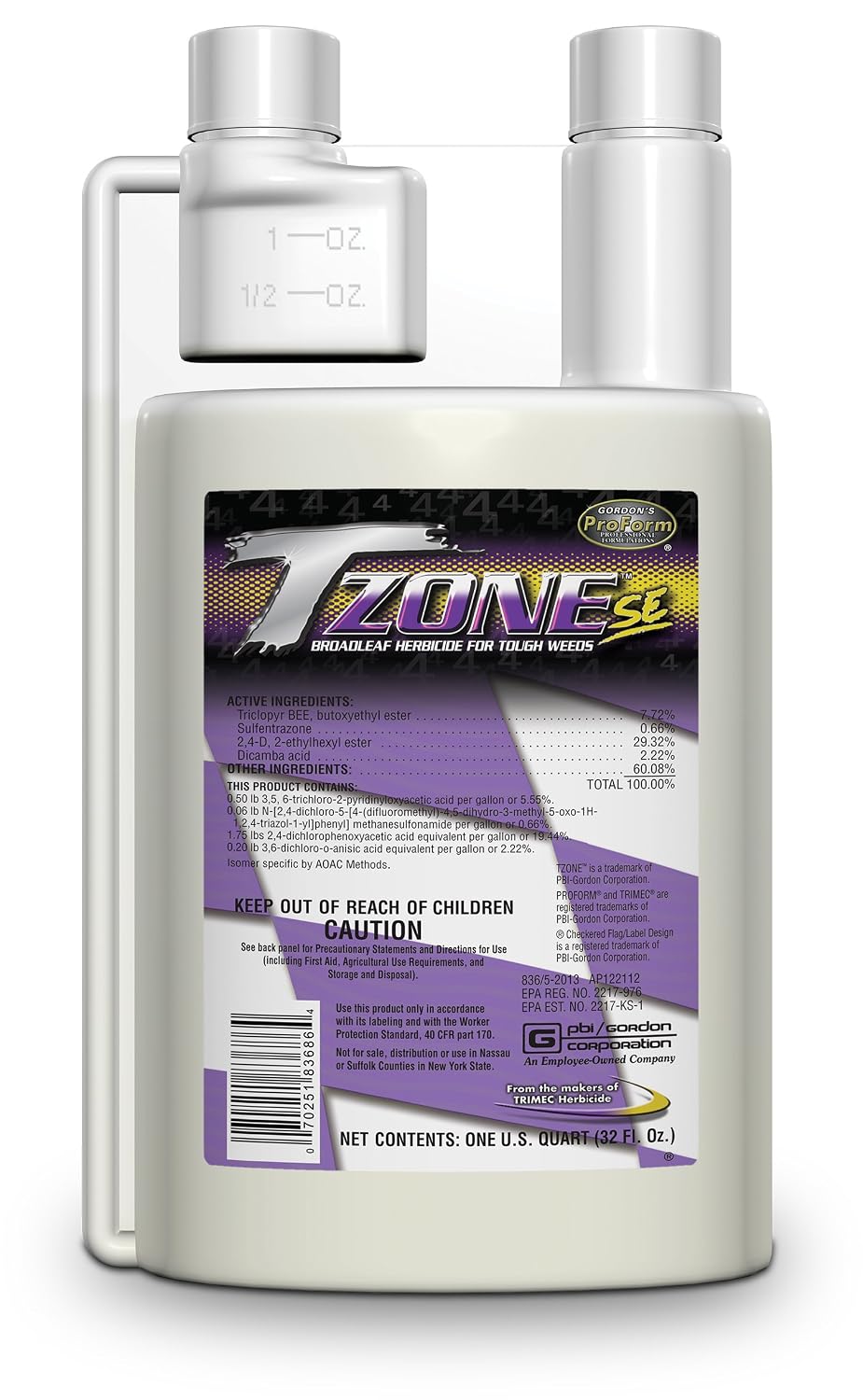
T-Zone Turf Herbicide Broadleaf Weed Control, 1 Quart
| Unit Count | 32 Fluid Ounces |
|---|---|
| Item Form | Liquid |
| Coverage | broad-leaf weeds, grassy weeds |
| Active Ingredients | Dicamba, triclopyr |
T-Zone Turf Herbicide is a ready-to-mix liquid weed killer intended for use on lawns, commercial turf and golf sites to target broadleaf weeds and some grassy species. It contains triclopyr, dicamba and other active ingredients that deliver fairly fast visible control and can be used in cool conditions down to about 50°F, which helps when treating early‑season invaders like hairy bittercress. Typical use is spot treatment or broadcast application following label rates and safety precautions; protective gloves and eyewear are recommended. Practical benefits include multi‑mode activity against tough broadleaves and suppression of yellow nutsedge, plus suitability across residential and commercial settings. Limitations are that it is a chemical herbicide requiring careful application to avoid off‑target damage to desirable plants and that repeat treatments may be needed for persistent seedlings. Follow label directions for timing, tank mix compatibility and buffer zones to protect flowers and ornamentals.
Best for: Gardeners and turf managers who want a versatile chemical option to control persistent broadleaf weeds in lawns, including early‑season species, and who are comfortable following label safety and application instructions.
Less Ideal for: People seeking organic or nonchemical solutions, or those who need a selective product safe to spray directly over sensitive ornamentals or mixed planting beds.
- Broadleaf and some grassy weed control from multiple active ingredients
- Works in cooler temperatures down to about 50°F for early‑season weeds
- Formulated for residential, commercial and golf turf uses
- Fast visual response helps reduce repeated callbacks or reapplications
- Requires careful handling and protective equipment due to active herbicides
- Potential for off‑target injury to desirable plants if not applied precisely
Verdict: A practical, multi‑ingredient turf herbicide that gives reliable broadleaf control for lawns and early‑season weeds when applied carefully to avoid off‑target damage.
Spectracide Weed & Grass Killer Concentrate, 16 oz

| Unit Count | 16 Fluid Ounces |
|---|---|
| Item Form | Spray |
| Coverage | 7 fl oz per gallon covers up to 300 sq ft |
| Rainproof | 15 minutes |
Spectracide Weed & Grass Killer Concentrate is a liquid nonselective herbicide mixed with water and applied with a tank sprayer for spot treatment on driveways, walkways, patios and around foundations. The concentrate is formulated to kill broadleaf weeds and grasses down to the root and becomes rainproof within 15 minutes, which makes it practical for quick projects and unpredictable weather. The label states visible dieback can appear in about three hours and treated areas can be replanted after 24 hours, so it suits seasonal cleanup and fast bed preparation. It covers approximately 300 square feet per 7 fluid ounces mixed per gallon, so a single bottle will treat multiple small infestations. Important limitations are that it is nonselective and must be kept off desirable plants and edible areas, and it requires careful mixing and spot application with a sprayer to avoid drift. Users should apply when temperatures are above 60°F and protect children and pets until treated foliage has died back.
Best for: Gardeners who want a reliable, fast-acting solution for clearing patches of unwanted weeds on hard surfaces or preparing small planting areas, and who prioritize efficiency and predictable results.
Less Ideal for: People needing a selective lawn herbicide or anyone who wants to treat edible gardens or areas with frequent pet and child traffic should choose a different product or method.
- Fast visible results, often within three hours
- Rainproof in 15 minutes so treatments hold up to short-term moisture
- Concentrate mixes with water to extend coverage for multiple spot treatments
- Kills weeds and grasses down to the root for longer-lasting control
- Nonselective formula can damage or kill desirable plants if contacted
- Requires careful mixing and use of a tank sprayer for proper coverage
Verdict: A fast, rainproof concentrate that delivers quick, root-killing control for spot treatment of unwanted weeds on hardscapes and planting edges.
Spectracide Weed Stop for Lawns Plus Crabgrass Killer Concentrate, 32 oz

| Liquid Volume | 32 fluid ounces |
|---|---|
| Item Form | Liquid |
| Coverage | 5000 square_feet |
| Unit Count | 32 Ounce |
Spectracide Weed Stop Plus Crabgrass Killer is a ready-to-mix liquid concentrate intended for spot or broadcast treatment of listed lawn weeds. You dilute it in a sprayer and spray until the weeds are wet; the formula kills by contact down to the root and shows visible results in about five hours. The label lists control of more than 470 weeds, so it covers common broadleaf and grassy targets gardeners encounter, and treated areas become rainproof in roughly three hours. Practical benefits include a single 32 fl oz bottle treating up to 5,000 sq ft and clear application guidance tied to temperature windows to avoid lawn injury. Important limitations are application timing and temperature constraints and precautions for newly seeded lawns and certain grasses such as bermudagrass, which can yellow under hot conditions. As a concentrate it requires a compatible sprayer and careful mixing and handling to avoid skin or eye contact and to keep children and pets safe until treated areas are dry.
Best for: Homeowners who want a cost-effective, broad-spectrum weed control for established lawns and prefer a concentrate they can stretch across a medium-sized yard.
Less Ideal for: People with newly seeded lawns, owners of heat-sensitive turf varieties who cannot avoid high temperatures, or gardeners who want a ready-to-spray product without mixing.
- Controls a very wide range of weeds including crabgrass and common broadleaf species
- Fast visible results in about five hours and becomes rainproof in roughly three hours
- Concentrate treats up to 5,000 sq ft so one bottle covers a typical medium lawn
- Clear label instructions on temperature windows and reseeding intervals
- Must be mixed and applied with a sprayer rather than ready-to-use bottle
- Not safe to apply in hot conditions for some grasses and can cause temporary discoloration on bermudagrass
- Requires precautions for pets, children, and newly seeded lawns
Verdict: A budget-friendly concentrate that delivers fast, broad-spectrum weed control across a medium lawn, making it a practical choice for homeowners tackling hairy bittercress and other common weeds.
Roundup Weed & Grass Killer4 with Pump 'N Go 2 Sprayer, 1.33 gal.

| Unit Count | 170 Fluid Ounces |
|---|---|
| Item Form | Spray |
| Coverage | 300 Square_Feet |
| Active Ingredients | Triclopyr, Triethylamine Salt, Fluazifop-P-Butyl, Diquat Dibromide |
This Roundup product combines a pre-mixed herbicide formula with a Pump 'N Go 2 sprayer for spot treatment of weeds and grasses around beds, driveways, walkways, mulch and gravel. It is designed to kill tough broadleaf weeds and many grasses to the root and shows visible browning in hours while becoming rainproof in about 30 minutes. The included extendable wand gives better reach and accuracy without bending, and the unit provides up to roughly ten minutes of continuous spray so you can treat small to medium areas without refilling. Practical benefits include no need to mix concentrate, the convenience of a handheld sprayer, and plant-back guidance that lets you replant within 1 to 30 days per directions. Important limitations are that it is intended for spot or perimeter use rather than broadcast lawn treatment, it contains multiple active herbicides so safety precautions and strict label following are required, and treated areas should be kept clear of people and pets until dry.
Best for: Buyers who want an easy, store-bought solution to spot-treat persistent broadleaf weeds and grasses around hardscapes and planting beds and who prioritize convenience and proven results.
Less Ideal for: Homeowners seeking a selective lawn-only herbicide or someone who prefers nonchemical or broad, systemic turf programs should consider alternative approaches.
- Pre-mixed ready-to-use formulation eliminates measuring and mixing
- Pump 'N Go 2 sprayer with extendable wand provides accurate, hands-free continuous spray
- Visible results in hours and rainproof in about 30 minutes
- Suitable for use around beds, patios, walkways, gravel and driveways for targeted control
- Not intended for wide-area lawn blanket application
- Contains multiple active herbicides requiring careful handling and PPE
Verdict: If you need a convenient, ready-to-use sprayer for quick, targeted elimination of stubborn broadleaf weeds around beds and hardscapes, this product delivers fast, visible results.
Roundup Weed & Grass Killer with Comfort Wand, 1.33 gal

| Item Form | Liquid |
|---|---|
| Coverage | 400 sq. ft. |
| Liquid Volume | 1.33 gallons |
This Roundup kit combines a 1.33 gallon jug of liquid herbicide with a Comfort Wand for continuous one-touch spraying, intended for spot treatments around beds, walkways, driveways, and fences. It targets a broad spectrum of weeds and grasses and claims fast visible results in as little as six hours and becomes rainproof in roughly 30 minutes, which is practical for unpredictable weather. The wand eases application for small- to medium-sized areas up to about 400 square feet and helps deliver a controlled spray to minimize drift when used on calm days. Its label guidance lets you replant in as little as 1 to 30 days depending on the situation, useful when treating near ornamentals. Important limitations are that it is a nonselective contact systemic herbicide so it will damage desirable plants if contacted, and treated areas must remain clear of people and pets until dry. For very small persistent patches such as hairy bittercress, careful spot application is effective, but repeated treatments or manual removal may still be necessary for complete control.
Best for: A cautious homeowner who wants a straightforward, fast-acting product for spot-treating common yard weeds near hardscapes and plantings while minimizing rework and scheduling uncertainty.
Less Ideal for: Those needing a selective lawn herbicide or someone treating very large turf areas should look for lawn-specific or bulk professional products instead.
- Integrated Comfort Wand with one-touch continuous spray reduces hand fatigue and makes spot application easier.
- Fast action with visible results in hours and rainproof protection in about 30 minutes for reliable scheduling.
- Covers up to 400 sq. ft. from one container, suitable for treating multiple small areas around a yard.
- Label includes guidance for replanting windows which helps when treating near flowers and shrubs.
- Nonselective formula will harm desirable plants if spray drifts or contacts foliage.
- Container is sized for spot and perimeter use rather than large lawns or commercial jobs.
Verdict: An easy-to-use, fast-acting ready-to-spray herbicide with a comfort wand that makes targeted control of common yard weeds simple for homeowners.
Choosing the Right Herbicide for Hairy Bittercress: Key Factors to Consider
Seedling Kill and Timing
Hairy bittercress is easiest to control at the seedling stage, so timing matters. Treatments that act quickly on cotyledons and tiny true leaves reduce the seed bank and prevent plants from setting more seed. Apply contact or fast-acting systemic products when seedlings are actively growing and not under drought stress for best uptake. Multiple applications are often necessary because seeds will germinate over several weeks during cool, moist conditions.
Systemic Versus Contact Action
Contact herbicides scorch tissues they touch and give fast visible results, which is useful for small patches and quick cleanup. However, they may not stop regrowth from deeper root systems or larger rosettes. Systemic herbicides move inside the plant and can kill established rosettes by reaching roots, but they usually act more slowly and often require actively growing plants for good translocation. Choose systemic action for mature infestations and contact action for very young seedlings or when you must avoid systemic exposure to nearby desirable plants.
Residual Activity and Replanting Safety
Some herbicides leave a residual effect in the soil that prevents weed germination for a window of time. Residual control can reduce follow-up work but can also limit when you can safely plant desirable seedlings or vegetables in treated areas. Short-residual options are preferable in mixed beds and vegetable gardens, while longer-residual chemistries may be acceptable in ornamental shrub lines or nonplanted turf where less replanting is expected. Always follow label guidance on replanting intervals to avoid damage.
Selectivity and Ornamental Safety
Selectivity determines whether a herbicide targets broadleaf weeds while leaving grasses or specific ornamentals unharmed. Gardeners need to match product selectivity to the planting context. Nonselective sprays can quickly damage any green tissue they contact and should be reserved for spot treatment on paved areas or in a bare patch. In mixed planting beds, use products labeled safe for the plant types present or use targeted application tools to minimize drift and contact.
Application Method and Equipment
Application method affects both effectiveness and safety. Handheld pump sprayers, trigger bottles, and wand attachments give precision for spot treatments, reducing exposure to nearby plants. Broadcast sprayers and spreaders are efficient for larger turf areas but require careful calibration and attention to wind and drift. Practical concerns include nozzle choice, droplet size, and the ability to rinse equipment properly between uses to avoid cross-contamination.
Environmental Conditions and Timing
Weather and soil moisture influence herbicide performance. Many products work best when applied on dry, calm days with temperatures in the recommended range and when plants are actively transpiring. Rain soon after application can wash off contact products or reduce uptake of systemic products. Consider local conditions and forecast windows to choose an application time that maximizes efficacy while minimizing off-target movement.
When to Treat Hairy Bittercress
Early spring and late winter are prime times because hairy bittercress germinates in cool, moist soils and flushes before many warm-season plants begin active growth. Scout shaded beds and cracks in paving to catch the first seedlings.
If you miss the initial flush, target rosettes before they flower and set seed. Repeat scouting matters because this weed germinates in waves and can reappear after an initial treatment.
- Look for delicate, umbrella-like seedling clusters in damp shade.
- Treat small seedlings promptly for best results.
- Recheck weekly during cool, wet periods for new germination.
Spot Treatment Versus Area Treatments
Spot treatment concentrates product where the weed is dense and reduces chemical exposure to desirable plants. Use a wand or shielded sprayer for precision applications.
Area treatments are useful in heavily infested turf or beds where the weed covers large swaths. Ensure the product label permits broadcast use in the planting type you have and adjust application equipment accordingly.
- Reserve nonselective options for pavement gaps and mulch-free areas.
- Use selective or lower-rate options in mixed beds to protect ornamentals.
- Consider mechanical removal for tiny infestations before chemical use.
Integration With Cultural Controls
Combining herbicides with cultural practices reduces reliance on chemicals and lowers the chance of reinfestation. Improve drainage and thin groundcover to reduce the shady, moist microclimates where hairy bittercress thrives.
Mulching weed-free beds and encouraging dense desirable plant growth can outcompete seedlings. Hand-pulling is effective for isolated plants and prevents seed set when done before flowering.
- Rake or thin thatch in turf to reduce favorable germination sites.
- Apply mulch after clearing existing weeds to reduce new seedlings.
- Avoid overwatering shady beds that encourage bittercress emergence.
Minimizing Off-Target Damage
Take steps to protect nearby ornamentals, seedlings, and lawn when applying herbicides. Use shields, low-pressure nozzles, and small droplet sizes to reduce drift and runoff. Cover sensitive plants or treat on calm days.
Rinse equipment between different application tasks and follow label instructions for buffer zones. For spot-work, target only the weed foliage to keep surrounding plants safe.
- Work on calm, dry days with light wind under 5 mph.
- Use a shielded wand when spraying near desirable plants.
- Keep a water source handy to flush accidental sprays from foliage quickly.
Safety and Storage Considerations
Always read and follow label directions for personal protective equipment, mixing, and storage. Store products in original containers, away from children and pets, and out of direct sunlight.
Dispose of rinse water and leftover mixes according to local regulations. Keep a record of application dates and areas treated to avoid repeated overlap and potential crop injury.
- Wear gloves, eye protection, and long sleeves during mixing and spraying.
- Label and date leftover containers if keeping for follow-up applications.
- Clean sprayers thoroughly after use to prevent cross-contamination.
How We Chose the Best Herbicide for Hairy Bittercress
We focused on practical, gardener-relevant performance factors that determine how well a herbicide manages hairy bittercress in real planting situations. Key criteria included contact efficacy against small seedlings and cotyledons, because early-season knockdown is critical for this species. We also rated systemic uptake where relevant, since products that translocate can control established rosettes. Application precision and delivery method were evaluated to reflect how easy it is to avoid harming nearby ornamentals and turf. Residual activity was assessed because some uses require short-lived chemistry while others benefit from longer control. Finally, we considered label flexibility for spot treatment versus broader broadcast use. We excluded off-label mixes and experimental chemistries not commonly available to home gardeners. Products lacking clear directions for ornamental or turf use, or with safety profiles unsuitable for typical residential settings, were not included. The resulting shortlist emphasizes products that balance effectiveness on hairy bittercress with realistic safety and application options for gardeners.
FAQ
Can I control hairy bittercress without chemicals?
Often yes. Hand-pulling before seed set removes current plants effectively in small patches. Improving light and reducing moisture through pruning and drainage also reduces germination. For larger infestations, cultural methods may need to be combined with targeted spot treatments.
How soon will I see results after applying a herbicide?
Results vary by product type. Contact herbicides often show tissue browning within days, while systemic products can take one to three weeks for full plant decline. Effectiveness also depends on plant size and weather at application.
Will treating one area prevent bittercress from returning?
Not necessarily. Hairy bittercress produces seeds that can germinate over an extended period. Expect multiple treatments or regular monitoring through the spring and early summer to manage successive germination flushes.
Is it safe to apply herbicides near vegetables and young ornamentals?
It depends on the product and label directions. Some herbicides have short replant intervals and are labeled for use around certain ornamentals and turf. Choose selective products and use spot techniques to reduce risk. When in doubt, protect sensitive plants or delay treatment.
Can I mow or pull after applying a systemic herbicide?
Mowing or pulling shortly after application can reduce systemic uptake and diminish effectiveness. For best results, allow treated plants time to translocate the herbicide, following label timing recommendations before mechanical removal.
What weather conditions are best for application?
Apply on dry, calm days with temperatures within the range specified on the label. Avoid rain for at least 24 hours after application for contact products and longer if the label specifies. Wind increases drift risk and lowers precision.
Final Verdict
Choose an approach that matches where hairy bittercress is growing and how much risk you can accept for nearby plants. For small patches in beds, targeted contact treatments or hand removal timed at early seedling stages are often sufficient. For heavier infestations or established rosettes, products with systemic action and careful application techniques provide deeper control but require more caution around ornamentals. Prioritize application precision, proper timing, and follow-up scouting. Balancing immediate knockdown with appropriate residual protection will help you reduce repeat germination while keeping desirable plants safe.
