

Note: This article contains affiliate links. If you click on these links and make a purchase, I may earn a small commission at no extra cost to you. This helps support my research and content. Read my full affiliate disclosure here.
Picking the right potting soil for seedlings matters more than you might think. Young plants need a light, well-aerated medium that retains consistent moisture, drains excess water quickly, and supplies gentle nutrition while roots establish. Using the wrong mix can cause damping-off, slow germination, or leggy seedlings. This guide covers seven top potting soils for seedlings selected for seed-starting situations. We evaluated mixes for moisture control, texture, nutrient profile, and ease of use so you can pick a starting medium that helps seedlings develop healthy roots and vigorous early growth. Read on for practical buying considerations and what to expect from each type of seed-starting mix.
Top Picks at a Glance
| Best Overall The best all-around choice for most situations | Old Potters Germination Mix with Peat Moss, Perlite & Vermiculite, 24 Quarts |  |
| Best Quality Built to a higher standard if you want something more solid | Burpee Premium Organic Potting Mix with Coco Coir (9 Quart) |  |
| Best Value The sweet spot between price and what you get | Midwest Hearth Seed Starter Potting Soil, Ready-to-Use Mix, 4 Dry Quarts |  |
| Best Budget The cheapest option that still gets the job done reliably | Back to the Roots 3-in-1 Organic Seed Starting Mix, 6 Quart |  |
| Highest Rated A top-rated pick with lots of positive feedback | FoxFarm Ocean Forest Potting Soil, 12 qt (with 2 Plant Tags) |  |
| Most Popular A crowd favorite that many people choose with confidence | Miracle‑Gro Indoor Potting Mix for Seed Starting (8 qt., 2‑pack) |  |
| Best Seller A high-volume bestseller chosen again and again | Back to the Roots Organic Seed Starting Mix, Expanding 12-Quart Block |  |
Old Potters Germination Mix with Peat Moss, Perlite & Vermiculite, 24 Quarts

| Volume | 24 quarts |
|---|---|
| Unit Count | 768 Fluid Ounces |
| pH range | 5.4 – 6.3 |
| Electrical Conductivity | 1.0 – 1.5 mmhos/cm |
This germination mix is built to give seedlings and cuttings a reliable start by combining 80–90% finely milled Canadian sphagnum peat moss with fine perlite and vermiculite. The blend holds moisture evenly while still offering good aeration so tiny roots can access oxygen without drying out, and the included wetting agent helps prevent dry spots in trays and plugs. Calcitic and dolomitic limestone are added to bring the pH into a seed-friendly 5.4–6.3 range and a light starter charge supplies early nutrients for initial growth. In practice it works well with both bottom-watering and overhead misting and the fine texture makes it easy to fill cell trays and handle small seeds. Expect uniform germination and healthy root development, though the peat-heavy mix is not ideal for longer-term potting without dilution or later repotting into a richer potting soil. Also note the moderate electrical conductivity, which means it is lightly charged but not a full fertilizer solution for later stages.
Best for: Gardeners who want a dependable, easy-to-use seed-starting medium that promotes uniform germination and strong initial root development in trays, plugs, or when propagating cuttings.
Less Ideal for: Growers who prefer peat-free or long-term potting mixes for larger transplants should look for alternatives formulated for extended feeding and structure retention.
- High peat content with fine perlite and vermiculite for consistent moisture retention and aeration
- Balanced pH via calcitic and dolomitic limestone suitable for most seeds
- Wetting agent prevents dry spots for more even germination
- Fine, uniform texture makes it easy to fill trays, plugs and handle small seeds
- Peat-dominant formula is not nutrient-rich enough for extended growth without repotting
- May compact slightly over time compared with coarser seed-starting mixes
Verdict: A finely textured, pH-balanced seed-starting mix that delivers consistent germination and healthy early root growth.
Burpee Premium Organic Potting Mix with Coco Coir (9 Quart)

| Item Form | Powder |
|---|---|
| Specific Uses For Product | Plant Growth, Root Development, Seed Development, Soil Conditioning |
| Coverage | 9 Qt Container |
Burpee Premium Organic Potting Mix is a ready-to-use blend designed for containers and seed starting that combines organic nutrients with coco coir to balance moisture and aeration. In practice you fill trays, pots, or small containers with the mix, sow seeds or transplant seedlings, and water; the formula claims to feed plants for up to three months while helping seedlings get strong root development without waterlogging. Notable features include OMRI listing for organic gardening and a coco coir base that retains moisture yet improves drainage compared with straight peat. For someone focused on seedling performance this mix provides a light, friable medium that encourages germination and early root growth and reduces the need for constant watering. Limitations are that the 9 quart bag is a small single-batch size for continued propagation and the product description notes included fertilizer but does not specify starter nutrient levels, so growers expecting a tailored seed-starting nutrient profile may still want to add a mild starter fertilizer for best results.
Best for: Gardeners who prioritize seedling vigor and want an organic, easy-to-use potting mix for trays, small pots, and container vegetables or herbs.
Less Ideal for: Growers needing large volumes for bench-scale propagation or those who require a custom-formulated seed-starting mix with precisely labeled nutrient concentrations.
- OMRI listed organic blend suitable for organic seed starting and container crops
- Coco coir content improves moisture retention while reducing waterlogging risk
- Ready-to-use, light and friable texture that supports germination and root development
- Contains slow-release nutrition that can feed plants for up to three months
- Small 9 quart bag size may not be sufficient for repeated seed-starting or larger projects
- Fertilizer composition and starter nutrient levels are not specified for precise feeding plans
Verdict: Choose this OMRI-listed, coco coir–enhanced potting mix when you want an organic, moisture-balanced medium that promotes strong seedling root growth in containers.
Midwest Hearth Seed Starter Potting Soil, Ready-to-Use Mix, 4 Dry Quarts

| Unit Count | 128 Ounce |
|---|---|
| Volume | 4 quarts |
| Item Type Name | Potting Soil |
| Item Highlight | Peat Moss, Perlite & Vermiculite, pH-Balanced |
This Midwest Hearth seed starter is designed specifically for starting seeds and raising young seedlings. The bagged mix combines organic peat moss with perlite and vermiculite to balance aeration and moisture retention, which helps seeds germinate reliably and encourages strong root development. It is pH-balanced for a wide range of plant types and is ready to use straight from the bag, so you do not need to amend it before sowing. Practical features include a visible color change as the mix dries, which makes watering decisions easier, and lightweight components that reduce compaction in trays and small pots. Limitations: the 4 quart bag covers only a small number of flats so you may need multiple bags for larger projects, and like other soilless mixes it contains dust and can irritate skin or eyes so handle with care. For routine seed starting and small-scale propagation this mix delivers consistent performance with minimal prep.
Best for: Buyers who want a no-fuss, pre-formulated seed starting mix for trays, small pots, and regular propagation tasks and who prioritize reliable germination with minimal preparation.
Less Ideal for: Not well suited for large-scale commercial propagation or for gardeners who need bulk quantities in a single purchase.
- Ready-to-use formulation optimized for seed germination
- Balanced peat-perlite-vermiculite blend that holds moisture while providing aeration
- pH-controlled mix suitable for a wide variety of plant types
- Visible color change helps time watering and avoid overwatering
- Small 4 quart volume may require multiple bags for larger seed-starting projects
- Can produce dust that may irritate eyes or skin if not handled carefully
Verdict: A compact, ready-to-use seed starter mix that simplifies germination and gives reliable early seedling growth for home growers.
Back to the Roots 3-in-1 Organic Seed Starting Mix, 6 Quart

| Unit Count | 192 Fluid Ounces |
|---|---|
| Style Name | 3-in-1 Seed Starting Mix |
| Brand Name | Back to the Roots |
This 3-in-1 seed starting mix is designed for beginning seeds and small transplants, combining organic nutrients, worm castings and moisture-controlling yucca to help seedlings establish faster. Typical use is filling seed trays or small pots for herbs, vegetables and flowers; the blend includes coconut coir and mycorrhizae to support root uptake while dolomitic limestone helps balance pH. The mix is peat-free, which appeals to gardeners who prefer sustainable materials, and its light, airy texture with added perlite-like components promotes drainage and prevents soggy stems. For budget-focused growers the 6-quart bag covers several flats of seedlings and removes the need to blend separate ingredients. Limitations are the bag size for larger starting operations and that a single ready mix may not suit species with unusual drainage or nutrient needs without additional amendments.
Best for: Budget-minded home gardeners and beginners who want a single, organic seed-starting mix that simplifies tray filling and gives reliable results for common herbs, veggies, and flowers.
Less Ideal for: Commercial growers or hobbyists starting large numbers of flats who need bulk volume or highly customized mixes for specialty seeds.
- Ready-to-use organic formula with added nutrients and worm castings for healthy seedling growth
- Peat-free blend using coconut coir and mycorrhizae to support root development and water uptake
- Includes moisture-controlling yucca to reduce overwatering risk in small pots and trays
- pH-balanced with dolomitic limestone to reduce acidity-related nutrient issues
- Only a 6-quart bag which may be small for gardeners starting many trays
- Single blend may require extra amendments for plants with very specific drainage or nutrient needs
Verdict: A convenient, peat-free organic seed starting mix that gives budget-conscious gardeners an easy, nutrient-rich foundation for healthy seedlings.
FoxFarm Ocean Forest Potting Soil, 12 qt (with 2 Plant Tags)

| Brand | FoxFarm |
|---|---|
| Unit Count | 144 Ounce |
| Item Highlight | Light, Aerated Texture with Fish Meal, Crab Meal, Earthworm Castings |
| Volume | 12 quarts |
FoxFarm Ocean Forest is a premium 12‑quart potting mix designed to get seedlings and container plants off to a strong start. The blend of aged forest products, sandy loam and sphagnum peat moss creates a light, airy texture that drains well while retaining enough moisture for young roots. It is charged with organic amendments including fish meal, crab meal and earthworm castings so seedlings receive an early nutrient boost without immediate need for additional nitrogen fertilizer. The bagged mix is ready to use straight from the package and the included plant tags make labeling starts simple. For reliability-focused growers, Ocean Forest offers consistent quality and a proven formula that supports vigorous root development and healthy early growth. Be aware that because it is richly amended, heavy feeders may need tailored fertilization later and the peat content means it is not a sustainably peat-free option. Also the 12 qt bag is convenient for flats and small pots but you will need multiple bags for larger seedling batches or big containers.
Best for: Gardeners who want a reliable, ready-made potting mix that promotes fast, healthy root and seedling development without extra prep work.
Less Ideal for: Large-scale growers or those seeking a peat-free or bulk commercial mix should consider alternative products better suited to high-volume or peat-free needs.
- Light, aerated texture suitable for seedlings and plant starts
- Pre-charged with organic amendments (fish meal, crab meal, earthworm castings) to support early growth
- Ready-to-use straight from the bag which saves prep time
- Includes plant tags for easy labeling of varieties and sowing dates
- Contains sphagnum peat moss which may be a sustainability concern for some gardeners
- 12 quart bag size means multiple bags are needed for larger projects
Verdict: A dependable, nutrient-rich potting mix that lets you sow seedlings right away and reliably support vigorous early growth.
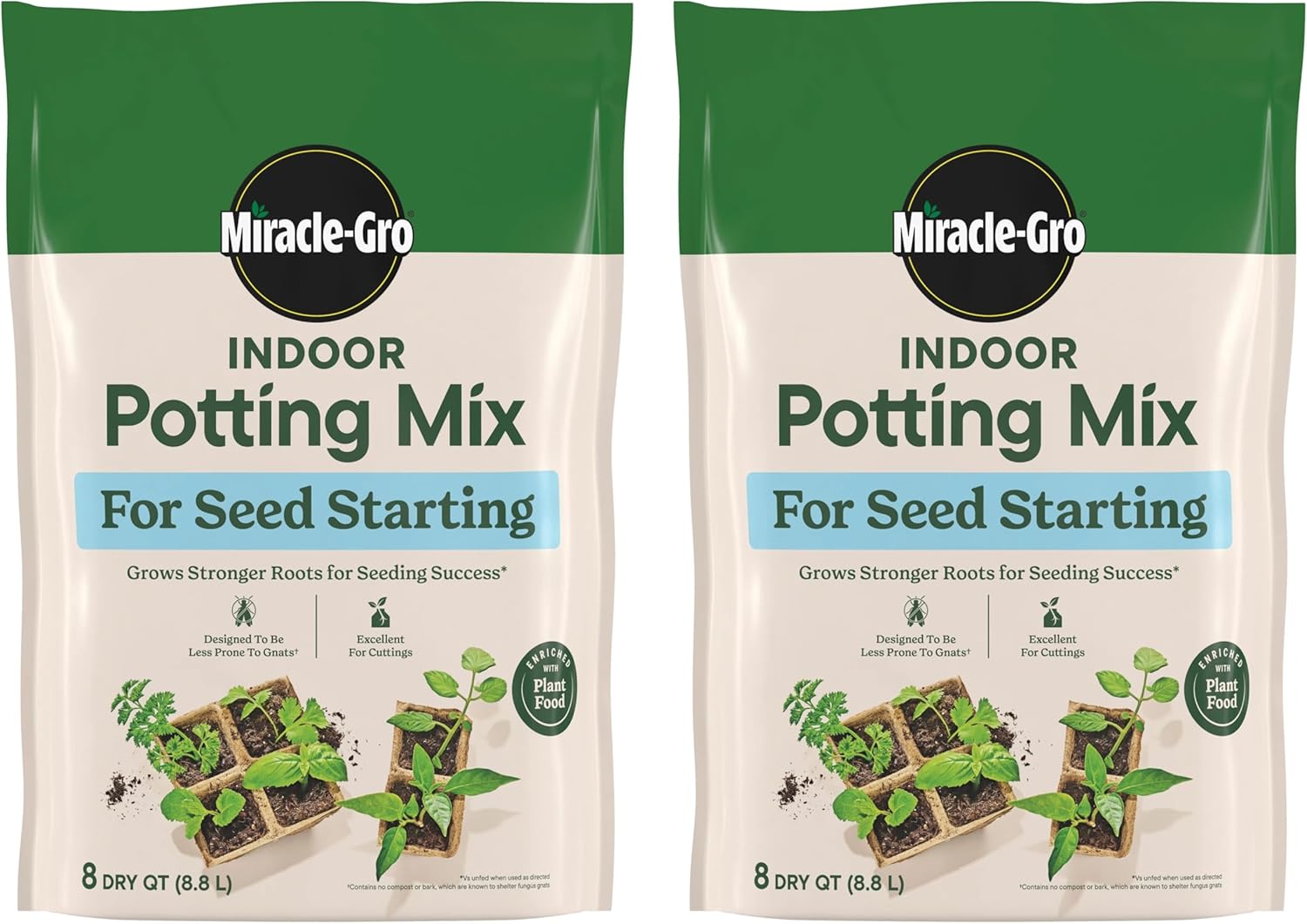
Miracle‑Gro Indoor Potting Mix for Seed Starting (8 qt., 2‑pack)
| Number of Packs | 2 |
|---|---|
| Unit Count | 512 Ounce |
| Item Type Name | Potting Mix |
| Brand Name | Miracle-Gro |
Miracle‑Gro Indoor Potting Mix is made for starting seeds and rooting cuttings indoors. The mix is lightweight and premixed with plant food so seedlings have a nutrient boost from the first true leaves until transplanting. It is typically used to fill cell trays, small pots, or propagation containers; the package notes that one 8 qt. bag fills about three 72‑cell trays. Notable features include a formula that omits compost and bark to lower the risk of fungus gnat sheltering and an included nutrient charge designed to support early root development. In practice this means easier germination, less early damping‑off risk from poor media, and reduced need for immediate fertilizing. Important limitations are that it already contains fertilizer so you should follow seed and packet instructions to avoid overfeeding very sensitive seedlings, and the bags are small relative to large sowing projects so you may need multiple bags for many trays. Safety handling is advised because the product contains fertilizer that can irritate if inhaled or mishandled.
Best for: Buyers who want a reliable, low‑fuss seed starting medium that helps seedlings establish roots quickly and reduces common early pest issues.
Less Ideal for: Growers who prefer fully inert media to control exact nutrient inputs or who need bulk volumes for large commercial or community sowing should consider alternatives.
- Lightweight, ready‑to‑use mix tailored for seed trays and propagation.
- Pre‑enriched with plant food to give seedlings an early nutrient boost.
- Formulation excludes compost and bark to reduce conditions that attract fungus gnats.
- Contains fertilizer so dosing additional nutrient sources requires care to avoid overfeeding.
- Small 8 qt. bag size means you may need multiple bags for larger seed starting projects.
Verdict: A convenient, seed‑starting potting mix that speeds early root growth and cuts down on fungus gnat risk, making it a safe choice for home seed trays.
Back to the Roots Organic Seed Starting Mix, Expanding 12-Quart Block

| Volume | 12 quarts |
|---|---|
| Item Type | Seed Starting Mix |
| OMRI Listed | Yes |
This compressed seed starting mix is designed to expand into 12 quarts of light, airy growing medium after adding water, making it convenient to store and use for indoor seed trays or small pots. It is OMRI listed and peat free, so it suits gardeners who want an organic, sustainable option for herbs, vegetables and flowers. The mix claims a balanced pH and low electrical conductivity, which supports steady nutrient uptake for young roots and reduces the risk of fertilizer burn when moving seedlings to larger pots. Because it comes as a compact brick, it takes up minimal space on the shelf and is easy to portion out for individual cells or small containers. The main limitations are that you must hydrate and break up the block before use and larger gardens will need multiple bricks, so it is best for starting many seedlings or as an amendment rather than for filling large beds. For cautious gardeners who prioritize predictable, beginner-friendly results, this product offers an easy-to-use organic foundation for healthy seedlings.
Best for: Cautious gardeners and beginners who want a predictable, organic seed-starting medium that is easy to store and use for trays, pots, and small-scale transplanting.
Less Ideal for: Gardeners who need bulk soil to fill large outdoor beds or those who prefer ready-to-use loose bagged potting mix for immediate large-volume use.
- Expands to 12 quarts from a compact compressed block for easy storage
- OMRI listed and peat free, meeting organic and sustainability preferences
- Balanced pH and low electrical conductivity to support seedling nutrient uptake
- Light, fluffy texture improves aeration and root development for young plants
- Requires rehydration and manual breaking up of the block before use
- Not practical as the sole medium for large beds because multiple bricks are needed
Verdict: A convenient, peat-free organic seed-starting block that reliably expands into a light, pH-balanced mix ideal for predictable seedling growth.
Choosing the Right Potting Soil for Seedlings: Key Factors to Consider
Texture and Particle Size
Seedlings need a medium with a fine, uniform texture so seeds make consistent contact with the soil. Small, evenly sized particles help seed coats absorb water evenly and promote even germination across a tray.
Coarse chunks or large fibrous pieces can create air pockets that dry out seeds unevenly, while overly compacted fine dust can restrict oxygen to fragile radicles. Look for mixes described as 'fine' or 'seed-starting' and avoid garden soils or potting mixes with large bark chips for the earliest stages.
Moisture Retention Versus Drainage
A seed-starting mix must strike a balance between holding moisture and allowing excess to drain. Seeds and young roots need steady moisture to germinate, but standing water or saturated cells increases risk of damping-off and root rot.
Good seed-starting media often include components that hold water like peat moss or coir, combined with perlite or vermiculite to improve drainage and aeration. Consider your watering routine and tray setup: if you bottom-water, choose a mix with good capillarity; if you mist frequently, a mix that dries quickly at the surface may be preferable.
Starter Nutrient Balance
Seeds contain stored nutrients to fuel initial germination, so mixes should not be heavily fertilized. A light, slow-release starter nutrient charge can support the first true leaves without burning tender roots or promoting weak, rapid growth.
Avoid mixes labeled for mature container plants that contain high fertilizer levels. For organic gardeners, choose blends with gentle, plant-safe amendments. For those who prefer to feed separately, a sterile, low-nutrient mix gives you more control over timing and strength of subsequent feedings.
Sterility and Cleanliness
Seedlings are vulnerable to pathogens and weed seeds. Sterile mixes reduce the chance of fungal diseases, damping-off, and unwanted seedlings that compete for space and resources.
Sterility is achieved by processing and heat treatment during manufacturing. While no mix is immune to contamination once opened, starting with a clean, pathogen-reduced medium lowers early losses and reduces the need for chemical interventions.
Ease of Use and Handling
How a mix behaves while filling trays, firming around roots, and during transplanting affects success. A workable mix packs lightly into cells without compressing, allows easy root inspection, and breaks apart cleanly at transplant time.
Consider mixes that rehydrate predictably after storage. Some compressed blocks or dry loose mixes need pre-wetting procedures. If you start large numbers of seedlings, prioritize mixes that are simple to rehydrate and handle to speed tray filling and reduce transplant stress.
pH and Long-Term Suitability
Soil pH affects nutrient availability once seedlings begin feeding. Many seed-starting mixes are formulated near neutral to slightly acidic ranges that suit a wide range of vegetables and flowers.
If you plan to start acid-loving or alkaline-preference species, choose a mix with a compatible pH or test and amend accordingly. Also consider whether the mix will continue to serve plants through early growth or if you will need to transplant to a different potting medium later.
Types of Seed-Starting Media
Seedlings can be started in several base media each with pros and cons. Common choices include peat-based mixes, coconut coir blends, and sterile vermiculite or perlite mixes. Peat tends to retain moisture well and has a fine texture, while coir is more renewable and often more neutral in pH.
Vermiculite holds water and nutrients, which can be useful for very small seeds. Perlite improves aeration and drainage when mixed into a finer base. Many seed-starting blends combine these components to balance moisture and air space.
- Peat-based mixes: fine texture and strong moisture retention.
- Coir-based mixes: renewable, good water-holding capacity, usually pH-neutral.
- Vermiculite-heavy mixes: excellent for tiny seeds and moisture retention.
- Perlite-amended mixes: better aeration and drainage for quick-rooting seedlings.
Rehydrating and Preparing Compressed Mixes
Some seed-starting media come compressed to save space. Proper rehydration is crucial. Add water gradually and allow the mix to soak and break up naturally, then fluff to restore a light texture. Overwatering during rehydration leads to soggy, compacted media that is hard to manage.
After rehydration, press the mix gently into cells so seeds have consistent contact but the medium remains airy. Let pre-filled trays sit for a short period to achieve even moisture before sowing.
- Use room-temperature water and add in stages until texture is uniform.
- Fluff with a fork or hand to restore aeration after soaking.
- Avoid compressing the mix too firmly when filling trays.
Watering Strategies for Seedlings
Consistent moisture is critical during germination. Many gardeners find a misting bottle or dome helpful during the first few days to keep surface moisture even. Once roots begin to develop, switch to bottom-watering or gentle top-watering to encourage root growth downward.
Watch for signs of both overwatering and underwatering. A mix that stays dark and soggy at the surface likely needs better drainage or less frequent watering, while a patchy dry surface suggests more frequent light watering or a finer-textured mix.
- Misting or humidity domes help during initial germination.
- Bottom-watering encourages roots to grow down into the mix.
- Adjust frequency based on tray size, ambient humidity, and mix water-holding characteristics.
Transplanting Seedlings Without Shock
When seedlings have true leaves and a healthy root system, transplant carefully to avoid root damage. Choose a medium for transplant that complements the starter mix so roots do not face a sudden change in texture or moisture dynamics. Keep the root ball intact where possible.
Water seedlings before transplanting to reduce stress, and plant at the same depth they were growing. If the starter mix is very light and airy, backfill with a slightly heavier potting medium to support steady moisture retention in the next stage.
- Transplant when true leaves appear and roots hold tray shape.
- Water and harden off seedlings gradually if moving outdoors.
- Match transplant soil texture to starter mix to minimize shock.
Common Problems and How the Mix Helps
Damping-off and fungal problems are often tied to poor drainage and excessive moisture. Using a clean, well-draining seed-starting mix and good sanitation helps prevent these issues. Sterile mixes reduce initial pathogen load and weed seeds.
Leggy seedlings usually stem from low light rather than the mix, but overly rich mixes can encourage weak, rapid growth. Choose a low-nutrient starter medium if you want to rely on controlled feeding and strong light to produce compact seedlings.
- Use sterile mixes and avoid overcrowding trays to reduce disease.
- Adjust light and nutrient levels to prevent legginess.
- Ensure consistent air circulation around trays to limit fungal growth.
How We Chose the Best Potting Soil for Seedlings
We concentrated on features that directly affect early seed and seedling performance. Primary evaluation criteria included particle size and texture, because a fine, consistent crumb structure improves seed-soil contact and even moisture distribution. Water retention and drainage were measured as paired qualities: mixes must hold enough moisture for germination without becoming waterlogged and encouraging disease. Nutrient profile and release rate were reviewed to ensure mixes supply a light starter charge without burning tender roots or forcing early transplant shock. Sterility and absence of weed seeds or pathogens mattered because contaminated media often spoils a seed tray quickly. Workability and transplant handling were also considered, including how easily the mix fills cells and firms around roots without compacting. We excluded garden soil and heavy compost blends that are not formulated for seed-starting. We also filtered out mixes designed only for mature plants or indoor containers because their particle size and fertilizer strength are usually inappropriate for seedlings. Our final short list emphasizes seed-starting performance, reliability, and predictable handling for gardeners starting seeds indoors or in protected outdoor flats.
FAQ
Can I use garden soil to start seedlings?
Garden soil is usually too heavy and prone to compaction and pathogen presence for starting seedlings. It often lacks the fine, uniform texture and sterility of dedicated seed-starting mixes, which are formulated to support germination and early root growth.
How long should seedlings stay in starter mix before transplanting?
Seedlings typically stay in starter mix until they develop true leaves and a well-formed root system, which is often two to six weeks depending on the species. Transplant when roots hold the cell and the plant can tolerate handling without major root disturbance.
Is coco coir a good alternative to peat for seedlings?
Coco coir can be an effective peat alternative because it holds moisture well and is more sustainable. It tends to be pH-neutral but may require buffering or supplementation for certain sensitive species. Coir mixes paired with perlite or vermiculite create good seed-starting textures.
Should seed-starting mixes contain fertilizer?
Most seed-starting mixes contain little or no fertilizer since seeds use stored nutrients to germinate. A light starter nutrient charge is acceptable for faster establishment, but heavy fertilizer should be avoided to prevent root burn and weak seedling growth.
How do I prevent damping-off in seed trays?
Use a sterile, well-draining seed-starting mix, avoid overwatering, provide good air circulation, and do not overcrowd trays. Starting with clean trays and tools and removing affected seedlings promptly also reduces spread.
Final Verdict
Choose a potting soil for seedlings that balances fine texture, reliable moisture retention, and clean sterility. Prioritize mixes that match your watering style and the seed types you grow, and avoid heavy, highly fertilized media that can harm young roots. Focus on practical tradeoffs: a slightly lighter, sterile mix reduces disease risk and eases transplanting, while a coir- or peat-based mix with some vermiculite will hold moisture for tiny seeds. With the right starter medium and consistent care, you can give seedlings the best start before moving them to their next growing stage.
