

Note: This article contains affiliate links. If you click on these links and make a purchase, I may earn a small commission at no extra cost to you. This helps support my research and content. Read my full affiliate disclosure here.
If you want a cleaner, weed-free lawn without harming the grass, the right herbicide matters. Lawn-safe broadleaf and grassy-weed controls behave very differently in a yard versus garden beds, and applying the wrong product can scorch turf or leave persistent residues. This guide covers six top-rated herbicides that kill everything but grass, shortlisted for their selectivity, ease of application, and predictable results in typical home lawns. Below we summarize how each option performs for common lawn issues and explain the evaluation criteria used so you can pick the right treatment for your yard and maintenance schedule.
Top Picks at a Glance
| Best Quality Built to a higher standard if you want something more solid | Nufarm Change Up Premium Selective Herbicide, 32 oz |  |
| Best Value The sweet spot between price and what you get | Southern Ag Atrazine St. Augustine Weed Killer, 32 oz |  |
| Best Budget The cheapest option that still gets the job done reliably | Image Herbicides Liquid Weed Killer Concentrate for Southern Lawns, 32 oz |  |
| Highest Rated A top-rated pick with lots of positive feedback | T-Zone Turf Herbicide (1 Quart) by PBI Gordon |  |
| Most Popular A crowd favorite that many people choose with confidence | Southern Ag Amine 2,4-D Liquid Weed Killer, 32 oz |  |
| Best Seller A high-volume bestseller chosen again and again | Syngenta Tenacity Turf Herbicide, 8 oz |  |
Nufarm Change Up Premium Selective Herbicide, 32 oz

| Item Form | Liquid |
|---|---|
| Coverage | 1000 square feet |
| Active Ingredients | MCPA, fluroxypyr, dicamba |
| Unit Count | 32 Ounce |
Nufarm Change Up is a concentrated liquid selective herbicide designed for turf managers and homeowners who need strong control of broadleaf weeds without harming common turfgrasses. It combines MCPA, fluroxypyr and dicamba to deliver fast knockdown on more than 200 species, including dandelion, plantain, oxalis and thistles. The product is mixed and applied to lawns at labeled rates to treat up to about 1,000 square feet per bottle's coverage indication, and it is labeled for both cool- and warm-season grasses so it fits a wide range of lawns. Practical benefits include broad spectrum efficacy, relatively quick visual control, and formulation that avoids 2,4-D for properties sensitive to that ingredient. Important limitations are that it is a chemical treatment requiring careful rate calculation and following label precautions, and it targets broadleaf weeds so grassy weed control will require different products or cultural practices. Users should expect to follow safety and application guidelines closely to avoid off-target damage.
Best for: Buyers who prioritize powerful, fast broadleaf weed control for maintained lawns and want a single selective product that works across common turf types.
Less Ideal for: People seeking organic or nonchemical weed control, or those whose main problem is grassy weeds rather than broadleaf species.
- Controls over 200 broadleaf weed species including hard-to-kill varieties
- Labeled for both cool- and warm-season turfgrasses for wide turf compatibility
- Contains a blend of three active ingredients for faster and more complete control
- Coverage listed to treat about 1,000 square feet from the unit volume
- Not formulated to control grassy weeds so additional products or methods are needed
Verdict: Choose Nufarm Change Up when you need a fast, turf-safe selective herbicide that reliably knocks out a wide range of broadleaf weeds across cool- and warm-season lawns.
Southern Ag Atrazine St. Augustine Weed Killer, 32 oz

| Unit Count | 32 Fluid Ounces |
|---|---|
| Item Form | Spray |
| Coverage | 3,720 square_feet |
| Item Type Name | Specialty Herbicide |
Southern Ag Atrazine is a concentrated liquid herbicide made specifically for St. Augustine and centipede grasses. It is mixed into spray and applied across the lawn to suppress crabgrass and remove many common broadleaf and grassy weeds; one quart claims coverage of roughly 3,720 square feet when diluted at the recommended rate. The product is intended for targeted seasonal use, with best results from early spring applications and careful, overlap-free spraying. Practical benefits include a focused label for the two grass types and a coverage rate that stretches a single bottle across a medium-sized yard, which helps keep costs down. Important limitations are that it is a chemical herbicide requiring careful handling and strict label following, it is not recommended for hose-end sprayers, and it is not a fertilizer so it will not improve turf nutrition or overall lawn health by itself. Use protective gear and avoid off-target drift to protect desirable plants.
Best for: Buyers who need an affordable, targeted weed control for St. Augustine or centipede lawns and want a product that covers a medium-sized yard without repeated purchases.
Less Ideal for: Homeowners seeking an all-in-one lawn treatment for nutrition or for use on other grass types should choose a different product or combine this with appropriate fertilization.
- Formulated specifically for St. Augustine and centipede lawns for targeted control
- Concentrated formula with coverage up to about 3,720 sq ft per quart
- Controls a range of broadleaf and some grassy weeds including suppression of crabgrass
- Practical application instructions for spot or broadcast spray use in early spring
- Chemical herbicide that requires protective handling and careful application
- Not a fertilizer so it does not provide nutrients or improve turf vigor
Verdict: A cost-effective, concentrated herbicide for homeowners who need focused weed control on St. Augustine or centipede lawns.
Image Herbicides Liquid Weed Killer Concentrate for Southern Lawns, 32 oz

| Item Form | Liquid |
|---|---|
| Coverage | 5000 square_feet |
| Unit Count | 32 Fluid Ounces |
| Active Ingredients | Penoxsulam |
This Image Herbicides concentrate is a post-emergent liquid designed specifically for southern turfgrasses like St. Augustine, Floratam, Bermuda, centipede and zoysia. You mix the measured amount into a sprayer, apply evenly across the lawn and should see effects within hours on common broadleaf weeds such as dandelion, clover and chickweed. The product uses penoxsulam as the active ingredient and advertises coverage up to 5,000 square feet from the package volume. Practical benefits include a formulation tuned for warm-season grasses that claims to be safe when applied as directed and a fast-acting result on roots as well as foliage. Important limitations are that it is intended for use in spring or summer when temperatures are between about 45 and 90 F and it targets broadleaf weeds rather than grasses or all weed types. Like all concentrated herbicides it requires careful measuring and proper sprayer application to avoid off-target damage to desirable plants.
Best for: Homeowners with warm-season southern lawns who want a targeted, fast-acting solution for broadleaf weeds and prefer a concentrated product to treat multiple areas.
Less Ideal for: Gardeners needing a non-selective or grass-targeting herbicide or those with cool-season lawns should look for products formulated for their turf type or broader weed control needs.
- Formulated specifically for warm-season southern turfgrasses so less risk to those lawns when used correctly
- Fast-acting on broadleaf weeds with root-killing activity
- Concentrate format treats a large area from one bottle (coverage listed as 5000 sq ft)
- Not a non-selective or grass weed killer so it will not control grassy weeds
- Use window limited to warmer seasons and specific temperature range
- Requires accurate mixing and sprayer application to avoid harming nearby plants
Verdict: A concentrated, fast-acting broadleaf herbicide made for warm-season southern lawns that treats large areas when applied correctly.
T-Zone Turf Herbicide (1 Quart) by PBI Gordon
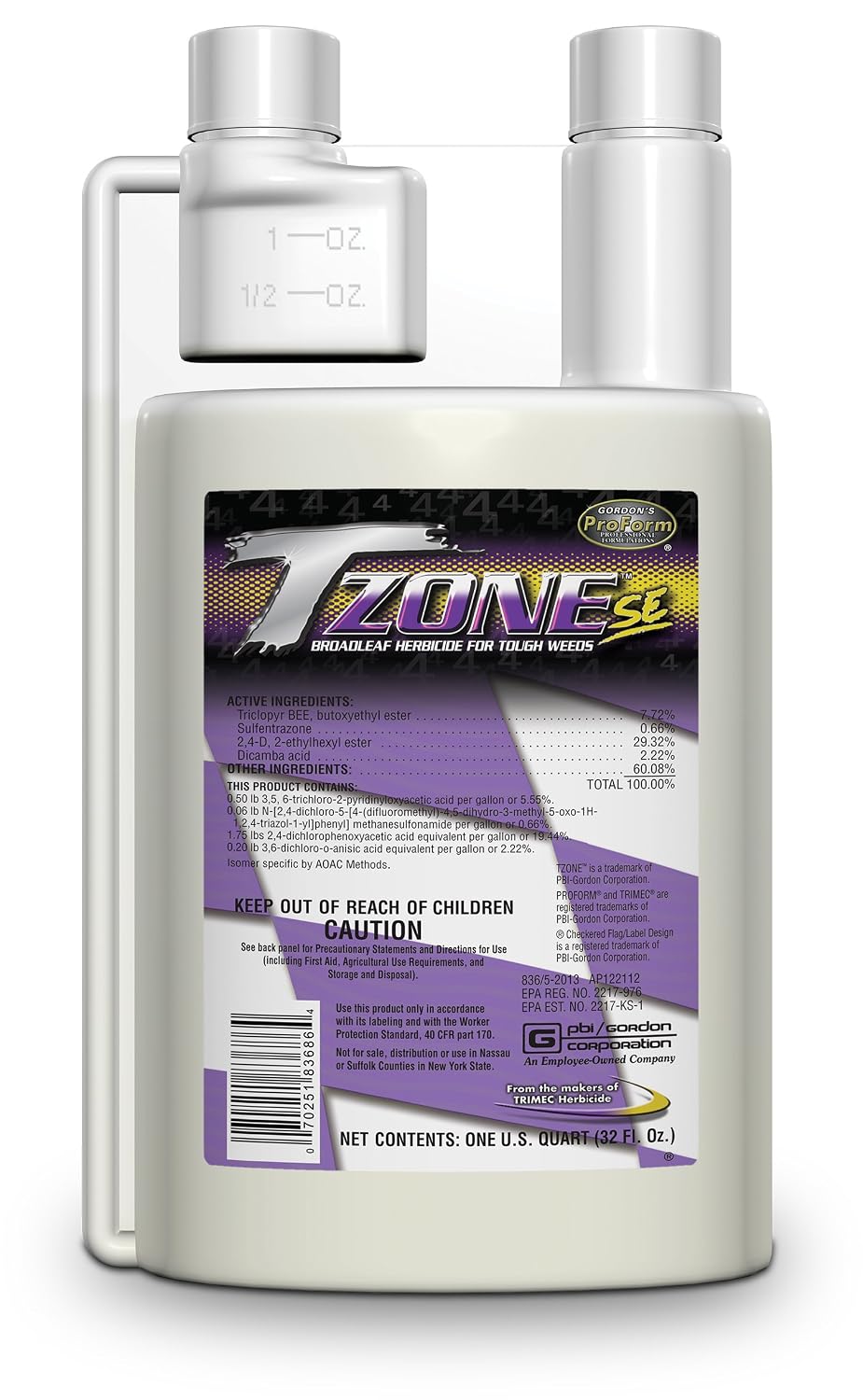
| Unit Count | 32 Fluid Ounces |
|---|---|
| Item Form | Liquid |
| Coverage | broad-leaf weeds, grassy weeds |
| Active Ingredients | Dicamba, triclopyr, others |
T-Zone Turf Herbicide is a concentrated liquid formula intended for spot and broadcast treatment of tough broadleaf and grassy weeds in lawns and turf areas. It contains multiple active ingredients including triclopyr and dicamba that give a fast visual response and help suppress difficult targets such as yellow nutsedge and oxalis when used according to label directions. Typical use is mixing to label rates and applying with a handheld sprayer or professional equipment on cool, calm days to avoid off-target movement. Notable features include suitability for residential, commercial, and golf sites and effectiveness at lower temperatures down to about 50°F. Practical benefits are reliable performance on persistent broadleaf weeds and a multi-ingredient formula that reduces the need for repeat applications. Important limitations are the need for protective gear during handling, restrictions and careful timing to prevent damage to desirable plants, and the potential for off‑target drift, so precise application technique is required.
Best for: Buyers who prioritize reliable, professional-strength control of persistent lawn weeds and who are comfortable following label directions and using proper protective equipment. Ideal for property owners or groundskeepers who need a solution that performs in cool weather and on challenging species.
Less Ideal for: Casual gardeners who want an all‑purpose, low‑risk product for mixed plantings or those unwilling to follow pesticide safety practices should consider gentler, selective options.
- Multi‑ingredient formulation targets a broad spectrum of stubborn broadleaf and grassy weeds
- Works in cool conditions (around 50°F) so seasonal timing is more flexible
- Fast visible weed control that can reduce repeat treatments
- Suitable for use on residential, commercial, and golf turf sites
- Contains potent active herbicides that require careful handling and PPE
- Risk of off‑target movement means application must be precise and weather‑aware
Verdict: Choose T-Zone when you need a dependable, professional-strength herbicide to knock back stubborn oxalis and other persistent turf weeds.
Southern Ag Amine 2,4-D Liquid Weed Killer, 32 oz

| Item Form | Liquid |
|---|---|
| Coverage | 5000 Square Feet |
| Liquid Volume | 32 quarts |
| Active Ingredients | Dimethylamine salt of 2,4-D-Dichlorophenoxyacetic acid |
Southern Ag Amine 2,4-D is a concentrated liquid herbicide formulated to control many broadleaf weeds and woody plants in lawns, pastures, rangeland, ditch banks, fences, and similar non-crop sites. It is mixed with water at modest rates (manufacturer guidance suggests roughly 2 to 3 tablespoons per 1,000 sq ft in typical small-spray mixes) and applied as a coarse, low-pressure spray to reduce drift. The active ingredient is the dimethylamine salt of 2,4-D, a well-established selective herbicide for broadleaf control. Practical benefits are its economical use rate, broad application range, and compatibility with common spray equipment. Limitations include the need to take drift precautions around desirable plants, the potential for injury to broadleaf ornamentals or sensitive crops, and the requirement to follow safety and local use restrictions for synthetic herbicides. This product is a straightforward choice when you need a proven, cost-effective tool to reduce broadleaf weed pressure over larger turf or non-crop areas, provided you apply it carefully and observe label safety directions.
Best for: Gardeners and land managers who prioritize effective, economical broadleaf weed control over larger turf or non-crop areas and who are comfortable following label mixing and application steps.
Less Ideal for: Homeowners with small, diverse ornamental beds or vegetable gardens near the treatment area should avoid this product and consider more targeted or non-chemical options.
- Proven active ingredient for broadleaf weed control
- Concentrated liquid with low recommended use rates for economical coverage
- Suitable for a wide range of non-crop and turf sites
- Designed for coarse, low-pressure spray to limit drift when applied correctly
- Can damage desirable broadleaf plants if spray drifts or is applied incorrectly
- Not suitable for use where 2,4-D-sensitive crops or ornamentals are nearby
- Requires careful handling and adherence to safety directions due to being a synthetic herbicide
Verdict: A concentrated, cost-effective 2,4-D amine concentrate for gardeners and land managers who need reliable broadleaf weed control across turf and non-crop areas.
Syngenta Tenacity Turf Herbicide, 8 oz

| Unit Count | 8 Fluid Ounces |
|---|---|
| Item Form | Liquid |
| Coverage | 2000 ft^2 per 1sp of product |
| Active Ingredients | Mesotrione |
Tenacity Turf Herbicide is a concentrated mesotrione-based liquid designed for both pre-emergent and post-emergent control of common lawn weeds including crabgrass, clover, chickweed and dandelions. You apply it diluted according to label rates with a handheld or hose-end sprayer to target problem areas or broadcast across the lawn; when used as a pre-emergent it is taken up as weeds emerge and when applied post-emergent it acts systemically for selective control. The product covers a large area per bottle and the active ingredient provides residual control so you can expect longer suppression than a contact-only herbicide. Important practical points are that it is turf-selective so follow the label for grass species and mixing instructions to avoid turf injury, and results can take several days to appear. Also this is a concentrated chemical intended for careful, measured application rather than spot-use by people who prefer non-chemical methods.
Best for: Gardeners focused on strong, reliable crabgrass and broadleaf weed control who are comfortable using concentrated herbicides and following label directions for turf safety.
Less Ideal for: People seeking organic, mechanical, or spot-only solutions or those unwilling to follow detailed mixing and application instructions should consider other options.
- Systemic mesotrione active ingredient controls both pre- and post-emergent weeds
- Selective to turf when used per label, allowing treatment without killing desirable grass species
- Concentrated 8 oz liquid provides wide coverage per bottle
- Provides residual suppression, reducing frequency of repeat applications
- Requires careful mixing and adherence to label for turf safety
- Not a non-chemical or organic option for weed control
Verdict: Choose Tenacity when you want a concentrated, turf-selective herbicide that delivers pre- and post-emergent control of crabgrass and other common lawn weeds.
Choosing the Right Herbicide That Kills Everything But Grass: Key Factors to Consider
Active Ingredient and Mode of Action
Knowing the active ingredient matters because it determines which weed types are controlled and how selective the herbicide will be toward lawn grasses. Some actives target broadleaf weeds while sparing grasses, others control grassy weeds and will damage turf. Understanding mode of action also helps avoid resistance buildup when you rotate products over multiple seasons.
Check the label for the active ingredient class and match it to the weeds you have. Products with different modes of action are useful in rotation plans to prevent resistant weed populations from developing.
Turf Compatibility
Turf compatibility refers to how safe a herbicide is for established lawn species under normal application rates. Warm-season and cool-season grasses respond differently to certain actives, and some formulations are labeled only for specific grass types. Applying a product not labeled for your grass can cause browning, thinning, or long-term damage.
Confirm the label lists your grass species and read recommended timing and rate adjustments. When in doubt, test a small area first and avoid use on newly seeded or recently sodded lawns until the label indicates it is safe.
Residual Activity and Re-Treatment Timing
Residual activity is how long a product remains active in the soil after application. Longer residuals can reduce follow-up treatments but may interfere with seeding, overseeding, or planting nearby ornamentals. Shorter residuals allow quicker reseeding but may need repeat applications to control persistent weeds.
Consider your lawn calendar: if you plan to overseed, choose a product with minimal soil persistence or follow label intervals. For long-term weed suppression in established turf, a product with some residual can be advantageous when used according to the label.
Application Method and Equipment
Herbicides come as ready-to-use sprays, trigger bottles, or concentrates for tank mixing. Application method affects coverage, cost per area, and the precision you can achieve. Spot treatments reduce non-target exposure but are labor intensive for large areas; broadcast applications cover more ground but require careful mixing and calibration.
Match the formulation to your yard size and comfort with spray equipment. Look for clear dilution instructions and recommended sprayer types on the label to ensure consistent results and to reduce the chance of drift to ornamentals or garden beds.
Safety, Buffering, and Drift Management
Gardeners must manage the risk of non-target damage from spray drift and overspray. Wind, nozzle selection, and spray pressure influence drift. Buffer zones and avoiding application during high temperatures or windy conditions reduce the chance of harming nearby plants or water sources.
Review personal protective equipment recommendations and post-application re-entry intervals on the label. Proper storage and disposal instructions also matter for household safety and local regulations.
Label Restrictions and Environmental Considerations
Labels include restrictions that affect where and when a herbicide can be used, including proximity to water, protected plants, or turf under renovation. Environmental considerations such as toxicity to aquatic life, pollinators, or soil microbes should influence product choice and timing.
Choose products whose label restrictions fit your landscape and follow buffer recommendations. If you have water features, edible gardens, or high pollinator activity nearby, favor options with minimal off-target risks and clear mitigation steps on the label.
When To Treat Your Lawn
Timing affects both safety and effectiveness. Treat broadleaf weeds when they are actively growing, typically in spring and fall for cool-season weeds and in warm months for warm-season weeds. Avoid treating during extreme heat or drought when grasses are stressed and more prone to injury.
For pre-overseeding windows, choose products with short residuals or wait the full interval stated on the label to avoid seedling damage. For spot-treating persistent patches, plan multiple spot applications spaced according to the product's re-treatment guidance.
- Treat actively growing weeds for best uptake
- Avoid application during heat waves or drought stress
- Follow label intervals before seeding or overseeding
Safe Use Around Flower Beds and Vegetables
Selective lawn herbicides can harm ornamental and edible plants if they drift or are misapplied. Create physical buffer zones and use low-drift nozzles to minimize off-target movement. When treating close to garden beds, consider spot treatments or a shielded sprayer to protect desirable plants.
If a product has known mobility or residual activity, keep treated areas isolated from planting zones for the recommended period. For accidental exposure, water the area thoroughly if the label suggests it and monitor nearby plants for stress.
- Use shielding and low-drift spray equipment
- Establish buffers near ornamentals and edibles
- Rinse equipment and dispose of rinse water per label
Maintaining Lawn Health After Treatment
After herbicide application, adjust your cultural practices to support recovery and prevent weed resurgence. Maintain proper mowing height, fertilize according to seasonal recommendations, and irrigate to keep turf vigor high. Healthy turf competes better and reduces the need for repeat chemical control.
If overseeding is part of your plan, wait the full interval on the product label. Where reseeding is delayed, improve soil contact with light aeration and topdressing to encourage thick, competitive turf that suppresses future weeds.
- Keep consistent mowing and watering to promote recovery
- Delay overseeding until label-allowed interval passes
- Use cultural practices to reduce long-term chemical reliance
Spot Treatment Strategies
For isolated weed patches, spot treatments minimize non-target exposure and reduce chemical usage. Apply at the right dilution and avoid walking wet areas until spray has dried. For perennial weeds with deep roots, multiple spot applications may be necessary to exhaust root reserves.
Use a marked sprayer or a trigger bottle for precise placement and consider placing cardboard or plastic shield between the target and desirable plants to prevent drift.
- Mark treated areas to avoid reapplication
- Expect the need for repeat treatments on deep-rooted perennials
- Combine spot treatment with mechanical removal when practical
Combining Chemical Control With Cultural Methods
Herbicide use is most effective when combined with good lawn care. Core aeration, appropriate fertilization, and mowing at the correct height all improve turf density and crowd out weeds. Chemical control treats the symptom; cultural practices address long-term weed pressure.
Monitor treated areas over the season and adjust your integrated plan. In many cases, small intensifications of cultural care will reduce dependence on herbicides over time.
- Use herbicides as part of an integrated lawn management plan
- Improve soil and mowing practices to lower future weed pressure
- Monitor and rotate modes of action to limit resistance
How We Chose the Best Herbicide That Kills Everything But Grass
We prioritized selective herbicides formulated for use on established turf that target broadleaf and other non-grass weeds while sparing most desirable lawn grasses. Selection focused on products offering clearly labeled turf safety, documented active ingredients known for selective action, and a range of application types such as ready-to-use sprays and concentrated mixes. We also weighed application flexibility, including spot-treatment versus broadcast applications, and packaging sizes appropriate for small yards through larger properties. Performance criteria included selectivity to common lawn grasses, residual activity and re-treatment intervals, speed of visible control, and label clarity for safe use around ornamentals and hardscape. We excluded any product lacking clear turf labeling or with widespread restrictions or high environmental persistence that make home use impractical. Products with inadequate user guidance or that require specialized equipment were also removed from consideration. The final list reflects what most home gardeners need: predictable selective control, manageable residuals, and straightforward application instructions.
FAQ
Will a selective herbicide damage my grass if applied at the wrong rate?
Yes, applying higher-than-recommended rates or using a product not labeled for your grass type can injure turf. Always follow label dilution rates and check that your grass species is listed as safe before use.
How soon will I see weed dieback after treatment?
Visible effects often appear within days to a couple of weeks depending on the active ingredient and weed species. Some systemic products take longer as they translocate to roots, while contact herbicides show quicker leaf burn but may not control roots.
Can I overseed after using a herbicide that kills everything but grass?
It depends on the product's residual activity. Many selective lawn herbicides require a waiting period before seeding. Check the label for specific intervals and choose a product with minimal persistence if overseeding soon.
Is it safe to apply these herbicides near water or pollinator-friendly areas?
Some herbicides have restrictions near water or during bloom due to risks to aquatic life and pollinators. Read the label for buffer requirements and timing recommendations, and avoid application during windy conditions to reduce drift.
How can I reduce the chance of drift to nearby plants?
Use low-drift nozzles, spray at lower pressures, apply during calm weather, and consider a shielded sprayer. Keeping nozzle height low and using larger droplet sizes helps limit drift.
Should I rotate herbicide modes of action in my lawn?
Rotating modes of action is advisable to slow resistance development among persistent weeds. Combine rotation with cultural practices to reduce overall herbicide reliance.
Final Verdict
Choose a herbicide that matches your turf species and the weeds you need to control, balancing selectivity against residual activity. Prioritize products with clear label guidance for your grass type, manageable application methods, and appropriate safety instructions for nearby plants and water. For most home lawns, selective control plus improved cultural care delivers the longest-lasting results. Use spot treatments where possible, follow label timing for reseeding, and rotate modes of action to maintain effectiveness over multiple seasons.
