

Note: This article contains affiliate links. If you click on these links and make a purchase, I may earn a small commission at no extra cost to you. This helps support my research and content. Read my full affiliate disclosure here.
When weeds push up between pavers they not only look untidy but can lift stones and widen joints over time. Choosing the right paver weed killer matters because treatments differ in how quickly they kill growth, how long they prevent regrowth, and whether they harm mortar, sand, or nearby plants. This guide covers seven top-rated options suited to paved patios, driveways, and walkways, shortlisted for their balance of effectiveness, safety for typical paving materials, and ease of application. Below you will find practical notes on how each approach behaves in a real garden, plus the criteria we used to evaluate them and what to consider before you treat hardscape surfaces.
Top Picks at a Glance
| Best Overall The best all-around choice for most situations | Ortho GroundClear Year-Long Vegetation Killer with Comfort Wand, 1 gal. |  |
| Best Quality Built to a higher standard if you want something more solid | Roundup Weed & Grass Killer with Comfort Wand, 1.33 gal. |  |
| Best Value The sweet spot between price and what you get | Spectracide Weed & Grass Killer Concentrate, 40 oz |  |
| Best Budget The cheapest option that still gets the job done reliably | Ortho GroundClear Super Weed & Grass Killer with Comfort Wand, 0.5 gal | 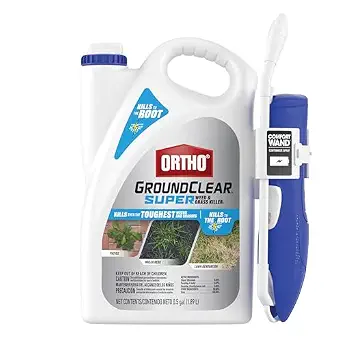 |
| Highest Rated A top-rated pick with lots of positive feedback | Spectracide Weed & Grass Killer Refill for AccuShot Sprayer, 1.33 Gal |  |
| Most Popular A crowd favorite that many people choose with confidence | Spectracide Weed & Grass Killer with AccuShot Power Sprayer, 1.33 Gal |  |
| Best Seller A high-volume bestseller chosen again and again | Roundup Weed & Grass Killer4 Refill, 1.25 gal |  |
Ortho GroundClear Year-Long Vegetation Killer with Comfort Wand, 1 gal.

| Unit Count | 128 Fluid Ounces |
|---|---|
| Item Form | Liquid |
| Coverage | 1 gallon |
| Active Ingredients | Imazapyr; Pelargonic acid |
Ortho GroundClear Year-Long Vegetation Killer is a 1 gallon ready-to-use herbicide with an attached Comfort Wand for continuous targeted spraying. It is intended for hardscape and unplanted areas such as driveways, sidewalks, gravel beds, and under decks where you want no plant growth. The formula combines fast-acting ingredients that show visible results within an hour and includes residual control that can prevent vegetation return for up to 12 months when applied as directed. Practical features include a wand for easy, low-bend application and a rainproof claim that allows light rain after about an hour. Important limitations are that it is nonselective so it will kill desirable plants on contact and should only be used where no vegetation is wanted, and optimal results require application on a sunny day above 60°F. Safety precautions are necessary because the product can irritate skin and eyes and must be kept away from children and pets until dry.
Best for: Buyers who want a low-effort, long-lasting solution to clear weeds and prevent regrowth on driveways, patios, gravel and other unplanted hardscape areas and value convenience and season-long control.
Less Ideal for: Gardeners who need selective control around lawns, flower beds, or established plants should choose a selective herbicide or spot-treating method instead.
- Ready-to-use with an included Comfort Wand for targeted, continuous spraying without bending or pumping
- Fast-acting formula with visible results in about one hour
- Provides up to 12 months of prevention in treated unplanted areas
- Rainproof quickly so light rain after application is less likely to wash it away
- Nonselective formula will kill any desirable plants it contacts
- Best performance requires application on sunny days above 60°F
Verdict: A convenient ready-to-use sprayer formula that clears unwanted vegetation quickly and keeps treated hardscape areas weed-free for up to a year.
Roundup Weed & Grass Killer with Comfort Wand, 1.33 gal.

| Item Form | Liquid |
|---|---|
| Coverage | 400 sq. ft. |
| Liquid Volume | 1.33 gallons |
This Roundup package pairs a 1.33 gallon liquid formulation with a Comfort Wand for easier spraying around beds, walkways, and foundations. It is formulated to kill common broadleaf weeds and grasses down to the root, with visible wilting in hours and rainfast protection in about 30 minutes, so treated areas are less likely to wash away after a brief rain. The wand offers one-touch continuous spray, which reduces hand fatigue during spot treatments and makes edging and targeted applications simpler than using a separate sprayer. Coverage is listed at about 400 sq. ft., appropriate for small yards, beds, or multiple spot-treatment sessions. Important limitations are that this is a nonselective herbicide so it will damage desirable plants if contacted and the product directions include replanting wait times of 1 to 30 days depending on use. Users should follow label precautions about keeping people and pets away until spray has dried and applying only in calm conditions to avoid drift.
Best for: Buyers who want a straightforward, ready-to-use herbicide for targeted spot treatments and edging where quick, reliable weed control is the priority and minimizing application fuss matters.
Less Ideal for: Large properties or users who need selective lawn-safe control should consider professional application methods or products formulated specifically for turf.
- Fast visible results in hours and rainproof in as fast as 30 minutes
- Comfort Wand with one-touch continuous spray reduces hand fatigue and improves targeting
- Kills a wide range of broadleaf weeds and grasses to the root
- Ready-to-use liquid requires no mixing and covers up to 400 sq. ft.
- Nonselective formula will damage desirable plants if contacted
- Container and wand limit treatment area per refill compared with larger tank sprayers
Verdict: A convenient, ready-to-use herbicide with a Comfort Wand that delivers fast, reliable spot control of broadleaf weeds and grasses for homeowners who want an easy, low-fuss solution.
Spectracide Weed & Grass Killer Concentrate, 40 oz

| Unit Count | 40 Fluid Ounces |
|---|---|
| Item Form | Spray |
| Coverage | 1200 square feet |
| Liquid Volume | 40 fluid ounces |
Spectracide Weed & Grass Killer Concentrate is a liquid herbicide you mix with water and apply with a tank sprayer to kill broadleaf weeds and grasses down to the root. It is intended for spot treatments on driveways, walkways, patios and around fences or foundations where you want to remove unwanted vegetation without tilling. The formula is rainproof in about 15 minutes and can show visible browning in as fast as three hours, allowing replanting of nonedible ornamentals after roughly one day. Key practical features include a concentrate format for multiple treatments from a single bottle and directions calibrated for coverage so you can treat up to the stated area when mixed correctly. Important limitations are that it is nonselective so it will damage desirable plants if it contacts them, it requires careful mixing and protected application to avoid drift, and label directions restrict use around edible food crops and limit applications per year. Proper PPE, shielding nearby plants, and applying in warm, calm conditions will get the best results.
Best for: For gardeners and homeowners who want an efficient, no-nonsense spot weed killer to clear unwanted vegetation from hardscapes and edges, and who prioritize fast, predictable results with controlled application.
Less Ideal for: Not a good choice for people who need selective weed control inside lawns or around edible gardens or for those who prefer ready-to-use sprayers instead of mixing concentrate.
- Concentrated formula lets you mix for multiple spot treatments.
- Fast-acting results with visible effects in about three hours.
- Rainproof within 15 minutes so light rain soon after application is less likely to reduce effectiveness.
- Suitable for hardscape and perimeter spot treatments where nonselective control is acceptable.
- Nonselective herbicide that will harm or kill desirable plants on contact.
- Requires mixing and a separate tank sprayer rather than an all-in-one applicator.
- Label restricts use near edible crops and limits annual applications to any area.
Verdict: A concentrated, fast-acting spot herbicide for homeowners who need reliable, no-frills removal of weeds and grasses from driveways, patios and other hardscape areas.
Ortho GroundClear Super Weed & Grass Killer with Comfort Wand, 0.5 gal

| Unit Count | 64 Fluid Ounces |
|---|---|
| Item Form | Spray |
| Coverage | Broad spectrum coverage |
| Liquid Volume | 0.5 gallons |
Ortho GroundClear Super Weed & Grass Killer is a ready-to-use spray intended for spot treatment of weeds and grasses in landscape beds, along walkways, driveways, and around structures. The bottle’s attached Comfort Wand delivers a continuous spray for targeted application, which helps avoid overspray on nearby plants. The formula combines a contact ingredient for rapid burn-down with systemic actives that penetrate to the root, so you can see visible effects within hours and full control in days to a couple of weeks. It is rainfast in about 15 minutes, so treatments hold up quickly after application. Practical benefits include ease of use without mixing, broad-spectrum control of common tough weeds, and suitability for prepping areas for renovation. Important limitations are that it is nonselective so care is required near desirable plants, it should not be used on edible crops, and protective gear is recommended during application because of the herbicidal strength.
Best for: Homeowners who want an easy, no-mix solution to remove persistent weeds from landscape beds, hardscapes, and around structures and who prioritize quick, visible results with precise application.
Less Ideal for: Gardners maintaining vegetable beds, pollinator or mixed planting areas where nonselective chemistry risks desirable plants, or users seeking an organic or granular spot-treatment method.
- Ready-to-use spray needs no mixing and the attached Comfort Wand enables targeted continuous application
- Dual-action formula gives quick visible burn-down and systemic root kill for longer control
- Rainfast in 15 minutes so treatments are less likely to wash off in light showers
- Nonselective herbicide that can damage desirable plants if not applied carefully
- Not labeled for use on edible crops so unsuitable for vegetable gardens
Verdict: Choose this ready-to-use spray when you need fast, targeted knockdown and root-level control of tough weeds in landscape beds without mixing or special equipment.
Spectracide Weed & Grass Killer Refill for AccuShot Sprayer, 1.33 Gal

| Item Form | Liquid |
|---|---|
| Unit Count | 166.4 Fluid Ounces |
| Coverage | 300 sq ft per gallon (claimed) |
| Rainproof | 15 minutes |
This Spectracide refill is a ready-to-use herbicide formulated to kill broadleaf weeds and grasses down to the root when applied with the AccuShot continuous power sprayer. It is typically used for spot treatment on driveways, walkways, around fences and foundations, and other non-lawn areas where you want quick control. Notable features include a rainproof formula after 15 minutes, visible results in as fast as three hours, and compatibility with the AccuShot wand for extended reach and more accurate targeting. Practical benefits are straightforward: no mixing, fast knockdown of common weeds like dandelion and clover, and the ability to replant treated areas within a day. Important limitations are that it is non-selective so it will damage desirable plants if misapplied, it is intended for use with the AccuShot sprayer for best ergonomics and targeting, and the effectiveness depends on applying when temperatures are above 60 degrees. For buyers prioritizing a low-cost, fast-acting solution for tough weeds on hard surfaces, this product delivers reliable, simple results.
Best for: Buyers who want an inexpensive, no-fuss solution to clear heavy weeds and grasses from hard surfaces and neglected areas quickly without mixing chemicals.
Less Ideal for: Gardeners who need a selective weed control for lawns, beds with desirable plants nearby, or those who prefer manual or non-chemical weed removal methods.
- Ready-to-use pre-mixed formula requires no measuring or dilution
- Rainproof in 15 minutes so recent watering or light rain won’t wash it away
- Visible results in as fast as three hours and replanting possible after one day
- Works with AccuShot sprayer for extended reach and continuous spray to reduce hand fatigue
- Non-selective herbicide that will kill desirable plants if sprayed accidentally
- Designed to be used with the AccuShot sprayer for easiest application
Verdict: If you need a fast, budget-friendly way to kill tough weeds and grasses on driveways and walkways, this ready-to-use Spectracide refill delivers reliable, quick results.
Spectracide Weed & Grass Killer with AccuShot Power Sprayer, 1.33 Gal

| Unit Count | 170 Fluid Ounces |
|---|---|
| Item Form | Spray |
| Coverage | 1 gallon |
| Active Ingredients | Diquat Dibromide 0.12%, Fluazifop-p-butyl 0.06%, Dicamba 0.04% |
Spectracide Weed & Grass Killer pairs a concentrated non-selective formula with a battery-powered AccuShot sprayer to clear weeds from driveway cracks, patios and around foundations. The product is used by aiming and spraying foliage until leaves are covered; the active ingredients move through the leaf to the root and can show visible die-back in as little as three hours. The AccuShot wand is extendable and provides continuous spray without manual pumping, which improves accuracy for narrow cracks and reduces hand fatigue during larger jobs. It is rainproof within 15 minutes, so treated areas are protected quickly. Practical benefits include fast results that let you replant or resume use of the area within a day and a reusable sprayer for follow-up applications. Important limitations are that the herbicide is non-selective so it will kill any plant it contacts, it requires careful handling and PPE to avoid skin or eye exposure, and the sprayer runs on four AA batteries that must be replaced periodically. Follow label directions to avoid runoff into water.
Best for: Buyers who want a fast, no-nonsense solution for weeds growing in driveways and hard surfaces and who prioritize tools with clear user feedback and proven results.
Less Ideal for: Gardeners who need a selective lawn-safe treatment, people unwilling to follow pesticide safety precautions, or those treating areas adjacent to water features.
- AccuShot battery-powered wand gives continuous spray for accurate application in tight cracks
- Formula moves through foliage to kill weeds down to the root with visible results in about three hours
- Rainproof after 15 minutes so treatments are not easily washed away by brief showers
- Covers approximately 300 square feet per gallon, suitable for multiple crack-treatment sessions
- Non-selective herbicide will damage any desirable plants it contacts
- Sprayer requires four AA batteries and occasional replacement to maintain function
- Product is toxic to aquatic life and must not be used near water or allowed to run off
Verdict: A fast-acting, easy-to-aim non-selective herbicide with a battery-powered wand that is well suited to reliably clear weeds from driveway cracks and other hard surfaces.
Roundup Weed & Grass Killer4 Refill, 1.25 gal

| Unit Count | 160 Fluid Ounces |
|---|---|
| Coverage | 375 square feet |
| Item Form | Spray |
| Active Ingredients | Triclopyr, Fluazifop P-Butyl, Diquat Dibromide |
This 1.25 gallon Roundup Weed & Grass Killer4 refill is designed to be poured into an empty spray container to treat weeds and grassy weeds around beds, walkways, driveways, foundations, and other hardscape edges. It contains multiple active ingredients that attack broadleaf weeds and grasses to the root and promises visible wilting within hours and rainproofing in as fast as 30 minutes, which makes it convenient when weather windows are short. The refill covers about 375 square feet and is intended for use in and around established plantings when applied carefully to avoid drift onto desirable plants. Practical benefits include fast action, the ability to replant some areas within a specified wait period, and compatibility with the brand’s comfort wand refills so you avoid frequent repurchasing of small bottles. Important limitations are that it is a nonselective herbicide so it will damage desirable plants if misapplied and treated areas should be kept clear of people and pets until spray dries; follow label directions closely for safe use and replanting intervals.
Best for: Buyers who prioritize reliable, fast-acting weed control for routine maintenance of beds, edges, and hardscape areas and who follow label directions to minimize risk.
Less Ideal for: Gardeners who need selective control inside densely planted flower beds or who prefer organic or nonchemical weed management methods.
- Kills a broad range of weeds and grasses to the root, including dandelion and crabgrass
- Fast visible results in hours and becomes rainproof in about 30 minutes
- Large 1.25 gal refill reduces need for frequent repurchases and covers roughly 375 sq ft
- Formulated to refill compatible spray wand for easy application around beds and hardscapes
- Nonselective formula that will harm desirable plants if it drifts or is oversprayed
- Requires careful handling and adherence to label safety and replanting intervals
Verdict: Choose this refill if you want a fast, proven, large-format herbicide that quickly kills tough weeds and grasses and refills a compatible spray wand for area-wide maintenance.
Choosing the Right Paver Weed Killer: Key Factors to Consider
Knockdown Speed and Visible Results
How quickly a treatment browns and kills tops matters when you need a fast visual improvement on patios and walkways. A contact-style product shows results in hours to days but may not eliminate roots in deep joints, while systemic options take longer to show visible wilting yet can interrupt regrowth from root fragments.
Fast knockdown is useful for high-visibility areas and for gardeners who want immediate cleanup before sealing or power-washing. If you plan to remove dead material manually after treatment, choose a product that kills foliage reliably within a predictable window so cleanup does not scatter viable fragments.
Residual Control Duration
Residual control describes how long a treatment prevents new seedlings from establishing in joints and cracks. Products with short residual action require more frequent applications in spring and summer, while long-residual treatments reduce upkeep but may be less suitable near desirable plants.
Consider the season and weed pressure: heavily used driveways and warm, moist climates favor longer residual protection. Be aware that residuals that persist in soil or sand can affect desirable plants if runoff or drift occurs, so balancing duration with safety is essential.
Compatibility With Paving Materials
Pavers come in concrete, clay, natural stone, and units set with polymeric or regular sand. Some chemicals can discolor, etch, or break down certain stone finishes or the binding agents in polymeric sand. Physical treatments like boiling water or steam avoid chemical contact but may not penetrate roots deeply in compacted joints.
Check how a treatment behaves on sealed and unsealed surfaces. For historic or delicate stone, non-chemical or spot treatments are often preferable. For polymeric sand joints, avoid aggressive solvents or high-alkaline products that could disrupt joint binders.
Application Method and Practicality
Ease of application affects whether you can treat joints effectively without causing damage to nearby planting beds. Ready-to-use sprays, hose-end applicators, or pump sprayers are common for broad coverage, while gel or paste formulations let you coat individual joints with reduced drift. Some approaches require protective equipment or specialized nozzles to get into narrow gaps.
Consider the time you have, the size of the area, and access. For large drives a hose-end or pump sprayer gives speed and uniform coverage. For patios with lots of furniture or tight joints, a brush-on or gel may be less messy and more precise.
Non-target Safety and Environmental Concerns
Runoff from treatments can reach ornamental beds, lawns, or storm drains, so evaluate toxicity to nearby plants and aquatic life. Biodegradable, low-persistence options reduce long-term exposure but may require more frequent reapplication. Conversely, persistent chemistries lower maintenance but increase risk to non-target vegetation.
If you have pollinator-friendly plantings adjacent to paved areas, avoid treatments with known harm to beneficial insects during bloom. Also consider the safety of pets and children who use the patio regularly and follow label guidance to minimize exposure.
Mechanical and Manual Removal Considerations
Non-chemical removal methods such as weeding tools, power brushes, or hot water are important tools for gardeners who prefer to avoid chemical residues. Manual removal lets you preserve desirable groundcovers growing close to paving and avoids runoff concerns, though it is more labor intensive and may not remove root fragments from deep joints.
Mechanical methods are best combined with a follow-up preventive approach, such as re-setting tight joints, applying polymeric sand where appropriate, or scheduling periodic spot treatments to catch regrowth before it establishes large root systems.
When to Treat Paver Weeds
Treat paver weeds when growth is actively producing new foliage, typically from spring through early fall. Active green growth takes up systemic herbicides and shows contact treatment effects fastest, so timing treatments for when weeds are healthy improves effectiveness.
Avoid treating during drought stress or when heavy rain is expected within 24 hours, as uptake and residual effectiveness decline with poor leaf activity or dilution from runoff. For winter annuals, a late-fall or very early-spring treatment can reduce seed return and make spring cleanup easier.
- Target weeds when temperatures are moderate and plants are actively growing.
- Do not treat immediately before heavy rain to prevent wash-off.
- Schedule follow-up checks 2 to 6 weeks after initial treatment to catch regrowth.
Preparing the Area and Protecting Surroundings
Clear loose debris and sweep sand back into joints so the product contacts green tissue or joint roots directly. Remove pots, furniture, and items that could trap product residues or block access.
Protect adjacent beds and lawn with plastic or a wet cloth barrier, or wet the soil in those beds before treatment to minimize uptake from accidental drift. Rinse any accidental overspray off desirable foliage promptly with water.
- Sweep and expose weed foliage for better contact.
- Cover nearby plants and hardscape elements that you do not want affected.
- Work from downwind sides to reduce drift onto plantings.
Post-treatment Cleanup and Joint Repair
After weeds have died back, remove dead tissue to prevent organic buildup in joints that can encourage new seedlings. Use a stiff broom, scraper, or power brush depending on the extent of material.
Repair or recompact joint sand to close gaps where seeds settle. If you plan to seal the paving, wait until residues have broken down as recommended by the treatment instructions to avoid trapping chemicals under a sealer.
- Dispose of removed weed material in green waste, not compost that returns to garden beds.
- Refill joints with appropriate sand and compact to reduce future weed establishment.
- Consider resealing only after confirming the chosen treatment is compatible with sealers.
Non-chemical Options and When They Make Sense
Mechanical removal, a narrow rotary brush, or pouring boiling water into joints are effective for small areas, sensitive stone, or where environmental exposure is a concern. These methods avoid chemical residues but require more frequent attention to prevent re-establishment.
Non-chemical approaches are practical for historic paving, areas with frequent foot traffic from children and pets, or when you want to protect adjacent pollinator plantings. Combine manual removal with improved joint maintenance to lengthen the interval between treatments.
- Use a joint trowel or weeding knife for tight cracks.
- Steam units can kill roots with less runoff risk than sprays.
- Pair mechanical methods with sanding and compaction for longer-term control.
Seasonal Maintenance Schedule
Adopt a simple seasonal routine: inspect and spot-treat in early spring, perform a midseason check and touch-ups, and do a late-summer cleanup before seed set in many annual weeds. This schedule reduces the need for full-area reapplications and keeps joints tidy.
For high-traffic or high-weed-pressure areas, increase inspections to monthly during the growing season. Record dates of treatments and weather conditions to refine timing for your locality.
- Early spring: remove winter survivors and spot-treat fresh growth.
- Midseason: address any re-emergence and repair joints.
- Late summer: remove seed-bearing weeds to cut seed return.
How We Chose the Best Paver Weed Killer
We selected products and methods based on measurable, garden-relevant criteria that matter for paved surfaces. Primary evaluation points included how quickly a treatment kills visible weeds and roots, the duration of residual control to limit regrowth, and the product's compatibility with common paving materials such as concrete, natural stone, and polymeric sand. We also weighed application practicality, including required equipment, coverage per unit, and how easy it is to treat joints and cracks safely. Environmental and non-target safety was considered, focusing on runoff potential, persistence in soil, and risk to nearby ornamental plants or turf. We excluded solutions primarily intended for lawns or broadcast weed control where label directions do not cover paved surfaces. Final selections favored options that balance reliable weed knockdown, realistic reapplication intervals for homeowners, and clear surface-safety guidance.
FAQ
Can I use a paver weed treatment near flower beds and turf?
It depends on the product. Many treatments can harm nearby plants if they drift or if treated runoff reaches roots. Take precautions like covering nearby plants, wetting ornamental beds before application, and choosing low-drift methods for close plantings.
How long after treatment can I walk on the pavers?
Most surface treatments dry within a few hours so normal foot traffic is possible once the chemical film has evaporated. Always follow label directions for re-entry times and avoid disturbing treated material until recommended drying or cure periods have passed.
Will boiling water or steam damage my pavers?
Short exposures to hot water or steam usually will not damage most concrete or natural stone pavers, but repeated high-temperature treatments can affect softer materials or joint binders. Test a small area first and avoid directing steam onto polymeric sand or sensitive finishes.
How often will I need to reapply a paver weed treatment?
Reapplication frequency depends on the product's residual profile and local weed pressure. Short-residual contact treatments may need repeat applications every few weeks during peak growth, while longer-residual options can extend control for months. Inspect regularly to decide when to retreat.
Is it safe to seal pavers after applying a weed killer?
That depends on the active chemistry and sealer type. Some treatments recommend waiting until residues have weathered or been washed away before sealing. Check product guidance to avoid trapping chemicals beneath a sealer, which can affect both performance and safety.
Final Verdict
Focus on matching the treatment to your paving material and the level of weed pressure. Fast-contact methods give quick visual improvement but often need follow-up, while systemic or longer-residual options reduce frequency at the cost of greater non-target risk. For sensitive stone or areas near ornamentals, favor precise application methods or mechanical removal and pair whatever treatment you choose with good joint maintenance to reduce future infestations. Prioritize surface compatibility, safety for adjacent plantings, and a realistic maintenance schedule so you can keep paved areas tidy with minimal rework.
