

Note: This article contains affiliate links. If you click on these links and make a purchase, I may earn a small commission at no extra cost to you. This helps support my research and content. Read my full affiliate disclosure here.
You want a driveway free of dandelions, grass, and moss without risking nearby beds, turf, or landscape plants. Choosing the right organic weed killer for driveways matters because hard surfaces concentrate runoff, stains, and contact exposure that can harm adjacent planting areas. This guide shortlists six top-rated organic driveway weed killers and explains how we evaluated them for speed of action, root control, surface safety, and environmental impact. Use the evaluation notes to pick a product that matches your driveway material and nearby planting concerns before you apply.
Top Picks at a Glance
| Best Overall The best all-around choice for most situations | Ortho GroundClear Weed & Grass Killer with Comfort Wand, 1.1 gal |  |
| Best Quality Built to a higher standard if you want something more solid | Natures Wisdom 20% Vinegar Weed & Grass Killer, 1 Gallon |  |
| Best Value The sweet spot between price and what you get | Spruce Weed & Grass Killer Refill, Ready-to-Use 64 fl oz |  |
| Best Budget The cheapest option that still gets the job done reliably | Energen Carolina Vinegar Weed & Grass Killer, Quart |  |
| Highest Rated A top-rated pick with lots of positive feedback | Simply Vinegar Industrial Strength 49% Vinegar, 1 Gallon (Pack of 2) |  |
| Most Popular A crowd favorite that many people choose with confidence | Ortho GroundClear Weed & Grass Killer with Comfort Wand, 1 gal. |  |
Ortho GroundClear Weed & Grass Killer with Comfort Wand, 1.1 gal

| Item Form | Liquid |
|---|---|
| Coverage | non-selective broad spectrum coverage |
| Liquid Volume | 1.1 gallons |
Ortho GroundClear is a ready-to-use liquid weed and grass killer designed for spot treatment around patios, walkways, and landscape beds. The included Comfort Wand makes it easy to aim the spray so you can attack individual weeds and grasses without a handheld pump sprayer. The formula acts quickly, with visible browning in about 15 minutes and rainproof protection two hours after drying, which helps keep results from washing away. It is OMRI listed for organic production use, and the label calls out common targets such as dandelions, chickweed, crabgrass, and moss. For persistent perennial weeds you may need repeat applications, and because the product is nonselective it will damage desirable plants if contacted, so careful edging and masking are required when used near flowers. This product is most practical for homeowners who want a fast, convenient solution for weeds on hard surfaces and in beds where contact with ornamentals can be avoided.
Best for: Gardeners who prioritize quick, reliable weed removal on hardscapes and in beds where they can avoid spray contact with ornamentals and need a convenient ready-to-use option.
Less Ideal for: Those managing mixed flower borders where you cannot prevent drift or direct contact with blooms should choose a selective or spot-mechanical approach instead.
- Fast visible results in about 15 minutes for quick cleanup of exposed weeds
- Comfort Wand enables precise, controlled spot application
- Becomes rainproof two hours after drying to reduce wash-off risk
- OMRI listed for use in organic production settings
- Nonselective formula will harm desirable flowers and plants on contact
- May require multiple applications for established perennial roots
Verdict: Buy this if you want a fast, easy ready-to-use spray for decisive spot control of weeds on hardscapes and landscape beds where you can avoid contact with flowers.
Natures Wisdom 20% Vinegar Weed & Grass Killer, 1 Gallon

| Liquid Volume | 1 gallons |
|---|---|
| Item Form | Liquid |
| Active Ingredients | Herbicide, vinegar |
| Coverage | 1 gallon |
This 1 gallon bottle of Natures Wisdom 20% Vinegar Herbicide is a ready-to-use, non-glyphosate option for spot-treating unwanted weeds and grasses. It delivers a concentrated acetic acid formula intended to brown and desiccate foliage within hours and usually shows full effect in under 24 hours when applied in direct sunlight. Typical use is direct spraying with a single-nozzle sprayer or hand-gun applicator without dilution, making it straightforward for driveways, sidewalks, garden beds, and small agricultural patches. The product is certified organic and formulated from ethanol distilled from USA-grown corn, so it breaks down quickly in soil and avoids persistent chemical residues. It works well on a wide list of annual and perennial broadleaf weeds and many grasses, though tough perennial roots may require repeat applications. Users should avoid contact with desirable plants and follow safety guidance because the 20% acetic acid is harsh on skin and foliage. For someone prioritizing strong, fast performance from an organic herbicide, this is a practical, effective choice for spot control.
Best for: Buyers who want a fast-acting, organic alternative to synthetic herbicides for targeted spot treatments and who prioritize visible performance over convenience of broad broadcast use.
Less Ideal for: Those needing a long-term soil residual or a broadcast herbicide for very large lawns and fields should consider other solutions.
- High-strength 20% acetic acid formula acts quickly to desiccate foliage within hours
- Certified organic and glyphosate-free, formulated from USA-grown corn ethanol
- Ready-to-use liquid that requires no dilution for direct spot spraying
- Effective on a broad list of annual and perennial broadleaf weeds and many grasses
- May require repeated applications for deep-rooted perennial weeds
- Harsh on skin and non-target plants so careful application and PPE are required
Verdict: If you want a fast, organic spot-treatment that visibly kills weeds within a day without using glyphosate, this 20% vinegar formula delivers strong performance.
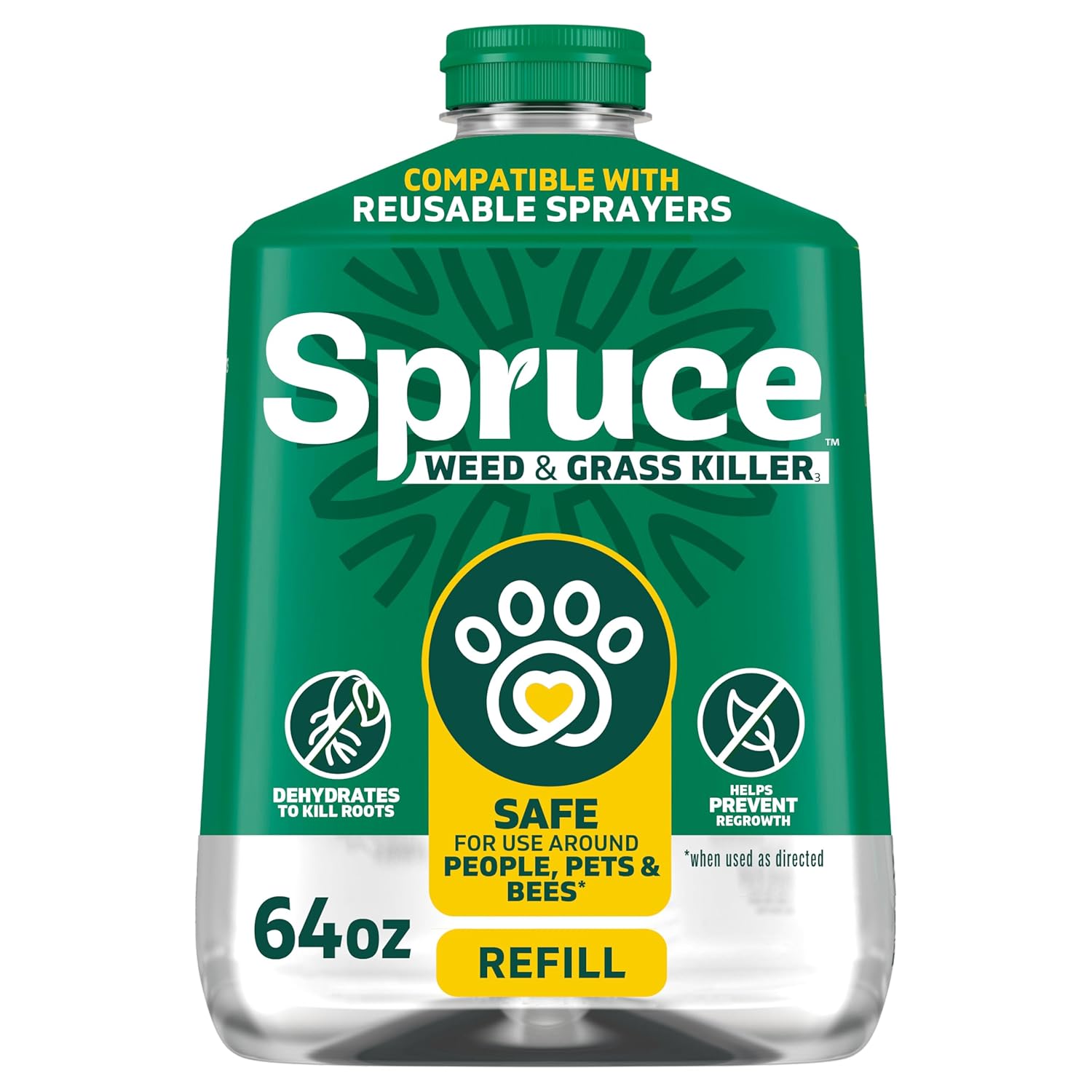
Spruce Weed & Grass Killer Refill, Ready-to-Use 64 fl oz
| Unit Count | 64 Fluid Ounces |
|---|---|
| Item Form | Spray |
| Coverage | 1 bottle treats up to 400 weeds |
| Active Ingredients | Sodium Lauryl Sulfate, Geraniol, Cornmint Oil |
This 64 fl oz Spruce refill is a no-mix replacement for the brand's Snap & Spray system that provides a convenient, ready-to-use weed and grass killer for spot treatments. It works on contact, dehydrating foliage with visible leaf darkening or wilting within an hour and complete plant death often by 24 hours. The formula relies on water, essential oils and sodium lauryl sulfate rather than synthetic herbicides, which makes it suitable for use around people and pets when directions are followed. One bottle is rated to treat up to about 400 weeds and is designed for hard surfaces, mulch beds, driveways and pavers rather than broadcast lawn application. Practical features include a snap-on refill top for the existing spray handle and a fast rainproof window of roughly 10 minutes. Be aware it is non-selective and must be applied carefully to avoid desirable plants, and it is most effective on young or small weeds rather than deep perennial roots where reapplication may be needed.
Best for: Buyers who want a low-fuss, pet-conscious spot weed killer for driveways, pavers and mulch beds and who prioritize convenience and visible speed of action.
Less Ideal for: Homeowners seeking a selective lawn treatment or long-term control of deeply rooted perennials should consider different systemic or professional options.
- Ready-to-use refill eliminates mixing and pouring
- Visible results in about one hour with full effect by 24 hours
- Formulated with water and essential oils for pet- and people-friendly use when directed
- Covers a high estimated count — one bottle treats up to 400 weeds
- Snap-on refill design fits the Spruce Snap & Spray handle for quick replacement
- Non-selective formula will damage desirable plants if oversprayed
- Less effective on large established perennial roots compared with systemic herbicides
Verdict: Choose this refill if you want a fast, ready-to-use, pet-conscious spot treatment that snaps into the Spruce spray handle for effortless weed control on hardscapes and beds.
Energen Carolina Vinegar Weed & Grass Killer, Quart

| Unit Count | 32 Fluid Ounces |
|---|---|
| Item Form | Liquid |
| Coverage | non-selective broad spectrum |
| Active Ingredients | Acetic Acid |
This quart of vinegar-based weed and grass killer is a concentrated liquid contact herbicide that uses acetic acid to rapidly desiccate foliage on annual weeds and grasses. It is applied as a foliar spray to unwanted plants on driveways, sidewalks, mulch beds, flower beds, and other areas where nonselective control is acceptable. Notable features include its organic-acid active ingredient, label notes supporting use in organic production, and a formulation that degrades quickly in soil so treated areas can be used by pets and children once dry. Practical benefits are quick visible burndown of crabgrass, clover, dandelions, and similar broadleaf and grassy weeds, and the ability to spray near hard surfaces without systemic residues. Important limitations are that it is a contact herbicide so it will not control established perennial roots or provide long-term residual control, and multiple applications may be required for tougher or re-sprouting weeds. Follow label directions for safe use and avoid contact with desirable plants since it is nonselective.
Best for: Gardeners and homeowners who want a quick, organic-acid option to spot-treat visible annual weeds on hardscapes, paths, and beds without systemic herbicides. Ideal for buyers prioritizing simple, fast results on small to medium problem patches.
Less Ideal for: People needing long-term control of established perennial weeds or large-area lawn weed management should consider systemic or residual herbicide solutions instead.
- Uses acetic acid so residues break down quickly and is approved for organic production use
- Concentrated quart size suitable for treating multiple small areas
- Nonselective contact action gives fast visible burndown of annual weeds and grasses
- Does not provide systemic or long-term residual control of perennial weeds
- Nonselective formula will damage desirable plants on contact
Verdict: A fast-acting, vinegar-based contact herbicide that quickly burns back annual weeds and is suitable for spot treatment when you want an organic-acid alternative to systemic products.
Simply Vinegar Industrial Strength 49% Vinegar, 1 Gallon (Pack of 2)

| Concentration | 49% Vinegar |
|---|---|
| Size | 128 oz |
| Material Feature | Biodegradable Warning |
| Manufacturer | Pure Origin Products |
Simply Vinegar 49% is a concentrated industrial-grade vinegar intended for heavy-duty cleaning and outdoor use. Sold in one-gallon containers, it is designed to be diluted for tasks that need strong acidity, such as stripping grime, removing mineral deposits, and spot treating persistent organic buildup. Notable features are its 49 percent acetic acid concentration and a formula free of bleach, dyes, and added chemicals, which makes its action straightforward and predictable. For outdoor weed control, the high concentration provides fast desiccation of foliage when applied directly, and a small amount diluted appropriately yields many gallons of working solution compared with household vinegar. Practical benefits include reduced packaging waste and consistent performance from batch to batch thanks to domestic manufacturing. Important limitations are that it is hazardous if mishandled, not for food use, and can damage desirable plants and some surfaces on contact, so careful mixing, targeted application, and protective equipment are essential.
Best for: Buyers who prioritize a dependable, concentrated natural option for tough outdoor and cleaning jobs and who plan to handle and dilute strong acids safely.
Less Ideal for: Casual gardeners or users who prefer ready-to-use, low-risk products or who lack protective gear and experience working with concentrated acids.
- Very high 49% acetic acid concentration provides rapid, powerful acidity for heavy-duty cleaning and plant desiccation
- Free of bleach, dyes, and added chemicals, giving a simple biodegradable formula
- Concentrated gallon size yields many gallons of working solution when diluted, reducing storage needs
- Made in the USA with consistent manufacturing for predictable batch-to-batch performance
- Hazardous at full strength and not safe for food use, requiring gloves and eye protection
- Can harm desirable plants, stained surfaces, and some finishes on contact
Verdict: A reliable, high-strength concentrated vinegar for users who need consistent, powerful natural cleaning or targeted plant desiccation when handled with proper safety.
Ortho GroundClear Weed & Grass Killer with Comfort Wand, 1 gal.

| Item Form | Spray |
|---|---|
| Coverage | 5120 square feet |
| Unit Count | 128 Fluid Ounces |
| Active Ingredients | Ammonium Nonanoate |
Ortho GroundClear is a one-gallon ready-to-use weed and grass spray designed for spot and surface treatment on driveways, walkways, patios, and landscape beds. The formula absorbs on contact and shows visible browning in about 15 minutes, becoming rainproof roughly two hours after drying, which helps when weather is unpredictable. The included Comfort Wand makes it easy to aim at weeds growing between gravel and pavers without soaking surrounding surfaces. It is OMRI Listed, so it can fit into some organic-minded maintenance routines. Coverage is large for a single container, and the product lists ammonium nonanoate as the active ingredient, which works by contact so small or actively growing weeds are best treated. Because it is a contact herbicide, perennial or well-established weeds may need repeat applications or mechanical removal for full control, and care is required to avoid spray drift onto desirable plants. Follow safety directions and keep pets and children away until treated areas are dry.
Best for: Homeowners who want a practical, hands-on solution to remove weeds from gravel driveways and hardscapes and who prioritize quick, targeted results with minimal setup.
Less Ideal for: People seeking a long-term systemic control for deep-rooted perennial weeds or a total lawn herbicide should consider systemic products or integrated mechanical removal instead.
- Fast visible results on contact, often browning in about 15 minutes.
- Comfort Wand enables precise targeting in gravel joints and along edges.
- Becomes rainproof in approximately 2 hours, reducing loss from unexpected rain.
- OMRI Listed, compatible with some organic production standards.
- Contact-only action means deeper or perennial roots may require multiple applications.
- Spray can damage nearby desired plants if not applied carefully.
Verdict: A fast, ready-to-use contact spray with a comfort wand that makes quick, precise weed control on gravel driveways simple and practical.
Choosing the Right Organic Weed Killer for Driveways: Key Factors to Consider
Active Ingredient and Mode of Action
Different organic products rely on acids, botanical oils, or physical desiccants, and each works differently in a driveway setting. Acid-based products burn leaf tissue quickly but may need higher concentrations or repeated applications to weaken deep roots. Botanical oils and soap-based mixtures disrupt cell membranes and can dry plants faster but may still leave crowns or rootstocks intact.
Understanding the mode of action helps you set expectations for how soon visible decline will occur and whether a follow-up treatment or mechanical removal will be necessary. It also informs safety precautions; for example, acidic sprays can irritate skin and corrode some surface sealers, while oil-based sprays can create slick residues on hard surfaces.
Effectiveness Against Roots and Perennials
Many driveway weeds are persistent perennials with deep crowns or creeping roots. A product that only desiccates tops often results in rapid regrowth from surviving root material. Conversely, treatments that penetrate and damage root tissue reduce the need for repeated applications and follow-up digging.
When you have tough perennials or spreading grasses, prioritize options and application techniques that increase contact with crowns and basal growth. Mechanical removal after an initial treatment can also improve long-term control when roots are not fully killed by an organic spray alone.
Driveway Surface and Finish Compatibility
Driveway materials vary in porosity and finish. Concrete and pavers can absorb staining ingredients or allow runoff into joints, while asphalt sealers may be degraded by strong acids or solvents. Gravel drives present a different challenge because spray contact with soil among stones can affect buried roots and nearby vegetation.
Match the product to your surface: choose gentle, non-staining formulations for light-colored pavers and stronger desiccants for bare concrete or asphalt where staining is less of a concern. Always test a small, inconspicuous patch first and rinse excess off smooth surfaces to reduce visible residue.
Risk to Nearby Plants and Soil Life
Driveways typically border beds, lawns, or hedges. Even organic ingredients can harm desirable plants if drift or runoff reaches roots or foliage. Some organic herbicides are nonselective and will damage any green tissue they contact, while others break down rapidly and pose lower residual risk.
Consider wind conditions, proximity to desirable plants, and plans for rain after treatment. Use targeted application methods like hand sprayers, shields, or spot treatments to limit off-target exposure. For sensitive plantings adjacent to the driveway, physical removal or thermal methods may be safer than a broad spray.
Application Method and Safety
How a product is applied affects both efficacy and safety. Ready-to-use sprays are convenient for small cracks and edges, while concentrated formulas are more economical for large drives but require careful mixing and equipment. Some formulations demand personal protective gear due to irritation risk, and some leave residues that require rinsing.
Factor in your comfort with sprayers, available protective equipment, and whether you can keep pets and people away during and immediately after treatment. Also consider storage and disposal requirements for concentrated products and the compatibility of application equipment with acidic or oil-based solutions.
Environmental Persistence and Rainfastness
Organic does not always mean short-lived. Some natural compounds break down quickly in sunlight and microbes, requiring reapplication, while others persist long enough to control regrowth but may move with runoff. Rainfastness determines how soon after application the product becomes effective and whether rainfall will wash it away.
If your driveway is on a slope or subject to runoff that drains into planting areas, prioritize formulations with low mobility and rapid binding to weed tissue. In climates with frequent rain, choose products that develop rainfast action within a few hours to avoid wasted applications.
Preparing Your Driveway for Treatment
Clear loose debris, sweep out joint material, and pull any large weed growth before applying an organic treatment. Removing that top growth improves spray contact on crowns and reduces the amount of product needed.
- Sweep and collect loose plant material rather than hosing it into garden beds.
- Use a wire brush or weeding tool to expose crowns in dense joints for better contact.
- Consider pre-wetting porous surfaces lightly if product instructions allow, as it can help some formulations cling to leaves.
Application Tips to Minimize Off-Target Damage
Apply on calm, dry days with temperatures in the range recommended by the product. Use low-pressure settings and a nozzle that produces a coarse spray to reduce drift. Hold shields or cardboard near sensitive borders when treating close to plants.
- Treat only when wind is below about 5 to 7 mph to limit drift.
- Avoid applying right before expected rain unless the product is labeled rainfast quickly.
- Rinse any accidental overspray from paved surfaces promptly to prevent staining or residue build-up.
Managing Tough Regrowth and Reinfestation
Expect regrowth from persistent root systems, and plan a follow-up strategy. For perennial infestations, start with a targeted organic treatment then remove weakened crowns with a hand tool once foliage has collapsed. Repeat treatments spaced according to label directions until roots fail to resprout.
- Monitor treated areas weekly for new shoots and reapply as needed to emerging growth.
- Combine treatments with mechanical scraping of joints to remove root fragments that can re-root.
- Seal wider joints or apply polymeric sand after control to reduce future seedling establishment.
Nonchemical Alternatives and When to Use Them
For small drives or narrow joints, physical removal, boiling water, or flame weeding are effective nonchemical options. These approaches avoid any risk to adjacent plants but can be labor intensive and may require repeated effort for deep-rooted perennials.
- Boiling water works best on young annual weeds and can be applied carefully to cracks.
- Flame weeding is quick but requires caution around flammable materials and nearby plantings.
- Hand-pulling with proper tools removes roots and is often the most reliable long-term solution in sensitive borders.
Timing Treatments for Best Results
Treat actively growing weeds when they are not drought-stressed so the plant will translocate compounds toward roots if the product relies on systemic action. Late spring to early fall is usually best for active growth, while treatments in cool weather may take longer to show results.
- Avoid treating during drought or heat stress when plants are shut down.
- Plan repeat visits after initial decline to catch late resprouts before they set seed.
- Treat before rain in the forecast only if the product is labeled rainfast within a short window.
How We Chose the Best Organic Weed Killer for Driveways
We selected products that specifically suit hard surfaces like concrete, pavers, gravel, and asphalt and that use ingredients accepted as organic or naturally derived. Our focus was on real-world field performance rather than marketing claims: how quickly weeds desiccate, whether the treatment kills roots or only tops, and how it behaves on porous surfaces. Evaluation criteria included contact speed, root-killing effectiveness, risk to adjacent plants from drift or runoff, and surface compatibility to avoid staining or degradation. We also considered ease of application and user safety measures such as required personal protective steps and re-entry times. Products that required excessive prep, repeated daily reapplication, or posed clear contamination risks to nearby plantings were excluded. We excluded synthetic herbicides and any formulations that rely on restricted chemicals or unverified labeling. The final list includes options that balance effectiveness with lower environmental impact and practical use on driveways, aligned with the scoring criteria below.
FAQ
Are organic weed killers safe for nearby lawn and garden plants if applied on a driveway?
Often they can be safe when applied carefully, but many organic herbicides are nonselective and will harm any green tissue they contact. Use shields, spot treatments, and avoid drift or runoff into beds to protect nearby plants.
How long does it take to see results from organic driveway weed treatments?
It depends on the active ingredient and weather. Some contact desiccants show browning within hours, while deeper control of roots can take days to weeks and may require multiple applications.
Will an organic spray permanently stop perennial weeds in cracks?
Sometimes, but not always. Perennials with deep crowns or extensive roots often need repeat treatments, mechanical removal of crowns, or a combination of methods for permanent control.
Can I use boiling water or flame weeding instead of an organic spray?
Yes, those nonchemical methods are effective for small areas or young annual weeds and avoid chemical exposure. They are labor intensive and may not be practical for large infestations or deep-rooted perennials.
Should I worry about staining my driveway when using organic weed killers?
Some organic formulations, especially those with strong acids or concentrated botanical oils, can leave residues or alter sealers. Test a small area first and rinse excess promptly where possible.
Final Verdict
Prioritize a product that matches your driveway surface and the type of weeds you face. For annual seedlings, contact desiccants and spot treatments are fast and usually sufficient. For persistent perennials, expect to combine chemical control with mechanical removal or repeat applications until roots fail to resprout. Balance effectiveness with the risk to adjacent plants and runoff. Use targeted application methods, test on a small patch, and plan follow-up inspections to catch regrowth. With the right choice and careful technique you can clear driveway weeds while protecting nearby landscaping.
