

Note: This article contains affiliate links. If you click on these links and make a purchase, I may earn a small commission at no extra cost to you. This helps support my research and content. Read my full affiliate disclosure here.
When you need to remove weeds without damaging a healthy lawn, choosing a selective post-emergent product matters. The wrong spray can scorch grass, set back growth, or leave bare patches that invite more weeds. This guide focuses on post emergent solutions that control broadleaf and common grassy intruders while preserving turfgrass health. We shortlisted six top post emergent weed killers that fit this capability-focused brief. We evaluated each option for how selectively it kills weeds, how quickly results appear, and how easy and safe it is to apply in a real yard. Read on for practical guidance about using these products in different turf situations and choosing the best fit for your lawn care routine.
Top Picks at a Glance
| Best Overall The best all-around choice for most situations | Jonathan Green Lawn Weed Control Granules (15,000 sq ft) |  |
| Best Quality Built to a higher standard if you want something more solid | Syngenta Tenacity Turf Herbicide, 8 oz |  |
| Best Value The sweet spot between price and what you get | Spectracide Weed Stop for Lawns Plus Crabgrass Killer, Ready-to-Use, 1 Gal |  |
| Best Budget The cheapest option that still gets the job done reliably | Spectracide Weed Stop for Lawns Plus Crabgrass Killer Concentrate, 32 oz |  |
| Highest Rated A top-rated pick with lots of positive feedback | Scotts Liquid Turf Builder Plus 2 Weed Control, Ready‑to‑Spray, 32 fl. oz. |  |
| Most Popular A crowd favorite that many people choose with confidence | Southern Ag Amine 2,4-D Liquid Weed Killer, 32 oz |  |
Jonathan Green Lawn Weed Control Granules (15,000 sq ft)

| Item Form | Granule |
|---|---|
| Coverage | 15000 square feet |
| Active Ingredients | Trimec |
| Unit Count | 960 Ounce |
Jonathan Green Lawn Weed Control is a post-emergent granular treatment that targets more than 200 broadleaf weeds across cool- and warm-season lawns. You spread it with a broadcast or drop spreader onto a moist lawn where weeds are actively growing so the granules adhere to leaves. Its practical benefits include wide coverage from a single 30 lb bag, the ability to reapply after 30 days for stubborn infestations, and compatibility with common turf types. Because it is granular and non-staining, it is easy to handle and avoids spray drift concerns. Important limitations are that it is a post-emergent product only so it will not prevent weed germination and it relies on contact with actively growing weeds to be effective. The label safety instructions mean you should keep people and pets off treated areas until dry and follow re-seeding restrictions. For someone wanting straightforward broadleaf control over a large existing lawn, this is a solid, low-fuss option; if you need pre-emergent crabgrass prevention or immediate spot-spray control, combine it with other products or methods.
Best for: Homeowners who want a straightforward, low-maintenance granular solution to reduce broadleaf weeds across a large established lawn and prefer broadcast applications over spot spraying.
Less Ideal for: People seeking a product to prevent weed germination or needing immediate spot treatment for small, isolated weeds should consider pre-emergent products or a liquid spot-spray instead.
- Covers up to 15,000 sq ft from a single 30 lb bag
- Controls over 200 broadleaf weeds including dandelions and poison ivy
- Granular, non-staining formula reduces drift and is easy to apply with a spreader
- Safe for use on both cool- and warm-season established turf
- Not a pre-emergent so it will not stop weed seeds from germinating
- Requires weeds to be actively growing and good leaf contact for best results
Verdict: A practical, easy-to-apply granular post-emergent that treats large established lawns for broadleaf weeds without the mess of liquid sprays.
Syngenta Tenacity Turf Herbicide, 8 oz
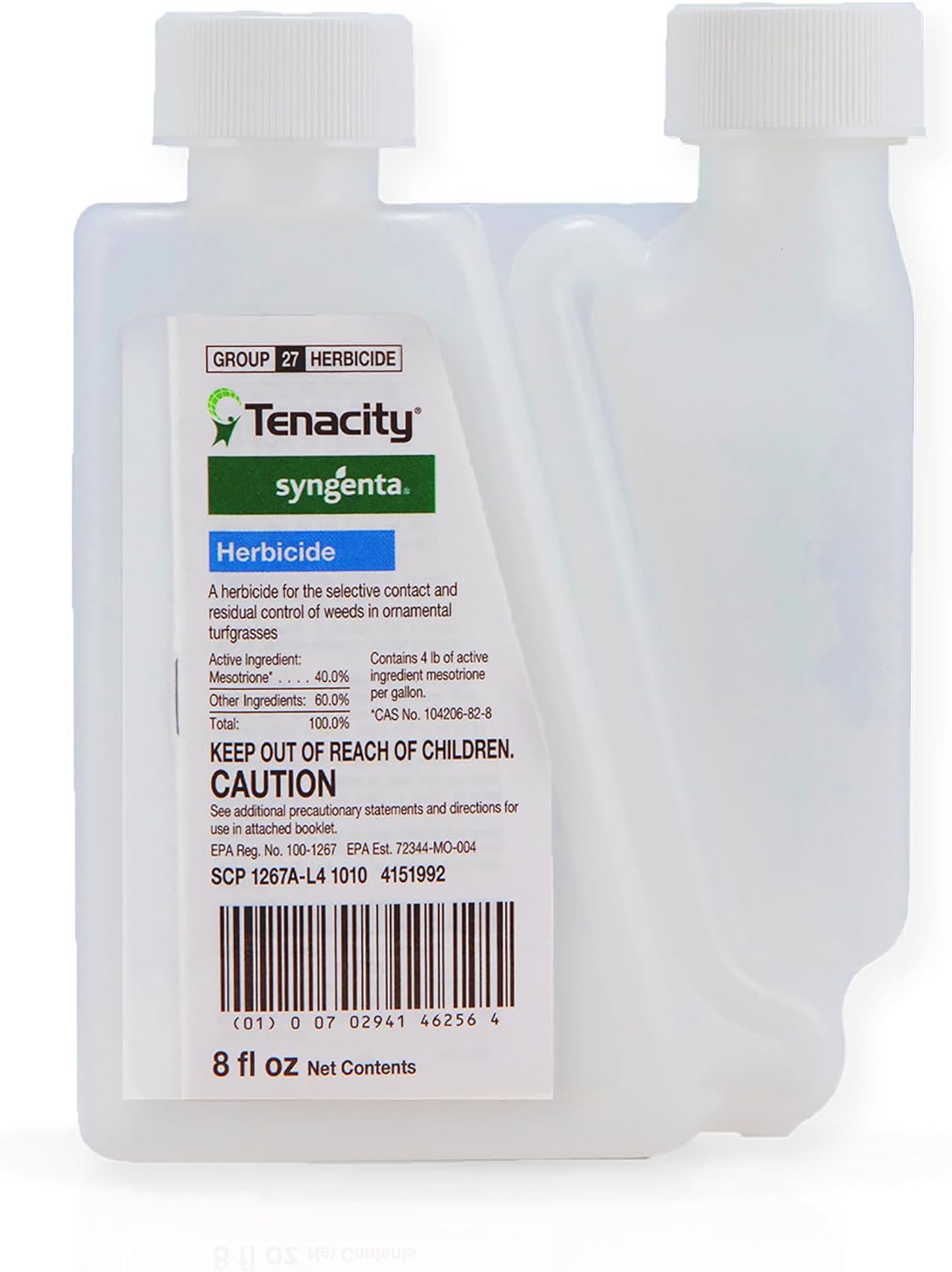
| Unit Count | 8 Fluid Ounces |
|---|---|
| Item Form | Liquid |
| Coverage | 2000 ft^2 per 1sp of product |
| Active Ingredients | Mesotrione |
Tenacity Turf Herbicide is a concentrated mesotrione-based liquid designed for both pre-emergent and post-emergent control of common lawn weeds including crabgrass, clover, chickweed and dandelions. You apply it diluted according to label rates with a handheld or hose-end sprayer to target problem areas or broadcast across the lawn; when used as a pre-emergent it is taken up as weeds emerge and when applied post-emergent it acts systemically for selective control. The product covers a large area per bottle and the active ingredient provides residual control so you can expect longer suppression than a contact-only herbicide. Important practical points are that it is turf-selective so follow the label for grass species and mixing instructions to avoid turf injury, and results can take several days to appear. Also this is a concentrated chemical intended for careful, measured application rather than spot-use by people who prefer non-chemical methods.
Best for: Gardeners focused on strong, reliable crabgrass and broadleaf weed control who are comfortable using concentrated herbicides and following label directions for turf safety.
Less Ideal for: People seeking organic, mechanical, or spot-only solutions or those unwilling to follow detailed mixing and application instructions should consider other options.
- Systemic mesotrione active ingredient controls both pre- and post-emergent weeds
- Selective to turf when used per label, allowing treatment without killing desirable grass species
- Concentrated 8 oz liquid provides wide coverage per bottle
- Provides residual suppression, reducing frequency of repeat applications
- Requires careful mixing and adherence to label for turf safety
- Not a non-chemical or organic option for weed control
Verdict: Choose Tenacity when you want a concentrated, turf-selective herbicide that delivers pre- and post-emergent control of crabgrass and other common lawn weeds.
Spectracide Weed Stop for Lawns Plus Crabgrass Killer, Ready-to-Use, 1 Gal

| Item Form | Spray |
|---|---|
| Coverage | Up to 5,000 sq ft |
| Liquid Volume | 1 gallons |
Spectracide Weed Stop for Lawns Plus Crabgrass Killer is a one-gallon, ready-to-use spray formulated to kill a wide range of lawn weeds by contact down to the root. You use it by spraying affected areas after mowing and when daytime temperatures are between 45 and 90 degrees F; the label warns about possible temporary discoloration on Bermudagrass at higher temperatures. Notable features include a no-mix formulation, advertised coverage up to 5,000 square feet, and a contact-action formula that produces visible wilting in about five hours. For clover in lawns this product is effective because it is designed to kill broadleaf weeds without harming turf when applied as directed. Important limitations are that it kills on contact, so complete coverage of foliage is necessary, and timing and temperature restrictions must be followed to avoid lawn stress on certain grass types. Also, as a spray it treats only visible weeds and does not provide residual preemergent control.
Best for: Buyers who want a simple, ready-to-use spray to remove visible clover and other broadleaf weeds quickly without mixing chemicals, and who prefer following label directions to protect their lawn.
Less Ideal for: People seeking long-term prevention of new weed growth or a solution for large commercial turf areas where broadcast application and residual control are needed should consider alternative products.
- Ready-to-use spray requires no mixing and is easy to apply to spot infestations
- Claims visible results in about five hours, so you can confirm effectiveness quickly
- Broad spectrum label lists 470+ weed types including clover and crabgrass
- Advertised coverage up to 5,000 sq ft from the one-gallon container
- Kills by contact so it requires thorough leaf coverage to be effective
- Temperature restrictions and potential temporary yellowing on Bermudagrass limit when it can be used safely
- No residual or preemergent activity so it will not prevent new weed germination
Verdict: A user-friendly, ready-to-use spray that quickly kills clover and other listed broadleaf weeds when applied carefully and at the right temperatures.
Spectracide Weed Stop for Lawns Plus Crabgrass Killer Concentrate, 32 oz
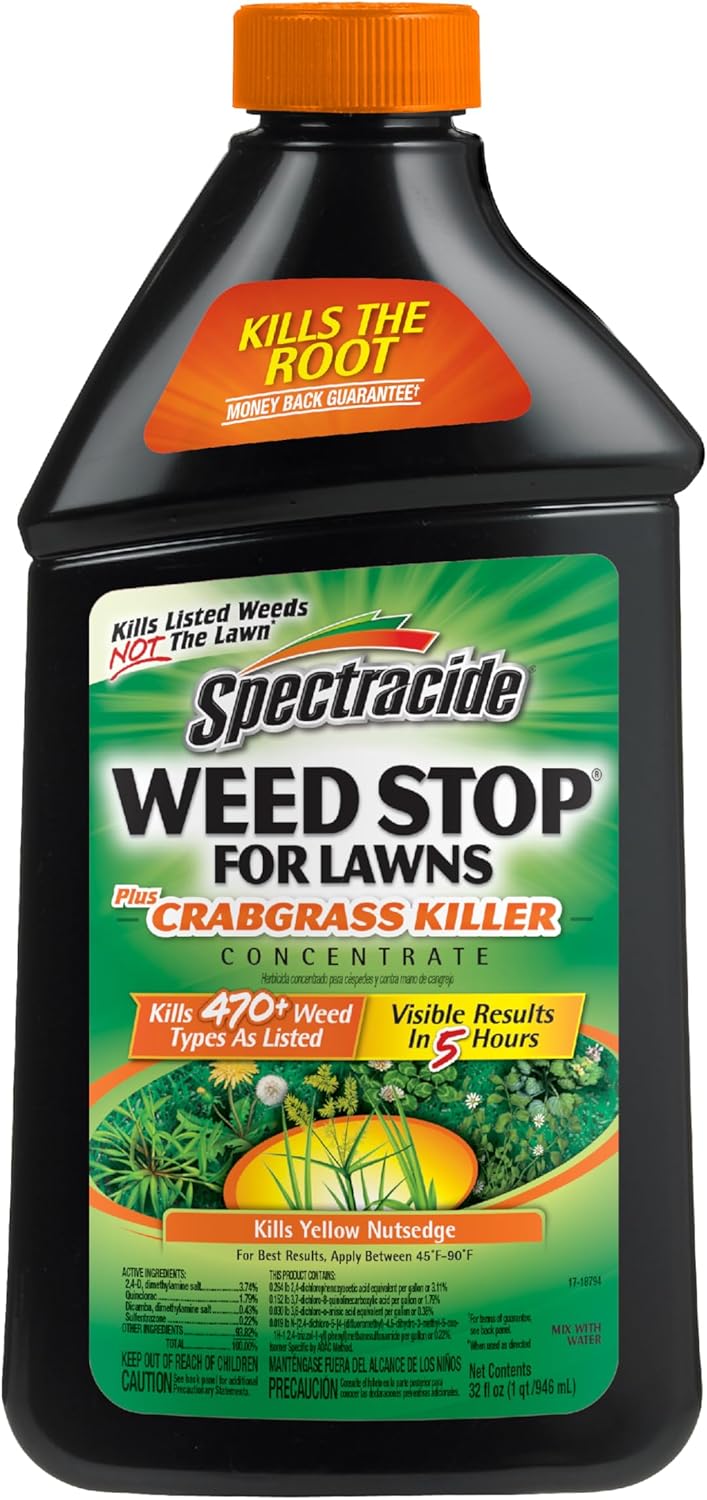
| Unit Count | 32 Ounce |
|---|---|
| Coverage | 5000 square_feet |
| Item Form | Liquid |
| Kills | 470+ listed weeds |
Spectracide Weed Stop Plus Crabgrass Killer is a ready-to-dilute concentrate designed to target grassy and broadleaf weeds across a typical yard. Mix and apply with a sprayer and the formula kills by contact down to the root with visible dieback in about 5 hours and becomes rainfast in roughly 3 hours. The 32 ounce bottle covers up to 5,000 square feet, making it a practical choice for treating whole lawns. Directions note best performance between 45 and 90 degrees daytime temperature and caution against treating Bermudagrass in very hot conditions to avoid temporary discoloration. Practical benefits include fast visible results, broad-spectrum control that includes dandelion and clover, and the convenience of a concentrated product that stretches across a larger area than ready-to-use sprays. Important limitations are the temperature restrictions for safe application, the need to let treated areas dry before people or pets return, and observing reseeding intervals after treatment. For routine crabgrass control on established lawns, this concentrate balances effectiveness and coverage for cost-conscious buyers.
Best for: Buyers who want an economical, concentrated treatment to control crabgrass and a wide range of weeds across a whole lawn and who are comfortable mixing and applying a spray product.
Less Ideal for: People with newly seeded lawns, very small patch treatments who prefer ready-to-use bottles, or those who cannot avoid applying during hotter daytime temperatures.
- Concentrated formula treats up to 5,000 sq ft from a 32 oz bottle
- Kills over 470 listed broadleaf and grassy weeds including crabgrass
- Visible results in about 5 hours and becomes rainfast in approximately 3 hours
- Designed to kill weeds down to the root when used as directed
- Must follow temperature limits to avoid lawn injury, particularly on Bermudagrass
- Requires mixing and a separate sprayer rather than being ready-to-use
Verdict: A budget-friendly concentrate that delivers fast, broad-spectrum crabgrass and weed control for established lawns while covering a large area per bottle.
Scotts Liquid Turf Builder Plus 2 Weed Control, Ready‑to‑Spray, 32 fl. oz.

| Liquid Volume | 32 fluid ounces |
|---|---|
| Coverage | 6000 square_feet (warm-season); 4000 square_feet (cool-season) |
| Item Form | Spray |
| Active Ingredients | Nitrogen |
This ready-to-spray bottle combines a quick nitrogen boost with broadleaf weed control for an easy lawn maintenance step. You attach the hose, spray evenly across the lawn when weeds are actively growing, then avoid watering for 48 hours so the product can work. The formula lists a 25-0-2 NPK balance and targets common weeds such as dandelions, clover, chickweed, and ground ivy, making it useful for both warm- and cool-season grasses. Coverage is generous for a single 32 fl. oz. bottle: up to 6,000 sq ft on warm-season lawns and 4,000 sq ft on cool-season lawns. Practical benefits include fast visible weed curl within days and no need for separate fertilizer and weed-killer steps, which simplifies care for homeowners who want predictable results. Limitations to note are the restricted list of safe grass types and the need to avoid application above 85°F or watering for two days, plus some stubborn weeds may require a repeat treatment in 3 to 4 weeks.
Best for: Homeowners who want a simple, low‑effort way to feed their lawn and control common broadleaf weeds without separate products and who prefer predictable, do‑it‑yourself lawn care steps.
Less Ideal for: Gardens with mixed planting beds or users who need a product safe around vegetables and ornamentals should choose a different targeted solution.
- Hose-end ready-to-spray design requires no measuring or mixing
- Combines fertilizer and weed control in one application
- Covers large areas per bottle for typical home lawns
- Works on a wide range of warm- and cool-season turf grasses
- Visible weed decline within a few days for many common broadleaf weeds
- Not safe for use on garden beds or non-listed plants
- May cause temporary injury on some bermudagrass varieties and is restricted to listed grasses
- Stubborn weeds may require a second application within a month
Verdict: A single ready-to-spray bottle that simplifies feeding and broadleaf weed control for risk-averse homeowners who want dependable, low-effort lawn results.
Southern Ag Amine 2,4-D Liquid Weed Killer, 32 oz

| Item Form | Liquid |
|---|---|
| Coverage | 5000 Square Feet |
| Liquid Volume | 32 quarts |
| Active Ingredients | Dimethylamine salt of 2,4-D-Dichlorophenoxyacetic acid |
Southern Ag Amine 2,4-D is a concentrated liquid herbicide formulated to control many broadleaf weeds and woody plants in lawns, pastures, rangeland, ditch banks, fences, and similar non-crop sites. It is mixed with water at modest rates (manufacturer guidance suggests roughly 2 to 3 tablespoons per 1,000 sq ft in typical small-spray mixes) and applied as a coarse, low-pressure spray to reduce drift. The active ingredient is the dimethylamine salt of 2,4-D, a well-established selective herbicide for broadleaf control. Practical benefits are its economical use rate, broad application range, and compatibility with common spray equipment. Limitations include the need to take drift precautions around desirable plants, the potential for injury to broadleaf ornamentals or sensitive crops, and the requirement to follow safety and local use restrictions for synthetic herbicides. This product is a straightforward choice when you need a proven, cost-effective tool to reduce broadleaf weed pressure over larger turf or non-crop areas, provided you apply it carefully and observe label safety directions.
Best for: Gardeners and land managers who prioritize effective, economical broadleaf weed control over larger turf or non-crop areas and who are comfortable following label mixing and application steps.
Less Ideal for: Homeowners with small, diverse ornamental beds or vegetable gardens near the treatment area should avoid this product and consider more targeted or non-chemical options.
- Proven active ingredient for broadleaf weed control
- Concentrated liquid with low recommended use rates for economical coverage
- Suitable for a wide range of non-crop and turf sites
- Designed for coarse, low-pressure spray to limit drift when applied correctly
- Can damage desirable broadleaf plants if spray drifts or is applied incorrectly
- Not suitable for use where 2,4-D-sensitive crops or ornamentals are nearby
- Requires careful handling and adherence to safety directions due to being a synthetic herbicide
Verdict: A concentrated, cost-effective 2,4-D amine concentrate for gardeners and land managers who need reliable broadleaf weed control across turf and non-crop areas.
Choosing the Right Post Emergent Weed Killer That Won T Kill Grass: Key Factors to Consider
Turf Selectivity and Grass Species Compatibility
Knowing which turfgrasses you have is essential because selectivity varies by species. Some active ingredients target broadleaf weeds while leaving common cool-season grasses such as fescue and bluegrass untouched, but warm-season grasses may respond differently. Check compatibility with your turf species before applying.
Selectivity affects how safe a product is for spot treatments near desirable plants and determines whether you can spray a whole lawn or should restrict to patches. Misjudging compatibility can cause bleaching, thinning, or dead spots that take weeks to recover.
Timing and Growth Stage of Weeds
Post-emergent products are most effective when weeds are actively growing. Apply during warm, moist periods when weeds are photosynthesizing vigorously; dormant or stressed weeds are harder to control. Early-season applications on young, actively growing weeds usually require lower dosages and deliver faster control.
Timing also ties into mowing and irrigation schedules. Apply to a recently mown lawn but wait the label-recommended period before mowing again so treated leaves remain to translocate herbicide into the root. Avoid applications when heavy rain is expected within 24 hours unless the product specifically tolerates early irrigation.
Application Method and Equipment Needs
Some post-emergent options come as ready-to-use sprayers for spot control while others are concentrated formulations meant for a pump sprayer or hose-end applicator. The choice affects coverage uniformity and the risk of over- or under-dosing.
Good application technique matters: use proper nozzle settings, maintain consistent walking speed for broadcast treatments, and mask off sensitive areas like flower beds. Small handheld sprayers are easier for spot work; larger lawns benefit from a calibrated tank sprayer to ensure even distribution.
Safety, Reentry, and Environmental Considerations
Look for products with clear instructions about how long to wait before mowing, allowing pets and children back on treated turf, and watering after application. Some formulations require longer reentry or irrigation delays to avoid off-target movement.
Environmental factors matter too. Avoid drift onto ornamentals or water sources, and do not apply near storm drains. Choose formulations and application timings that reduce volatilization and runoff risk, especially on slopes or compacted soils that shed water.
Compatibility With Turf Care Practices
Consider how herbicide timing fits with overseeding, fertilization, and irrigation. Some selective post-emergents advise waiting several weeks before seeding to avoid damage to new grass seedlings. Applying fertilizer immediately before or after treatment can stress turf and reduce selectivity.
Plan integrated lawn care: schedule weed control when it will not interfere with overseeding windows or heavy cultural practices. When in doubt, follow label guidance for intervals between herbicide use and other lawn care operations.
Coverage Area and Cost Efficiency for Your Yard Size
Match the product form to the size of the job. Ready-to-use sprays work well for small patches but become inefficient on large lawns. Concentrates reduce packaging waste and tend to be more economical on larger coverage areas when measured and applied accurately.
Also account for how often retreatment is needed. Some post-emergents suppress weeds long enough that a single season application suffices, while others require follow-up sprays for persistent species. Factor in mixing, cleanup, and storage costs when calculating real-world efficiency.
When to Use Spot Treatment Versus Whole-Lawn Applications
Spot treatment is the safest option when weeds are isolated or when you are uncertain about turf compatibility. Treating only the visible patches minimizes chemical use, lowers the risk of turf injury, and reduces the chance of drift to nearby plantings. Handheld ready-to-use sprays or small pump sprayers are ideal for this method.
- Spot treat isolated broadleaf weeds and clumps of dandelions or plantain.
- Reserve broadcast treatments for widespread infestations or when the lawn has a uniform grass species compatible with the product.
Mowing, Watering, and Other Timing Details
For best results, mow the lawn a day or two before application so leaves are short but still healthy. This improves contact with weed foliage without removing too much leaf tissue that translocates the herbicide. After treatment follow label guidance for how long to delay mowing; many products require waiting 24 to 72 hours or longer.
Avoid watering the lawn for the period specified on the product label. Some sprays need dry conditions for several hours to allow uptake, while others are rain-fast within a short window. Planning around weather and irrigation helps ensure uptake and reduces the need for retreatment.
- Mow 24 to 48 hours before application when possible.
- Check forecast and avoid applications just before heavy rain.
Safe Handling and Storage Tips for Gardeners
Mix only the amount you need and use appropriate personal protective equipment such as gloves and eye protection when handling concentrates. Keep applicators clean and flush sprayers after use according to label instructions to prevent cross-contamination with other garden chemicals.
Store products in original containers in a locked, dry area away from children and pets. Dispose of rinsate and empty containers following local guidance and label instructions to reduce environmental impact.
- Wear gloves and protective eyewear when mixing concentrates.
- Rinse and store sprayers away from food or animal feed.
Common Tough Weeds and Practical Expectations
Some perennial weeds and hardy broadleaf species take longer to show control and may need repeat applications. Expect visible browning and dieback on susceptible species within days, but complete control can take several weeks as roots and crowns die off.
Plan for follow-up cultural practices such as hand removal of large taproots after initial decline, and overseed bare patches once the herbicide waiting period for seeding has passed to restore turf density.
- Persistent perennials may require 2 to 3 treatments spread over weeks.
- Combine chemical control with manual removal for large, established weeds.
How We Chose the Best Post Emergent Weed Killer That Won T Kill Grass
We limited our shortlist to products formulated for post-emergent use on established turf where the goal is to remove weeds but not harm common lawn grasses. Selection started with product labels and technical bulletins to confirm active ingredients known for selective activity, then moved to real-world performance notes and manufacturer application guidelines. Key evaluation criteria included selectivity to turf species, speed of visible control, application safety for home gardeners, recommended mowing and reentry intervals, and the flexibility of coverage (spot treatment vs broadcast application). We also considered compatibility with common turf care practices such as overseeding, fertilizer timing, and irrigation. We excluded non-selective herbicides, pre-emergent-only products, and formulations intended for ornamentals or agricultural row crops. Products that required specialized commercial licensing or unusual equipment were removed. The remaining picks balance predictable turf selectivity, practical application instructions, and dependable timing for results in typical home lawns.
FAQ
Will a post-emergent product labeled as turf-safe harm newly seeded grass?
Often it depends on the product and the seedling stage. Many selective post-emergents advise waiting several weeks after seeding before applying. Seedlings are more vulnerable, so follow label intervals for seeding to avoid stunted establishment.
Can I apply a turf-safe post-emergent in hot weather?
Applying during periods of heat stress increases the risk of turf injury. It usually works best when weeds and turf are actively growing but not under drought or extreme heat. If in doubt, choose cooler parts of the day or wait for milder conditions.
How soon will I see results after treating weeds?
Visible effects often appear within a few days for susceptible broadleaf weeds, with full dieback taking up to several weeks for tougher species. Speed depends on weed type, growth stage, and environmental conditions at the time of application.
Can I water my lawn after spraying a post-emergent weed killer?
That depends on the product. Some formulations require a dry period after application for proper uptake, while others become rain-fast sooner. Always follow the product-specific watering guidance printed on the label.
Is it safe for pets to walk on treated turf?
Safety varies by product and recommended reentry interval. Many labels give a timeframe for when pets can return. Keep pets off treated areas until the specified reentry time has passed and sprays are dry.
What should I do for broadleaf weeds that return after treatment?
Repeat applications may be necessary for persistent species, applied according to label intervals. Combine retreatment with improved cultural practices such as correcting mowing height, improving soil fertility, and overseeding thin spots to reduce future weed pressure.
Final Verdict
Prioritize turf selectivity and timing when choosing a post-emergent that will not kill grass. Verify compatibility with your grass species, plan applications when weeds are actively growing, and match the product form to the size of the job. Balance speed of control against safety and recovery needs: faster visible results are useful, but long-term turf health depends on correct timing and careful application. Use spot treatments for isolated problems and broadcast options only when the label confirms safety across your lawn species. Follow label reentry, mowing, and seeding intervals to protect turf recovery and reduce repeat treatments. With those tradeoffs in mind, you can confidently select a turf-safe post-emergent and keep your lawn healthy while reducing weed pressure.
