

Note: This article contains affiliate links. If you click on these links and make a purchase, I may earn a small commission at no extra cost to you. This helps support my research and content. Read my full affiliate disclosure here.
If lifting and pushing a loaded wheelbarrow aggravates your back, choosing a design made for lower strain can make everyday yard work manageable again. This guide focuses on wheelbarrows for bad back that reduce bending, improve leverage, and cut vibration so you can move soil, mulch, and planters with less discomfort. We shortlisted six top options that fit common garden tasks and body mechanics, then evaluated them on ergonomics, stability, and ease of use. Read on to see which features most affect back comfort and how the shortlisted picks compare on those practical criteria.
Top Picks at a Glance
| Best Overall The best all-around choice for most situations | Chore Warrior Electric Wheelbarrow with 6 cu ft Poly Tray |  |
| Best Value The sweet spot between price and what you get | Gorilla Carts 600 lb Poly Garden Dump Cart (4 cu ft) |  |
| Best Budget The cheapest option that still gets the job done reliably | PWOOME 2-Wheel Garden Cart with 5 cu ft Poly Tray |  |
| Highest Rated A top-rated pick with lots of positive feedback | TerraTrek 2‑in‑1 7 cu. ft. Garden Cart / Wheelbarrow, 600 lb Capacity |  |
| Most Popular A crowd favorite that many people choose with confidence | BILT HARD 900 lb Capacity Poly Garden Dump Cart with Quick‑Release Dumping |  |
| Best Seller A high-volume bestseller chosen again and again | InBrave 34" Extra Long Foldable Wagon Cart — Heavy‑Duty Collapsible Utility Wagon |  |
Chore Warrior Electric Wheelbarrow with 6 cu ft Poly Tray

| Weight Capacity Maximum | 350 pounds |
|---|---|
| Number of Wheels | 2 |
| Tire Type | Pneumatic |
| Additional Features | Self Propelled, Maneuverable, Heavy Duty |
This Chore Warrior electric wheelbarrow replaces manual hauling with a 24V battery-driven two-wheel drive that handles loads up to 350 pounds and comes with a 6 cubic foot poly tray. It is typically used for moving soil, mulch, tools, or heavy supplies around medium to large yards and job sites; the sealed 9Ah AGM batteries and an illuminated charge indicator let you monitor runtime and recharge from a standard 120V outlet. The 500W brushless motor, metal straight-cut gears, and sealed bearings give a durable drivetrain, while 15-inch pneumatic tires and a differential two-wheel drive make steering and turning on uneven ground easier than a single-wheel barrow. The powder-coated steel frame and coated steel rims improve longevity outdoors. Limitations to expect are the 350 lb rated capacity, which constrains very heavy loads, and an assembled weight that requires effort to lift into trucks or storage; battery runtime depends on load and terrain so very long continuous use may need additional charges or spare batteries.
Best for: Buyers who want a practical, labor-saving upgrade to a manual wheelbarrow for regular yard work or light commercial landscaping and value durability and easier maneuvering.
Less Ideal for: Not the best choice for contractors needing to move consistently oversized or extremely heavy loads or for users who need continuous multi-day operation without access to recharging.
- Motorized two-wheel drive and 500W brushless motor reduce physical effort for hauling heavy loads
- 6 cu ft poly tray handles typical landscaping volumes without rust issues
- Pneumatic 15-inch tires and differential drive improve traction and turning on uneven terrain
- Powder-coated steel frame and sealed bearings increase durability for outdoor use
- 350 pound capacity limits very large or commercial loads
- Battery runtime varies with load and terrain and may require recharging for extended jobs
Verdict: If you want to cut the physical strain of hauling typical landscaping loads, this electric wheelbarrow delivers dependable motorized power and durable construction.
Gorilla Carts 600 lb Poly Garden Dump Cart (4 cu ft)
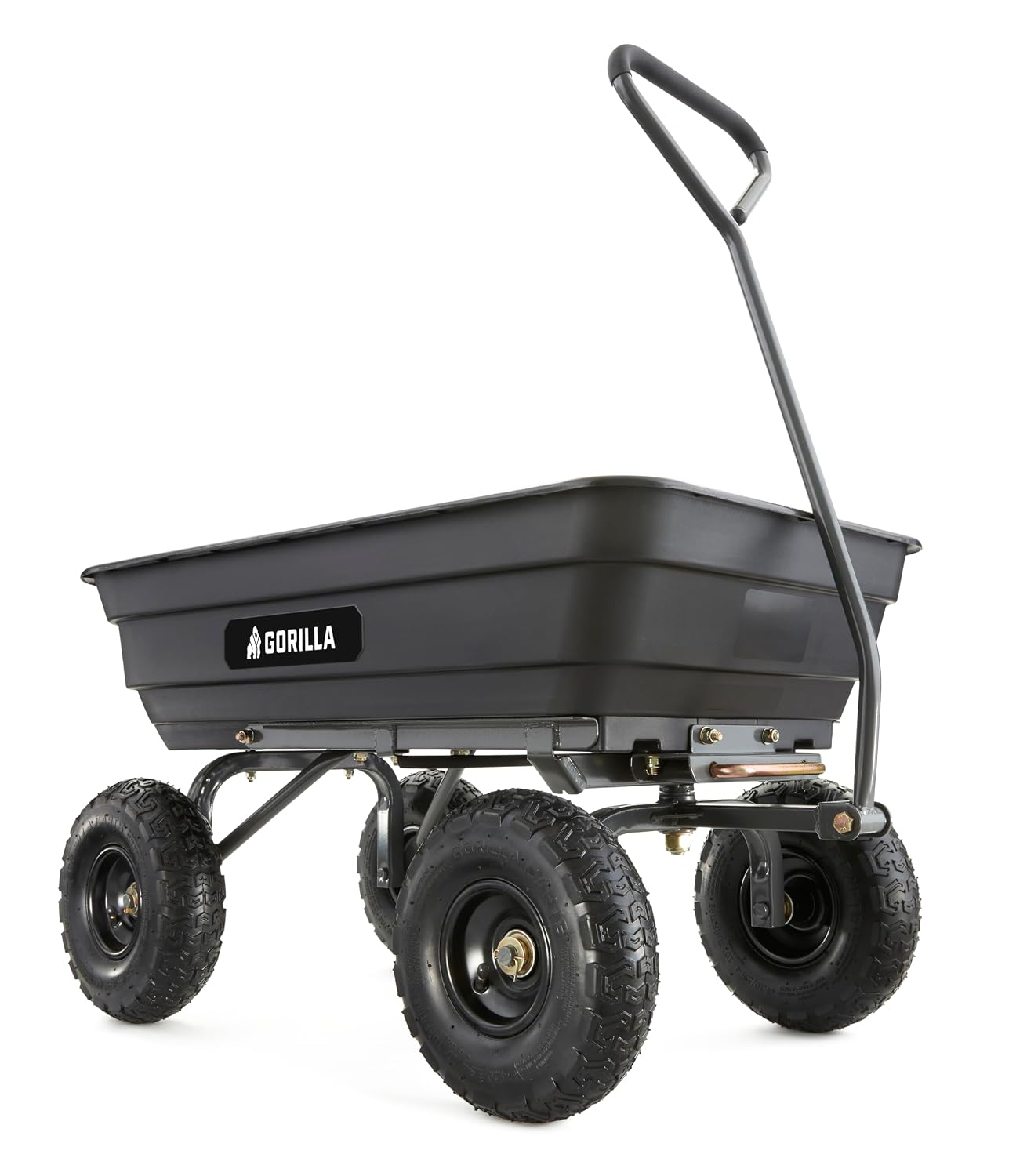
| Weight Capacity Maximum | 600 pounds |
|---|---|
| Tire Type | Pneumatic |
| Number of Wheels | 4 |
| Material Type | Maintenance-Free Poly, Powder-Coated Steel |
The Gorilla Carts poly dump cart is a workhorse for gardeners and landscapers who need a durable, easy-to-use hauling solution. Its 4 cu ft rust-resistant poly bed and powder-coated steel frame handle everyday yard tasks like moving soil, mulch, compost, plants, and firewood. The patented quick-release dump system makes unloading heavy material straightforward and reduces the physical strain of tipping. Four-wheel stability and 10-inch pneumatic tires give controlled handling on grass, dirt, and gravel, while the straight pull handle and tight-turn steering keep maneuvering simple in tight beds and around garden beds. Assembly is straightforward and the materials are low maintenance so it stands up to wet conditions without rusting. Limitations to note are that it is a hand-pulled, non-towable cart intended for paths and yards rather than vehicle towing or very rough off-road use, and the 600 lb capacity, while substantial, still requires mindful loading for balance and steering.
Best for: Gardeners and small-scale landscapers who want a proven, sturdy cart to move heavy materials around lawns and beds with minimal fuss and reliable real-world performance.
Less Ideal for: People who need a towable or off-road utility trailer for large properties or commercial hauling should look for a tow-capable or larger-capacity option.
- High 600 lb weight capacity suitable for heavy garden loads
- Patented quick-release dump system speeds and simplifies unloading
- Pneumatic 10-inch tires and 4-wheel stability handle grass, dirt, and gravel well
- Rust-resistant poly bed and powder-coated frame reduce maintenance and corrosion
- Not designed for towing behind a vehicle so use is limited to hand-pulling
- Relatively compact 4 cu ft bed may require multiple trips for very large projects
Verdict: A durable, low-maintenance garden dump cart with a proven quick-release dump and pneumatic tires that makes hauling heavy yard materials easy and reliable.
PWOOME 2-Wheel Garden Cart with 5 cu ft Poly Tray

| Weight Capacity Maximum | 300 pounds |
|---|---|
| Number of Wheels | 2 |
| Caster Type | Pneumatic |
| Material Type | Acrylonitrile Butadiene Styrene (ABS), Steel |
This PWOOME two-wheel garden cart is built to make routine yard work easier for homeowners who need stable, low-effort hauling. The 5 cu ft polyethylene tray carries soil, mulch, plants and debris while the dual 15-inch pneumatic wheels spread the load for easier balance and less tipping compared with a single-wheel barrow. The continuous loop handle gives multiple grip positions so you can push, pull or tip the tray from whichever posture is most comfortable for your back. At about 22 pounds it is notably lighter than metal-only carts, which reduces the effort to position or lift the cart when empty. Assembly is straightforward and the ABS tray resists abrasion and weathering. Limitations include a 300 lb capacity that may be low for very heavy loads and a plastic tray that is less impact-resistant than heavy-gauge steel, so avoid overloading or dropping sharp-edged materials. For short-distance hauling, planting and cleanup around the yard this cart reduces strain during repeated trips, but it is not designed for heavy commercial use.
Best for: Gardeners with back sensitivity who prioritize easier balance and lower lifting effort for routine residential hauling and cleanup. Ideal for homeowners wanting a lighter, easier-to-push alternative to single-wheel steel wheelbarrows.
Less Ideal for: Contractors or users who regularly move very heavy, sharp, or abrasive loads and need industrial-strength steel construction or higher weight capacity.
- Dual 15-inch pneumatic wheels provide stable, easier-to-maneuver support than a single wheel
- Lightweight construction (about 22 lb) makes the empty cart easy to lift and reposition
- 5 cu ft polyethylene tray resists rust and is roomy for common garden materials
- Continuous loop handle offers multiple grip positions to reduce bending and twisting during use
- Polyethylene tray is less durable against sharp, heavy impacts than steel
- 300 lb maximum limits very heavy or bulked loads
Verdict: Choose this lightweight dual-wheel garden cart if you want a stable, low-effort wheelbarrow that reduces bending and balancing for everyday residential yard work.
TerraTrek 2‑in‑1 7 cu. ft. Garden Cart / Wheelbarrow, 600 lb Capacity

| Weight Capacity Maximum | 600 pounds |
|---|---|
| Material Type | Polypropylene (PP) |
| Frame Material | Powder Coated Steel |
| Tire Type | No-Flat |
| Number of Wheels | 2 |
The TerraTrek 2‑in‑1 garden cart is a utility wagon designed for demanding hauling tasks where reliability matters. It functions as a traditional wheelbarrow with ergonomic handles or converts to a tow cart with a detachable hitch that locks into place for towing behind a mower, ATV, or UTV. Notable features include a reinforced powder‑coated steel frame, a rustproof polypropylene tub, built‑in tool holders, and 13" no‑flat all‑terrain wheels with steel rims for maintenance‑free rolling. In practice the cart is easy to assemble, handles heavy loads without flexing, and the rear dump mechanism makes controlled unloading straightforward on landscaping and construction jobs. The no‑flat tires and reinforced frame reduce downtime from punctures or bent components, which is valuable for commercial use. Limitations are that the cart is relatively large to store and the rigid caster and two‑wheel configuration can be less nimble than a single‑wheel wheelbarrow in very tight spaces. For buyers prioritizing dependability and heavy hauling, this cart delivers a rugged, low‑maintenance solution.
Best for: Buyers who need a dependable, low‑maintenance utility cart for frequent heavy hauling on landscaping, farm, or light construction jobs and value equipment that stays in service with minimal fuss.
Less Ideal for: Gardeners with very limited storage space or users who need a compact, highly nimble single‑wheel wheelbarrow for narrow beds and tight turns.
- 600 lb load capacity with reinforced steel frame and rustproof polypropylene tub for heavy‑duty use
- 2‑in‑1 design lets you push manually or lock a hitch for towing behind mowers and ATVs
- 13" no‑flat all‑terrain wheels with steel rims provide maintenance‑free rolling and good traction
- Rear dump mechanism enables controlled unloading of mulch, gravel, and debris
- Large footprint makes storage more difficult in small sheds or tight spaces
- Two‑wheel, rigid caster setup is less maneuverable than a single‑wheel wheelbarrow in very tight areas
Verdict: A rugged, low‑maintenance 2‑in‑1 cart built to reliably haul heavy loads across any terrain for commercial or demanding residential use.
BILT HARD 900 lb Capacity Poly Garden Dump Cart with Quick‑Release Dumping

| Weight Capacity Maximum | 900 pounds |
|---|---|
| Number of Wheels | 4 |
| Caster Type | Pneumatic |
| Frame Material | Alloy Steel |
| Additional Features | Quick-Release Dumping System, Flexible Capacity Expansion |
The BILT HARD dump cart is a heavy-duty, four-wheeled garden cart designed to replace a traditional wheelbarrow for medium to large yard jobs. It uses a durable polypropylene bed on a reinforced alloy steel frame and rides on 10" pneumatic tires for traction over grass, dirt, and gravel. The quick-release dumping mechanism and 180° adjustable handle let you tip and empty loads fast, while side expansion slots allow adding panels to increase volume when you need it. Practical benefits include improved balance compared with single-wheel wheelbarrows, easier towing of heavy or awkward loads, and a 900 lb rated capacity for hauling soil, mulch, rocks, or tools. Expect easier maneuvering on uneven ground but more bulk to store than a single-wheel barrow, and the cart will require some assembly. The pneumatic tires give a smoother ride but need occasional inflation and are more vulnerable to flats than solid tires. For routine garden hauling this cart speeds work and reduces strain, especially when moving larger or heavier loads.
Best for: Buyers who want a sturdy, low-effort solution for moving large or heavy garden loads and who prioritize efficient, repeatable yard work over minimal storage footprint.
Less Ideal for: Small-space gardeners or people who need a very lightweight, highly compact wheelbarrow for tight storage should consider simpler single-wheel or folding alternatives.
- High 900 lb maximum load rating for heavy garden tasks
- Quick-release dumping system speeds unloading and reduces bending
- 10" pneumatic all-terrain tires improve traction and ride over uneven surfaces
- Steel frame with poly bed offers rust-resistant durability and easy cleaning
- Pneumatic tires require inflation and can puncture unlike flat-free designs
- Larger footprint and weight make it bulkier to store and assemble than a single-wheel wheelbarrow
Verdict: If you need a stable, high-capacity garden cart that reduces lifting and speeds unloading, this BILT HARD dump cart is a practical workhorse.
InBrave 34" Extra Long Foldable Wagon Cart — Heavy‑Duty Collapsible Utility Wagon

| Frame Material | Alloy Steel |
|---|---|
| Item Highlight | Foldable Utility Cart with Wheels, Heavy‑Duty, 130L Storage, 600D Oxford |
| Weight Capacity Maximum | 480 pounds |
| Additional Features | Foldable, All‑Terrain Wheels, Adjustable Handle |
| Number of Wheels | 4 |
This InBrave 34" foldable wagon is a multipurpose utility cart built to move heavy loads with less strain than carrying by hand. It uses an alloy steel frame and 600D oxford fabric to support up to 480 pounds, and the wide all‑terrain wheels plus 360° rotating front casters help it roll over sand, gravel, grass, and packed dirt. The wagon collapses quickly for storage and the adjustable handle with auto‑return reduces awkward bending when pulling. Practical touches include a removable waterproof cover for easy cleaning and two mesh drink holders for short trips. Because it is longer than standard wagons, it holds more gear so you make fewer trips when moving tools, soil bags, or garden supplies. Important limitations are that the metal frame and larger size make it bulkier when folded than smaller hand trucks, and maneuvering very heavy single items on uneven slopes still requires care to avoid tipping. Assembly and folding are straightforward but expect some weight when lifting the folded unit into a car.
Best for: Buyers who prioritize reducing physical strain when moving garden supplies and want a stable, easy‑rolling cart for routine yard work and errands.
Less Ideal for: People who need an ultra‑compact, lightweight cart for very tight storage spaces or who primarily move single extremely heavy items on steep slopes.
- High 480 lb weight capacity for hauling heavier loads
- Alloy steel frame and 600D oxford fabric for durable, washable use
- All‑terrain wheels with swivel front casters for easier rolling over uneven surfaces
- Quick fold design for compact storage and transport
- Bulkier folded footprint compared with narrow hand trucks or compact dollies
- Still requires care on steep or very uneven terrain to avoid tipping
Verdict: If you want a durable, high‑capacity collapsible wagon that eases lifting and reduces trips for heavier garden loads, this InBrave wagon is a practical choice.
Choosing the Right Wheelbarrow for Bad Back: Key Factors to Consider
Handle Height and Grip Design
Handle height determines how much you need to bend to lift and push. Taller handles and adjustable grips allow you to maintain a more upright posture, cutting lumbar flexion when loading and starting a push. Grip diameter and geometry affect wrist and forearm positioning; softer, contoured grips reduce the need to squeeze and help distribute effort across the hand.
Look for handles that align with your torso height and allow a slight forward lean rather than deep bending. Angled handles or multiple grip positions can also let you change hand placement for different tasks, such as low scoops versus steady transport, which reduces repetitive strain on the same muscle groups.
Load Balance and Center of Gravity
A well-balanced wheelbarrow keeps the heaviest portion of the load close to the wheel, so lifting the handles requires less force. Designs that place the wheel under the load or use dual-wheel configurations often shift the center of gravity forward, reducing the moment arm at the handles and lowering the torque on your back.
Evaluate how the bucket sits relative to the wheel and how easy it is to position heavy items near the wheel axle. Poor balance forces you to lift more with your lower back and can quickly cause fatigue during repeated trips.
Wheel Configuration and Stability
Wheel setup affects both steadiness and the amount of corrective muscle work you must do while pushing. Single-wheel models are often more maneuverable on narrow paths but require constant balance corrections, which can strain the lower back and obliques. Dual-wheel or wider-track designs improve lateral stability and reduce the need for stabilizing effort.
Consider the terrain you use most. Soft soil and uneven ground can make single wheels sink or veer, increasing compensatory lifting and twisting. For heavier loads on variable surfaces, a stable wheel arrangement reduces the chance of unexpected shifts that jar the spine.
Tire Type and Vibration Dampening
Tires transmit road shock into your arms and upper body. Pneumatic tires offer cushioning that absorbs bumps and reduces transmitted vibration, whereas hard rubber or plastic wheels are low-maintenance but send more shock back to you. Wider tires also lower ground pressure and roll easier over loose material.
Some designs add suspension elements or thicker sidewalls to smooth the ride. If you frequently move loads over gravel, roots, or compacted ground, prioritize tire constructions that reduce vibration and the repetitive micro-impacts that can aggravate back discomfort over time.
Construction Weight and Material
The weight of an empty wheelbarrow matters when you lift it onto raised surfaces, load it empty, or store it. Lighter frames reduce the starting lift but must still be stiff enough to carry the payload safely. Materials like lightweight steel, aluminum, or reinforced plastic each offer tradeoffs in rigidity, longevity, and how much they contribute to the overall lift weight.
Assess whether a slightly heavier, more rigid frame that improves balance is better for your routine than a very light unit that flexes under load. Also consider rust resistance and how long the structural parts will hold geometry that preserves ergonomic benefits.
Bucket Shape and Capacity
Bucket geometry affects how materials sit relative to the wheel. Narrow, deep buckets are good for concentrated loads like pavers but can place weight further from the wheel axle. Shallow, wide trays let you keep material close to the wheel for easier lifting. Capacity should match the amount you realistically move per trip; overfilling increases torque and forces you to handle heavier lifts.
Choose a capacity that balances fewer trips with manageable lift weight. Consider whether the bucket shape allows you to pack material near the axle and whether the sides make unloading by tipping safe and controlled without requiring excessive force.
Ergonomic Adjustments You Can Make
Small modifications can significantly reduce strain. Adding padded grips or replacing straight handles with angled aftermarket grips improves wrist alignment and can make a standard frame feel less taxing. Slightly raising the handle height with secure extenders can help you keep a more upright posture when lifting loaded trays.
Adjust how you load to keep heavy material near the wheel. Use smaller, more frequent loads rather than one large mound. When possible, slide heavy items into the bucket rather than lifting them high over the rim.
- Pad handles with foam to reduce vibration and pressure points
- Use a loading ramp or step to avoid high lifts when loading into raised beds
- Practice a hip-hinge lifting pattern instead of bending at the waist
Terrain Considerations and Tire Choices
Match tire selection to common surfaces. Pneumatic tires are best for bumpy, uneven ground because they absorb shock and reduce jarring. Solid or foam-filled tires are low-maintenance and resist punctures but transfer more impact to your body.
Wider tires distribute weight and improve traction on soft soil. If your garden has a mix of lawn, gravel, and compacted paths, choose a tire profile that balances rolling ease with stability to cut the effort needed for each trip.
- Pneumatic tires: comfort and cushioning
- Foam-filled tires: puncture-proof with moderate cushioning
- Solid rubber: low maintenance, higher vibration
Techniques to Reduce Repetitive Strain
Alter task sequencing to avoid repetitive heavy lifts. Fill multiple smaller containers closer to the wheel or use a dolly for very heavy items to minimize time spent in loaded pushing. Rest briefly between trips and switch hands or stance to vary the load on muscles.
Use proper body mechanics when tipping and unloading. Face the load, keep feet shoulder-width apart, and pivot with your hips. Avoid twisting motions while holding a load; reposition the wheelbarrow instead.
- Break heavy jobs into shorter sessions
- Switch between pushing and lighter tasks to rest core muscles
- Use lifting aids like transfer boards or short ramps when possible
Storage, Maintenance, and Long-Term Safety
Keep tires inflated to the recommended pressure to preserve rolling efficiency and minimize required effort. Tighten and lubricate wheel axles to prevent binding which increases push force. Check handle mounts and bucket fasteners regularly to maintain the original geometry that supports low-strain lifting.
Store the wheelbarrow so it is easy to access without awkward lifting. Hanging the wheelbarrow off the ground can make cleaning and maintenance simpler and prevents corrosion that would weaken structural points important for balance and safety.
- Check tire pressure monthly during active season
- Inspect handle joints for play or looseness
- Clean abrasive soil or grit away from moving parts to reduce wear
Alternatives and Complementary Tools
In some tasks, a wheelbarrow is still the best choice for maneuverability, but other tools can reduce back workload. Garden carts with four wheels and a lower load bed reduce tipping and eliminate constant balance corrections. A compact utility dolly or hand truck can move dense loads like bags of potting mix or stone with less lifting.
Consider ergonomic aids such as transfer boards, small ramps, or a partner for particularly heavy or awkward items. These solutions reduce the frequency and intensity of lifts without replacing the need for a back-friendly wheelbarrow in everyday chores.
- Garden cart: stable, less lifting
- Dolly: good for dense, wheeled transport
- Transfer board or ramp: reduces high lifts
How We Chose the Best Wheelbarrow for Bad Back
We prioritized features that directly affect spine stress, repetitive bending, and pushing effort. Key evaluation criteria included handle ergonomics and height for reduced bending, wheel configuration and tracking for stability, load balance and center of gravity for lighter lifting forces, and construction weight versus payload so the tool itself does not add unnecessary strain. We also judged tire type and suspension or shock-damping where relevant because vibration transmits to the body during use. Durability and maintenance needs were considered to ensure long-term consistent performance in real garden conditions. Products were excluded if they prioritized cargo volume alone over ergonomic design or required extensive assembly that alters handle geometry. We also filtered out options that rely exclusively on complex power assists without clear user-adjustable settings. The final list contains models that demonstrated clear design choices to reduce back stress while remaining practical for routine gardening tasks.
FAQ
Are dual-wheel wheelbarrows always better for back problems?
Dual-wheel designs improve lateral stability and reduce the need for constant balance corrections, which can lower strain for many users. However, they are sometimes wider and less maneuverable in tight spaces, so the best choice depends on your terrain and garden layout.
Do pneumatic tires make a noticeable difference for back comfort?
Yes, pneumatic tires absorb bumps and reduce vibration transmitted to your arms and spine. That cushioning lowers the cumulative jarring from repeated trips, which can help people with back sensitivity, especially on uneven ground.
Is a lighter wheelbarrow always easier on the back?
Not always. A lighter frame reduces the empty lift but may flex under load, shifting the balance and making handling harder. Sometimes a slightly heavier, stiffer construction that keeps the load closer to the wheel axle is easier on the back during transport.
How should I load heavy materials to minimize back strain?
Place the heaviest material as close to the wheel axle as possible and avoid piling weight at the far end of the bucket. Use smaller, frequent loads and slide items into position rather than lifting them high over the rim when feasible.
Can handle extensions help reduce bending?
Properly designed handle extensions that preserve safe leverage can let you keep a more upright posture when lifting. Make sure any modification is secure and does not introduce play or change the center of gravity in a way that increases instability.
Final Verdict
Prioritize handle ergonomics, load position relative to the wheel, and wheel/tire choices when selecting a wheelbarrow for bad back. Those elements most directly reduce bending, torque on the spine, and vibration transferred during use. Balance tradeoffs between maneuverability and stability based on your terrain and common loads. Choosing a model that keeps heavy material close to the axle, uses cushioned tires, and fits your height will deliver the biggest reduction in strain. Combine a back-friendly wheelbarrow with simple loading techniques and maintenance to make garden work safer and more comfortable over time.
