

Note: This article contains affiliate links. If you click on these links and make a purchase, I may earn a small commission at no extra cost to you. This helps support my research and content. Read my full affiliate disclosure here.
If you share your home with dogs, selecting an ant control method that reduces hazard to pets is essential. The wrong product or application can expose curious animals to baits, sprays, or residues that irritate skin or cause ingestion risks. This guide focuses on dog friendly ant killers shortlisted for safer ingredients, secure application formats, and proven ant control behavior. We evaluated products across safety-to-pet profiles, effectiveness against common house ants, and ease of use in homes with active dogs. Below you will find brief editorial notes on each shortlisted option plus the decision criteria we used to choose them.
Top Picks at a Glance
| Best Overall The best all-around choice for most situations | Wondercide Outdoor Pest Control Spray — 32 oz Ready-to-Use |  |
| Best Quality Built to a higher standard if you want something more solid | EcoVenger Ant Killer & Nest Treatment, 32 oz |  |
| Best Value The sweet spot between price and what you get | Syngreen Diatomaceous Earth Food Grade Powder with Peppermint, 1 lb |  |
| Best Budget The cheapest option that still gets the job done reliably | STEM Plant-Based Bug Spray for Ants, Roaches and Flies, 12 fl oz |  |
| Highest Rated A top-rated pick with lots of positive feedback | CVKDGJD Indoor Ant Repellent Pack (6 per bag) |  |
| Most Popular A crowd favorite that many people choose with confidence | Mighty Mint Peppermint Oil Insect Repellent Spray, 16 oz |  |
| Best Seller A high-volume bestseller chosen again and again | EcoVenger Roach & Ant Killer Spray, 64 oz |  |
Wondercide Outdoor Pest Control Spray — 32 oz Ready-to-Use

| Format | Pre-mixed, hose-end spray |
|---|---|
| Active ingredients | Cedarwood Oil 12.63%, Sesame Oil 2.73% |
| Coverage | Up to 5,000 sq ft (general); 2,500 sq ft (ticks/mosquito repel) |
Wondercide Ready-to-Use Outdoor Pest Control is a hose‑end spray designed for treating yards up to 5,000 sq ft for general pests and 2,500 sq ft for ticks and mosquito repellency. You attach the bottle to a garden hose, sweep the nozzle across lawns, patios, and foundation lines, and the cedarwood‑based formula delivers quick coverage with no dry time required. Notable features include plant-powered active ingredients (cedarwood and sesame oils), ready-to-use convenience, and instructions for both active infestations and preventative maintenance. Practical benefits are that it is safe to use around people and pets when directions are followed, residues are reported to be non-harmful to pollinators, and the hose attachment makes treating large areas fast. Important limitations are that effectiveness depends on water pressure, walking speed, and weather, heavy rain may require reapplication, and spraying in temperatures above 90°F or direct sun can cause plant burn. Users who need an all‑season, high‑durability pesticide for heavy infestations should plan on repeated applications and follow label precautions to protect sensitive plants.
Best for: Buyers who prioritize effective, plant‑based mosquito and tick control for medium to large yards and want a fast hose‑attached solution that is safe around families and pets when used as directed.
Less Ideal for: Gardeners who need a single, long‑lasting professional‑grade pesticide for severe, persistent infestations or who cannot reapply after rain should consider alternative, heavier‑duty treatments.
- Ready-to-use hose-end applicator for fast coverage of large yards
- Plant-based active ingredients (cedarwood and sesame oils) that target common yard pests
- No dry time required so kids and pets can re-enter treated areas quickly
- Covers up to 5,000 sq ft for general pest control and 2,500 sq ft for ticks/mosquito repellency
- May cause phytotoxic burning if applied in direct sun or temperatures above 90°F
- Performance depends on water pressure and user walking speed which can lead to uneven coverage
- Heavy rain can wash it away and requires reapplication
Verdict: If you want a fast, family- and pet-friendly plant‑based spray to reduce mosquitoes and ticks across a medium to large yard, this ready‑to‑use hose‑end formula delivers practical, repeatable results.
EcoVenger Ant Killer & Nest Treatment, 32 oz

| Unit Count | 32 Fluid Ounces |
|---|---|
| Item Form | Spray |
| Target Species | Odorous House Ants, Fire Ants, Roaches, Fleas, Spiders |
| Active Ingredients | Citronella Oil, Geraniol, Cedarwood oil, Sodium Lauryl Sulfate |
EcoVenger Ant Killer is a plant-extract spray formulated to kill house ants on contact, treat fire ant mounds, and leave a residual barrier that deters re-entry for up to four weeks. You use it like a standard ready-to-use spray: spot-treat visible trails, spray around entry points and saturate mound tops or nest openings to reach the colony. Notable features include a citronella/cedarwood/geraniol active blend, a user-friendly trigger sprayer and claims of university testing and professional use. In practice the product offers fast knockdown for foraging ants and the ability to deliver treatment down tunnels using the spray wand, which helps target queens in mounds. The botanical formulation is marketed as non-staining and safe to use around pets and children when directions are followed, and the light citrus scent dissipates quickly. Limitations are that efficacy details beyond labeled target species rely on manufacturer testing and heavier infestations may need repeated treatments or perimeter work; the nozzle has delicate parts so care is needed when handling.
Best for: Homeowners who prioritize effective, fast-acting ant control but want a pet- and child-friendly botanical option for indoor and outdoor use.
Less Ideal for: People needing an industrial-strength chemical treatment for very large or persistent infestations or those who prefer products supported by multiple independent field trials.
- Kills odorous house ants on contact and eradicates fire ant mounds when applied to the colony
- Botanical active ingredients (citronella, geraniol, cedarwood) offer a lower-toxicity alternative to conventional pesticides
- Provides residual repellency for up to four weeks to help prevent re-entry
- Suitable for indoor and outdoor use and formulated to be non-staining on carpets and fabrics
- Nozzle contains delicate parts that can be damaged and may require careful handling
- Manufacturer efficacy claims are based on internal or cited studies rather than independent third-party field trials
Verdict: A fast-acting, plant-powered ant spray that balances quick colony knockdown with a formulation designed for use around pets and children.
Syngreen Diatomaceous Earth Food Grade Powder with Peppermint, 1 lb

| Item Form | Powder |
|---|---|
| Target Species | Insects |
| Active Ingredients | Diatomaceous Earth Food Grade, Peppermint Oil |
This Syngreen diatomaceous earth combines food-grade silica powder with peppermint oil to control crawling insects like ants, roaches, fleas, and bed bugs without synthetic pesticides. Apply a fine dust along baseboards, under appliances, in pantry corners, or around doorways for indoor protection, or dust garden edges and planters outdoors. The powder works mechanically by abrading insect exoskeletons so pests dehydrate, while the peppermint helps deter pests and leaves a fresh scent. It is simple to use with a shaker, brush, or gloved hand and can begin reducing activity within 24 to 48 hours, lasting for weeks in dry conditions. Important limitations: it must stay dry to remain effective so reapply after cleaning or rain, and it is a contact killer rather than a bait so it will not eliminate nests or hidden colonies by itself. For use around pets and children follow the directions carefully and avoid applying where animals will inhale dust.
Best for: Pet owners and families who want a low-toxicity, non-chemical solution to reduce indoor ant activity and spot-treat problem areas while avoiding synthetic insecticides.
Less Ideal for: People who need a fast colony-level eradication method or who expect long-lasting control in wet environments without frequent reapplication should consider professional or bait-based options instead.
- Food-grade diatomaceous earth provides a non-chemical, mechanical mode of action against crawling insects
- Added peppermint oil helps deter pests and leaves a pleasant scent compared with plain DE
- Versatile for indoor and outdoor use including baseboards, pantries, planters, and perimeter barriers
- Easy application with a shaker, brush, or glove and begins working within 24–48 hours
- Effectiveness requires staying dry and will be reduced by moisture or cleaning
- Kills on contact but does not function as a nest-targeting bait to eliminate colonies
Verdict: A pet-safe, non-chemical powder that reduces indoor ant and crawling insect activity with the added deterrent of peppermint when kept dry and applied to targeted areas.
STEM Plant-Based Bug Spray for Ants, Roaches and Flies, 12 fl oz

| Active ingredients | Geraniol 6.2%, Lemongrass Oil 0.5% |
|---|---|
| Other ingredients | White Mineral Oil, Isopropyl Myristate, (+)-Ethyl Lactate 93.9% |
| Form | Trigger spray |
| Use | Indoor and outdoor spot treatments |
This STEM bug spray is a trigger-spray insecticide formulated with plant-derived actives such as geraniol and lemongrass oil to kill ants, roaches and flies on contact. It is intended for targeted indoor and outdoor spot treatments: shake, hold about a foot from the insect and spray directly on or where insects congregate. The product’s botanical formula and absence of added dyes or strong chemical fragrances make it a reasonable choice for homes where users prefer less synthetic-smelling options. The trigger bottle gives control for spot application and repeated short bursts, and the directions note it is oil-based so spills should be cleaned promptly. Important limitations are that it is not for spraying on people, pets or plants and requires direct hits for best effect rather than long-range fogging. For persistent infestations you may need supplemental measures because this is designed for surface and contact kills rather than residual baiting or area-wide control.
Best for: Buyers who want an affordable, low-odor botanical spray for quick spot control of common household pests and who prioritize a simple, easy-to-use trigger bottle for targeted treatments.
Less Ideal for: People facing large or hidden infestations who need long-lasting residual control or bait-style solutions should consider professional products or integrated pest control approaches.
- Plant-based active ingredients (geraniol and lemongrass oil) that reduce strong chemical odor
- Trigger-spray bottle for controlled, targeted application
- Labeled for both indoor and outdoor spot treatments when used as directed
- No added dye or fragrance listed, which minimizes residue and scent
- Oil-based formula can leave slippery residue if spilled
- Requires direct spraying of insects for effectiveness and offers limited residual control
- Not safe to spray on people, pets or plants
Verdict: A budget-friendly, low-odor plant-based trigger spray that provides quick, targeted kills of ants, roaches and flies for everyday spot treatments.
CVKDGJD Indoor Ant Repellent Pack (6 per bag)

| Unit Count | 5 Count |
|---|---|
| Number of Pieces | 6 |
| Brand Name | CVKDGJD |
This indoor ant repellent is a place-and-forget product that uses natural ingredients formulated to be safe around pets and children while targeting ant colonies. You set the included pellets or bait packs in areas where ants are active such as kitchen edges, pantry corners, or entry points. Foraging ants take the bait back to the nest, which helps suppress both visible trails and hidden sources over three to five days and can provide protection that lasts up to two months. The packaging is compact and easy to deploy with no mixing or messy cleanup, making it convenient for busy households. Limitations are that it is a slow-acting colony control rather than a quick-contact killer, so you should expect gradual reduction rather than immediate elimination, and effectiveness can vary by ant species and infestation size. For persistent or very large infestations you may need multiple placements or professional treatment. The product is strongest as a low-effort maintenance and prevention tool in homes with pets when used as directed.
Best for: Buyers who want a low-effort, pet-safe way to reduce indoor ant activity and prefer preventive, maintenance-focused solutions over immediate knockdown.
Less Ideal for: People needing immediate elimination of large or fast-spreading infestations or those who prefer non-bait contact insecticides.
- Pet-safe formulation intended for indoor use around children and animals
- Works via bait transfer to the nest to address hidden colony sources
- Easy to set with no mixing, tools, or cleanup required
- Provides ongoing protection up to about two months when placed in problem areas
- Not an instant contact killer so visible ants may persist for several days
- Effectiveness depends on ant species and proper placement
Verdict: A convenient pet-safe bait you can place and forget to reduce indoor ant colonies over time.
Mighty Mint Peppermint Oil Insect Repellent Spray, 16 oz
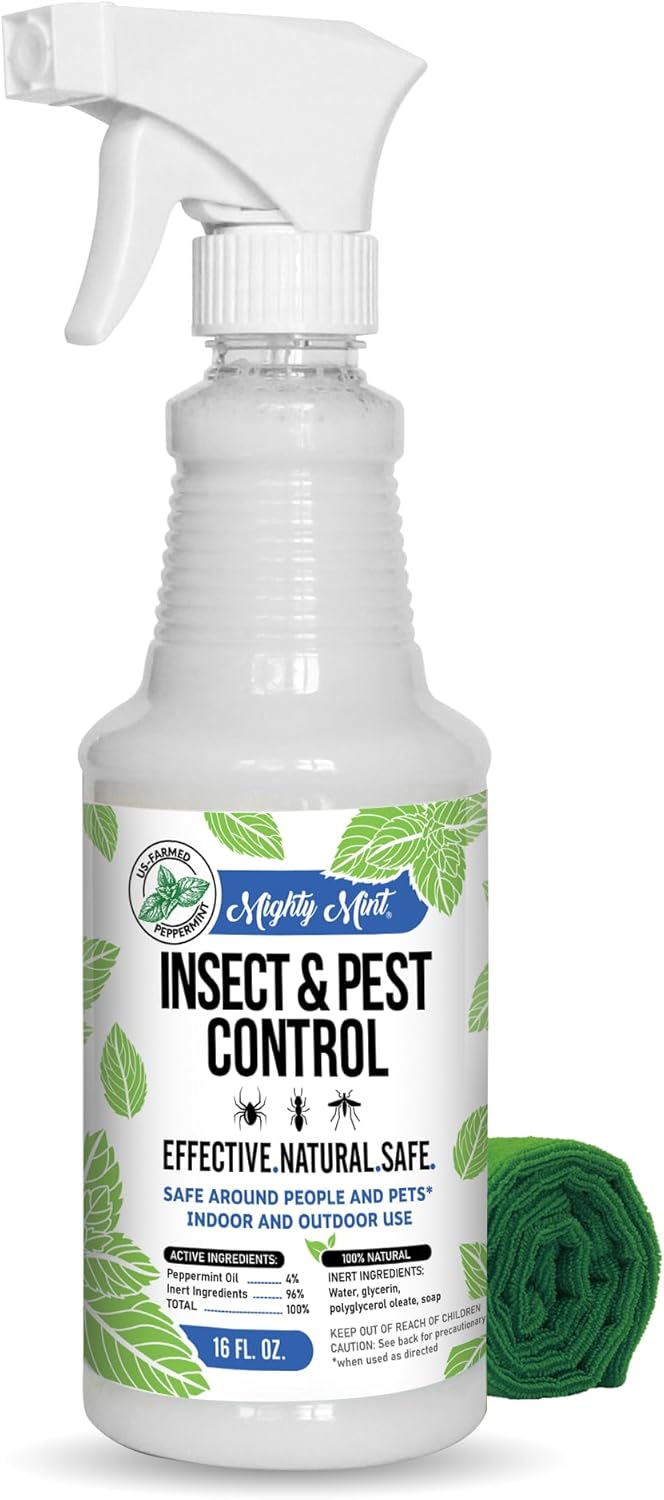
| Ingredients | Water, Glycerine, Polyglycerol oleate, Soap, Peppermint oil |
|---|---|
| Use Areas | Indoor / Outdoor |
| Size | 16 oz |
Mighty Mint is a plant-based, ready-to-use spray that uses concentrated peppermint oil to repel a broad range of household and patio pests. You apply it directly to problem areas such as baseboards, entryways, patios and around outdoor seating; the manufacturer recommends shaking and spraying until surfaces are covered and repeating applications two or more times per week for best results. Notable features include a peppermint-only scent profile, a formulation that avoids synthetic fragrances and the convenience of a 16 oz spray bottle for targeted spot treatments. Practical benefits are that it is safe to use around people and pets when dry and does not leave obvious stains on most surfaces, and the scent can make treated areas smell fresher than chemical alternatives. Important limitations are that it is a repellent rather than a pesticide so it works by discouraging pests rather than killing them, effectiveness depends on regular reapplication and it should not be applied when pollinators are present or to skin or food-contact surfaces.
Best for: Buyers who prioritize natural, low-toxicity solutions and want a targeted spray to reduce insects around patios and entryways while keeping family and pets in mind.
Less Ideal for: Anyone needing a one-time extermination or long-term residual pesticide for severe infestations should consider professional treatments or products formulated to kill pests rather than repel them.
- Plant-based peppermint formula that avoids synthetic fragrances
- Ready-to-use spray for quick, targeted indoor and outdoor applications
- Safe for people and pets when used as directed and allowed to dry
- Nonstaining on most surfaces and leaves a fresh mint scent
- Repels rather than kills insects so regular reapplication is needed to maintain protection
- Strong peppermint concentration may bother scent-sensitive individuals and requires keeping children and pets away until dry
Verdict: Choose Mighty Mint when you want a pet-friendly, plant-based spray to reduce patio and entryway insects with a fresh peppermint scent.
EcoVenger Roach & Ant Killer Spray, 64 oz

| Active ingredients | Geraniol, Cedarwood Oil, Peppermint Oil, Sodium Lauryl Sulfate |
|---|---|
| Residual protection | Up to 4 weeks |
| Intended pests | Roaches, ants and other crawling insects |
| Format | Ready-to-use trigger spray |
EcoVenger Roach & Ant Killer is a ready-to-use botanical spray designed to knock down and deter crawling pests in homes and commercial spaces. You use it like a typical trigger-spray insecticide: apply directly to visible insects, spray along baseboards, entry points, and around food-storage or outdoor perimeter areas to create a barrier. Its active ingredients are plant extracts including geraniol, cedarwood oil, and peppermint oil in a water-based carrier, so it has a pleasant peppermint scent and is non-staining on most common surfaces. The formula claims quick contact kills and residual protection for up to four weeks, which can reduce repeat applications for persistent problems. It is marketed and tested for safety around children, pets, birds, and fish, so it suits households where avoiding harsh synthetic pesticides is a priority. Limitations are that effectiveness can vary by infestation severity and botanical products sometimes require more frequent reapplication than strong synthetic insecticides for heavy infestations, and the nozzle is noted as delicate so handle carefully. For routine indoor ant control where pet safety matters, this offers a low-toxicity option with practical residual protection.
Best for: Homeowners and pet owners who prioritize low-toxicity, child- and pet-safe pest control and want an easy-to-use spray for indoor ant and roach problems.
Less Ideal for: People facing very large or long-established infestations who need the strongest chemical control or professional-grade treatments.
- Plant-derived, water-based formula suitable for sensitive indoor areas
- Kills on contact and provides up to four weeks of residual repellency
- Pleasant peppermint scent that dissipates quickly and is non-staining on most surfaces
- Tested in EPA-authorized labs and presented as safe for children, pets, birds, and fish
- May be less immediately potent than strong synthetic pesticides on very large or established infestations
- Spray nozzle is delicate and can be damaged if handled roughly
Verdict: A low-toxicity, pet-friendly spray that kills and deters ants and roaches while providing weeks of residual protection.
Choosing the Right Dog Friendly Ant Killer: Key Factors to Consider
Application Format and Containment
How the ant control is packaged and applied directly affects pet safety. Bait stations and tamper-resistant feeders keep the toxic material inside a small enclosure, which reduces the chance a dog will sniff, paw, or ingest the product. Granular baits placed loose on soil or open-surface sprays are riskier in dog-accessible areas because a dog can readily pick up particles or step in treated spots.
When evaluating formats, consider where ants are active relative to where your dog spends time. Indoor bait stations, wall-mountable options, and enclosed gel applicators are preferable for homes with roaming pets. For outdoor use, choose products designed to be placed in protected stations or applied to areas dogs rarely access. Proper placement and routine inspection of stations are important to maintain containment and effectiveness.
Active Ingredients and Toxicity
Different ant control ingredients carry different toxicity profiles for mammals. Low-dose insect growth regulators or slow-acting baits are less likely to cause acute toxicity from a single small ingestion, but they still require containment. Contact insecticides may be effective for immediate knockdown but can leave residues on floors, which increases oral or dermal exposure risk for dogs that groom themselves.
Look for products with clear labeling about pet risk and first-aid instructions. Even 'pet-friendly' formulations should be used with caution: ingredient concentration, the quantity present in a single station, and the potential for repeated ingestion matter. If a dog is a heavy licker, chewer, or tends to find small objects, minimize access to treated areas and monitor stations closely.
Effectiveness Against Local Ant Species
A product that is safer for pets but fails to stop the colony will lead to repeated treatments and increased cumulative exposure risk. Different ant species respond to different baits and attractants. For example, sugar-based baits work best on sweet-seeking ants, while protein- or grease-targeting baits attract other species. Understanding which ants you have helps you choose a formulation that reduces reapplication frequency.
When possible, observe ant trails and feeding behavior to pick a bait attractant that matches their preference. Choose options that list common household ant species or that combine attractants to cover mixed infestations. Effective colony-level control reduces how often you must place or replace stations in pet areas.
Placement Strategy and Household Habits
Placement planning is as important as product choice. Dogs often patrol baseboards, kitchen perimeters, and entryways where ants forage. Place bait stations where ants travel but out of reach from typical dog pathways. Mounting stations behind appliances, under cabinetry, or in corners behind furniture can reduce interactions while keeping the bait accessible to ants.
Also factor in cleaning routines and where food is served. Frequent floor washing can remove residual attractants and reduce ant pressure, but it can also disturb bait stations. Train household members to check and maintain stations instead of moving them, and store unused baits in sealed containers out of pet reach.
Signal Instructions and Safety Labeling
Clear manufacturer instructions and safety labeling determine whether a product can be used responsibly around dogs. Labels should specify placement restrictions, time-to-action, and first-aid steps in case of accidental contact or ingestion. Products with vague or absent pet-safety guidance make it harder for homeowners to take appropriate precautions.
Prefer items with explicit tamper-resistance guidelines and visible warnings about keeping pets away until stations are secured. Documentation that explains how long baits remain attractive to ants and when to replace them helps minimize unnecessary exposure. If a product lacks clear directions, plan for additional containment or choose a different formulation.
Cleanup and Residual Exposure
Consider how easy it is to clean treated surfaces and the potential for lingering residue. Surfaces with sticky or oily residues can trap bait particles and attract dogs. Contact sprays that leave residues require surface cleaning after treatment, which is an extra step when living with pets. Conversely, contained baits usually leave minimal residues and are simpler to manage.
When using sprays or granular treatments outdoors, think about where runoff could deposit residues. Areas that dogs frequent after rain or in the evening can become secondary exposure zones. Choose products and application methods that limit residue or that can be cleaned with standard household cleaners without leaving behind harmful traces.
Matching Bait Type to Ant Behavior
Ants vary in what they seek from a foraging trip. Observing whether ants are carrying sugary crumbs or greasy bits will tell you whether a sugar-based or protein-based bait is more likely to be effective. Choosing the right attractant reduces the need for multiple products and repeated placements in dog-accessible zones.
If you cannot identify the preference, select options that combine attractants or start with inconspicuous monitoring stations to see what ants take. That approach keeps active baits out of the open until you confirm the preferred food type.
- Sugar baits: Best for sweet-seeking species and kitchen trails
- Protein/grease baits: Better for outdoor or carpenter ant types
- Dual-attractant baits: Useful for mixed infestations or uncertain species
Indoor Vs Outdoor Use Considerations
Indoor treatments must prioritize containment and low-residue options. Bait stations, wall-mountable feeders, and enclosed gels work well in kitchens and utility areas. For floors and baseboards that dogs can reach, mount stations higher or tuck them behind heavy furniture where ants still access them but dogs do not.
Outdoor control should focus on perimeter treatments and protected stations away from common dog paths. Avoid scattering loose granules in areas where dogs run or play. Keep outdoor stations shaded and anchored so curious pets cannot overturn them.
- Place indoor stations along ant trails but out of direct pet reach
- Use anchored or stake-mounted stations outdoors to prevent tipping
- Reapply or replace according to label instructions to avoid prolonged attractiveness
Monitoring and Maintenance Routine
Regular checks cut down on risk and maintain efficacy. Inspect stations weekly to ensure baits are being taken by ants and that the enclosure remains intact. Replace spent baits promptly so ants do not abandon the station and seek alternate, less secure food sources around the house.
Keep a log of placement locations and outcomes so you can move or swap attractants if uptake is slow. For households with multiple dogs, consider additional stations in out-of-the-way areas to reduce competition between ant access and dog activity.
- Weekly inspection for containment integrity and bait uptake
- Document trail observations to adjust bait type if necessary
- Replace baits before they become stale to maintain attractiveness
Safe Emergency Steps if a Dog Contacts Product
If a dog licks or chews a bait station, remove the dog from the area and check for visible residue on fur or paws. Rinse paws and muzzle with water and dry thoroughly. For jaws or mouths that have chewed into formulations, prevent further licking or swallowing and consult a veterinarian if you observe vomiting, drooling, lethargy, or abnormal behavior.
Keep the product container or label handy when seeking veterinary advice so you can provide ingredient information. Prompt rinsing and professional guidance reduce the risk of complications and help determine whether observation or active treatment is required.
- Rinse contaminated fur and paws immediately with water
- Collect packaging to show ingredient details to a vet
- Monitor the pet for signs of distress and contact a veterinarian if needed
Non-Chemical and Integrated Options
Non-chemical measures can reduce ant pressure and the need for toxicants. Seal entry points, keep food sealed and counters clean, and remove standing water that attracts ants. Diatomaceous earth in tamper-resistant zones or physical barriers can help in some settings, though results are slower than baits.
Integrated pest management combines sanitation, exclusion, monitoring, and targeted baits in secure stations. This layered approach reduces reliance on repeated chemical treatments and limits overall exposure risk for dogs.
- Seal gaps and weatherstrip doors to reduce ant entry
- Maintain strict food storage and cleaning routines
- Use physical barriers and monitoring before escalating to baits
How We Chose the Best Dog Friendly Ant Killer
We prioritized formulations and application formats that lower accidental exposure for dogs while still interrupting ant foraging and colony activity. Key evaluation dimensions included bait safety and ingredient profile, containment or packaging that prevents pet access, documented efficacy against household ant species, and practical application features for indoor and outdoor use. We also considered residual risk on floors, the scent and attractant strength that might draw pets, and clear usage instructions from manufacturers to reduce misuse. Products that rely on highly toxic contact sprays without containment, or that require frequent reapplication in dog-accessible areas, were excluded. We focused on items available in secure bait stations, granular baits placed in tamper-resistant feeders, or low-toxicity baits where ingestion risk is minimized. Editorial filters removed options lacking clear labeling about pet safety or those with poor containment options. The result is a set of choices that balance ant control effectiveness with practical safety measures for homes with dogs.
FAQ
Are any ant baits completely safe for dogs?
No bait is entirely risk-free, but many baits in contained stations pose a low risk if left intact. Safety depends on formulation, containment, and how your dog interacts with the station. Always follow label instructions and monitor stations regularly.
How quickly should ant control take effect with safer baits?
Slow-acting colony-control baits can take several days to weeks to noticeably reduce visible activity because they rely on ants carrying bait back to the nest. Faster-acting contact options work sooner but may increase residue and exposure risk to pets.
Can I use non-chemical methods alone to stop an infestation?
Non-chemical methods help prevent and reduce ant pressure but may not eliminate established colonies quickly. Sanitation and exclusion reduce reinfestation risk, and physical traps or barriers can supplement these methods when you want to minimize chemical use.
Where should I place outdoor bait stations to keep dogs safe?
Place stations along ant trails but away from dog paths, play areas, and places where dogs rest. Anchor or stake stations in shaded locations and inspect them regularly to ensure they remain intact and inaccessible to pets.
What signs indicate my dog may have ingested an ant product?
Watch for vomiting, excessive drooling, lethargy, tremors, or agitation. If you suspect ingestion, rinse the mouth and paws, gather product information, and contact your veterinarian promptly for advice.
Can I use indoor bait stations outside near dog runs?
Some indoor stations are not weatherproof and may degrade outdoors. Use outdoor-rated, tamper-resistant stations for exposed areas to prevent tipping, water damage, and easier access by curious dogs.
Final Verdict
Prioritize containment and the right attractant when choosing an ant control for a dog household. Secure bait stations and slow-acting formulations that target colony behavior reduce repeated exposure and the need for broad sprays. Balance efficacy with practical placement and routine monitoring to keep both ants under control and dogs safe. When in doubt, opt for a product and application method that minimizes contact opportunities for pets and pair it with non-chemical practices like sealing entry points and improving sanitation. That combination helps you control ants while limiting risks to your dogs.
