

Note: This article contains affiliate links. If you click on these links and make a purchase, I may earn a small commission at no extra cost to you. This helps support my research and content. Read my full affiliate disclosure here.
Choosing the right granular fertilizer changes how your soil holds nutrients, how often you need to feed, and how reliably plants respond. In many home gardens and larger beds, a granular formula gives predictable application rates, easy storage, and options for slow or quick release. This guide shortlists seven top granular fertilizers suited to a range of garden types and feeding plans. We evaluate each pick on nutrient balance, release behavior, ease of application, and suitability for common garden uses so you can match a product to your soil test and planting goals.
Top Picks at a Glance
| Best Overall The best all-around choice for most situations | Miracle-Gro Shake 'N Feed All Purpose Plant Food, 8 lb. |  |
| Best Quality Built to a higher standard if you want something more solid | MicroLife Multi-Purpose Organic Granular Fertilizer (6-2-4), 7 lb |  |
| Best Value The sweet spot between price and what you get | GreenView Multi-Purpose Fertilizer 10-10-10, 33 lb |  |
| Best Budget The cheapest option that still gets the job done reliably | Jobe's Organics Granular Tomato & Vegetable Fertilizer, 4 lb |  |
| Highest Rated A top-rated pick with lots of positive feedback | Osmocote Smart-Release Plant Food Plus Outdoor & Indoor, 8 lb |  |
| Most Popular A crowd favorite that many people choose with confidence | Miracle-Gro Shake 'N Feed All Purpose Plant Food, 4.5 lb |  |
| Best Seller A high-volume bestseller chosen again and again | Scotts Turf Builder Lawn Food, 37.5 lb. |  |
Miracle-Gro Shake 'N Feed All Purpose Plant Food, 8 lb.

| Item Form | Granules |
|---|---|
| Application Method | Shake onto soil and work into top 1-3 inches |
| Target Species | all plants |
| Unit Count | 128 Ounce |
Miracle-Gro Shake 'N Feed All Purpose is a granular continuous-release fertilizer intended for use on in-ground and container plants. You apply it by sprinkling the granules over the soil, lightly working them into the top 1 to 3 inches, then watering to activate the feed. The formula includes natural ingredients to support soil microbes and supplies micronutrients that help strengthen roots, boost vigor, and improve water efficiency. A single 8 pound container covers roughly 320 sq. ft. and the three-month feeding interval makes it convenient for busy gardeners who want seasonal maintenance without frequent applications. Important limitations are that it is an all-purpose product so it will not replace specialty formulas for heavy-feeding crops or acid-loving plants, and overapplication can harm roots so users must follow the label rates. It is best used as a regular, low-effort maintenance feed in mixed beds, pots, and general landscape plantings rather than a targeted treatment for specific nutrient deficiencies.
Best for: Gardeners who want a low-effort, general-purpose fertilizer to maintain mixed flower beds, containers, and basic vegetable plots with infrequent reapplication.
Less Ideal for: Growers seeking a targeted fertilizer program for heavy-feeding crops, specific NPK ratios, or plants with special soil pH needs should consider specialty fertilizers instead.
- Continuous-release granules feed plants for up to 3 months reducing application frequency
- Suitable for both in-ground and container plants so one product covers many uses
- Contains natural ingredients to support soil microbes and root development
- Covers a large area from one 8 lb. container (about 320 sq. ft.)
- Not formulated for specialty needs so may be insufficient for heavy-feeding vegetables or acid-loving plants
- Requires careful application and incorporation to avoid localized overfeeding
Verdict: A convenient, all-purpose granular feed that keeps a variety of container and in-ground plants healthy for three months with a single application.
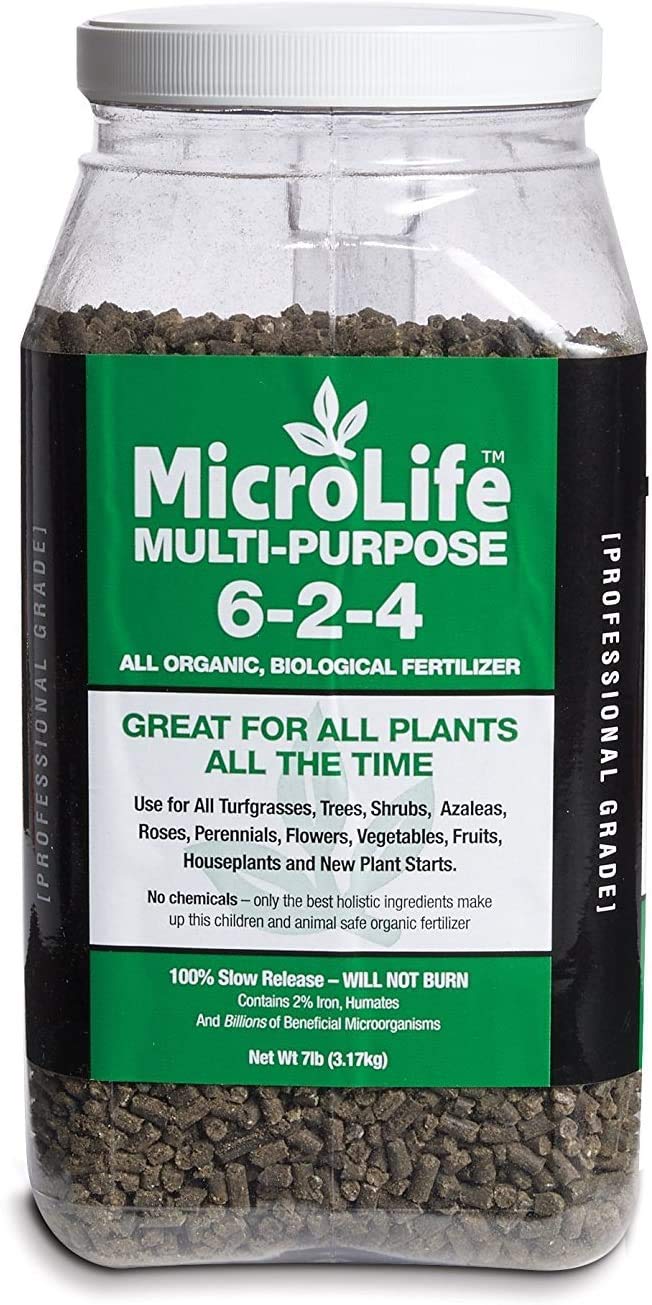
MicroLife Multi-Purpose Organic Granular Fertilizer (6-2-4), 7 lb
| Item Form | Granules |
|---|---|
| Specific Uses For Product | Organic |
| Target Species | vegetables, flowers, ornamentals, perennials, trees, bushes |
| Mixing Ratio | 6-2-4 |
MicroLife Multi-Purpose 6-2-4 is a biological, slow-release granular fertilizer designed for broad use in vegetable beds, flower borders, containers and new plantings. It combines organic feedstocks such as fish, kelp, meals and rock phosphate with humates, sugars, vitamins and a bio-inoculant package that includes mycorrhizal organisms. Typical use is broadcast or worked into beds on a 3-to-4 month schedule at the recommended rates for turf, beds or containers. The practical benefits are stronger root systems, improved soil microbial activity and steady nutrient release that reduces burn risk and watering needs. Because it is concentrated and organic, you can expect longer-lasting feeding compared with quick-release synthetic fertilizers and visible improvements in plant vigor and resilience. Limitations to note are the need to follow weight-based application rates for different uses and the slower nutrient uptake, so you should not expect immediate green-up the way fast-release products deliver.
Best for: Gardeners and small-scale landscapers who prioritize long-term plant performance and soil health and who want an organic, microbe-rich fertilizer to support stronger roots and sustained growth.
Less Ideal for: Those who need rapid, short-term greening or instant nutrient correction for a specific deficiency should choose a fast-release or targeted supplement instead.
- Contains a broad mix of organic inputs plus billions of beneficial microbes including mycorrhizae
- Slow-release formulation reduces burn risk and provides steady feeding for 3 to 4 months
- Formulation promotes larger root systems and improved soil biology for long-term soil health
- Versatile for vegetables, flowers, ornamentals, perennials, trees and containers
- Slower to show aboveground greening compared with synthetic quick-release fertilizers
- Requires careful weight-based application rates for different uses to avoid under- or over-application
Verdict: Choose this product when you want a proven organic granular fertilizer that builds soil biology and root strength for lasting plant performance.
GreenView Multi-Purpose Fertilizer 10-10-10, 33 lb

| Item Form | Granules |
|---|---|
| Application Method | broadcast or drop spreader |
| Specific Uses For Product | Plant Growth, Root Development, Seed Development, Soil Conditioning |
| Target Species | Trees, Shrubs, Vegetables, Flowers, Ornamental Gardens |
GreenView 10-10-10 is a granular, balanced fertilizer designed for routine feeding across mixed garden beds. It is applied with a broadcast or drop spreader and can be used when planting or as a general feed to support plant growth, root development, and seed establishment. The product's NPK 10-10-10 formulation supplies nitrogen, phosphorus, and potassium in equal measure, which makes it a safe choice when you need broad-spectrum nutrition without strengthening one growth phase excessively. The bag covers a large area so it is convenient for medium to large beds and mixed plantings. Important practical notes are that it is intended to be distributed with a spreader rather than hand spread and that label directions differ by plant type, so following coverage and timing guidance is important. For gardeners that prefer tailored, soil-test-based fertilization or slow-release formulations targeted to a single crop, this general-purpose granular will be less specific than specialty blends.
Best for: Gardeners who want a single, straightforward fertilizer to maintain mixed garden beds and prefer a practical, easy-to-apply solution that covers multiple plant types.
Less Ideal for: Growers seeking a slow-release feed, highly targeted nutrient program, or formulas tuned to a specific crop or diagnosed soil deficiency.
- Balanced 10-10-10 NPK suitable for a wide range of vegetables, flowers, shrubs, and trees
- Granular form works with broadcast or drop spreaders for fast, even coverage
- Large coverage per bag makes it practical for multiple garden beds
- Supports plant growth, root development, and seed establishment
- Not a crop-specific or soil-test tailored formula for addressing particular nutrient deficiencies
Verdict: A single balanced granular fertilizer that delivers broad-spectrum nutrition and easy spreader application for maintaining mixed garden beds.
Jobe's Organics Granular Tomato & Vegetable Fertilizer, 4 lb

| NPK | 2-5-3 |
|---|---|
| Item Form | Granules |
| Target Species | Vegetable and tomato |
| Unit Count | 64 Ounce |
Jobe's Organics granular fertilizer is a simple, slow-release feed designed specifically for tomato and vegetable beds. You apply the granules around plants every 4 to 6 weeks during the growing season to supply roots with nitrogen, phosphorus, and potassium in a 2-5-3 ratio aimed at fruiting and root development. The formula derives nutrients from bone meal and processed poultry manure and includes calcium and other micronutrients, which helps reduce blossom end rot and supports solid fruit set. Because it is OMRI listed it fits into organic vegetable production and is safe to use around children and pets when applied as directed. Practical gardeners will appreciate the measured, low-mess granular format and the moderate coverage for small to medium plots. Limitations are that it is not a fast-acting soluble feed for immediate correction and the 4 lb bag covers only a modest area, so larger vegetable gardens will need larger or repeated purchases.
Best for: Gardeners who prioritize organic, low-maintenance feeding for home vegetable and tomato beds and who want a measured, slow-release product for steady crop development.
Less Ideal for: Growers who need rapid correction of nutrient deficiencies or who manage large-scale vegetable plots and prefer concentrated or high-coverage fertilizers.
- OMRI listed for use in certified organic vegetable production
- Balanced 2-5-3 NPK with added calcium and micronutrients to support fruiting and root health
- Slow-release granular form feeds roots over time and reduces risk of over-fertilizing
- Easy to measure and apply for small to medium garden beds
- Not a quick soluble feed for immediate nutrient correction
- 4 lb bag provides only moderate coverage for larger vegetable gardens
Verdict: A reliable OMRI-listed granular feed that delivers balanced, slow-release nutrition ideal for home tomato and vegetable gardens.
Osmocote Smart-Release Plant Food Plus Outdoor & Indoor, 8 lb

| Item Form | Granules |
|---|---|
| Application Method | Sprinkle |
| Specific Uses For Product | Plant Food |
| Coverage | Full |
| Mixing Ratio | 1 scoop (3 tbsp) per 2 gal pot or 4 sq. ft. |
Osmocote Smart-Release Plant Food Plus is a granular, resin-coated fertilizer designed to deliver steady nutrition for up to six months from a single application. It is applied by sprinkling the recommended scoopful into the top 1 to 3 inches of potting or garden soil and watering in; outdoor rates are halved for indoor plants. The resin coating times nutrient release so plants receive consistent feeding rather than a sudden flush, which the product backs with a no-burn pledge when used as directed. Practical benefits include broad compatibility with vegetables, flowers, shrubs and container plants, long coverage that reduces reapplication frequency, and clear dosing guidance for pots and garden beds. Limitations are that the formula details and ingredient breakdown are not specified on the listing and that granular slow-release products can be slower to correct acute nutrient deficiencies compared with soluble feeds.
Best for: Gardeners who prioritize steady, low-maintenance feeding and want a single, long-lasting application for mixed beds and containers.
Less Ideal for: Growers needing immediate correction of nutrient deficiencies or those who prefer liquid feeds and frequent, adjustable dosing.
- Feeds continuously for up to six months with a single application
- Resin-coated granules control nutrient release to reduce risk of overfeeding
- Suitable for both indoor and outdoor use across many plant types
- Clear application rates for pots and garden beds make dosing straightforward
- Ingredient breakdown is not specified, so exact nutrient ratios beyond '11 nutrients' are not clear
- Not ideal for quickly correcting acute nutrient deficiencies since release is slow
Verdict: Choose this product when you want a reliable, low-maintenance, six-month slow-release fertilizer that works across most garden and container plants.
Miracle-Gro Shake 'N Feed All Purpose Plant Food, 4.5 lb

| Item Form | Granules |
|---|---|
| Application Method | Shake onto soil and work into top 1-3 inches |
| Target Species | flowers, vegetables, herbs |
| Unit Count | 72 Ounce |
| Feeds For | up to 3 Months |
Miracle-Gro Shake 'N Feed All Purpose is a granular, continuous-release fertilizer you sprinkle onto soil and lightly work into the top inch or three before watering. It is typically used on in-ground garden beds, raised beds and established container plants to provide slow feeding across the season; the label recommends reapplying every three months. Notable features include natural ingredients that feed soil microbes, added micronutrients, and an easy shake-on application that requires no mixing. In practice this product is convenient for routine garden maintenance because one application supports steady nutrient availability without frequent dosing. For garden beds it helps promote root strength and consistent growth while reducing the need to remember weekly feedings. The main limitations are that it is a general-purpose formula rather than a crop-specific blend and that application rates must be followed to avoid overfeeding; it also provides broad coverage but not the fast boost of a water-soluble feed if plants need immediate recovery.
Best for: Gardeners who want a low-maintenance, reliable feeding method for flower and vegetable beds and containers and prefer scheduled, less frequent fertilizing over weekly applications.
Less Ideal for: Growers seeking fast corrective feeding, precise NPK ratios for fruiting crops, or specialty blends for roses or acid-loving plants should consider targeted fertilizers instead.
- Continuous-release formula feeds plants for up to three months per application
- Granular shake-on application is simple and requires no mixing
- Contains micronutrients and ingredients that support soil microbes and root health
- Suitable for both in-ground garden beds and container plants
- All-purpose formula may not match nutrient ratios for specific crops or problems
- Slower acting than water-soluble fertilizers when immediate nutrient correction is needed
Verdict: Use this granular, three-month continuous-release fertilizer when you want a simple, low-maintenance feed that keeps garden beds and containers nourished through the season.
Scotts Turf Builder Lawn Food, 37.5 lb.

| Item Form | Granules |
|---|---|
| Specific Uses For Product | Lawn |
| Coverage | 15000 |
| Mixing Ratio | 32:0:4 |
Scotts Turf Builder Lawn Food is a granular, all-purpose lawn fertilizer formulated to thicken and green lawns while building deeper roots. It is used by broadcasting with a spreader or dropping with a drop spreader; Scotts gives specific spreader settings for easy, repeatable application. The bag covers a large area so it is convenient for whole-yard spring feeding routines. Practical benefits include improved root strength and better nutrient and water uptake compared with unfed turf, plus flexible timing since it can be applied to wet or dry grass and lightly watered in for faster greening. The product is pesticide-free and intended for any grass type, so it can fit into a seasonal program for warm-season grasses like Zoysia. Limitations are that it is a straight lawn food without weed control or insect ingredients, so you will need separate products for weeds or pests, and handling a 37.5 lb bag can be bulky for small yards or single-application needs.
Best for: Homeowners who want a straightforward, high-coverage spring fertilizer to strengthen and green their Zoysia lawn as part of a planned feeding routine.
Less Ideal for: Gardners who need one-step weed and feed or combined pest control solutions or those with very small lawns who prefer smaller package sizes.
- Covers up to 15,000 sq. ft. from one 37.5 lb. bag
- Formulated to build stronger roots and improve nutrient uptake
- Can be applied to wet or dry lawns and used with common spreaders
- Pesticide-free lawn food suitable for any grass type
- Does not include weed or insect control so additional products may be required
- Large bag size may be awkward for small properties or single applications
Verdict: A simple, high-coverage lawn food that reliably builds root strength and greens Zoysia when used as part of a seasonal feeding plan.
Choosing the Right Granular Fertilizer: Key Factors to Consider
Nutrient Ratio and Purposes
The N-P-K ratio tells you what the fertilizer emphasizes: nitrogen for leafy growth, phosphorus for root and bloom development, and potassium for stress tolerance. Choose a balanced ratio for general maintenance, higher nitrogen for lawns and heavy-feeding greens, and formulations with extra phosphorus when establishing new plants or transplanting.
Beyond the three numbers, check for secondary nutrients like magnesium, calcium, and sulfur as well as micronutrients such as iron and zinc. Those extras matter when your soil test shows deficiencies or when you're growing plants with specific needs like container crops or acid-loving ornamentals.
Release Rate and Feeding Schedule
Granular fertilizers are available as quick-release, slow-release, or controlled-release blends. Quick-release granules dissolve rapidly and give an immediate nutrient boost but may require more frequent applications and carry higher leaching risk. Slow-release granules feed over weeks to months, smoothing out nutrient availability and reducing burn risk.
Consider how often you want to feed and how likely nutrients are to wash away in your site. For sandy soils or heavy rainfall areas, controlled or slow-release products reduce waste. For rapid green-up or corrective feeding, a fast-release option is useful but plan the follow-up schedule accordingly.
Application Method and Granule Uniformity
How you will apply the fertilizer affects which product is best. Uniform granule size spreads more evenly through a broadcast spreader, while finer granules may be better for hand application or topdressing. Some granules are formulated to be compatible with drop spreaders, rotary spreaders, or even planter boxes for banded application.
Also check whether the product clumps when moist. Granules that resist caking make life easier during storage and ensure consistent dosing when you apply. If you plan to apply around sensitive seedlings, a product with low salt index and even granule size reduces the risk of localized burns.
Soil Compatibility and Salt Index
Salt index indicates the fertilizer's potential to draw moisture from plant roots and cause burn, especially in containers or newly planted clumps. High salt formulations require careful placement and incorporation into soil; low salt options are safer for direct contact with roots and for feeding seedlings.
Match fertilizer choice to soil texture and organic matter. Heavy clay retains nutrients longer so slower release is often fine; sandy soils benefit from split applications or slow-release forms to limit leaching. A soil test helps you pick a product that complements existing nutrient levels rather than doubling up on what is already abundant.
Environmental Impact and Runoff Risk
Granular fertilizers can contribute to runoff if applied excessively or before heavy rain. Products that release nutrients gradually reduce peak losses, and clear label guidance on application rates helps prevent overuse. Placing granules away from hard surfaces and water bodies and sweeping up overspread granules reduces environmental risk.
Also consider formulation choices such as low-phosphate blends for established lawns and careful timing of phosphorus applications to avoid runoff into waterways. Knowing local regulations about phosphorus use in turf areas can guide product selection and application timing.
Storage, Handling, and Safety
How you store granular fertilizer affects its shelf life and safety. Look for products that remain free-flowing in a variety of humidity conditions and that come with resealable packaging or fit well into dry storage bins. Keep granules in a cool, dry place away from children, pets, and food items.
Follow label instructions for protective equipment when spreading dusty or high-nitrogen formulas. Proper storage minimizes caking and preserves release characteristics, ensuring the product performs as expected when applied.
Matching Granular Fertilizer to Garden Types
Different garden settings need different granular fertilizer approaches. Lawns benefit from nitrogen-focused blends with even granule distribution for uniform green-up. Vegetable beds often need balanced N-P-K or phased feeding that shifts from nitrogen-heavy growth to phosphorus- and potassium-rich formulas as plants flower and set fruit. Container gardens need low-salt or slow-release granules to avoid root stress from concentrated salts.
Assess your garden type, planting schedule, and how frequently you can apply fertilizer. That will narrow the field quickly and point you toward either quick-acting granules for fast correction or long-duration products for low-maintenance feeding.
- Lawns: even spread and nitrogen emphasis
- Vegetable beds: balanced or phased feeds
- Containers: low salt and controlled release
- New plantings: starter blends with higher phosphorus
When to Apply Granular Fertilizer
Timing depends on plant growth stage and weather. For most garden plants, apply in early spring as growth begins and again after the main flush of growth. Slow-release granules are often applied less frequently, such as once in spring and once midseason. For lawns, follow a seasonal schedule that avoids late-season high-nitrogen applications unless you need rapid recovery.
Avoid applying right before heavy rain to reduce runoff risk. If a soil test recommends phosphorus or micronutrients, place granules where roots will contact them or lightly incorporate into the topsoil to improve availability.
- Spring application to start growth
- Midseason touch-up for long-season crops
- Avoid immediate pre-storm applications
- Light incorporation improves root contact
Reading the Label and Calculating Rates
The fertilizer label contains the N-P-K numbers, recommended application rate, and instructions for where and how to apply. Use the label's rate recommendations with your soil test to avoid over-application. Convert rates from pounds per 1,000 square feet to smaller garden patches by simple proportion when necessary.
When calculating how much product you need, account for granule coverage differences. Some granules are denser and require different spreader settings. If in doubt, start at the lower end of the recommended range and monitor plant response before reapplying.
- Use label rates adjusted by soil test results
- Convert broadcast rates to small bed doses proportionally
- Set spreader for even coverage and recheck after first pass
Combining Granular Fertilizer with Organic Practices
Granular fertilizers can complement organic matter rather than replace it. Incorporating compost improves soil structure and water retention, which helps granular nutrients stay available to plants. Use granular feeds to correct specific nutrient shortages while continuing to build soil with mulches and compost.
In vegetable gardens, alternate or combine slow-release granules with seasonal organic side-dressings to support both immediate needs and long-term soil health. This hybrid approach reduces reliance on repeated synthetic applications and balances quick availability with sustained supply.
- Use compost to improve retention and nutrient cycling
- Alternate granular feeding with organic side-dressing
- Monitor soil health to reduce synthetic dependency
Application Tools and Techniques
Choose an application tool that matches the granule size and the area you are treating. Broadcast spreaders work well for lawns and large beds; handheld rotary spreaders and scoop-and-scatter methods are better for irregular beds. For banding near new transplants, place granules along the root zone and lightly incorporate to avoid direct contact with stems.
After spreading, water in light to moderate amounts unless the product is a dry controlled-release formula that requires no immediate irrigation. If you use a spreader, practice on a small area first to calibrate rate settings for the granule type you selected.
- Broadcast spreaders for open lawns
- Handheld spreaders for beds and borders
- Banding for transplants with light incorporation
- Light watering after application unless label advises otherwise
How We Chose the Best Granular Fertilizer
We selected contenders that matched practical gardener needs for granular fertilizer usage across lawns, vegetable beds, ornamentals, and containers. Editorial filters prioritized clear nutrient labeling with complete N-P-K ratios, documented release behavior (fast release versus slow or controlled release), and formulation suitability for common application methods such as broadcast spreading and banding. We also considered physical factors that affect handling: granule uniformity for consistent spread, resistance to caking in storage, and compatibility with common spreaders. Environmental and safety considerations were included by preferring formulas with clear guidance on salt index, application rates, and runoff risk. Exclusions: we omitted products lacking transparent ingredient lists, experimental blends without application guidance, or granular mixes intended only for commercial turf with unusually high salt loads. The criteria we used align with the scoring metrics below and reflect what gardeners actually measure in the garden rather than marketing claims.
FAQ
How often should I apply granular fertilizer to vegetable beds?
It depends on the product. Quick-release granules often require applications every four to six weeks during active growth. Slow-release formulations can last several months and reduce the need for repeated feedings. Base the schedule on crop needs and soil test results.
Can I use the same granular fertilizer on my lawn and flower beds?
Often you can, but the ideal N-P-K balance differs. Lawns usually need higher nitrogen for leaf growth, while flower beds may benefit from more balanced formulas or higher phosphorus during establishment. Adjust application rates and timing accordingly.
Will granular fertilizer burn plants if I overapply?
Yes. High application rates or applying high-salt formulations directly against roots can cause burn. Follow label rates, avoid placing granules against stems or crowns, and water in or lightly incorporate when recommended to reduce burn risk.
Is it safe to store granular fertilizer outdoors?
Granules should be kept dry to prevent caking and performance changes. If storing outdoors, use tightly sealed containers and keep them off the ground and under cover to avoid moisture. Long-term outdoor storage without protection increases the risk of clumping and nutrient loss.
How do I choose between slow-release and quick-release granules?
Choose slow-release if you want lower maintenance, reduced leaching, and steadier feeding. Quick-release is useful for rapid correction or fast green-up. Consider soil texture, rainfall patterns, and how often you can realistically reapply when deciding.
Can I combine granular fertilizer with liquid feeding?
Yes, but plan the timing. Use granular products for baseline feeding and liquids for targeted supplements or foliar feeds. Avoid doubling up nitrogen-heavy treatments at the same time to prevent overfeeding and potential plant stress.
Final Verdict
Match granular fertilizer choice to the soil test, garden type, and how much maintenance you want to do. Prioritize nutrient labeling and release behavior first, then consider granule uniformity, salt index, and how you will apply and store the product. If you need steady, low-maintenance feeding choose a slow-release form; if you need quick correction pick a fast-acting granular and plan follow-up applications. With those tradeoffs in mind, you can confidently select a granular fertilizer that fits your planting schedule and soil needs.
