

Note: This article contains affiliate links. If you click on these links and make a purchase, I may earn a small commission at no extra cost to you. This helps support my research and content. Read my full affiliate disclosure here.
Choosing the right American felling axe matters when you need consistent, controlled tree-felling performance in a backyard or worksite. The wrong head weight or a poorly balanced handle makes swings tiring and increases the chance of glancing blows or poor cuts. This guide looks at five shortlisted tools that suit common felling jobs and different user strengths. We focus on factors that affect real-world chopping: head weight and profile, handle length and material, how well an axe holds an edge in field conditions, and how predictable the swing feels. Below you will find concise evaluations, decision criteria, and practical advice to match an axe to your trees and technique.
Top Picks at a Glance
| Best Overall The best all-around choice for most situations | 1844 Helko Werk Forester Full-Size Felling Axe (Made in Germany) |  |
| Best Quality Built to a higher standard if you want something more solid | Hults Bruk Kisa Felling Axe (2 lb head, 26" handle) |  |
| Best Value The sweet spot between price and what you get | Truper Michigan Axe, 3.5 lb Forged Steel Head with 35" Hickory Handle |  |
| Best Budget The cheapest option that still gets the job done reliably | Fiskars 28" A-Series Chopping Axe |  |
| Highest Rated A top-rated pick with lots of positive feedback | Gränsfors Bruks American Felling Axe, 35" Curved Handle |  |
1844 Helko Werk Forester Full-Size Felling Axe (Made in Germany)

| Head Material | C50 high carbon steel |
|---|---|
| Head Type | Felling |
| Head Weight | 3.5 lb |
| Handle Material | American hickory |
| Handle Length | 31 in |
The Helko Werk Forester is a purpose-built full-size felling axe that brings a hand-forged C50 high carbon steel head and a carefully selected American hickory handle to demanding tree work. With a roughly 3.5 lb head and a 31 inch handle it delivers the mass and reach needed to fell medium and large trees while remaining manageable for a single user. The polished finish on the head reduces cutting friction and helps resist surface rust, and the handle is sanded and treated with boiled linseed oil for a comfortable grip. Included leather sheath and a small bottle of protective Axe Guard oil make basic care and transport straightforward. Because it is a premium handmade tool, the Forester emphasizes edge retention and balance over low cost and requires routine sharpening and proper storage to protect the wooden handle and carbon steel. It is not lightweight for casual pruning but shines when you need a reliable, well-balanced axe that holds an edge for sustained chopping tasks.
Best for: A buyer who prioritizes chopping performance and durability for regular tree-felling or heavy-duty yard work and wants a precision-forged tool that holds an edge and feels balanced under swing.
Less Ideal for: Not a good fit for casual gardeners, light pruning, or ultralight backpacking where a smaller hatchet or lightweight saw would be easier to handle.
- Hand-forged C50 high carbon steel head for strong edge retention and durability
- Balanced full-size design (3.5 lb head, 31 in handle) suited to felling medium and large trees
- Premium grade A American hickory handle finished with boiled linseed oil for comfort and shock absorption
- Polished head finish reduces cutting friction and helps resist surface rust
- Includes leather sheath and Axe Guard oil for protection and basic maintenance
- Requires regular sharpening and oiling to maintain the carbon steel head and prevent rust
- Heavier and longer than compact axes, so it is less suitable for tight spaces or extended backpacking carries
Verdict: Buy this axe if you want a high-performance, hand-forged felling axe that combines weight, balance, and premium materials for reliable tree-chopping results.
Hults Bruk Kisa Felling Axe (2 lb head, 26" handle)

| Head Weight | 2 pounds |
|---|---|
| Handle Material | Hickory Wood |
| Blade Material | Solid Swedish steel |
| Recommended Uses For Product | light felling, bucking, splitting |
The Hults Bruk Kisa is a performance-focused felling axe intended for chopping, bucking, and light splitting. Its 2-pound hand-forged Swedish steel head is tempered to hold a keen edge, and the straight blade geometry makes controlled, deep cuts when felling small to medium trees. The 26-inch curved hickory handle provides reach and good swing dynamics while the linseed finish and HB engraving add durable protection and a classic look. The axe ships with a leather sheath and user manual for safe storage. In practice this axe feels well balanced for repeated swings and keeps its edge longer than many cheap alternatives, though it benefits from periodic sharpening and proper maintenance. The solid construction and traditional materials favor buyers who value long-term performance and a tool they can service. It is not a lightweight hatchet for limb work or an oversized maul for heavy splitting, so users should match it to regular felling and chopping tasks rather than specialized splitting or precision carving.
Best for: Buyers who prioritize lasting cutting performance and a traditional, serviceable tool for routine felling and chopping will appreciate this axe.
Less Ideal for: People who need a compact hatchet for camping, a heavy splitting maul, or a tool for precision woodworking should consider different specialized tools.
- Hand-forged Swedish steel head tempered to hold a sharp edge
- Well balanced 26-inch hickory handle for powerful, controlled swings
- Includes leather sheath for safe transport and storage
- Straight blade profile suited to deep cuts when felling and bucking
- Designed for felling and general chopping rather than heavy splitting or delicate carving
- Requires periodic sharpening and basic maintenance to preserve edge and finish
Verdict: Choose the Kisa if you want a well balanced, hand-forged American-style felling axe built for durable, high-quality chopping performance.
Truper Michigan Axe, 3.5 lb Forged Steel Head with 35" Hickory Handle

| Head Weight | 4.2 pounds |
|---|---|
| Handle Material | Hickory Wood |
| Blade Material | High Carbon Steel |
| Head Type | Felling |
The Truper Michigan Axe is a purpose-built felling axe that pairs a 3.5 lb forged high-carbon steel head with a 35-inch North American hickory handle. It is designed for chopping, limbing, and felling trees; the Michigan head shape and straight blade give deep penetration and predictable swing control for cutting into large rounds. The head is heat-treated and precision-ground for edge retention, and the handle is kiln-dried and lacquered to resist moisture and absorb shock. A dual-wedge assembly with both wooden and steel wedges keeps the head secure during heavy use. For a practical buyer who values durable, no-frills tools, this axe delivers professional-grade performance without specialty features. Expect a reliable chopping tool that needs routine sharpening and safe handling practices; the wooden handle can require occasional maintenance and will not resist impacts as well as modern composite shafts. Overall it is a straightforward, dependable felling axe well suited to regular outdoor use by people comfortable with traditional wooden-handled tools.
Best for: Buyers who prioritize durable, traditional hand tools and want a reliable axe for regular felling and chopping tasks rather than a lightweight or novelty option.
Less Ideal for: People seeking a low-maintenance synthetic-handle axe or those who need specialized splitting or lightweight backpacking tools should consider alternatives.
- Forged high-carbon steel head for strong edge retention and deep wood penetration
- Classic Michigan felling head shape that promotes efficient chopping and limbing
- 35-inch North American hickory handle provides natural shock absorption and solid swing control
- Dual-wedge head assembly (wood and steel) secures the head for heavy use
- Includes sheath for safer transport and storage
- Wooden handle requires occasional maintenance and is more susceptible to breakage than composite handles
- No modern vibration-reduction or ergonomic features found on some contemporary axes
Verdict: A solid, no-frills American-style felling axe for buyers who want a durable, high-performance chopping tool with a traditional hickory handle.
Fiskars 28" A-Series Chopping Axe

| Head Type | Felling |
|---|---|
| Blade Edge | Hardened, non-stick |
| Handle Material | Steel,Wood |
| Blade Material | Alloy Steel |
The Fiskars 28" A-Series Chopping Axe is built for heavy backyard chopping and light tree felling. It pairs a low-friction, hardened alloy-steel blade with a precision-balanced head that helps the blade bite deeper on each swing, so you get cleaner cuts and fewer stuck strikes when felling small trees or splitting logs. The handle combines steel and wood construction with a shock-absorbing FiberComp-style design to reduce vibration and make repeated swings less fatiguing. Practical benefits include an ultra-sharp edge that stays effective through routine use and a balanced feel that multiplies swing power for faster work. Limitations are that this is a midweight, 28-inch tool intended for small to medium trunks rather than heavy timber, and its mixed-material handle may require occasional care compared with full-composite or all-wood traditional designs. For routine firewood prep, campsite work, and clearing small trees, it offers a reliable, user-friendly chopping performance.
Best for: Buyers who want a dependable, easy-to-swing axe for routine tree felling, firewood prep, and yard cleanup and who value tools with solid real-world performance evidence.
Less Ideal for: Professional arborists or anyone who regularly needs to fell very large trunks should choose a heavier, longer-handled felling axe or specialized chainsaw instead.
- Balanced head design increases swing power and cutting efficiency
- Hardened alloy-steel blade with low-friction coating reduces sticking
- Shock-absorbing handle reduces vibration during repeated swings
- Sharp edge and blade geometry suitable for clean felling and log splitting
- 28-inch length and midweight construction are not ideal for very large or old-growth trees
- Handle uses mixed materials that may need occasional maintenance
Verdict: A well-balanced, sharp 28-inch axe that delivers efficient, low-sticking cuts for felling small trees and prepping firewood.
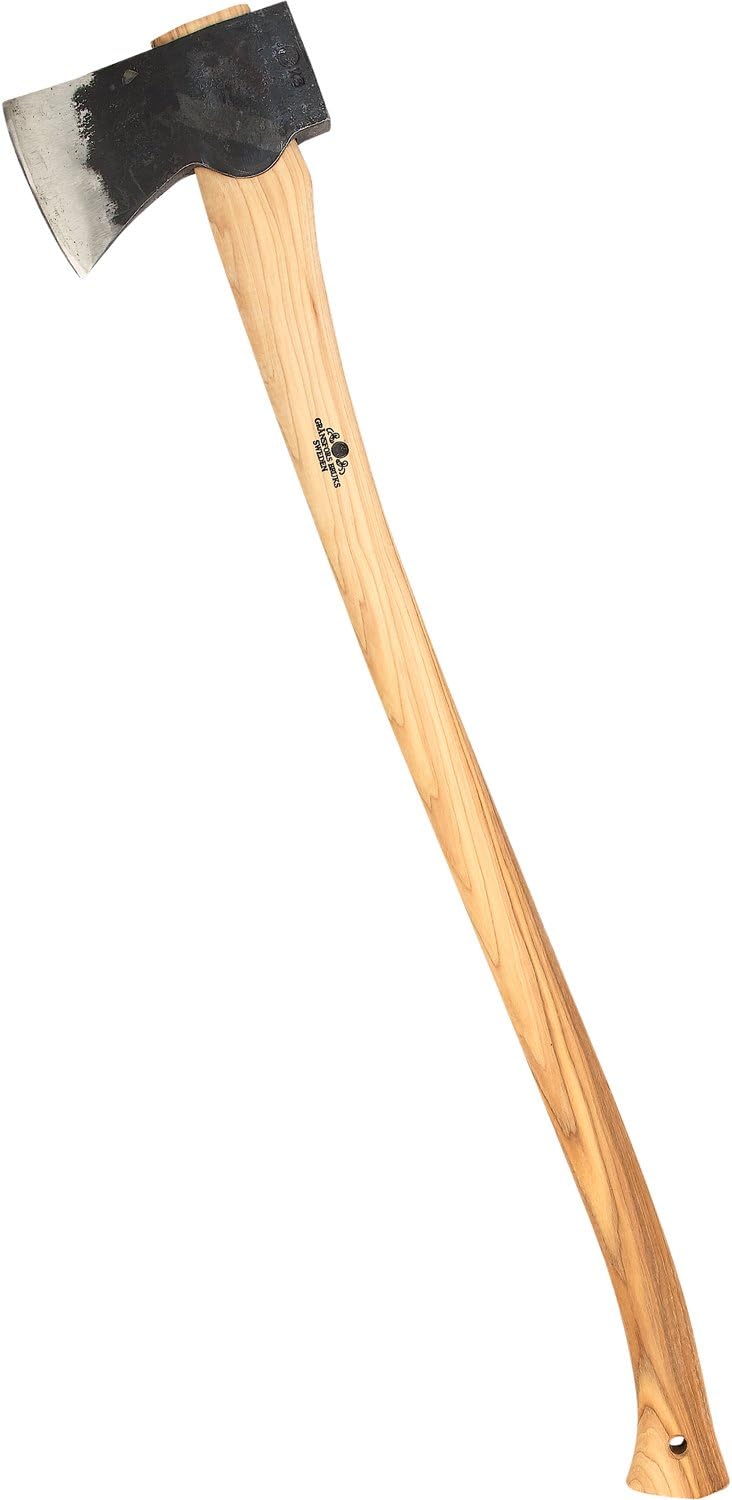
Gränsfors Bruks American Felling Axe, 35" Curved Handle
| Head Weight | 4.6 pounds |
|---|---|
| Item Weight | 5.3 pounds |
| Handle Material | Leather, Wood |
| Blade Material | Stainless Steel |
| Head Type | Felling |
The Gränsfors Bruks American Felling Axe is a professional, hand-forged tool built for cutting down large trees and making deep, controlled felling cuts. It pairs a heavy 4.6 lb head with an extended curved handle to deliver strong momentum and reach, which helps the blade bite into fresh, resinous woods like pine and spruce. The curved bit and long, broad 11.5 cm edge are suited to smooth, efficient chopping rather than fine carving, and the stainless steel blade plus vegetable-tanned leather sheath make it durable and straightforward to maintain. Typical use is repeated felling swings from standing or on a low stump and clearing large limbs where power per strike matters more than lightness. The axe is noticeably heavier than small forest axes, so it reduces the number of swings needed but requires more physical effort and control, especially over long sessions. For users who prioritize a long-lasting, purpose-built felling tool, this axe brings dependable performance, though it is not optimized for backpacking or very prolonged overhead work.
Best for: Buyers who want a durable, professional-grade felling tool for regular tree-felling and heavy forest work and who prioritize reliable cutting power over minimal weight.
Less Ideal for: Gardeners needing a lightweight multipurpose axe for occasional trimming or users who must carry an axe long distances on foot.
- Hand-forged heavy head delivers powerful, deep cuts suited to large trees
- Curved 11.5 cm cutting edge and curved bit improve bite into resinous wood
- Stainless steel blade and vegetable-tanned leather sheath offer durable, low-maintenance materials
- Long curved handle increases reach and swing momentum for efficient felling
- Heavier head and longer handle make it more tiring to use for extended periods
- Not appropriate for backpacking or light-duty pruning tasks
Verdict: Choose this axe when you need a rugged, hand-forged felling tool that delivers dependable cutting power for large trees.
Choosing the Right American Felling Axe: Key Factors to Consider
Head Weight and Momentum
Head weight determines how much cutting force is delivered with each swing. A heavier head transfers more kinetic energy and can cut deeper per hit, reducing the total number of swings on medium to large trunks.
Too heavy a head, however, becomes tiring and harder to control for longer sessions or for users with less upper-body strength. Choose a head weight that balances powerful cuts with the ability to place controlled blows for precise notch and backcut work.
Head Profile and Cutting Angle
The head profile and bevel angle control how the axe slices wood and how it behaves when it strikes knots or irregular grain. A more acute bevel slices aggressively and produces cleaner felling cuts, while a slightly blunter angle resists chipping and can survive tougher wood without frequent regrinding.
Pay attention to the eye and poll shape as well. A slim poll helps with follow-through and balance for swing recovery, while a carelessly shaped eye can make reshafting or tool maintenance harder in the field.
Handle Length and User Reach
Handle length affects leverage, swing arc, and user stance. Longer handles provide more reach and allow heavier heads to develop momentum with less effort, useful on larger trunks and when working from awkward angles.
Shorter handles improve control for precise notch cutting and are easier to maneuver in tight spaces. Consider your height, typical working distance from the trunk, and whether you will be using the axe single-handed for lighter tasks or two-handed for full-power swings.
Handle Material and Shock Absorption
Handle material influences comfort, durability, and how well vibrations are dampened. Traditional hickory absorbs shock well and is easy to replace or reshape; modern composite handles resist weather and splitting and often require less maintenance.
Wood handles are repairable and give tactile feedback that many users prefer. Synthetic or fiberglass-reinforced handles can last longer in damp conditions but may transmit more vibration. Think about climate and how often you want to maintain or replace the handle.
Edge Retention and Ease of Sharpening
Edge retention defines how long the axe will hold a usable cutting edge before you must sharpen it in the field. Steel hardness and heat treatment affect durability under repeated impacts and exposure to sap or grit.
Ease of sharpening matters when you are away from a full sharpening setup. A head that takes and holds a simple, rebuildable bevel lets you recover performance quickly with basic stones or files.
Balance and Swing Feel
Balance is the relationship between the head and handle mass and where the center of gravity falls during a swing. A balanced axe tracks predictably through the cut, letting you place strikes accurately and recover quickly for follow-up blows.
Poorly balanced tools feel twitchy or require constant correction mid-swing, increasing fatigue and the chance of glancing blows. Try to evaluate balance relative to your preferred grip and swing style rather than by head weight alone.
Matching Axe Choice to Tree Size and Species
Different tree diameters and wood hardness change how an axe performs. Small to medium deciduous trees often respond well to a medium-weight head with a keen bevel, while larger trunks or dense conifers may need more momentum from a heavier head to avoid long, tiring cutting sessions.
- Estimate diameter and species before selecting head weight.
- For hardwoods, lean toward slightly heavier heads or a more acute angle to ensure bite.
- For sap-heavy species, choose steel and finishes that resist corrosion and allow easier cleaning.
Technique and Safety Tips for Felling
Good technique reduces the number of swings and keeps cuts accurate. Set a proper notch and backcut sequence, stand clear of the expected fall path, and maintain stable footing. Use controlled, repeatable swings and let the axe do the work rather than forcing each hit.
Wear eye and hearing protection, and inspect the tool before use for secure head seating and any handle cracks. If a handle shows damage, replace it before attempting felling; a loose head is a major safety risk.
- Plan escape routes and clear hazards in the drop zone.
- Check for overhead hazards or lean that might change fell direction.
Maintaining an Axe in the Field
Field maintenance keeps an axe effective and safe during a cutting session. Carry a small file or stone to touch up the bevel between cuts, and wipe sap and grit from the head to prevent corrosion and abrasive wear. Keep the handle dry and reapply linseed oil to wooden grips when they start to dry out.
When storing, hang the axe in a dry place or use a blade cover to protect the edge. Replace or reshaped handles that show deep splinters or looseness; a sound handle is essential for control and safety.
- Clean and dry the head after use to slow rusting.
- Carry a sheath and a compact sharpening stone for quick touch-ups.
Choosing Between Wood and Synthetic Handles
Wood handles offer tactile feedback and are often easier to replace in the field or at a local workshop. They absorb shock well and can be sanded to a custom grip shape. However, wood requires periodic maintenance and can swell or shrink with moisture changes.
Synthetic handles resist weathering and are less likely to split, which reduces downtime. They sometimes transmit more vibration and can be harder to repair if damaged, but their low maintenance makes them attractive for users who work in damp conditions or who prefer a durable, worry-free option.
- Consider climate and storage when choosing handle material.
- Think about repairability versus long-term durability.
Transport and Carry Considerations
How you move an axe to the worksite affects what features you prefer. A longer handle provides better leverage but is bulkier to carry; consider a blade cover and secure transport method to protect the edge and prevent damage during transit.
For uphill approaches or work in dense brush, a slightly shorter axe or a collapsible carrier can make carrying simpler without sacrificing too much felling performance.
- Use a sheath when transporting to avoid accidental damage.
- Balance carrying length with the distance and terrain you must cross.
How We Chose the Best American Felling Axe
Our selection process prioritized features that matter most in real-world felling tasks. We evaluated head geometry and weight because these directly affect cutting power and how many swings are required per cut. Handle length and material were reviewed for durability, shock absorption, and control at typical felling distances. Edge retention and ease of sharpening were considered so each axe performs across multiple cuts without frequent re-profiling. Balance and swing feel received close attention since a well-balanced tool reduces fatigue and improves accuracy. We also checked construction quality for secure head-to-handle fit and corrosion resistance for outdoor storage. We excluded lightweight hatchets and specialty splitting mauls because they do not provide the long, controlled cuts needed for felling. Tools with obvious manufacturing defects, loose heads, or nonstandard handle fittings were filtered out. The final list favors axes built with traditional felling head profiles, reliable steel hardness for sustained edges, and handles sized to typical arborist and homeowner workflows.
FAQ
What head weight is best for general backyard tree felling?
For most homeowners felling small to medium trees, a medium head weight balances power and control. It lets you make effective notches without quickly tiring. Very large trees typically require heavier heads or alternative cutting equipment.
How often should I sharpen a felling axe during a day of work?
Sharpening frequency depends on wood condition and how many cuts you make. Expect to touch up the edge several times in a long session, especially when cutting dirty or knotty wood. A quick file or stone between heavy cuts keeps performance steady.
Are wooden handles better than synthetic for felling work?
Both have advantages. Wooden handles absorb shock and are easy to replace, while synthetic handles resist weather and splitting. Your climate, willingness to maintain the tool, and repair options usually determine the best choice.
Can I use a splitting axe or maul for felling?
Splitting axes and mauls are designed for separating grain, not making long slicing cuts. They perform poorly for felling because their profiles and weight distribution do not support clean notch and backcut work. Use a felling-specific head for predictable results.
How do I know if an axe is balanced for my swing?
Balance feels intuitive during practice swings. A balanced axe tracks straight and requires less mid-swing correction. Try a few dry swings with your typical grip and stance to assess whether the tool feels stable and predictable.
What maintenance keeps an axe safe long term?
Regularly inspect the head-to-handle fit, clean sap and grit off the head, keep the edge protected with a sheath, and treat wooden handles with oil to prevent drying. Replace handles if they split or loosen to avoid safety hazards.
Final Verdict
When choosing an American felling axe, prioritize head weight and balance relative to the trees you will work and your typical swing style. Head profile and edge-holding matter for clean cuts and easier sharpening in the field. Handle length and material influence reach, control, and maintenance needs. Tradeoffs are common: heavier heads cut more per swing but tire you faster; synthetic handles last longer but may change feel. Decide first on the typical tree size and working conditions, then match head weight, handle length, and balance to your technique. That approach makes it easier to pick an axe that stays safe, effective, and comfortable through many seasons of felling work.
