

Note: This article contains affiliate links. If you click on these links and make a purchase, I may earn a small commission at no extra cost to you. This helps support my research and content. Read my full affiliate disclosure here.
A good wood chopping axe makes a weekend of splitting firewood faster, safer, and less tiring. Whether you work with seasoned oak or softer species, the right axe head geometry and a dependable handle change how the tool behaves on every swing. This guide lists the top shortlisted options for heavy-duty wood chopping, chosen for their splitting geometry, handle durability, and ease of resharpening. You will find picks suited to regular firewood duties, occasional backyard jobs, and sustained outdoor use. Below you'll find each shortlisted axe evaluated on real-world factors gardeners and homeowners care about, plus practical buying guidance to match an axe to how you chop.
Top Picks at a Glance
| Best Overall The best all-around choice for most situations | Fiskars Pro IsoCore 8 lb Splitting Maul, 36" |  |
| Best Quality Built to a higher standard if you want something more solid | Hults Bruk Akka Forester Axe |  |
| Best Value The sweet spot between price and what you get | Fiskars X32 32" Splitting Axe |  |
| Best Budget The cheapest option that still gets the job done reliably | DESHIL 10" Outdoor Hatchet Mini Camping Axe with Sheath |  |
| Highest Rated A top-rated pick with lots of positive feedback | Fiskars X27 Super Splitting Axe, 36-inch |  |
| Most Popular A crowd favorite that many people choose with confidence | Fiskars X7 14" Hatchet |  |
| Best Seller A high-volume bestseller chosen again and again | Fiskars X25 28" Splitting Axe |  |
Fiskars Pro IsoCore 8 lb Splitting Maul, 36"

| Head Type | Splitting Maul |
|---|---|
| Blade Material | Forged Steel |
| Handle Material | Steel,Wood |
| Head Weight | 6.4 pounds |
The Fiskars Pro IsoCore 8 lb Splitting Maul is a purpose-built wood-splitting tool that combines a heavy forged-steel head and a long 36-inch handle to deliver strong, controlled swings for medium to extra-large logs. Typical use is splitting firewood at a backyard woodpile or campsite where leverage and one-strike splits matter. Notable features include Fiskars IsoCore shock control system in the handle that reduces strike shock and vibration, a high-performance textured grip that helps prevent slips, and an advanced blade geometry with a sharp edge that drives through wood and pulls free more easily. The durable construction and rust-resistant head make it suited to regular outdoor use, and the long handle gives taller users extra leverage. Limitations are that the 36-inch length and 8 lb head make it heavier and less maneuverable for tight spaces or users who prefer a lighter, more compact tool, and safe use requires proper technique and protective gear due to the maul's power.
Best for: Buyers who want a robust, reliable maul for regular firewood splitting and value leverage and reduced vibration to get through larger logs efficiently.
Less Ideal for: People who need a compact or lightweight splitting tool for tight spaces, frequent transport, or who have limited upper-body strength should consider smaller axes or splitting mauls.
- IsoCore shock-absorbing handle reduces vibration and hand strain during repeated swings
- 36-inch handle provides strong leverage for splitting medium to large logs
- Forged steel head with advanced blade geometry promotes deeper penetration and easier removal
- Textured, slip-reducing grip improves control on powerful swings
- Long 36-inch profile can be awkward in confined spaces or for shorter users
- Heavier overall weight requires more user strength and can fatigue during long sessions
Verdict: Choose this maul if you want a powerful, vibration-reducing 36-inch tool built to split medium to extra-large logs with fewer swings.
Hults Bruk Akka Forester Axe

| Head Weight | 1.5 pounds |
|---|---|
| Handle Material | Hickory Wood |
| Blade Material | Swedish Steel |
| Head Type | Forest |
| Blade Edge | Straight |
The Akka Forester is a performance-focused forest axe built for light chopping, trail clearing, and backcountry work. Its 1.5 pound hand-forged Swedish steel head delivers a hard, durable cutting edge while the 24-inch American hickory handle gives excellent leverage and control with relatively low overall weight. The straight knife-ground blade and finger notch near the neck make carving and precision cuts easier than with a broad felling head. It arrives with a traditional leather sheath and is finished with linseed oil on the handle. Expect crisp cuts on small to medium logs and good swing rhythm during extended use; the lighter head means less fatigue when carrying on overnight trips but limits efficiency on very large rounds compared with heavier felling axes. The handmade construction and quality steel support repeated sharpening and long life, though those qualities also mean you should treat it as a tool to maintain rather than a disposable option.
Best for: Buyers who prioritize cutting performance, edge durability, and a well-balanced tool for trail clearing, camping, or light forestry work and who are willing to maintain a high-quality hand tool.
Less Ideal for: People who need maximum splitting power for very large firewood or who want a no-maintenance, budget-oriented axe.
- Hand-forged Swedish steel head offers durable edge retention and can be sharpened repeatedly
- 24-inch hickory handle provides strong leverage and comfortable swing for trail and campsite tasks
- Light overall weight and 1.5 lb head reduce fatigue for hiking or extended use
- Includes leather sheath and user manual for safe transport and care
- 1.5 lb head is less efficient for splitting large diameter logs compared with heavier felling axes
- Premium handmade construction requires regular maintenance to preserve finish and edge
Verdict: Choose the Akka Forester if you want a lightweight, high-quality forest axe with a durable Swedish steel head and excellent balance for trail and camp work.
Fiskars X32 32" Splitting Axe
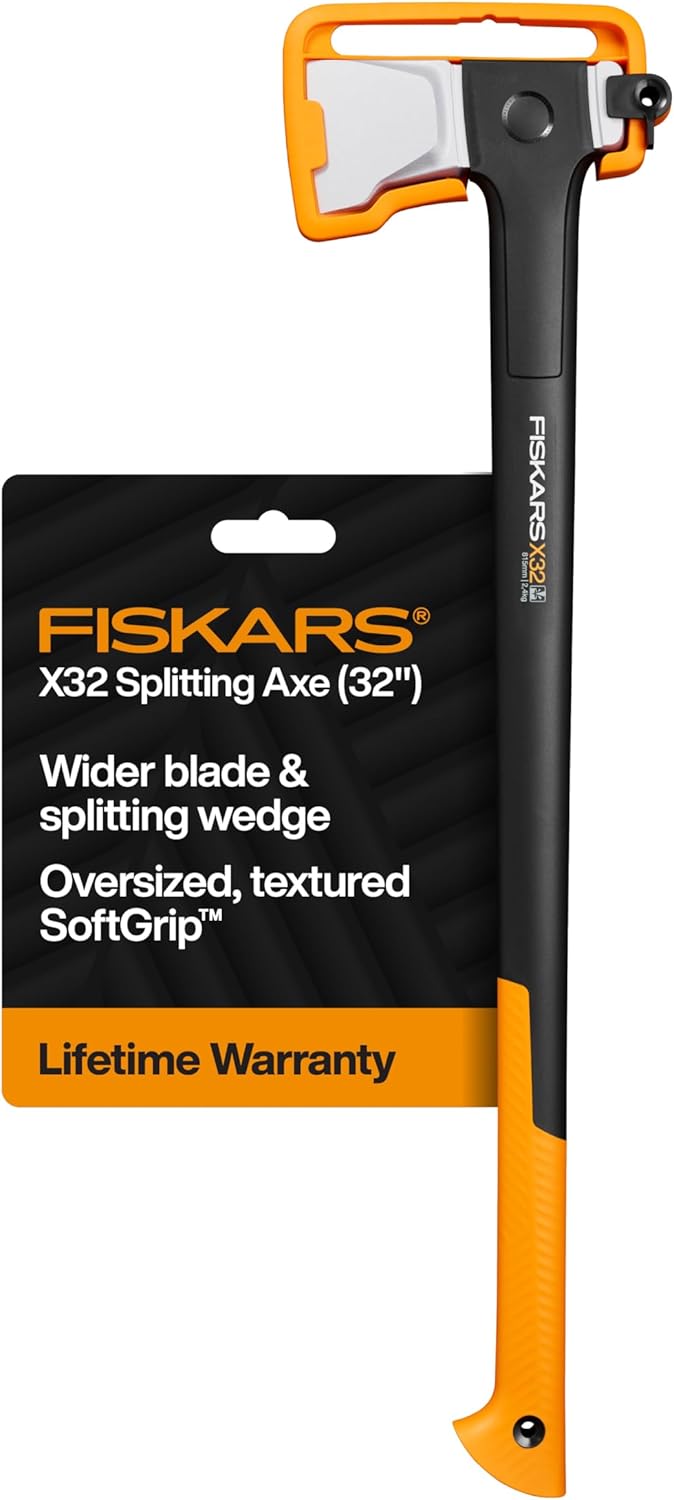
| Handle Material | Fiberglass |
|---|---|
| Blade Material | Forged Steel |
| Head Type | Splitting Wedge |
| Included Components | Sheath |
The Fiskars X32 is a purpose-built splitting axe for chopping large firewood and rounds over about 11.75 inches in diameter. Its wider forged-steel blade and splitting-wedge geometry concentrate impact force for cleaner, often one-strike splits, while the low-friction coating helps the blade slide out of wood and resists rust. The 32-inch FiberComp handle keeps the tool light, reduces vibration on overstrike, and the oversized textured SoftGrip plus hooked end improve control through repeated swings. The head is insert-molded for long-term retention, and the included sheath protects the edge in storage. Practical users will appreciate the balance between power and user comfort, especially when processing larger logs where swing speed and blade release matter. The axe is focused on splitting rather than felling or fine carving, so it is not the best choice for limb work or delicate chopping tasks.
Best for: Buyers who want an efficient, low-fatigue tool for processing large firewood and value clean one-strike splits and durable construction over versatility.
Less Ideal for: People who need a general-purpose or one-handed axe for limbing, felling small trees, or fine chopping should choose a different, shorter tool.
- Wider forged-steel splitting wedge concentrates force for faster, cleaner splits
- Low-friction coated blade reduces sticking and adds rust protection
- FiberComp handle absorbs shock and keeps the tool lighter than steel equivalents
- Oversized SoftGrip and hooked end improve secure handling during swings
- Insert-molded head design reduces risk of head loosening over time
- Designed specifically for splitting large logs so it is less suitable for felling or precision chopping
- Long 32-inch length may be unwieldy for users who prefer one-handed work or smaller logs
Verdict: A purpose-built splitting axe that delivers powerful, low-fatigue one-strike splits on large logs thanks to its wide forged blade and shock-absorbing handle.
DESHIL 10" Outdoor Hatchet Mini Camping Axe with Sheath

| Handle Material | Fiberglass |
|---|---|
| Blade Material | Carbon Steel |
| Head Type | Hatchet |
| Blade Edge | Convex |
The DESHIL 10-inch outdoor hatchet is a lightweight, budget-friendly tool designed for camping, kindling and light backyard work. Its heat-treated carbon steel head and convex blade edge hold a decent cutting profile for splitting small logs and trimming branches, and the painted finish helps resist corrosion. The fiberglass handle is shock-absorbing and has an anti-slip grip that reduces vibration during repetitive strikes and keeps the tool comfortable in wet conditions. A flat hammer-style poll adds simple multifunctionality for driving tent stakes or small nails. The hatchet ships with a protective sheath for safe transport and storage. Important limitations are its small size and lighter overall mass, which make it unsuitable for heavy-duty felling or splitting large rounds; expect slower progress on larger wood. For basic camp chores and occasional yard use this hatchet gives good value, but buyers who need high-powered splitting should choose a larger, heavier axe.
Best for: Buyers looking for an affordable, portable hatchet for camping, backpacking or light backyard chores who prioritize low cost and convenience over heavy splitting power.
Less Ideal for: People who regularly split large firewood or need a heavy-duty felling axe should choose a larger, heavier model designed for sustained splitting.
- Heat-treated carbon steel head for reasonable edge retention
- Fiberglass shock-reduction handle with anti-slip grip for comfort and reduced vibration
- Includes protective blade sheath for safe transport and storage
- Flat poll doubles as a hammer for driving stakes and small tasks
- Small 10-inch form limits chopping power and is not suited to splitting large logs
- Lightweight design may require more swings compared with heavier hatchets
Verdict: A practical, low-cost 10-inch hatchet that delivers dependable performance for campfire kindling and general campsite tasks.
Fiskars X27 Super Splitting Axe, 36-inch

| Included Components | Fiskars X27 Super Splitting Axe (36") |
|---|---|
| Head Weight | 4.3 pounds |
| Handle Material | Steel,Wood |
| Blade Material | Alloy Steel |
The Fiskars X27 is a purpose-built splitting axe that pairs a long 36-inch handle with a razor-sharp, convex-ground alloy steel head to make one-strike splits more likely on medium and large firewood. In typical use you stand with the longer handle to generate extra leverage and swing for deep blade penetration, then let the widened head and bevel geometry drive the split apart. Notable features include an insert-molded forged steel head for durability, a shock-absorbing textured handle to reduce hand strain and improve control, and a protective sheath for safe storage. The design emphasizes efficient, higher-power swings so you can split more wood with fewer strikes, which is especially helpful when prepping large cords of firewood or working by a fire pit. The axe is built for longevity with hardened blade steel and a handle meant to resist breakage, but the heavier head and long reach make it best suited to outdoor splitting rather than fine detail work or confined spaces.
Best for: Buyers who want an efficient, durable splitting axe for processing medium to large firewood and who value extra leverage and fewer swings when cutting cords of wood.
Less Ideal for: People who need a lightweight, maneuverable hatchet for camping, fine carpentry, or working in tight spaces should consider smaller tools instead.
- Long 36-inch handle provides extra leverage for taller users and harder swings
- Convex bevel and hardened alloy-steel head increase one-strike splitting performance
- Insert-molded forged steel head and shock-absorbing handle for durability and reduced vibration
- Includes protective sheath for safe transport and storage
- Long, heavy design is less maneuverable for small or precise jobs
- Not intended for indoor use or tight spaces
Verdict: Choose the Fiskars X27 if you want a rugged, long-handled splitting axe that maximizes leverage and one-swing splitting power for medium to large logs.
Fiskars X7 14" Hatchet

| Blade Material | Forged Steel |
|---|---|
| Head Type | Hatchet |
| Included Components | Fiskars X7 Hatchet (14") |
| Manufacturer Warranty Description | Lifetime Manufacturer Limited |
The Fiskars X7 14" Hatchet is a lightweight, purpose-built tool for campfire prep and light wood chopping. Its forged-steel head uses a proprietary grind and low-friction coating to hold an edge longer and reduce blade sticking when splitting small to medium kindling. The hatchet’s weight distribution increases swing speed and perceived power, so one-handed or short two-handed chops feel efficient compared with a basic hatchet. The FiberComp insert-molded handle provides shock absorption and a non-slip grip that reduces fatigue during repeated use, and the included sheath makes it safe to carry. Practical limitations are its size and head weight, which make it unsuitable for heavy-duty felling or large log splitting. The wooden handle listed in some specs may need occasional care compared with full synthetic handles, but the build and edge geometry make this a dependable choice for campers and yard work where a compact, durable hatchet is preferred.
Best for: Buyers who prioritize a reliable, easy-to-use hatchet for camping, firewood prep, and light yard tasks and who look for proven performance rather than experimental features.
Less Ideal for: People needing a heavy-duty splitting axe or a tool for cutting large trees should choose a larger splitting axe or maul instead.
- Proprietary ground forged-steel blade that stays sharp longer and reduces sticking
- Balanced weight distribution for increased swing speed and chopping power
- Shock-absorbing FiberComp handle with non-slip grip reduces user fatigue
- Compact size with included sheath makes it easy to carry for camping and hikes
- Not designed for heavy felling or splitting large logs due to lighter head weight
- Some listings reference a wooden handle which may require more maintenance than full synthetic handles
Verdict: A compact, well-engineered hatchet that delivers durable sharpness and efficient chopping power for campers and outdoor enthusiasts.
Fiskars X25 28" Splitting Axe

| Included Components | Fiskars X25 Splitting Axe (28") |
|---|---|
| Handle Material | Steel,Wood |
| Blade Material | Alloy Steel |
| Head Type | splitting wedge |
The Fiskars X25 28" Splitting Axe is built for efficient firewood splitting and yard work. Its convex bevel and sharp edge improve bite and blade penetration so you get more one-strike splits on medium to large logs, while the perfected weight distribution increases swing speed without extra effort. The insert-molded forged steel head and FiberComp shock-absorbing handle provide a durable, impact-resistant combination that reduces hand strain and resists overstrike damage. It ships with a protective sheath for safer storage and transport. Practical benefits include faster splitting sessions and reduced fatigue compared with generic axes, plus a design intended to shed from wood rather than sticking. Limitations are typical of full-size splitting axes: it is a two-handed tool not suited to delicate tasks or backpacking and requires practice to swing safely and accurately. For buyers focused on reliable, repeatable wood-splitting performance, the X25 is a robust, low-maintenance choice.
Best for: Buyers who want a dependable, easy-to-use splitting axe for regular firewood cutting and yard cleanup and who prioritize safety and predictable performance over lightweight portability.
Less Ideal for: People seeking a compact hatchet for one-handed use, ultralight backpacking gear, or precision chopping for woodworking projects should consider smaller or specialized tools instead.
- Convex bevel and sharp edge for deeper blade penetration and more one-strike splits
- Insert-molded forged steel head for long-term durability
- FiberComp shock-absorbing handle reduces hand strain and resists overstrike damage
- Designed balance and weight distribution to increase swing speed and efficiency
- Includes protective sheath for safer storage and transport
- Two-handed 28-inch design is bulky for small tasks or tight spaces
- Not intended for backpacking or ultralight camping use
Verdict: A sturdy, safety-minded splitting axe that delivers faster, lower-effort splits for routine firewood work.
Choosing the Right Wood Chopping Axe: Key Factors to Consider
Head Geometry and Wedge Angle
The shape of the axe head and the angle of the wedge determine how readily the blade forces wood fibers apart. A wider wedge pushes more wood aside and is better for splitting seasoned, knotty logs, while a narrower profile slices in more easily but can stick in dense wood.
Think about the types of wood you cut most often. If you split large, tough rounds, a pronounced wedge helps finish the split with fewer strikes. For smaller, wetter, or softer wood, a slimmer head reduces the swinging effort and improves control.
Blade Retention and Head Attachment
Secure attachment between the head and handle is essential for safety and longevity. Forged heads with full tang or well-set wedges resist loosening under repeated impact, while heads held on by simple friction can work loose over time.
Pay attention to how the head is fixed to the handle and whether it can be re-wedged or replaced. A design that allows straightforward maintenance avoids the need to replace the entire tool after wear or weather-related shrinkage of wooden handles.
Handle Material and Construction
Handle composition affects vibration damping, durability, and comfort. Traditional hickory absorbs shock well and can be shaped for a comfortable grip, but it requires occasional care and may crack if left outdoors. Fiberglass or composite handles resist weathering and often include molded grips, though they can transmit more vibration depending on construction.
Consider how often you will be chopping and whether you prefer a handle that can be repaired in the field. For heavy seasonal use, a balance of shock control and impact resistance will reduce fatigue and blistering during long sessions.
Weight, Length, and Balance
An axe's head weight and handle length control swing force and accuracy. Heavier heads deliver more splitting momentum, which reduces the number of strikes needed, but they also increase user fatigue and require greater control. Longer handles give leverage for power but can be harder to maneuver in tight spaces.
Balance between head and handle helps with predictable strikes. Try to match axe mass and length to your strength and typical log size. Overpowered tools make beginners tire quickly; undersized tools require more strikes and risk causing uneven splits.
Sharpening, Edge Holding, and Maintenance
Edges that are easy to sharpen and hold a keen profile reduce downtime and keep performance consistent. A blade steel that accepts a crisp bevel will cut and split more cleanly, but harder steels can be more difficult to reprofile in the field.
Also consider how the finish and coating protect against rust and whether the manufacturer or design makes routine upkeep straightforward. A blade you can quickly touch up after a day of chopping keeps work moving and prevents dangerous dull strikes.
Matching Axe Type to Chopping Tasks
Different chopping tasks call for different axe geometries and sizes. For splitting large rounds, a heavier splitting axe with a pronounced wedge reduces the need to prise the log open after initial impact. For smaller rounds or kindling, a shorter-handled axe with a slimmer profile gives better control and fewer misses.
Use lighter tools for trimming and clearing where precision and wrist control matter. Reserve longer, heavier tools for organized firewood processing where you have room to swing and the logs are consistently sized.
- Splitting large rounds: heavier head, pronounced wedge, longer handle
- Small logs and kindling: lighter head, narrower profile, shorter handle
- General yard use: balanced weight and medium length for versatility
Safe Chopping Technique and Maintenance Routine
Technique and upkeep matter as much as tool choice. Stand with a stable stance and aim for the log's natural cracks to reduce glancing blows. Keep a controlled swing and avoid overreaching to maintain accuracy and reduce the chance of the head striking the handle or bouncing.
Regularly inspect the head-to-handle fit and the cutting edge before each session. Replace or refit loose handles, and touch up nicks or dullness. Proper storage-dry and off the ground-prevents handle rot and blade corrosion, extending the axe's useful life.
- Check head fit and handle integrity before use
- Sharpen edge regularly to prevent dangerous dull strikes
- Store in a dry place and protect the blade with a sheath
Repair and Replacement Considerations
A practical chopping axe should allow common repairs. Wooden handles can usually be replaced with basic tools, and heads that can be re-wedged or pounded back into secure fit avoid premature retirement of the entire tool. Consider whether replacement handles are readily available for the design you choose.
For composite handles, check whether the manufacturer supports repairs or if damage requires full replacement. Think about long-term ownership: tools that are simple to service save time and money over repeated seasons of chopping.
- Look for designs that accept standard replacement handles
- Prefer heads that can be re-wedged rather than permanently fixed
- Keep a basic sharpening kit and spare wedges in your toolbox
Transporting and Storing Heavy Chopping Axes
Plan how you will move and store a heavy axe safely. A quality sheath protects the edge and prevents accidental cuts while transporting. When storing multiple axes, keep them separated to avoid nicking and to allow airflow around wooden handles.
In a workshop or shed, hang axes by the handle or use racks that cradle the head so the edge does not contact other tools. Long-term storage in humid areas calls for additional protective measures such as light oiling of the blade.
- Use edge protection when transporting
- Hang or rack axes to prevent dulling and moisture damage
- lightly oil bare steel if storing for long periods in damp conditions
Choosing an Axe for Occasional Vs Frequent Use
If you chop wood occasionally, prioritize ease of maintenance and a forgiving handle that requires little upkeep. For frequent or professional use, durability and repairability become paramount: robust head fixation, replaceable handles, and a steel that balances edge life with re-sharpenability.
Occasional users can accept slightly heavier maintenance demands if the tool delivers better splitting performance, while heavy users will save time with designs engineered for long runs of repetitive strikes.
- Occasional use: choose comfort and low maintenance
- Frequent use: choose repairable designs and durable construction
- Consider having two axes: one for heavy splitting and one for general trimming
How We Chose the Best Wood Chopping Axe
We focused on attributes that determine how an axe performs day after day in real chopping conditions. Primary evaluation criteria included head geometry and blade retention to assess splitting effectiveness and how well an edge stays put; handle material and construction to judge shock absorption and long-term durability; weight and balance to determine swing control and user fatigue over repetitive swings; and ease of maintenance, including how readily the head can be sharpened and the handle repaired or replaced. We also considered safety features such as secure head-to-handle fit and whether the design reduces bounce or off-center strikes. Exclusions included light hatchets and carving axes that are not intended for splitting logs, and novelty or decorative axes that lack practical chopping specifications. Final selections emphasize predictable splitting behavior, repairability, and long-term reliability for firewood and general yard chopping tasks.
FAQ
What length handle is best for splitting large logs?
Handle length depends on your strength and working space. Longer handles increase leverage and power, helping split big rounds with fewer strikes, but they require more swing control and space. For most adults processing large firewood, a medium-to-long handle offers a good balance between power and accuracy.
Can I use a hatchet for regular firewood splitting?
Hatchets are designed for light chopping and kindling and usually lack the wedge geometry and mass needed for efficient splitting of larger logs. They work for small, thin rounds and kindling but will require many more strikes on heavier logs and increase fatigue.
How often should I sharpen a wood chopping axe?
Sharpening frequency depends on use and wood type. For regular firewood sessions, a quick touch-up before each session and a fuller reprofile every few weekends of work keeps the edge effective. Hard or dirty wood dulls edges faster and may require more frequent attention.
Is a fiberglass handle better than a wooden one?
Fiberglass handles tend to resist weathering and can be more impact-resistant in certain designs, while wooden handles, especially hickory, offer excellent shock absorption and are easy to replace in the field. Which is better depends on whether you prioritize repairability and feel or low maintenance and weather resistance.
How can I tell if an axe head is loose and needs attention?
Signs of a loose head include a perceptible wobble, shifting during use, or repeated movement after striking. You may also hear a hollow knock on impact. Address a loose head immediately by removing the axe from service and re-wedging or replacing the handle to avoid unsafe conditions.
What protective gear should I use when chopping wood?
Wear eye protection to guard against chips and gloves to reduce blisters. Sturdy footwear and long pants protect legs and feet from stray blades or falling wood. Consider hearing protection for prolonged sessions and use a chopping block to raise the workpiece to a safe height.
Final Verdict
Pick a Wood Chopping Axe that matches the size of the logs you process and the frequency with which you chop. Prioritize head geometry and a secure head-to-handle connection for reliable splitting, then match handle material and weight to your comfort and maintenance preferences. Balance power and control: a heavier, well-wedged head reduces strikes but must be offset by a handle you can swing safely. By focusing on wedge shape, attachment security, and serviceability, you can choose an axe that lasts through seasons of firewood work while keeping swings efficient and safe.
