

Note: This article contains affiliate links. If you click on these links and make a purchase, I may earn a small commission at no extra cost to you. This helps support my research and content. Read my full affiliate disclosure here.
A small axe is often the most-used tool for light felling, limbing, kindling prep, and campsite chores. Choosing the right small axe matters because weight, head geometry, and handle ergonomics change how quickly and safely you work in a garden, yard, or on a trail. This guide shortlists seven top small axes suitable for garden and outdoor tasks and explains the practical differences that matter in real use. We evaluated cutting geometry, materials, and handling to help you pick the best tool for compact chopping needs.
Top Picks at a Glance
| Best Overall The best all-around choice for most situations | Estwing Sportsman’s Axe 14" Leather Grip Hatchet (E24A) |  |
| Best Quality Built to a higher standard if you want something more solid | Gränsfors Bruks Small Forest Axe, 19-inch |  |
| Best Value The sweet spot between price and what you get | Fiskars X13 Ultralight 13" Hiking Axe |  |
| Best Budget The cheapest option that still gets the job done reliably | DESHIL 10" Outdoor Hatchet Mini Camping Axe with Sheath |  |
| Highest Rated A top-rated pick with lots of positive feedback | Fiskars X14 14" Universal Hatchet |  |
| Most Popular A crowd favorite that many people choose with confidence | Fiskars X7 14" Hatchet |  |
| Best Seller A high-volume bestseller chosen again and again | Fiskars X11 17" Splitting Axe |  |
Estwing Sportsman’s Axe 14" Leather Grip Hatchet (E24A)

| Blade Material | Alloy Steel |
|---|---|
| Handle Material | Leather |
| Head Type | Hatchet |
| Blade Length | 3.25 inches |
The Estwing Sportsman’s Axe is a compact, one-piece forged hatchet built for rugged outdoor use. Its solid alloy-steel head and handle are forged as a single piece, which removes weak joints and gives the tool excellent balance and long-term durability. Typical uses include chopping small limbs, splitting kindling, driving tent stakes and light camp clearing; the 3.25-inch cutting edge handles those chores efficiently while the leather-sanded grip helps control swings and limits hand fatigue. The included ballistic nylon sheath with belt loop keeps the edge covered for transport and gives quick access at camp. Because the axe is relatively short and light, it is easy to carry in a pack or on a belt but will not replace a full-size felling axe for large logs or prolonged heavy splitting. Also the leather handle requires some care to avoid weather degradation compared with synthetic grips. For bushcraft tasks that need a durable, easy-to-carry hatchet that stays sharp and balanced, this model is a practical choice.
Best for: A practical bushcrafter or camper who values a durable, easy-to-carry hatchet for campsite tasks, firewood prep, and trail use and prefers tools built to last rather than lightweight novelty gear.
Less Ideal for: Not the best choice for users who need a dedicated felling axe or who will be splitting large quantities of thick firewood as their primary task.
- One-piece forged alloy-steel construction for strength and consistent balance
- Compact 14-inch length makes it easy to carry and maneuver in tight workspaces
- Hand-sanded leather grip improves comfort and control during extended use
- Ballistic nylon sheath with belt loop provides safe, convenient carry
- Short handle and small blade limit effectiveness on large-diameter logs or heavy-duty splitting
- Leather grip needs occasional maintenance to preserve durability in wet conditions
Verdict: Buy this if you want a stout, one-piece forged hatchet that balances durability and portability for bushcraft and campsite chores.
Gränsfors Bruks Small Forest Axe, 19-inch

| Blade Material | Stainless Steel |
|---|---|
| Handle Material | Hickory Wood |
| Head Type | Forest |
| Blade Edge | Convex |
The Gränsfors Bruks Small Forest Axe is a high-quality 19-inch hand axe built for cutting, limbing, and splitting small sticks and limbwood on camp trips. It pairs a convex stainless steel head shaped for forest work with a hickory handle that balances control and swing power in a compact package. Typical use will be chopping small trees, limbing felled wood, and splitting kindling for a campfire; the included vegetable-tanned leather sheath protects the blade when stored. Notable features are the finely ground convex edge for effective bite and durability, the short handle that makes it easy to carry and control around a campsite, and traditional hand-forging craftsmanship that keeps the head robust against repeated strikes. Limitations are its modest blade length and lighter head mass, which make it less efficient on large rounds or heavy splitting compared with full-sized splitting axes or mauls. For campers who want a durable, well-balanced axe for chopping and preparing small to medium firewood, this model delivers refined performance in a portable size.
Best for: Campers and outdoorspeople who prioritize a durable, well-crafted axe for chopping, limbing, and splitting kindling at camp and want a compact tool that is easy to carry and control.
Less Ideal for: Users who need maximum splitting power for large rounds or who prefer two-handed full-size splitting mauls for felling and heavy-duty processing should choose a larger tool.
- High-quality convex stainless steel head for reliable cutting performance and edge durability
- Hickory handle provides good balance and shock absorption for controlled swings
- Compact 19-inch length is easy to carry and maneuver at camp
- Comes with a vegetable-tanned leather sheath for safe transport and storage
- Smaller head and shorter handle limit efficiency on large logs and heavy splitting tasks
Verdict: A compact, hand-forged forest axe that gives campers dependable cutting and kindling-splitting performance in a portable form.
Fiskars X13 Ultralight 13" Hiking Axe
| Blade Material | Forged Steel |
|---|---|
| Handle Material | Alloy Steel |
| Included Components | Belt Loop, Sheath |
| Head Type | Hatchet |
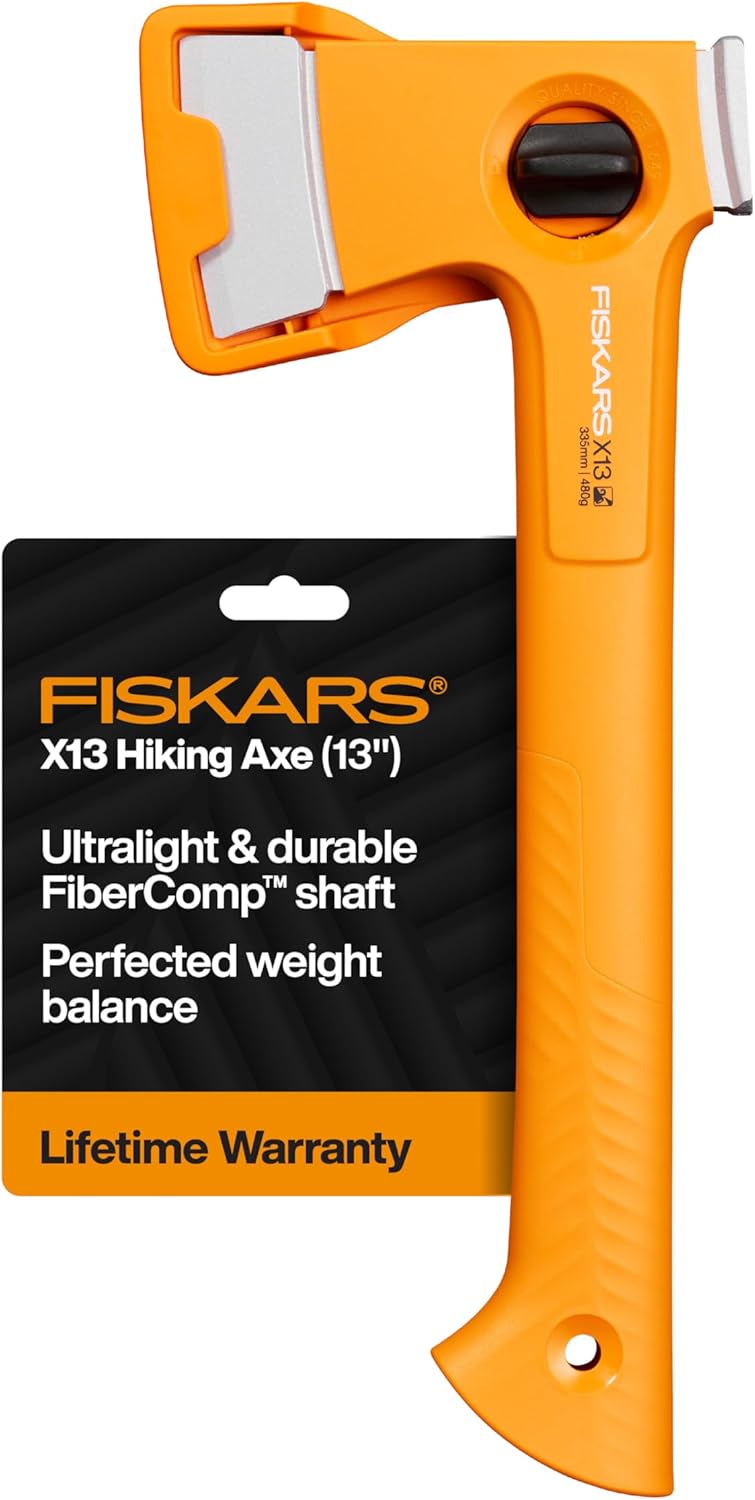
The Fiskars X13 Ultralight 13" hiking axe is built as a lightweight, easy-to-carry camp hatchet for hikers and backpackers who need a reliable tool for cutting kindling, light chopping and driving tent stakes. Its masterfully balanced, compact design makes single-handed swings comfortable and reduces fatigue on long hikes. The double-hardened forged steel blade and proprietary grinding give a sharp cutting edge that holds up for repeated use, while a low-friction coating helps the blade glide through wood and adds rust resistance. The bright orange FiberComp handle is strong, absorbs shock and is easy to spot if dropped, and the included locking sheath with belt loop keeps the blade covered in transit. Because it is an ultralight hatchet, it handles light campsite work very well but is not intended for heavy log splitting or felling large trees. Buyers should expect a tool optimized for portability and precision rather than maximum chopping power.
Best for: Buyers who prioritize a portable, dependable campsite hatchet for chopping kindling, light woodwork and driving tent stakes and who value ease of carry and reliable edge retention.
Less Ideal for: People who need a heavy splitting axe or a tool for sustained felling and large firewood processing should choose a larger, heavier-duty axe instead.
- Very lightweight, making it easy to carry on hikes and backpacking trips
- Double-hardened forged steel blade with proprietary grinding stays sharp and cuts cleanly
- Low-friction coating improves cutting performance and provides rust protection
- Bright FiberComp handle resists shock and is easy to locate outdoors
- Includes locking sheath with belt loop for safe transport
- Not suited for heavy-duty splitting or felling larger logs
Verdict: A lightweight, well-balanced hatchet that delivers sharp, reliable cutting for hikers and campers who need a portable everyday campsite tool.
DESHIL 10" Outdoor Hatchet Mini Camping Axe with Sheath

| Handle Material | Fiberglass |
|---|---|
| Blade Material | Carbon Steel |
| Head Type | Hatchet |
| Blade Edge | Convex |
The DESHIL 10-inch outdoor hatchet is a lightweight, budget-friendly tool designed for camping, kindling and light backyard work. Its heat-treated carbon steel head and convex blade edge hold a decent cutting profile for splitting small logs and trimming branches, and the painted finish helps resist corrosion. The fiberglass handle is shock-absorbing and has an anti-slip grip that reduces vibration during repetitive strikes and keeps the tool comfortable in wet conditions. A flat hammer-style poll adds simple multifunctionality for driving tent stakes or small nails. The hatchet ships with a protective sheath for safe transport and storage. Important limitations are its small size and lighter overall mass, which make it unsuitable for heavy-duty felling or splitting large rounds; expect slower progress on larger wood. For basic camp chores and occasional yard use this hatchet gives good value, but buyers who need high-powered splitting should choose a larger, heavier axe.
Best for: Buyers looking for an affordable, portable hatchet for camping, backpacking or light backyard chores who prioritize low cost and convenience over heavy splitting power.
Less Ideal for: People who regularly split large firewood or need a heavy-duty felling axe should choose a larger, heavier model designed for sustained splitting.
- Heat-treated carbon steel head for reasonable edge retention
- Fiberglass shock-reduction handle with anti-slip grip for comfort and reduced vibration
- Includes protective blade sheath for safe transport and storage
- Flat poll doubles as a hammer for driving stakes and small tasks
- Small 10-inch form limits chopping power and is not suited to splitting large logs
- Lightweight design may require more swings compared with heavier hatchets
Verdict: A practical, low-cost 10-inch hatchet that delivers dependable performance for campfire kindling and general campsite tasks.
Fiskars X14 14" Universal Hatchet

| Handle Material | Alloy Steel |
|---|---|
| Blade Material | Forged Steel |
| Included Components | Sheath |
| Head Type | Hatchet |
The Fiskars X14 is a balanced 14-inch universal hatchet intended for chopping kindling, limbing small branches, and light felling tasks where single-handed control matters. It pairs a double-hardened forged steel blade with a low-friction coating to cut through fresh, resinous wood cleanly and resist surface corrosion. The FiberComp handle is lightweight but engineered to absorb shock and protect the head from overstrike damage, while the ergonomically curved grip and SoftGrip texture help keep your wrist comfortable during repeated swings. An insert-molded head reduces the risk of handle separation and loosening over time, and the included sheath keeps the blade protected in storage or transport. The tool is not meant for heavy log splitting or prolonged two-handed chopping; users who overwork it on large firewood may find the blade or handle strained. For regular garden clearing, campsite tasks, and producing kindling, the X14 offers a reliable, low-maintenance option built for dependable everyday use.
Best for: A buyer who prioritizes a dependable, low-maintenance tool for routine garden work, campsite tasks, and making kindling will appreciate this hatchet's durability and consistent performance.
Less Ideal for: People who need an axe for splitting large logs, prolonged two-handed chopping, or heavy-duty forestry work should choose a dedicated splitting axe or a longer-handled felling axe instead.
- Balanced, single-handed design for controlled swings and accurate chopping
- Double-hardened forged steel blade with low-friction coating for cleaner cuts and rust resistance
- FiberComp handle that absorbs shock and reduces overstrike damage
- Insert-molded head construction to minimize loosening and handle separation
- Included sheath for safe storage and transport
- Not intended for heavy log splitting or sustained two-handed chopping
- Handle material listed as alloy steel in some specs which may confuse buyers expecting composite
Verdict: A dependable, well-balanced hatchet built for clean cuts and long-term reliability in routine garden and campsite tasks.
Fiskars X7 14" Hatchet

| Blade Material | Forged Steel |
|---|---|
| Head Type | Hatchet |
| Included Components | Fiskars X7 Hatchet (14") |
| Manufacturer Warranty Description | Lifetime Manufacturer Limited |
The Fiskars X7 14" Hatchet is a lightweight, purpose-built tool for campfire prep and light wood chopping. Its forged-steel head uses a proprietary grind and low-friction coating to hold an edge longer and reduce blade sticking when splitting small to medium kindling. The hatchet’s weight distribution increases swing speed and perceived power, so one-handed or short two-handed chops feel efficient compared with a basic hatchet. The FiberComp insert-molded handle provides shock absorption and a non-slip grip that reduces fatigue during repeated use, and the included sheath makes it safe to carry. Practical limitations are its size and head weight, which make it unsuitable for heavy-duty felling or large log splitting. The wooden handle listed in some specs may need occasional care compared with full synthetic handles, but the build and edge geometry make this a dependable choice for campers and yard work where a compact, durable hatchet is preferred.
Best for: Buyers who prioritize a reliable, easy-to-use hatchet for camping, firewood prep, and light yard tasks and who look for proven performance rather than experimental features.
Less Ideal for: People needing a heavy-duty splitting axe or a tool for cutting large trees should choose a larger splitting axe or maul instead.
- Proprietary ground forged-steel blade that stays sharp longer and reduces sticking
- Balanced weight distribution for increased swing speed and chopping power
- Shock-absorbing FiberComp handle with non-slip grip reduces user fatigue
- Compact size with included sheath makes it easy to carry for camping and hikes
- Not designed for heavy felling or splitting large logs due to lighter head weight
- Some listings reference a wooden handle which may require more maintenance than full synthetic handles
Verdict: A compact, well-engineered hatchet that delivers durable sharpness and efficient chopping power for campers and outdoor enthusiasts.
Fiskars X11 17" Splitting Axe

| Blade Material | Forged Steel |
|---|---|
| Handle Material | Wood |
| Head Type | Splitting Wedge |
| Included Components | Sheath |
The Fiskars X11 17" Splitting Axe is a compact, well-balanced tool built to split small logs and produce kindling with fewer swings. It pairs a wedge-shaped forged steel head and advanced blade geometry to increase penetration and make the blade easier to remove from wood. The lightweight FiberComp handle provides shock absorption and an insert-molded head design that prevents loosening, so the axe feels secure during repetitive swings and holds up to outdoor use. Typical uses include splitting camp firewood, trail clearing, and backyard kindling preparation where portability and one-handed control matter. The included sheath protects the blade in transport. Limitations are inherent to its size: it is optimized for small to medium rounds and not intended for heavy-duty felling or splitting large logs, and users expecting a traditional wooden handle may notice the composite feel. For buyers wanting a reliable, low-maintenance hatchet for campsite and light yard work, this model offers a compelling combination of power and durability.
Best for: Buyers who want a portable, durable splitting axe for campsite use, kindling prep, and light yard work and who prioritize efficiency and low maintenance over heavy-duty splitting.
Less Ideal for: People who need an axe for regularly splitting large rounds, felling trees, or heavy commercial use should choose a larger splitting maul or full-size axe instead.
- Wedge-shaped forged steel head and advanced blade geometry for efficient one-strike splits
- FiberComp composite handle absorbs shock and resists weathering
- Insert-molded head design prevents the head from loosening over time
- Lightweight, well-balanced design improves swing speed and control
- Includes protective sheath for safe transport and storage
- 17-inch length and lighter head limit effectiveness on large logs or heavy-duty splitting
- Composite handle lacks the traditional feel preferred by some users
Verdict: A rugged, lightweight 17-inch splitting axe that gives campers and homeowners efficient, low-maintenance splitting power for small logs and kindling.
Choosing the Right Small Axe: Key Factors to Consider
Head Steel and Hardness
Head steel and heat treatment determine how long a small axe will hold an edge and how easily it can be sharpened in the field. Harder steels can maintain a keen cutting edge longer but can be more brittle if not properly heat treated. Softer steels are easier to reprofile and more forgiving if the axe contacts dirt or stone, but they require more frequent sharpening.
For gardeners who use an axe for regular limb removal or kindling preparation, a balance between hardness and toughness is ideal. Consider whether you are comfortable sharpening the head yourself and how often you expect to touch up the blade between uses.
Head Shape and Edge Geometry
The head profile and bevel angle affect how the axe cuts and how it splits wood. A thinner, more acute edge slices cleanly and is excellent for chopping small to medium-diameter wood, while a slightly blunter, wedge-shaped head is better at splitting and preventing the blade from sticking.
Think about the main tasks you will do. If you frequently cut through green limbs and small trunks, a thinner cutting profile saves effort. If you primarily split dry logs into kindling, a heavier wedge-style head reduces binding and speeds the job.
Weight and Balance
Small axes vary from lightweight carry axes to denser camp or woodworking tools. Overall weight influences swing power and fatigue. A heavier head generates more chopping force with each strike but requires more effort to control and can tire you faster during long sessions. Balance between head and handle determines how predictable the swing feels and how easily you can place precise cuts.
For yard work and one-handed limbing, choose a lighter, well-balanced axe. For two-handed chopping of small trunks or for faster kindling production, a slightly heavier head can be advantageous.
Handle Material and Ergonomics
Handles come in wood, fiberglass, or composite materials, each with tradeoffs. Wooden handles offer a natural feel and can absorb shock well but need occasional care to prevent rot and loosening. Fiberglass or composite handles are low-maintenance and resist weather, but they can transmit more vibration to the hands depending on design.
Ergonomics matter for control and comfort. A handle profile that fits your grip and allows for a secure two-handed hold will reduce blisters and improve accuracy. Consider handle length relative to your height and the tasks you plan to do.
Edge Retention and Sharpenability
How long an axe keeps a usable edge and how easy it is to sharpen in the field will shape your maintenance routine. Some steels hold an edge well but are difficult to resharpen without specialized stones. Others are simple to touch up with common files or whetstones.
If you expect to use the axe away from a workshop, favor heads that accept straightforward field sharpening. For home garden use where you have sharpening tools on hand, longer-lasting but harder steels can be acceptable.
Protective Features and Safety
Safety touches the whole design: a well-secured head, a non-slip grip, and an effective sheath for transport. A loose head or slick handle increases the chance of accidents during swings or when the axe bounces out of wood. Sheaths protect the edge and anyone handling the tool when it is stored or carried.
Check construction methods that prevent the axe head from loosening, and prefer handles with textured grips or comfortable contours that reduce the chance of slipping when hands are sweaty or wet.
Best Uses for a Small Axe in the Garden
Small axes shine in tasks that require control rather than raw power. They are ideal for pruning larger limbs that are too big for loppers, cutting small trunks, and producing kindling quickly. Their compact size also makes them suitable for working in tight spaces where a full-sized felling axe would be awkward.
Beyond routine yard work, a small axe is useful for campsite chores, clearing brush from narrow trails, and shaping stakes or small posts for garden structures. Think of it as the go-to tool when a pruning saw is too slow and a heavy maul is overkill.
- Limbing and small trunk cutting
- Kindling and firewood preparation
- Trail clearance and brush work
- Light carpentry tasks like shaping stakes
Field Sharpening and Edge Care
Keeping a small axe sharp maintains cutting efficiency and reduces the force required per strike, which lowers fatigue and risk of mishits. Portable files, a diamond sharpener, or a small whetstone are the most practical tools for field maintenance. Remove nicks promptly to prevent edge failure during use.
After sharpening, protect the blade with a thin coat of oil to resist rust and store the axe in a sheath. Periodic stropping or honing between jobs keeps the edge working well without full reprofile work.
- Carry a compact file or diamond stone for field touch-ups
- Use oil to prevent rust after humid or wet use
- Address dents quickly to avoid larger edge damage
Safe Handling and Swing Technique
Good technique reduces accidents and improves effectiveness. Stance and controlled swings are more important with a small axe because users often work closer to branches and bodies. Use a stable footing, keep others clear of your swing arc, and make deliberate strikes rather than wild, momentum-driven swings.
When limbing, support the branch where possible and strike at an angle that encourages the limb to fall away from you. For splitting, aim for the top of the log and follow through so the axe head completes the cut rather than bouncing out.
- Maintain a clear swing zone and secure footing
- Use two hands for controlled, accurate strikes
- Cut at angles that direct falling limbs away from you
Maintaining Wooden Handles
Wooden handles need occasional attention to remain safe and comfortable. Check for cracks, loose heads, and wear at the shoulder where the handle meets the head. Treat handles with boiled linseed oil or a similar finish to reduce drying and splitting in outdoor storage conditions.
If the handle becomes splintered or develops a soft spot from moisture, replace it before use. Well-kept wooden handles provide a good balance of shock absorption and tactile feedback that many gardeners prefer.
- Apply linseed oil periodically to prevent drying
- Inspect for cracks and loose heads before each use
- Replace handles that show persistent damage or softness
Transport and Storage Tips
Store small axes in a dry place with a sheath covering the blade to protect the edge and prevent accidents. Hanging the tool keeps the handle from resting on surfaces that can attract moisture. For transport, secure the axe so it cannot shift and risk cutting through other gear.
If you carry the axe in a pack while hiking, use a dedicated sheath and consider wrapping the handle to limit exposure to the elements. Keeping the head clean and oiled after trips reduces corrosion and keeps the axe ready for the next use.
- Use a fitted sheath for storage and transport
- Store in a dry, ventilated spot away from direct ground contact
- Clean and oil the head after wet conditions
How We Chose the Best Small Axe
We focused on practical gardening and outdoor use when selecting the seven small axes on this list. Key evaluation criteria were head steel and hardness for edge retention, head geometry and poll design for efficient wood splitting and controlled swings, handle material and shape for grip comfort and shock control, overall weight and balance for fatigue and accuracy during repeated chops, and durability of construction for long-term garden work. We tested how each factor affected typical tasks like limb removal, small trunk felling, and kindling production in backyard and campsite conditions. We excluded specialty forest felling tools and decorative or novelty axes that lack the build quality for regular use. Items that required extensive aftermarket modification to be safe or usable were not considered. The result is a set of compact axes that meet real gardener expectations for cutting performance, handling, and longevity.
FAQ
What size small axe is best for garden limbing?
A small axe with a head weight around 1.5 to 2.5 pounds and a handle length between 14 and 22 inches is often best for limbing. That range offers a balance between control for one-handed work and enough mass for efficient chopping.
Can I use a small axe to fell small trees?
You can fell small trees with a small axe, but it depends on trunk diameter and wood type. For small-diameter saplings and thin trunks, a compact axe can work well. For larger trunks, a saw or larger felling axe is safer and more efficient.
How often should I sharpen a small axe used in the yard?
Frequency depends on use intensity and wood types. Light, occasional yard use may require touch-ups every few outings, while heavy daily work calls for more frequent sharpening. Maintain a sharp edge to reduce strike force and avoid chipping.
Is a fiberglass handle better than wood for outdoor use?
Fiberglass handles resist moisture and require less maintenance, making them good for wet conditions. Wooden handles offer better vibration damping and a natural feel but need periodic care to prevent drying and rot. The best choice depends on your maintenance preferences and exposure to weather.
What maintenance should I do after cutting dirty or frozen wood?
Clean off sap, dirt, and ice as soon as possible to prevent corrosion and edge damage. Wipe the blade dry and apply a light coat of oil. Inspect the edge for nicks and touch up with a file if necessary before storing.
Are sheaths important for small axes?
Yes. A proper sheath protects the edge and reduces the risk of accidental cuts during storage and transport. It also helps keep the blade drier and cleaner when the axe is not in use.
Final Verdict
Prioritize the features that match how and where you will use a small axe. If you need precise, frequent limbing and campsite tasks, favor a lighter, well-balanced head and a comfortable handle. If you plan to split more wood or do tougher yard jobs, accept a slightly heavier head and a sturdier handle. Tradeoffs between edge retention and ease of sharpening, and between wooden and synthetic handles, are the main decisions to make. With those priorities clear, you can choose a compact axe that is safe, effective, and comfortable for regular garden work.
