

Note: This article contains affiliate links. If you click on these links and make a purchase, I may earn a small commission at no extra cost to you. This helps support my research and content. Read my full affiliate disclosure here.
Choosing the right felling axe under $100 matters when you need to fell small trees, clear windfall, or split large logs for firewood. The right axe balances a sharp, well-shaped head with a handle that resists shock and stays comfortable during repeated swings. In this guide we shortlisted five felling axes that fit the price cap and the demands of backyard and light forestry work. Each pick was evaluated for cutting performance, head materials, handle durability, and everyday usability so you can pick the best tool for the jobs you expect to do. Read on to see how we assessed these axes and which features matter most in the field.
Top Picks at a Glance
| Best Quality Built to a higher standard if you want something more solid | Council Tool 3.5 lb Jersey Axe with 36" Curved Hickory Handle |  |
| Best Value The sweet spot between price and what you get | Fiskars X24 24" Universal Axe |  |
| Best Budget The cheapest option that still gets the job done reliably | INTERTOOL 36" Felling Axe HT-0264 — 2.8 lb Carbon Steel Head with Fiberglass Handle |  |
| Highest Rated A top-rated pick with lots of positive feedback | Husqvarna A2400 28 in Multi-Purpose Axe |  |
| Most Popular A crowd favorite that many people choose with confidence | Fiskars X15 24" Chopping Axe |  |
Council Tool 3.5 lb Jersey Axe with 36" Curved Hickory Handle

| Head Weight | 3.5 pounds |
|---|---|
| Blade Length | 5 inches |
| Handle Material | Hickory Wood |
| Blade Material | Tool Steel |
| Head Type | Jersey |
The Council Tool 3.5 lb Jersey axe is a purpose-built felling axe aimed at serious woodcutting tasks. Its forged tool-steel head is heat-treated and hand-sharpened with a tapered bit and single blade edge to retain a keen cutting profile through repeated use. The Jersey-pattern head includes pronounced lugs for a secure wedge fit and a square poll for striking or driving wedges. The 36-inch curved American hickory handle is dried to low moisture and attached with a double-wedge system, giving a confident, low-looseness connection that absorbs shock while maintaining control. In practice this axe excels at driving deep, controlled cuts on standing timber and felling medium to large trees, and the head weight balances power with manageable swing speed. Important limitations are that it is a full-sized professional tool suited to outdoor heavy work rather than light garden chores, and it requires routine maintenance such as sharpening and handle inspection to keep peak performance. For buyers focused on durable, field-ready felling power, this is a straightforward, no-nonsense choice.
Best for: Buyers who prioritize felling performance and durability for regular timber work and want a traditional, field-ready axe that holds an edge.
Less Ideal for: Casual gardeners, occasional users, or anyone needing a lightweight multiuse hatchet or indoor-friendly tool should consider smaller, easier-to-handle options.
- Forged tool-steel head heat-treated and hand-sharpened for edge retention and cutting performance.
- Jersey-pattern head with lugs for a secure, durable head-to-handle connection.
- Strong American hickory curved handle dried below 10% moisture to reduce shrinkage and shock.
- Square poll and tapered bit add versatility for driving wedges and delivering controlled cuts.
- Full-sized professional design is heavier and less maneuverable for light yard tasks.
- Requires regular sharpening and handle checks to maintain safety and performance.
Verdict: Choose this axe if you want a tough, American-made felling tool built for dependable cutting power in regular timber work.
Fiskars X24 24" Universal Axe

| Handle Material | Fiberglass |
|---|---|
| Blade Material | Forged Steel |
| Head Type | Felling |
| Blade Edge | Wide |
The Fiskars X24 is a purpose-built 24-inch felling axe that prioritizes balanced power and control for cutting down trees and heavy chopping tasks. Its thin, wide forged-steel blade with a low-friction coating slices cleanly through fresh, resinous woods like pine and spruce and resists sticking and surface rust. The FiberComp handle is lighter than steel and designed to absorb shock, reducing hand and arm fatigue during repetitive swings, while the insert-molded head lowers the chance of head loosening after heavy use. A large textured SoftGrip zone and hooked handle end improve hold and safety through the swing. It ships with a protective sheath for transport and storage. Limitations to note are that its 24-inch length and blade profile favor felling and chopping rather than splitting small rounds or delicate limbing, and users expecting a heavier splitting axe will find this optimized more for controlled swings and cutting than for splitting large, seasoned logs.
Best for: Buyers who want a reliable, efficient axe for tree felling and heavy chopping that balances power with reduced fatigue and secure handling.
Less Ideal for: People who primarily split large, seasoned firewood or need a compact hatchet for backpacking should consider a splitting axe or smaller tool instead.
- Balanced 24-inch design amplifies swing power while remaining controllable for felling tasks
- Low-friction, double-hardened forged-steel blade stays sharp longer and reduces sticking in resinous wood
- FiberComp handle reduces shock and hand fatigue compared with metal handles
- Insert-molded head construction minimizes risk of head separation under heavy use
- Includes sheath for safer transport and storage
- Not optimized for splitting large, seasoned rounds where a heavier, wedge-style axe is preferable
- Long 24-inch length may be less convenient for tight or precision limbing tasks
Verdict: Choose the Fiskars X24 if you need a well-balanced 24-inch felling axe that delivers powerful, clean cuts with less vibration and reliable head retention.
INTERTOOL 36" Felling Axe HT-0264 — 2.8 lb Carbon Steel Head with Fiberglass Handle
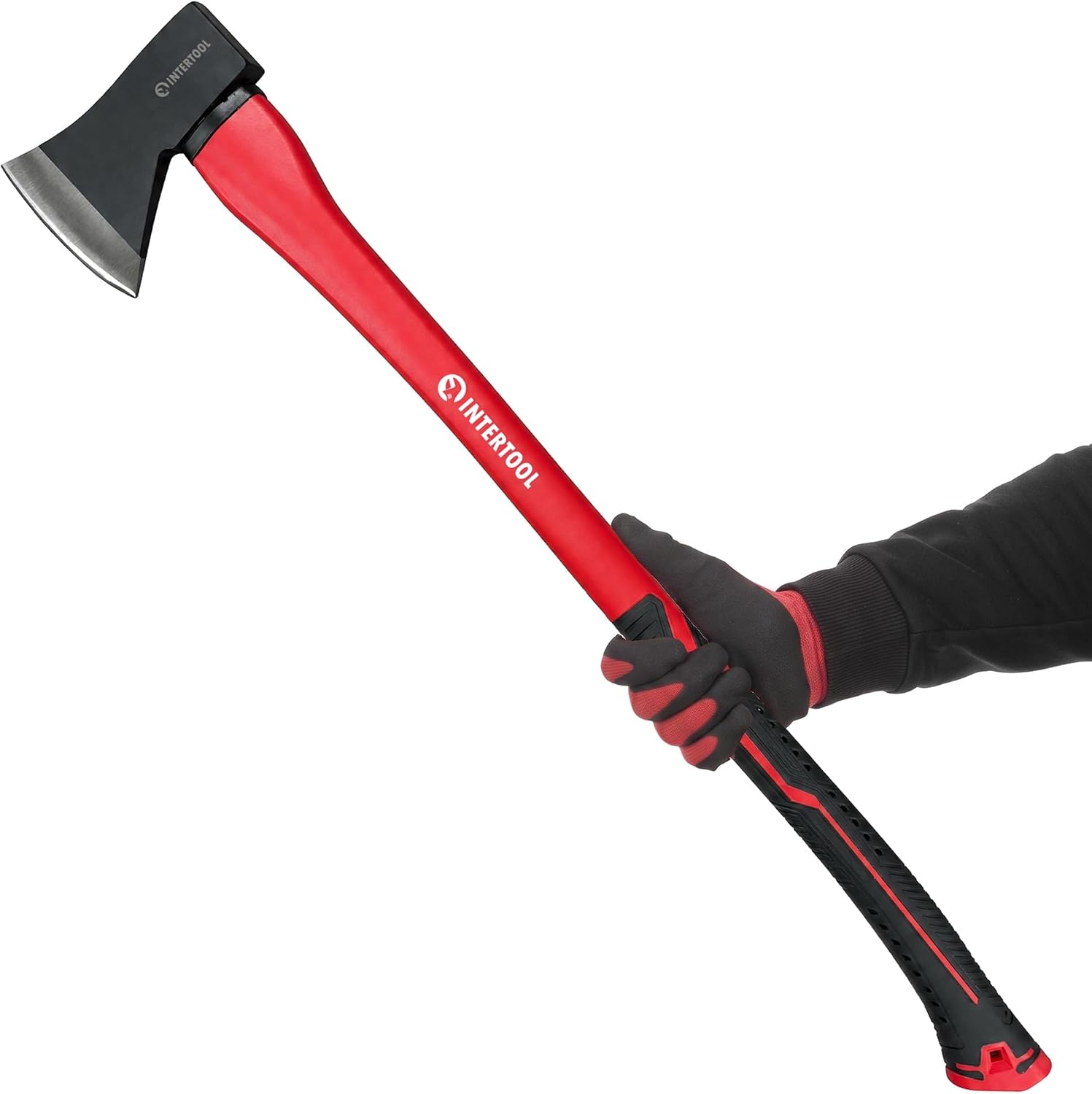
| Head Type | Felling |
|---|---|
| Head Weight | 2.8 pounds |
| Handle Material | Fiberglass |
| Blade Length | 5.1 inches |
The INTERTOOL HT-0264 is a long-handled felling axe built for yard work and cutting firewood. With a 36-inch fiberglass handle it gives good leverage for deeper swings, while the 2.8 pound forged carbon steel head arrives pre-sharpened and coated to resist rust. The textured, non-slip rubber grip and shock-absorbing handle reduce vibration and make repetitive chopping more comfortable. Use it for felling smaller trees, limbing, and splitting rounds into firewood; the head-to-handle balance improves swing control so you can place cuts more accurately. The included sheath protects the blade during storage and transport. Limitations to expect are the midweight head, which is better suited to smaller trunks and splitting than to heavy-duty professional felling, and the fiberglass handle, which while low-maintenance is less traditional than wood and may feel different to some users. For routine property maintenance it combines power, corrosion resistance, and user comfort in a practical package.
Best for: Buyers who want a practical, low-maintenance felling axe for regular property work and firewood preparation and who prioritize leverage, comfort, and corrosion resistance over maximum head mass.
Less Ideal for: Not the best choice for professional arborists or anyone who needs a very heavy head for felling large trees or for those who insist on a traditional wooden handle feel.
- Long 36-inch fiberglass handle gives improved leverage for longer swings and deeper cuts.
- Forged, heat-treated carbon steel head (2.8 lb) ships pre-sharpened and has a protective coating to resist rust.
- Shock-absorbing handle and textured rubber grip reduce vibration and improve control during repetitive chopping.
- Comes with a blade sheath for safer transport and storage.
- 2.8 lb head is midweight and may be underpowered for large-diameter trees or heavy professional felling.
- Fiberglass handle offers less traditional feel and may not suit users who prefer wooden handles.
Verdict: A practical, comfortable long-handled felling axe that delivers good leverage and durability for routine tree felling and firewood work.
Husqvarna A2400 28 in Multi-Purpose Axe

| Head Type | Felling |
|---|---|
| Blade Edge | Hollow Grind |
| Blade Material | Stainless Steel |
| Handle Material | Stainless Steel, Steel, Wood |
The Husqvarna A2400 is a 28-inch multi-purpose felling axe built for regular woodcutting and pruning tasks. Its hollow-ground stainless steel blade with a non-stick coating reduces friction and helps the head bite and release cleanly through wood. The fiber-reinforced shaft includes a stainless steel component at the head for added protection and longer service life, and the overall balance is tuned for controlled swings. You can also use the back of the head as a hammer with standard splitting wedges, which adds versatility on the job. Practical benefits include reduced sticking during cuts, a durable shaft that resists damage at the head connection, and a size and weight distribution that make repetitive cutting less fatiguing. The axe is a straightforward, reliable tool for regular felling and limb work, though its 28-inch length and head weight make it less convenient for very tight spaces or ultralight carry when hiking.
Best for: Buyers who prioritize a dependable, durable felling axe for regular yard and forestry tasks and want a tool that stays serviceable with routine use.
Less Ideal for: Not the best choice for backpackers, ultralight hikers, or anyone needing a very compact axe for confined spaces.
- Non-stick coated stainless steel head reduces friction and sticking during cuts
- Fiber-reinforced shaft with stainless steel component reinforces the head connection for longer life
- Balanced weight distribution designed to reduce user fatigue during repetitive swings
- Multi-purpose head can be used as a hammer with regular splitting wedges for added versatility
- 28-inch length and head weight may be cumbersome in tight work areas or for ultralight transport
- Handle materials list includes wood and metal components which may require occasional maintenance compared with full synthetic handles
Verdict: Choose the Husqvarna A2400 if you want a well-balanced, durable felling axe built to perform reliably during regular yard and forestry cutting tasks.
Fiskars X15 24" Chopping Axe

| Blade Material | Alloy Steel |
|---|---|
| Handle Material | FiberCom |
| Head Type | Splitting Wedge |
| Manufacturer | Fiskars |
The Fiskars X15 24" chopping axe is built to make tree felling, limbing, and firewood splitting faster and more controlled. It pairs a hardened alloy-steel blade shaped with advanced geometry and a low-friction coating so the bit penetrates deeper on each swing and stays sharp longer. The insert-molded PermaHead design locks the head to the FiberComp handle, which is weatherproof and engineered to absorb shock, reducing hand strain and the risk of breakage from overstrike. At a shorter, more controllable length this axe feels easier to swing and aim than oversized models, and it ships with a sheath for safe storage. Limitations to note are that it is not a heavy maul for driven splitting of very large, knotty rounds and users who need a longer reach or maximum splitting force may prefer a larger splitting axe or maul. For routine yard cleanup, chopping, and most home firewood tasks the Fiskars X15 balances safety, durability, and cutting efficiency.
Best for: Buyers who want a dependable, low-maintenance chopping axe for routine felling, limbing, and firewood preparation and who prioritize durability and safety over maximum splitting force.
Less Ideal for: People who regularly split very large or stubborn rounds, or those who need extended reach for tall trees should consider a larger splitting axe or a dedicated maul instead.
- Insert-molded head prevents the blade from loosening or coming off
- FiberComp handle absorbs shock while remaining weatherproof and strong
- Advanced blade geometry with low-friction coating improves bite and edge retention
- Shorter, controllable length makes swings more accurate and reduces user fatigue
- Not designed as a heavy maul for splitting very large or extremely knotty logs
Verdict: A safe, durable all-purpose chopping axe that delivers controlled, efficient cuts for home firewood and yard work.
Choosing the Right Felling Axe: Key Factors to Consider
Head Steel and Heat Treatment
The type of steel and how it is heat treated determine how long the cutting edge holds up and how easily it can be sharpened. Higher-carbon steels generally take a sharper edge and can be hardened more effectively, which helps when making repeated felling cuts into hardwoods. However, very hard steels can be more brittle and chip if used on frozen or knotty wood, so a balanced tempering process is important.
For under-$100 axes you should expect a compromise between edge retention and toughness. Inspect how the head is finished and whether the edge geometry supports field sharpening. A head with a straightforward bevel profile will be easier to touch up in the woods with basic files or stones.
Head Geometry and Poll Shape
The head profile controls how the axe moves through wood. A narrower, more wedge-like bit bites aggressively and clears wood quickly, which is useful for felling where efficient, deep cuts are needed. A slightly fuller or convex profile will be kinder when encountering knots and reduces the chance of sticking.
Poll shape and mass distribution also matter for repeated swings. A heavier poll behind the eye can add momentum but increases fatigue. For most homeowners, a head geometry that balances bite with avoidance of pinching gives the most predictable control when felling small to medium trees.
Handle Material and Construction
Handles come in wood, fiberglass, and composite materials, each with tradeoffs. Hickory and ash handles provide natural shock absorption and are easy to replace if broken, but they require occasional care to avoid drying and cracking. Fiberglass or composite handles resist weathering and moisture and often have molded grips, but they transmit more vibration and, in some designs, are harder to repair if damaged.
Also consider how the head is attached. Traditional wedged wooden handles allow for easy field replacement and secure fit when done correctly. Bonded or riveted constructions can be very secure but may complicate repairs. For under-$100 tools, look for solid attachment methods and handles that offer a confident grip without excessive flex.
Weight, Balance, and Swing Comfort
The axe weight influences fatigue and the type of work it is suited for. Lighter felling axes are easier to control and less tiring for single-tree removal or pruning, while heavier heads deliver more chopping force per swing and can speed felling of larger trunks. Balance between head and handle makes a tool feel lighter than its mass suggests; a well-balanced axe transfers energy efficiently and reduces the effort needed to make clean cuts.
Try to match the axe weight and length to your body size and the jobs you expect. Handle length affects reach and leverage, with longer handles giving more power at the cost of maneuverability in tight spaces.
Edge Sharpening and Maintenance Needs
All axes require periodic sharpening, rust prevention, and occasional handle care. Consider how easy it is to maintain the edge with basic tools like files or stones you can carry into the yard. Some head finishes resist corrosion better than others, reducing the frequency of rust-related prep work.
Also think about long-term care: can the handle be replaced without specialized tools, and are spare parts commonly available? Lower-maintenance options may cost slightly more upfront but save time and frustration over seasons of use.
Safety and Ergonomics
A good felling axe under $100 should still support safe use. Features that improve safety include a secure, non-slip grip, a head shape that resists unexpected twisting on impact, and a handle length that matches the user's stance so the swings do not bring the blade too close to the body. Consider compatibility with personal protective equipment like wrist-supporting gloves.
Ergonomic comfort reduces the chance of sloppy swings and compensatory posture that lead to accidents. Evaluate how the handle diameter fits your hand, how well the grip sheds moisture, and whether the axe allows a natural rhythm of swings over an extended session.
Choosing the Right Handle Type
Handle material changes how an axe feels and endures outdoors. Wooden handles such as hickory are traditional for a reason: they absorb shock, can be reshaped, and are relatively simple to replace if damaged. They do require occasional oiling and inspection for cracks.
Fiberglass or composite handles stand up to moisture and sun exposure better and often include molded or textured grips for slip resistance. They can be less forgiving on your hands over a long day and may be more difficult to repair if they break.
- Wood handles are repairable and absorb vibration.
- Fiberglass handles resist weather and need less seasonal care.
- Grip texture and diameter influence swing control and comfort.
How Head Profile Affects Cutting
Axe head shape is not just aesthetic. A thinner bit cuts more efficiently through green wood and reduces the work per swing, while a fuller or more convex edge is less likely to chip in knotty or frozen wood. For general yard felling, a moderately thin edge gives the best compromise between bite and durability.
Consider whether you will be dealing mainly with straight-grained hardwood, softwood, or a mix. Different profiles will perform noticeably differently, so pick a geometry that matches the wood types you most often encounter.
- Thin bevels bite quickly but can chip on knots.
- Convex profiles are forgiving and resist sticking.
- Edge shape affects how easily you can sharpen in the field.
Length and Weight Recommendations
Most homeowners find felling axes in the 28 to 36 inch handle range strike a useful balance between power and maneuverability. Shorter axes are easier to use in tight groves or for smaller trees, while longer handles increase leverage for larger-diameter trunks. Head weight also matters: roughly 2.5 to 3.5 pounds is common for general-purpose felling work, but personal strength and endurance should guide your choice.
If you plan longer work sessions, prioritize lower overall weight and better balance to reduce fatigue. If your work is occasional and involves larger trees, a heavier head can reduce the number of swings required.
- 28-32 inches for easier control and smaller trees.
- 34-36 inches for increased leverage on larger trunks.
- Match head mass to your strength and typical job size.
Transport, Storage, and Weather Considerations
Think about how you will carry and store the axe. Leather or synthetic sheaths protect the edge in trailers and sheds and prevent accidental contact. If you leave tools outdoors or in an unheated shed, handles that resist moisture and finishes that reduce rust will be beneficial.
For axes under the price cap, additional protective care such as wiping the head after use and oiling wooden handles will extend service life. When transporting in a vehicle, secure the axe to avoid impacts that could dent the head or damage the handle.
- Use a sheath to protect the edge and users during transport.
- Store dry and off concrete to prevent moisture damage.
- Regular light maintenance prevents corrosion and handle failure.
Field Sharpening and Edge Care
Being able to sharpen an axe quickly in the field keeps it productive. A coarse file and a compact sharpening stone are enough to restore a working bevel on most felling axe heads. Maintaining the correct bevel angle is more important than achieving a mirror finish; durable cutting geometry beats a razor edge that chips easily.
Remove burrs after filing and protect the head with a light coat of oil when storing. Check for nicks or rolling along the edge after each heavy session and address them before they worsen.
- Carry a file and stone for in-field touch-ups.
- Maintain bevel angles rather than ultra-fine polish.
- Rust prevention is part of routine edge care.
How We Chose the Best Felling Axe
We focused on attributes that actually affect how a felling axe behaves in a real yard or small-woodland job. Key evaluation criteria included head steel and geometry, because cutting efficiency and edge retention are determined by steel type, heat treatment, and the head profile. Handle material and construction were assessed for shock absorption, grip comfort, and long-term durability under repeated impact. Balance and swing weight were evaluated to judge how easy an axe is to control during long sessions of chopping or felling. Maintenance needs such as edge sharpening, rust resistance, and replaceability of handles were factored in so tools that are easier to keep serviceable scored higher. Safety and ergonomics rounded out the selection filters, including how well the axe couples with common protective gear and whether the head-to-handle fit reduces loosening over time. We excluded heavy-duty professional felling tools and specialty splitting mauls that exceed the price scope or are designed for commercial crews. Our shortlist highlights tools suited to homeowners and land managers who need dependable performance under the under $100 constraint.
FAQ
What handle length is best for a homeowner felling small trees?
A handle between 28 and 34 inches usually balances control and power for most homeowners. Shorter handles increase maneuverability in tight spaces, while longer handles give more leverage on thicker trunks.
How often should I sharpen a felling axe used occasionally?
For occasional use, a quick touch-up after every few hours of chopping keeps the edge efficient. If you notice the axe requiring more force or producing ragged chips, it is time to file and stone the bevel.
Can I use a felling axe on frozen or knotty wood?
You can, but be cautious. Frozen or knotty wood increases the risk of chipping and sticking. A slightly tougher edge profile and careful, controlled swings reduce the chance of damage compared with using an ultra-thin shaving edge.
Is a fiberglass handle better than wood for outdoor storage?
Fiberglass handles resist moisture and sun damage better than wood, making them lower maintenance if you must store tools in less-than-ideal conditions. However, wooden handles remain repairable and comfortable for many users if cared for properly.
How do I know when a handle should be replaced?
Replace a handle if you see visible cracks, serious splits, or if the head begins to loosen. Excessive vibration or a notable change in balance after hits can also indicate internal damage that warrants replacement for safety.
Final Verdict
When choosing a felling axe under $100, prioritize head steel and geometry that match the wood you will cut, then select a handle material and length that suits your strength and storage habits. Expect tradeoffs: cheaper tools may compromise on finish or handle refinement, but strong head materials and secure attachment methods are the most important for safe, durable use. Focus on balance, ease of maintenance, and a handle you can comfortably swing for the length of the job to make a confident choice.
