

Note: This article contains affiliate links. If you click on these links and make a purchase, I may earn a small commission at no extra cost to you. This helps support my research and content. Read my full affiliate disclosure here.
Picking the right natural compost changes how your garden grows. A well-made natural compost improves soil structure, feeds plants slowly and helps retain moisture through dry spells. For edibles and ornamentals alike, the difference shows in root health, yield and the need for fewer synthetic fertilizers. This guide covers seven shortlisted natural composts chosen for home gardens and small-scale plots. We evaluated each option on nutrient content, contamination risk and usability so you can pick the right compost for your soil, planting style and climate. Read on for practical buying guidance and the criteria we used to select these top picks.
Top Picks at a Glance
| Best Overall The best all-around choice for most situations | Espoma Organic Land and Sea Gourmet Compost with Lobster & Crab Meal, 1 cu ft |  |
| Best Quality Built to a higher standard if you want something more solid | Blue Ribbon Organics OMRI-Certified Organic Compost (Bag) |  |
| Best Value The sweet spot between price and what you get | BRUT Worm Farms Cow Compost — 10 Quart Bag |  |
| Best Budget The cheapest option that still gets the job done reliably | Gantessa Stone Premium Organic Compost, 2 lb |  |
| Highest Rated A top-rated pick with lots of positive feedback | Brut Organic Worm Castings, 5 lb |  |
| Most Popular A crowd favorite that many people choose with confidence | Plantonix Compost Bliss — 100% Natural Compost (8 qts) |  |
| Best Seller A high-volume bestseller chosen again and again | Wiggle Worm Pure Worm Castings Organic Fertilizer, 30 lb |  |
Espoma Organic Land and Sea Gourmet Compost with Lobster & Crab Meal, 1 cu ft

| Item Form | Granules |
|---|---|
| Specific Uses For Product | Soil Conditioning, Plant Growth, Seed Development, Root Development |
| Included Components | Lobster and crab meal |
| Ingredients | Aged forest products, sphagnum peat moss, humus, limestone, lobster meal & crab meal |
Espoma Organic Land and Sea is a premium, ready-to-use compost intended for amending garden beds, planters, and transplant holes. The mix combines aged forest products, sphagnum peat moss, humus, limestone for pH adjustment, and lobster and crab meal to deliver organic nutrients and slow-release nitrogen. It also includes a mycorrhizae blend to help root establishment and nutrient uptake. In practice this product is mixed into native soil when planting or used to refresh container mixes, and it noticeably improves moisture retention and soil texture while adding a food source for vegetables, flowers, trees, and shrubs. Because it is a finished compost you do not need to wait for further decomposition before planting. Limitations are typical of peat-containing mixes: it is somewhat bulky to handle and not a concentrated fertilizer for rapid greening, so heavy feeders may still need supplemental feedings during the season. Overall it is a convenient, performance-focused soil amendment for gardeners who want an organic, biologically active boost at planting time.
Best for: Gardeners who prioritize reliable, organic soil improvement at planting time and want a biologically active amendment that supports root development and steady plant performance.
Less Ideal for: Buyers seeking an instant, high-nitrogen fertilizer or those who strictly avoid peat-based products should consider alternatives.
- Finished, ready-to-use compost suitable for immediate planting
- Contains lobster and crab meal for slow-release organic nutrients
- Includes endo and ecto mycorrhizae to support root growth and nutrient uptake
- Improves soil texture and moisture retention for containers and beds
- Contains peat moss which some gardeners avoid for sustainability reasons
- Not formulated as a high-concentration fertilizer for rapid greening
Verdict: A ready-to-use organic compost that boosts soil biology and root performance at planting for gardeners focused on steady, long-term results.
Blue Ribbon Organics OMRI-Certified Organic Compost (Bag)

| Brand | Blue Ribbon Organics |
|---|---|
| Included Components | Compost |
| Item Type Name | Organic Compost |
| Volume | 7.48 gallons |
Blue Ribbon Organics OMRI-Certified Compost is a bagged, fully processed organic compost designed to be worked into beds, used as a topdressing on lawns, or applied as a mulch around trees and shrubs. It is made from recycled food and yard residuals, monitored for maturity and contaminants, and certified for organic use so you can add it directly to vegetable, flower, and landscape plantings. Typical applications include incorporating 3–4 inches into new beds, adding a light 1/4–1 inch replenishment to established beds, or topdressing lawns at 1/4–1/2 inch in fall. The product claims improved aeration, increased water retention, pH buffering, and a boost of key nutrients such as nitrogen, phosphorus, and potassium. Because it is a natural material, moisture variation can affect bag weight and handling, and a single bag covers a modest area, so larger projects will require multiple bags or bulk compost. For gardeners focused on measurable soil improvement and organic certification, this compost delivers an easy, safe way to rebuild soil health without synthetic inputs.
Best for: Gardeners who prioritize measurable soil improvement and organic certification and want a ready-made compost to reliably boost planting beds, lawns, and established landscapes.
Less Ideal for: Large-scale landscapers or gardeners needing to amend many beds quickly should consider bulk compost options rather than repeated bag purchases.
- OMRI certified and meets US Composting Council standards so it is suitable for organic vegetable and flower gardens
- Processed and tested for maturity, pathogens, and weed seed to reduce risk of introducing problems
- Versatile use: can be tilled into new beds, used as a topdressing for lawns, or applied as mulch around trees and shrubs
- Contains a balanced mix of organic nutrients and improves soil aeration and water retention
- Bag size/volume is modest so several bags are needed for large beds or multiple trees
- Moisture variation in a natural product can make individual bag weights inconsistent
Verdict: Choose this bagged OMRI-certified compost when you want a tested, organic-ready product that reliably improves soil structure and supports performance-oriented gardening.
BRUT Worm Farms Cow Compost — 10 Quart Bag

| Unit Count | 192 Ounce |
|---|---|
| Volume | 10 quarts |
| Brand Name | BRUT WORM FARMS |
| UPC | 860000284295 |
Brut Cow Compost is a ready‑to‑use bagged cow manure compost aimed at improving soil fertility and structure. It is made from 100% composted cow manure that has been finely sifted, which makes it easy to mix into potting mixes, top‑dress containers, or incorporate into garden beds. Notable features include an OMRI listing for organic use, a nutrient profile with nitrogen, calcium and iron, and a low‑odor, non‑burning formula that is safe around seedlings and houseplants. In practice the compost increases microbial activity and helps retain moisture, so plants show healthier foliage and better growth when used regularly. The 10 quart bag is convenient for small gardens, potted plants, or spot treatments without handling bulk loads. Limitations are the modest volume per bag for larger beds and the product is a general amendment rather than a complete, balanced fertilizer, so heavier feeding or specific NPK management may still be needed for high‑demand crops.
Best for: Gardeners who want an easy, certified organic soil amendment to boost soil life and moisture retention in containers, small beds, or targeted spots without handling raw manure.
Less Ideal for: People establishing large garden plots or those seeking a complete NPK fertilizer for heavy feeding crops should consider bulk compost or supplemental fertilizers instead.
- OMRI‑listed organic compost safe for edible and ornamental plants
- Finely sifted, low‑odor formula suitable for indoor use and seedlings
- Adds organic matter and beneficial microbes to improve moisture retention and soil structure
- Versatile application as top dressing, mix‑in amendment, or container soil enhancer
- Small 10 quart volume requires multiple bags for larger garden projects
- Not formulated as a balanced complete fertilizer for high‑demand crops
Verdict: A compact, OMRI‑listed bag of finely composted cow manure that reliably adds organic matter and microbial life to containers and small garden beds.
Gantessa Stone Premium Organic Compost, 2 lb

| Item Form | Solid |
|---|---|
| Application Method | Soil Amendment, Top Dressing, Compost Tea |
| Coverage | Medium |
| Target Species | flowers, vegetables, herbs, and more |
| Unit Count | 32 Ounce |
This 2 lb bag of Gantessa Stone premium organic compost is a screened, manure-based amendment meant to boost soil structure and moisture retention in small vegetable garden beds or containers. Typical uses are mixing into potting mixes at the recommended 1:2 ratio, top-dressing established beds, or brewing compost tea. The product emphasizes improved porosity and water holding capacity and supplies a range of organic nutrients and beneficial microbes rather than concentrated NPK values. Because it is screened and sold in a compact unit, it is handy for hobby gardeners, balcony growers, and patch repairs where hauling large bags is impractical. Limitations are the small unit size and lack of guaranteed nutrient analysis, so it is best used to build organic matter rather than as a primary fertilizer for heavy-feeding crops. For larger beds you will need multiple bags or a bulk compost source, but for spot applications and seedling mixes this is a convenient, low-effort option.
Best for: Gardeners working on small vegetable beds, containers, or seedlings who want an easy-to-use organic amendment without hauling bulk compost.
Less Ideal for: Large-scale vegetable gardeners or those who need a measured fertilizer program for heavy-feeding crops should choose bulk compost or a product with a guaranteed nutrient analysis.
- Screened organic compost improves soil structure and water retention
- Suitable for multiple application methods: soil amendment, top dressing, or compost tea
- Compact 2 lb bag is convenient for container gardeners and small repairs
- Small 2 lb unit requires buying multiple bags for larger vegetable beds
- No detailed NPK or guaranteed nutrient analysis provided
Verdict: A handy screened organic compost for small vegetable gardens and containers when you want to quickly add organic matter without buying bulk.
Brut Organic Worm Castings, 5 lb

| Item Form | Granules |
|---|---|
| Specific Uses For Product | Gardening,Organic |
| Target Species | All plants |
| Mixing Ratio | 1:5 |
Brut Organic Worm Castings function as a concentrated, natural soil amendment you mix into potting mixes or top-dress garden beds and raised beds. Typical use is mixing at the recommended 1:5 ratio for new indoor plants, sprinkling a cup around established houseplants, or working into outdoor planting holes and beds according to the brand directions. The product is OMRI/CDFA listed and produced in controlled conditions, which supports consistent nutrient content and beneficial microbial life that help roots establish, improve soil structure, and increase moisture retention without burning plants. Practical benefits for raised garden beds include improved aeration, slow-release nutrients, and a boost in microbial activity that supports long-term fertility. Limitations are that it is not a complete NPK fertilizer for immediate heavy feeding needs and larger beds require significant quantities to hit the suggested per-square-foot rates, so frequent applications or bulk purchases may be needed for big projects.
Best for: Gardeners who prioritize dependable, organic soil improvement for raised beds and container gardens and prefer predictable, low-risk amendments that support long-term soil health.
Less Ideal for: Those needing immediate, high-NPK feeding for heavy-feeding crops or gardeners who want to amend very large beds without buying supplemental bulk material.
- Certified organic and produced indoors for consistent purity
- Rich in beneficial microbes that improve soil structure and plant vigor
- Easy-to-use granular form suitable for mixing or top-dressing
- Not a standalone high-NPK fertilizer for rapid nutrient correction
- Five-pound bag may be small for large raised beds and repeated seasonal use
Verdict: Use this OMRI/CDFA-listed worm castings product to reliably build long-term fertility and microbial health in raised beds and containers.
Plantonix Compost Bliss — 100% Natural Compost (8 qts)

| Brand | plantonix |
|---|---|
| Unit Count | 160 Ounce |
| Volume | 8 quarts |
| Style Name | 100% Natural Compost |
Plantonix Compost Bliss is a ready-to-use, 100% natural compost designed to be mixed into garden soil, potting mixes, or used when starting seed and laying grass seed. It arrives fully cured so you can open the bag and blend it immediately with topsoil or seed-starting mixes to improve aeration and water retention while adding organic nutrients. Practical benefits include easier soil crumbling, better moisture holding for young grass roots, and a way to avoid synthetic fertilizers since the product is OMRI-listed and made from plant-based materials. For lawn repair or overseeding, a light incorporation with topsoil can help seed-to-soil contact and give seedlings a nutrient-rich environment without burning tender roots. The main limitation is bag size and volume: at 8 quarts this is convenient for small patches, pots, or starter mixes but you will need multiple bags for larger lawn projects. Also there are no added controlled-release nutrients, so for longer-term fertility planning you may still need scheduled feeding.
Best for: Gardeners who prefer low-risk, natural amendments for seed starting and small lawn repairs and who value an immediately usable compost they can mix into soil without extra steps.
Less Ideal for: Large-scale lawn projects or homeowners who need a one-step granular fertilizer with specified N-P-K values for season-long feeding.
- Fully composted and ready to use with no curing or preparation required
- Made from 100% plant-based materials for a natural, OMRI-friendly amendment
- Improves soil structure and moisture retention useful for seed germination
- Suitable for both containers and small garden or lawn repair projects
- Small 8 quart volume means multiple bags are required for larger lawn areas
- No added slow-release or specific fertilizer ratios for long-term feeding
Verdict: A ready-to-use, plant-based compost that gives seed and small lawn patches a natural nutrient and moisture boost with minimal risk.
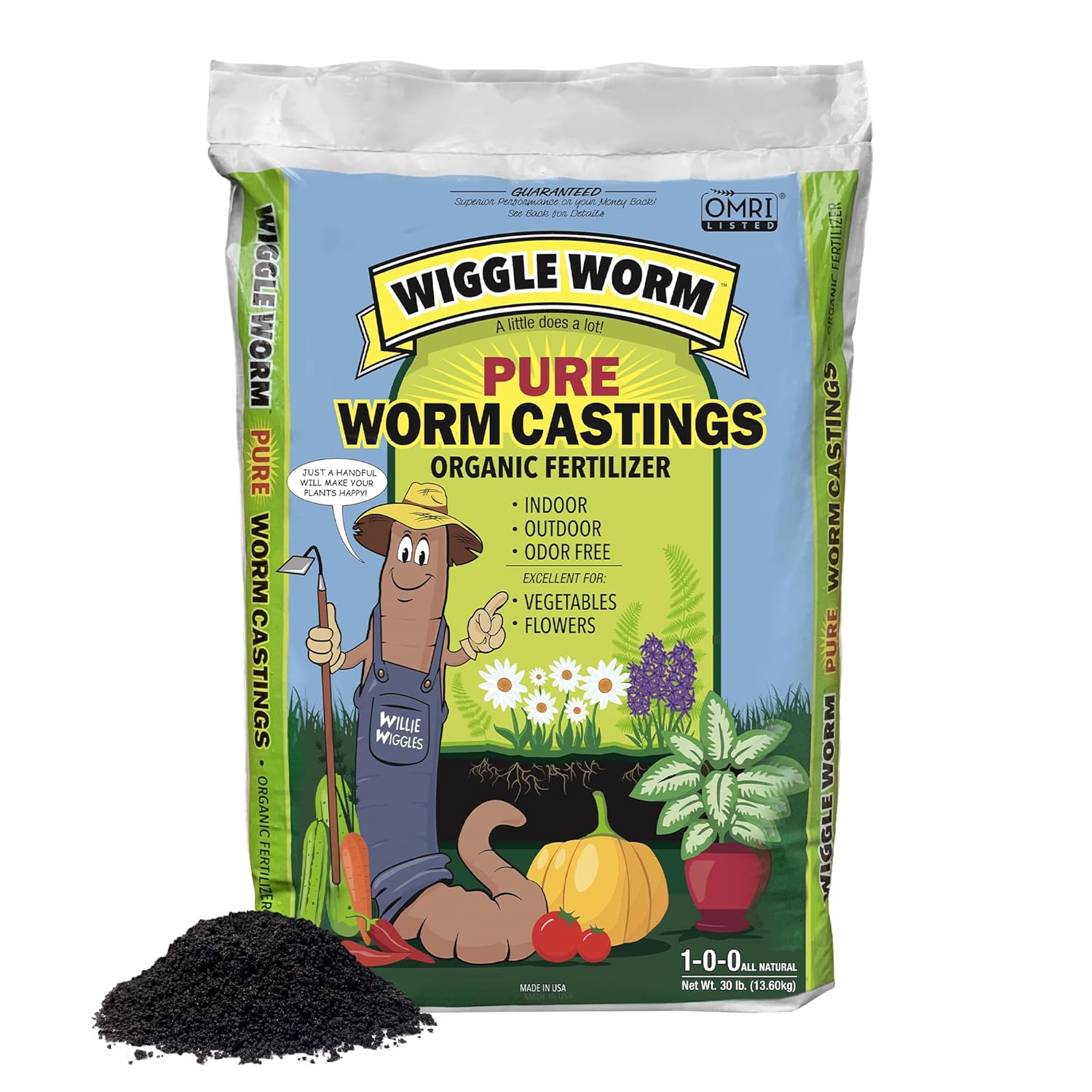
Wiggle Worm Pure Worm Castings Organic Fertilizer, 30 lb
| Item Form | Granules |
|---|---|
| Specific Uses For Product | Soil Conditioning |
| Application Method | Apply to soil |
| Unit Count | 480 Ounce |
Wiggle Worm Pure Worm Castings are a ready-to-use organic soil amendment made from concentrated earthworm castings. Gardeners typically mix a portion into potting mixes, top-dress established plants, work it into transplant holes, or brew it as a nutrient tea; the product page includes specific dosing for vegetables, containers, lawns, and roses. The castings are odorless, non-burning, and OMRI listed for organic use, so they supply water-soluble nutrients plus microbes that improve aeration, water retention, and root development without synthetic chemicals. Practical benefits include easy application, safe use on seedlings and mature plants, and versatility across raised beds, container gardens, and lawns. The main limitation is that this is a concentrated soil builder rather than an all-in-one fertilizer with NPK labels, so users seeking precise, fast-acting nutrient ratios may need to supplement for specific deficiencies; also a 30 lb bag is bulky to handle for small-space gardeners. For gardeners focused on long-term soil health and organic production, it functions as a low-risk, effective amendment.
Best for: Gardeners who prioritize building long-term soil health and want a safe, organic amendment for vegetables, ornamentals, and containers; buyers who value proven, low-risk inputs backed by strong user feedback.
Less Ideal for: Gardeners who need targeted, rapid nutrient correction based on precise NPK values or those who only want a lightweight product for very small balconies or indoor micro-gardens.
- OMRI listed organic and made from 100% worm castings
- Provides beneficial microbes that improve soil structure and water retention
- Odorless and non-burning so safe for seedlings and established plants
- Versatile dosing for containers, raised beds, lawns, and making worm casting tea
- No standard NPK nutrient label so not a precise standalone fertilizer for targeted feeding
- Large 30 lb bag can be heavy and awkward for gardeners with limited storage or mobility
Verdict: Choose this product when you want a proven, OMRI-listed worm casting that builds soil biology and improves plant health across beds and containers.
Choosing the Right Natural Compost: Key Factors to Consider
Source Materials and Transparency
Knowing what went into the compost matters for safety and performance. Compost made from yard waste, vegetable scraps and properly managed plant residues tends to be predictable in nutrient composition. Compost derived from unknown or mixed municipal waste streams can contain plastics, chemical residues or contaminants that are hard to detect.
When source materials are clearly listed, you can anticipate the likely nutrient profile and potential contaminants. This affects whether the compost is safe for vegetable beds, young seedlings or ornamental plantings. Transparency also helps you judge long-term soil health implications and whether to pair the compost with other amendments.
Maturity and Curing
Mature compost has finished the active decomposition phase and is stable in the garden. Properly cured compost no longer heats up, has a crumbly texture and a pleasant earthy smell. Immature compost can continue decomposing in the soil and temporarily lock up nitrogen, causing yellowing or stunted growth.
Check for signs of maturity such as uniform dark color, absence of recognizable raw food scraps, and a neutral aroma. For container plants and newly seeded beds you should favor fully cured compost to avoid seedling damage and unpredictable nutrient release.
Nutrient Content and Release Pattern
Compost supplies a mix of nitrogen, phosphorus and potassium along with micronutrients. Unlike synthetic fertilizers, compost releases nutrients slowly as soil biology breaks it down. The initial nutrient content gives a sense of short-term feeding, but biological activity and soil conditions control the longer-term release.
Gardeners should consider whether the compost leans heavy on a particular nutrient or is balanced. For young vegetables that need steady nitrogen, choose composts with measurable nitrogen levels and a reputation for even release. For flower beds or established shrubs, composts that boost structure and micronutrients may be preferable.
Particle Size and Soil Structure Effects
Texture influences how compost integrates with existing soil. Fine, crumbly compost mixes readily with heavy clay and improves tilth, while coarser compost adds long-lasting organic matter that helps sandy soils retain moisture. Large woody pieces can take longer to break down and may be undesirable in seed beds.
Consider the planting situation when choosing particle size. Container mixes need finer particles to avoid voids and rapid drying. Raised beds and in-ground amendments benefit from a mix that balances immediate tilth improvement with longer-term structure building.
Contaminant Screening and Safety
Not all composts are created equal when it comes to contaminants. Heavy metals, persistent pesticides and weed seeds can make a compost unsuitable for food gardens. Reliable producers test for contaminants or avoid high-risk input streams such as industrial wastes and untreated biosolids.
Gardeners growing edibles should favor compost with documented screening or clear feedstock lists. For non-edible landscapes, slightly higher risk may be acceptable, but knowing the testing status helps you manage long-term soil safety and plant health.
Application Ease and Handling
Practical handling matters: moisture level, odor, bagging, and how the compost spreads or mixes into soil affect how quickly you can use it. A compost that is too wet may clump and be hard to incorporate, while very dry compost can blow away and fail to bind with soil.
Consider whether you need screened and bagged compost for tidy container work, or bulk deliveries for large beds. Ease of application also includes how much additional work is required, such as sifting out large particles or mixing with other amendments to balance pH and nutrients.
Using Natural Compost in Vegetable Gardens
Natural compost improves soil biology and moisture retention, which directly benefits vegetables with high nutrient and water needs. Apply compost as a top-dressing before planting or work it into the top 6 to 8 inches when preparing new beds to mix organic matter through the root zone.
- Top-dress 1 to 2 inches around established plants to feed slowly over the season.
- Incorporate up to 25 percent compost by volume into seed-starting mixes sparingly to avoid excess soluble salts.
- For new beds, blend compost with existing soil rather than replacing it entirely to preserve soil structure.
Best Practices for Container and Patio Plantings
Containers need a lighter, well-draining mix. Use finer natural compost sparingly as a component of potting mixes to add nutrients and water-holding capacity without reducing drainage. Overuse in containers can hold too much moisture and suffocate roots.
- Mix no more than 20 to 30 percent compost into potting soil for most vegetables and flowering containers.
- Choose screened compost to avoid large particles that trap air pockets or block drainage.
- Refresh container top-dressings midseason to maintain nutrient supply.
How to Test Compost Maturity at Home
You can check compost maturity with simple observations and a couple of quick tests. Mature compost smells earthy, has a uniform dark color and the texture should be crumbly. Put a small handful into a sealed jar with a little water and wait 24 hours; if it smells sour or ammonia-like the compost may still be active.
- Look for absence of recognizable food scraps and a steady, cool temperature.
- Perform a germination test by planting a few quick-germinating seeds in a small pot with the compost mixed in; poor germination suggests immaturity.
- If in doubt, age the compost another month in a covered pile before using on seedlings.
Storing and Handling Natural Compost
Store compost in a dry, covered area to prevent nutrient loss and weed seed germination. Bagged compost takes less space but inspect for moisture and compaction; overly wet bags can promote anaerobic pockets that produce odors and reduce effectiveness.
- Keep bulk piles covered and turn occasionally to maintain aeration.
- Use gloves and a dust mask when handling dry compost to limit inhalation of spores or dust.
- Avoid storing compost directly on bare soil if you want to keep it clean and free from crawling pests.
How We Chose the Best Natural Compost
We prioritized attributes that matter for gardeners using natural compost in beds, containers and raised planters. Selection began with source transparency and manufacturing method, because compost made from clearly identified inputs and controlled aerobic processes is less likely to contain persistent contaminants or weed seeds. Nutrient profile and balance was assessed to favor products that supply both macro- and micro-nutrients without a single overly dominant element that can harm seedling growth. Particle texture and maturity were essential filters. We excluded any product lacking verifiable cure times or showing signs of high carbon content and immaturity, as unfinished compost can tie up nitrogen and damage plants. Pathogen and contaminant screening was a factor: products that reported screening for heavy metals, persistent chemicals, or that used unknown feedstocks were removed. Ease of use rounded out the criteria, including moisture level, odor control, and how readily the compost integrates with existing soil or potting mixes. In short, we chose natural composts that provide stable fertility, safe inputs, usable texture and clear sourcing. Products were excluded if they lacked testing transparency, showed immature characteristics, or relied on unspecified industrial biosolids or unvetted waste streams.
FAQ
Can I use natural compost straight from the bag for seedlings?
Usually you should avoid using straight compost for seedlings. Even mature compost can be too rich and may hold moisture that drowns tiny roots. Mix compost with sterile seed-starting mix at low ratios or use it as a thin top-dress after seedlings are established.
Will natural compost introduce weed seeds into my garden?
It depends on the feedstocks and processing. Properly heated and cured compost usually kills weed seeds, but compost made from unheated feedstocks or inadequately processed material can contain viable seeds. Choose compost with documented curing or screening if weed seeds are a concern.
How much compost should I add when building new beds?
A common approach is to work in 2 to 3 inches of mature compost into the top 6 to 8 inches of soil. For heavy clay or sandy soils, you can gradually build organic matter over a couple of seasons rather than trying to add large volumes at once.
Is there any risk using natural compost on edible gardens?
There can be risks if source materials are unknown or if the compost contains contaminants. For edible gardens select compost with clear input lists and contaminant screening. Avoid compost made from untreated sewage sludge or unspecified industrial wastes for food-producing areas.
How often should I top-dress with compost?
Top-dressing once or twice a year is usually sufficient for most beds. Apply a thin layer in spring and another in fall if you want to maintain organic matter and slowly replenish nutrients without disturbing plant roots.
Final Verdict
Natural compost is one of the simplest ways to improve soil biology, structure and long-term fertility. Prioritize mature compost with transparent feedstocks and testing when growing edibles, and consider particle size based on whether you are working in containers, raised beds or in-ground soil. Balance nutrient needs, contamination risk and handling convenience to choose the right natural compost for your garden. When in doubt, start with a small trial area or container mix to see how a compost behaves in your soil and climate. That practical test will show whether it supports seedlings, improves tilth, and fits your routine before you commit to larger applications.
