

Note: This article contains affiliate links. If you click on these links and make a purchase, I may earn a small commission at no extra cost to you. This helps support my research and content. Read my full affiliate disclosure here.
If you manage a large greenhouse, indoor farm, or commercial cultivation space, picking the right Commercial LED grow light is one of the biggest decisions you will make. Light affects crop schedule, quality, and total yield, while fixture layout and power draw shape your operating costs and HVAC needs. This guide shortlists seven top-performing Commercial LED options and explains the practical tradeoffs you should expect in real grow rooms. We evaluate fixtures for light spectrum control, usable output across canopy area, power efficiency, thermal management, and durability. Read on to learn which features matter most for commercial setups and how each criterion affects plant performance and facility operations.
Top Picks at a Glance
| Best Overall The best all-around choice for most situations | Spider Farmer SE7000 Commercial LED Grow Light with App Control and Osram Red |  |
| Best Quality Built to a higher standard if you want something more solid | Spider Farmer G1000W Commercial 1000W LED Grow Light |  |
| Best Value The sweet spot between price and what you get | Spider Farmer G8600 800W LED Grow Light with App Control |  |
| Best Budget The cheapest option that still gets the job done reliably | MARS HYDRO TS3000 420W LED Grow Light |  |
| Highest Rated A top-rated pick with lots of positive feedback | AC Infinity IONFRAME A7 700W Full Spectrum LED Grow Light |  |
| Most Popular A crowd favorite that many people choose with confidence | Spider Farmer SF1000 100W Full Spectrum LED Grow Light |  |
| Best Seller A high-volume bestseller chosen again and again | VIPARSPECTRA P4000 450W LED Grow Light (Dimmable, Full Spectrum) |  |
Spider Farmer SE7000 Commercial LED Grow Light with App Control and Osram Red

| Wattage | 730 watts |
|---|---|
| Light Source Type | Light Emitting Diode |
| Mounting Type | Ceiling Mount |
| Dimmable | Yes |
| App Control | Yes |
The Spider Farmer SE7000 is a 730W, six‑bar LED panel built for full‑cycle plant production in tents or small commercial racks. It uses premium Bridgelux diodes with supplemental Osram deep red to deliver a plant‑focused full spectrum and a quoted 2146 μmol/s output, which the manufacturer says covers a 5×5 ft canopy with even bar‑style distribution. The fixture is dimmable, supports daisy‑chaining up to 50 units, and pairs with the Spider Farmer app for remote scheduling, sunrise/sunset simulation, and brightness control—useful for maintaining consistent photoperiods across multiple fixtures. Cooling and a detachable driver simplify installation and maintenance. Practical benefits include strong PAR output for flowering, flexible intensity control for different growth stages, and scalability for larger setups. Important limitations are the high power draw that requires adequate electrical planning and the physical size that is intended for tent or commercial spaces rather than small desktops. The SE7000 is best used by growers who need reliable, high‑intensity light across a full canopy and who can accommodate its power and mounting needs.
Best for: Growers who want a balanced, high‑performance fixture for full‑cycle cultivation and who value remote control and scalability across tents or small commercial racks.
Less Ideal for: Casual plant owners with a single desktop setup or anyone who cannot accommodate a dedicated circuit or the physical size of a 730W commercial fixture.
- High delivered photon output suitable for full‑cycle flowering across a 5×5 ft canopy
- App control and adjustable schedules let you remotely fine‑tune intensity and photoperiods
- Dimmable with daisy‑chain support for scaling to multi‑light commercial setups
- Premium diodes and added deep red spectrum optimize photosynthesis and flowering
- 730W power draw requires proper electrical circuit planning and cooling
- Large footprint and ceiling‑mount design make it unsuitable for very small workspaces
Verdict: Choose the SE7000 if you need a scalable, high‑output LED with app scheduling and spectrum tuned for commercial full‑cycle yields.
Spider Farmer G1000W Commercial 1000W LED Grow Light

| Light Source Type | LED |
|---|---|
| Power Source | Corded Electric |
| Voltage | 110 volts_of_alternating_current |
| Light Source Wattage | 1000 watts |
| Mounting Type | Ceiling Mount |
The Spider Farmer G1000W is a high‑power LED grow fixture built for commercial and serious hobbyist growers who need strong, uniform light across multi‑tier racks or a 5x5ft tent. It uses Bridgelux diodes across an eight‑bar layout to push a reported 2940 µmol/s and a PPE of about 2.9 µmol/J, which translates to efficient PAR delivery and deeper canopy penetration when paired with CO2. Key practical features are daisy‑chain dimming so multiple units can be controlled together, ceiling mounting for rack systems, and a plug‑and‑play design that needs no assembly. The integrated foldable bar layout and aluminum housing support heat dissipation for continuous commercial runtimes. You get app control for schedules and remote dimming, which simplifies managing multiple fixtures. Downsides to consider are the high 1000W power draw requiring adequate electrical planning and cooling, and the unit is large so it is best suited to dedicated grow rooms or tents rather than casual desktop setups.
Best for: Growers running commercial or high‑output home setups who prioritize maximum PAR, uniform coverage, and centralized control for multi‑light arrays.
Less Ideal for: Casual hobbyists with small desktop setups or growers constrained by limited electrical capacity or ventilation should consider lower‑wattage fixtures instead.
- High photon output with reported 2940 µmol/s and PPE ~2.9 µmol/J for efficient PAR delivery
- Daisy‑chain dimming supports synchronized control of multiple fixtures
- Eight‑bar design gives wide, edge‑to‑edge light distribution for uniform canopy coverage
- App control and scheduling for remote brightness and light cycle management
- Aluminum body and foldable layout improve heat dissipation and simplify installation
- 1000W power draw requires substantial electrical capacity and may increase HVAC load
- Large physical footprint limits use to dedicated grow tents or rooms rather than small spaces
Verdict: If you need a commercial‑grade 1000W fixture with strong, uniform PAR output and daisy‑chain dimming for multi‑light setups, the G1000W delivers the performance-oriented power growers want.
Spider Farmer G8600 800W LED Grow Light with App Control

| Light Source Type | Light Emitting Diode |
|---|---|
| Power Source | Corded Electric |
| Voltage | 120 volts |
| Light Source Wattage | 800 watts |
| Light Source Special Features | Dimmable |
The Spider Farmer G8600 is a heavy-duty LED grow light built for commercial racks and 5×5 foot grow tents. It delivers an 800W draw using Bridgelux diodes and claims up to 2.85 μmol/J PPE with 2,283 μmol/s PPF, so it is intended to provide strong, uniform light across a 4×4 commercial bench or 5×5 personal footprint. The fixture uses a 6-bar layout and aluminum housing to improve airflow and lower heat; the detachable driver can be mounted outside a tent to reduce internal temperature. Controls are modern: WiFi and Bluetooth through the Spider Farmer app let you schedule cycles, dim levels and simulate sunrise/sunset, and the unit supports daisy-chaining up to 50 lights for scalable installs. Practical benefits include a built-in digital display, included dimmer and hangers, and a 5-year warranty that supports longer deployments. Important limitations are the high power draw requiring appropriate electrical provisioning and the large physical footprint that needs sufficient mounting space and ventilation planning.
Best for: Growers running commercial racks or large 4×4–5×5 grow tents who prioritize high light output, remote scheduling, and the ability to scale multiple fixtures reliably.
Less Ideal for: Small hobbyists, low-power microgrow setups, or anyone without the electrical capacity or ventilation to support an 800W fixture.
- High output: 800W power with reported 2,283 μmol/s PPF for strong photosynthetic light
- Energy-efficient Bridgelux diodes with up to 2.85 μmol/J PPE for commercial yields
- App control with WiFi/Bluetooth plus sunrise/sunset scheduling and dimming
- Detachable driver and aluminum bar design reduce in-tent heat and ease thermal management
- Daisy-chainable up to 50 units and includes dimmer, driver, and hangers for scalable installs
- High electrical demand requires dedicated circuits and careful power planning
- Large fixture footprint needs ample mounting space and may not fit compact setups
Verdict: Choose the G8600 when you need a high-output, app-controlled LED that scales for commercial 4×4–5×5 grows and eases thermal management with a detachable driver.
MARS HYDRO TS3000 420W LED Grow Light
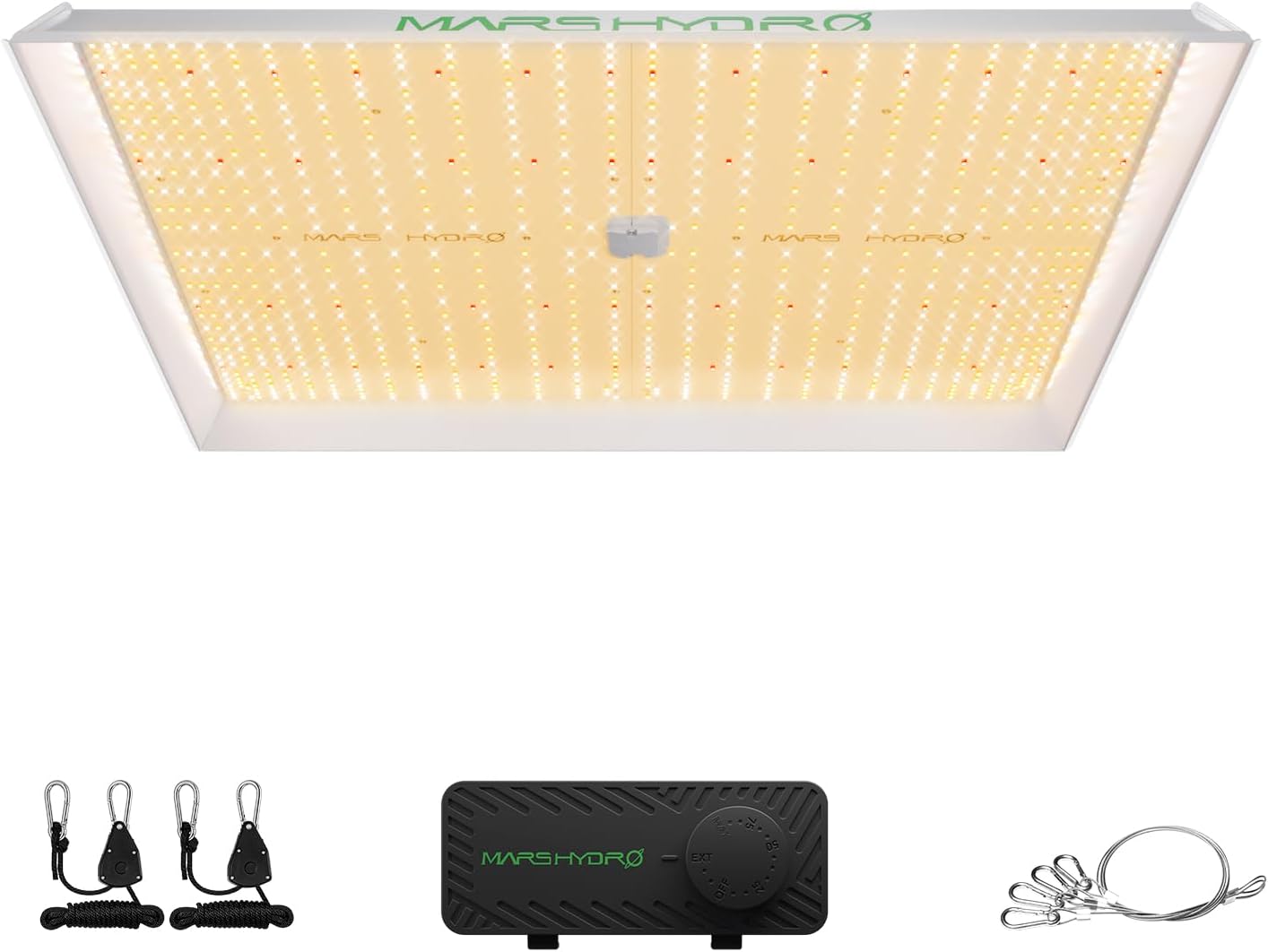
| Light Source Type | LED |
|---|---|
| Light Source Wattage | 420 watts |
| Light Source Special Features | Dimmable, Daisy Chain Compatible |
| Mounting Type | Ceiling Mount |
| Specification Met | ETL |
The MARS HYDRO TS3000 is a panel-style LED grow light designed for small commercial or serious hobby indoor grows. It delivers a sunlike full spectrum with dense diode placement in the center for more even canopy penetration and is sized to cover about a 5' x 5' veg area or a 4' x 4' bloom area. Use it ceiling-mounted over multiple plants and pair with the optional iControl/iHub modules to schedule cycles, run sunrise/sunset dimming, or control multiple units via Bluetooth/WiFi. Notable features include a dual manual/smart dimmer box, daisy-chain compatibility, an aluminum reflector hood for wider 120-degree beam spread, and a removable power supply with a 2 m cord for flexible placement. Practically, it replaces older 600W HPS rigs while using noticeably less power and claims high PPF and photon efficiency, so growers focused on operating cost should see lower energy consumption per yield. Important limitations are that full smart functions require separate Mars Hydro controllers and the unit is relatively large and bright, so ventilation and heat management must be considered in commercial racks or tents.
Best for: Growers who need a cost-effective, energy-efficient LED capable of supporting small commercial runs or multiple tents and who prioritize lower operating costs over an out-of-the-box smart kit.
Less Ideal for: Large-scale commercial operations needing plug-and-play networked control across many fixtures without buying extra controllers or growers who need a compact light for very small single-plant setups.
- Full-spectrum output tuned for all growth stages for seed-to-flower use
- Built-in dimmer box plus app-compatible smart control for scheduling and group control
- Wide 120° beam and reflective hood for even coverage across a 4×4 to 5×5 area
- High reported photon output and efficiency to reduce electricity per unit of light
- Advanced app features require separately sold Mars Hydro controllers
- Rated voltage listed at 220V which may require confirmatory wiring or compatibility checks in some setups
Verdict: A high-efficiency, budget-minded LED panel that replaces higher-watt HPS units and cuts operating costs for small commercial growers willing to add Mars Hydro controllers for full smart features.
AC Infinity IONFRAME A7 700W Full Spectrum LED Grow Light

| Light Source Type | Light Emitting Diode |
|---|---|
| Wattage | 700 watts |
| Light Source Special Features | daisy-chain capable, app-controlled, remote automation |
| Color Temperature | 5000 Kelvin |
| Material Type | Aluminum |
The AC Infinity IONFRAME A7 is a commercial-style 700W LED grow light built for steady, high-output performance in controlled grow rooms. It supplies a full spectrum that includes warm 3000K, 5000K white, and 660nm red diodes to support seedlings through flowering, and its spec'd coverage is roughly a 4 by 5 foot area per unit. The fixture is made from aluminum with a heavy heatsink and a detached driver to reduce thermal stress, and an IP67-rated build makes it suitable for high-humidity setups. Practical features include RJ-11 daisy-chain capability for linking multiple units, a UIS adapter for integration with AC Infinity controllers, and app/remote automation for scheduling and remote adjustments. For growers who prioritize uptime, the thermal design and detachable driver reduce failure risk during continuous operation. Trade-offs are the unit size and full 700W draw, which require adequate ventilation and electrical planning in larger arrays rather than casual home use.
Best for: Growers running commercial or serious multi-light setups who need a dependable, high-output fixture they can link and control centrally and that will tolerate humid environments.
Less Ideal for: Casual hobbyists with very small closets or limited electrical/ventilation capacity should consider lower-wattage, smaller fixtures instead.
- 700W full spectrum diodes cover vegetative and flowering stages
- Robust aluminum heatsink and detached driver for improved thermal management
- IP67-rated build suitable for humid grow-room environments
- Daisy-chain RJ-11 connectivity and UIS adapter for scalable, centralized control
- App-controlled and remote automation for scheduling and remote adjustments
- Full 700W power draw requires adequate ventilation and dedicated electrical capacity
- Large physical footprint may be overkill for small hobby closets
Verdict: Choose the IONFRAME A7 when you need a rugged, networkable 700W fixture built for continuous commercial-style growing with reliable thermal protection and centralized control.
Spider Farmer SF1000 100W Full Spectrum LED Grow Light

| Light Source Type | LED |
|---|---|
| Light Output Maximum | 10000 lumens |
| Light Source Wattage | 100 watts |
| Light Source Special Features | Dimmable |
| Specification Met | IP67 |
The Spider Farmer SF1000 is a compact 100W full spectrum LED grow light intended for 2×2 to 3×3 grow spaces and small tents. It uses a high diode count and upgraded LED chips to deliver broad-spectrum output that supports seedlings through flowering, with a dimmer knob to reduce intensity for early stages and ramp up for bloom. The fanless design and thick aluminum heatsink keep operation quiet while providing passive cooling, and the fixture meets IP67 for durable performance. Typical use is ceiling or tent mounting above individual plants or a small canopy where uniform coverage and deeper canopy penetration matter. Notable features include daisy-chain compatibility for linking multiple units under unified dimming, a 0–100% dimmable control, and a driver claimed to offer efficient power delivery. Practical benefits are even light distribution in a small footprint, predictable veg-to-flower capability, and near-silent operation. Limitations are inherent to its class: it is sized for small areas so you will need multiple units for larger tents, and the product description emphasizes specs from manufacturer tests rather than independent third-party PPFD maps.
Best for: Growers who want a quiet, compact full spectrum light for a small tent or single-plant setup and value adjustable intensity for each growth stage.
Less Ideal for: People running larger multi-plant rooms or commercial operations who need higher total output and broader single-fixture coverage.
- Full spectrum output suitable for all growth stages with added red and IR for flowering
- Dimmable 0–100% control lets you tailor light intensity to seedlings, veg, and bloom
- Fanless design with sturdy aluminum heatsink for quiet, low-maintenance operation
- Compact footprint ideal for 2×2 to 3×3 tents and small indoor setups
- Daisy-chain capable so multiple fixtures can be linked and dimmed together
- Coverage and power are intended for small grows so larger areas require multiple units
- Manufacturer gives efficiency and coverage figures without independent third-party PPFD charts
Verdict: A quiet, dimmable 100W full spectrum fixture that is a practical, balanced choice for hobbyists running 2×2 to 3×3 tents.
VIPARSPECTRA P4000 450W LED Grow Light (Dimmable, Full Spectrum)

| Light Source Type | LED |
|---|---|
| Power Source | Corded Electric |
| Light Source Wattage | 450 watts |
| Color Temperature | 4000 Kelvin |
| Mounting Type | Ceiling Mount |
The VIPARSPECTRA P4000 is a plug-and-play LED grow light built for medium commercial or serious hobby setups that need high PAR output with lower energy draw than traditional HID systems. It delivers a broad full spectrum — a mix of red (660 nm), warm white (3000K), cool white (5000K) and some far-red — and a single dimmer knob so you can lower output for seedlings or crank it for flowering. Its fanless design uses large solid-aluminum heat sinks for passive cooling, keeping operation quiet and reducing moving parts to fail. The fixture is rated around 450W actual draw and is specified for roughly 5×4 ft vegetative coverage and 5×3 ft flowering coverage, which makes it suitable for a single medium tent or a clustered multi-panel layout. Setup is straightforward with included hangers, hooks and a power cord. Limitations to note are the lack of daisy-chain capability and a single fixed spectrum layout with no programmable schedules; commercial growers who need chained units or fine spectral programming will need additional controllers. The light is FCC and UL specified and comes with a three-year manufacturer warranty for extra reassurance.
Best for: Growers who prioritize reliable, low-maintenance lights and predictable performance for medium commercial or advanced hobby grow tents and want a straightforward dimmable full-spectrum fixture.
Less Ideal for: Large commercial operations that require daisy-chaining, integrated controllers, or programmable spectrum cycling should consider more modular or controllable systems.
- High PAR-focused full-spectrum blend including reds, warm and cool whites for veg and bloom
- Dimmable with a simple knob to adjust intensity across growth stages
- Fanless aluminum heat-sink design for quiet, low-maintenance operation
- Plug-and-play setup with hangers and hooks included
- Specified coverage suitable for a single medium grow tent (vegetative and flowering figures provided)
- No daisy-chain or networked control for chaining multiple fixtures
- Spectrum is fixed and not user-programmable beyond intensity
Verdict: A dependable, low-maintenance 450W full-spectrum LED that delivers strong coverage and easy dimming for growers who want predictable results without complex controls.
Choosing the Right Commercial LED Grow Light: Key Factors to Consider
Canopy PPFD and Coverage
Photosynthetic photon flux density at the canopy is the primary driver of plant growth in commercial settings. Fixtures should provide consistent PPFD across the intended hanging height and footprint so plants receive even light from edge to edge. Uneven coverage forces growers to rotate plants or overlit zones to compensate, which reduces overall efficiency.
Consider published PPFD maps or measured output at your planned mounting height. Look for fixtures with a predictable footprint so you can design a lamp grid that minimizes hot and cold spots. When scaling a room, predictable coverage cuts the need for awkward overlaps and simplifies environmental control.
Spectrum Flexibility and Crop Matching
Different growth stages and crop types respond to variations in spectrum. Commercial fixtures that offer tunable spectra or multi-channel control allow you to shift from vegetative to flowering spectra or to tailor light for specific cultivars. Fixed full-spectrum fixtures can still perform well, but they limit in-season adjustments.
Assess whether your operation benefits from dynamic spectrum control, such as reducing blue during flower stretch or emphasizing far-red for shade-avoidance effects. Spectrum also affects secondary traits like terpene and pigment development, so coordination with your crop schedule matters for quality outcomes.
Energy Efficiency and Operating Cost
Energy efficiency expressed as micromoles per joule (µmol/J) directly affects electricity bills and total cost per gram. In commercial farms with continuous daily run hours, small differences in efficacy compound into large savings. Balance efficiency claims with real-world output: a high µmol/J is only useful if the fixture maintains that output at commercial drive currents and ambient temperatures.
Also consider driver efficiency and dimming behavior. Fixtures that retain high efficacy when dimmed let you optimize light schedules without wasting energy. Check for power factor and THD specs if your electrical infrastructure is sensitive to harmonics.
Thermal Management and Longevity
Heat is the enemy of LED lifespan and consistent light output. Commercial fixtures are expected to operate long daily cycles and elevated ambient temperatures. Effective thermal management-through heatsink design, active cooling, or low-heat emitter choices-keeps junction temperatures low and stabilizes PPFD over time.
Thermal performance also influences facility HVAC load. A cooler-running fixture reduces room cooling needs and improves overall energy economics. Look for thermal specifications, L70 projections, and any data about performance at elevated ambient temperatures.
Build Durability and Environmental Ratings
Commercial grow rooms, greenhouses, and vertical farms present humidity, nutrient aerosols, and cleaning cycles that demand robust fixtures. IP ratings, corrosion-resistant finishes, and sealed optics prevent moisture ingress and simplify sanitation. Durable wiring, high-quality connectors, and reinforced housings reduce downtime and maintenance calls.
Consider the expected cleaning regimen and whether fixtures will be exposed to fogging or foliar sprays. Fixtures designed for commercial environments will use materials and finishes that resist corrosion and allow for safe wet-cleaning where necessary.
Installation, Serviceability, and Scalability
Time spent installing and servicing lighting in large operations becomes a significant labor cost. Fixtures that are modular, lightweight for your mounting system, and compatible with common suspension hardware reduce installation time. Serviceable designs with replaceable drivers or LED modules limit the need to remove entire fixtures for repair.
Scalability features like daisy-chaining drivers, standardized mounting dimensions, and remote dimming controls make it easier to expand or reconfigure rooms. Evaluate wiring access, driver placement, and whether the fixture supports centralized controls for large-scale farms.
Designing a Fixture Layout for Large Canopies
Fixture spacing depends on the fixture footprint, canopy height, and crop light requirements. Start with manufacturer or third-party PPFD maps at your planned mounting height, then create a grid that minimizes variance across plants. Allow for overlap where needed but avoid excessive redundancy that wastes power.
Account for planned plant spacing and pathway areas. In multi-tier operations, consider vertical light interactions and whether you can use reflective surfaces to recover stray photons. Keep service access in mind so technicians can reach lamps without disrupting crops.
- Use measured PPFD maps rather than nominal wattage for spacing decisions
- Plan cable runs and suspension points with future expansion in mind
- Factor in maintenance clearance and access aisles
Managing Heat and Room Climate with High-Output LEDs
High-output LED fixtures concentrate thermal energy in drivers and diode arrays. Even though LEDs emit less radiant heat than HID lamps, their heat still affects room temperature and canopy microclimate. A lighting plan should integrate with HVAC capacity and consider heat stratification across racks.
Monitor actual fixture case temperatures during peak operations and adjust airflow or spacing to avoid heat buildup. In many facilities, pairing efficient LEDs with modest room cooling yields lower total energy use than overcooling a room to compensate for inefficient lighting.
- Position intake and exhaust to avoid blow-through across delicate canopies
- Use thermal sensors during commissioning to verify design assumptions
- Consider dimming schedules that reduce heat load during warm periods
Controls, Automation, and Integration
Commercial control systems enable spectrum changes, dimming profiles, and integration with environmental controllers. Look for fixtures compatible with common industry protocols and centralized management platforms to simplify scheduling and monitoring across dozens or hundreds of fixtures.
Automation reduces human error and ensures repeatable light recipes, which is important when scaling production. Also verify firmware update processes and backup strategies to avoid downtime from corrupted control nodes.
- Prefer open or standard protocols for long-term compatibility
- Confirm dimming ranges and whether dimming affects spectrum or efficacy
- Plan for remote monitoring of driver health and channel status
Fixture Maintenance and Replacement Planning
Create a maintenance schedule that covers lens cleaning, driver inspection, and suspension checks. LED output decays slowly, so tracking PPFD over time helps decide when to replace or re-lamp fixtures before crop quality is affected.
Keep spare drivers or modular modules on hand for rapid swaps in high-throughput facilities. Establish procedures for safe lockout and access when servicing fixtures above production zones.
- Document expected L70 timelines and align replacement plans with production cycles
- Train staff on safe working distances and electrical isolation procedures
- Label circuits and fixture IDs for quick troubleshooting
Regulatory and Electrical Infrastructure Considerations
Commercial installations must comply with local electrical codes, including breaker sizing, conduit runs, and ventilation for driver enclosures. Confirm power factor, inrush current, and harmonic distortion figures to avoid surprises when connecting large numbers of fixtures.
Coordinate with electricians and facility engineers during planning to ensure your existing infrastructure supports target layouts and future expansion. Consider load balancing and distribution to prevent nuisance trips and to optimize electrical efficiency.
- Verify driver mounting requirements and ventilation needs
- Plan circuit distribution to avoid overloading branches during peak draw
- Check for required certifications for commercial lighting in your jurisdiction
How We Chose the Best Commercial LED Grow Light
We selected fixtures that deliver the practical outcomes commercial growers care about: consistent canopy-level photon delivery, reliable thermal management that protects LEDs and reduces HVAC load, measured energy efficiency that ties directly to operating cost, and build quality suited to continuous commercial use. We favored lights offering tunable spectra or well-balanced full-spectrum output that match common crop staging, plus modular or scalable form factors for even canopy coverage. Our filters excluded small hobby-style units, fixtures lacking commercial power ratings, products without clear thermal specs, and lights intended only for supplemental home use. We prioritized units with documented photosynthetic photon flux density (PPFD) maps or usable published output figures, IP ratings appropriate for humid environments, and serviceability options such as replaceable drivers or LED modules. Evaluation criteria focused on light output and uniformity, spectrum flexibility, energy use per mole, thermal design and longevity, and commercial installation features. These dimensions reflect what actually influences yield, labor, and utility costs in a professional cultivation or greenhouse environment.
FAQ
How many micromoles per joule should I expect from a commercial LED?
Most modern commercial LEDs range widely depending on drive current and spectrum, but you should expect efficacy figures reported in manufacturer specs. Higher µmol/J is better for operating costs, though real-world PPFD at canopy matters more than a single efficacy number.
Can I use adjustable spectrum settings to speed up crop cycles?
Spectrum changes can influence plant responses such as stretch and flowering triggers, so adjustable fixtures can be helpful for optimizing cycles. Benefits depend on your crop and whether you have reproducible light recipes and environmental controls to match.
What mounting height is typical for commercial grow lights?
Mounting height depends on the fixture footprint, desired PPFD, and crop stage. Vegetative stages often tolerate higher mounts with wider spacing, while flowering may require closer, denser placement. Use PPFD maps to choose heights that deliver the target photon flux uniformly.
How should I budget for maintenance and replacements?
Budget for periodic cleaning, occasional driver replacements, and eventual LED module swaps based on published lumen or photon decay timelines. Large operations often keep spare parts on site to minimize downtime and align replacements with production schedules.
Do I need special ventilation for LED fixtures?
LED fixtures with active cooling or high single-point heat loads may require adequate airflow to maintain thermal performance. Passive fixtures also benefit from good room circulation. Coordinate lighting plans with HVAC capacity to manage both plant and fixture temperatures.
Are IP ratings important for greenhouse installs?
Yes. In humid or misted greenhouse environments, higher IP ratings and corrosion-resistant materials extend fixture life and reduce the risk of moisture-related failures during routine operations.
Final Verdict
Prioritize canopy PPFD, energy efficiency, and thermal performance when selecting large-scale LED fixtures. Spectrum flexibility and serviceability are important secondary considerations that influence crop quality and operational uptime. Balance initial fixture features against ongoing operating costs and maintenance needs to choose lights that fit your facility layout and production goals. The right Commercial LED grow light for your operation will be the one that delivers predictable canopy-level photons, integrates with your control systems, and limits downtime through robust construction and service options.
