

Note: This article contains affiliate links. If you click on these links and make a purchase, I may earn a small commission at no extra cost to you. This helps support my research and content. Read my full affiliate disclosure here.
If you are growing two plants indoors, the right grow light makes the difference between sparse, leggy stems and healthy, vigorous growth. A grow light sized and tuned for a two-plant setup saves space, lowers energy use, and simplifies temperature and humidity control in a small tent, shelf, or sunny corner. This guide covers seven shortlisted grow lights chosen for compact coverage, spectrum control, and simplicity of use. We evaluate each on how well it lights a two-plant footprint, how simple it is to install and adjust, and how efficiently it runs. Read on to find a setup that matches your space and plant needs.
Top Picks at a Glance
| Best Overall The best all-around choice for most situations | VIPARSPECTRA P700 70W Dimmable Full Spectrum LED Grow Light |  |
| Best Quality Built to a higher standard if you want something more solid | BESTVA DC1000 100W Bloom Boost LED Grow Light for 2×2/2×3 ft Tents |  |
| Best Value The sweet spot between price and what you get | RWNTAO Dual-Head Clip Grow Lights, Full-Spectrum LED 2-Pack |  |
| Best Budget The cheapest option that still gets the job done reliably | Garpsen 2-Head USB LED Grow Light — Full Spectrum, Clip-On |  |
| Highest Rated A top-rated pick with lots of positive feedback | boostool 2-Pack Full-Spectrum Adjustable Floor Grow Lights with Timer and Remote |  |
| Most Popular A crowd favorite that many people choose with confidence | GooingTop HY-021 6000K Full-Spectrum Clip Grow Light |  |
| Best Seller A high-volume bestseller chosen again and again | Aokrean Halo Full-Spectrum LED Grow Light with Base (2-Pack) |  |
VIPARSPECTRA P700 70W Dimmable Full Spectrum LED Grow Light

| Light Output Maximum | 11000 lumens |
|---|---|
| Light Source Wattage | 70 watts |
| Mounting Type | Hanging Mount |
| Light Source Special Features | Dimmable |
| Number of Light Sources | 216 |
The VIPARSPECTRA P700 is a 70W full spectrum LED grow light built for seed starting and vegetative stages. It uses 216 diodes and a tuned mix of red and white LEDs to deliver high PAR output (advertised 11,000 lumens) across a small footprint roughly suited to a 2×2 ft veg area. The light is fanless and relies on large aluminum heat sinks to keep running temperatures low while the included 4-level dimmer lets you dial intensity for seedlings, clones, or mature veg. Setup is simple with hanging mount hardware included and the unit draws about 0.65 A at 120V so it runs far cooler and uses far less power than a comparable 150W HPS/MH system. For compact tents, shelves, or single-cabinet grows it offers a good balance of light output, spectrum, and efficiency. Limitations are its small coverage area and modest absolute wattage compared with larger fixtures, so gardeners with bigger canopies will want a higher-output model or multiple units.
Best for: Growers who want an efficient, low-heat fixture to run a single tent, shelf, or cabinet and who prioritize electricity savings and adjustable output for seedlings and veg.
Less Ideal for: Commercial growers or hobbyists running multi-plant canopies or larger tents who need wider coverage and higher total light output.
- Full spectrum diode layout optimized for seedlings and vegetative growth
- Low power draw (70W) with high reported lumen/PAR output for energy efficiency
- Fanless design with aluminum heat sinks for quiet, low-heat operation
- Integrated 4-level dimmer for easy intensity adjustment
- Coverage geared to a small 2×2 ft veg area so not ideal for larger grows
- Absolute wattage and diode count are modest compared with larger commercial fixtures
Verdict: A compact, energy-efficient full spectrum LED that delivers strong veg-stage light and adjustable intensity for small tents and cabinets.
BESTVA DC1000 100W Bloom Boost LED Grow Light for 2×2/2×3 ft Tents

| Light Source Type | LED |
|---|---|
| Wattage | 100 watts |
| Mounting Type | Hanging |
| Light Source Special Features | VEG and BLOOM modes; full spectrum (3000K, 5000K, 460nm, 660nm) |
| Number of Light Sources | 640 |
The BESTVA DC1000 is a compact LED grow light built for small tents and compact indoor setups. It delivers a full spectrum combining 3000K and 5000K white LEDs plus 460nm blue and 660nm red diodes, and offers separate VEG and BLOOM modes so you can tailor output for seedlings, vegetative growth, and flowering. The light is rated at 100 watts and uses 640 diodes with a 120 degree beam angle to provide even coverage across a 2×2 or 2×3 ft space. The unit hangs easily and has a metal body with an aluminum heat-dissipation design and a durable cooling system to keep intensity steady during long cycles. For growers on a budget, it targets higher yields per footprint by improving canopy penetration compared with basic shop LEDs. Limitations include its modest total power if you plan to push very high-light plants or very dense canopies and the need to add side or supplemental lighting for heavier canopies; users should also manage hanging height and run time to avoid light stretch or heat stress.
Best for: Practical growers outfitting a 2×2 or 2×3 ft tent who want a stage-adjustable, full-spectrum light on a limited budget and value straightforward setup and reliable cooling.
Less Ideal for: Large or high-demand commercial grows, or growers who need very high PAR for dense mature canopies without adding extra fixtures.
- Full spectrum with dedicated VEG and BLOOM modes for stage-specific lighting
- Designed for 2×2–2×3 ft tents with even 120° beam coverage
- Durable metal housing and active cooling for stable operation
- High diode count (640) for more uniform light distribution
- 100W output may be insufficient for very high-light or densely canopied crops
- No built-in dimmer or timer included, requiring external control for schedules
Verdict: A budget-friendly 100W full-spectrum LED that gives reliable, stage-specific coverage for 2×2–2×3 ft grow tents.
RWNTAO Dual-Head Clip Grow Lights, Full-Spectrum LED 2-Pack

| Power Source | Corded Electric (USB, 5V) |
|---|---|
| Wattage | 8 watts |
| Control Method | App |
| Additional Features | Dimmable, Full Spectrum |
| Installation Type | Clip-on |
The RWNTAO dual-head clip grow lights are a compact, practical solution for indoor plants that need supplemental light. Each pack includes two two-headed lamps with a mix of white and red LEDs to provide a full spectrum aimed at both vegetative growth and flowering. The flexible 360 degree goosenecks and strong clips make it easy to position the beams over pots, shelves, or a small grow rack, while the 10 dim levels and three light modes let you tune intensity for seedlings through mature plants. The built-in timer with cycle memory (3/9/12 hours) removes the need to turn the lights on and off daily. These lights run from USB/5V power and claim high PPFD and flicker-free output, so they are energy efficient and gentle on plants. Limitations to note are the relatively low total wattage compared with larger fixtures and the tabletop/clip mounting only, which means they are best for a few plants or close-proximity setups rather than full shelves or larger grow tents.
Best for: A practical choice for hobbyist indoor gardeners who want an easy, adjustable clip-on light to supplement a few houseplants or a small seedling station without complex setup.
Less Ideal for: Not well suited to growers who need high-output fixtures for full shelving, large grow tents, or commercial-scale propagation.
- Full-spectrum mix of white and red LEDs tailored for vegetative growth and flowering
- 360 degree flexible gooseneck and sturdy clips allow precise positioning over pots and shelves
- Ten dim levels and three light modes provide adaptable intensity for different growth stages
- Timer with cycle memory (3/9/12 hours) automates daily on/off schedules
- USB/5V power makes them energy efficient and easy to power from adapters or power banks
- Low total wattage compared with larger grow fixtures limits coverage and depth for bigger setups
- Clip-on mounting restricts use to surfaces that can accept the clamp and may not suit all layouts
Verdict: A versatile, user-friendly clip-on grow light pack that delivers adjustable full-spectrum lighting and automated timers for small indoor gardens.
Garpsen 2-Head USB LED Grow Light — Full Spectrum, Clip-On
| Wattage | 12 watts |
|---|---|
| Light Source Type | LED |
| Number of Light Sources | 2 |
| Power Source | Corded Electric (USB) |
| Timer | 6/12/16H |
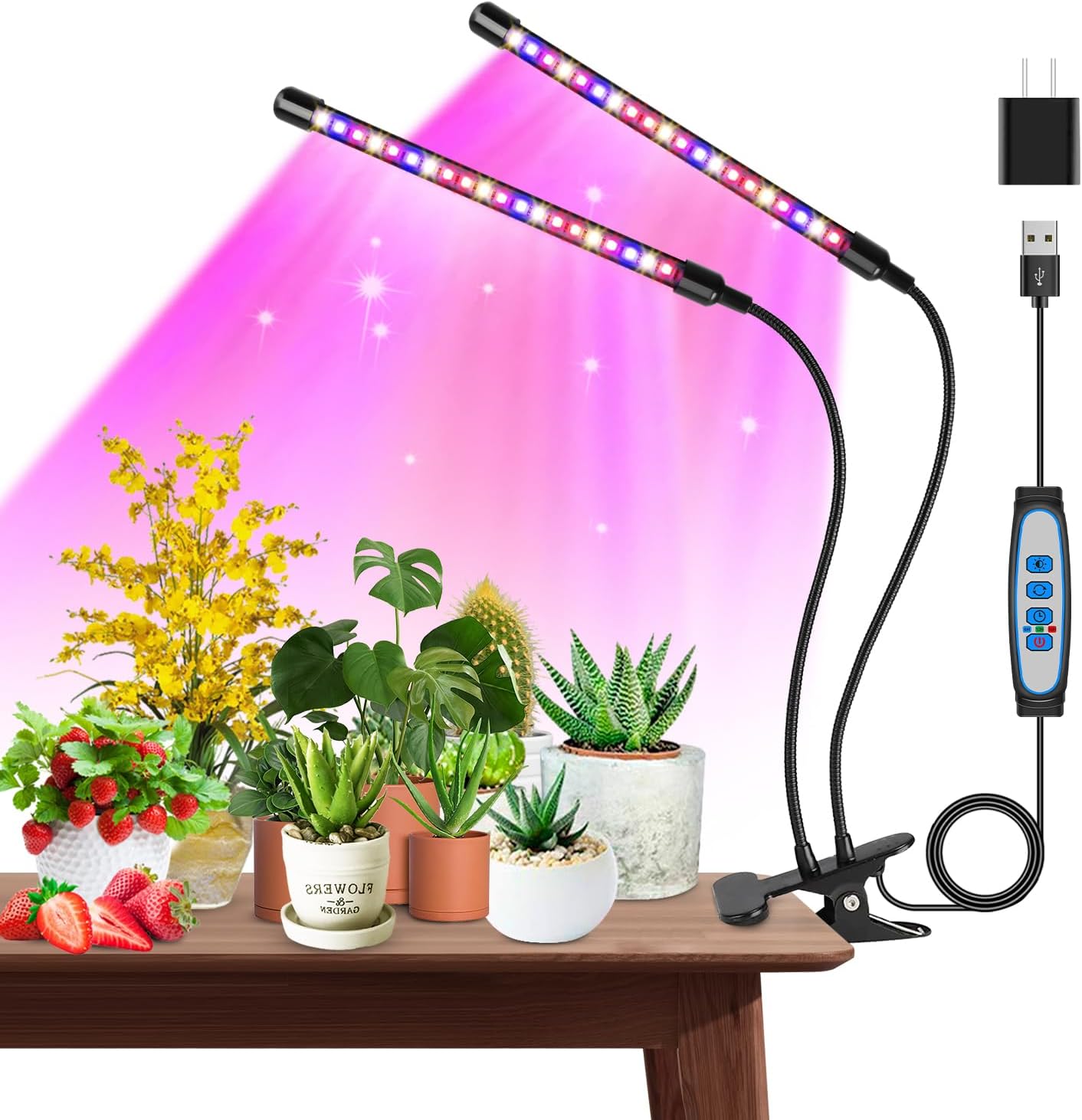
This Garpsen two-head grow light is a budget-friendly option for supplementing light for small indoor plants or seedlings. Each head contains 20 LEDs (red, blue, warm white) to provide a fuller spectrum, and the lamp offers three color modes plus five brightness levels so you can tailor light to germination, vegetative growth, and flowering stages. A built-in timer with 6/12/16 hour cycles and a remote control make daily scheduling easy without extra equipment. The flexible goosenecks and strong clip let you aim light precisely over one or two pots, and USB power with the included adapter keeps running costs low. Important limits are its modest 12 watt draw and relatively small coverage area, so it is best for a pair of small pots or a seed tray rather than a larger canopy. The unit is lightweight and easy to set up but lacks IP-rated water resistance despite a single "Is Waterproof: True" entry, so avoid wet environments. For growers who need inexpensive, adjustable light for two plants or seed starting, this covers the basics well.
Best for: Buyers who want an inexpensive, easy-to-install light to supplement sunlight for one to two small indoor plants or to start seeds, and who prioritize simple controls and low operating cost.
Less Ideal for: People growing multiple larger plants, larger trays, or canopy-level crops that need high-intensity or wide-area lighting should choose a higher-power fixture.
- Full-spectrum array (red, blue, warm white) suitable for multiple growth stages
- Built-in timer (6/12/16 hours) and remote control for hands-off scheduling
- 360° flexible goosenecks and strong clip allow precise positioning over pots
- USB-powered with included adapter keeps energy use and operating cost low
- Low total wattage and limited coverage make it unsuitable for larger plant groups
- Not clearly rated for water resistance for use in humid or wet setups
Verdict: A cost-effective, plug-and-play full-spectrum grow light that gives two small plants or seedlings adjustable, timed lighting without complexity.
boostool 2-Pack Full-Spectrum Adjustable Floor Grow Lights with Timer and Remote

| Light Source Type | LED |
|---|---|
| Power Source | Corded Electric |
| Mounting Type | Floor Mount |
| Light Source Special Features | dimmable, timer, remote control, multiple light modes |
| Color Rendering Index | 95 |
These boostool grow lights are a two-pack of vertical floor lamps built to give steady, adjustable light to indoor plants. Each lamp uses LEDs to deliver full-spectrum output with three light modes and five brightness levels, and a high CRI for truer plant color. They include a 3/6/12-hour timer plus touch controls and a remote for predictable scheduling, which makes them easy to run consistently without frequent intervention. Height adjusts across multiple settings to accommodate taller specimens, and the aluminum construction suggests reasonable durability for regular use. Practical benefits include set-and-forget timing, fine-grained dimming for different growth stages, and two lamps so you can cover a pair of plants without complex mounting. Limitations are that they are floor-mounted rather than clamp-style so placement can be less flexible in tight spaces, and detailed light output numbers such as PAR or lumen values are not provided, so precise intensity planning requires trial and adjustment.
Best for: Home growers who want a dependable, low-maintenance solution to light two indoor plants reliably and prefer programmable controls over daily manual adjustments.
Less Ideal for: Growers needing precise light output metrics for high-intensity or horticultural-grade setups or those who require clamp-mounted or overhead fixtures for tight spaces.
- Two lamps included so two plants can be lit independently or together
- Full spectrum with three modes and five brightness levels for different growth stages
- Built-in 3/6/12-hour timer and remote control for consistent automated schedules
- Height adjustable to fit short to tall indoor plants
- Aluminum build and touch controls offer a durable, user-friendly design
- No manufacturer-provided PAR or lumen figures to quantify usable light intensity
- Floor-mount design can limit placement options in very small setups
Verdict: Two height-adjustable full-spectrum lamps with timers and remote control make this a reliable, low-effort choice for keeping a pair of indoor plants consistently lit.
GooingTop HY-021 6000K Full-Spectrum Clip Grow Light
| Power Source | Corded Electric |
|---|---|
| Color Temperature | 6000 Kelvin |
| Light Output Maximum | 2500 lumens |
| Light Source Special Features | Dimmable |
| Number of Light Sources | 84 |
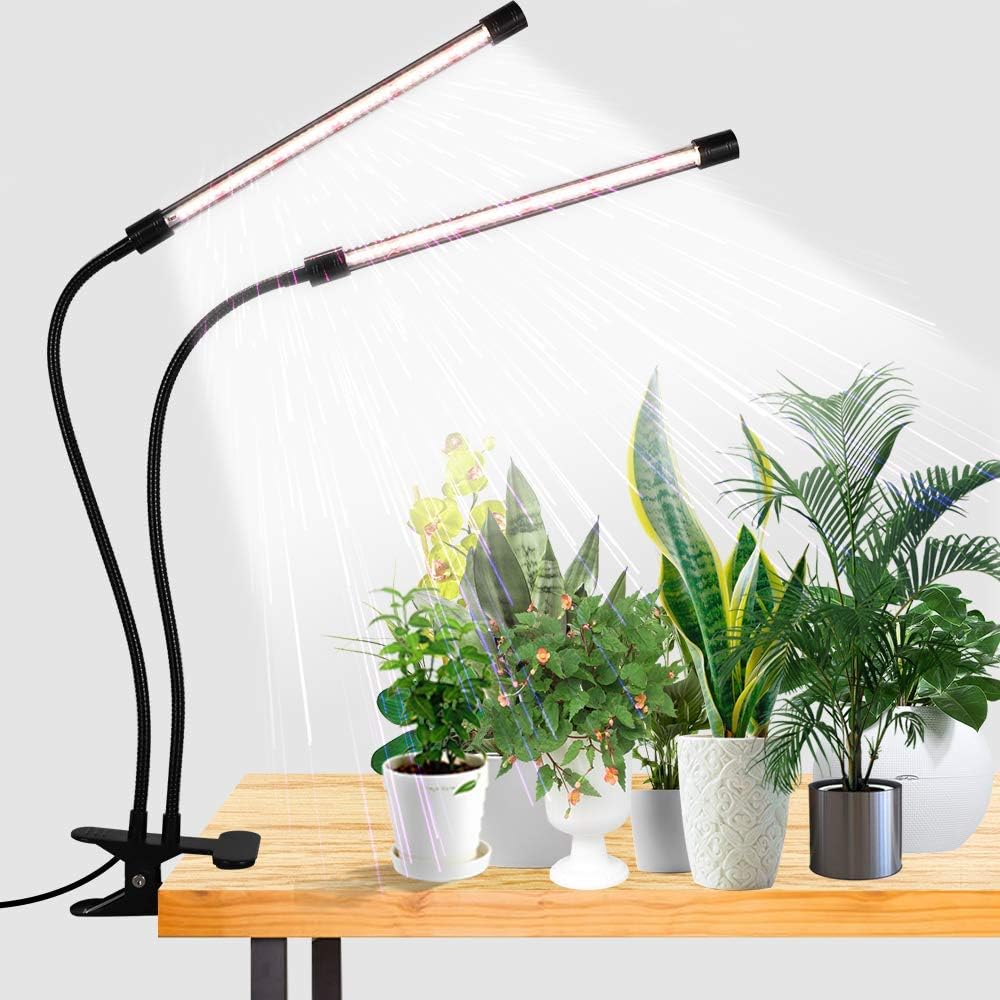
This GooingTop HY-021 is a compact clip-on grow light built for small houseplants, seedlings and shelf gardens. It uses 84 LEDs (white plus deep red) to deliver a 6000K full-spectrum output intended to mimic midday sun, with a high color-rendering output that also makes it pleasant as a reading lamp. Two flexible gooseneck heads and a strong clamp let you aim light precisely over pots and seed trays, while the attached remote provides 50%/100% dim levels and repeating timers at 4, 8 or 12 hours for hands-off scheduling. Practical benefits include low power draw (listed as roughly 10 W LED draw), a claimed 1 to 2 square meter coverage for seedlings, and an included timer that simplifies day/night cycles. Limitations are its design for small setups rather than large grow racks and the clip mounting limits placement compared with freestanding fixtures. The unit also relies on the corded remote instead of a smartphone app and the lifespan claim is typical of LEDs but not independently verifiable from the listing.
Best for: Buyers who want a simple, low-power, plug-and-play grow light to boost seedlings and a few houseplants on a desk or shelf and who value an easy-to-use timer and adjustable brightness.
Less Ideal for: Growers planning multi-shelf installations, larger vegetable grows, or who need networked or app-based control should consider larger bar lights or fixtures designed for commercial racks.
- Full-spectrum 6000K output with added 660 nm red LEDs to support vegetative growth and flowering
- Attached remote with dimming (50%/100%) and repeat timer settings (4/8/12 hours) for easy scheduling
- Flexible dual goosenecks and strong clamp enable precise positioning over small pots and seed trays
- High reported color rendering for comfortable viewing and accurate plant color assessment
- Low electrical draw around 10 W while covering small growing areas
- Clip-mount design and stated 1–2 m² coverage make it better suited to individual plants or small trays rather than large multi-shelf setups
- No smart app or wireless control option; remote is cord-attached which limits placement flexibility
Verdict: A compact, easy-to-use clip grow light that delivers full-spectrum light and convenient timer/dim controls for small indoor plant setups.
Aokrean Halo Full-Spectrum LED Grow Light with Base (2-Pack)

| Bulb Base | E26 |
|---|---|
| Number of Light Sources | 48 |
| Wattage | 10 watts |
| Power Source | Corded Electric |
| Timer | 3/9/12H |
The Aokrean Halo grow light is a compact LED lamp designed for indoor plant growth and decorative display. It ships as a two-pack and can be used either by inserting the stake into potting soil or by placing the pot on the supplied ABS base for a freestanding lamp. The unit uses 48 LEDs per light and offers three spectrum modes (white, warm white plus red, and mixed) plus ten brightness levels controlled by a touch/push button and a built-in timer with 3/9/12 hour cycling. The telescoping pole extends to cover taller small-to-medium pots and the 5V USB power and low 10W draw make it energy efficient and safe for continuous use. Practical benefits include flexible placement, multiple spectrum settings for seedlings through vegetative growth, and a small footprint that doubles as home decor. Limitations are its non-waterproof construction and modest light output suited to single pots or small clusters rather than a full grow shelf, and the base relies on pot weight for stability.
Best for: Buyers who want a simple, low-risk grow light for a few houseplants or seedlings and prefer plug-and-play controls, automatic timers, and a neat decorative look that fits on a windowsill or tabletop.
Less Ideal for: Gardeners who need high-intensity lighting for multiple larger plants, full shelves, or humid greenhouse conditions should choose a more powerful, waterproof fixture.
- Dual installation: stake into soil or place on included base for freestanding use
- Full-spectrum LEDs with three spectrum modes and 10 brightness levels for different growth stages
- Built-in timer with 3/9/12 hour cycles for automated daily light scheduling
- Low power draw (10 watts) and USB/5V power for efficient, low-heat operation
- Not water resistant so it must be kept away from wet environments
- Light output is modest and best for single small-to-medium pots rather than larger setups
Verdict: Aokrean Halo is a compact, easy-to-use full-spectrum grow light best suited to low-risk buyers who want a plug-and-play solution for a few indoor pots or seedlings.
Choosing the Right Grow Light for 2 Plants: Key Factors to Consider
Coverage Footprint and Beam Uniformity
How much horizontal area a light can evenly illuminate is essential when you only have two plants. A fixture with a narrow, intense beam may create hot central spots and underlit outer leaves, causing uneven growth. Look for lights that specify coverage at realistic hanging heights and show even PPFD distribution. For two plants placed side by side, aim for a footprint that maintains useful light across both crowns without forcing plants to stretch toward the center.
Light Spectrum and Stage Control
Different growth stages benefit from different wavelengths. Seedlings and vegetative growth typically respond well to blue-rich light for compact structure, while flowering responds to red and far-red components. A grow light that offers a full spectrum or switchable veg/flower modes helps you tune output as plants progress. Adjustable spectrum also helps when growing mixed species that prefer different light recipes.
Dimming, Timers, and Usability
Simple controls make daily care easier in a small setup. Built-in dimming lets you reduce output for seedlings or lower energy draw during warmer days. Integrated timers or compatibility with plug-in timers simplify photoperiod scheduling so you do not have to remember manual on/off cycles. Consider how intuitive the controls are and whether the unit supports common routines without extra hardware.
Thermal Performance and Room Impact
Even compact grow lights can generate heat close to plant foliage. Good thermal management prevents stress from localized heat and reduces the need for extra ventilation. Passive cooling or quiet low-speed fans are preferable for small spaces like closets or micro-tents. Also consider how the light affects ambient temperature and humidity in the immediate area; poor heat control can drive condensation or increased transpiration.
Form Factor and Mounting Options
When working with only two plants, size and mounting flexibility matter. Slim bars, small panels, or adjustable-height fixtures save vertical and horizontal space. Look for integrated hangers, ratchet rope hangers, or adjustable brackets that fit your tent or shelving. A fixture that allows easy height changes will help you maintain proper distance as plants grow without reconfiguring the whole setup.
Energy Use and Long-Term Operating Cost
Operating a grow light daily adds to household energy use. Compare published efficacy values expressed as micromoles per joule and consider the nominal wattage you will actually run when dimmed. Higher initial efficiency often pays off over months of use, especially with daily photoperiods running many hours. Also factor in the expected lifespan of LEDs and whether the unit allows straightforward replacement of components.
Best Hanging Heights and Placement for Two Plants
Getting the distance from light to canopy right is one of the fastest ways to improve plant architecture. For compact LED fixtures, a common starting point is 12 to 24 inches above the top of the canopy, adjusting based on measured light intensity and plant response. If seedlings show bleaching, raise the light; if plants stretch, lower it.
Place the two plants so their leaf edges just overlap the even portion of the beam. Avoid off-center positioning that forces one plant into shade. If using narrow-bar fixtures, consider offsetting the bar between the pots rather than centering it over a single pot.
- Measure PPFD at canopy level if possible, aiming for recommended ranges for your species.
- Reposition plants rather than the light for minor balance adjustments when space is tight.
Managing Heat in Small Grow Spaces
Heat build-up can quickly become a limiting factor in closets, cabinets, or tents. Passive-cooled LEDs often run cooler than fan-cooled units, but they may still transfer heat down to foliage. Keep a few inches of clearance above the fixture and maintain airflow across the canopy to dissipate warmth.
Use small clip fans or low-speed circulation fans to prevent microclimates. Monitor temperature and humidity near the plants rather than relying on room readings because micro-tent conditions can differ significantly from general room air.
- Aim for gentle cross-flow air movement rather than direct blasts on leaves.
- Check for heat stress signs such as leaf curling, bleaching, or rapid drooping during lights-on periods.
When to Use Full-Spectrum Vs Stage-Specific Modes
Full-spectrum light mimics natural daylight and is a good default when you are growing different species or want a simple setup. Stage-specific modes that emphasize blue for vegetative growth and red for flowering can boost targeted development if you follow a clear growth plan.
If you prefer a single program for convenience, choose a balanced full-spectrum fixture with reliable intensity. If optimizing flowering or fruiting for a particular plant, a fixture with switchable modes gives more control.
- Start seedlings under slightly reduced intensity and a balanced spectrum, then shift toward a fuller or flower-biased output as plants mature.
- Monitor plant form and leaf color to decide if spectrum adjustments are needed.
Power and Timer Strategies for Two-Plant Setups
Most indoor plants need a consistent photoperiod rather than continuous light. Use timers to automate day-night cycles, matching species-specific needs. For example, common photoperiods are 16/8 for vegetative growth and 12/12 for flowering in many species that respond to day length.
If you are using a dimmable light, consider lowering intensity during the warmest hours to reduce heat stress and energy draw. Staggering light-on times for adjacent micro-gardens can help distribute electricity use in small households.
- Choose mechanical or digital timers that support the daily schedule you plan to run.
- Pair timers with dimming schedules if the fixture and controller allow it.
Maintaining Plant Health Under Compact Lighting
When plants are grown close together under a small fixture, leaf shading and humidity pockets can increase disease risk. Prune lower foliage to improve airflow and reduce humidity around crowns. Regularly rotate pots if the light beam favors one side.
Keep an eye on nutrient and water needs because high-intensity light increases demand. Adjust feeding to match growth rate and avoid overwatering in cooler conditions or underwatering when lights are running hotter and vapor pressure deficit rises.
- Inspect undersides of leaves and the soil surface weekly for pests and mold.
- Adjust irrigation frequency based on pot size, substrate, and observed transpiration.
How We Chose the Best Grow Light for 2 Plants
We prioritized practical, measurable criteria that matter in a small indoor garden for two plants. First, light output and coverage: we looked for fixtures that provide uniform photosynthetic photon flux across a roughly 1-2 square foot canopy without hot spots or deep shade. Spectrum flexibility was next, favoring lamps that offer full-spectrum or adjustable spectra to support both vegetative and flowering stages. Build and mounting options were assessed for compactness and ease of hanging in tents, shelves, or over windowsills. Energy efficiency and thermal performance were evaluated through published efficacy figures and passive cooling designs so lights run cool in constrained spaces. Usability factors included dimming, timers, and plug-and-play setup to suit beginner and intermediate growers. We excluded large panels and horticultural systems designed for multi-plant benches or commercial racks, and we did not consider fixtures that require custom drivers or complex wiring. The final list reflects products that balance canopy coverage, spectral control, thermal management, compact form factor, and user-friendly controls.
FAQ
How much light do two small houseplants need under a single fixture?
It depends on species, but many common houseplants do well with moderate PPFD ranges that a compact LED can deliver at 12 to 18 inches. Use a light meter or look for even leaf color and compact growth as practical indicators.
Can I use a seedling setting for the entire grow to keep things simple?
You can, but seedlings require less intensity than mature plants, so running a seedling setting long-term may slow growth or delay flowering. Increasing intensity or switching to a fuller spectrum as plants mature usually produces better results.
Does a higher wattage always mean better growth for two plants?
Not necessarily. Effective growth depends on how that wattage translates to usable light at the canopy and how evenly it is distributed. A lower-watt fixture with better optics or higher efficacy can outperform a higher-watt unit that wastes energy as heat.
How close should LEDs be to the foliage to avoid burning?
Start with the manufacturer's recommended distance, commonly around 12 to 24 inches, and watch for signs of stress. If leaf tips bleach or curl, move the light up several inches and reassess.
Are timers necessary for a two-plant setup?
Timers are not strictly necessary, but they greatly simplify consistent photoperiods and reduce the chance of human error. Digital timers allow finer control of daily cycles and pair well with dimming schedules.
Final Verdict
For a two-plant setup, prioritize a fixture that provides even coverage across both crowns, offers useful spectrum control, and manages heat within your small space. Tradeoffs are common: very compact lights may limit peak intensity, while larger fixtures can create hot spots or need more clearance. Focus on canopy coverage, thermal performance, and ease of use to match the light to your available space and plant types. With those priorities in mind, you can confidently pick a compact grow light that supports steady, healthy growth for two plants.
