

Note: This article contains affiliate links. If you click on these links and make a purchase, I may earn a small commission at no extra cost to you. This helps support my research and content. Read my full affiliate disclosure here.
Picking the right Cob grow light matters because it determines how evenly your plants develop, how quickly they move through growth stages, and how much heat you must manage in a confined space. Whether you run a small tent, a multi-shelf propagation rack, or a larger indoor garden, the wrong fixture can create hot spots, wasted electricity, or uneven yields. This guide covers five shortlisted Cob grow lights that represent reliable choices across common indoor growing setups. We evaluated them on spectrum quality, heat control, and canopy coverage so you can match a fixture to your space and plants.
Top Picks at a Glance
| Best Overall The best all-around choice for most situations | HMVPL Bamboo Wall-Mounted COB Full-Spectrum Grow Light with Swing Arm and Timer |  |
| Best Quality Built to a higher standard if you want something more solid | HMVPL COB Full‑Spectrum LED Grow Light Floor Lamp, 20W, Height Adjustable |  |
| Best Budget The cheapest option that still gets the job done reliably | Walfront 100W COB LED Full-Spectrum Grow Light Bead (110V) |  |
| Most Popular A crowd favorite that many people choose with confidence | HMVPL 20W Full-Spectrum COB Floor Grow Light with Adjustable Height and Timer | 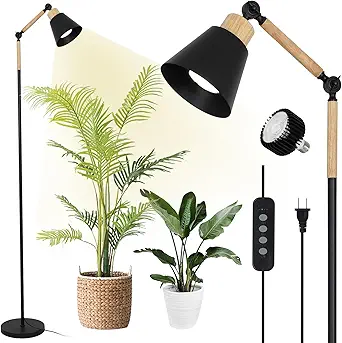 |
| Best Seller A high-volume bestseller chosen again and again | HMVPL 20W COB Full-Spectrum Floor Grow Light Stand with Timer |  |
HMVPL Bamboo Wall-Mounted COB Full-Spectrum Grow Light with Swing Arm and Timer

| Wattage | 20W |
|---|---|
| Spectrum | 380–780nm full spectrum |
| Color temperature | 4000K |
| Timer | 4/8/12H cycle |
| Reported PPFD | 1716 μmol/m²/s |
This HMVPL wall-mounted grow light pairs a 20W COB bulb with a wooden swing arm to give flexible, directed lighting for indoor plants. The 380–780nm full spectrum and reported PAR/PPFD numbers make it suitable for seedlings through flowering, while the 4000K output is easy on the eyes for extended indoor use. The swing arm has two pivots and a semicircular range so you can reposition the lamp over multiple pots without remounting. Built-in heat-dissipating aerospace aluminum on the COB housing helps manage temperature and should improve component longevity. Practical features include a 4/8/12 hour cycle timer so the lamp will run automated daily schedules, which is convenient for steady photoperiods. Expect a reasonably compact, wall-focused solution rather than whole-bench illumination; coverage is best for individual plants or small groupings where you can place the arm close to foliage. You will need to reset the timer after power loss and plan placement to make the most of the arm reach and light radius.
Best for: Buyers who want a tidy, wall-mounted grow light to support seedlings to flowering on individual plants or small collections and who value easy automated schedules and adjustable positioning.
Less Ideal for: Not ideal for growers who need to light large benches, multi-shelf setups, or whole grow tents where wider, more powerful arrays are required.
- Full 380–780nm spectrum suitable for all growth stages
- 20W COB design with aerospace aluminum housing for better heat dissipation
- Adjustable bamboo swing arm with two pivot points for targeted positioning
- Built-in 4/8/12H cycle timer for unattended daily schedules
- Designed for spot or small-group lighting rather than broad area coverage
- Timer needs manual reset after power interruption
Verdict: A compact, wall-mounted COB grow light with a flexible swing arm and timer that delivers full-spectrum output for reliable, hands-off support of single plants and small groupings.
HMVPL COB Full‑Spectrum LED Grow Light Floor Lamp, 20W, Height Adjustable

| Wattage | 20 watts |
|---|---|
| Light Source Type | LED |
| Bulb Base | E26 |
| Control Method | Remote |
| Is Waterproof | True |
This HMVPL COB floor lamp is a compact, performance‑focused grow light aimed at multi‑stage indoor growing. The COB LED delivers a full 380–780nm spectrum with a high CRI to render plant color accurately while the aluminium body improves heat dissipation for more stable output. It mounts on a freestanding, height‑adjustable pole with six height settings and two angle knobs so you can place even tall or mid‑size specimens directly under the array. The unit includes a 4/8/12 hour cycle timer and remote control for hands‑off daily scheduling, and its E26 bulb base and corded power make it straightforward to install. Measured output figures in the listing (PPFD 1716 μmol/㎡/s and 1628 lm) indicate strong light intensity suitable for vegetative growth and flowering of many houseplants. Limitations to note are the single 20W light source, which may require multiple units or close placement for wide canopies, and the lamp is specified for indoor use only and not water resistant. For growers prioritizing compact, high‑quality COB light and precise scheduling, this unit performs well; for larger setups you will likely need additional fixtures.
Best for: Growers who want a compact, high‑quality COB fixture for single‑plant or small‑group setups and who prioritize spectral fidelity and automated scheduling for performance results.
Less Ideal for: People building large multi‑shelf or canopy systems that need broad uniform coverage or waterproof fixtures for humid environments.
- Full 380–780nm spectrum with high CRI for accurate plant color and all growth stages
- COB aerospace aluminum construction for improved heat dissipation and durability
- Height and angle adjustments accommodate tall and medium plants
- Built‑in 4/8/12H timer plus remote control for automated daily schedules
- Single 20W light source may not cover wide canopies without multiple units
- Not water resistant so it cannot be used in humid or wet locations
Verdict: A compact, performance‑oriented COB floor grow light that delivers full‑spectrum output and convenient automated timers for focused indoor plant setups.
Walfront 100W COB LED Full-Spectrum Grow Light Bead (110V)

| Light Source Type | LED |
|---|---|
| Light Source Special Features | Full Spectrum (380-800nm), Uniform Light Emission, No Flicker |
| Wattage | 100 watts |
| Mounting Type | Surface Mount |
| Color Rendering Index | 85 |
This compact COB LED grow light bead supplies a full-spectrum 380–800nm output at 100W and is built on an aluminum base for heat dissipation. It is typically used as a component in DIY fixtures or small grow setups where a single high-output lamp bead is mounted to a plate or housing. Notable features include a claimed >30,000-hour life, CRI of 85 for reasonable color rendering, and a standard E26-style compatibility for straightforward integration. Practical benefits are bright, uniform light with no reported flicker and low power draw compared with older HID options, making it a simple way to boost light intensity for seedlings or a small cluster of plants. Limitations are the need for a proper driver or mounting solution because the listing shows the bare COB on a small plate rather than a finished fixture, and thermal management and electrical hookup are left to the builder. The item is best for people who can safely wire and mount a lamp bead and want a low-cost way to add concentrated full-spectrum light to a small grow area.
Best for: Practical hobbyists and budget-focused growers who want an inexpensive, high-output COB component to build or upgrade a small DIY grow light rather than buying a finished fixture.
Less Ideal for: Growers who prefer plug-and-play, fully enclosed fixtures or who are uncomfortable with electrical assembly and heat-management tasks should choose a finished light instead.
- Full-spectrum 380–800nm output suitable for a wide range of plant growth stages
- Built on an aluminum base for improved heat dissipation and longer service life
- Compact, lightweight component that is easy to store and incorporate into DIY fixtures
- Sold as a bare COB lamp bead on a small plate so it requires a separate driver, mounting, and wiring to use safely
- Limited seller-provided safety or installation details compared with finished grow light fixtures
Verdict: If you want a low-cost, high-output COB component to build a small DIY grow light, this 100W full-spectrum lamp bead gives concentrated plant-ready light without the expense of a finished fixture.
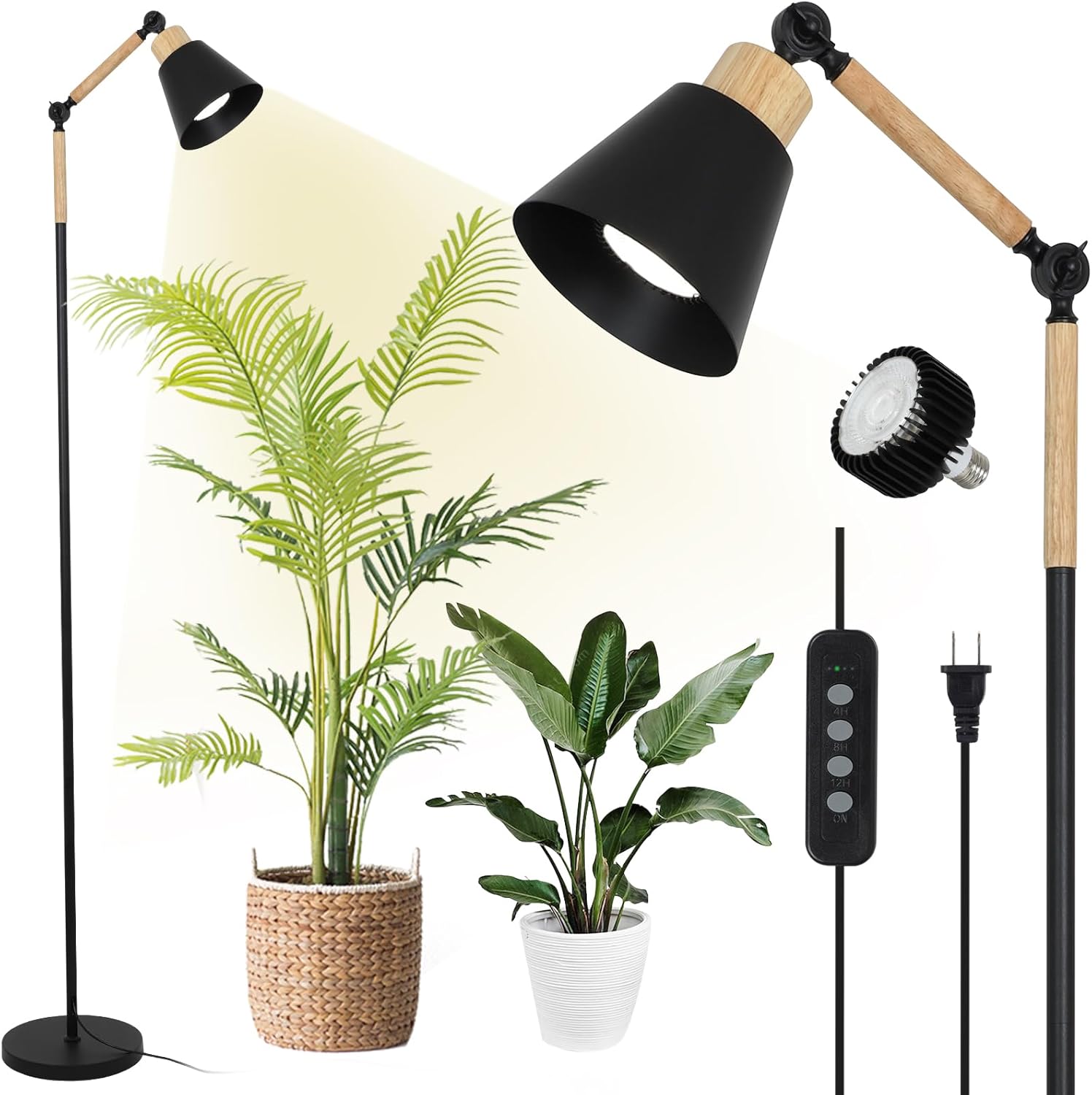
HMVPL 20W Full-Spectrum COB Floor Grow Light with Adjustable Height and Timer
| Wattage | 20 watts |
|---|---|
| Light Source Type | LED |
| Bulb Base | E26 |
| Mounting Type | Floor Mount |
| Timer | 4/8/12H cycle |
This freestanding HMVPL grow lamp is built around a 20W COB LED in an aluminum cylinder shade that delivers a broad 380–780 nm spectrum meant to approximate sunlight. It is used as a supplemental light for taller houseplants: the lamp extends to multiple height positions and has two adjustable-angle knobs so you can aim the beam at the crown of a large plant like a bird of paradise. The built-in 4/8/12-hour cycle timer automates daily light periods, and a remote plus push-button controls make it easy to change settings without moving pots. The aerospace-aluminum construction and metal shade help dissipate heat, and the manufacturer lists a high CRI and measured PPFD indicating strong light output for foliar color and flowering. Limitations include a single 20W light source, so coverage is focused rather than wide and you may need to position the lamp close to larger specimens or use more than one unit for multi-plant setups; it is not water resistant and is intended for indoor use only.
Best for: Buyers who want a compact, automated supplemental light for one or two large indoor tropical plants and who value adjustable reach and easy daily scheduling.
Less Ideal for: Not a good fit for growers needing broad-area coverage for many plants or for humid greenhouse and outdoor setups.
- Full 380–780 nm spectrum suitable for all growth stages
- Height and angle adjustments accommodate tall plants like bird of paradise
- 4/8/12-hour timer automates daily light cycles
- Aerospace aluminum body and COB LED for improved heat dissipation and efficient output
- Single 20W light source produces a focused beam that may not evenly cover very large leaves or multiple plants
- Not water resistant so unsuitable for humid or outdoor locations
Verdict: A practical, height-adjustable full-spectrum floor lamp that gives a bird of paradise focused, automated supplemental light for better growth and flowering.
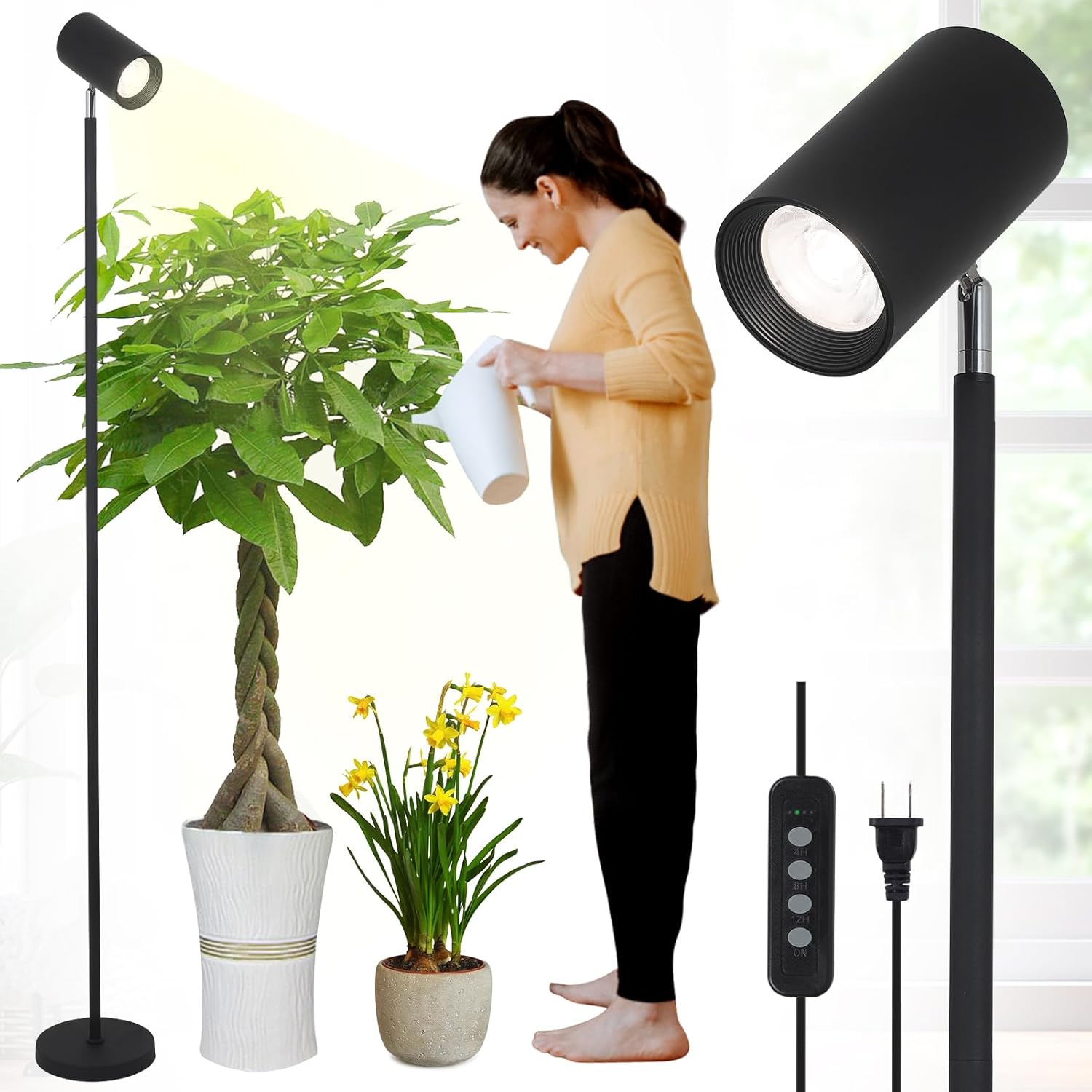
HMVPL 20W COB Full-Spectrum Floor Grow Light Stand with Timer
| Light Source Type | LED |
|---|---|
| Light Source Wattage | 20 watts |
| Color Temperature | 4000 Kelvin |
| Color Rendering Index | 98 |
| Mounting Type | Floor Mount |
This HMVPL floor grow light pairs a 20W COB full-spectrum bulb with a tall, adjustable stand to support seedlings through mature plants. The lamp delivers 4000K full-spectrum light with a high CRI that makes foliage look vivid and a 360° rotatable head so you can target individual pots or a shelf. The included 4/8/12-hour cycle timer makes daily schedules hands-off once set, and the six-level height adjustment lets you position the head for low seedlings or taller houseplants. Its iron stand and aluminum shade give a stable, durable feel and the COB design improves heat dissipation compared with older LEDs. Expect useful light output for indoor germination and vegetative growth, though at 20W this is best suited to small groups of plants or single larger specimens rather than replacing a full grow-bay of high-demand crops. The unit is corded and not dimmable, so brightness control is limited to distance and timer settings. For buyers who prefer a straightforward, low-maintenance COB lamp, this is a practical, easy-to-use option.
Best for: Buyers who want a simple, low-maintenance COB grow lamp to supplement light for seedlings, individual houseplants, or a small indoor gardening setup and prefer automatic scheduling.
Less Ideal for: Growers planning a large multi-shelf or high-light crop system who need higher wattage fixtures, adjustable dimming, or professional-level PPFD control.
- Full-spectrum COB LED with high CRI for natural-looking foliage and broad growth-spectrum coverage
- 360° rotatable head and six-level height adjustments let you aim light precisely at seedlings or taller plants
- Built-in 4/8/12-hour cycle timer provides automatic daily on/off scheduling after a single setup
- Sturdy iron stand and aluminum shade improve durability and heat dissipation compared with standard LEDs
- 20W output is modest and may be insufficient for dense arrays or high-light crops
- Not dimmable so intensity can only be adjusted by distance or timer rather than output control
Verdict: A user-friendly COB floor grow light with a reliable timer and adjustable head that makes supplemental indoor growing easy for small collections.
Choosing the Right Cob Grow Light: Key Factors to Consider
Spectrum and PAR Output
Spectrum determines which wavelengths reach plant leaves and drives photosynthesis across different growth stages. A balanced spectrum that delivers strong PAR in the blue and red bands supports both vegetative and flowering development, while some broad white output improves human visibility for pruning and inspection.
Check published PAR maps or PPFD readings at realistic hanging heights. Fixtures that provide clear PAR charts make spacing and fixture count decisions simpler and reduce the guesswork about light intensity across your canopy.
Heat Management and Placement
COB emitters concentrate light into a small area, which also concentrates heat. Effective heat management-passive heatsinks, active fans, or integrated thermal paths-keeps canopy temperatures stable and reduces the risk of leaf burn or stalled growth.
Placement matters: hang height and reflector design affect both light spread and heat exposure to foliage. Consider how much clearance you have above plants and whether you need additional ventilation to carry heat away from the fixture.
Canopy Coverage and Beam Angle
A single COB can provide high intensity in a focused beam or be engineered with optics to widen coverage. Beam angle and lensing determine how many fixtures you will need to cover a tent or rack without creating bright hot spots and dark zones.
Estimate required fixture count using the manufacturer PPFD footprint or by calculating desired PPFD at canopy level. Wider beam angles reduce fixture count but can lower peak intensity, so match coverage to plant spacing and light needs.
Electrical Efficiency and Driver Quality
Efficiency affects both light output per watt and operating cost. High-efficiency COB fixtures convert more electricity into usable PAR rather than heat. Driver quality matters for stable current delivery, long life, and consistent light output.
Look for fixtures with well-specified driver ratings, power factor information, and protection features like overcurrent and thermal cutoff. Reliable drivers also support dimming without flicker or color shifts.
Controls, Dimming, and Flexibility
Dimmability and control options let you tune intensity through vegetative and flowering stages and adapt to different varieties. Smooth, linear dimming is preferable to stepped or abrupt changes because it preserves light quality while adjusting intensity.
Consider whether you need integrated timers, external dimmers, or compatibility with common controllers. Flexible controls reduce the need to move fixtures as plants grow and can extend the fixture's usefulness across multiple crop cycles.
Build Quality and Mounting
Durable housings, corrosion-resistant hardware, and secure mounting points matter in humid garden environments. A well-built fixture resists moisture and mechanical wear and makes maintenance easier.
Mounting options should allow stable height adjustment and safe installation above canopies. If a fixture lacks robust mounting, you may need additional rigging hardware that can complicate setup and safety.
Matching a Cob Fixture to Your Grow Space
Measure the usable canopy area before selecting a COB fixture. For small tents and single-shelf setups, a single high-intensity COB with a narrow beam may be ideal. Larger footprints typically need multiple fixtures spaced to create an even PPFD map across the crop.
Consider the vertical space available. If your ceiling clearance is limited, choose fixtures with wider beam angles or add reflectors to spread light without hanging too low. Tighter spaces also demand stronger thermal controls to keep canopy temperatures safe.
- Small tents: prioritize intensity and a compact heatsink.
- Multi-shelf racks: favor lower-heat, dimmable fixtures with controllable schedules.
- Large single canopy: plan fixture grid for overlap to avoid dark spots.
Heat Control Strategies for COBs
Managing heat is a key part of successful COB use. Passive heatsinks can handle moderate loads, but denser installations or high-output COBs often need active cooling or improved room ventilation. Heat rising from fixtures also affects upper canopy microclimates, so place temperature sensors at canopy height.
If you cannot increase ventilation, lower fixture power or raise hanging height to reduce leaf temperature. Another option is to run lights on cooler cycles or use supplementary airflow aimed at dissipating heat from the fixture body rather than the leaves.
- Use canopy-level thermometers to spot hot zones.
- Angle fans to move warm air out of the canopy rather than blowing directly on leaves.
- Plan airflow paths that take heat away from hanging fixtures.
Dimming and Light Schedules for Different Stages
Seedlings and early vegetative plants need lower PPFD and benefit from a gentler spectrum. Use dimming to reduce intensity rather than raising hanging height too far, which can change coverage patterns. During flowering, increase intensity gradually and watch for heat stress as output rises.
Implement consistent light schedules and ramp intensities slowly over several days to allow plants to adapt. If your COB supports programmable ramps, use them to mimic natural dawn and dusk and reduce transplant shock when increasing light levels.
- Seedlings: low intensity, longer photoperiods.
- Vegetative: moderate intensity, strong blue component.
- Flowering: higher intensity, gradual increases with attention to heat.
Maintenance and Longevity Tips
Keep heatsinks and cooling fins free of dust to preserve thermal performance. Periodic cleaning prevents reduced airflow and prolonged elevated temperatures that accelerate component wear. Inspect wiring and driver enclosures for signs of moisture or corrosion.
Track runtime hours so you can evaluate light depreciation over seasons. Many COBs will maintain useful output for thousands of hours, but slight declines in lumen or PAR output are normal. Re-evaluate hanging height and PPFD footprints yearly to account for depreciation.
- Clean heatsinks every few months in dusty environments.
- Monitor driver temperature and listen for fan noise changes.
- Document PPFD or visual crop indicators to time adjustments.
Optimizing Light Positioning and Overlap
Avoid hard edges between fixture footprints by overlapping coverage at the periphery. Slight overlap reduces hotspots and dark seams that stunt outer canopy growth. Use temporary PPFD readings or a smartphone PAR meter to validate uniformity across the canopy.
Tilt or offset fixtures slightly when necessary to correct localized shading from plant structures or trellis systems. For multi-tier systems, ensure that upper fixtures do not outshine lower shelves and that airflow remains sufficient at every level.
- Overlap footprints by 10 to 20 percent for even coverage.
- Use adjustable hangers or ratchets to fine-tune positioning.
- Check coverage after plants reach full canopy to correct gaps.
How We Chose the Best Cob Grow Light
We focused on attributes that directly affect plant growth and daily handling in indoor gardens. Primary evaluation criteria included spectral fidelity, because accurate PAR output across useful wavelengths drives photosynthesis; thermal management, since COBs produce concentrated heat that must be dispersed for healthy canopies; and canopy coverage, to determine how many fixtures a grower needs for a given footprint. We also scored electrical efficiency and dimmability to reflect operating cost and flexibility across life stages, plus build quality for long-term durability in humid garden environments. For exclusions we filtered out fixtures with incomplete spectral data, poor thermal design, or inadequate mounting options. We did not consider fixtures intended exclusively for decorative use or those lacking measurable PAR or spectrum specifications. These choices ensured the list focuses on usable Cob grow lights that perform in real indoor growing conditions rather than concept or novelty products.
FAQ
How high should I hang a COB grow light above the canopy?
Hanging height depends on beam angle and output. Start at the manufacturer recommended height and observe for leaf bleaching or stretching. Adjust in small increments while monitoring PPFD and canopy temperature.
Are COB grow lights better for flowering or vegetative stages?
COBs can be effective for both stages because they provide intense, high-quality light. Use dimming and spectrum considerations to tailor intensity for seedlings, vegetative growth, and flowering to avoid heat stress during high-output periods.
Will COB fixtures run hotter than other LED formats?
COBs concentrate light and heat in a smaller emitter area, so they often require more robust thermal solutions. With proper heatsinking and ventilation, they can run safely, but expect to plan for heat dissipation in tighter spaces.
Can I use multiple COBs in a small tent?
Yes, multiple COBs can provide even coverage if spaced and dimmed appropriately. Pay special attention to total heat load and cumulative PPFD to avoid creating hot spots or exceeding safe temperature ranges.
How do I compare PAR data between COB fixtures?
Compare published PPFD maps at the same hanging heights and the same power settings. Look for consistency across the footprint and check spectrum charts to ensure the PAR is delivered in useful wavelengths rather than skewed outside photosynthetic ranges.
Do I need special mounting hardware for COB lights?
Some COB fixtures include integrated mounting points, while others require additional hangers or rails. Choose fixtures with secure, adjustable mounting options to simplify height changes and ensure safety above the canopy.
Final Verdict
Choosing a Cob grow light means balancing high-intensity output with practical heat management and coverage needs. Prioritize fixtures with clear PAR data and good thermal design for reliable canopy performance. Match beam angle and dimming capability to your space, and plan ventilation and mounting around the fixture's heat and footprint. With these tradeoffs in mind, you can select a COB that fits your tent or room layout and supports steady plant development.
