

Note: This article contains affiliate links. If you click on these links and make a purchase, I may earn a small commission at no extra cost to you. This helps support my research and content. Read my full affiliate disclosure here.
Choosing the right color grow light changes how plants develop color, flower, and use energy in your indoor garden. The wrong spectrum or uneven coverage can leave foliage washed out, stressed, or prone to stretching. This guide shortlists the top fixtures suited to color-focused growing and practical canopy management. We evaluated options across spectrum control, coverage pattern, and usable output to help you find a fixture that matches your space and plants. Below are the top picks and the evaluation criteria we used to judge them.
Top Picks at a Glance
| Best Overall The best all-around choice for most situations | VIVOSUN LumaLight 100W Full-Spectrum LED Grow Light, 2-Pack | 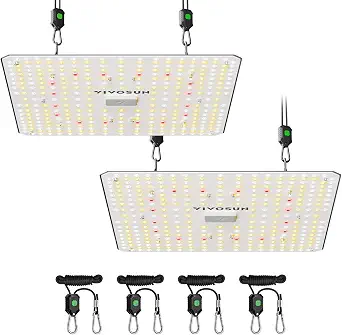 |
| Best Quality Built to a higher standard if you want something more solid | VIVOSUN LumaLight 200W Full Spectrum Dimmable LED Grow Light |  |
| Best Value The sweet spot between price and what you get | LEOTER 4-Head LED Grow Light with Full Spectrum, Timer and 10-Level Dimming |  |
| Best Budget The cheapest option that still gets the job done reliably | Sondiko LED Grow Light Strip — Dimmable Red/Blue Spectrum Bar |  |
| Highest Rated A top-rated pick with lots of positive feedback | Hemonee 5-Head LED Grow Light with Adjustable Tripod Stand |  |
| Most Popular A crowd favorite that many people choose with confidence | GooingTop HY-021 6000K Full-Spectrum Clip Grow Light |  |
| Best Seller A high-volume bestseller chosen again and again | Aokrean Halo Full-Spectrum LED Grow Light with Base (3-Pack) |  |
VIVOSUN LumaLight 100W Full-Spectrum LED Grow Light, 2-Pack
| Light Source Type | Light Emitting Diode |
|---|---|
| Wattage | 100 watts |
| Dimmable | Yes (25%–100%) |
| IP Rating | IP65 |
| Number of Light Sources | 672 |
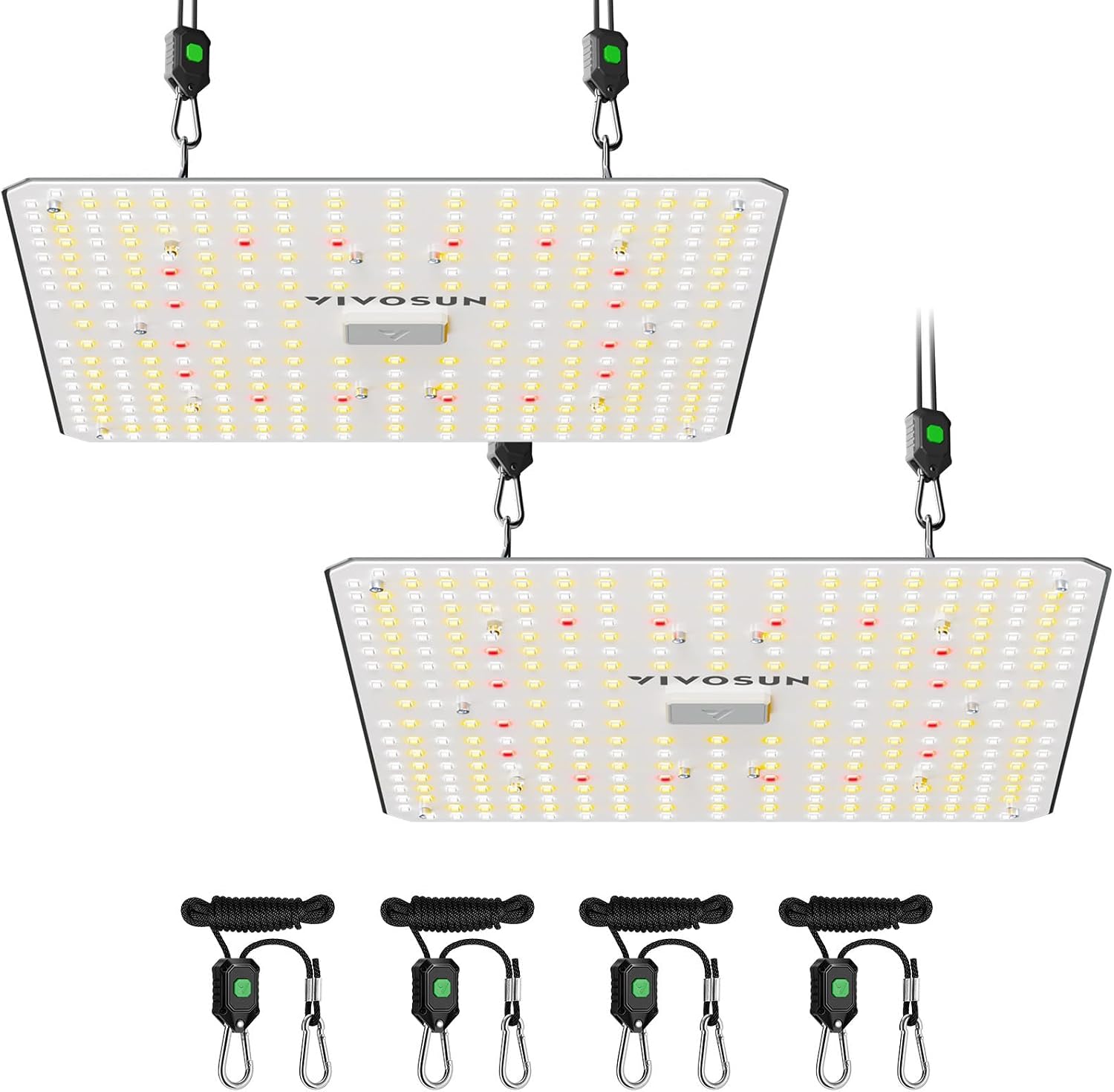
The VIVOSUN LumaLight 100W (two-pack) is a compact full-spectrum LED designed to deliver usable light for seedlings through flowering in small indoor setups. Each disc contains 672 diodes covering white, blue, red, and far-red bands so photosynthesis and flowering receive targeted wavelengths, while the diode layout helps keep intensity even across a 2×2 to 2×4 tent. A four-level dimming knob lets you tune output from 25 to 100 percent without complicated wiring, and the lights are compatible with VIVOSUN GrowHub for automated schedules. The fixtures run cool thanks to built-in thermal management and an IP65 rating makes them safe for humid environments or light spraying. Practical strengths are the included rope hangers, a modest power draw at 100W per unit, and a long claimed lifetime for sustained use. Expect limits in coverage for larger canopies and growers who need very high PPFD at canopy level will prefer higher-wattage fixtures, but for balanced hobbyists managing a small tent this offers a convenient, low-heat, full-spectrum option.
Best for: Home growers who want an easy-to-use, full-spectrum LED for a 2×2–2×4 tent or a couple of potted plants and value dimming, low heat, and humidity-safe operation.
Less Ideal for: Large-scale or commercial growers and anyone needing very high PPFD across multiple square feet should choose higher-wattage or multi-bar fixtures instead.
- Full spectrum LEDs including far-red to support both vegetative growth and flowering
- Dimmable control (25%–100%) and GrowHub compatibility for scheduling and remote adjustments
- IP65 rating for safe use in humid or wet environments
- Low heat output with thermal management for closer placement to plants
- Sold as a two-pack with rope hangers for immediate tent setup
- 100W per unit limits effective coverage for larger tents or dense canopies
- Disc form factor provides less deep canopy penetration than higher-wattage bar-style fixtures
Verdict: A convenient, low-heat full-spectrum LED two-pack that gives balanced, dimmable light for hobby growers using small tents or tabletop setups.
VIVOSUN LumaLight 200W Full Spectrum Dimmable LED Grow Light

| Wattage | 200 watts |
|---|---|
| Light Source Type | LED |
| Dimmable | Yes, 25%–100% via knob |
| Mounting Type | Ceiling Mount |
| IP Rating | IP65 |
The VIVOSUN LumaLight 200W is a performance-focused LED grow light engineered to push vegetable growth from seedling through harvest. It combines a full spectrum (white, blue, red, and far-red) with 672 diodes arranged to produce a high and even PPFD across the canopy, which helps reduce edge-to-center variation and encourages consistent leaf and fruit development. Use it mounted over a single grow bench or small tent where you need concentrated output; the four-level dimming knob (25 to 100 percent) and compatibility with VIVOSUN GrowHub let you tune intensity and schedules to crop stage. Thermal management keeps surface temperatures lower than many HID options, and IP65 protection means it tolerates humid conditions and light washdowns common in vegetable grows. Practical limits are its coverage: at 200 watts it is best for 2×2 to 3×3 spaces rather than large multi-plant rooms, and advanced growers who need fully tunable spectrums or integrated fans may prefer higher-end fixtures. For focused, reliable vegetable production in modest indoor spaces, it delivers strong, usable light with smart control options.
Best for: Growers seeking reliable, high-intensity light to maximize vegetable yields in a 2×2 to 3×3 indoor setup who prioritize steady performance and simple intensity control.
Less Ideal for: Large-scale hobbyists or commercial growers who need broad coverage or fully tunable spectrum controls should consider higher-wattage or more advanced fixtures.
- Full spectrum LEDs including far-red to support all growth stages and flowering
- High diode count and strategic layout for uniform PPFD across the canopy
- Dimmable 25%–100% with local knob and GrowHub compatibility for scheduling
- IP65 rated for resistance to humidity and light washdowns
- 200W output is optimized for small tents or single benches rather than large rooms
- No built-in fan or advanced spectrum tuning compared with premium tunable fixtures
Verdict: A compact, high-intensity full-spectrum LED that gives vegetable growers tunable, uniform light for small indoor gardens to improve yields.
LEOTER 4-Head LED Grow Light with Full Spectrum, Timer and 10-Level Dimming

| Light Source Type | LED |
|---|---|
| Number of Light Sources | 80 |
| Wattage | 80 watts |
| Control Method | Remote |
| Mounting Type | Clip On |
The LEOTER 4-head grow light is a USB-powered, clip-on lamp built for indoor plant care that combines full-spectrum and targeted red/blue diodes to support seedlings, vegetative growth and flowering. It uses 80 LEDs arranged across four adjustable heads on flexible goosenecks so you can position light over individual large plants or groupings. Notable features are three spectral modes (red+blue, warm/full spectrum, and combined), a circular memory timer with 3/9/12-hour presets, and ten brightness levels for fine control over intensity. The strong metal clip and flexible necks make it simple to aim light at tall foliage without permanent installation. Practical benefits include reduced need for supplemental natural light, convenient daily scheduling for busy users, and a compact footprint that suits shelves or plant stands. Important limitations are that the unit is described as a clip/desk lamp rather than a wide-panel fixture, so coverage for very large single specimens may require placing heads close to foliage or using multiple units, and the timer resets if unplugged so it needs occasional reprogramming after power loss.
Best for: Buyers who want a controllable, space-efficient grow light to supplement indoor sun for larger houseplants and prefer a proven, feature-rich unit with preset timers and adjustable heads.
Less Ideal for: Growers who need single-fixture coverage for floor-to-ceiling specimens or large multi-plant setups should consider full-size panel fixtures or multiple units instead.
- Full spectrum plus red and blue LEDs (80 total) to support all growth stages
- Ten dimming levels for precise intensity control
- Three timer presets with memory function for hands-off daily scheduling
- Adjustable 4-head design and flexible goosenecks for targeted placement
- Strong metal clip allows mounting on shelves, desks, or plant stands
- Designed as a clip-on lamp so single-unit coverage is limited for very large plants
- Timer settings must be reset after the light is unplugged
Verdict: A versatile, adjustable clip-on grow light that gives busy indoor gardeners precise control over spectrum, intensity and scheduling to boost large plant growth in compact spaces.
Sondiko LED Grow Light Strip — Dimmable Red/Blue Spectrum Bar
| Light Source Type | LED |
|---|---|
| Light Source Special Features | Dimmable (4 Levels) |
| Number of Light Sources | 48 |
| Mounting Type | Wall Mount |
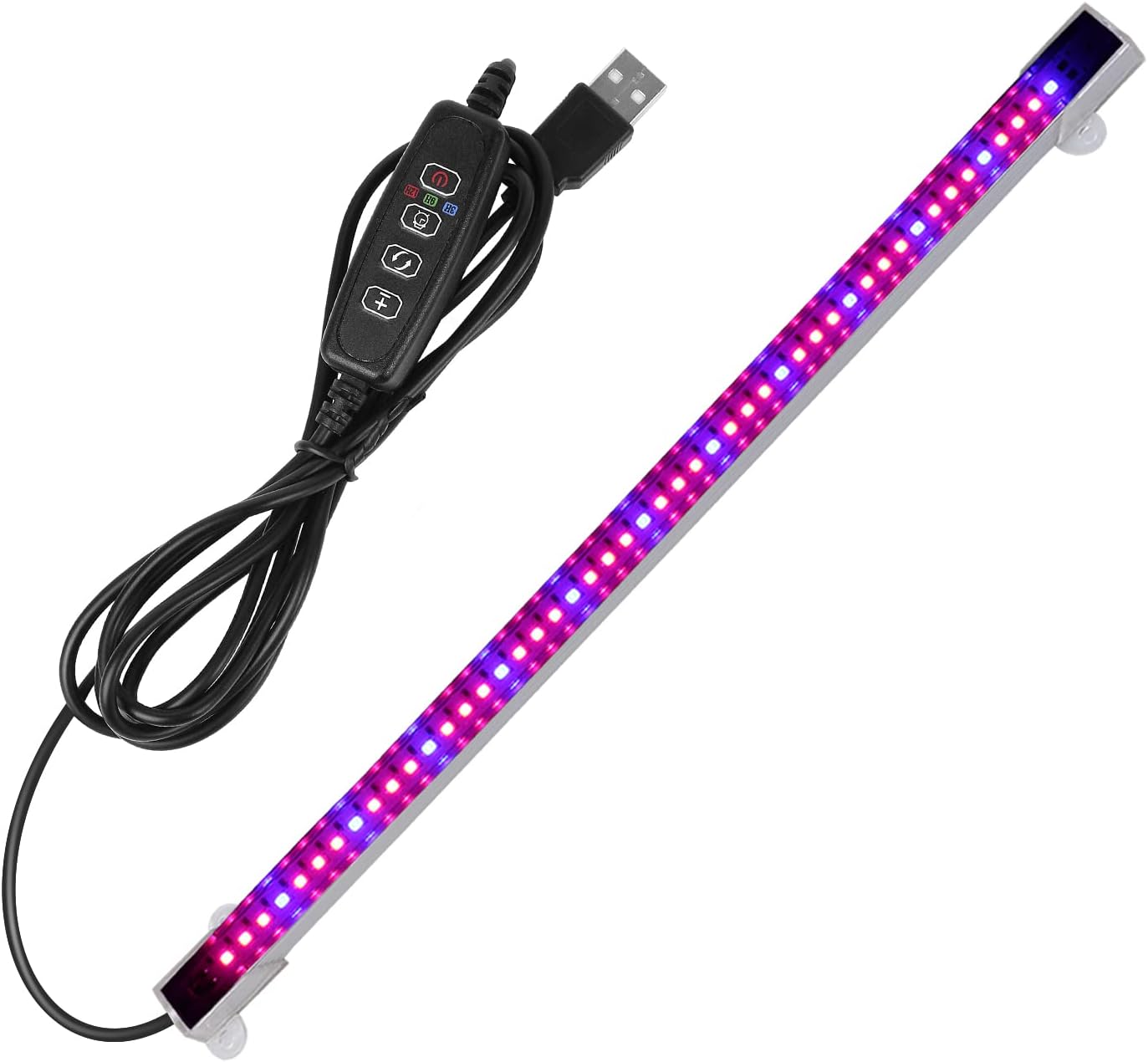
The Sondiko LED Grow Light Strip is a small, wall- or shelf-mountable grow lamp designed to give seedlings and small houseplants extra light. It uses an array of LEDs covering a broad wavelength range rather than only pure red and blue, and offers four dimming settings so you can reduce output for tender seedlings or raise it for more light-hungry stages. The unit includes a more precise electronic timer and an auto on/off control so daily schedules can run without manual operation. Installation is straightforward with included screws, double-sided tape and zip ties, and the modest footprint fits cabinets, micro-gardens, and single-shelf setups. Limitations are its short length and fixed mounting style, which make it best for small clusters rather than full grow benches, and the product information lists mixed wattage numbers that suggest buyers should check actual power draw for larger arrays. For budget buyers wanting a simple, adjustable supplemental lamp for color-corrected light, this is a practical choice.
Best for: Best for gardeners on a tight budget who need an affordable, compact supplemental light for seedlings, single shelves, or small indoor plant groups and prefer simple, configurable controls.
Less Ideal for: Not a good fit for growers who need wide-area coverage, multi-shelf rigs, or a professional full-spectrum fixture for flowering and large vegetable setups.
- Broad wavelength LED array rather than only red/blue, which supports multiple plant stages
- Four dimmable levels for customizing intensity from seedlings to vegetative growth
- Built-in timer and auto on/off for hands-off daily schedules
- Multiple mounting options and included hardware for easy installation
- Short 13.2-inch length limits coverage area to a few small plants or a single shelf
- Mounting is primarily fixed so it is less flexible than adjustable-arm fixtures
Verdict: A low-cost, adjustable LED strip that delivers broad-spectrum supplemental light and simple timer control for small indoor plant setups.
Hemonee 5-Head LED Grow Light with Adjustable Tripod Stand

| Spectral modes | Red+Blue, White, Combined |
|---|---|
| Brightness levels | 10 levels (10%–100%) |
| Timer options | 4/8/12 hours |
| Stand height range | 15"–63" |
| Remote control | RF remote (up to 30 m) |
This Hemonee 5-head LED grow light is built for steady, repeatable indoor plant lighting. The five independent heads sit on flexible goosenecks so you can aim light exactly where plants need it, and the tripod extends from a low setup to taller placements for seedlings or mature plants. It offers three spectral modes (red+blue, white, and combined) and 10 brightness steps, which makes it straightforward to match light color and intensity to different growth stages. Practical controls include an inline panel plus an RF remote with a 30 meter range and built-in 4/8/12 hour timers so you can automate schedules without daily adjustments. The aluminum shell and aviation-grade heat sink improve heat dissipation for longer runtime. Assembly is quick and the independent-head control gives flexibility for mixed trays or grouped pots. Limitations to note are that output numbers are not specified so growers wanting exact PPFD or wattage readings will need a meter, and the unit is better suited for small to medium setups rather than full-scale grow rooms.
Best for: Buyers who prioritize a dependable, automatable grow light that can be aimed precisely at individual plants and adjusted for different growth stages in home or hobby setups.
Less Ideal for: Large-scale growers or those who need exact light output specifications for scientific or commercial applications should consider more powerful fixtures with published PPFD/wattage data.
- Five independently adjustable heads for targeted coverage and flexible geometry
- Three spectral modes plus 10 dimming levels to match growth stages
- RF remote and inline controller with 4/8/12 hour timers for reliable automation
- Tripod stand with wide height range to suit seedlings through larger plants
- Aluminum shell and aviation-grade heat sink for improved heat dissipation
- No technical output specifications (PPFD or total wattage) provided for precision light planning
- Designed for small to medium setups rather than large commercial grow rooms
Verdict: A reliable, easy-to-position multi-head LED lamp with selectable spectrums and timers that delivers automated, flexible light for home and hobby growers.
GooingTop HY-021 6000K Full-Spectrum Clip Grow Light

| Power Source | Corded Electric |
|---|---|
| Color Temperature | 6000 Kelvin |
| Light Output Maximum | 2500 lumens |
| Light Source Special Features | Dimmable |
| Number of Light Sources | 84 |
This GooingTop HY-021 is a compact clip-on grow light built for small houseplants, seedlings and shelf gardens. It uses 84 LEDs (white plus deep red) to deliver a 6000K full-spectrum output intended to mimic midday sun, with a high color-rendering output that also makes it pleasant as a reading lamp. Two flexible gooseneck heads and a strong clamp let you aim light precisely over pots and seed trays, while the attached remote provides 50%/100% dim levels and repeating timers at 4, 8 or 12 hours for hands-off scheduling. Practical benefits include low power draw (listed as roughly 10 W LED draw), a claimed 1 to 2 square meter coverage for seedlings, and an included timer that simplifies day/night cycles. Limitations are its design for small setups rather than large grow racks and the clip mounting limits placement compared with freestanding fixtures. The unit also relies on the corded remote instead of a smartphone app and the lifespan claim is typical of LEDs but not independently verifiable from the listing.
Best for: Buyers who want a simple, low-power, plug-and-play grow light to boost seedlings and a few houseplants on a desk or shelf and who value an easy-to-use timer and adjustable brightness.
Less Ideal for: Growers planning multi-shelf installations, larger vegetable grows, or who need networked or app-based control should consider larger bar lights or fixtures designed for commercial racks.
- Full-spectrum 6000K output with added 660 nm red LEDs to support vegetative growth and flowering
- Attached remote with dimming (50%/100%) and repeat timer settings (4/8/12 hours) for easy scheduling
- Flexible dual goosenecks and strong clamp enable precise positioning over small pots and seed trays
- High reported color rendering for comfortable viewing and accurate plant color assessment
- Low electrical draw around 10 W while covering small growing areas
- Clip-mount design and stated 1–2 m² coverage make it better suited to individual plants or small trays rather than large multi-shelf setups
- No smart app or wireless control option; remote is cord-attached which limits placement flexibility
Verdict: A compact, easy-to-use clip grow light that delivers full-spectrum light and convenient timer/dim controls for small indoor plant setups.
Aokrean Halo Full-Spectrum LED Grow Light with Base (3-Pack)

| Light Source Type | LED |
|---|---|
| Number of Light Sources | 48 |
| Wattage | 10 watts |
| Control Method | Touch |
| Power Source | Corded Electric |
This Aokrean Halo grow light is a small, versatile LED solution for indoor plants that offers a lot of convenience in a compact package. Each lamp uses 48 LEDs with a full-spectrum output and three lighting modes plus ten brightness levels, so it can be tuned for seedlings, vegetative growth, or supplemental light for potted houseplants. The lamp can be inserted into soil or mounted on the included base, and the telescoping pole adjusts up to about 26 inches to suit taller pots or change light intensity. Controls are touch-based and include a timer with preset cycles for automated daily on/off. Practical benefits include a neat decorative look, low power draw at 10 watts, and USB/Bluetooth connectivity for modern setups. Limitations are that the base requires the pot to help stabilize the stand and the unit is not water resistant, so it must stay dry and indoors. For balanced buyers looking for adaptable, easy-to-use grow lights for multiple indoor plants, this hits the mark.
Best for: Buyers who want a compact, adjustable grow light that works for seedlings and small to medium houseplants and who value easy controls and automated timers.
Less Ideal for: Growers needing heavy-duty, waterproof fixtures for greenhouse or outdoor use or those who require high-output lighting for large-scale indoor gardens.
- Full-spectrum LED array (48 LEDs) with three lighting modes and 10 brightness levels for flexible plant lighting
- Height-adjustable pole and dual mounting (insert in soil or use the base) to fit a range of pot sizes
- Touch controls with built-in timer options for automatic daily cycles
- Low power consumption (10 watts) and high efficiency for continuous use
- Base stability depends on placing a pot on it so it can be less secure with lighter containers
- Not water resistant so unsuitable for humid or outdoor environments
Verdict: Aokrean's Halo is a space-saving, full-spectrum grow light with adjustable height and timers that makes it easy to give small indoor plants the right light without complex setup.
Choosing the Right Color Grow Light: Key Factors to Consider
Spectrum Accuracy and Peak Wavelengths
The exact wavelengths a fixture emits have a direct effect on pigment production and visual color in foliage and flowers. Lights with peaks at specific red, blue, and far-red bands stimulate chlorophyll production and color expression differently, so knowing measured spectra helps you match light to the plants you grow.
Spectrometer data or manufacturer-provided spectral distribution charts are useful because they reveal whether a lamp emphasizes the wavelengths you want. Fixtures that list only general color terms without spectral graphs are harder to evaluate and may not produce the color results you expect.
Adjustable Spectrum and Control Options
Being able to tune the ratio of red to blue or introduce white and far-red channels is valuable when you are optimizing for color at different growth stages. Adjustable fixtures let you emphasize blue for compact vegetative growth or increase certain red ranges to deepen flower and leaf pigmentation.
Control interfaces matter too. Fixtures that offer manual dimming, onboard switches for channel selection, or digital control via timers and dimmers make it easier to reproduce a color strategy across multiple light units and growing cycles.
Coverage Area and Beam Uniformity
A fixture that produces great color in one spot but has hot and cold patches will deliver inconsistent results across a canopy. Look for fixtures with measured PPFD maps or manufacturer coverage statements that match your hanging height and canopy size.
Consider beam angle and optics as well. Wide angle lenses spread light more evenly at closer heights, while narrower optics concentrate light for deeper canopies. For even color development, aim for overlapping coverage patterns when using multiple fixtures.
Usable Output and Energy Efficiency
Photosynthetic photon flux density (PPFD) at canopy level tells you how much useful light plants receive. A fixture that draws less power but delivers good PPFD is more efficient for long-term running costs and heat control.
Compare output-per-watt figures and look for fixtures that maintain output without large drops when dimmed. High efficiency reduces the need for excessive cooling and helps maintain the spectral balance that influences color.
Thermal Management and Component Longevity
Heat affects both the lifespan of diodes and the stability of spectral output. Fixtures with robust heat sinks, active cooling where needed, and well-ventilated designs keep diode junction temperatures lower and preserve intended color output over time.
Poor thermal design can shift peak wavelengths or reduce total light output as the fixture ages. For growers focused on color consistency across seasons, reliable cooling extends useful life and keeps color results repeatable.
Form Factor and Installation Flexibility
The physical design of the fixture influences how easy it is to place over benches, shelves, or hanging rigs. Slim panels can fit tight shelves, while larger fixtures may be better for open canopy tables. Consider mounting points, suspension options, and whether the fixture can be daisy chained for simplified installs.
Installation flexibility also affects how easily you can adjust height and spacing to fine-tune color outcomes. Fixtures that are cumbersome to move or that lack attachment options reduce your ability to experiment with spectrum and coverage.
Why Color Spectrum Matters for Plant Appearance
Plant pigments respond to specific parts of the light spectrum. Blue light tends to keep foliage compact and can intensify green tones, while particular red bands and far-red influence flowering and pigment production in petals and leaves. White or full-spectrum channels provide balance and more natural-looking color under the lamp.
For growers focused on aesthetics, choosing fixtures that deliver the right mix of wavelengths is the primary way to shape plant appearance without altering nutrition or other cultural factors.
- Blue peaks tighten internodes and affect leaf gloss
- Red peaks promote flower initiation and deepen some pigments
- White channels render colors more naturally for display or photography
Setting Up Your Light Layout for Even Color
Plan the layout so fixtures overlap their coverage slightly. That reduces edge banding where color and intensity can shift. Use measured PPFD maps when available to place fixtures at heights that match your desired canopy intensity.
Adjust channel ratios across fixtures strategically. For example, run a slightly higher blue proportion in peripheral units to avoid stretching at the edges, and central units can carry a different mix to optimize flower color.
- Use a handheld PPFD meter to verify uniformity
- Stagger fixture heights to manage hot spots
- Keep controller settings consistent across a run for repeatable color
Tuning Spectrum Through Growth Stages
Seedlings and young vegetative plants often benefit from a bluer spectrum to build compact structure. As plants transition to flowering or display stages, gradually increasing red and far-red channels can deepen bloom and leaf color. These adjustments should be gradual to avoid shock.
Document the channel mixes and runtimes that produced the best color so you can reproduce them. If you are managing multiple cultivars, note that each variety may respond differently, so small tweaks are normal.
- Start with a blue-forward mix for early growth
- Shift to red-rich mixes for flowering and color development
- Use dimming to fine-tune intensity without changing spectrum immediately
Practical Tips for Evaluating Spectral Data
When manufacturers publish spectral distribution charts, look for clear peaks and labeled wavelengths. Relative output across blue (400-500 nm), red (600-700 nm), and far-red (700-750 nm) bands tells you what the fixture emphasizes.
If spectral data is missing, seek fixtures with adjustable channels or those that list measured PPFD across relevant heights. Real-world measurements provide more reliable guidance than vague color descriptions.
- Compare spectral graphs at the same scale
- Verify PPFD at your intended hanging height
- Prefer fixtures that show channel-specific output
Maintaining Color Consistency Over Time
Regularly clean lenses and maintain fans or passive heatsinks to prevent dust buildup that can shift intensity and apparent color. Replace or service units according to manufacturer guidance to avoid spectral drift as components age.
Keep track of runtime hours and consider swapping older fixtures out of zones where precise color is important. Consistent environmental control for temperature and humidity also helps plants display predictable coloration under the lights.
- Wipe lenses periodically with a soft cloth
- Monitor fixture temperature during long runs
- Rotate fixtures between zones to even out aging
How We Chose the Best Color Grow Light
We focused on attributes that matter for growers who prioritize plant color, pigment development, and reliable canopy illumination. Key evaluation criteria included spectrum accuracy and control, which measures whether a fixture provides the wavelengths plants use for pigmentation and whether those bands can be adjusted. Coverage and beam uniformity were used to assess how evenly light falls across a typical canopy for the fixture size. Usable output and efficiency considered photosynthetic photon flux density relative to power draw, so a lamp that wastes energy was downgraded. Build quality and thermal management were judged because overheating alters spectrum stability and shortens component life. We excluded fixtures that lack basic spectrum data or provide only vague output claims. We also left out products intended solely for decorative or occasional use that do not aim for horticultural results. The resulting list emphasizes real-world performance, controllability, and durability for indoor growers focused on color and plant appearance.
FAQ
Does a Color Grow Light need to be full spectrum to produce good color?
Not always. Full-spectrum fixtures render natural-looking color, but a targeted spectrum with strong red and blue bands can enhance specific pigments. The choice depends on whether you want natural appearance or intensified coloration.
How high should I hang a Color Grow Light to get uniform color?
Hanging height depends on the fixture optics and desired PPFD. Use manufacturer coverage charts or a PPFD meter to find the height that gives even illumination. Slight overlap between fixtures helps maintain uniformity at the canopy.
Can dimming affect plant color development?
Dimming changes intensity more than spectral balance, but some fixtures alter channel ratios when dimmed deeply. For consistent color, check how a fixture behaves at different dim levels and prefer units that keep spectrum stable when dimmed.
Will different plant varieties respond the same way to the same spectrum?
Varieties often differ in pigment response. While general trends hold, you may need to tweak spectrum mixes for specific cultivars to achieve the best color and form.
How often should I clean or maintain my lights to preserve color output?
Clean lenses and cooling surfaces regularly, typically every few weeks in dusty conditions. Check fans and heat sinks for debris and inspect fixtures for visible degradation every few months.
Final Verdict
Focus on spectrum accuracy, control, and even canopy coverage when choosing a Color Grow Light. Those three dimensions determine how reliably plants develop the pigment and floral characteristics you want. Balance energy efficiency and thermal design to keep fixtures stable and affordable to run over time. Prioritize a fixture that matches your installation size and gives predictable spectral behavior when dimmed and aged. That approach delivers consistent color across cycles and makes it easier to fine-tune results for different plants.
