

Note: This article contains affiliate links. If you click on these links and make a purchase, I may earn a small commission at no extra cost to you. This helps support my research and content. Read my full affiliate disclosure here.
Picking the right dimmable LED grow light matters because light intensity and spectrum directly shape plant structure, flowering times, and overall yield. In confined spaces such as closets, small tents, or tabletop setups, the ability to dial in output and spectrum helps you avoid heat stress and stretch while matching light to each growth stage. This guide covers seven shortlisted dimmable LED grow lights that suit a range of indoor growing setups. We evaluate each option against practical criteria gardeners care about, including spectral control, energy draw, build and heat management, and ease of mounting and adjustment. Read on to understand which features matter most for your space and growing goals before the product breakdowns below.
Top Picks at a Glance
| Best Overall The best all-around choice for most situations | Spider Farmer SF1000D 100W Dimmable Full-Spectrum LED Grow Light |  |
| Best Quality Built to a higher standard if you want something more solid | MARS HYDRO TS600 100W Dimmable Full‑Spectrum LED Grow Light |  |
| Best Value The sweet spot between price and what you get | SANSI 40W Dimmable Full-Spectrum Grow Light Bulb with Remote (E26) |  |
| Best Budget The cheapest option that still gets the job done reliably | SGLEDs 10W Dimmable PAR20 Full Spectrum Grow Light Bulb with Remote |  |
| Highest Rated A top-rated pick with lots of positive feedback | VIPARSPECTRA P700 70W Dimmable Full Spectrum LED Grow Light |  |
| Most Popular A crowd favorite that many people choose with confidence | LEOTER 4-Head LED Grow Light with Full Spectrum, Timer and 10-Level Dimming |  |
| Best Seller A high-volume bestseller chosen again and again | Aokrean Halo Full-Spectrum LED Grow Light with Base (3-Pack) |  |
Spider Farmer SF1000D 100W Dimmable Full-Spectrum LED Grow Light

| Light Source Wattage | 100 watts |
|---|---|
| Light Source Type | Light Emitting Diode |
| Light Source Special Features | Samsung LM301B diodes, full spectrum, no-fan design |
| Number of Light Sources | 600 |
| Input Voltage | AC110-130V |
The Spider Farmer SF1000D is a compact, 100W full-spectrum LED built for small grow spaces such as 2×2 tents. It uses high-density Samsung/Bridgelux-type diodes arranged across a waterproof board and an aluminum heat sink to deliver even canopy coverage with low noise because it has a no-fan design. Typical use is ceiling- or hook-mounted over a 2×2 to 3×3 area for seed starting, vegetative growth, and flowering; the manufacturer lists a veg footprint around 3×3 and a flowering footprint of 2×2. The dimmable driver makes it easy to dial light intensity for different growth stages, and the low 100W draw offers better energy efficiency than comparable HID fixtures, with less heat to manage. Practical benefits include quiet operation, solid build materials, and protective cable covers for safer tent installations. Limitations are the modest output for larger or commercial setups and the fixed coverage pattern that may require raising or adding fixtures for denser canopies.
Best for: Growers who want a quiet, energy-efficient light for a single 2×2 tent and who value straightforward, adjustable performance across all plant stages.
Less Ideal for: Commercial growers or hobbyists running multiple tents or large canopies who need higher total output or advanced control features.
- Full spectrum with blue, 3000K, 5000K, deep red (660-665nm) and IR suitable for all growth stages
- Dimmable 100W driver for adjustable intensity across veg and flower phases
- No-fan design with large aluminum heat sink provides quiet operation and passive cooling
- Waterproof LED board and protective cable covers improve safety inside tents
- 100W total output is ideal for 2×2 tents but may be insufficient for larger or heavily canopied grows
- No integrated controller or app features for scheduling or advanced automation
Verdict: A quiet, energy-efficient 100W full-spectrum LED that gives balanced, adjustable light for a single 2×2 tent setup.
MARS HYDRO TS600 100W Dimmable Full‑Spectrum LED Grow Light

| Wattage | 100 watts |
|---|---|
| Light Output Maximum | 10000 lumens |
| Light Source Type | LED |
| Light Source Special Features | Sunlike Full Spectrum |
| Number of Light Sources | 225 |
The MARS HYDRO TS600 is a 100W dimmable LED grow light built for small tents, cabinets, and single‑plant setups. It delivers a sunlike full spectrum with dedicated red/IR diodes and an advertised PPF of about 190 µmol/s and PPE around 2.0 µmol/J, so you get usable photosynthetic light while drawing modest power. The unit uses an aluminum body, a patented 120° reflector layout to spread light more evenly across a 2×2 area, and a 0–100% dimmer to tailor intensity from seedlings through flowering, which helps control stretch and save energy. Practical benefits include low noise, low power draw compared with HPS, and a light footprint appropriate for beginners who still want tunable output. Limitations are its modest total PPF and PPE compared with larger fixtures, so it is best for one to two plants or small racks rather than bigger grow rooms, and the dimmer and reflector promise rely on correct hanging height and uniform tent reflectivity for best results.
Best for: Buyers who prioritize controllable light output and efficient performance for small grow spaces and want a tunable fixture that adapts from seedling to bloom with minimal energy use.
Less Ideal for: Growers running multiple plants across larger tents or commercial racks who need higher total photon output and deeper canopy penetration should consider more powerful fixtures.
- Dimmable 0–100% control lets you match intensity to growth stages and save energy.
- Full‑spectrum LED array including red/IR diodes tailored for vegetative and flowering phases.
- Patented reflector layout for improved light uniformity across a 2×2 footprint.
- Low power draw (100W) and quiet operation compared with traditional HPS/MH lighting.
- Aluminum construction that sheds heat and supports long service life.
- Total PPF and photon efficiency are modest relative to larger, higher‑end fixtures, limiting canopy penetration for dense canopies.
- Optimized performance assumes use in a reflective grow tent or close mounting height; open rooms will reduce uniformity.
Verdict: If you want an energy‑efficient, dimmable LED that gives even, full‑spectrum coverage for a 2×2 grow tent, the TS600 is a focused performance choice.
SANSI 40W Dimmable Full-Spectrum Grow Light Bulb with Remote (E26)

| Wattage | 40 watts |
|---|---|
| Bulb Base | E26 |
| Color Temperature | 4000 Kelvin |
| Light Output Maximum | 3800 lumens |
| Light Source Operating Life | 25000 hours |
The SANSI 40W grow light bulb is designed to replace a high-wattage incandescent for indoor plant lighting by delivering a full 400nm–780nm spectrum and up to 3800 lumens while using 40 watts. It screws into a standard E26 socket and is controlled by the included remote, which adjusts four brightness levels and sets 4-, 8-, or 12-hour timers with memory of the last setting. The bulb uses a patented ceramic heat-sink approach for improved thermal transfer and is ETL listed, which supports longer operating life and more stable output. In practice this makes it a simple plug-and-play option for single pots, shelves, or small grow tents where high white brightness and good color rendering are helpful for both plant growth and visual inspection. Limitations are that it provides a 60 degree beam angle so it is best for focused placements rather than wide-area coverage, and one bulb may not be enough for larger setups or multi-shelf systems despite the high lumen output.
Best for: Buyers who want a straightforward, plug-in solution to supplement light for individual indoor plants or small grow areas and who value easy remote control and scheduling.
Less Ideal for: Growers planning to light large rooms, wide benches, or multi-shelf systems should consider panel-style fixtures or multiple bulbs instead.
- Full visible spectrum (400nm–780nm) suited for all growth stages
- Remote with dimming and 4/8/12 hour timer and last-used memory for hands-off scheduling
- High lumen output (3800 lm) while consuming 40W, offering strong white brightness
- Ceramic heat-sink design for improved thermal management and component longevity
- High color rendering index (CRI 90) makes plant health and color easier to assess
- 60 degree beam angle focuses light narrowly, limiting wide-area coverage
- Single bulb may be insufficient for larger or multi-tier grow setups
Verdict: A simple, high-output full-spectrum bulb with remote dimming and timers that makes adding reliable supplemental light to single pots or small setups easy.
SGLEDs 10W Dimmable PAR20 Full Spectrum Grow Light Bulb with Remote
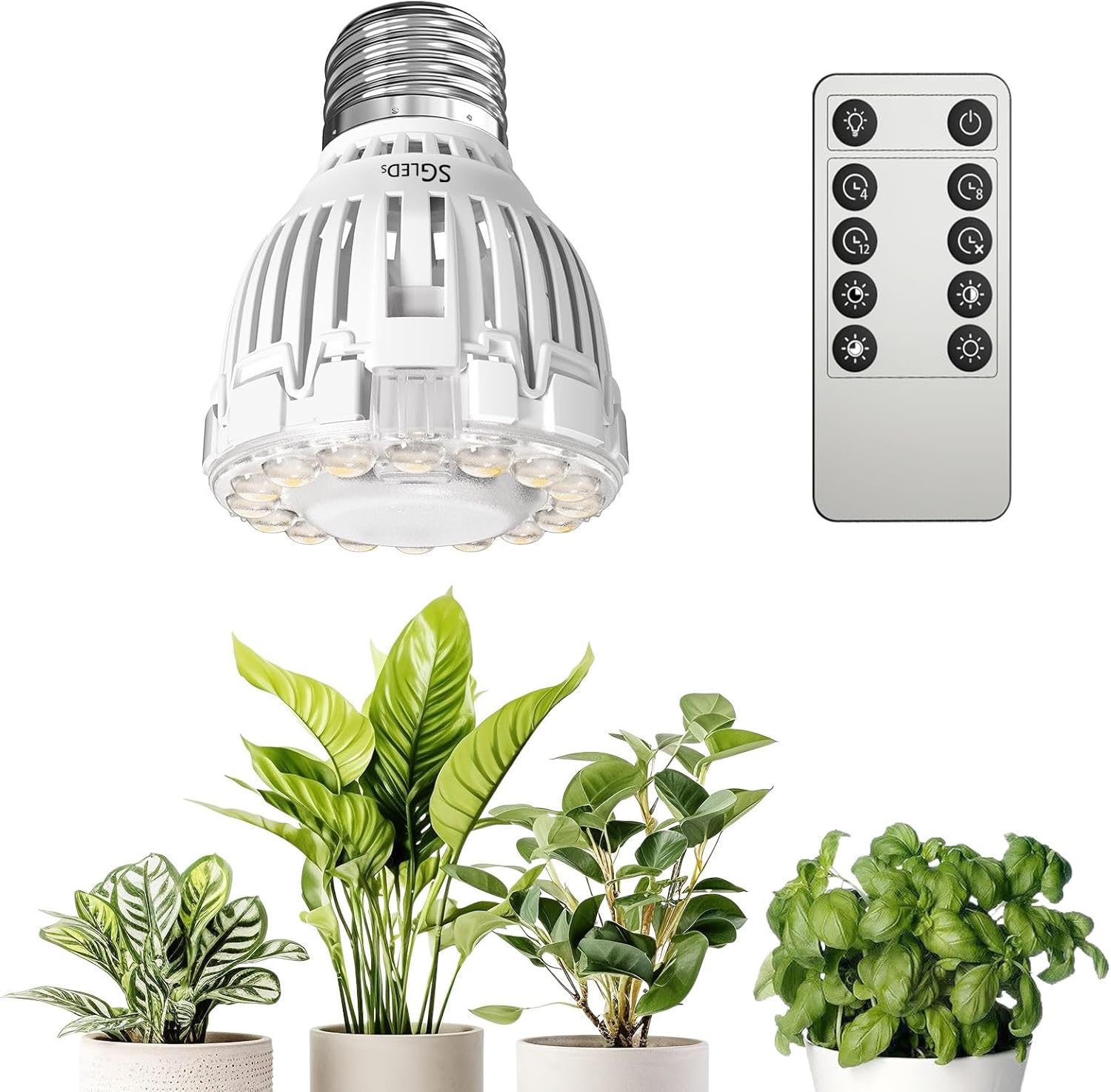
| Wattage | 10 watts |
|---|---|
| Bulb Base | E26 |
| Color Temperature | 4000 Kelvin |
| Light Output Maximum | 1000 lumens |
| Light Source Operating Life | 25000 hours |
This SGLEDs PAR20 grow bulb is a compact, user-friendly option for supplementing light to indoor potted plants. Screw it into any standard E26 fixture and use the included remote to choose one of four brightness levels (25 to 100 percent) or set automatic 4, 8, or 12 hour on/off cycles. The bulb delivers a full visible spectrum (400–780 nm) and claims a high PPFD at 1 foot, so it is suitable for seedlings, herbs, succulents, and foliage plants that need steady supplemental light. The PAR20 shape and secondary optical lens focus light toward plants rather than scattering it, which improves usable light at the canopy. It runs at 10 watts while advertising a 150W incandescent equivalent, and the rated life is 25,000 hours, so it is energy efficient for long-term use. Limitations are that a single 10W bulb covers a small footprint so multiple bulbs or closer positioning are needed for larger setups, and the 4000 K color may look cooler than natural daylight to some users.
Best for: Gardeners who prioritize low upfront and running cost and want an easy, plug-and-play supplemental grow light for seedlings, herbs, and small houseplants.
Less Ideal for: Growers needing broad coverage for many plants or high-light fruiting crops should consider higher-output fixtures or multiple bulbs rather than a single 10W PAR20 bulb.
- Full visible spectrum (400–780 nm) suitable for different growth stages
- Remote control with four dimming levels and 4/8/12 hour timers for hands-off scheduling
- Low power draw (10W) with high claimed PPFD for efficient supplemental light
- PAR20 shape with secondary optical lens concentrates light toward plants
- Small coverage area per bulb so multiple units are required for larger plant groups
- Color temperature is fixed at 4000 K which may appear cooler than natural daylight
Verdict: A budget-friendly, energy‑efficient dimmable PAR20 bulb that gives hands‑free, full‑spectrum supplemental light for seedlings and small houseplants.
VIPARSPECTRA P700 70W Dimmable Full Spectrum LED Grow Light

| Light Output Maximum | 11000 lumens |
|---|---|
| Light Source Wattage | 70 watts |
| Mounting Type | Hanging Mount |
| Light Source Special Features | Dimmable |
| Number of Light Sources | 216 |
The VIPARSPECTRA P700 is a 70W full spectrum LED grow light built for seed starting and vegetative stages. It uses 216 diodes and a tuned mix of red and white LEDs to deliver high PAR output (advertised 11,000 lumens) across a small footprint roughly suited to a 2×2 ft veg area. The light is fanless and relies on large aluminum heat sinks to keep running temperatures low while the included 4-level dimmer lets you dial intensity for seedlings, clones, or mature veg. Setup is simple with hanging mount hardware included and the unit draws about 0.65 A at 120V so it runs far cooler and uses far less power than a comparable 150W HPS/MH system. For compact tents, shelves, or single-cabinet grows it offers a good balance of light output, spectrum, and efficiency. Limitations are its small coverage area and modest absolute wattage compared with larger fixtures, so gardeners with bigger canopies will want a higher-output model or multiple units.
Best for: Growers who want an efficient, low-heat fixture to run a single tent, shelf, or cabinet and who prioritize electricity savings and adjustable output for seedlings and veg.
Less Ideal for: Commercial growers or hobbyists running multi-plant canopies or larger tents who need wider coverage and higher total light output.
- Full spectrum diode layout optimized for seedlings and vegetative growth
- Low power draw (70W) with high reported lumen/PAR output for energy efficiency
- Fanless design with aluminum heat sinks for quiet, low-heat operation
- Integrated 4-level dimmer for easy intensity adjustment
- Coverage geared to a small 2×2 ft veg area so not ideal for larger grows
- Absolute wattage and diode count are modest compared with larger commercial fixtures
Verdict: A compact, energy-efficient full spectrum LED that delivers strong veg-stage light and adjustable intensity for small tents and cabinets.
LEOTER 4-Head LED Grow Light with Full Spectrum, Timer and 10-Level Dimming

| Light Source Type | LED |
|---|---|
| Number of Light Sources | 80 |
| Wattage | 80 watts |
| Control Method | Remote |
| Mounting Type | Clip On |
The LEOTER 4-head grow light is a USB-powered, clip-on lamp built for indoor plant care that combines full-spectrum and targeted red/blue diodes to support seedlings, vegetative growth and flowering. It uses 80 LEDs arranged across four adjustable heads on flexible goosenecks so you can position light over individual large plants or groupings. Notable features are three spectral modes (red+blue, warm/full spectrum, and combined), a circular memory timer with 3/9/12-hour presets, and ten brightness levels for fine control over intensity. The strong metal clip and flexible necks make it simple to aim light at tall foliage without permanent installation. Practical benefits include reduced need for supplemental natural light, convenient daily scheduling for busy users, and a compact footprint that suits shelves or plant stands. Important limitations are that the unit is described as a clip/desk lamp rather than a wide-panel fixture, so coverage for very large single specimens may require placing heads close to foliage or using multiple units, and the timer resets if unplugged so it needs occasional reprogramming after power loss.
Best for: Buyers who want a controllable, space-efficient grow light to supplement indoor sun for larger houseplants and prefer a proven, feature-rich unit with preset timers and adjustable heads.
Less Ideal for: Growers who need single-fixture coverage for floor-to-ceiling specimens or large multi-plant setups should consider full-size panel fixtures or multiple units instead.
- Full spectrum plus red and blue LEDs (80 total) to support all growth stages
- Ten dimming levels for precise intensity control
- Three timer presets with memory function for hands-off daily scheduling
- Adjustable 4-head design and flexible goosenecks for targeted placement
- Strong metal clip allows mounting on shelves, desks, or plant stands
- Designed as a clip-on lamp so single-unit coverage is limited for very large plants
- Timer settings must be reset after the light is unplugged
Verdict: A versatile, adjustable clip-on grow light that gives busy indoor gardeners precise control over spectrum, intensity and scheduling to boost large plant growth in compact spaces.
Aokrean Halo Full-Spectrum LED Grow Light with Base (3-Pack)

| Light Source Type | LED |
|---|---|
| Number of Light Sources | 48 |
| Wattage | 10 watts |
| Control Method | Touch |
| Power Source | Corded Electric |
This Aokrean Halo grow light is a small, versatile LED solution for indoor plants that offers a lot of convenience in a compact package. Each lamp uses 48 LEDs with a full-spectrum output and three lighting modes plus ten brightness levels, so it can be tuned for seedlings, vegetative growth, or supplemental light for potted houseplants. The lamp can be inserted into soil or mounted on the included base, and the telescoping pole adjusts up to about 26 inches to suit taller pots or change light intensity. Controls are touch-based and include a timer with preset cycles for automated daily on/off. Practical benefits include a neat decorative look, low power draw at 10 watts, and USB/Bluetooth connectivity for modern setups. Limitations are that the base requires the pot to help stabilize the stand and the unit is not water resistant, so it must stay dry and indoors. For balanced buyers looking for adaptable, easy-to-use grow lights for multiple indoor plants, this hits the mark.
Best for: Buyers who want a compact, adjustable grow light that works for seedlings and small to medium houseplants and who value easy controls and automated timers.
Less Ideal for: Growers needing heavy-duty, waterproof fixtures for greenhouse or outdoor use or those who require high-output lighting for large-scale indoor gardens.
- Full-spectrum LED array (48 LEDs) with three lighting modes and 10 brightness levels for flexible plant lighting
- Height-adjustable pole and dual mounting (insert in soil or use the base) to fit a range of pot sizes
- Touch controls with built-in timer options for automatic daily cycles
- Low power consumption (10 watts) and high efficiency for continuous use
- Base stability depends on placing a pot on it so it can be less secure with lighter containers
- Not water resistant so unsuitable for humid or outdoor environments
Verdict: Aokrean's Halo is a space-saving, full-spectrum grow light with adjustable height and timers that makes it easy to give small indoor plants the right light without complex setup.
Choosing the Right Dimmable LED Grow Light: Key Factors to Consider
Spectral Output and PAR Distribution
The quality of the light spectrum and the amount of usable photosynthetic radiation (PAR) determine how plants use light for photosynthesis, morphology, and flowering. A dimmable LED that offers both full-spectrum coverage and stage-specific settings lets you tailor light to seedlings, vegetative growth, and bloom. Even distribution matters too; hotspots or steep falloff force frequent repositioning and can create uneven growth.
When assessing fixtures, look for published PAR maps or manufacturer data that show PPFD at realistic hanging heights. Consider whether the fixture lets you adjust spectrum as well as intensity so you can reduce blue during bloom or increase red during flowering when desirable.
Dimming Range and Control Options
How fine and accessible the dimming is affects how precisely you can match plant needs and manage heat. Some fixtures offer simple knob or button control, others include external controllers, smartphone apps, or 0-10V compatibility for integration with timers and environmental controllers. A wide dimming range is useful for moving plants through stages without changing the fixture.
Also check whether dimming is stepped or smooth and whether spectrum shifts when intensity changes. For shared circuits or multiple fixtures, look for synchronized control options so you can adjust multiple lights consistently.
Power Draw and Energy Efficiency
Energy use is a recurring cost for indoor growing. A dimmable fixture with high photon efficacy (micromoles per joule) delivers more usable light for each watt consumed, reducing electric bills and wasted heat. Consider realistic power draw at typical settings rather than peak draw alone; many growers run lights at partial output to control heat and light intensity.
Fixtures with documented efficacy at several dimming points give a clearer picture of running costs. For long photoperiods or multiple fixtures, small differences in efficiency quickly add up over a season.
Thermal Design and Noise
Heat management affects both fixture longevity and the microclimate around plants. Passive-cooled fixtures are silent and simple but may be bulkier. Active-cooled units with fans can run cooler at high output but may introduce noise and another failure point. Excess heat raises canopy temperature and can stress plants, forcing extra ventilation and higher energy use for cooling.
Inspect heat sink size, airflow paths, and any noise ratings where available. For small rooms or noise-sensitive areas, prioritize low-noise designs or fixtures that perform well at reduced output to limit fan activity.
Form Factor and Mounting Options
Fixture shape, weight, and mounting hardware determine how easily the light fits in your space. Slim panels hang well in tents and shelves, while larger arrays might suit dedicated spaces. Adjustable hang points, integrated ratchets, or included hardware make setup faster and reduce the need for aftermarket parts.
Also think about height adjustment range and whether the fixture can be angled or repositioned to cover multiple trays. A versatile mounting system saves time when rearranging plants or scaling up your setup.
Durability and Serviceability
A well-built fixture resists moisture, dust, and the occasional bump, and it should be repairable or supported with clear documentation. Look for solid wiring, protected drivers, and replaceable components when possible. Long-term reliability reduces downtime and replacement frequency, which is important for growers who rely on continuous light schedules.
Consider warranty coverage and how easy it is to access drivers or connectors if a repair is needed. Sealed units can be durable but harder to service, so weigh the tradeoff between robustness and serviceability.
Matching Light to Growth Stages
Seedlings, vegetative plants, and flowering crops each benefit from different combinations of intensity and spectral balance. Seedlings usually need lower PPFD and somewhat higher blue ratios to produce compact growth, while flowering plants often respond to higher total light with a greater red component. A dimmable LED that lets you reduce intensity without changing spectrum is handy for delicate starts and for lowering heat near young plants.
Use dimming to step output as plants mature rather than swapping fixtures. If the fixture also offers spectrum adjustment, you can shift output toward blue for tightened vegetative growth or toward red to support flowering responses.
- Lower intensity and higher blue for seedlings and clones
- Higher PPFD and increased red during bloom for many flowering crops
- Gradual ramping reduces transplant shock and stretch
Managing Heat in Small Spaces
In tents and closets, heat from lights concentrates quickly. Even energy-efficient LEDs deliver some heat, and in a confined environment that heat changes humidity and temperature profiles. Using dimming to limit peak output during hot parts of the day or to run a lower baseline overnight can keep canopy temperatures optimal without extra ventilation.
Position lights to allow airflow across heat sinks and avoid blocking fans or vents. If fan noise is a concern, favor fixtures with larger passive heatsinks or those that achieve required light levels at lower power when dimmed.
- Leave clearance above fixtures for air circulation
- Use dimming to reduce fan speeds and noise when possible
- Monitor canopy temperature separately from ambient air
Integration with Timers and Controllers
Dimmable LEDs that support external control standards such as 0-10V, PWM, or smart ecosystem connections simplify automation and day/night ramping. Smooth dawn/dusk ramps can reduce plant stress and avoid sudden light swings. For multi-fixture setups, grouping and synchronizing dimming reduces manual adjustments and creates uniform conditions across the canopy.
When choosing a controller-compatible fixture, confirm wiring needs and whether the light requires a separate driver or adapter. Simpler built-in controls are fine for single-fixture hobby setups, while growers scaling up will appreciate standard control interfaces.
- Look for 0-10V or PWM compatibility for integration
- Smartphone apps add convenience but check stability
- Confirm compatibility before adding third-party controllers
Placement and Light Coverage Planning
Before installation, sketch your canopy and plan fixture spacing based on coverage patterns. Wide, even spread reduces the number of fixtures needed but may require higher wattage units. Narrow, intense beams concentrate light and can be ideal for focused racks or single plants. Dimmable fixtures let you adjust spacing strategies without swapping hardware.
Consider vertical growing and multi-tier racks where adjustable hanging height and uniform spread become critical. Use dimming to equalize PPFD across tiers so lower shelves still receive usable light.
- Measure PPFD at multiple points, not just center
- Adjust hanging height before fine-tuning dimmer settings
- Account for edge falloff when placing multiple fixtures
Maintenance and Longevity Tips
Keep lenses and heatsinks free of dust because buildup reduces light output and impairs cooling. Check fan function periodically if the fixture uses active cooling and listen for changes in noise that might indicate bearing wear. Secure electrical connections to prevent arcing and intermittent faults in humid or damp environments.
Schedule periodic checks of dimming and control interfaces to catch flaky pots, loose wiring, or firmware issues early. Replacing fans or drivers proactively is often cheaper than replacing an entire fixture and extends service life.
- Clean optics and heatsinks regularly
- Monitor fans and replace if noise or decreased airflow appears
- Verify dimmer responsiveness after long runs
How We Chose the Best Dimmable LED Grow Light
We focused on features that affect plant response and everyday usability in indoor garden spaces. Primary evaluation criteria included spectral control and PAR output because uniform, usable light across vegetative and bloom stages determines plant health. Energy efficiency and measured power draw were assessed to estimate running costs and fixture heat. Thermal design and fan noise were reviewed to judge reliability and suitability for small enclosed environments. Physical form factor, mounting options, and dimming controls were considered for fit in common setups like tents, shelves, and hobby cabinets. Build quality and control precision were used to assess long-term value and user experience. We excluded fixtures that lacked adjustable output or fixed single-spectrum arrays, low-quality construction, or inadequate heat dissipation for continuous indoor use. We also filtered out units with ambiguous control options or unclear power ratings. The remaining products represent devices that balance usable light, controllable output, and dependable thermal management for most indoor gardeners.
FAQ
How bright should a dimmable LED be for seedlings?
Seedlings usually do well with lower PPFD in the range of modest light levels rather than full output. Use a dimmable setting to provide gentle, steady light and avoid high-intensity beams that cause stretch or stress until true leaves develop.
Will dimming reduce the light spectrum quality?
It depends on the design. Some fixtures dim overall output while maintaining the same spectral balance, while others change relative channel intensities as they dim. Check manufacturer documentation or look for independent PAR and spectral data across dimming levels.
Can I use dimmable LEDs in small tents without extra ventilation?
Dimming can help reduce heat, but even efficient LEDs generate warmth. Small tents still need some ventilation to manage humidity and CO2. Relying solely on dimming without any airflow can lead to issues with temperature and humidity over time.
Are smartphone controls reliable for long-term use?
Smartphone apps are convenient but vary in reliability. They are useful for single fixtures and occasional adjustments. For more critical or multi-fixture setups, external controllers with proven standards like 0-10V or wired controllers tend to be more dependable.
How often should I clean a grow light fixture?
Clean optics and heatsinks every few months or more often in dusty environments. Frequent cleaning maintains output and thermal performance. Use a soft cloth and avoid spraying water directly into driver openings.
Does dimming save energy long term?
Dimming reduces immediate power draw, so running at lower output lowers energy use during those periods. Overall savings depend on how often and how much you dim relative to full-output operation and the fixture's efficiency at partial power.
Final Verdict
When choosing a dimmable LED grow light, prioritize spectral control and usable PAR output first because these factors most directly influence plant development. Balance that with energy efficiency and thermal management so the fixture can deliver the light you need without overheating small spaces. Also factor in control options and mounting flexibility to fit your specific setup. The right choice trades off absolute peak output for controllability and long-term reliability. If you need precision across growth stages or operate in a confined space, favor fixtures with fine dimming, solid thermal design, and compatible control interfaces to get consistent results.
