

Note: This article contains affiliate links. If you click on these links and make a purchase, I may earn a small commission at no extra cost to you. This helps support my research and content. Read my full affiliate disclosure here.
If you grow blooming annuals, perennials, or potted ornamentals indoors or in a greenhouse, the right grow light can be the difference between sparse buds and a full floral display. Choosing a grow light for flowering plants matters because bloom development depends on both the light spectrum and the amount of usable light reaching the canopy. This guide shortlists the top picks for flowering-stage lighting and explains how we evaluated spectrum, output, coverage, and heat management. Below are our selected grow lights for flowering plants, followed by practical guidance to match a fixture to your space and plants.
Top Picks at a Glance
| Best Overall The best all-around choice for most situations | KOSCHEAL KS2000 230W LED Grow Light (Full Spectrum) |  |
| Best Quality Built to a higher standard if you want something more solid | VIVOSUN LumaLight 400W Full Spectrum LED Grow Light |  |
| Best Value The sweet spot between price and what you get | LEOTER 4-Head LED Grow Light with Full Spectrum, Timer and 10-Level Dimming |  |
| Highest Rated A top-rated pick with lots of positive feedback | Hemonee 5-Head LED Grow Light with Adjustable Tripod Stand |  |
| Most Popular A crowd favorite that many people choose with confidence | GooingTop HY-021 6000K Full-Spectrum Clip Grow Light |  |
| Best Seller A high-volume bestseller chosen again and again | Aokrean Halo Full-Spectrum LED Grow Light with Base (3-Pack) |  |
KOSCHEAL KS2000 230W LED Grow Light (Full Spectrum)

| Light Source Type | Light Emitting Diode |
|---|---|
| Wattage | 230 watts |
| Power Source | Corded Electric |
| Mounting Type | Ceiling Mount |
| Light Source Special Features | 3-way switching |
The KOSCHEAL KS2000 is a compact, high-output LED fixture built to run a complete flowering cycle for indoor plants. It draws 230 watts from the wall and uses 596 SMD diodes including 395nm and 730nm chips to deliver a broad spectrum useful for both veg and bloom stages; independent Veg and Bloom switches let you tailor spectrum and intensity as plants develop. The light claims 2.8 µmol/J efficacy and a dense PAR distribution, which translates to strong canopy penetration and the ability to replace older 400W HPS/CMH setups for many small to medium tents. Practical features include daisy-chain linking for up to three units, quiet cooling fans with aluminum heat sinks for thermal management, and a compact housing with included hanging kit. Expect lower power draw for good yields and easy setup, but realize the unit is optimized for single-fixture coverage areas (manufacturer lists roughly 4×4 ft veg and 3.5×3.5 ft bloom) so larger grows will need multiple fixtures. The three-year warranty and US support are useful for longer-term reliability.
Best for: Growers who want a single, potent fixture to run flowering and vegetative cycles in small to medium indoor grows and prefer adjustable spectrum and tidy wiring for scalable setups.
Less Ideal for: Large commercial rooms or growers who need a single fixture to cover very large footprints should consider higher‑capacity fixtures or using multiple units.
- High actual power draw (230W) with claimed 2.8 µmol/J efficacy for strong PAR output
- Full spectrum with specialized 395nm and 730nm diodes plus separate Veg and Bloom switches
- Daisy-chainable to connect up to three units and reduce cable clutter
- Quiet, active cooling and aluminum heat sinks for stable temperatures and extended diode life
- Coverage is targeted to small-to-medium tents so multiple units are needed for larger rooms
- Manufacturer lists amperage and wattage without detailed PPFD maps in the product listing
Verdict: A powerful, spectrum‑adjustable 230W LED that delivers strong PAR for flowering plants while keeping setup simple and scalable.
VIVOSUN LumaLight 400W Full Spectrum LED Grow Light

| Light Source Type | LED |
|---|---|
| Wattage | 400 watts |
| Mounting Type | Ceiling Mount |
| Light Source Special Features | Dimmable |
| Power Source | AC/DC |
The VIVOSUN LumaLight 400W is a performance-oriented LED grow fixture built to push plants through vegetative and flowering stages. It combines white, blue, red and far-red diodes to provide a broad spectrum that supports photosynthesis from seedling to harvest, and an increased diode count for stronger PPFD and more even coverage across a typical greenhouse bench or tent. The fixture is dimmable from 25 to 100 percent via an on-unit knob and can be integrated with VIVOSUN GrowHub for automated scheduling and remote control. Its metal housing and advanced thermal design keep operating temperatures low, while IP65 dustproof and waterproof protection makes it safe to use in humid greenhouse environments and easy to clean. Expect long service life with the stated long maintenance hours and low heat output. Limitations include its single hardwired GU24-compatible unit and reliance on the GrowHub for advanced smart features, so gardeners wanting plug-and-play wireless control out of the box may need additional accessories.
Best for: Growers who prioritize high light output and uniform canopy coverage in greenhouse or controlled-environment setups and who plan to integrate lighting into a performance-focused system.
Less Ideal for: Casual hobbyists who want a simple plug-and-play lamp with built-in wireless control or growers on a very tight budget seeking lower-wattage entry units.
- Full spectrum (white, blue, red, far-red) tailored for all growth stages
- High-intensity, even PPFD distribution for consistent canopy coverage
- Dimmable 25%–100% for precise light management
- IP65 rating for safe use in humid greenhouse conditions
- Robust thermal design for lower operating temperatures and long lifespan
- No built-in wireless controller; advanced scheduling requires separate GrowHub
- Bulb base listed as GU24 may require specific wiring or adapter for some installs
Verdict: Choose this light if you need a high-intensity, full-spectrum LED that delivers even PPFD and reliable greenhouse performance.
LEOTER 4-Head LED Grow Light with Full Spectrum, Timer and 10-Level Dimming

| Light Source Type | LED |
|---|---|
| Number of Light Sources | 80 |
| Wattage | 80 watts |
| Control Method | Remote |
| Mounting Type | Clip On |
The LEOTER 4-head grow light is a USB-powered, clip-on lamp built for indoor plant care that combines full-spectrum and targeted red/blue diodes to support seedlings, vegetative growth and flowering. It uses 80 LEDs arranged across four adjustable heads on flexible goosenecks so you can position light over individual large plants or groupings. Notable features are three spectral modes (red+blue, warm/full spectrum, and combined), a circular memory timer with 3/9/12-hour presets, and ten brightness levels for fine control over intensity. The strong metal clip and flexible necks make it simple to aim light at tall foliage without permanent installation. Practical benefits include reduced need for supplemental natural light, convenient daily scheduling for busy users, and a compact footprint that suits shelves or plant stands. Important limitations are that the unit is described as a clip/desk lamp rather than a wide-panel fixture, so coverage for very large single specimens may require placing heads close to foliage or using multiple units, and the timer resets if unplugged so it needs occasional reprogramming after power loss.
Best for: Buyers who want a controllable, space-efficient grow light to supplement indoor sun for larger houseplants and prefer a proven, feature-rich unit with preset timers and adjustable heads.
Less Ideal for: Growers who need single-fixture coverage for floor-to-ceiling specimens or large multi-plant setups should consider full-size panel fixtures or multiple units instead.
- Full spectrum plus red and blue LEDs (80 total) to support all growth stages
- Ten dimming levels for precise intensity control
- Three timer presets with memory function for hands-off daily scheduling
- Adjustable 4-head design and flexible goosenecks for targeted placement
- Strong metal clip allows mounting on shelves, desks, or plant stands
- Designed as a clip-on lamp so single-unit coverage is limited for very large plants
- Timer settings must be reset after the light is unplugged
Verdict: A versatile, adjustable clip-on grow light that gives busy indoor gardeners precise control over spectrum, intensity and scheduling to boost large plant growth in compact spaces.
Hemonee 5-Head LED Grow Light with Adjustable Tripod Stand

| Number of heads | 5 |
|---|---|
| Height range | 15 to 63 inches |
| Spectral modes | Red+Blue, White, Combined |
| Brightness levels | 10 levels (10%–100%) |
| Timer options | 4/8/12 hours |
This Hemonee 5-head LED grow light is built for hands-off, reliable supplemental lighting for flowering plants. The tripod stand extends from 15 to 63 inches and each of the five flexible goosenecks rotates 360 degrees so you can direct light precisely over multiple pots or a single larger bloom. It offers three spectral modes (Red+Blue, White, and combined) and 10 brightness settings from 10 to 100 percent to match seedling, vegetative, and flowering stages. Practical controls include an inline panel plus an RF remote that works up to about 30 meters and preset timers for 4/8/12-hour cycles so you can automate daily light periods. The unit uses an aluminum shell with an aviation-grade heat sink for better dissipation, which helps keep output stable during long runs. Important limitations are that it is a freestanding lamp rather than an overhead panel, so coverage is best for small to medium collections rather than a large canopy, and final light intensity will depend on how close you position the heads to blooms. For growers who want dependable timed light and directional control for individual flowering pots, this is a practical choice.
Best for: Growers who prioritize dependable, automated lighting and need flexible directional control for a few flowering plants or small racks.
Less Ideal for: Not a good fit for large-scale flowering setups or growers who need a high-intensity overhead fixture to cover a broad canopy.
- Adjustable tripod and 360° goosenecks allow precise light placement over multiple plants
- Full spectrum with three modes and 10 dimming levels covers seedling through flowering stages
- Dual control with inline panel and RF remote plus 4/8/12h timers enables reliable automation
- Aviation-grade heat sink and aluminum shell improve heat dissipation for stable performance
- Freestanding design limits even coverage for wide or dense flowering canopies
- No stated total PPFD or wattage makes exact light output hard to compare with fixtures
Verdict: A reliable, easy-to-use adjustable 5-head grow light that automates daily light cycles and targets individual flowering plants with directional full-spectrum output.
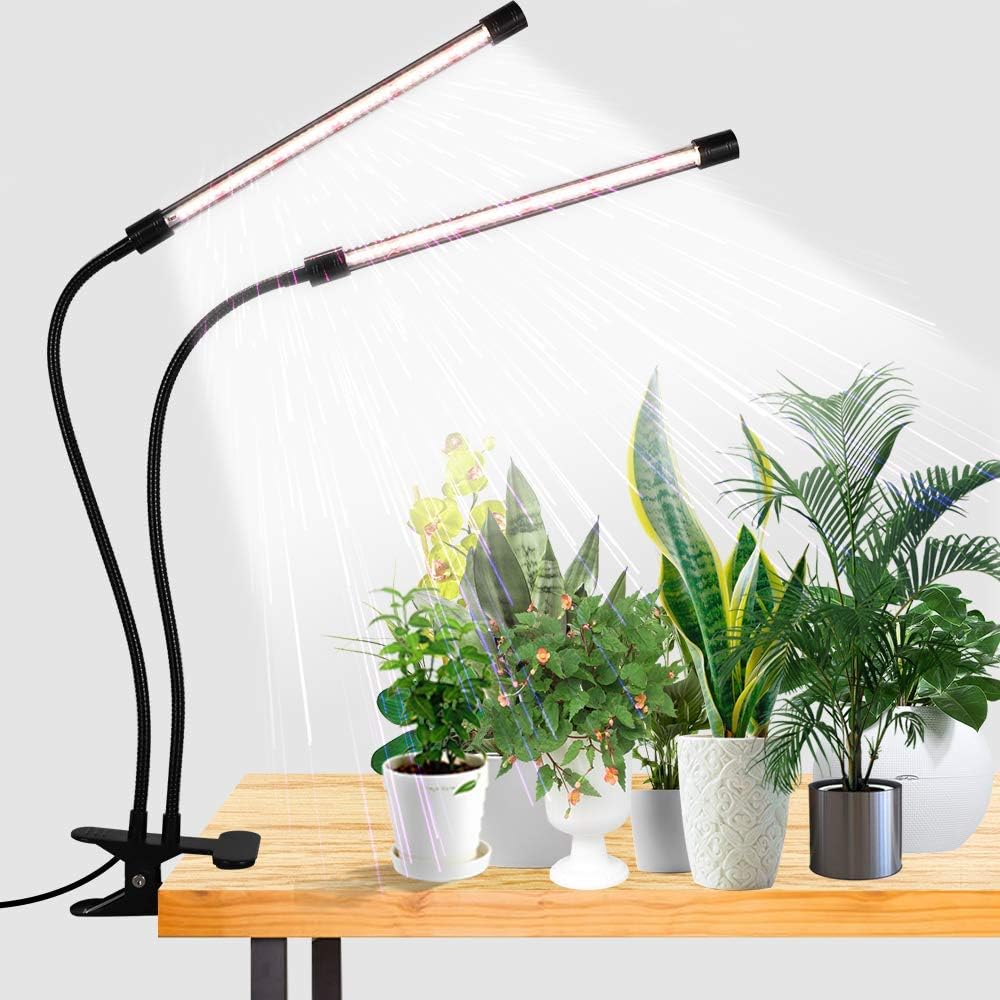
GooingTop HY-021 6000K Full-Spectrum Clip Grow Light
| Power Source | Corded Electric |
|---|---|
| Color Temperature | 6000 Kelvin |
| Light Output Maximum | 2500 lumens |
| Light Source Special Features | Dimmable |
| Number of Light Sources | 84 |
This GooingTop HY-021 is a compact clip-on grow light built for small houseplants, seedlings and shelf gardens. It uses 84 LEDs (white plus deep red) to deliver a 6000K full-spectrum output intended to mimic midday sun, with a high color-rendering output that also makes it pleasant as a reading lamp. Two flexible gooseneck heads and a strong clamp let you aim light precisely over pots and seed trays, while the attached remote provides 50%/100% dim levels and repeating timers at 4, 8 or 12 hours for hands-off scheduling. Practical benefits include low power draw (listed as roughly 10 W LED draw), a claimed 1 to 2 square meter coverage for seedlings, and an included timer that simplifies day/night cycles. Limitations are its design for small setups rather than large grow racks and the clip mounting limits placement compared with freestanding fixtures. The unit also relies on the corded remote instead of a smartphone app and the lifespan claim is typical of LEDs but not independently verifiable from the listing.
Best for: Buyers who want a simple, low-power, plug-and-play grow light to boost seedlings and a few houseplants on a desk or shelf and who value an easy-to-use timer and adjustable brightness.
Less Ideal for: Growers planning multi-shelf installations, larger vegetable grows, or who need networked or app-based control should consider larger bar lights or fixtures designed for commercial racks.
- Full-spectrum 6000K output with added 660 nm red LEDs to support vegetative growth and flowering
- Attached remote with dimming (50%/100%) and repeat timer settings (4/8/12 hours) for easy scheduling
- Flexible dual goosenecks and strong clamp enable precise positioning over small pots and seed trays
- High reported color rendering for comfortable viewing and accurate plant color assessment
- Low electrical draw around 10 W while covering small growing areas
- Clip-mount design and stated 1–2 m² coverage make it better suited to individual plants or small trays rather than large multi-shelf setups
- No smart app or wireless control option; remote is cord-attached which limits placement flexibility
Verdict: A compact, easy-to-use clip grow light that delivers full-spectrum light and convenient timer/dim controls for small indoor plant setups.
Aokrean Halo Full-Spectrum LED Grow Light with Base (3-Pack)

| Light Source Type | LED |
|---|---|
| Number of Light Sources | 48 |
| Wattage | 10 watts |
| Control Method | Touch |
| Power Source | Corded Electric |
This Aokrean Halo grow light is a small, versatile LED solution for indoor plants that offers a lot of convenience in a compact package. Each lamp uses 48 LEDs with a full-spectrum output and three lighting modes plus ten brightness levels, so it can be tuned for seedlings, vegetative growth, or supplemental light for potted houseplants. The lamp can be inserted into soil or mounted on the included base, and the telescoping pole adjusts up to about 26 inches to suit taller pots or change light intensity. Controls are touch-based and include a timer with preset cycles for automated daily on/off. Practical benefits include a neat decorative look, low power draw at 10 watts, and USB/Bluetooth connectivity for modern setups. Limitations are that the base requires the pot to help stabilize the stand and the unit is not water resistant, so it must stay dry and indoors. For balanced buyers looking for adaptable, easy-to-use grow lights for multiple indoor plants, this hits the mark.
Best for: Buyers who want a compact, adjustable grow light that works for seedlings and small to medium houseplants and who value easy controls and automated timers.
Less Ideal for: Growers needing heavy-duty, waterproof fixtures for greenhouse or outdoor use or those who require high-output lighting for large-scale indoor gardens.
- Full-spectrum LED array (48 LEDs) with three lighting modes and 10 brightness levels for flexible plant lighting
- Height-adjustable pole and dual mounting (insert in soil or use the base) to fit a range of pot sizes
- Touch controls with built-in timer options for automatic daily cycles
- Low power consumption (10 watts) and high efficiency for continuous use
- Base stability depends on placing a pot on it so it can be less secure with lighter containers
- Not water resistant so unsuitable for humid or outdoor environments
Verdict: Aokrean's Halo is a space-saving, full-spectrum grow light with adjustable height and timers that makes it easy to give small indoor plants the right light without complex setup.
Choosing the Right Grow Light for Flowering Plants: Key Factors to Consider
Light Spectrum and Bloom Response
Flowering plants respond differently to wavelengths than seedlings. In the bloom stage, a higher proportion of red wavelengths around 660 nm stimulates flowering hormones that encourage bud formation and expansion. White-balanced or full-spectrum fixtures that include targeted red peaks can deliver both bloom stimulation and a visible spectrum that helps you assess plant color and health.
Choosing a light with published spectral data matters because it tells you whether the fixture actually emphasizes bloom-relevant wavelengths. Without that information you may end up with a light that looks bright to the eye but lacks the red content needed to trigger robust flowering responses.
Photosynthetic Photon Flux Density (PPFD) Needs
PPFD measures the amount of usable light landing on plant leaves per unit area. Flowering plants typically need considerably higher PPFD than seedlings to set and mature buds, especially high-energy bloomers. Selecting a fixture that can deliver target PPFD levels across the intended canopy ensures buds develop evenly rather than forming only on the topmost shoots.
Consider both the maximum PPFD directly under the fixture and the average PPFD across the whole canopy area. Fixtures with strong center hotspots may show high peak numbers but fail to produce usable light at the edges, requiring either multiple fixtures or closer mounting heights.
Coverage Pattern and Fixture Spacing
How a light spreads matters as much as how much light it produces. A wide, even footprint reduces shading and prevents plants from stretching toward hotspots. Coverage is affected by the fixture's optics, lens angle, and mounting height. For dense layouts or multiple pots, think in terms of how many square feet a single unit can reliably light at the flowering target PPFD.
Planning fixture spacing in advance helps avoid surprises when plants are larger and need uniform light. If you have limited mounting height, prioritize fixtures with optics that maintain uniform PPFD at lower hang heights rather than those that require tall clearance.
Heat Output and Canopy Stress
Lights produce heat, and during flowering excess heat can stress buds, desiccate delicate flowers, and increase pest pressure. Good thermal management reduces the need for extra ventilation and keeps canopy temperatures within the range that favors bud set.
Look at how the fixture dissipates heat-passive heatsinks, active fans, or remote driver options-and consider the microclimate of your space. In small tents or enclosed beds, lower heat density or remote-mounted drivers help protect blooms and maintain stable humidity.
Dimming and Spectral Control
Being able to adjust intensity or tweak spectrum helps you fine-tune light for different cultivars or stages of bloom. Dimming can prevent light stress when plants are very close to the canopy or during cool night cycles that need reduced radiative load. Spectral control, such as adding far-red or adjusting red-to-blue ratios, can influence internode spacing and flowering timing for some species.
If you plan to run mixed cycles or grow multiple varieties, fixtures with simple dimming or selectable spectrum modes provide versatility without requiring multiple types of lights.
Fixture Form Factor and Installation
The physical size, weight, and mounting options determine how a fixture fits into your setup. Slim panels work well in low-clearance racks while larger bars or clusters suit open benches and greenhouse benches. Ease of installation affects how quickly you can scale a setup or reposition lights as plants grow.
Consider driver placement, plug type, and whether the fixture requires separate mounting hardware. Fixtures that are easy to hang, chain, or mount to rails reduce setup time and make it simpler to maintain consistent canopy distance as plants grow.
Matching Light to Plant Type and Blooming Habit
Different flowering plants have distinct light appetites. Compact, shade-tolerant bloomers need lower PPFD than sun-loving ornamentals and some fruiting houseplants. Assess your plants' natural habitat and choose lighting that approximates those conditions rather than applying a one-size-fits-all intensity.
For plants with dense flower clusters, aim for uniform coverage to avoid singed or underdeveloped florets at the margins. For tall or vining bloomers, prioritize fixtures that can be mounted higher while still delivering adequate PPFD to the lower canopy.
- Shade-adapted bloomers: moderate PPFD, softer red emphasis
- Sun-loving ornamentals: higher PPFD and stronger red peaks
- Vining/tall plants: fixtures that maintain uniformity at height
Practical Mounting Tips for Even Flowering
Position fixtures so their beam overlap creates even light across the canopy. Small offsets and staggered hang heights help mitigate hotspots. If you are retrofitting existing racks, measure the usable footprint at the mounting height you can realistically achieve before committing to a fixture layout.
Use adjustable hangers or ratchet ropes to fine-tune distance as blooms emerge. Frequent checks with a PPFD meter or even a smartphone light sensor app can identify dark patches that will reduce bloom density.
- Overlap beams by 20 to 30 percent to smooth edges
- Raise lights gradually during flowering to prevent stretch
- Check canopy temperatures after prolonged runs
Dealing With Heat and Humidity Around Blooms
Flower clusters trap humidity and limit airflow. Excess heat from lights can speed moisture loss on petals and increase the risk of fungal issues. Maintain gentle air movement across the canopy and consider lower-heat fixtures or remote drivers in tight enclosures.
If humidity spikes around dense flowers, increase ventilation or lower light intensity during peak heat hours. That protects delicate blooms and keeps pollinator-attracting scent profiles intact for outdoor or greenhouse situations.
- Use oscillating fans to move air without creating direct windburn
- Monitor spot temperatures at the bud zone, not just ambient air
- Prefer fixtures with passive cooling in small enclosed spaces
Energy Use and Run-Time Strategies
Flowering stages often need long daily light totals combined with high intensity, which can increase energy consumption. Balance daily photoperiod, intensity, and duration to match your plants' needs and avoid unnecessary energy waste. In many cases a slightly lower intensity for a longer photoperiod produces similar flowering results with lower peak power draw.
Timers and dimmers help you manage daily cycles without manual intervention. Scheduling gradual ramp-up or ramp-down periods can reduce stress and mimic natural dawn and dusk, which some plants respond to during bud formation.
- Use timers for consistent daylengths
- Consider dimming during hottest parts of the day
- Track cumulative daily light integral for precise control
Maintaining Fixtures for Consistent Bloom Performance
Keep lenses and covers clean because dust and residue reduce usable light and skew spectral output. Regularly inspect fans and heatsinks for clogging if the fixture has active cooling. Replacing a degraded driver or cleaning optics maintains PPFD and protects bloom quality over multiple seasons.
Record operating hours for fixtures that lose output over time. Some LEDs slowly shift spectrum with age, which can subtly alter flowering performance. A maintenance schedule prevents surprises during critical bloom windows.
- Clean optics monthly in dusty environments
- Log runtime hours and check spectral output if possible
- Replace faulty drivers promptly to avoid heat buildup
How We Chose the Best Grow Light for Flowering Plants
We evaluated candidates by focusing on the attributes that actually affect flower production under artificial light. Primary filters included spectral power distribution targeted to bloom wavelengths and photosynthetic photon flux density output that supports flowering-stage needs. We also measured effective canopy coverage patterns so a single fixture could uniformly light the intended grow area. Heat management and fixture durability mattered because excess heat or short-lived components change plant stress and long-term operating cost. Practical installation factors like mounting flexibility and power draw were included since many growers retrofit fixtures into existing racks or small greenhouses. We excluded fixtures designed solely for seedling or vegetative phases and any lights lacking clear spectral data or reliable coverage specs. The outcome is a list of lights that balance bloom-focused spectrum, usable light intensity, coverage geometry, thermal control, and straightforward installation.
FAQ
How much PPFD do flowering plants typically need?
It depends on the species, but many flowering ornamentals perform well between moderate to high PPFD ranges. Shade-tolerant bloomers may thrive at lower PPFD, while sun-loving varieties often need higher intensity to maximize bud set. Check species-specific guidance and target average PPFD across the canopy rather than just peak readings.
Can I use a vegetative-spectrum light for flowering plants?
You can, but it may not optimize bloom development. Vegetative fixtures emphasize blue light, which supports compact growth but does not strongly trigger flowering responses. For best bloom results choose a fixture with enhanced red output or a spectrum designed for flowering.
Will more light always produce more blooms?
More usable light up to a plant's saturation point generally supports stronger bloom production, but too much intensity can cause stress, heat damage, or bleaching. Balance intensity with proper temperature, humidity, and nutrient management to translate extra light into better flowers.
How close should I hang grow lights during flowering?
Optimal distance varies with fixture power and optics. Hang lights close enough to reach your target PPFD without creating hotspots or overheating the canopy. Start at the manufacturer's suggested flowering height if available, then adjust based on canopy response and temperature checks.
Do I need dimming or spectrum control for flowering lights?
Dimming and spectrum adjustment add flexibility and help tailor light to different species or stages. They are not strictly required for all setups, but they make it easier to prevent light stress, manage energy use, and fine-tune flowering behavior for mixed plantings.
Final Verdict
When selecting a grow light for flowering plants, prioritize a fixture that delivers the right spectrum for bloom stimulation and consistent PPFD across your canopy. Balance coverage needs with heat management and installation limits to avoid hotspots and canopy stress. Decide which tradeoffs matter most in your space-maximum intensity, spectrum control, or low-heat operation-and use that priority to choose a light that supports reliable, uniform flowering.
