

Note: This article contains affiliate links. If you click on these links and make a purchase, I may earn a small commission at no extra cost to you. This helps support my research and content. Read my full affiliate disclosure here.
If couch grass has crept into your lawn or garden beds, picking the right herbicide matters because this grass spreads by stolons and rhizomes and can quickly reestablish. You want a product that reliably suppresses or kills the grass while minimizing damage to desirable turf and plants nearby. This guide covers six shortlisted herbicide options chosen for their proven modes of action, labeled use on common turf types, and practical application flexibility. Below we explain the criteria used to compare products, highlight what matters in real garden use, and walk through follow-up care and timing so you can choose the option that fits your lawn goals and maintenance routine.
Top Picks at a Glance
| Best Overall The best all-around choice for most situations | Syngenta Fusilade II Turf and Ornamental Herbicide, 4 oz |  |
| Best Quality Built to a higher standard if you want something more solid | TENKOZ Clethodim 2E Herbicide Concentrate (1 Gallon) |  |
| Best Value The sweet spot between price and what you get | Roundup Weed & Grass Killer with Comfort Wand, 1.33 gal. |  |
| Highest Rated A top-rated pick with lots of positive feedback | Target 6 Plus MSMA 48.3% Post-Emergent Turf Herbicide, 2.5 Gallon |  |
| Most Popular A crowd favorite that many people choose with confidence | Spectracide Weed & Grass Killer with AccuShot Power Sprayer, 1.33 Gal |  |
| Best Seller A high-volume bestseller chosen again and again | Roundup Weed & Grass Killer4 Refill, 1.25 gal |  |
Syngenta Fusilade II Turf and Ornamental Herbicide, 4 oz

| Unit Count | 4 Ounce |
|---|---|
| Item Form | Liquid |
| Coverage | Grass Weeds |
| Active Ingredient Concentration | 24.5% Fluazifop-P-butyl |
Fusilade II is a concentrated liquid herbicide designed to target grassy weeds in turf, ornamentals, nurseries and sports fields without injuring most broadleaf plants. You mix small amounts into a sprayer for spot treatments or broadcast over-the-top applications and add a non-ionic surfactant for better coverage. The active ingredient (fluazifop-P-butyl) moves into shoots and roots, producing visible yellowing within about a week and reliable control of many perennial and annual grasses. It is rainfast after roughly one hour, which gives flexibility when weather is uncertain. Because it is a selective grass killer rather than a nonselective product, it is useful for removing problem grasses like dallisgrass from desirable turf stands when applied carefully. Limitations to expect are the need for accurate mixing and application rates, and that it will not control broadleaf weeds or require repeat treatments for very established infestations; careful spot application is recommended near sensitive plants to avoid drift or off-target contact.
Best for: Gardeners and turf managers focused on performance who need a targeted product to remove grassy weeds from lawns, sports fields, or landscaped areas while preserving ornamentals.
Less Ideal for: Homeowners seeking a broad-spectrum or nonselective weed killer for all weed types or those who prefer low-precision, ready-to-use sprays.
- Selective control of perennial and annual grass weeds without killing most ornamentals or broadleaf plants
- Concentrated formula allows small-volume mixing for spot treatments or larger coverage
- Active ingredient translocates into roots for effective knockdown and longer-term control
- Rainfast within about one hour so brief post-application showers are less likely to reduce effectiveness
- Requires careful measurement and mixing and the addition of a surfactant for best results
- Not effective on broadleaf weeds so may need to be combined with other products for complete weed management
- May require repeat applications or follow-up cultural controls for very heavy or established infestations
Verdict: Choose Fusilade II when you need a potent, selective grass killer that delivers fast, root-acting control for performance-driven removal of dallisgrass and other grassy weeds.
TENKOZ Clethodim 2E Herbicide Concentrate (1 Gallon)

| Item Form | Liquid |
|---|---|
| Coverage | annual and perennial grasses |
| Unit Count | 128 Fluid Ounces |
| Brand | TENKOZ |
TENKOZ Clethodim 2E is a concentrated, selective post-emergence herbicide formulated to kill annual and perennial grasses while leaving many broadleaf plants intact. It is typically mixed with water and applied with a sprayer to actively growing grass weeds; the product information specifies it does not control sedges or broadleaf weeds. The concentrate format gives flexibility over coverage rate and is suited to spot treatments or treating larger patches when measured and mixed correctly. For someone targeting tough grassy weeds like couch grass, clethodim’s grass-specific mode of action makes it a practical choice because it moves into grass foliage and disrupts growth without broadleaf damage. Users should note it requires accurate mixing and application timing on actively growing grass to be effective and that it will not address sedges or non-grass weeds, so additional products or follow-up treatments may be needed for complete lawn cleanup. Follow label directions for safe use and avoid applying to desirable grass species sensitive to clethodim.
Best for: Gardeners and lawn-care pros who prioritize aggressive, grass-specific control and are comfortable mixing and applying a concentrated herbicide to active grassy infestations.
Less Ideal for: Homeowners seeking an all-in-one weed killer for mixed weed types or those who want a ready-to-use spray without measuring and mixing.
- Selective action targets annual and perennial grasses without killing many broadleaf plants
- Concentrated liquid allows flexible mixing for spot treatments or larger areas
- Formulation translocates in grass foliage for effective control of actively growing weeds
- Does not control sedges or broadleaf weeds so additional products may be required
Verdict: Choose this concentrated clethodim formula when you need a focused, high-performance herbicide for killing active grass weeds like couch grass.
Roundup Weed & Grass Killer with Comfort Wand, 1.33 gal.

| Item Form | Liquid |
|---|---|
| Coverage | 400 sq. ft. |
| Liquid Volume | 1.33 gallons |
This Roundup package pairs a 1.33 gallon liquid formulation with a Comfort Wand for easier spraying around beds, walkways, and foundations. It is formulated to kill common broadleaf weeds and grasses down to the root, with visible wilting in hours and rainfast protection in about 30 minutes, so treated areas are less likely to wash away after a brief rain. The wand offers one-touch continuous spray, which reduces hand fatigue during spot treatments and makes edging and targeted applications simpler than using a separate sprayer. Coverage is listed at about 400 sq. ft., appropriate for small yards, beds, or multiple spot-treatment sessions. Important limitations are that this is a nonselective herbicide so it will damage desirable plants if contacted and the product directions include replanting wait times of 1 to 30 days depending on use. Users should follow label precautions about keeping people and pets away until spray has dried and applying only in calm conditions to avoid drift.
Best for: Buyers who want a straightforward, ready-to-use herbicide for targeted spot treatments and edging where quick, reliable weed control is the priority and minimizing application fuss matters.
Less Ideal for: Large properties or users who need selective lawn-safe control should consider professional application methods or products formulated specifically for turf.
- Fast visible results in hours and rainproof in as fast as 30 minutes
- Comfort Wand with one-touch continuous spray reduces hand fatigue and improves targeting
- Kills a wide range of broadleaf weeds and grasses to the root
- Ready-to-use liquid requires no mixing and covers up to 400 sq. ft.
- Nonselective formula will damage desirable plants if contacted
- Container and wand limit treatment area per refill compared with larger tank sprayers
Verdict: A convenient, ready-to-use herbicide with a Comfort Wand that delivers fast, reliable spot control of broadleaf weeds and grasses for homeowners who want an easy, low-fuss solution.
Target 6 Plus MSMA 48.3% Post-Emergent Turf Herbicide, 2.5 Gallon
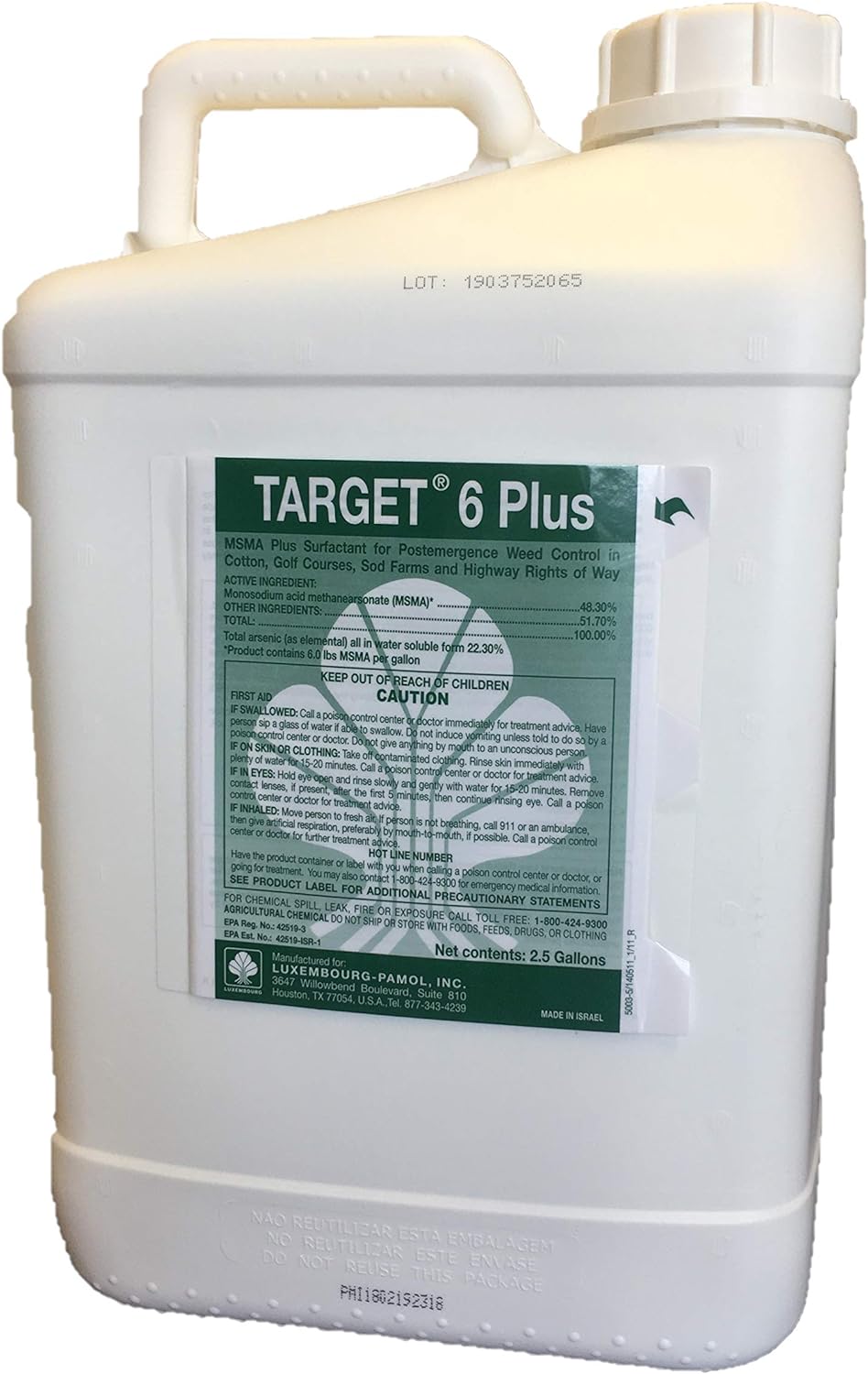
| Active Ingredients | Monosodium acid Methanearsonate MSMA |
|---|---|
| Unit Count | 320 Fluid Ounces |
| Item Form | Liquid |
| Coverage | Selective: Crabgrass, Dallisgrass, Johnsongrass, Nutsedge, Pigweed, Chickweed |
Target 6 Plus MSMA is a concentrated post-emergent herbicide intended for selective control of crabgrass, dallisgrass, johnsongrass, nutsedge, pigweed, and chickweed in turf. It is mixed at about 2 ounces per gallon and applied as a coarse spray, so most users will use it with a pump sprayer to spot-treat or cover larger areas such as golf course turf, sod farms, or established lawns. The primary strength is its active ingredient, monosodium acid methanearsonate (MSMA), which is effective on weeds that many general lawn products struggle to suppress. The product comes in a 2.5 gallon jug, which provides a substantial supply for repeated treatments across medium to large lawns. Important practical considerations are safety and label directions: the product can be harmful if absorbed or swallowed and must not be applied where food is grown, and protective equipment and careful handling are required. This makes it suitable for experienced users or contractors who follow label instructions, while casual gardeners should exercise caution or seek professional application.
Best for: Buyers who prioritize reliable, contractor-grade control of stubborn post-emergent turf weeds and who are comfortable following strict label safety and application procedures.
Less Ideal for: Casual gardeners, small-plot vegetable or edible growers, or anyone unwilling to use personal protective equipment or follow restricted-use safety guidance.
- High concentration of MSMA effective on hard-to-control grassy weeds
- Large 2.5 gallon volume supports multiple treatments for medium to large turf areas
- Selective post-emergent activity targets both grassy and some broadleaf weeds listed on the label
- Simple mix rate (2 oz per gallon) makes dilution and repeat applications straightforward
- Contains an arsenical active ingredient that requires strict safety precautions and may have regulatory restrictions
- Not intended for use where food is grown and requires protective equipment during handling and application
Verdict: Choose this concentrated MSMA formulation when you need proven, contractor-grade post-emergent control of tough turf weeds and will follow label safety and application requirements.
Spectracide Weed & Grass Killer with AccuShot Power Sprayer, 1.33 Gal

| Unit Count | 170 Fluid Ounces |
|---|---|
| Item Form | Spray |
| Coverage | 1 gallon |
| Active Ingredients | Diquat Dibromide 0.12%, Fluazifop-p-butyl 0.06%, Dicamba 0.04% |
Spectracide Weed & Grass Killer pairs a concentrated non-selective formula with a battery-powered AccuShot sprayer to clear weeds from driveway cracks, patios and around foundations. The product is used by aiming and spraying foliage until leaves are covered; the active ingredients move through the leaf to the root and can show visible die-back in as little as three hours. The AccuShot wand is extendable and provides continuous spray without manual pumping, which improves accuracy for narrow cracks and reduces hand fatigue during larger jobs. It is rainproof within 15 minutes, so treated areas are protected quickly. Practical benefits include fast results that let you replant or resume use of the area within a day and a reusable sprayer for follow-up applications. Important limitations are that the herbicide is non-selective so it will kill any plant it contacts, it requires careful handling and PPE to avoid skin or eye exposure, and the sprayer runs on four AA batteries that must be replaced periodically. Follow label directions to avoid runoff into water.
Best for: Buyers who want a fast, no-nonsense solution for weeds growing in driveways and hard surfaces and who prioritize tools with clear user feedback and proven results.
Less Ideal for: Gardeners who need a selective lawn-safe treatment, people unwilling to follow pesticide safety precautions, or those treating areas adjacent to water features.
- AccuShot battery-powered wand gives continuous spray for accurate application in tight cracks
- Formula moves through foliage to kill weeds down to the root with visible results in about three hours
- Rainproof after 15 minutes so treatments are not easily washed away by brief showers
- Covers approximately 300 square feet per gallon, suitable for multiple crack-treatment sessions
- Non-selective herbicide will damage any desirable plants it contacts
- Sprayer requires four AA batteries and occasional replacement to maintain function
- Product is toxic to aquatic life and must not be used near water or allowed to run off
Verdict: A fast-acting, easy-to-aim non-selective herbicide with a battery-powered wand that is well suited to reliably clear weeds from driveway cracks and other hard surfaces.
Roundup Weed & Grass Killer4 Refill, 1.25 gal

| Unit Count | 160 Fluid Ounces |
|---|---|
| Coverage | 375 square feet |
| Item Form | Spray |
| Active Ingredients | Triclopyr, Fluazifop P-Butyl, Diquat Dibromide |
This 1.25 gallon Roundup Weed & Grass Killer4 refill is designed to be poured into an empty spray container to treat weeds and grassy weeds around beds, walkways, driveways, foundations, and other hardscape edges. It contains multiple active ingredients that attack broadleaf weeds and grasses to the root and promises visible wilting within hours and rainproofing in as fast as 30 minutes, which makes it convenient when weather windows are short. The refill covers about 375 square feet and is intended for use in and around established plantings when applied carefully to avoid drift onto desirable plants. Practical benefits include fast action, the ability to replant some areas within a specified wait period, and compatibility with the brand’s comfort wand refills so you avoid frequent repurchasing of small bottles. Important limitations are that it is a nonselective herbicide so it will damage desirable plants if misapplied and treated areas should be kept clear of people and pets until spray dries; follow label directions closely for safe use and replanting intervals.
Best for: Buyers who prioritize reliable, fast-acting weed control for routine maintenance of beds, edges, and hardscape areas and who follow label directions to minimize risk.
Less Ideal for: Gardeners who need selective control inside densely planted flower beds or who prefer organic or nonchemical weed management methods.
- Kills a broad range of weeds and grasses to the root, including dandelion and crabgrass
- Fast visible results in hours and becomes rainproof in about 30 minutes
- Large 1.25 gal refill reduces need for frequent repurchases and covers roughly 375 sq ft
- Formulated to refill compatible spray wand for easy application around beds and hardscapes
- Nonselective formula that will harm desirable plants if it drifts or is oversprayed
- Requires careful handling and adherence to label safety and replanting intervals
Verdict: Choose this refill if you want a fast, proven, large-format herbicide that quickly kills tough weeds and grasses and refills a compatible spray wand for area-wide maintenance.
Choosing the Right Herbicide for Couch Grass: Key Factors to Consider
Mode of Action and Active Ingredient
Different herbicide active ingredients attack weeds in different ways, and couch grass is a tough perennial that often requires systemic activity to move into rhizomes and stolons. Knowing the mode of action helps you choose a product likely to translocate through the plant and reduce regrowth.
Selecting an active ingredient with a proven effect on perennial grasses also helps avoid repeated trial-and-error. Rotating modes of action between seasons can reduce the risk of resistance if you treat the same area repeatedly.
Label Directions and Turf Compatibility
The product label is the legal and practical guide for how to use an herbicide safely and effectively. Look for clear instructions on dilution rates, application timing, and whether the product is safe for the turf species you want to keep.
Labels also spell out restrictions such as maximum seasonal application rates, reentry intervals, and whether the herbicide is suitable for spot treatment only versus broadcast applications. Following the label reduces the chance of turf injury and off-target damage.
Application Timing and Growth Stage
Couch grass control often depends on timing. Actively growing plants absorb systemic herbicides more readily, so treatments are typically most effective when the grass is in vigorous growth rather than dormant.
Seasonal timing also affects how many applications you will need. Early treatment of small patches can limit spread, while late-season applications may weaken but not eradicate well-established stands. Plan follow-up treatments according to regrowth and label guidance.
Method of Application and Equipment
How you apply the herbicide affects both effectiveness and safety. Spot treatments with a hand sprayer let you concentrate product on small infestations and limit collateral damage, while wider outbreaks may require a controlled broadcast application.
Proper nozzles, calibration, and good spray technique reduce waste and prevent drift onto desirable plants. Consider whether a ready-to-use spray, concentrate to mix in a tank sprayer, or a gel/directed formulation best fits your garden setup.
Residual Effects and Lawn Recovery
Some herbicides leave residual activity in soil that can affect replanting or overseeding schedules. If you plan to reseed or plant sensitive ornamentals after treatment, check residual persistence to avoid crop injury.
Residual activity can be a benefit when it helps suppress regrowth, but it also requires planning for when you can safely introduce new turf or plants. Understand the tradeoffs between longer control and delayed replanting.
Environmental and Safety Considerations
Consider how the product behaves around pollinator habitat, water features, and drainage areas. Some active ingredients have label restrictions near water or require buffer zones to protect aquatic life.
Personal protective equipment, proper storage, and disposal instructions are part of safe use. Choosing products with clear safety instructions and following them reduces risk to people, pets, and beneficial wildlife.
When to Treat Couch Grass
Treatments are most effective when couch grass is actively growing and not drought-stressed. In many climates that means late spring through summer for a warm-season grass that resprouts quickly once temperatures rise.
For small patches, early intervention limits spread. For large stands, plan staged treatments and follow-up monitoring to reduce the plant's energy reserves over multiple growth cycles.
- Avoid treating during drought or when turf is dormant.
- Treat in the morning when spray conditions are calm and dew has dried.
Spot Treatment Versus Broadcast Applications
Spot treatment targets visible patches and minimizes impact on surrounding turf and plants. It is often the best choice for isolated infestations and for gardeners who want to preserve mixed-species lawns.
Broadcast applications cover larger areas but demand strict attention to label rates and turf compatibility. Use broadcast sprays only when the label explicitly approves them for your turf type and when you can accurately calibrate your equipment.
- Spot treatment is usually faster and uses less chemical.
- Broadcast applications require careful calibration to avoid overapplication.
Follow-Up Care After Application
After treating couch grass, monitor the area for signs of wilting and regrowth. Systemic herbicides can take days to weeks to show visible effects; do not retreat prematurely without checking the label's recommended interval.
Once treated plants have died back, remove large dead clumps to reduce thatch and improve seed-to-soil contact if you plan to overseed. Consider light aeration or dethatching before reseeding to encourage establishment of desirable turf.
- Wait the label-specified interval before reseeding or planting.
- Raking or coring can help new seed contact soil after treated plants are removed.
Minimizing Off-Target Damage
To prevent harm to nearby plants, avoid spraying in windy conditions and use shields or a wand for directed applications. Keep spray droplets large enough to reduce drift and use lower-pressure nozzles when possible.
Protect ornamentals by covering them during treatment or applying herbicide to the grass only. Read label warnings about drift and buffer zones, especially near water or desirable flower beds.
- Use a targeted wand for spot treatments near desirable plants.
- Consider nonchemical control like hand-pulling in sensitive areas when practical.
Integrating Cultural Controls
Long-term suppression of couch grass is most successful when chemical control is combined with cultural practices. Improving turf density, mowing at recommended heights, and overseeding with competitive grass species reduce opportunities for couch grass to spread.
Addressing soil compaction and fertility helps promote vigorous desirable turf that can outcompete couch grass, lowering the need for repeated chemical interventions.
- Raise mowing height to encourage deep-rooted turf grasses.
- Use regular core aeration and appropriate fertilization to strengthen desired lawn species.
How We Chose the Best Herbicide for Couch Grass
We prioritized herbicides that offer reliable activity on couch grass and that include label guidance for common turf and garden situations. Key editorial filters included documented modes of action effective on warm-season and perennial grasses, clarity of label instructions for spot treatment and broadcast use, and compatibility with standard application equipment. Evaluation focused on measurable, gardener-relevant dimensions: efficacy against couch grass, safety for adjacent turf and ornamentals when applied per label, required number of treatments and timing, and ease of application and cleanup. We also considered persistence in the soil and replanting restrictions because these affect long-term lawn recovery. We excluded products without clear couch grass control claims or without straightforward homeowner labeling. We also filtered out formulations that require specialized licensing or equipment beyond typical homeowner sprayers. The result is a list of options that balance performance with practical use for gardeners managing couch grass.
FAQ
Can I use a nonselective herbicide to kill couch grass in my lawn?
Nonselective herbicides will kill most green plants they contact, including desirable turf. They are useful for removing couch grass from garden beds or paved areas but are not recommended for treating couch grass within a lawn unless you are prepared to reseed or resod the area.
How many treatments does couch grass typically need to control?
Control often requires multiple treatments because couch grass stores energy in underground structures. The exact number depends on infestation size, treatment timing, and product used. Follow label intervals and reassess after each recommended waiting period.
Will treating couch grass harm nearby ornamentals or vegetables?
It can if spray drifts or if the product permits root uptake by adjacent plants. Use targeted applications, physical shielding, and choose formulations labeled safe for proximity to the plants you want to keep.
When is the best time of year to treat couch grass?
Treat during active growth when temperatures favor rapid plant metabolism, often late spring through summer for warm-season couch grass. Avoid treating during stress periods like drought or extreme heat for better uptake.
Can I overseed immediately after killing couch grass?
Usually not immediately. Many herbicides have replant or reseeding windows on the label. Wait the specified period after the final application and prepare the soil by removing dead material before overseeding.
Are there nonchemical options that help reduce couch grass?
Yes. Regular hand removal of small patches, smothering with landscape fabric or mulch, improving turf vigor through mowing and fertilizing, and mechanical removal for isolated areas can all reduce spread without chemicals.
Final Verdict
Choose an herbicide based on the active ingredient's suitability for perennial grass control, the product label's compatibility with your turf, and the timing that matches active growth. Balance the need for effective kill with the desire to protect nearby turf and plants, and plan for follow-up treatments and lawn recovery. Prioritize products and techniques that fit your application method and replanting timeline. With the right timing, method, and cultural follow-up, you can regain control of couch grass while restoring healthy turf.
