

Note: This article contains affiliate links. If you click on these links and make a purchase, I may earn a small commission at no extra cost to you. This helps support my research and content. Read my full affiliate disclosure here.
If burrowing critters, rabbits, or persistent neighborhood wildlife are churning your soil or snacking on young plants, the right small animal repeller can protect beds, containers, and compact yards without heavy-duty equipment. In a small outdoor space, placement, effective coverage radius, and weather resistance matter more than raw power. This guide covers the top shortlisted small animal repellers suited to garden beds, patios, and container groups, and explains the practical tradeoffs you should expect. We evaluate each option for how well it covers tight areas, how it holds up to weather, and how easy it is to install or maintain.
Top Picks at a Glance
| Best Overall The best all-around choice for most situations | Broox RB-101 Solar Ultrasonic Animal Repellent |  |
| Best Quality Built to a higher standard if you want something more solid | G-Jyuncyou Solar Ultrasonic Animal Repeller (2-Pack) |  |
| Best Value The sweet spot between price and what you get | CKCOEO Solar Ultrasonic Animal Repellent with Motion Sensor and Strobe Light |  |
| Best Budget The cheapest option that still gets the job done reliably | Roypet Solar Motion-Activated Ultrasonic Animal Repellent |  |
| Highest Rated A top-rated pick with lots of positive feedback | Thcritter Solar Ultrasonic Outdoor Animal Repeller (Upgraded) |  |
| Most Popular A crowd favorite that many people choose with confidence | Bonide Repels-All Animal Repellent Granules, 3 lb |  |
Broox RB-101 Solar Ultrasonic Animal Repellent

| Target Species | Cat, Dog, Rabbit, Raccoon, Skunk, Squirrel |
|---|---|
| Infrared sensor angle | 110 degrees |
| Detection range | 20-25 feet |
| Power supply | Solar plus 3 Ni-MH rechargeable batteries with USB charging |
The Broox RB-101 is a weatherproof, solar-powered ultrasonic animal repellent intended to keep gardens and yards clear of cats, squirrels, raccoons, deer and similar animals. It mounts in the ground or on a wall, uses an infrared motion sensor to trigger ultrasonic tones and a flashing LED, and offers five frequency modes and a sensitivity knob so you can match output to different species and detection distances. Practical benefits include solar charging with USB backup so it can run with minimal maintenance, a 110 degree sensor sweep and roughly 20–25 foot detection range for decent coverage of small to medium areas, and clearly labeled mode settings that make it easy to adjust. Limitations are that effectiveness depends on animals being sensitive to ultrasonic frequencies and on correct placement and orientation, and some users may not hear the device because the sound is above human hearing range. The unit is a straightforward, low-effort option for reducing nuisance wildlife where a humane, nonchemical approach is preferred.
Best for: Someone who wants a low-maintenance, humane way to discourage common garden pests and prefers configurable settings to tailor coverage to specific animals and areas.
Less Ideal for: People needing guaranteed removal of burrowing or hearing-insensitive animals or those who require a solution for very large acreage beyond the stated detection range.
- Solar panel with USB backup reduces need for frequent battery changes
- Adjustable frequency and sensitivity knobs let you target different species and distances
- Motion-activated ultrasonic sound plus flashing LED adds both audio and visual deterrence
- IP65 weatherproof construction suitable for outdoor exposure
- Relies on animals being able to hear ultrasonic frequencies so it will not affect all species
- Effectiveness depends on correct placement and periodic repositioning if animals habituate
Verdict: A simple, weatherproof solar ultrasonic repeller with adjustable frequency and motion detection that offers a low-effort, humane way to reduce common garden pests.
G-Jyuncyou Solar Ultrasonic Animal Repeller (2-Pack)
| Power Source | Solar Powered |
|---|---|
| IP Rating | IP65 |
| Frequency Range | 18–45 kHz |
| Charging | Solar and USB charging option |
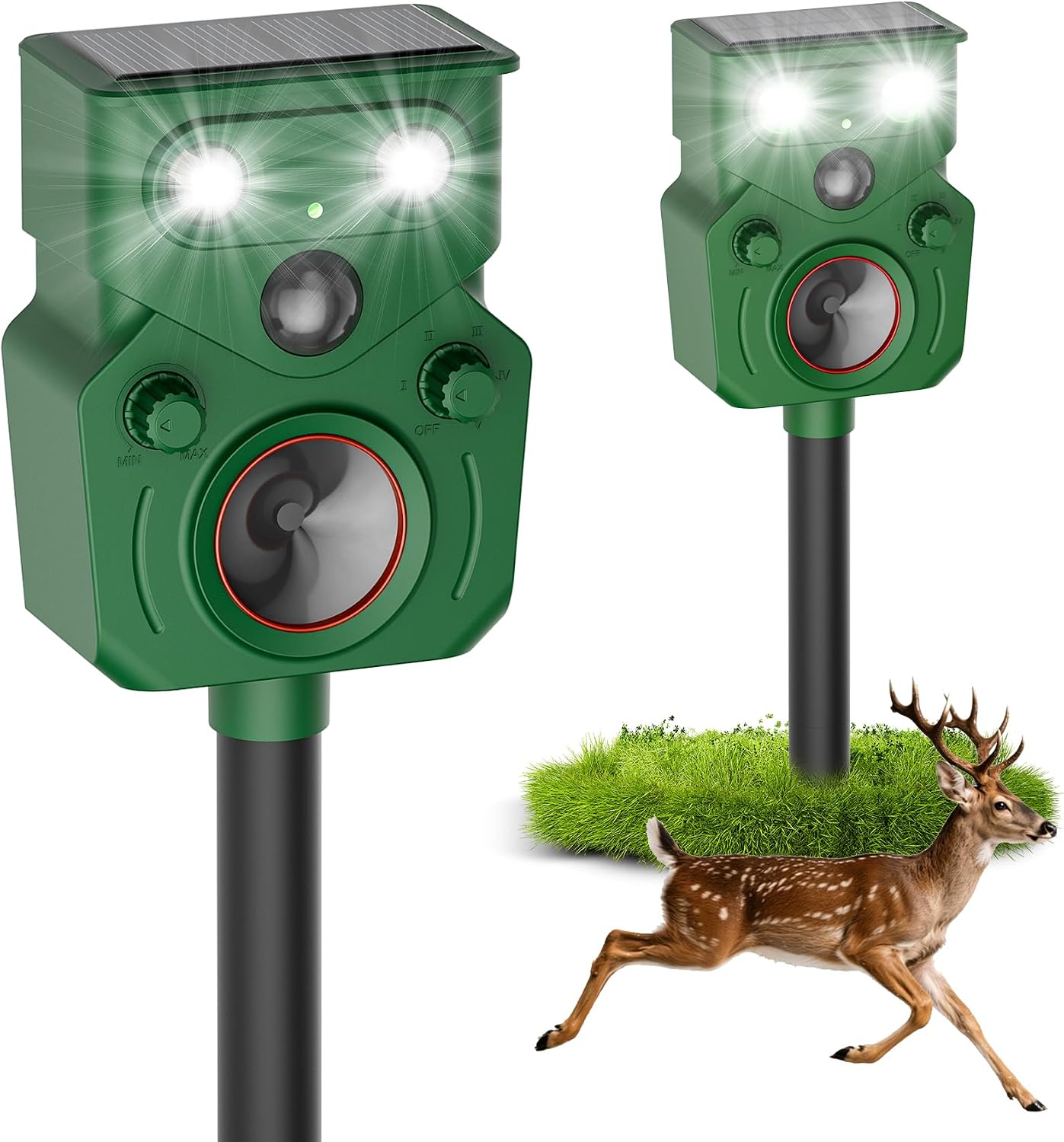
This two-pack of G-Jyuncyou solar ultrasonic repellers combines PIR motion detection, adjustable ultrasonic frequency and strobe lighting to protect yards, orchards, and gardens from deer, raccoons, coyotes and similar animals. Install by staking into the ground or hanging; the PIR sensor triggers ultrasonic pulses (18–45 kHz depending on mode) and flashing LEDs when animals enter the detection zone. There are five modes including sweep, high-frequency, full cycle and strobe-only, plus separate knobs for sensitivity and frequency so you can tune coverage for different animals and distances. Solar panels recharge during the day and a USB port lets you top up the internal battery when sunlight is limited. The unit is IP65 rated, built from ABS plastic, and intended for continuous outdoor use. Important limitations are that ultrasonic effectiveness varies by species and environment and requires correct placement and angle; sound does not physically harm animals and results are not instant in every situation. The device is best used as part of a layered approach to deer control rather than a guaranteed single solution.
Best for: Buyers who prioritize a low-maintenance, weatherproof deterrent they can rely on for continuous outdoor protection and who want the ability to fine-tune detection and frequency settings.
Less Ideal for: Those seeking an immediate, guaranteed elimination of large herd deer or users who prefer physical exclusion methods only should consider alternative or additional solutions.
- Adjustable frequency and sensitivity knobs let you target different animals and tune detection range.
- Dual charging via solar panel plus USB ensures power even in cloudy weather or winter.
- IP65 waterproof rating and ABS construction for outdoor durability.
- Multiple working modes including strobe-only and full-cycle provide flexible deterrent patterns.
- Ultrasonic effectiveness depends on species, landscape and placement so results can vary.
- No detailed coverage radius provided, so planning exact placement requires trial and error.
Verdict: A weatherproof, adjustable solar-powered repeller that provides reliable, low-maintenance deterrence when used as part of a broader deer-control strategy.
CKCOEO Solar Ultrasonic Animal Repellent with Motion Sensor and Strobe Light

| Power source | Solar |
|---|---|
| Detection angle | 150 degrees |
| Detection range | 25-30 ft |
| Waterproof rating | IP65 |
This solar ultrasonic repellent combines a PIR motion sensor, high-frequency sound pulses, and a flashing strobe to keep small mammals out of gardens and yards. Install it on a stake about 9 to 10 inches above the ground or hang it on a fence facing animal paths; when the sensor detects movement within about 25 to 30 feet and 150 degrees, the unit emits ultrasonic bursts and a bright LED flash for immediate deterrence and then returns to standby. The built-in solar panel charges the internal battery so the device runs after dark without wiring, and the IP65 ABS housing tolerates rain and sprinklers for year-round outdoor use. Practical benefits include easy, tool-free setup, chemical-free operation, and coverage that targets a wide range of species. Limitations to note are the need for good sun exposure to maintain charge, an advertised adjustment period of a few weeks for persistent animals, and the typical line-of-sight requirement of ultrasonic devices which reduces effectiveness around dense vegetation or obstructed approaches.
Best for: Gardeners and yard owners who want a low-maintenance, chemical-free deterrent that can be set-and-forgotten to reduce small mammal damage around beds and lawns.
Less Ideal for: People with shaded sites that get little direct sun or those who need immediate, guaranteed removal of persistent animals in heavily obstructed areas.
- Solar-powered with on-board charging so it runs at night without external power
- PIR motion sensor covers up to about 150 degrees and 25–30 feet for triggered activation
- IP65-rated ABS housing protects electronics from rain and outdoor conditions
- Dual-action deterrent using ultrasonic pulses plus flashing LED to startle animals
- Performance depends on direct sunlight for reliable charging and runtime
- Ultrasonic effectiveness is reduced by obstacles and may take weeks for animals to adapt or leave
Verdict: A hands-off, solar-powered ultrasonic repeller that gives practical, weatherproof protection against squirrels and other small pests for sun-exposed gardens.
Roypet Solar Motion-Activated Ultrasonic Animal Repellent

| Power Source | Solar Powered |
|---|---|
| Material Type | Acrylonitrile Butadiene Styrene (ABS) |
| Number of Pieces | 1 |
| Unit Count | 4 Count |
This Roypet unit uses a motion sensor to trigger an ultrasonic sweep that discourages a wide range of animals from entering lawn and garden areas. It is solar powered and housed in waterproof ABS plastic, so it can run outdoors without wiring and tolerates typical weather. Setup is simple: twist the stake into soil and position the panel in sun, making it a low-effort option for seasonal pest control. The device claims sonic and vibration modes that may also help with burrowing pests like moles and gophers, and its ultrasonic output is inaudible to people and most pets. Limitations to expect are uneven effectiveness across species and environments and potential reduced performance in low-light conditions if the solar charge is insufficient. This is best viewed as a maintenance-level deterrent rather than a guaranteed exclusion solution for persistent or food-motivated wildlife.
Best for: Buyers who want an inexpensive, low-effort deterrent to reduce casual visits from common yard pests and prefer a plug-free, solar solution for general garden protection.
Less Ideal for: People dealing with heavy, persistent infestations or who need a guaranteed exclusion method should consider professional services or mechanical barriers instead.
- Solar powered for cordless operation and no ongoing electricity cost
- Motion-activated only runs when needed to conserve power
- Weatherproof ABS construction suits outdoor placement
- Simple stake installation requires no tools
- Effectiveness varies by species and local conditions and is not guaranteed for determined animals
- Relies on sunlight for charging so performance can drop in shaded or cloudy locations
Verdict: A budget-friendly, solar motion-activated ultrasonic repellent that offers simple, tool-free installation for light to moderate yard pest deterrence.
Thcritter Solar Ultrasonic Outdoor Animal Repeller (Upgraded)

| Power Source | ac |
|---|---|
| Number of Pieces | 2 |
| Waterproof Rating | IP66 |
The Thcritter Solar Ultrasonic Outdoor Animal Repeller is a weatherproof, solar-powered unit that uses a PIR motion sensor and ultrasonic pulses to discourage animals such as squirrels, rabbits, raccoons, and deer from entering a protected area. You install the stake in a sunny spot, let the internal battery charge from the solar panel, and the device remains in standby until the 110° sensor detects motion within roughly 25 to 30 feet. When triggered it emits ultrasonic signals and a brief active period before returning to standby, and LEDs indicate charging and activation status. Practical benefits include hands-free operation with no regular battery changes, IP66-rated water resistance for outdoor durability, and a humane, chemical-free deterrent method. Limitations are that ultrasonic effectiveness varies by species and environmental conditions and coverage is directional and limited to the sensor’s range, so multiple units may be needed for larger or irregularly shaped areas. The compact ABS housing appears robust but small physical size means the solar panel needs good sun exposure to maintain reliable operation.
Best for: Gardeners and homeowners who want a low-maintenance, humane way to reduce visits from small animals and prefer a reliable, weatherproof device that runs on solar power.
Less Ideal for: People needing instant broad-area protection for large properties or those targeting burrowing pests where ultrasonic waves are less effective should consider other approaches.
- Solar-powered design reduces or eliminates battery replacement
- PIR motion sensor with about 110° detection for automatic activation
- IP66 waterproof rating and durable ABS construction for outdoor use
- Humane, non-chemical deterrent suitable for a variety of small and medium animals
- Ultrasonic effectiveness depends on species and can be reduced by obstacles or ambient noise
- Limited coverage per unit may require multiple devices to protect larger areas
Verdict: If you want a low-maintenance, weatherproof solar unit to humanely deter small garden pests, this reliable ultrasonic repeller is a straightforward choice.
Bonide Repels-All Animal Repellent Granules, 3 lb

| Net weight | 3 lb |
|---|---|
| Form | Granules |
| Claims | Biodegradable; People & pet safe when used as directed |
| Coverage duration | Up to 60 days (under normal conditions) |
Bonide Repels-All is a ready-to-use granular repellent formulated to keep deer, rabbits, squirrels, raccoons and many other pests away from planting areas. You spread the granules around beds, borders or other vulnerable spots and lightly water them in if no rain is expected; the manufacturer says the effect can last up to two months under normal conditions. The formula relies on scented and taste-irritant ingredients derived from fish meal, oils and minerals to trigger avoidance behavior rather than kill wildlife, and the product is described as biodegradable and safe for lawns and ornamentals when used as directed. For gardeners focused on protecting perennials, shrubs and newly planted areas it provides a low-effort barrier and can be re-applied more frequently after heavy rain or during rapid plant growth. Limitations are that effectiveness varies by species and local pressure of animals, and the granules require reapplication on a schedule for consistent protection and must not be applied directly to edible crops intended for human consumption.
Best for: Gardeners who want a low-effort, nonlethal way to protect ornamental plants from deer and small mammals and who prefer products that are described as safe for people and pets when used as directed.
Less Ideal for: Growers who need a guaranteed solution for heavy deer browsing or those wanting a repellent they can apply directly to fruits and vegetables should consider other targeted methods.
- Ready-to-use granular form is simple to apply around beds and borders
- Repels a broad list of animals including deer and rabbits using scent and taste deterrents
- Manufacturer states granules are biodegradable and safe for lawns and ornamental plants when used as directed
- Long-lasting effect up to 60 days under normal conditions with light watering after application
- Effectiveness varies with local animal pressure and weather and may require frequent reapplication after heavy rain
- Not labeled for direct use on edible crops intended for human consumption
Verdict: Choose these granules if you want a simple, nonlethal barrier that reduces deer and small-mammal damage to ornamental beds with infrequent reapplication.
Choosing the Right Small Animal Repeller: Key Factors to Consider
Coverage and Placement
Small animal repellers advertise different coverage shapes and radii. In a compact garden or patio, an advertised wide radius does not guarantee even protection. Consider how the repeller directs its deterrent, whether beam, ultrasonic spread, visual motion, or scent-dispersal, and map that shape against your beds or container groupings. A device with adjustable angle or multiple directional outputs usually gives better real-world coverage than a single fixed emitter.
Placement matters as much as stated range. Obstacles like trellises, dense foliage, and garden furniture can block or reflect deterrents. Plan to place units so the protected area falls within the strongest part of the coverage pattern and allow overlapping zones when protecting multiple adjacent beds.
Durability and Weatherproofing
Small animal repellers live outdoors year-round in many gardens, so construction quality is critical. Look for corrosion-resistant housings, sealed seams, and components rated for wet conditions. UV exposure can degrade plastics and rubber seals, so materials and UV-stable finishes extend service life. Consider whether the unit has replaceable parts or maintenance steps such as reapplying protective coatings.
Also assess operating temperature ranges. Units with moving parts or batteries can be sensitive to cold winters or hot summers. If you plan to leave devices in place through seasonal changes, choose options that list explicit weather resistance and provide guidance for winter care or long-term outdoor deployment.
Power Source and Runtime
Power options vary between mains, battery, solar, or hybrids. In small yards and patios where outlets may be distant, solar or battery-powered units offer flexibility, but their runtime depends on panel size and local sun exposure. Rechargeable battery systems can reduce ongoing costs but require periodic servicing. Mains-powered units deliver consistent performance but limit placement.
Evaluate how long a unit runs between charges or replacements and whether it has power-saving modes or timers. For gardeners who want continuous deterrence, a system that supports daytime charging and nighttime operation, or easy battery swaps, reduces the risk of gaps in protection.
Type of Deterrent and Garden Impact
Repellers use a range of mechanisms: ultrasonic sound, motion-activated lights or spikes, reflective motion, scent-based repellents, or physical vibration. Ultrasonic devices can be effective against certain mammals but may be less reliable where foliage or structures block waves. Visual and motion methods can scare animals away but may also disturb neighborhood pets or passersby. Scent-based approaches are affected by wind and rainfall and may need reapplication.
Consider non-target effects. Some deterrents can stress or chase backyard pets or attract curious wildlife. Choose a deterrent type that reduces garden damage while fitting within your tolerance for noise, visible motion, and potential impacts on other animals.
Ease of Installation and Maintenance
Small spaces often require creative mounting. Check whether a repeller can be staked into soil, mounted on a wall, clipped to a railing, or placed on a flat surface. Tools needed for installation, the ability to aim or tilt the unit, and clear instructions make setup faster and more reliable.
Maintenance includes cleaning sensors, replacing batteries, charging solar panels, and checking seals after storms. Simpler maintenance routines are preferable for busy gardeners. Also verify whether replacement parts like stakes, covers, or battery packs are available and straightforward to swap in the field.
Humane Effectiveness and Local Wildlife Considerations
Gardeners often prefer deterrents that do not injure animals. Assess whether a repeller relies on non-harmful aversive stimuli and whether those stimuli are likely to work on the species common in your area. Different small mammals respond differently to sound, motion, or scent. Local regulations and community standards may also influence acceptable methods.
Plan for variable results: initial success can wane as animals habituate to a single stimulus. Combining repellent types or varying placement and timing can sustain effectiveness while maintaining humane treatment of wildlife.
Where Small Animal Repellers Work Best
Repellers are most effective in clearly defined, limited areas such as raised beds, community garden plots, and patio container groupings. In small zones you can place devices strategically to cover the whole planting area without needing high output.
They are less reliable as the sole solution in open fields or locations with dense wildlife traffic. In those settings, repellers can supplement barriers or habitat modification but usually will not provide complete control alone.
- Ideal for concentrated planting areas and pathways
- Complementary to physical barriers like collars or fencing
- Work best when lines of sight or signal paths are clear
Combining Repellents with Physical Barriers
Using a repeller together with small fences, root collars, or lightweight netting reduces pressure on the device and increases overall protection. Physical barriers block direct access while electronic or motion methods discourage repeated probing or hunting behavior.
Layering methods also allows you to choose a lower-intensity repeller, which can reduce non-target disturbance and improve long-term tolerance by wildlife.
- Use collars or mesh for young plants plus repellers for perimeter deterrence
- Temporary netting can protect seedlings until repellers condition local wildlife to avoid the area
Placement Tips for Tight Spaces
Aim repellers toward the most vulnerable plants, not toward open lawn. For container gardens, position units at container height to align with the animal's approach path. When protecting multiple containers, use two low-power units with overlapping coverage rather than one high-power device placed off-center.
Watch for reflective surfaces or dense foliage that can scatter or block signals and adjust mounting height or angle accordingly. Periodic observation during dawn and dusk will show where animals enter and help refine placement.
- Mount at the same height as the animal's approach when possible
- Use multiple low-intensity units for irregularly shaped beds
- Avoid placing directly behind dense plants or fences
Seasonal Care and Storage
In climates with wet winters or heavy snow, remove or shelter sensitive units to prevent moisture damage and freezing of batteries. For solar-powered options, keep panels clean and angled for winter sun, and bring rechargeable batteries indoors if temperatures drop below the device's safe range.
During the active growing season, check units monthly for debris, insect nests in sensors or vents, and secure mounting stakes after storms. Regular seasonal checks extend service life and maintain deterrent effectiveness.
- Protect batteries from extreme cold to preserve lifespan
- Clean sensors and solar panels regularly
- Inspect seals and housing after heavy rain
Minimizing Non-Target Disturbance
If you live near neighbors or keep pets, choose settings and placements that focus deterrent effects within your property. Directional mounting, lower-intensity modes, and timers reduce spillover to adjacent areas. For ultrasonic devices, placement behind plantings or barriers can limit sound propagation to unwanted directions.
Observe for unintended impacts and adjust modes or placement. Many gardeners rotate devices or switch deterrent types seasonally to reduce habituation while also limiting disturbance to pets and beneficial fauna.
- Use directional mounts to aim away from sidewalks and neighbor yards
- Prefer adjustable intensity or timed operation
- Combine non-audible deterrents where pets are present
How We Chose the Best Small Animal Repeller
We evaluated candidates using gardener-focused, measurable criteria that reflect real-world use in small outdoor spaces. Coverage radius and pattern were considered first because a compact repeller must actually protect the target planting area without creating gaps. Durability and weatherproofing were assessed to ensure electronics or moving parts survive sun, rain, and temperature swings. Power and runtime options were included so units can operate reliably in areas without easy outlet access. Ease of installation and placement flexibility matter for small beds and patio containers where mounting options are limited. Humane effectiveness was judged by how consistently units deter common small mammals without harming wildlife. We excluded devices intended only for large agricultural fields or those relying on illegal or harmful control methods. Products that lacked clear durability specifications or that depended on constant human intervention were not considered. The resulting shortlist focuses on practical, low-impact solutions suited to gardeners managing compact outdoor spaces.
FAQ
Will an ultrasonic repeller hurt my pets?
Ultrasonic repellers are usually tuned for the hearing ranges of small wild mammals and are typically not audible to most humans. Some pets, especially small rodents or sensitive animals, can detect high frequencies. Placement, direction, and lower intensity settings reduce potential disturbance to domestic pets.
How far apart should I place multiple devices?
Spacing depends on the stated coverage pattern, but in tight gardens you should aim for overlapping zones rather than edge-to-edge placement. Overlap ensures no gaps where animals can slip through, and multiple lower-power units often outperform a single high-power unit in irregular spaces.
Do scent-based repellents work in windy areas?
Scent-based repellents lose effectiveness in strong or shifting winds because the repellent dissipates quickly. They can work in sheltered beds or containers where airflow is limited, but expect shorter durations between reapplications in windy conditions.
Can animals get used to a single deterrent over time?
Habituation is common. Using multiple deterrent types, changing placement periodically, or alternating active hours can help maintain effectiveness. Physical barriers also reduce reliance on any single method.
Are solar-powered repellers reliable on cloudy days?
Solar panels rely on cumulative sunlight, so efficiency drops on cloudy days. Systems with battery backups perform better through cloudy stretches. For consistently cloudy climates, choose units with larger panels or battery support.
Will rain or snow damage repellers left outside?
Many outdoor repellers are designed with weather resistance, but heavy rain, snow accumulation, and freeze-thaw cycles can compromise seals and batteries over time. Follow manufacturer guidance for winter storage or sheltering sensitive units.
Final Verdict
For small gardens and patios, prioritize placement, coverage pattern, and weather resistance over raw output. Choosing a repeller that fits the geometry of your beds and offers flexible power options reduces maintenance and improves reliability. Expect to combine electronic deterrents with simple physical barriers for the most durable protection. Pick a solution that balances humane effectiveness with installation ease and seasonal care requirements. That approach gives the best chance of protecting plantings while minimizing non-target impacts and ongoing upkeep.
