

Note: This article contains affiliate links. If you click on these links and make a purchase, I may earn a small commission at no extra cost to you. This helps support my research and content. Read my full affiliate disclosure here.
A properly matched LED grow light transforms a 4×4 tent from a cramped propagation space into a productive small grow room. You want even light across the canopy, enough intensity for flowering, and a fixture that runs cool and reliably under continuous schedules. This guide covers six top shortlisted LED options suited to 4×4 tents and explains the technical traits that matter in everyday indoor gardening. We evaluate each unit on canopy coverage, spectral balance, heat management, and electrical efficiency so you can choose the right light for your space and crop goals.
Top Picks at a Glance
| Best Overall The best all-around choice for most situations | Spider Farmer SE5000 480W LED Grow Light (App‑Controlled) |  |
| Best Quality Built to a higher standard if you want something more solid | AC Infinity IONBOARD S44 LED Grow Light Board, Dimmable 4×4 |  |
| Best Value The sweet spot between price and what you get | MARS HYDRO FC-E4800 480W LED Full Spectrum Grow Light |  |
| Best Budget The cheapest option that still gets the job done reliably | Barrina 4×4 Full Spectrum Dimmable Grow Light Panel, 200W |  |
| Highest Rated A top-rated pick with lots of positive feedback | Spider Farmer SF4000 450W LED Grow Light (4×4 Coverage) |  |
| Most Popular A crowd favorite that many people choose with confidence | VIVOSUN LumaLight 400W Full Spectrum LED Grow Light |  |
Spider Farmer SE5000 480W LED Grow Light (App‑Controlled)
| Power Source | Corded Electric |
|---|---|
| Voltage | 120 volts |
| Wattage | 480 watts |
| Light Source Type | LED |
| Dimmable | Yes |
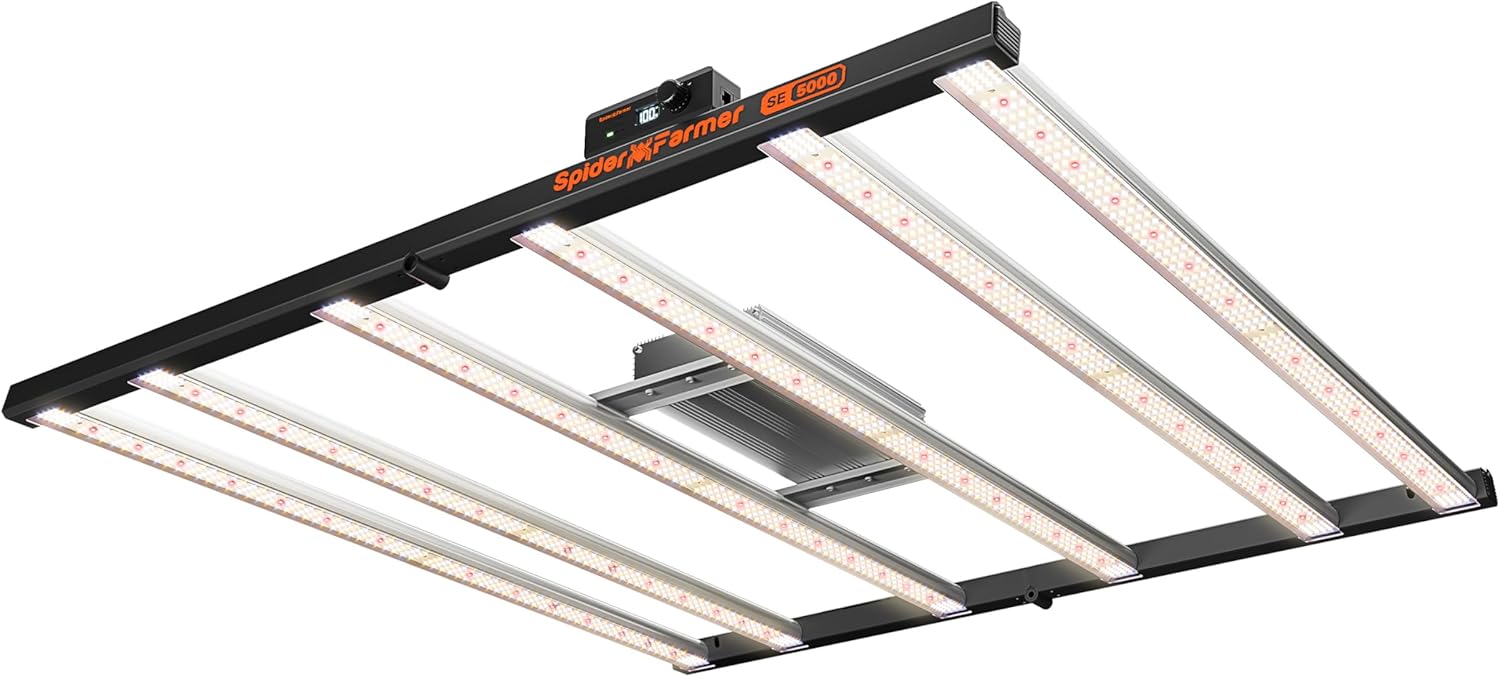
The Spider Farmer SE5000 is a bar‑style 480W LED grow light built to cover a 4×4 grow tent with even, deep canopy penetration. It uses high‑quality Bridgelux diodes and a plant‑centric spectrum heavy on deep red for photosynthesis, which translates to strong flowering and good canopy uniformity across a tent. The fixture includes a digital dimming display and app control so you can set schedules, simulate sunrise and sunset, and adjust brightness remotely. Practical features include a detachable driver, daisy‑chain capability for multi‑light setups, and aluminum construction for heat dissipation. In everyday use it functions well for full growth cycles from seedlings through flower when hung at typical tent heights, and the app/scheduling tools reduce hands‑on adjustments. Important limitations are its 480W draw which requires attention to ventilation and electrical load, and its size and power make it more suited to dedicated tent setups rather than small desktop grows. The light is a solid choice if you want efficient, commercial‑style performance with convenient digital controls in a 4×4 tent.
Best for: Growers who need reliable, high‑output performance in a 4×4 tent and value remote scheduling and precise dimming for full growth cycles. It suits hobbyists stepping up to more serious or small commercial setups who want even canopy coverage and strong flowering results.
Less Ideal for: Casual growers with very small spaces, beginners who prefer plug‑and‑play low‑power lights, or anyone constrained by limited electrical capacity or ventilation.
- True 480W power with Bridgelux diodes for high PPFD and canopy penetration
- Full spectrum tuned for plants with strong deep‑red output for flowering
- App control plus a digital dimming display for easy scheduling and remote adjustments
- Detachable driver and daisy‑chain support for scalable multi‑light setups
- Aluminum construction aids heat dissipation and durability
- Higher 480W power draw requires adequate ventilation and appropriate electrical planning
- Large footprint and output are excessive for small or desktop grows
Verdict: If you want efficient, high‑output, app‑controllable performance for a 4×4 tent, the SE5000 delivers commercial‑style results with precise dimming and wide, even coverage.
AC Infinity IONBOARD S44 LED Grow Light Board, Dimmable 4×4

| Light Source Type | LED |
|---|---|
| Light Source Wattage | 400 watts |
| Number of Light Sources | 1024 |
| Light Source Special Features | dimmable |
| Power Source | Corded Electric |
The AC Infinity IONBOARD S44 is a high‑output LED grow light built for a 4×4 grow tent. It uses Samsung LM301H diodes arranged across a unibody aluminum board to deliver uniform PAR and deeper canopy penetration, and the 5‑level dimmer (0–100% control) lets you dial intensity for clones through flowering. The fixture is IP65 rated so it stands up to humid tent environments, and it pairs with AC Infinity controllers and the app for scheduling, automation, and remote monitoring when you want more advanced environmental control. In practice the S44 is suited to growers who need even coverage and strong PPFD across a four‑by‑four footprint without assembling bars; the built‑in diode layout means fewer hotspots and simpler hanging. Expect a relatively high wattage draw and a larger physical board compared with bar fixtures, so plan tent layout and ventilation accordingly. If you want integrated smart control and a compact board form factor for a single 4×4 canopy, this unit delivers strong performance.
Best for: Growers running a single 4×4 tent who prioritize uniform high PPFD and built‑in smart control to maximize yields.
Less Ideal for: Gardeners who need a lightweight, modular multi‑fixture setup across multiple small tents or who must minimize power consumption at all costs.
- Full‑spectrum Samsung LM301H diodes for high efficacy and plant growth
- Engineered diode layout for uniform PAR and deeper canopy penetration
- Dimmable 0–100% control for all growth stages
- IP65 rating and aluminum unibody for durability in tent environments
- Relatively high wattage draw requiring adequate ventilation and power planning
- Large single‑board form may be less modular than multi‑bar fixtures
Verdict: A purpose‑built 4×4 LED board that delivers uniform, high‑performance lighting and smart controller integration for growers focused on maximizing yields.
MARS HYDRO FC-E4800 480W LED Full Spectrum Grow Light

| Light Source Type | LED |
|---|---|
| Power Source | Corded Electric |
| Wattage | 480 watts |
| Light Source Special Features | dimmable,remote control |
| Specification Met | ETL, CE, UKCA, RoHS |
The MARS HYDRO FC-E4800 is a 480W LED fixture built for full-cycle indoor growing in a 4×4 tent. It uses high-efficiency Bridgelux diodes and an enhanced OSRAM red spectrum to push flowering performance while keeping energy use relatively low. Typical setup requires basic assembly and hanging in the tent; the lamp is dimmable and can be integrated with MARS HYDRO controllers or an app for scheduling and remote adjustments. In practice the light gives even coverage across a 4×4 footprint and stronger red output in the core 3×3 area, which helps bud development during bloom. The aluminum housing and removable bars aid heat dissipation and serviceability, but the unit is relatively heavy compared with smaller panels and needs sturdy hang points. For growers who want reliable, app-compatible control and a focused flowering spectrum without moving to a top-tier premium model, this balances output and value well. Expect to pair it with adequate ventilation and a solid suspension when installing in a 4×4 tent.
Best for: Growers outfitting a 4×4 tent who prioritize efficient flowering performance and smart control while keeping costs reasonable.
Less Ideal for: Gardeners who need an ultra-light or plug-and-play fixture for small seedlings or who demand the highest-end, premium-output fixtures for commercial-scale yields.
- High-efficiency Bridgelux LEDs with boosted OSRAM red spectrum to improve flowering
- Dimmable and compatible with app or controller for remote scheduling and precise light cycles
- Designed for uniform 4×4 coverage with stronger core 3×3 output for bloom performance
- Aluminum construction and removable bars support heat dissipation and maintenance
- Requires assembly and is relatively heavy, needing secure hanging hardware
- Advanced smart controls such as iHub-Pro are sold separately
Verdict: A cost-conscious 480W full-spectrum fixture that gives reliable 4×4 tent coverage and smart dimming tailored for stronger flowering results.
Barrina 4×4 Full Spectrum Dimmable Grow Light Panel, 200W

| Light Source Type | LED |
|---|---|
| Wattage | 200 watts |
| Mounting Type | Plug and play |
| Light Source Special Features | Dimmable |
| Material Type | Aluminum, Polycarbonate (PC) |
The Barrina 4×4 Grow Light Panel is a 200W full-spectrum LED fixture aimed at indoor growers who need broad, adjustable coverage for a small tent or shelf. It uses 816 LEDs across blue, warm white, red (660nm) and near-infrared (730nm) diodes to support vegetative growth and flowering, and the panel angle is adjustable so you can concentrate light or widen the spread for a roughly 4×4 coverage. A front-mounted dimmer lets you lower intensity without extra controllers and the plug-and-play mounting includes hanging chains and hooks for quick installation. The aluminum construction helps dissipate heat passively so the unit runs quietly without a fan. On the downside this is a single-panel solution that may need careful placement or multiple units to hit uniform PPFD across a 4×4 tent, and the spec sheet mixes several PPFD and LED-count figures that require interpreting for real-world setups. For growers prioritizing low-cost setup and simple adjustable output, this panel delivers strong light output and easy installation, but larger or commercial tents will likely need additional fixtures for even canopy coverage.
Best for: Growers outfitting a small 4×4 tent on a tight budget who want a simple, plug-and-play full-spectrum fixture with adjustable output and quick installation.
Less Ideal for: Large commercial setups or growers who need guaranteed uniform PPFD across the entire canopy without adding multiple fixtures.
- Full-spectrum array (blue, 3000K warm white, 660nm red and 730nm IR) supports both veg and bloom stages
- Dimmable control allows easy intensity adjustment for seedlings through flowering
- Adjustable panel angle lets you focus or widen light distribution
- Quiet passive cooling via aluminum body reduces noise and maintenance
- Single 200W panel may produce uneven PPFD across a full 4×4 tent without additional units or careful positioning
- Specification listings include multiple conflicting LED and PPFD figures that require interpretation when planning coverage
Verdict: A budget-friendly, dimmable full-spectrum 200W panel that gives growers an easy plug-and-play option to light a 4×4 tent when paired or positioned thoughtfully.
Spider Farmer SF4000 450W LED Grow Light (4×4 Coverage)

| Light Source Type | LED |
|---|---|
| Light Source Wattage | 450 watts |
| Dimming Range | 0%-100% |
| Coverage | 4'x4'/5'x5' |
| Input Voltage | AC100-277V |
The Spider Farmer SF4000 is a high-output LED panel built for a 4×4 tent setup and all growth stages from veg to bloom. It delivers a full spectrum that combines 3000K and 5000K whites with 660nm red and IR diodes, and the manufacturer lists an actual power draw around 450W and a claimed coverage of 4×4 to 5×5. The light is fanless so it runs silently and uses a thick aluminum heat sink and branded driver for passive cooling and long life. A dimming knob and daisy-chain compatibility make it easy to dial intensity for seedlings through flower and to link multiple units for larger tents. Practical benefits include strong PPFD across the canopy, simple ceiling mounting, and a 5-year warranty for peace of mind. Important limitations are the unit size and 450W draw, which may require adequate electrical circuits and tent space planning, and the product listing references specific diode brands and performance claims that buyers may want to verify with third-party PPFD measurements for exact output in their setup.
Best for: Growers equipping a single 4×4 tent who prioritize quiet, full-spectrum performance and want a robust, easy-to-dim fixture with manufacturer support.
Less Ideal for: People needing minimal power consumption for tiny trays or shelves or growers who require published third-party PPFD maps before buying.
- Full spectrum including 3000K, 5000K, 660nm red and IR for veg and bloom stages
- Dimmable with knob and daisy-chain support for multi-light setups
- Fanless passive cooling with sturdy aluminum heat sink for quiet operation
- Rated actual power around 450W with claimed 4×4 to 5×5 coverage suitable for a single 4×4 tent
- 5-year manufacturer warranty for after-sale support
- High 450W power draw may require dedicated circuit planning in multi-light installs
- Output and PPFD values are implied by specs rather than provided as measured charts in the listing
Verdict: A quiet, full-spectrum 450W LED that is well suited as the primary fixture for a 4×4 grow tent when you want adjustable intensity and manufacturer support.
VIVOSUN LumaLight 400W Full Spectrum LED Grow Light

| Light Source Type | LED |
|---|---|
| Wattage | 400 watts |
| Mounting Type | Ceiling Mount |
| Light Source Special Features | Dimmable |
| Power Source | AC/DC |
The VIVOSUN LumaLight 400W is a performance-oriented LED grow fixture built to push plants through vegetative and flowering stages. It combines white, blue, red and far-red diodes to provide a broad spectrum that supports photosynthesis from seedling to harvest, and an increased diode count for stronger PPFD and more even coverage across a typical greenhouse bench or tent. The fixture is dimmable from 25 to 100 percent via an on-unit knob and can be integrated with VIVOSUN GrowHub for automated scheduling and remote control. Its metal housing and advanced thermal design keep operating temperatures low, while IP65 dustproof and waterproof protection makes it safe to use in humid greenhouse environments and easy to clean. Expect long service life with the stated long maintenance hours and low heat output. Limitations include its single hardwired GU24-compatible unit and reliance on the GrowHub for advanced smart features, so gardeners wanting plug-and-play wireless control out of the box may need additional accessories.
Best for: Growers who prioritize high light output and uniform canopy coverage in greenhouse or controlled-environment setups and who plan to integrate lighting into a performance-focused system.
Less Ideal for: Casual hobbyists who want a simple plug-and-play lamp with built-in wireless control or growers on a very tight budget seeking lower-wattage entry units.
- Full spectrum (white, blue, red, far-red) tailored for all growth stages
- High-intensity, even PPFD distribution for consistent canopy coverage
- Dimmable 25%–100% for precise light management
- IP65 rating for safe use in humid greenhouse conditions
- Robust thermal design for lower operating temperatures and long lifespan
- No built-in wireless controller; advanced scheduling requires separate GrowHub
- Bulb base listed as GU24 may require specific wiring or adapter for some installs
Verdict: Choose this light if you need a high-intensity, full-spectrum LED that delivers even PPFD and reliable greenhouse performance.
Choosing the Right LED Grow Light for 4X4 Tent: Key Factors to Consider
Light Intensity and Canopy Coverage
Intensity determines whether plants reach optimal photosynthetic rates, especially during flower. For a 4×4 tent you need a fixture or combination of fixtures that produces enough PPF across the entire four-by-four footprint without severe hot spots in the center or deep dark corners.
Consider published PPF and recommended hanging heights. Higher intensity is useful for dense canopies and heavy feeding schedules, but too much intensity close to plants can cause light stress. Balance intensity with the number of fixtures and the ability to dim so you can fine-tune spectrum and photon delivery through the crop cycle.
Spectrum and Control
Spectrum affects plant morphology, compactness, leaf thickness, and flowering response. Full-spectrum fixtures that include both blue and red channels let you tailor light during veg and bloom stages. Switchable veg/flower modes or tunable channels provide practical control in a 4×4 tent where you may run heavier flowering settings for shorter durations.
A good spectrum also reduces the need for supplemental bulbs or separate fixtures. Look for units with clear spectral data rather than vague color temperature claims, and prioritize controllable outputs when you need to manage stretch or promote resin and flower density.
Energy Efficiency and Operating Costs
Energy draw directly affects the cost of running lights on continuous 12 to 18-hour schedules. Evaluate fixture efficiency by its PPF per watt rating to estimate how much usable light you get for each watt consumed. Higher PPF/W means lower electricity per photon delivered and often less waste heat inside the tent.
Consider dimming capability since running slightly lower power during veg saves energy. Also factor in driver reliability and whether the fixture operates at a stable output under dimmed settings, as poor drivers can reduce effective lifespan and efficiency.
Heat Output and Thermal Management
Tents are confined spaces where heat builds up quickly. Effective thermal design lets fixtures run at higher outputs without raising canopy temperatures or forcing the ventilation system to work harder. Passive cooling with large aluminum heatsinks or active cooling with quiet fans both have tradeoffs: passive designs are quieter and less failure-prone, while active cooling can allow a smaller fixture to put out more PPF but introduces moving parts.
Match fixture thermal characteristics to your tent ventilation. If your tent has limited exhaust or you run dense flower rooms, prioritize low-heat fixtures or ensure your ventilation and air circulation can handle the load.
Form Factor and Mounting Flexibility
Fixture size and mounting options affect how evenly light spreads and how easy it is to position lights above the canopy. Wide, flat panels usually give the most even coverage for a 4×4 footprint, while narrow bar-style fixtures allow customizable arrays. Consider adjustable hang points, included hardware, and the ability to daisy-chain power or control lines.
Also consider weight and clearance inside the tent. Bulky fixtures can limit access when servicing plants or adjusting height. A modular fixture that can be split into sections gives more placement options for multi-tier or staggered canopy setups.
Durability and Serviceability
Grow lights are long-term investments that run on daily schedules, so construction quality and the ability to service or replace parts matters. Check for durable housings, quality drivers with thermal protection, and accessible cables or connectors. IP-rated connectors or conformal-coated boards add resilience in humid tent environments where transpiration increases moisture exposure.
Also account for warranty terms and available support. Reliable documentation and clear mounting or wiring instructions reduce setup errors and downtime during a grow cycle.
Sizing a Setup for a 4X4 Tent
Start by deciding whether a single high-output panel or multiple bar fixtures will deliver more uniform light. A single wide panel simplifies mounting and reduces shadowing from plant movement, while an array of smaller bars can be positioned to fill corners and improve penetration.
Measure the hanging height range available in your tent and compare it to the manufacturer's recommended heights for full canopy coverage. Also plan for dimensional clearance so you can raise fixtures as plants grow without hitting the tent ceiling or ventilation ducts.
- Verify recommended hanging heights and PPF footprint at those heights
- Account for tent ceiling clearance and accessory mounting points
- Consider modular arrays when you plan to expand or run multiple crops
Managing Heat and Ventilation
Match fixture heat output to your ventilation capacity. If your exhaust and inline fan can move enough air to keep canopy temperature within the ideal range, you can run higher-power fixtures closer to recommended heights. If ventilation is minimal, choose fixtures with lower radiant heat.
Use circulation fans inside the tent to break boundary layers on leaves and improve uniform temperature and CO2 distribution. That helps the canopy make better use of photons delivered by the grow light.
- Check max operating temperature near the fixture
- Plan ducting and fan capacity to offset added heat load
- Keep some clearance around passive heatsinks for airflow
Dimming, Scheduling, and Controller Options
Dimming gives you precise control over intensity without changing hanging height. Many advanced LEDs include onboard dimmers or remote controllers that let you program veg and flower curves. Timers and smart controllers help you simulate dawn and dusk to reduce stress during daily transitions.
If you plan to pair lights with environmental controllers, confirm compatibility and whether the fixture uses analog dimming or digital protocols. Some drivers offer stable dimming across a wide range, while others may flicker or change spectrum slightly at low settings.
- Prefer fixtures with stable dimming and clear documentation
- Use controllers that can integrate light schedules with ventilation and CO2
- Test dim ranges before a critical flowering cycle
Light Placement for Single Vs Multi-Tier Crops
Single canopy grows prioritize even top light and penetration; place the fixture to minimize center hot spots and maximize corner coverage. For multi-tier setups, smaller panels or bar fixtures are often better because they can be placed closer to each tier with minimal wasted vertical space.
Consider reflectivity of tent walls and the orientation of fixtures. Angled mounting or offset bars can compensate for areas where reflective loss reduces effective PAR at the lower canopy.
- Use smaller, lower-power fixtures for each tier in stacked grows
- Angle or offset bars to fill shadowed canopy pockets
- Monitor lower canopy PAR when running multiple tiers
Safety and Electrical Considerations
Check that your tent power circuits can handle continuous draw from the lights plus exhaust and ancillary devices. Use properly rated power cables and surge protection where appropriate. Avoid overloading household circuits with multiple high-watt fixtures.
Keep electrical connections elevated and protected from spills and high humidity. Ensure drivers have proper ventilation and are not tucked against insulating fabric, which can trap heat and reduce lifespan.
- Calculate total amp draw for lights, fans, and other equipment
- Use certified power hardware and follow wiring best practices
- Place drivers and controllers outside the most humid zones when possible
How We Chose the Best LED Grow Light for 4X4 Tent
We prioritized specifications and real-garden performance factors that directly affect results in a 4×4 tent. Key evaluation criteria included measured PPF output and footprint to ensure fixtures could deliver adequate photosynthetic photons across a four-by-four canopy. Spectrum balance and switchable veg/flower channels were considered because spectrum affects stretch, branching, and bud development. Thermal design and build durability were included to assess how a light performs on continuous schedules inside confined tents. Electrical efficiency and driver quality were used to predict operating costs and dimming reliability. Ease of mounting and modularity mattered for growers who want flexible hang heights or multi-fixture setups. Products were excluded if their published specifications lacked clear PPF or coverage charts, if they relied on unverified marketing metrics, or if they were single-use consumer lights not intended for continuous horticultural schedules. The short list contains fixtures that meet baseline safety and performance expectations for a 4×4 tent while offering different tradeoffs in intensity, spectrum control, and thermal footprint.
FAQ
How much light does a 4×4 tent need for flowering?
Flowering typically benefits from higher average PAR than veg. A 4×4 canopy usually requires fixtures or a combination that can deliver high PPF across the footprint at recommended bloom heights. Exact numbers vary by crop, but prioritize even photon distribution and the ability to tune intensity as flowers develop.
Can I use a single high-power LED instead of multiple fixtures?
You can, but a single very high-power panel may create a strong center hot spot and weaker corners. Multiple smaller fixtures or a wider panel often deliver more even coverage, which matters for uniform bud development across the tent.
Do I need to worry about the light spectrum for a 4×4 tent?
Yes. Spectrum affects compactness and flower quality. Full-spectrum fixtures with dedicated veg and bloom channels let you fine-tune plant responses. If you do not plan spectrum adjustments, choose a balanced full-spectrum unit that supports both stages adequately.
How close should I hang LEDs to the canopy in a 4×4 tent?
Follow manufacturer guidance for the flowering and veg modes, but expect to adjust based on observed plant response. Start higher and move down in small increments while watching for signs of light stress or bleaching. Dimming capability reduces the need for constant height changes.
Will passive-cooled LEDs perform better than fan-cooled units in a tent?
Passive cooling tends to be quieter and has fewer moving parts, which can improve long-term reliability in humid tent environments. Fan-cooled units can achieve higher peak PPF in a smaller package but introduce potential failure points and extra heat from the fan motor.
How important is PPF per watt when choosing a grow light?
PPF per watt is a useful efficiency metric that estimates how much usable light you get for each watt consumed. Higher PPF/W helps reduce operating costs and heat per photon, but it should be considered alongside coverage and spectrum rather than as the only deciding factor.
Final Verdict
For a 4×4 tent your priority should be even canopy coverage, sufficient PPF for flowering, and a thermal profile that matches your ventilation setup. Balance spectrum flexibility and dimming with real-world footprint measurements so you avoid center hot spots or dark corners. Consider modular or multi-bar arrays if you need tiered setups or precise control over penetration. Focus on fixtures with clear PPF and coverage data, stable drivers, and mounting options that fit your tent geometry. That approach makes it easier to match light output to crop needs and to scale or reconfigure the setup without costly surprises.
