

Note: This article contains affiliate links. If you click on these links and make a purchase, I may earn a small commission at no extra cost to you. This helps support my research and content. Read my full affiliate disclosure here.
If you have carpenter ants in or around your house, choosing the right treatment changes a slow nuisance into a one-time intervention. The wrong approach risks wasted effort, repeated treatments, and further damage to structural wood. This guide covers six top shortlisted carpenter ant killers for home use, with practical notes on how each type behaves in real indoor and perimeter situations. We assess products on bait effectiveness, safety for households with pets and children, ease of use, and how well they stop foraging trails and nesting activity. Read on to match the treatment style to the size of your infestation and the layout of your home.
Top Picks at a Glance
| Best Overall The best all-around choice for most situations | Spectracide Terminate Termite & Carpenter Ant Killer with AccuShot Sprayer, 1.33 Gal |  |
| Best Quality Built to a higher standard if you want something more solid | BioAdvanced Carpenter Ant & Termite Killer Plus Concentrate (40 fl oz) |  |
| Best Value The sweet spot between price and what you get | Amdro Ant Killer for Outdoor Home Perimeter, 24 oz |  |
| Highest Rated A top-rated pick with lots of positive feedback | ROUTADE 48-Pack Slow-Acting Ant Gel Bait Stations |  |
| Most Popular A crowd favorite that many people choose with confidence | Ortho Home Defense Insect Killer for Indoor & Perimeter, 1.33 gal. with Comfort Wand |  |
| Best Seller A high-volume bestseller chosen again and again | TERRO Liquid Ant Killer Bait Stations, 12-Pack (T300B) |  |
Spectracide Terminate Termite & Carpenter Ant Killer with AccuShot Sprayer, 1.33 Gal

| Unit Count | 166.4 Fluid Ounces |
|---|---|
| Item Form | Spray |
| Target Species | Insects |
| Active Ingredients | Lambda-Cyhalothrin |
| Specification Met | EPA |
Spectracide Terminate combines a ready-to-use lambda-cyhalothrin formula with a battery-powered AccuShot sprayer to deliver targeted indoor and perimeter treatments. It is used by aiming the extendable wand at cracks, baseboards, foundations, decks or woodpiles and pressing the trigger for a continuous spray or twisting the nozzle for a stream. Notable features include a two-finger trigger to reduce hand fatigue, an extendable wand for improved reach and a clear, non-staining formula with minimal odor. In practical use it provides fast knockdown on contact for many common wood-infesting and nuisance insects and offers up to nine months of indoor control against carpenter ants. Important limitations are that it is not intended as the sole solution for active termite infestations and users must follow safety directions to keep people and pets away during application. The sprayer requires brief priming and uses batteries which are included, but occasional re-priming may be needed for overhead or angled spraying.
Best for: Homeowners who want a convenient, all-purpose indoor and perimeter treatment to manage termites, carpenter ants and other common pests without hiring a pro and who value ease of application.
Less Ideal for: People facing confirmed, active termite colonies or large structural infestations that need professional termite control or specialized products.
- Ready-to-use formula kills termites, carpenter ants and many listed insects on contact
- AccuShot battery-powered sprayer with extendable wand reduces hand fatigue and improves accuracy
- Clear, non-staining formula with minimal lingering odor
- Provides up to 9 months indoor control against carpenter ants
- Not recommended as the sole treatment for active termite infestations
- Requires batteries and occasional priming for reliable spray performance
Verdict: A convenient ready-to-use spray with a powered wand that makes targeted indoor and perimeter treatments against termites and carpenter ants easy for typical homeowners.
BioAdvanced Carpenter Ant & Termite Killer Plus Concentrate (40 fl oz)

| Unit Count | 40 Fluid Ounces |
|---|---|
| Item Form | Concentrate |
| Target Species | Insects |
| Active Ingredients | B-Cyfluthrin (2.5%) |
| Specification Met | EPA |
This BioAdvanced concentrate is formulated for outdoor perimeter treatments to control wood‑infesting pests and a wide range of other insects. You dilute the concentrate into a pump sprayer or hose‑end applicator and apply it around foundations, decks, patios, wood piles and landscape areas to establish a protective barrier that the label says lasts up to three months. The active ingredient, β‑Cyfluthrin 2.5%, delivers quick contact kill against ants, termites, carpenter bees and many common crawling and flying pests, so you can treat entry points and likely nesting sites rather than chasing individual insects. Because it is a concentrate, one bottle covers more area than a ready‑to‑use product and is more economical for routine seasonal treatments. The product is intended for outdoor use only, so it is not suitable for indoor crack-and‑crevice applications, and users must follow the label for safe handling and environmental precautions. If you want a cost‑effective perimeter protector for preventing infestations around an average house, this concentrate performs that role well.
Best for: Homeowners who want an economical, season‑long outdoor perimeter treatment to prevent and reduce carpenter ant and termite activity around their house.
Less Ideal for: People seeking an indoor spray or a non‑chemical/organic solution should look at ready‑to‑use indoor products or alternative pest control methods.
- Concentrated formula extends coverage and is more economical than ready‑to‑use bottles
- Effective on contact against a broad list of pests including carpenter ants and termites
- Establishes a multi‑month perimeter barrier for preventive control
- Suitable for common outdoor treatment sites such as foundations, decks, wood piles and landscaped areas
- Concentrate is labeled for outdoor use only so it cannot be applied indoors
- Contains a synthetic pyrethroid active ingredient requiring careful handling and strict label compliance
Verdict: A cost‑effective concentrated perimeter treatment that quickly kills wood‑infesting pests and provides up to three months of outdoor protection.
Amdro Ant Killer for Outdoor Home Perimeter, 24 oz

| Item Form | Granules |
|---|---|
| Target Species | Insects |
| Special Features | Ant Killer for Outdoor Home Perimeter |
| Active Ingredients | Hydramethylnon |
This granular ant bait is formulated for outdoor perimeter control around foundations, lawns, and landscaped areas. You apply a 12-inch band around the house or sprinkle directly on visible trails and mounds; worker ants take the granules back to the colony so the active ingredient, hydramethylnon, can reach the queen and reduce the nest. The label claims protection up to three months and treatment coverage measured in linear feet, which makes it suitable for ongoing seasonal control rather than spot fixes. It works best when applied in cool morning or evening hours on dry ground and should not be used before rain or when temperatures are below 50°F. Practical benefits include simple shake-on application, broad efficacy against many common ant species, and residual activity that lowers repeat treatments. Important limitations are that it is a chemical bait requiring careful handling and adherence to safety directions and that results depend on ant foraging behavior so very large or established colonies may need follow-up treatments or combined tactics.
Best for: Buyers who prioritize strong, season-long perimeter control and want a targeted bait solution for lawns and landscaped areas rather than temporary surface sprays.
Less Ideal for: Those seeking non-chemical or immediate-kill surface treatments, or people who need a one-time indoor solution should consider other products or integrated approaches.
- Designed for outdoor perimeter use with instructions for 12-inch band application around the home
- Granular bait formulation is carried by foragers to the colony to target the queen
- Label lists effectiveness against a wide range of common ant species
- Offers residual control claimed up to three months reducing application frequency
- Contains hydramethylnon and requires careful handling and adherence to safety directions
- Performance depends on ants discovering and collecting the bait so results can vary by species and activity levels
Verdict: Choose this product if you want a proven granular perimeter bait that targets colonies to deliver longer-lasting outdoor ant control.
ROUTADE 48-Pack Slow-Acting Ant Gel Bait Stations
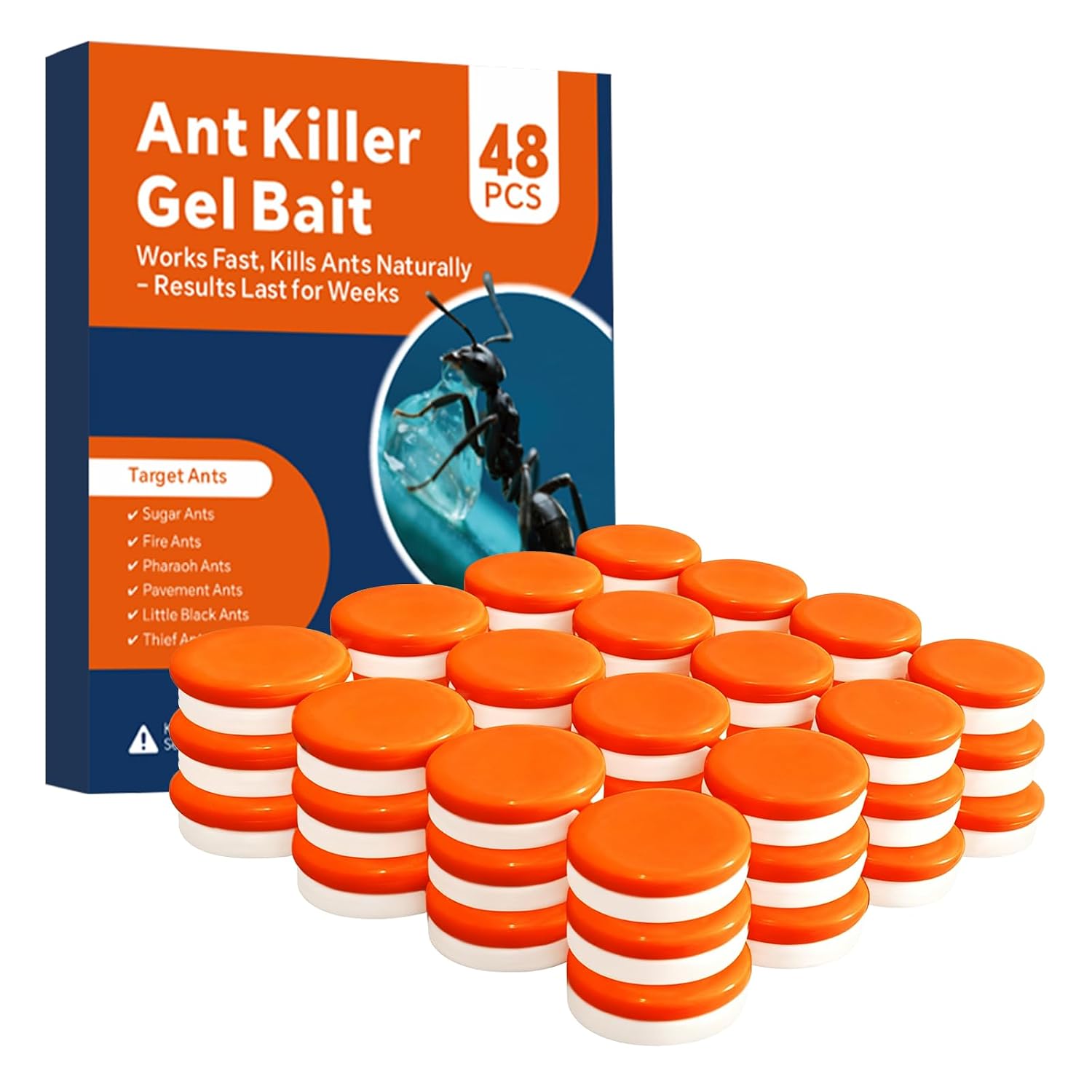
| Unit Count | 48 Count |
|---|---|
| Item Form | Gel |
| Target Species | Ants |
| Included Components | Ant gel bait |
This 48-pack of ROUTADE slow-acting ant gel bait stations is built for systematic, long-term ant control in and around the kitchen. Each station contains a gel formula that worker ants consume and carry back to the nest, which helps reduce the entire colony rather than only visible foragers. The product is supplied in ready-to-use stations with adhesive tape so you can place them along baseboards, in cabinets, near sinks, and on entry thresholds without messy sprays or frequent repositioning. The large pack lets you deploy multiple stations in high-traffic areas and replace them over time for continuous coverage. Because the formula is slow-acting, it is effective against a range of common household species including carpenter ants and sugar ants, but it requires several days to weeks to knock down a colony and will not give instant removal of visible ants. Also the stations are small and contain gel rather than a tamper-resistant hard block, so keep them away from children and pets. For someone wanting a low-maintenance, colony-focused approach to kitchen ant problems, this kit makes it easy to set and forget while the bait works.
Best for: Homeowners who prioritize reliable, long-term elimination of ant colonies in kitchens and want a low-maintenance bait they can deploy across multiple hotspots.
Less Ideal for: People who need an immediate knockdown of visible ants or who require childproof solid bait stations should consider alternatives.
- Slow-acting gel designed for worker ants to carry bait back to the nest for colony-level control
- Ready-to-use bait stations with adhesive for easy placement along baseboards and in cabinets
- 48-count pack provides broad coverage around a kitchen and enough replacements for extended use
- Versatile for indoor and outdoor placement to block entry points and high-traffic ant routes
- Slow-acting formula takes days to weeks to eliminate a colony so visible results are not immediate
- Gel in small stations may require careful placement to keep away from children and pets
Verdict: A practical, deploy-and-forget gel bait kit for reliable colony-level control of kitchen ant infestations.
Ortho Home Defense Insect Killer for Indoor & Perimeter, 1.33 gal. with Comfort Wand

| Item Form | Spray |
|---|---|
| Target Species | Insects |
| Liquid Volume | 1.33 gallons |
| Active Ingredients | Bifenthrin 0.05%, Zeta-Cypermethrin 0.0125% |
This 1.33 gallon Ortho Home Defense spray is designed to treat both indoor problem spots and the outdoor perimeter of a home to reduce ants, roaches, spiders and many other crawling and flying insects. It comes with a battery-powered Comfort Wand that delivers a continuous spray so you can apply a uniform band around foundations, patios and entry points without bending or pumping. The formula with bifenthrin and zeta-cypermethrin is intended to kill on contact and establish a barrier that the manufacturer says lasts up to 12 months for ants, roaches and spiders on non-porous indoor surfaces. In real-world use that means fewer repeat treatments in busy yard perimeters and around doors and windows. The spray dries clear with minimal fumes which helps for indoor use near kitchens and living areas. Limitations are that this is a chemical insecticide so users should follow safety directions around children, pets and plants and it is not a specific solution for pests not listed on the label. For homeowners focused on strong, perimeter-level protection this product simplifies application and covers a large area per container.
Best for: Homeowners who want a performance-focused perimeter treatment to reduce recurring yard and entry-point insect problems and prefer a ready-to-use product that is easy to apply.
Less Ideal for: People seeking organic or non-chemical control methods or those who need a targeted solution for pests not listed on the label should consider alternative products.
- Includes battery-powered Comfort Wand for continuous, fatigue-free application
- Ready-to-use 1.33 gallon container covers large perimeters without mixing
- Formula creates a barrier claimed to provide up to 12 months protection against ants, roaches and spiders on non-porous indoor surfaces
- Dries clear and gives off minimal fumes, making indoor use more practical
- Contains synthetic insecticides so precautions are required around children, pets and ornamentals
- Protection claims are specific to certain species and surfaces so results vary by pest and conditions
Verdict: A powerful, ready-to-use perimeter and indoor spray for homeowners who want long-lasting, performance-oriented protection against common yard and household insects.
TERRO Liquid Ant Killer Bait Stations, 12-Pack (T300B)

| Unit Count | 12 Count |
|---|---|
| Item Form | Liquid |
| Target Species | Insects |
| Active Ingredients | Sodium Tetraborate Decahydrate (Borax), 5.40% |
Terro Liquid Ant Killer bait stations are prefilled, single-use traps designed for indoor control of common sugar-loving ants. You place the small stations along baseboards, in corners, under appliances, or on countertops where you see ant activity. Worker ants are drawn to the sweet liquid, feed on it, and take it back to the nest so the borax-based active ingredient can eliminate the colony over days to weeks. The product is easy to use with no mixing or setup and the 12-pack gives coverage for several rooms. Because the bait is contained inside a low-profile plastic station, it reduces incidental contact risk compared with loose sprays or powders and lasts for weeks while ants continue to visit. Limitations are that the formula targets sugar-preferring species so very protein- or grease-attracted ants may ignore it, and control can take 2 to 4 weeks for larger infestations. Also stations should be placed away from pets and children despite the contained design since the bait contains borax.
Best for: Homeowners who prioritize an easy, low-hassle indoor solution and want a bait that works at the colony level with minimal hands-on pest handling.
Less Ideal for: People who need immediate knockdown of ants or who have pets or children that frequently access treated areas and cannot reliably keep them away from placed stations.
- Ready-to-use stations require no mixing or setup
- Designed to be carried back to the nest for colony-level control
- Low-profile enclosed bait reduces messy exposure compared with loose liquids or sprays
- 12 stations provide coverage for multiple rooms or hotspots
- Formulation is sugar-based so less effective on ants that prefer protein or grease
- Control can take 2–4 weeks for large or established colonies
Verdict: A simple, low-contact indoor bait system that reliably reduces sugar-loving ant infestations by getting worker ants to carry borax back to the colony.
Choosing the Right Carpenter Ant Killer for Home: Key Factors to Consider
Bait Type and Attractiveness
Carpenter ants are foragers that prefer sweet or protein-rich baits depending on season and colony needs. Choosing a bait formulation that matches what foragers are seeking matters because attractive baits get carried back to the nest and kill more ants than contact-only sprays.
If baits are ignored because food is abundant, they will not control the colony. Place bait where ants forage, keep alternative food sealed, and be patient – slow-acting baits often produce better colony-level control than instant-kill products.
Safety for Occupied Homes
Homes with pets, babies, or people sensitive to chemicals require careful selection. Look for formulations and delivery systems that minimize exposed granules or residues and that have clear label instructions for indoor use around food preparation areas.
Safety also includes how residues persist on surfaces and whether treatments can be applied in cracks and voids out of reach. Safer application methods reduce the need for restrictive cleanup or room evacuation during treatment.
Application Flexibility and Accessibility
Carpenter ants nest inside wall voids, in baseboards, and in damp wood. Products that offer multiple delivery options – bait stations, gel baits, injectors, and small-volume liquid treatments – give homeowners ways to reach nests and trails without invasive work.
Flexible application matters when access is limited. Gel syringes and narrow applicator tips help place material deep in crevices, while exterior perimeter treatments protect entry points. Consider how easy the product is to apply accurately and whether it requires specialized tools.
Residual Control and Longevity
Residual activity determines how long a treatment prevents re-infestation from ants foraging from nearby colonies. For perimeter treatments, a longer-lasting residue can reduce cross-border incursions, while indoor baits with sustained attractiveness continue to suppress the nest over time.
Long residuals are helpful, but persistent residues also increase the importance of choosing products labeled for indoor use and following re-entry guidelines to limit exposure.
Speed of Action Versus Colony Impact
Fast knockdown can quickly reduce visible ants, which is important when you need immediate relief. However, rapid-contact toxins often do not travel back to the nest, leaving the colony intact. Slow-acting toxicants that allow workers to return to the nest are usually better for eliminating colonies long term.
Balance immediate control needs with the goal of colony elimination. In many home situations a two-pronged approach is practical: a contact treatment to stop heavy foraging and baiting to address the nest.
Placement Strategy and Monitoring
Where you place the product is as important as which product you choose. Baits and gels work best along foraging trails, near entry points, and inside voids where worker ants travel. Perimeter treatments should focus on gaps, vents, and foundation seams where ants cross the boundary.
After application, monitor activity for several days and move or refresh bait as needed. Consistent monitoring helps confirm whether the chosen tactic is reaching the nest and when follow-up treatments are necessary.
Understanding Carpenter Ant Behavior in Homes
Carpenter ants do not eat wood but carve galleries inside it to nest. They prefer moist, decaying wood and often establish satellite nests as a colony expands. For homeowners, this means infestations can involve both interior and exterior nesting sites.
Detecting carpenter ants early requires watching for frass deposits, rustling sounds in walls, and worker trails. Because nests are often hidden in voids, effective control focuses on intercepting foragers and delivering toxicant back to the nest rather than only treating visible ants.
- Workers forage widely at night and along consistent trails.
- Nesting sites can be inside wall cavities, porch posts, and tree stumps near the house.
- Moisture problems increase the risk of indoor nesting.
Practical Application Tips for Homeowners
Prepare the area by sealing food, cleaning crumbs, and wiping obvious trails so baits become more attractive. Place bait stations and gel trails near where ants are seen and along baseboards rather than in open areas where pets can reach them.
When using liquid or dust treatments, follow label directions for plugs, vents, and foundation gaps. Use minimal volumes and targeted placement to reduce unnecessary exposure and improve efficacy. Re-check placements every few days and relocate bait if trails shift.
- Seal alternate food sources to improve bait uptake.
- Target cracks, voids, and entry points, not open surfaces.
- Wear gloves when handling concentrated formulations and clean spills immediately.
When to Call a Professional
Large or persistent infestations, structural damage visible in framing, or nests inside inaccessible wall voids may require professional intervention. Pest pros can inspect for hidden galleries and use application tools or dusts that reach deep voids safely.
If you are uncomfortable using concentrated formulations in living spaces or if you have a widespread infestation that does not respond to homeowner-directed tactics, a licensed technician can provide targeted treatments and advice on structural repairs to prevent recurrence.
- Consider professionals if you find extensive wood damage.
- Get help when multiple colonies or satellite nests are present.
- Professionals can advise on moisture mitigation to prevent future nesting.
Preventive Measures to Reduce Reinfestation
Simple changes in home maintenance reduce the chance of future carpenter ant problems. Address moisture sources like leaking gutters, plumbing leaks, and poor ventilation in crawl spaces. Remove or repair decayed wood and keep tree limbs trimmed away from the house to limit easy access.
Regularly inspect exterior siding, porch supports, and attics for signs of ants or wood deterioration. Preventive perimeter treatments and seasonal monitoring can catch early activity before colonies establish inside the structure.
- Fix leaks and improve ventilation in damp areas.
- Store firewood away from the house and off the ground.
- Trim vegetation so branches do not touch siding or rooflines.
How We Chose the Best Carpenter Ant Killer for Home
We prioritized products and formulations that reliably target carpenter ants in typical home settings. Our editorial filters emphasized bait systems that attract worker ants and deliver slow-acting toxicants back to the nest, perimeter contact options for immediate reduction of foraging activity, and residual treatments suited to indoor framing and exterior entry points. Evaluation criteria included bait attractiveness under typical household food availability, safety profile for occupied homes (including label instructions for pets and kids), application flexibility for cracks, voids, and baseboards, and residual control to prevent reinfestation. We also considered ease of use for homeowners who are not pest-control professionals and whether the product allowed targeted placement to limit exposure. We excluded broad-spectrum sprays and outdoor-only solutions that are not intended for indoor or entry-point use. Products that lack clear usage directions for common home scenarios or that require professional-only application were also removed from consideration. The final list focuses on options that balance efficacy, safety, and practical application for homeowners.
FAQ
How long does it take for bait to eliminate a carpenter ant colony?
It often takes several days to a few weeks for slow-acting baits to reduce or eliminate a colony because workers must take bait back to the nest. Results depend on bait acceptance, colony size, and whether alternate food sources are available.
Are baits safe to use around pets and children?
Many baits are formulated for use in homes and are safe when used as directed, but safety depends on the delivery system and placement. Use enclosed stations or place gels in inaccessible voids to minimize exposure, and always follow label instructions.
Will contact sprays alone get rid of carpenter ants in my walls?
Contact sprays can reduce visible foragers quickly but usually do not eliminate the nest because they do not reach the hidden queens. For long-term control, combine contact treatments with baiting strategies that reach the colony.
Can I use outdoor perimeter products indoors?
Products labeled for outdoor perimeter use are often not suitable for indoor application. Always check label restrictions. Using outdoor-only formulations inside can create unnecessary exposure and may be ineffective against indoor nests.
How do I know where to place bait stations?
Place bait along ant trails, near entry points, and where you observe activity such as baseboards and window sills. If trails move, reposition bait accordingly and reduce other accessible food sources to increase uptake.
Final Verdict
Choose a carpenter ant control approach that matches the infestation type and the layout of your home. Prioritize bait systems that attract foragers and allow toxicants to reach the nest for lasting control, but use contact treatments when immediate reduction of visible ants is needed. Balance speed, safety, and application practicality. Use targeted placements, monitor activity, and address moisture or wood decay that invites nesting. With the right treatment strategy and follow-up, most homeowner infestations can be resolved without invasive repairs.
