

Note: This article contains affiliate links. If you click on these links and make a purchase, I may earn a small commission at no extra cost to you. This helps support my research and content. Read my full affiliate disclosure here.
Creeping red fescue has specific nutrient and cultural needs that affect color, density, and stress tolerance. Choosing the right fertilizer matters because too much nitrogen, the wrong ratio, or a mismatched release pattern can cause disease, shallow roots, or winter weakness. This guide covers six top fertilizers selected for creeping red fescue and explains how each type of formulation behaves in a cool-season lawn. You will find practical notes on nutrient balance, release type, and timing so you can pick a fertilizer that supports color, root development, and seasonal stress resilience. The shortlist includes products representing common approaches so you can match one to your lawn and maintenance routine.
Top Picks at a Glance
| Best Overall The best all-around choice for most situations | The Andersons Professional PGF 16-0-8 Granular Lawn Fertilizer with Humic DG, 40 lb |  |
| Best Quality Built to a higher standard if you want something more solid | The Andersons Professional PGF Complete 16-4-8 Fertilizer with Humic (40 lb) |  |
| Best Value The sweet spot between price and what you get | Simple Lawn Solutions 15-0-15 Liquid Lawn Fertilizer (32 oz) with Hose-End Sprayer |  |
| Best Budget The cheapest option that still gets the job done reliably | Jonathan Green Veri-Green Starter Fertilizer for Seeding & Sodding, 1,500 Sq Ft |  |
| Most Popular A crowd favorite that many people choose with confidence | Scotts Turf Builder WinterGuard Fall Lawn Food, 10 lb. |  |
| Best Seller A high-volume bestseller chosen again and again | Scotts Liquid Turf Builder Plus 2 Weed Control, Ready‑to‑Spray, 32 fl. oz. |  |
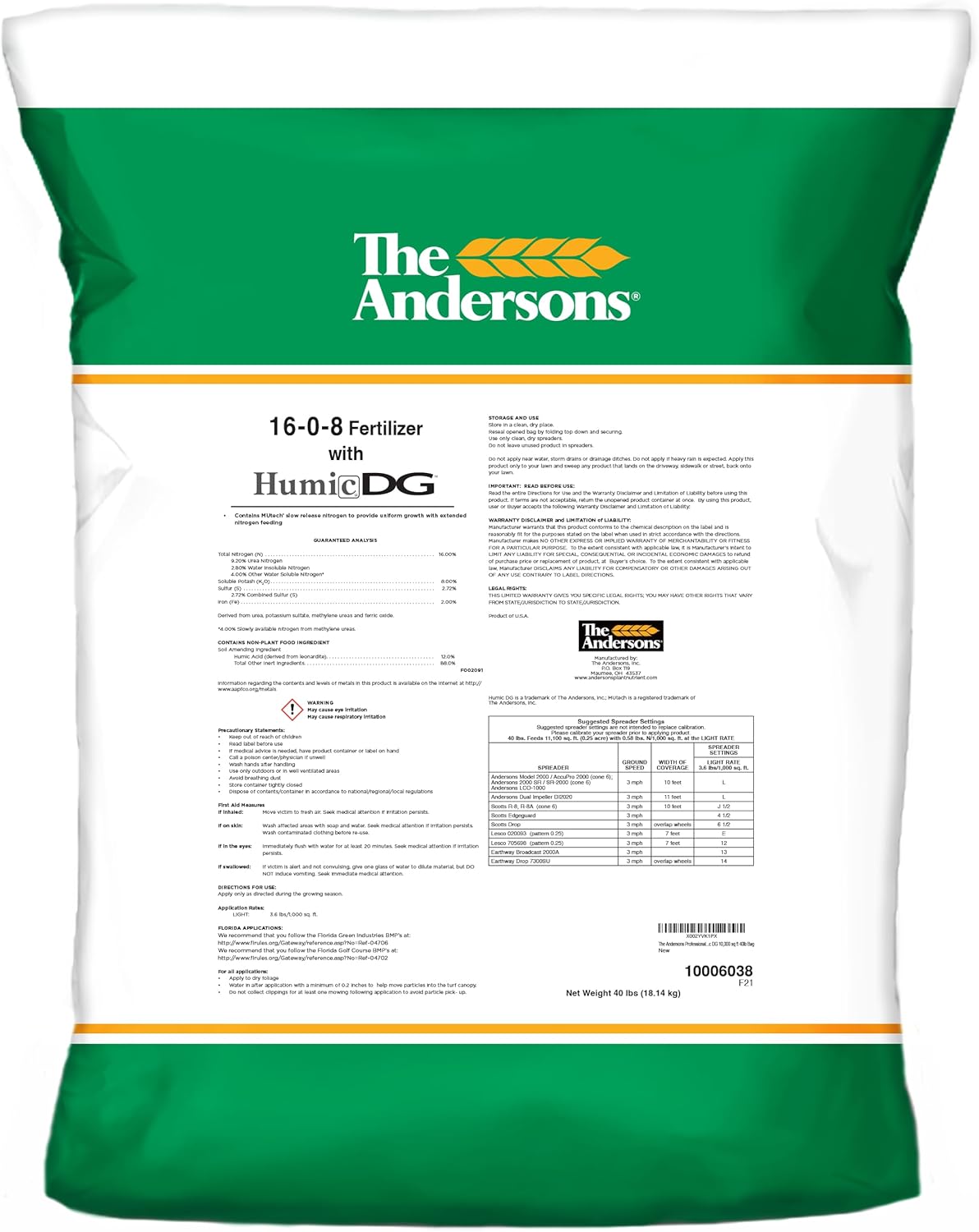
The Andersons Professional PGF 16-0-8 Granular Lawn Fertilizer with Humic DG, 40 lb
| Form | Granules |
|---|---|
| Specific Uses For Product | Lawns |
| Target Species | lawn grasses |
| Mixing Ratio | 1:4.5 |
The Andersons Professional PGF 16-0-8 is a granular lawn fertilizer designed to deliver both immediate and extended nitrogen feeding while adding humic DG and micronutrients. It is intended for broadcast spreader use on lawns and is applied at 3.6 pounds per 1,000 sq ft every 6 to 8 weeks. The super-fine granules promote even distribution, which helps avoid streaking and ensures more uniform green-up. Because the formula is phosphorus-free and includes iron and Humic DG, it supports turf color and soil health without adding phosphorus. Practical benefits include a mix of quick- and slow-release nitrogen for steady growth, clear directions for application rates, and a resealable bag for storage. Limitations to consider are that it is not labeled for use in some states and centipede lawns require a reduced rate, and like any granular fertilizer, correct spreader calibration and dry application conditions are important to avoid uneven results or runoff risk.
Best for: Buyers who want reliable, performance-focused feeding to green and maintain warm-season lawns like zoysia with predictable scheduling and steady growth.
Less Ideal for: Homeowners seeking a fertilizer to correct phosphorus deficiency or those who need a product approved for restricted states should look elsewhere.
- Blend of quick- and slow-release nitrogen for immediate color and up to eight weeks of feeding
- Super-fine granules for more even spread and reduced streaking
- Includes iron, micronutrients, and Humic DG to support turf color and soil biology
- Clear application rate and schedule guidance with a resealable bag for storage
- Phosphorus-free formula may not address phosphorus-deficient soils
- Not labeled for sale or use in certain states
Verdict: Choose this fertilizer when you want a performance-oriented, even-spreading granular feed that delivers immediate color and up to eight weeks of controlled nitrogen for warm-season lawns like zoysia.
The Andersons Professional PGF Complete 16-4-8 Fertilizer with Humic (40 lb)

| N-P-K | 16-4-8 |
|---|---|
| Item Form | Granules |
| Specific Uses For Product | Lawn Care |
| Target Species | lawn grasses |
| Coverage | 40 |
This 40 lb bag of The Andersons Professional PGF Complete is a granular 16-4-8 lawn fertilizer designed to deliver both immediate and extended feeding for turf. It combines quick- and slow-release nitrogen so you get a mid-season green-up plus continued nutrition for up to eight weeks, while iron and micronutrients help deepen color. The super-fine particle size promotes even spread when applied with a broadcast or drop spreader and the included humic DG supports soil biology and nutrient uptake. Typical use is a spring application on established cool-season grasses like fescue, followed by watering to activate the granules. Practical benefits are consistent coverage, longer feeding intervals between applications, and visible color improvement. Important limitations are the strong safety warnings for eye and skin irritation and that the 16-4-8 ratio is a high-nitrogen formula best suited for growth and color rather than slow, low-nitrogen maintenance. It is not formulated for sale in certain states and requires careful handling and correct spreader settings to avoid overapplication.
Best for: Gardeners who prioritize strong, visible spring performance and want a product that delivers both immediate and sustained feeding for established fescue lawns.
Less Ideal for: People managing newly seeded turf, low-nitrogen maintenance programs, or those who prefer organic fertilizers should consider gentler or alternative products.
- Balanced quick- and slow-release nitrogen delivers immediate green-up plus up to eight weeks of feeding
- Includes iron, micronutrients, and humic DG to improve color and nutrient uptake
- Super-fine granules enable more even distribution with a spreader
- Large 40 lb bag covers significant lawn area between applications
- Causes skin, respiratory and serious eye irritation and requires protective handling
- High nitrogen ratio may be too strong for fine maintenance or newly seeded lawns
Verdict: Choose this product when you want a performance-focused spring fertilizer that gives fast green-up plus extended feeding for established fescue.
Simple Lawn Solutions 15-0-15 Liquid Lawn Fertilizer (32 oz) with Hose-End Sprayer

| Item Form | Liquid |
|---|---|
| Specific Uses For Product | Lawn |
| Application Method | Spray |
| Coverage | up to 3200 sq ft |
| Liquid Volume | 32 fluid ounces |
This 15-0-15 liquid from Simple Lawn Solutions is a ready-to-use lawn fertilizer designed to speed green-up and support turf hardiness. It hooks to a garden hose via the attached sprayer and applies evenly across lawns up to about 3,200 square feet, making it practical for small-to-medium yards. The formulation emphasizes nitrogen for growth plus potassium and humic materials to support stress tolerance, and includes fish and seaweed extracts that can help with nutrient uptake. Use it during spring, summer, or fall as part of a broader feeding program; the liquid form means nutrients are available fast and are easy to spread with minimal equipment. Important limitations are that it is phosphate-free and formulated for maintenance or correction rather than heavy feeding programs, and safety precautions (gloves, eyewear) are needed during application. For users who prefer granular schedules or need a custom nutrient ratio for a specific soil test, this concentrated ready-spray approach may be less flexible.
Best for: Gardeners who want a convenient, fast-acting liquid fertilizer to maintain color and vigor across a small-to-medium lawn and who prioritize ease of application and predictable results.
Less Ideal for: Those managing large properties, following a strict soil-test driven program that needs adjustable NPK or those who prefer granular slow-release feeds should consider other options.
- Ready-to-use hose-end sprayer for quick, even application
- Liquid formula delivers nutrients quickly for faster green-up
- Contains potassium and humic acid to support turf stress tolerance
- Includes organic extracts (fish and seaweed) to aid nutrient uptake
- Not intended as a phosphate source so not suitable where phosphorus is required
- Single pre-mixed ratio limits flexibility for custom nutrient programs
Verdict: A convenient, hose-end liquid fertilizer that delivers fast green-up and simple coverage for small to medium lawns.
Jonathan Green Veri-Green Starter Fertilizer for Seeding & Sodding, 1,500 Sq Ft

| N-P-K ratio | 12-18-8 |
|---|---|
| Application method | Spreader |
| Form | Granules |
| Coverage | 1,500 sq ft |
| Included components | Grass Seed, Plant Fertilizer |
Jonathan Green Veri-Green Starter Fertilizer is a granular lawn starter designed to be applied the same day as seeding or sodding to help new grass establish quickly. It delivers a 12-18-8 N-P-K blend that emphasizes phosphorus for root development and includes humates and micronutrients to improve nutrient availability. Use it with a rotary, drop, or handheld spreader over the area being seeded; a 5 lb bag covers up to 1,500 sq ft and feeds seedlings for roughly two months. Practically, this product speeds germination, encourages deeper roots, and helps new grass withstand early stressors like temperature swings and light drought. Its granule form is easy to apply and safe for kids and pets to re-enter the lawn after treatment. The main limitations are coverage and longevity for larger projects since a single 5 lb bag suits only small yards or spot repairs, and it is specifically a starter fertilizer so additional feeding with a general lawn fertilizer will be needed later in the season.
Best for: Homeowners who need an affordable, purpose-built starter fertilizer for seeding, overseeding, or laying sod on small lawns or repair patches and who prioritize quick germination and strong root development.
Less Ideal for: People caring for large properties or seeking a season-long all-purpose fertilizer should consider larger coverage or multi-application products instead.
- High-phosphorus 12-18-8 formula targeted to promote seed germination and root growth
- Granular form works with rotary, drop, or handheld spreaders for even application
- Includes humates and micronutrients to improve nutrient uptake and early vigor
- Feeds new grass for up to two months, supporting initial establishment
- 5 lb bag only covers about 1,500 sq ft so multiple bags are needed for larger lawns
- Designed as a starter fertilizer so it does not replace regular seasonal feedings
Verdict: A cost-effective, phosphorus-rich starter fertilizer that speeds germination and builds strong roots for new or repaired lawns up to 1,500 sq ft.
Scotts Turf Builder WinterGuard Fall Lawn Food, 10 lb.

| Item Form | Granules |
|---|---|
| Specific Uses For Product | Lawn Fertilizer |
| Application Method | spread |
| Coverage | 4000 |
| Target Species | lawn grasses |
Scotts Turf Builder WinterGuard is a granular fall lawn food designed to build strong, deep roots and help turf recover from summer heat, drought, and regular wear. It is applied with a broadcast or drop spreader over a lawn in autumn and can be used on any grass type. The bag covers about 4,000 sq. ft., and the package directions include recommended spreader settings and note that watering-in is optional for fast results. In practice this product provides a straightforward, DIY-friendly way to add nutrients before winter; the granules are easy to spread and work with standard spreaders. Notable features are its all-grass compatibility and clear application guidance. Limitations are that it is a single-season bag sized for small to medium yards and it does not include weed or insect control functions found in some other Scotts formulas, so you may need additional products if those issues are a concern. For homeowners wanting a simple autumn boost to root strength, this is an effective, no-frills option.
Best for: Homeowners who want a simple, reliable fall fertilizer to strengthen roots and help lawns recover from summer stress without complicated application steps.
Less Ideal for: People managing large lawns who need wide-coverage bulk fertilizer or those who want combined weed or insect control in the same product.
- Formulated specifically for fall to build deep, winter-ready roots
- Works on all grass types so it fits mixed lawns
- Clear application instructions and spreader settings for easy DIY use
- Covers 4,000 sq. ft. from a single 10 lb. bag for small to medium yards
- No built-in weed or insect control so additional products may be needed
- Single 10 lb. bag may be small for larger properties
Verdict: Choose this bag if you want an easy-to-apply fall fertilizer that strengthens roots and helps your lawn recover before winter.
Scotts Liquid Turf Builder Plus 2 Weed Control, Ready‑to‑Spray, 32 fl. oz.

| Liquid Volume | 32 fluid ounces |
|---|---|
| Coverage | 6000 square_feet (warm-season); 4000 square_feet (cool-season) |
| Item Form | Spray |
| Active Ingredients | Nitrogen |
This ready-to-spray bottle combines a quick nitrogen boost with broadleaf weed control for an easy lawn maintenance step. You attach the hose, spray evenly across the lawn when weeds are actively growing, then avoid watering for 48 hours so the product can work. The formula lists a 25-0-2 NPK balance and targets common weeds such as dandelions, clover, chickweed, and ground ivy, making it useful for both warm- and cool-season grasses. Coverage is generous for a single 32 fl. oz. bottle: up to 6,000 sq ft on warm-season lawns and 4,000 sq ft on cool-season lawns. Practical benefits include fast visible weed curl within days and no need for separate fertilizer and weed-killer steps, which simplifies care for homeowners who want predictable results. Limitations to note are the restricted list of safe grass types and the need to avoid application above 85°F or watering for two days, plus some stubborn weeds may require a repeat treatment in 3 to 4 weeks.
Best for: Homeowners who want a simple, low‑effort way to feed their lawn and control common broadleaf weeds without separate products and who prefer predictable, do‑it‑yourself lawn care steps.
Less Ideal for: Gardens with mixed planting beds or users who need a product safe around vegetables and ornamentals should choose a different targeted solution.
- Hose-end ready-to-spray design requires no measuring or mixing
- Combines fertilizer and weed control in one application
- Covers large areas per bottle for typical home lawns
- Works on a wide range of warm- and cool-season turf grasses
- Visible weed decline within a few days for many common broadleaf weeds
- Not safe for use on garden beds or non-listed plants
- May cause temporary injury on some bermudagrass varieties and is restricted to listed grasses
- Stubborn weeds may require a second application within a month
Verdict: A single ready-to-spray bottle that simplifies feeding and broadleaf weed control for risk-averse homeowners who want dependable, low-effort lawn results.
Choosing the Right Fertilizer for Creeping Red Fescue: Key Factors to Consider
Nutrient Ratio and Timing
The balance of nitrogen, phosphorus, and potassium determines how creeping red fescue grows. Fine fescues usually need moderate nitrogen to maintain color without excessive leaf growth. Potassium helps with winter hardiness and drought tolerance, so formulations with adequate potassium are helpful for year-round resilience. Phosphorus should be used based on soil test results because many established lawns do not need added phosphorus.
Timing matters as much as ratio. Apply fertilizer in fall to support root growth before winter, and use light, more frequent feeds in the growing season if you want steady color. Avoid heavy spring nitrogen on shaded or disease-prone fescues because lush, rapid topgrowth can invite fungal issues.
Release Type and Longevity
How nitrogen is delivered-quick-release, slow-release, or a blend-affects both performance and maintenance. Slow-release sources feed grass over weeks to months, producing steady color and reducing mowing frequency and disease pressure. Quick-release products give an immediate green-up but can cause a surge in growth followed by a decline, which may demand more frequent mowing and raise disease risk.
Consider your maintenance schedule when choosing a release type. If you prefer fewer applications and more stable turf, choose a predominantly slow-release formula. If you need immediate repair or fast color for a special occasion, a product with some quick-release nitrogen can be useful as a spot treatment rather than a season-long regimen.
Application Method and Spread Uniformity
Even distribution of granules or liquid matters for avoiding stripes, patches, and burn. Granular fertilizers require an accurate spreader and consistent walking speed to get uniform coverage. Some formulations have coatings that affect how they distribute and how they release nutrients, so spreader settings from the manufacturer are essential.
Liquid fertilizers can give rapid, even coverage when applied correctly, but they often require more frequent reapplication. Consider the typical size and layout of your lawn and choose a format that suits your equipment and skill level to minimize waste and uneven growth.
Soil Health and Root Support
Fertilizers that support root development help creeping red fescue withstand drought, wear, and disease. Look for products that balance nutrients in a way that encourages deeper rooting rather than just leaf growth. Inclusion of secondary nutrients and micronutrients can correct deficiencies that limit root function.
Complement fertilizer choice with soil testing and practices like aeration and overseeding to improve root zone conditions. Good fertilizer decisions are only as effective as the soil they are applied to, so address compaction, pH, and organic matter alongside nutrient inputs.
Shade and Disease Considerations
Creeping red fescue commonly grows in partially shaded lawns and can be sensitive to some diseases when growth is excessive. Fertilizers that promote steady, moderate growth reduce leaf wetness and canopy density, lowering the risk of fungal problems. In shaded areas, lower nitrogen rates and slower-release formulas are generally safer.
For lawns with recurring disease pressure, prioritize formulations that support plant vigor and root health rather than rapid topgrowth. Adjust rates and timing to cooler, drier parts of the season to minimize conditions favorable to pathogens.
Compatibility with Overseeding and Cultural Practices
If you overseed or perform frequent turf repairs, you need a fertilizer that is safe for new seedlings and that complements seeding schedules. High quick-release nitrogen can burn young seedlings if rates are too high, while some starter formulations include phosphorus to help root establishment. Follow label guidance for seeding windows and any recommended rate reductions near newly seeded areas.
Cultural practices such as mowing height, irrigation, and aeration interact with fertilizer effects. A well-timed aeration followed by a balanced feed will produce better long-term results than fertilizer alone. Match your fertilizer plan to the cultural calendar for best outcomes.
When to Fertilize Creeping Red Fescue
Creeping red fescue performs best with cool-season feeding cycles. The most important window is early fall, when cooler temperatures and active root growth allow the plant to store carbohydrates and strengthen roots for winter. A lighter follow-up in late spring can help recovery from winter wear, but heavy spring nitrogen is usually unnecessary and can increase fungal risk.
Fertilizing in midsummer should be done sparingly and only with low rates and predominantly slow-release sources to avoid heat and drought stress. Always check soil temperature and local climate patterns before applying late-season fertilizer.
- Primary window: early fall for root growth and winter hardiness
- Secondary window: late spring for recovery, use moderate rates
- Avoid heavy applications in hot, dry summer conditions
Adjusting Rates for Shade and Sun
Creeping red fescue tolerates shade better than many turfgrasses, but shaded sites need less nitrogen. Reduce application rates in heavy shade to prevent leggy, disease-prone turf. In full sun or high-traffic areas, slightly higher nitrogen and more frequent light feeds can maintain density without overfertilizing.
Walk the lawn and note microclimates. Apply conservative rates where canopy is thick and increase modestly in compacted, high-use zones that benefit from extra vigor.
- Reduce rates under tree canopies and dense shade
- Increase light, frequent feeds for high-traffic sunny areas
- Use soil tests to refine rate adjustments
Starter and Repair Feeding for Overseeding
When overseeding creeping red fescue, choose a starter approach that supports root establishment. Starter feeds are typically higher in phosphorus relative to standard maintenance formulas, which helps seedling root development. Follow label guidelines for seeding windows and avoid high quick-release nitrogen that could damage young shoots.
If you are renovating patches, lightly feeding at seeding and again after seedlings have established gives steady support without excessive topgrowth. Combine with good seed-to-soil contact and irrigation to ensure successful establishment.
- Use starter formulas at seeding when soil tests indicate low phosphorus
- Avoid heavy quick-release nitrogen during early seedling stages
- Feed again after seedlings have established to promote density
Integrating Fertilizer with Irrigation and Mowing
Fertilizer performance depends on consistent cultural care. Proper irrigation helps nutrients move into the root zone and reduces burn risk. For creeping red fescue, water deeply but infrequently to encourage deeper roots; frequent shallow watering encourages shallow rooting and disease.
Mowing height affects how the grass uses fertilizer. Maintain a slightly higher mowing height for fescue to shade soil and reduce heat stress. Adjust fertilizer timing to avoid fresh heavy applications immediately before prolonged wet weather.
- Water deeply to move nutrients into the root zone
- Maintain moderate mowing height to reduce stress
- Avoid fertilizing just before long wet periods to reduce disease risk
How We Chose the Best Fertilizer for Creeping Red Fescue
We shortlisted fertilizers based on criteria that directly affect creeping red fescue performance in cool-season lawns. Primary evaluation points included nutrient formulation and ratio, since fescue responds best to balanced nitrogen with adequate potassium for stress tolerance. Release type was a second filter because slow-release nitrogen reduces growth spikes and disease risk on fine fescues. We assessed particle uniformity and spreadability to ensure even coverage and to limit patchy growth. Application flexibility and recommended timing were weighed because many gardeners need products that work for both spring and fall feeding windows. Disease and shade considerations were included, favoring formulations that support root health and slow, steady topgrowth. We excluded any products that are formulated only for warm-season grasses or that rely solely on high quick-release nitrogen without an alternative slow-release source. Finally, we looked for clear manufacturer guidance on rates and safety around overseeding to reflect real-world lawn care practices.
FAQ
How often should I fertilize creeping red fescue?
Often the best approach is two to three light applications per year, with an emphasis on early fall. A late spring feed can help recovery, while summer applications should be light and slow-release if used at all.
Do I need a phosphorus-containing starter to overseed creeping red fescue?
It depends on your soil test. Many established soils have adequate phosphorus and do not need extra. If a soil test shows low phosphorus, a starter formulation can improve early root establishment.
Can I use the same fertilizer on other cool-season grasses?
Usually similar formulations work across cool-season species, but rates and timing may differ. Adjust nitrogen rates and timing to match the specific grass type and local climate.
Will a slow-release fertilizer prevent disease on fescue?
A slow-release nitrogen reduces the risk of disease by avoiding sudden lush growth, but it does not eliminate disease risk. Good cultural practices, proper timing, and appropriate rates all contribute to disease management.
How should I adjust fertilizer rates for shaded lawns?
Reduce nitrogen rates in shaded areas and favor slow-release sources. Shaded turf produces less biomass and is more disease-prone when overfertilized, so conservative feeding is safer.
Final Verdict
Choose a fertilizer for creeping red fescue by prioritizing nutrient balance, a gentle nitrogen release profile, and compatibility with your cultural practices. Match rates and timing to your climate and shade conditions, and use soil testing to correct specific deficiencies. When you focus on root support and steady feeding rather than quick green-up, you will get a denser, healthier fescue stand that resists stress and disease.
