

Note: This article contains affiliate links. If you click on these links and make a purchase, I may earn a small commission at no extra cost to you. This helps support my research and content. Read my full affiliate disclosure here.
Orchids respond quickly to dissolved nutrients, so choosing the right liquid fertilizer matters for steady growth, stronger roots, and bigger blooms. In confined pots and bark mixes, overfeeding and incorrect ratios are common problems that stress plants more than benefit them. This guide presents six shortlisted liquid fertilizers for orchids that work well across common growing situations, from windowsill Phalaenopsis to shaded greenhouse cymbidiums. We evaluated options against practical grower concerns like nutrient balance, salt buildup risk, and dosing clarity. Read on to see why these factors matter and how each pick fits typical orchid care routines.
Top Picks at a Glance
| Best Overall The best all-around choice for most situations | Miracle-Gro Ready-to-Use Orchid Plant Food Mist, 8 oz |  |
| Best Quality Built to a higher standard if you want something more solid | SUPERthrive Orchid-Pro Liquid Fertilizer 7-9-5, 32 oz |  |
| Best Value The sweet spot between price and what you get | Purived Orchid Liquid Fertilizer, 16 oz (Makes 50 Gallons) |  |
| Best Budget The cheapest option that still gets the job done reliably | Bonide Liquid Orchid Food 9-7-9, 8 oz Concentrate |  |
| Highest Rated A top-rated pick with lots of positive feedback | Rubisco Orchid Magic MSU Formula Liquid Plant Food, 8 fl oz |  |
| Most Popular A crowd favorite that many people choose with confidence | TPS Nutrients Orchid Fertilizer Bloom Boosting Liquid Plant Food, 8 oz |  |
Miracle-Gro Ready-to-Use Orchid Plant Food Mist, 8 oz

| Item Form | Liquid |
|---|---|
| Application Method | Mist |
| Coverage | Medium |
| Target Species | orchids |
| Unit Count | 8 Fluid Ounces |
This ready-to-use Orchid Plant Food Mist is designed to make regular feeding simple for indoor orchid growers. The spray delivers water-soluble nutrients immediately to roots and growing media, and the bottle is intended for weekly application to Phalaenopsis, Cattleya, Cymbidium, Dendrobium and other common orchid varieties. Typical use is to mist the potting mix and exposed roots while avoiding flowers and to pair feeding with routine watering and appropriate light. The key practical benefits are ease of use, no mixing required, and targeted delivery that helps orchids access nutrients quickly. Because it is a light, spray-applied formula it is best for maintenance feeding rather than heavy fertilization or correcting major nutrient deficiencies. Users should follow label directions and avoid overwatering plant foliage; results are most reliable when combined with proper potting mix and cultural care. The compact 8 ounce bottle is convenient for hobbyists with a few plants but may require frequent replacement for larger collections.
Best for: Ideal for home orchid owners who want a low-effort, weekly feeding routine to keep a small collection healthy and thriving.
Less Ideal for: Not the best choice for growers needing concentrated feeds for nutrient-deficient plants or for large-scale collections that require bulk fertilizer supplies.
- Ready-to-use spray requires no measuring or mixing
- Formulated specifically for orchids and lists common orchid genera
- Feeds quickly by delivering nutrients directly to roots and media
- Simple weekly application fits into routine plant care
- 8 oz volume may be small for users with many plants
- Spray format provides maintenance feeding but is not a corrective high-strength fertilizer
Verdict: A convenient, ready-to-use mist that makes weekly feeding of indoor orchids fast and fuss-free.
SUPERthrive Orchid-Pro Liquid Fertilizer 7-9-5, 32 oz
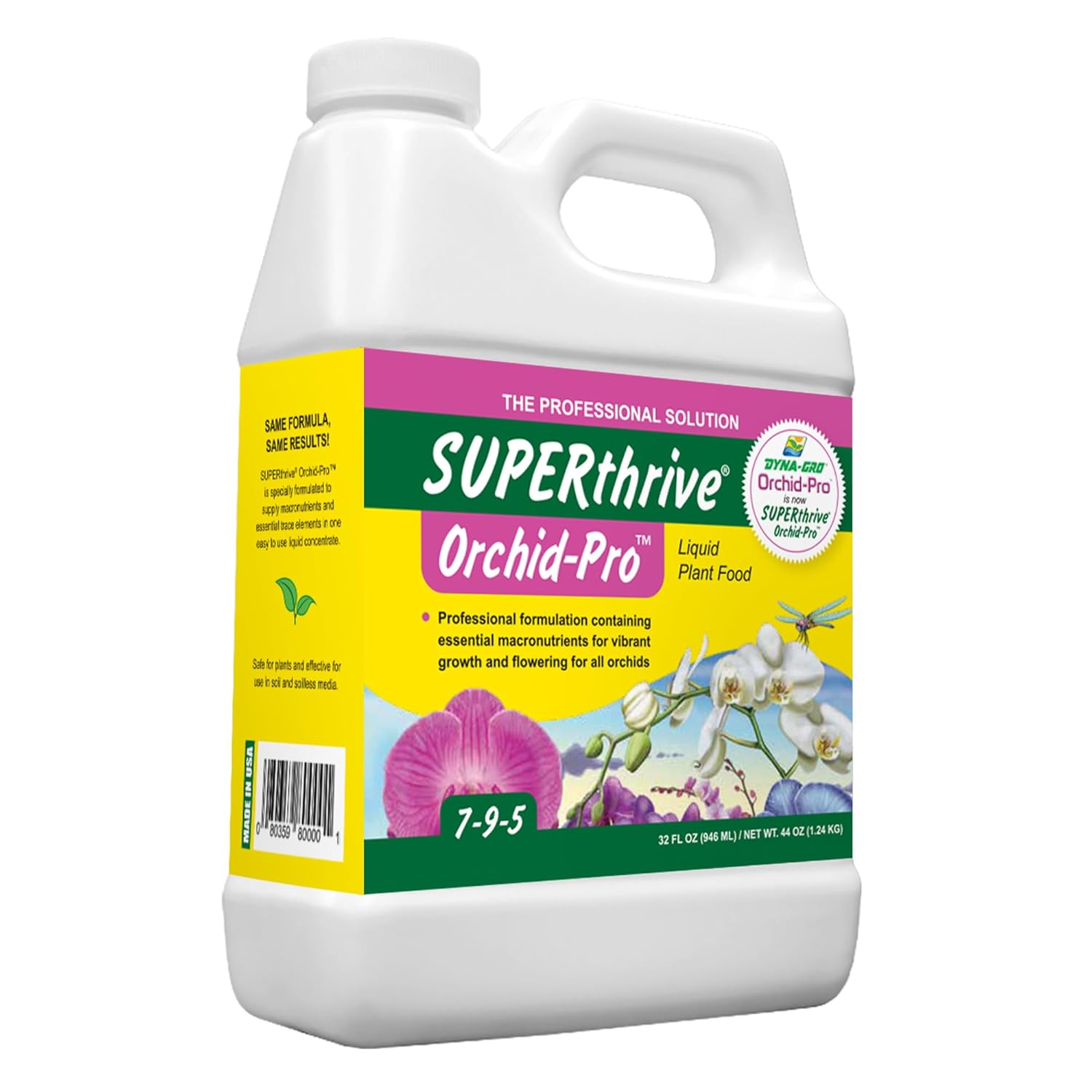
| Unit Count | 32 Fluid Ounces |
|---|---|
| Item Form | Liquid |
| Mixing Ratio | 1/2 tsp per gallon |
| Target Species | Orchids |
SUPERthrive Orchid-Pro is a concentrated, urea-free liquid fertilizer designed for orchids and other blooming houseplants. You mix a half teaspoon per gallon of water and apply it each time you water, so it integrates easily into routine care for potted and mounted orchids. The 7-9-5 formula emphasizes phosphorus to encourage flowering while supplying macro and trace nutrients for root strength and overall vigor. Because it is liquid and concentrated, a small bottle treats many waterings and allows precise control over frequency and dilution. It is labeled safe for soil and soilless media and works for both indoor and outdoor plants, which is useful if you rotate orchids between locations. Limitations to expect are the need for regular, consistent feeding rather than a slow-release convenience and no crop-specific directions beyond the simple mixing ratio, so growers seeking targeted schedules for different orchid types will need to adjust themselves. For someone focused on maximizing bloom performance and steady nutrient supply, Orchid-Pro is a practical, workmanlike choice.
Best for: Growers who prioritize bloom performance and want a controllable, repeatable liquid feed for potted or mounted orchids and who will stick to a regular feeding routine.
Less Ideal for: Casual owners who prefer low-maintenance, set-and-forget fertilizers or gardeners who need species-specific feeding plans included.
- High-phosphorus 7-9-5 formula supports flowering
- Concentrated liquid that allows precise dosing and many treatments per bottle
- Urea-free formulation suitable for soil and soilless media
- Simple mixing ratio (1/2 tsp per gallon) for routine use
- Requires regular application at each watering rather than a one-time slow-release solution
- No detailed feeding schedule for different orchid species included
Verdict: If you want a concentrated, performance-focused liquid feed to boost orchid flowering, SUPERthrive Orchid-Pro delivers precise, repeatable nutrient support.
Purived Orchid Liquid Fertilizer, 16 oz (Makes 50 Gallons)

| Item Form | Liquid |
|---|---|
| Application Method | soil drench, foliar feeding, hydroponics |
| Target Species | Orchids |
| Mixing Ratio | 320:1 |
| Unit Count | 16 Fluid Ounces |
Purived Orchid Liquid Fertilizer is a concentrated 16 oz bottle formulated specifically for orchids and designed to make up to 50 gallons of feed solution. It uses a 3-1-1 NPK ratio with elevated calcium and magnesium plus micronutrients, which supports stronger roots and more consistent blooms when used as directed. Typical use is straightforward: mix one capful into a gallon of water and apply as a soil drench, foliar spray, or in semi- or full-hydroponic setups. The formula is water-soluble and odorless, so it integrates easily into weekly or biweekly watering routines without leaving residue. Practical benefits include long shelf yield from a small bottle and versatile application across common orchid types like Phalaenopsis and Dendrobium. Limitations to note are that the product assumes users will follow dilution guidance exactly and does not list specific ppm or EC targets for growers who monitor nutrient strength, so precision feeding for advanced greenhouse setups may require external testing.
Best for: Buyers who want a practical, easy-to-use orchid fertilizer that stretches a small bottle into many feedings and simplifies routine care for common orchid varieties.
Less Ideal for: Specialist growers who need documented electrical conductivity or parts-per-million targets for strict nutrient control should consider a product with detailed concentration specs.
- Concentrated 16 oz bottle mixes to about 50 gallons, reducing frequent repurchase
- Balanced 3-1-1 NPK with higher Cal-Mag and added micronutrients tailored for orchids
- Versatile application: suitable for soil drench, foliar feeding, and hydroponic systems
- Odorless and water-soluble for easy mixing and clean application
- Does not provide ppm or EC guidelines for growers who require exact nutrient strength
- Mixing instructions rely on a cap measure rather than a graduated dosing tool for precise measurement
Verdict: A concentrated, easy-to-use orchid fertilizer that delivers a balanced 3-1-1 formula and long-lasting value for routine home orchid care.
Bonide Liquid Orchid Food 9-7-9, 8 oz Concentrate

| Item Form | Liquid |
|---|---|
| Application Method | Watering |
| Target Species | Orchids |
| Specific Uses For Product | Plant Food,Plant Growth |
| Mixing Ratio | 128:3785.41 |
Bonide Liquid Orchid Food is a simple, concentrated 9-7-9 liquid fertilizer made specifically for orchids and meant to be mixed into the water used for regular watering. You dilute a small amount of the concentrate into a quart of water and apply at watering time, so feeding is integrated into normal care rather than adding separate steps. The balanced 9-7-9 formula supplies nitrogen for leaf growth, phosphate for root and bloom development, and potassium for overall vigor, which helps promote stronger roots and better blooms when used as directed. The product is compact and easy to store and the bottle size is convenient for hobbyists or those with a few plants. Limitations are that the concentrate is small so frequent buyers may need larger volumes, and directions require careful measuring and not storing diluted solution. It is not a one-off soil amendment but a regular water-applied feed, so expect gradual improvements rather than immediate dramatic changes.
Best for: Orchid hobbyists on a budget who want an easy-to-use water-applied fertilizer that supports steady root and bloom development without adding extra care steps.
Less Ideal for: Collectors with large greenhouse collections or commercial growers who need bulk supply or automated dosing systems should look for larger or concentrated industrial options.
- Formulated specifically for orchids with a 9-7-9 N-P-K balance
- Applied through watering so feeding fits into regular care routines
- Concentrated 8 oz bottle is compact and easy to store
- Promotes stronger roots and fuller blooms when used consistently
- Small bottle size may require frequent repurchase for larger collections
- Requires precise dilution and diluted product must not be stored
Verdict: A budget-friendly, water-applied orchid fertilizer that delivers a balanced 9-7-9 feed to support healthier roots and better blooms with minimal fuss.
Rubisco Orchid Magic MSU Formula Liquid Plant Food, 8 fl oz

| Item Form | Liquid |
|---|---|
| Specific Uses For Product | Orchids and Tropical House Plants |
| Target Species | Orchids and Tropical House Plants |
| Liquid Volume | 8 fluid ounces |
Rubisco Orchid Magic is a professional-grade liquid concentrate based on the MSU orchid formula used by growers and greenhouses. It is designed for orchids and other plants that prefer low-mineral water and can be mixed into rainwater, reverse-osmosis, or low-mineral tap water at three clearly labeled strengths for seedlings, maintenance, and active growth or bloom pushes. The 13-3-15 NPK balance combined with calcium, magnesium, and a full micronutrient package helps feed root-sensitive species without building up salts, and the bottle treats multiple gallons depending on dilution, so a small bottle lasts many feedings. Directions are printed on the label for straightforward weekly dosing. Limitations are that it is formulated specifically for plants that do best with low-mineral water, so gardeners who rely on hard tap water without conditioning may not get the intended benefits without switching water sources or using filtered water.
Best for: Growers who prioritize consistent, greenhouse-style nutrition for orchids and tropical houseplants and who use or are willing to use rainwater or low-mineral water for feeding.
Less Ideal for: Casual gardeners who rely solely on untreated hard tap water or who prefer slow-release granular fertilizers that do not require regular mixing.
- MSU-based 13-3-15 formula with added calcium, magnesium, and micronutrients suited to orchids
- Concentrated bottle covers many gallons with three labeled feeding strengths for different growth stages
- Low-salt formulation that reduces mineral buildup when used with rainwater or RO water
- Clear label directions for weekly dosing make routine feedings simple
- Designed for low-mineral water so effectiveness is reduced if used with hard tap water without filtration
- Only sold as a liquid concentrate which requires measuring and mixing
Verdict: If you want reliable, greenhouse-style nutrition for orchids and other root-sensitive tropicals and can use low-mineral water, this concentrated MSU-formula feed delivers consistent results.
TPS Nutrients Orchid Fertilizer Bloom Boosting Liquid Plant Food, 8 oz

| Item Form | Liquid |
|---|---|
| Application Method | foliar spray |
| Coverage | Medium |
| Target Species | orchids |
| Unit Count | 8 Fluid Ounces |
This 8 oz TPS Nutrients orchid fertilizer is a liquid, foliar-spray plant food designed specifically to support flowering and root health in indoor orchids. It delivers a kelp-enriched nutrient mix meant to encourage new bloom spikes and richer color in foliage, and the liquid form absorbs quickly when applied as a spray. Typical use is straightforward: dilute per the included mixing guidance and spray the leaves and growing medium on a routine schedule to support blooms and root uptake. Its compact bottle is convenient for hobbyists and small collections and the product focuses on flowering results rather than heavy vegetative growth. Limits to consider are the small unit size for larger collections and the lack of detailed NPK ratios on the main listing, so users who track exact fertilizer balance may want to supplement with a general-purpose orchid feed or test mixes first. For cautious growers, the foliar method reduces waste and can be spot-applied to individual plants.
Best for: Buyers who want a simple, bloom-focused foliar feed for indoor orchids and prefer a ready-to-use liquid that is easy to apply to individual plants.
Less Ideal for: Growers managing large collections, greenhouse operations, or those who require exact NPK ratios for strict fertilization schedules should consider bulk or fully specified alternatives.
- Formulated specifically for orchids to encourage bloom spikes and flowering.
- Kelp-enriched liquid promotes root health and nutrient uptake.
- Foliar spray application allows quick absorption and targeted feeding.
- Compact 8 fl oz bottle is easy to store and handy for small collections.
- Small 8 oz volume may require frequent repurchasing for multiple plants.
- Product listing does not provide a full NPK breakdown in the visible details.
Verdict: A convenient kelp-enriched foliar liquid that makes it easy to boost orchid blooms and support root health in small indoor collections.
Choosing the Right Liquid Fertilizer for Orchids: Key Factors to Consider
Nutrient Ratio and Concentration
Orchids need a balanced, often lower-concentration fertilizer compared with heavy-feeding plants. The N-P-K ratio matters because higher nitrogen promotes leaf growth while higher phosphorus supports blooming. Many orchid growers use a balanced feed for maintenance and a bloom-boost formulation with slightly higher phosphorus when flowering is desired.
Concentration and how a product lists its dilution instructions are equally important. A concentrated liquid labeled only with a vague 'dilute before use' is less useful than one that gives exact teaspoon-to-gallon or milliliter-per-liter instructions. Clear concentration guidance reduces the chance of salt burn or root damage in sensitive orchid roots.
Salt Accumulation and Rinse Frequency
Liquid fertilizers can leave salts behind in potting media and on roots, and orchids are sensitive to high salt levels because of their exposed feeder roots. Choose formulas with a low salt index or that explicitly recommend flushing routines. The media you use changes how often you should rinse; very fine mixes and sphagnum retain more salts, while coarse bark drains and flushes more readily.
Rinsing frequency affects both plant health and convenience. If a fertilizer requires frequent deep flushing to avoid buildup, consider whether your routine and container choice make that practical. Regular leaching with plain water helps prevent residue but may also wash away beneficial microbes in some setups.
Application Method and Dosing Convenience
How a fertilizer is applied – whether from a measuring cap, dropper, or pump sprayer – influences dosing accuracy. Orchid growers benefit from simple, repeatable measurements because slight overdoses can cause leaf tip burn or stunted roots. Look for products with clear measuring devices or markings and instructions for both weak weekly feeds and stronger occasional feeds.
Flexibility for different application styles matters too. Some growers prefer bottom-watering or pouring diluted feed over media, while others use foliar misting for certain species. A product that works safely across these methods reduces the need for multiple products.
Support for Blooming Vs Maintenance
Orchids have distinct needs during active growth, spike initiation, and flowering. Maintenance formulas supply steady nutrients to support root health and leaf development, while bloom-oriented mixes emphasize phosphorus and micronutrients that may encourage spike production and flower color. Choosing a product that clearly states its intended phase helps set expectations and timing for switching feeds.
Consider also whether the product pairs well with cultural practices like altered watering to encourage spike formation. Fertilizers alone will not force blooming, but the right balance at the right time supports the plant's natural cycle.
Compatibility with Potting Media and Water Quality
Orchids are often grown in bark, sphagnum, charcoal, or mixed soilless blends, and each medium interacts differently with liquid feeds. Coarse bark allows quick drainage and less salt retention, making slightly stronger dilutions workable. Sphagnum and finer mixes retain moisture and salts, so weaker, more frequent feeding may be necessary.
Tap water chemistry also influences choice. Hard water can increase salt buildup and change nutrient availability. If you use softened or high-iron water, select a fertilizer with explicit guidance for such conditions or plan to use rainwater or reverse-osmosis water when diluting.
When to Switch Between Maintenance and Bloom Feeds
Timing feed changes around orchid life stages helps avoid wasted nutrients and stress. Many growers switch to a bloom-focused formulation when new spikes are visible or when you want to encourage spike initiation. For species that flower in response to cooler nights or a change in watering, coordinate feeding changes with those environmental triggers.
Make changes gradually over a few waterings rather than abruptly. Monitor leaf and root condition for signs of stress during transitions and reduce concentration if you see tip burn or slowed root growth.
- Start bloom feed when a spike is 1 to 2 inches tall for many Phalaenopsis
- Reduce concentration if older leaves show browning at the tips
- Use a gentle maintenance mix between bloom cycles
Practical Dilution and Application Routines
Set a routine that fits your schedule and the plant's moisture needs. A common approach is weak weekly feeds or half-strength every watering. Alternatively, use a stronger feed every three to four waterings if that suits your watering frequency. Consistency matters more than absolute concentration.
Record the measurements you use so you can replicate successful results across your collection. If you change water sources, double-check dilution to avoid unintentional concentration shifts.
- Label measuring cups or syringes to match product instructions
- Flush pots with plain water every few months to prevent salt buildup
- Adjust feeding frequency seasonally as growth slows in cooler months
Managing Water Quality and Supplementation
Test the water you normally use for pH and hardness. Hard water with high mineral content can interact with fertilizer salts and reduce nutrient availability or accelerate buildup in media. If municipal water is very hard, consider mixing feed with rainwater or filtered water for sensitive orchids.
Some growers add calcium and magnesium supplements separately if deficiencies appear. Check for common deficiency signs like yellowing between veins or weak new growth before adding supplements, and follow recommended dosing for orchids rather than blanket increases.
- Use rainwater where possible for dilution to reduce mineral interactions
- Watch new roots for robust white tips as a sign of healthy feeding
- Adjust pH only if persistent nutrient lockout is suspected
Feeding Small Collections and Single Pots
If you keep a small number of orchids in a windowsill or apartment, convenience and low mess matter. Choose liquids with small measuring caps or droppers that make accurate small-volume dilutions easy. Pre-mixed diluted concentrates can be convenient but watch shelf life and contamination risk.
For single pots, localized flushing is simple. Use a tray method to bottom-water with diluted feed occasionally and plain water for leaching when needed.
- Measure precisely to avoid overfeeding in small pots
- Store concentrates tightly capped and away from heat
- Consider smaller bottles to avoid long-term storage issues
Environmental and Safety Considerations
Follow label guidance for disposal and avoid pouring concentrated solutions into drains or garden beds. Even low-concentration liquids can affect surrounding plantings if spilled in quantity. Keep fertilizers out of reach of children and pets and avoid inhaling concentrated aerosols during mixing.
Choose formulations with clear safety directions and stable shelf life. Some organic liquid feeds may have odor or microbial activity that requires refrigeration or rapid use; handle these according to instructions.
- Wear gloves when mixing concentrated solutions
- Rinse measuring tools after use to prevent cross-contamination
- Store in a cool, dark place with the cap securely fastened
How We Chose the Best Liquid Fertilizer for Orchids
We focused on products that suit the particular needs of orchids rather than general-purpose houseplant feeds. Criteria prioritized included nutrient ratio and concentration, salt and residue behavior in potting mixes, application flexibility for different watering schedules, and packaging or dosing features that reduce the risk of overfeeding. We also assessed suitability across common orchid media such as bark, sphagnum, and soilless mixes, and how well a fertilizer supports both growth and flowering phases. Excluded from consideration were general high-nitrogen solutions intended for lawns or heavy-feeding vegetables, and slow-release granular fertilizers that do not provide the controlled, water-soluble feeding orchids need. We focused on liquid formulations with clear dosing instructions and options for bloom-boost versus maintenance feeding. Editorial filters required consistent labeling of N-P-K, low salt index or clear dilution guidance, and practical application methods for hobby and intermediate growers.
FAQ
How often should I feed my orchids with a liquid fertilizer?
Often orchids do well with a weak feed every one to two weeks, or a stronger dilution every three to four waterings. Frequency depends on your potting media and water quality; coarser media and faster-draining pots tolerate less frequent, slightly stronger feeds.
Can I use the same liquid fertilizer year-round?
Usually you can use the same base fertilizer year-round but adjust concentration and frequency. Reduce feeding during slower growth in cooler months and consider switching to a bloom-focused mix when initiating spikes or flowering.
What signs indicate I am overfeeding my orchid?
Common signs include leaf tip burn, brown leaf margins, wilting despite moist media, or a white crust of salts on the potting mix. If you see these, flush the pot thoroughly with plain water and reduce fertilizer concentration.
Is foliar feeding safe for orchids?
Foliar feeding can supplement root feeding if done carefully, but orchids vary in tolerance. Use a very dilute solution and avoid spraying flowers. Foliar misting is most useful for small corrections, not as a primary feeding method.
Do I need to adjust fertilizer for different orchid species?
It depends. Some species and cultural types, like terrestrials versus epiphytes, have different moisture and nutrient demands. Epiphytic orchids in bark often need weaker, more frequent feeds than terrestrials in richer mixes. Adjust dilution and timing accordingly.
Final Verdict
Choose a liquid fertilizer that matches your orchid style and routine: clear dilution instructions, a moderate salt index, and dosing ease will reduce risk and simplify care. Prioritize nutrient ratio clarity and how the product behaves in your chosen media, and be ready to adjust frequency based on growth cycles and water quality. A thoughtful feeding routine that includes occasional flushing, careful switching between maintenance and bloom formulations, and accurate measuring will support stronger roots and better flowering. Use the decision criteria above to pick the formulation that fits your growing conditions and time commitments.
