

Note: This article contains affiliate links. If you click on these links and make a purchase, I may earn a small commission at no extra cost to you. This helps support my research and content. Read my full affiliate disclosure here.
Choosing the right seed compost makes a real difference the moment seeds swell and the first roots form. For sowing on a windowsill, in a cold frame, or under cover, a purpose-built seed compost gives you the right texture, drainage, and gentle nutrients that help tiny seedlings establish without root binding or disease. This guide covers seven shortlisted seed composts chosen for their sowing performance, structure, and consistency. Below you will find the evaluation criteria used to compare mixes and practical guidance to match a seed compost to your propagation method.
Top Picks at a Glance
| Best Overall The best all-around choice for most situations | Burpee Organic Coconut Coir Seed Starting Mix (Coir Brick, expands to 8 qt) |  |
| Best Quality Built to a higher standard if you want something more solid | Espoma Organic Seed Starter Premium Potting Mix, 16 qt |  |
| Best Value The sweet spot between price and what you get | Back to the Roots Organic Expanding Coco Coir Potting Soil Brick (10 lb) |  |
| Best Budget The cheapest option that still gets the job done reliably | Back to the Roots 3-in-1 Seed Starting Mix, 6 Quart, Organic Peat-Free |  |
| Highest Rated A top-rated pick with lots of positive feedback | Vermont Compost Company Fort Vee Organic Potting Soil Mix, 40 Quart (2 Pack) |  |
| Most Popular A crowd favorite that many people choose with confidence | Miracle-Gro Indoor Potting Mix for Seed Starting, 8 qt. (2-Pack) |  |
| Best Seller A high-volume bestseller chosen again and again | Back to the Roots Organic Seed Starting Mix — Expanding 12 Quart Block |  |
Burpee Organic Coconut Coir Seed Starting Mix (Coir Brick, expands to 8 qt)

| Brand Name | Burpee |
|---|---|
| Item Highlight | OMRI Listed coconut coir expands with water to 16 qts of growing mix; ideal for seed starting and seedlings. |
| Included Components | Coir |
| Ingredients | Coconut Coir |
Burpee’s compressed coconut coir brick is a simple, space-saving seed starting medium: add water and the brick expands into about 8 quarts of loose coir suitable for sowing seeds and potting seedlings. It is OMRI listed and made from recycled coconut husks, so it holds moisture well while maintaining good aeration around roots, which helps germination and early root development for vegetables, herbs, and flowers. The dehydrated brick is easy to store and transport compared with bulky bagged mixes, and it mixes readily with compost or a small amount of fertilizer when you need extra nutrients. Because it is essentially pure coir, you should plan to add starter nutrients or blend with organic potting mix for longer-term growth since it contains no built-in fertilizer. Some gardeners may find it slower to rehydrate if not broken apart first, and the product is a single concentrated brick so you must expand a full unit even when you need less volume. For someone optimizing space and wanting a reliable, low-mess seed-start medium, this is a practical choice.
Best for: Gardeners who value compact storage and a reliable, sterile medium for starting vegetable and herb seeds and who plan to amend or feed seedlings after germination.
Less Ideal for: Those who want an all-in-one potting mix with built-in fertilizer or growers who need small precise single-use portions without expanding a whole brick.
- OMRI listed organic coir made from recycled coconut husks
- Expands with water to about 8 quarts per brick for compact storage
- Good moisture retention with improved aeration for seed germination
- Mixes easily with compost or potting soil to tailor nutrient levels
- Contains no nutrients so you must add starter fertilizer for sustained growth
- Sold as a concentrated brick so you may over-expand when only a small amount is needed
Verdict: A compact, organic coir brick that gives practical gardeners an easy-to-store, moisture-retentive seed starting medium they can amend as needed.
Espoma Organic Seed Starter Premium Potting Mix, 16 qt

| Brand Name | Espoma |
|---|---|
| Volume | 16 quarts |
| Unit Count | 598.4 Ounce |
| Model Number | SS16 |
Espoma Organic Seed Starter is a peat-based, lightweight potting mix designed specifically for germinating seeds and rooting cuttings. The blend of sphagnum peat moss and perlite gives good aeration and drainage while the formula includes yucca extract to improve wetting and lime to balance pH. It also contains Myco-tone mycorrhizae to help early root establishment and improve nutrient access during the seedling stage. Typical use is filling trays, cells, or small pots for seeds and softwood cuttings; its fine texture and moisture retention reduce damping-off risk when used with proper sanitation and watering. Because it contains no synthetic fertilizers, it is appropriate for organic growing but you will need to begin light feeding once true leaves form or when transplanting. The bag size covers routine home-seed-starting needs, and the product is straightforward to handle and mix for small-scale propagation projects.
Best for: Gardeners focused on reliable seed germination and strong early root development who want an organic, ready-to-use mix for trays and small pots.
Less Ideal for: Growers wanting a peat-free or pre-fertilized seed mix or those starting very large volumes commercially should consider alternatives tailored to those needs.
- Formulated for seedlings with peat and perlite for balanced aeration and moisture retention
- Includes Myco-tone mycorrhizae to support early root development
- Organic ingredients with no synthetic fertilizers, suitable for organic growing
- Contains yucca extract to improve wetting and lime to help stabilize pH
- No starter nutrients included so plants need feeding after true leaves appear
- Peat-based mix is not the most sustainable choice for gardeners preferring peat-free media
Verdict: Choose this organic seed starter when you want a ready-to-use mix that promotes rapid root development and reliable germination for home seedlings and cuttings.
Back to the Roots Organic Expanding Coco Coir Potting Soil Brick (10 lb)

| Item Highlight | 10 lb compressed coco coir brick; peat-free; OMRI Listed |
|---|---|
| Item Type Name | Coconut Coir |
| Volume | 2 cubic feet |
| Ingredients | Coconut Coir |
| Style Name | Expanding Potting Soil |
This compressed coco coir brick provides a lightweight, peat-free potting medium that expands when you add water to create loose, airy substrate for containers and seed flats. It is typically used by hydrating the 10 lb block to about 2 cubic feet of coir and then using it alone for potted plants, mixing it into garden soil to improve drainage and aeration, or blending with compost for starting seeds. Notable features include OMRI listing for organic use, a balanced pH suited to a wide range of plants, and compact storage before expansion which saves space. Practical benefits are improved root aeration and water retention compared with heavy garden loam, easier handling than bulky bags, and versatility across vegetables, herbs, and ornamentals. Important limitations are that coco coir is a soilless substrate and does not supply significant nutrients on its own so you will need to add fertilizer or compost for long-term potted herbs like rosemary, and the product requires time and a water source to expand before use.
Best for: Buyers who prioritize low-risk, easy-to-handle, organic potting media and want a versatile base for container herbs and seed starting without dealing with heavy bags.
Less Ideal for: Gardeners who want a ready-to-plant, nutrient-rich potting mix out of the box or those who prefer soil with built-in slow-release fertilizer.
- Peat-free OMRI listed organic coco coir suitable for organic growing
- Expands from a compact brick to about 2 cubic feet for easy storage and transport
- pH balanced and airy texture that improves drainage and root aeration
- Versatile use: can be used alone, for seed starting, or mixed into existing soil
- Provides little inherent fertility so supplemental feeding or compost is needed for nutrient-hungry plants
Verdict: A compact, peat-free coco coir brick that expands into an airy, pH-balanced base ideal for low-risk organic container gardening and seed starting when paired with fertilizer or compost.
Back to the Roots 3-in-1 Seed Starting Mix, 6 Quart, Organic Peat-Free

| Unit Count | 192 Fluid Ounces |
|---|---|
| Style Name | 3-in-1 Seed Starting Mix |
| Brand Name | Back to the Roots |
| UPC | 810667035822 |
This 6-quart Back to the Roots 3-in-1 Seed Starting Mix is a peat-free, organic blend aimed at making seed starting and early potting simple. You use it straight from the bag to fill trays, small pots, or starter cells; the mix includes coconut coir for water retention, dolomitic limestone to balance pH, mycorrhizae to support root uptake, and yucca extract for moisture control. Practically, that means fewer extra amendments for a new gardener and a more forgiving environment for delicate seedlings. The formula is designed to drain well while retaining enough moisture for even watering, and the included nutrients and worm castings can reduce early feeding. Limits to note are the small 6-quart volume, which is best for hobby-scale starting rather than large beds, and a lighter texture that may dry faster in very hot, exposed conditions. For budget growers who want an all-in-one starter mix without experimenting with multiple additives, this is a convenient choice.
Best for: Great for budget-minded home gardeners who want a single, ready-to-use seed starting mix that reduces extra amendments and simplifies starting herbs, vegetables, and flowers.
Less Ideal for: Not the best fit for landscapers or gardeners starting large numbers of plants or filling large containers where bulk bagged mixes would be more economical.
- Peat-free organic formula with coconut coir for moisture retention and aeration
- Includes mycorrhizae and worm castings to support early root development and nutrient uptake
- pH balancing with dolomitic limestone reduces the need for corrective amendments
- Ready-to-use blend suitable for seed trays, small pots, and indoor container starts
- Only 6 quarts per bag, so multiple bags are needed for larger projects
- Light, fast-draining texture can require more frequent watering in hot or windy conditions
Verdict: A convenient, peat-free all-in-one starter mix that saves time and extra purchases for home gardeners starting small batches of seeds.
Vermont Compost Company Fort Vee Organic Potting Soil Mix, 40 Quart (2 Pack)

| Brand | Vermont Compost Company |
|---|---|
| Volume | 40 quarts |
| Style Name | Garden,Peat Moss,Potting,Potting Soil Mix,Soil Mix,Vermiculite |
| Unit Count | 1280 Ounce |
This Fort Vee organic potting soil is a compost-heavy mix designed for seed starting, transplants, and container vegetables that need a nutrient boost. It is intended for indoor and outdoor use in trays, soil blocks, and pots and is blended from composted manure and plant materials with sphagnum peat moss, vermiculite, coconut coir, and mineral amendments to improve structure and nutrients. In practice the mix holds its form well for transplanting and gives heavy-feeding crops like tomatoes and peppers a strong start thanks to added blood meal, kelp meal, and bone meal. It is easy to use straight from the bag with no extra amendments required for short-term container growth, and the composition should help with moisture retention while still draining better than plain compost. Important limitations are typical of rich mixes: it is a starter or container medium rather than a final garden topsoil, and the nutrient level may require adjustment or dilution before long-term use in beds or for very young seedlings sensitive to strong fertilizer salts.
Best for: Gardeners who want a reliable, ready-made organic potting mix to start and grow nutrient-hungry vegetables in containers or for transplanting to the garden.
Less Ideal for: People seeking a low-nutrient seed-starting medium for delicate micro-seedlings or gardeners who need bulk topsoil for bed building rather than a concentrated potting mix.
- Compost-based formula supplies organic nutrients useful for heavy-feeding vegetables
- Includes moisture-holding and aeration components like vermiculite and coconut coir
- Pre-mixed with mineral and biological amendments (bone meal, blood meal, kelp) for immediate plant support
- Designed to hold form for soil blocks, trays, and pots which eases transplanting
- High nutrient content makes it stronger than basic seed mixes and may be too rich for very small seedlings
- Formulated as a potting/starting mix rather than a finished garden soil for permanent beds
Verdict: A dependable, nutrient-rich organic potting mix that gives tomato seedlings and other heavy feeders a strong, ready-to-use start in containers.
Miracle-Gro Indoor Potting Mix for Seed Starting, 8 qt. (2-Pack)
| Brand Name | Miracle-Gro |
|---|---|
| Item Type Name | Potting Mix |
| Number of Packs | 2 |
| Volume | 8 quarts |
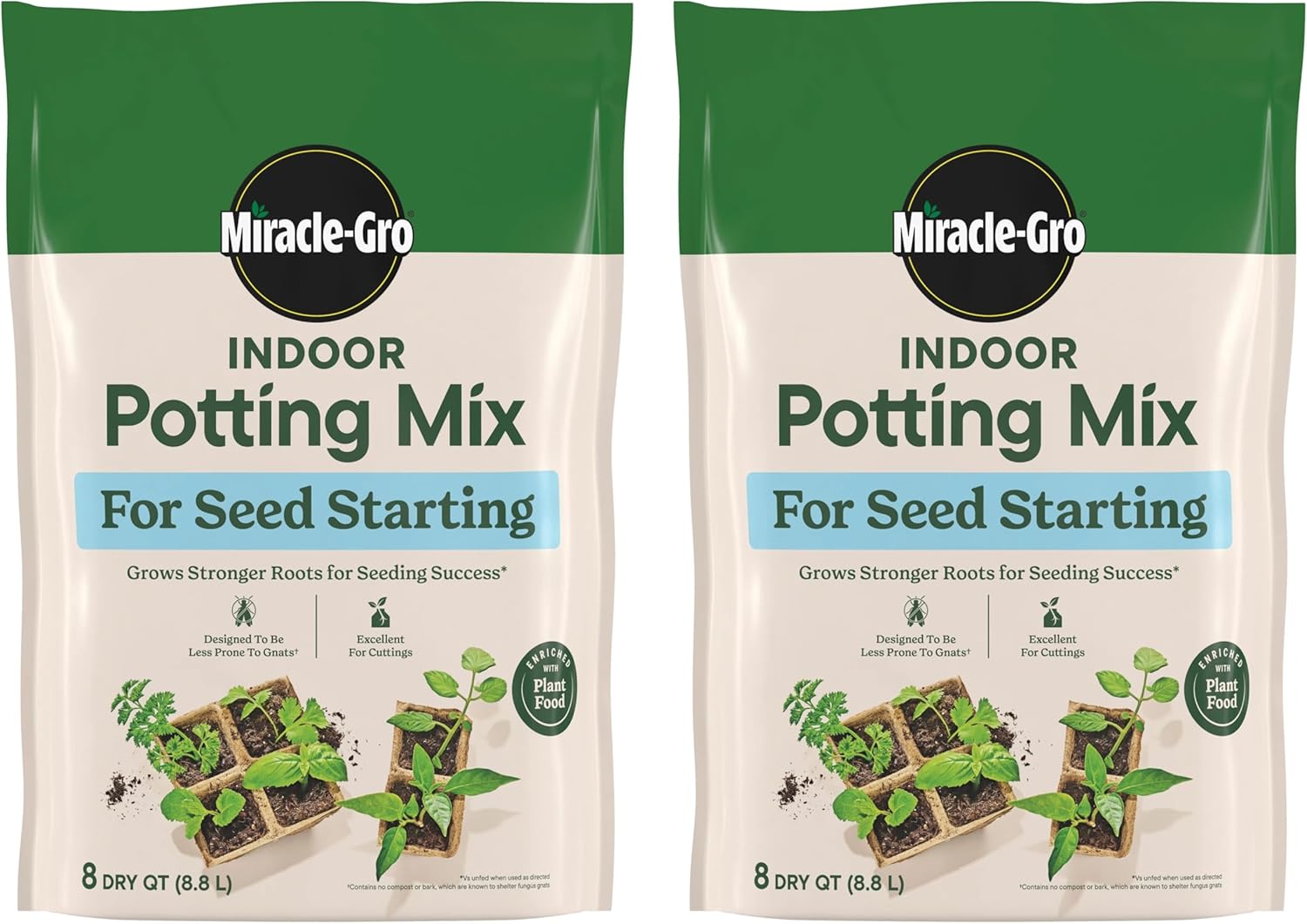
This two-pack of Miracle-Gro Indoor Potting Mix is designed specifically for starting seeds and rooting cuttings indoors. The blend is lightweight and pre-enriched with plant food so seedlings get a nutrient boost during early root development, and the manufacturer says it yields stronger roots compared with unfed mixes when used as directed. It is intended for vegetables, flowers, and herbs and works well in cell trays and small containers; one 8 qt. bag will fill roughly three 72-cell trays. Notably, the formula omits compost and bark, which helps lower the chance of fungus gnat infestations in damp seed-starting setups. Use it by filling trays or pots, keeping the mix evenly moist, and shielding newly sown seeds from direct sun until germination. Important limitations are standard for enriched mixes: it contains fertilizer (so handle carefully) and it is a seed-starting medium rather than an all-purpose potting soil for mature plants, so you will likely transplant seedlings into a different mix or amend soil later.
Best for: Buyers who want a low-effort, indoor seed-starting medium that supports faster root development and reduces common pest risks while following proven seed-starting practices.
Less Ideal for: Gardeners who need a permanent potting soil for mature container plants or who prefer fully organic, compost-rich mixes should consider alternatives.
- Lightweight, ready-to-use formula tailored for seed germination and cuttings
- Pre-enriched with plant food to support early root and seedling growth
- Excludes compost and bark to reduce habitat for fungus gnats
- Comes as a two-pack so you have enough mix for multiple trays
- Contains fertilizer which requires careful handling and storage
- Intended for seed starting so not formulated as long-term potting soil for mature plants
Verdict: A practical, low-risk seed-starting mix that boosts early root growth and reduces fungus gnat risk, making it a reliable choice for indoor vegetable seedlings.
Back to the Roots Organic Seed Starting Mix — Expanding 12 Quart Block

| Volume | 12 quarts |
|---|---|
| Item Type Name | Seed Starting Mix |
| Unit Count | 384 Fluid Ounces |
| OMRI Listed | Yes |
| Peat Free | Yes |
This compressed seed starting mix is a coir-based block that expands to 12 quarts of loose, ready-to-use seedling soil after adding water. It is designed for starting seeds, potting up seedlings, and amending small pots for herbs, vegetables, and flowers. Notable features include an OMRI-listed organic formulation, balanced pH and low electrical conductivity to support nutrient uptake, and compact storage compared with bulky soil bags. In practice the block is easy to hydrate and fluffs up quickly, producing a light, airy medium with good water retention and aeration for root development. The convenience of a single expanding block and beginner-friendly handling makes it a reliable choice for cautious gardeners who want predictable results without mixing multiple ingredients. Limitations are that it is a single-purpose starter mix rather than an all-in-one fertilized potting soil and larger projects will need multiple blocks, so plan quantities ahead.
Best for: Practical gardeners who want a reliable, easy-to-use organic starter medium for small-scale seed trays, pots, and indoor seedlings and who prioritize predictable, low-fuss results.
Less Ideal for: Gardeners needing a ready-to-use, fertilized all-purpose potting soil for large container gardens or immediate long-term container plantings should consider an enriched potting mix instead.
- Expands to 12 quarts from a compact compressed block for easy storage and transport
- OMRI-listed organic and peat-free formulation suitable for organic growing
- Neutral pH and low electrical conductivity support seedling nutrient uptake
- Light, fluffy texture promotes good aeration and root development
- Simple to hydrate and use, friendly for beginners and low-effort setups
- Sold as a bare starting mix without added fertilizer for later stages
- Single block size requires purchasing multiple units for larger seed batches
Verdict: A compact, OMRI-listed organic seed starter that reliably expands into a light, neutral-pH medium for predictable, beginner-friendly seed starting.
Choosing the Right Seed Compost: Key Factors to Consider
Texture and Drainage
Seed compost should be fine-textured yet open. A fine crumb allows small seeds to make consistent contact with the compost surface so they absorb moisture evenly. At the same time the mix must have enough coarse particles or added grit to create air pockets for early root growth and to avoid compaction when watered.
If the mix is too dense it can hold water against the seed and reduce oxygen availability, which increases damping off risk. Conversely, mixes that drain too quickly may need more frequent misting to keep seeds moist. Think of texture as the single most important physical trait for germination success.
Starter Nutrient Balance
Seeds do not need heavy feeding immediately, but a light, balanced starter nutrient level supports the first true leaves after cotyledons have formed. Look for composts that advertise a low to moderate starter feed or that list slow-release or buffered nutrients that will not scorch delicate roots.
Too much soluble fertilizer in a seed mix can cause cotyledon burn and uneven growth. A quality seed compost provides just enough nutrition for the seedling stage and relies on later potting-on mixes to supply higher nutrient needs.
Sterility and Disease Risk
A sterile or pasteurized seed compost reduces the chance of fungal and bacterial pathogens that cause damping off and seed rots. Many professional growers use sterilized mixes for the first sowing stage to lower disease pressure in humid, crowded conditions.
While absolute sterility is rare in bagged goods, attention to processing and low weed seed content are important. For gardeners who reuse trays and modules, choosing a compost with low initial pathogen load makes sanitation and routine hygiene practices more effective.
Moisture Retention and Watering Ease
Seed compost must balance holding water long enough for seeds to imbibe with the ability to shed excess when overwatered. Components such as finely graded peat substitutes, coir, or small amounts of fine vermiculite influence how quickly a mix dries and how easy it is to water without disturbing tiny seeds.
A mix that dries out too quickly forces frequent misting and increases handling; a mix that stays soggy invites disease. Consider your propagation environment and how often you can check trays when judging moisture performance.
Particle Consistency and Sowing Uniformity
Even grading of particles helps seeds sit at a uniform depth and prevents large clumps or oversized fragments from creating dry pockets under seeds. Consistency also improves the accuracy of thin sowing and the success of tiny seeds that require a very fine surface.
Variable particle size can be acceptable in mixes meant for larger seeds, but for a dedicated seed compost you want predictability so germination rates are more uniform across a tray.
Suitability for Different Propagation Methods
Different sowing methods impose different demands on compost. Trays and flats need a mix that levels smoothly and can be firmed without compacting. Paper pots and peat-free pellets often require a compost that rehydrates quickly and holds shape. Surface-sown tiny seeds benefit from mixes that can be sieved to an ultra-fine finish.
Consider whether you will prick out seedlings, transplant plugs, or sow directly in modules, because that affects the ideal firmness and moisture behavior of the seed compost you choose.
Preparing Trays and Sowing Technique
Start with clean seed trays or modules and pre-moisten the compost to a damp-but-not-soggy state. Fill trays and firm the surface gently to provide good seed-to-soil contact without compressing the mix.
For very small seeds, use a sieve or fine screen to create an even, smooth surface and sow at the recommended surface depth. Larger seeds can be pressed into shallow hollows. Label trays clearly and use a humidity dome or clear cover only until germination to maintain moisture while avoiding prolonged high humidity that encourages fungal growth.
- Pre-moisten compost before filling containers
- Firm surface gently, do not compact
- Use covers briefly until most seeds have emerged
Managing Moisture and Ventilation After Sowing
Keep the surface consistently moist during germination with gentle bottom watering or fine misting. Bottom watering helps avoid disturbing tiny seeds and encourages roots to grow downward.
Once seedlings appear, introduce airflow and reduce humidity gradually to harden them off and minimize damping off. That means removing covers for longer periods each day and ensuring adequate ventilation in the propagation area.
- Use bottom watering to reduce surface disturbance
- Gradually reduce humidity after germination
- Provide gentle airflow to strengthen seedlings
When to Move Seedlings Into Potting-on Compost
Transplant seedlings when they have their first true leaves and handle them by the leaves, not the stem. Moving on at the right time prevents root crowding and nutrient depletion in the seed compost.
Potting into a slightly richer, more structured compost gives growing seedlings the nutrients and support they need for further development. Avoid leaving seedlings in seed compost too long, because most mixes are intentionally low in feed and fine in structure and will not sustain vigorous growth.
- Transplant at the first true-leaf stage
- Use a more nutrient-rich potting mix for growing on
- Handle seedlings carefully by the leaves
Peat-free and Sustainable Seed Compost Options
Many gardeners prefer peat-free seed composts for environmental reasons. Effective peat-free mixes substitute coir, well-aged bark fines, or composted green waste combined with fine mineral components to mimic the water-holding and structural properties of peat.
When choosing peat-free options, check that the texture remains fine and consistent. Coir-based mixes often need pre-wetting to fully expand and may require slightly different watering rhythms than peat-based counterparts.
- Pre-wet coir-based mixes to ensure even hydration
- Assess texture and particle size in peat-free blends
- Adjust watering frequency to account for different materials
Common Troubleshooting Tips
If seedlings fail to emerge, check seed viability, depth, and moisture. Surface crusting or uneven watering are common culprits. Light dustings of very fine grit or fine vermiculite can help maintain surface moisture without sealing.
If damping off occurs, remove affected seedlings, improve ventilation, and allow the surface to dry slightly between waterings. Sterile seed compost and clean trays minimize recurrence.
- Use fine grit to reduce surface crusting
- Improve airflow to reduce fungal issues
- Replace compost in trays after repeated disease problems
How We Chose the Best Seed Compost
We shortlisted seed composts based on attributes that directly affect germination success and seedling health. Our primary evaluation criteria were drainage and texture, because an open, fine but airy structure prevents damping off and encourages root penetration; nutrient profile and starter feed, to ensure a gentle, balanced food supply that supports early growth without burning tender cotyledons; microbial hygiene and sterility, since pathogen-free mixes reduce disease risk in moist propagation environments; moisture retention and water management, because mixes need to hold enough moisture for tiny seeds without becoming waterlogged; and consistency and particle grading, which affect seed-to-soil contact and sowing uniformity. We also considered ease of use for common sowing methods, including trays, modules, and paper pots. Exclusions included multipurpose garden composts and heavy soil-based mixes that are formulated for established plants rather than propagation. Products that relied mainly on raw garden compost or unpasteurized material were not considered, because they raise disease and weed-seed concerns for sowing.
FAQ
Can I use multipurpose compost for sowing seeds?
Often multipurpose compost is too rich and has coarser particles that are not ideal for tiny seeds. It may also contain higher nutrient levels that can burn delicate roots. For best germination, use a dedicated seed compost or a fine sieved portion of multipurpose mix for larger seeds.
How do I tell when a seed compost is pasteurized or sterile?
Manufacturers usually state pasteurization or sterilization on the packaging. Sterile or pasteurized mixes are processed to reduce pathogens and weed seeds. If that information is not available, assume a higher disease risk and use extra hygiene measures when sowing.
Is peat-free seed compost as reliable as peat-based mixes?
Peat-free mixes can be equally reliable if they match the fine texture and moisture behavior of peat-based composts. Some peat-free materials need pre-wetting or slightly altered watering, so test a small batch first to learn how it behaves in your propagation environment.
How often should I water newly sown seeds?
Watering frequency depends on the mix and environment, but generally keep the surface consistently moist until germination. Use bottom watering or gentle misting to avoid displacing seeds. Once seedlings appear, reduce frequency and improve ventilation to prevent damp conditions.
Can I add fertilizer to seed compost before sowing?
Adding extra fertilizer is usually unnecessary and can harm tiny seedlings. Seed composts are formulated with a light starter nutrient. If you prefer, use a very dilute, weak fertilizer only after true leaves develop.
Final Verdict
Pick a seed compost that prioritizes fine, airy texture and controlled starter nutrition for reliable germination. Balance moisture retention with good drainage and look for mixes with low disease risk if you are propagating in confined, humid spaces. For different sowing methods and environmental conditions, tradeoffs are normal: finer mixes give better contact for tiny seeds while slightly chunkier blends suit larger seed types. Focus on the texture, sterility, and moisture behavior described above, and you will be better positioned to raise healthy seedlings ready for potting on.
