

Note: This article contains affiliate links. If you click on these links and make a purchase, I may earn a small commission at no extra cost to you. This helps support my research and content. Read my full affiliate disclosure here.
Picking the right natural fertilizer for flowers affects more than just immediate bloom color. The right feed improves soil biology, encourages deeper root systems, and supports repeat flowering across the season. This guide focuses on tried garden-friendly fertilizer types suited for flower beds, containers, and mixed borders. We shortlisted six top natural fertilizer options and evaluated them on nutrient profile, ease of use, and how they behave in real garden settings. Below you will find clear guidance on which characteristics matter most and practical tips for application and timing before the product list.
Top Picks at a Glance
| Best Overall The best all-around choice for most situations | Espoma Organic Bio-Tone Starter Plus 4-3-3 Organic Starter Fertilizer, 8 lb |  |
| Best Quality Built to a higher standard if you want something more solid | Down To Earth Organic Rose & Flower Mix Fertilizer 4-8-4, 1 lb |  |
| Best Value The sweet spot between price and what you get | True Organic All Purpose Plant Food, 4 lb |  |
| Highest Rated A top-rated pick with lots of positive feedback | Espoma Organic Flower-Tone 3-4-5 Plant Food, 4 lb. Bag (3 Pack) |  |
| Most Popular A crowd favorite that many people choose with confidence | FoxFarm Big Bloom Liquid Plant Food, 16 fl oz |  |
| Best Seller A high-volume bestseller chosen again and again | Burpee All-Purpose Organic Granular Plant Food, 4 lb |  |
Espoma Organic Bio-Tone Starter Plus 4-3-3 Organic Starter Fertilizer, 8 lb

| Item Form | Granules |
|---|---|
| Application Method | Mix with soil |
| Specific Uses For Product | Gardening |
| Target Species | For everything you plant |
Espoma Organic Bio-Tone Starter Plus is a granular, ready-to-use starter fertilizer designed for planting and transplanting a wide range of garden plants. You mix it into backfill soil or potting mixes so the nutrients and added mycorrhizae sit in the root zone at planting time. The formula combines an organic 4-3-3 nutrient ratio with beneficial bacteria, humates, and both endo and ecto mycorrhizae to encourage faster root development, improved soil structure, and better establishment under stressful conditions. Typical uses include flower beds, bulbs, transplant holes, and planting mixes where quick root growth matters. Because it is organic and approved for organic gardening, it is suited to gardeners who prefer natural inputs. The main limitations are that it is intended as a starter or planting amendment rather than an all-season feed and dosing is by volume for different applications so you need to follow the mixing instructions for correct results. For gardeners wanting an easy organic boost at planting, this product provides a focused, microbially active start.
Best for: Gardeners who prioritize natural, microbially active amendments and want a reliable organic boost when planting or transplanting ornamentals, vegetables, and bulbs.
Less Ideal for: Buyers looking for a one-product solution for seasonal feeding or those who prefer liquid feeds or quick-release chemical fertilizers for immediate foliar results.
- Contains both endo and ecto mycorrhizae to aid root establishment
- Organic 4-3-3 formula enhanced with beneficial bacteria and humates
- Ready-to-use granules that are mixed into soil at planting
- Approved for organic gardening and made by a long-standing organic fertilizer brand
- Formulated primarily for initial planting and transplant use rather than ongoing feeding
- Dosing instructions vary by application and require measuring by volume for correct results
Verdict: Choose this if you want an organic, microbe-enhanced starter fertilizer to help new plantings establish strong roots.
Down To Earth Organic Rose & Flower Mix Fertilizer 4-8-4, 1 lb
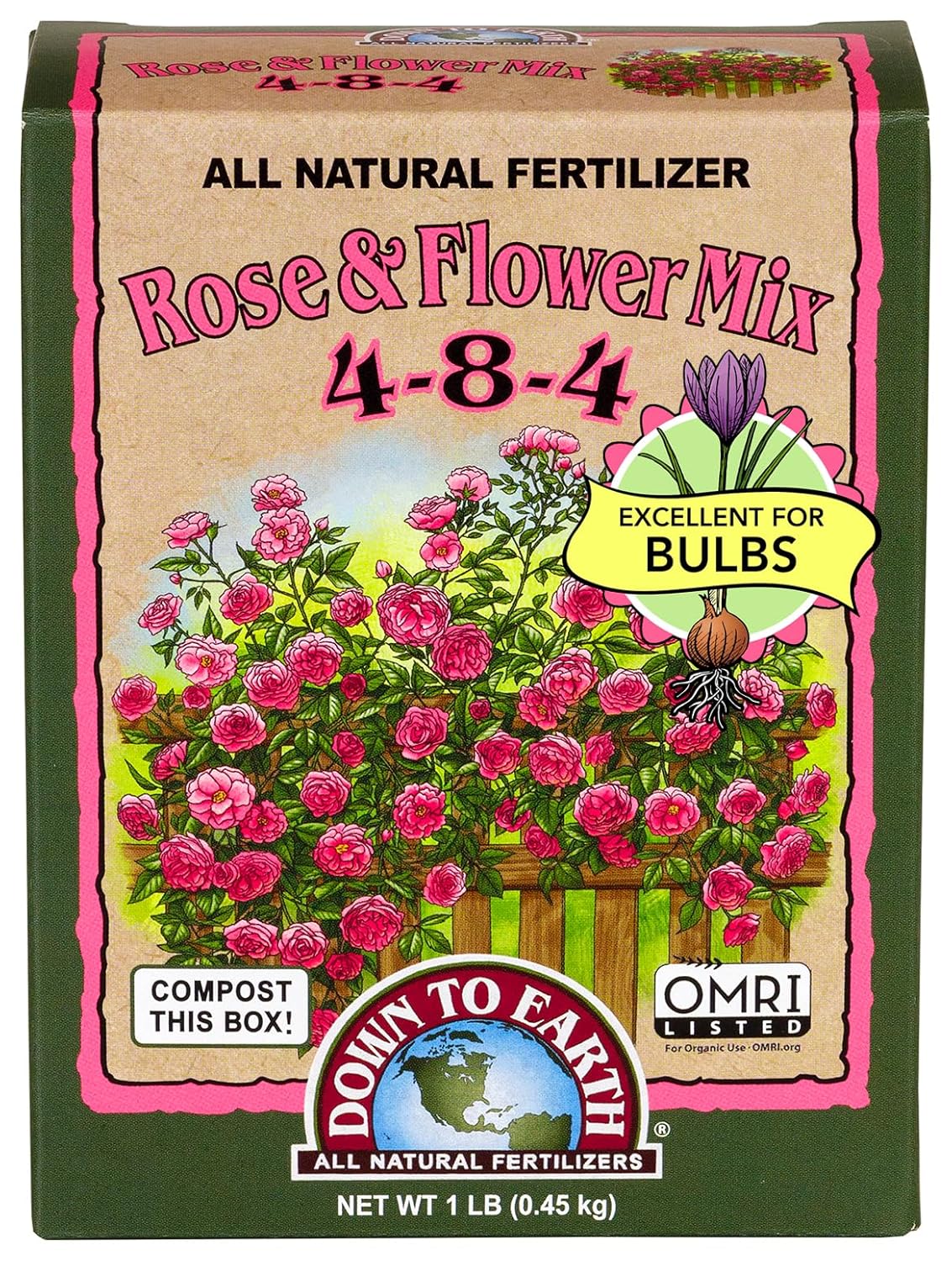
| NPK | 4-8-4 |
|---|---|
| Item Form | Granules |
| Specific Uses For Product | Plant Growth |
| Coverage | Medium |
| Mixing Ratio | 2 tbsp per gallon of soil |
This 1 lb box of Down To Earth Organic Rose & Flower Mix is a granular, OMRI-listed fertilizer designed specifically to encourage flowering and healthier root systems in roses and other ornamentals. Gardeners typically work it into the soil around established plants or use the brand mixing guidance for containers and small beds to provide periodic feeding. The relatively high middle number (phosphorus) helps stimulate prolific blooms while the balanced nitrogen and potassium support foliage and overall plant vigor. Because it is derived from natural plant, animal, and mineral resources it also contributes organic matter that supports soil microorganisms over time. The mini box size is convenient for trialing on a few plants or for container and patio gardens, but it means frequent reorders or multiple boxes are needed for larger beds. Users should follow the recommended mixing ratio and avoid overapplication since organic granules release nutrients more slowly than synthetic feeds and are best used as part of a regular feeding schedule.
Best for: Practical gardeners who prioritize organic inputs and want a bloom-focused feed for a few roses, containers, or small flower beds and who prefer predictable, soil-building nutrition over quick synthetic fixes.
Less Ideal for: Gardeners managing large rose borders or commercial plantings who need fast-acting, high-volume feeding or a single large-bag supply.
- Phosphorus-forward 4-8-4 formula supports larger and more frequent blooms
- OMRI-listed organic formulation suitable for organic rose care
- Granular form adds organic matter that benefits soil microbial activity
- Compact 1 lb size is convenient for containers, patio gardens, and small beds
- Small package size requires multiple purchases for larger rose gardens
- Slower nutrient release compared with synthetic fertilizers, so results take longer to appear
Verdict: A compact, OMRI-listed granular fertilizer that favors bloom production and soil health, making it a sensible organic choice for home rose growers with small gardens or containers.
True Organic All Purpose Plant Food, 4 lb

| Item Form | Granules |
|---|---|
| Specific Uses For Product | Agriculture, Gardening |
| Coverage | Full |
| Target Species | Plants |
True Organic All Purpose Plant Food is a granular, multi-purpose organic fertilizer designed for monthly use during the growing season. It delivers balanced macronutrients (roughly 5% N, 4% P, 5% K) with slow-release nitrogen plus secondary elements like calcium and sulfur, and relies on organic inputs such as seabird guano, fish bone meal, crab and shrimp shell meal, poultry manure, and soybean meal. In practice you sprinkle or broadcast it around in-ground beds or use lightly in containers to support flowering, foliage growth, and soil microbial activity. The slow-release portion helps reduce the need for frequent feedings and lowers burn risk compared with synthetic feeds. The product is versatile for both ornamental flowers and mixed garden plantings and is available in small sizes that suit trialing in flower borders. Limitations are that nutrient analysis is modest compared with concentrated synthetic fertilizers so results are gradual, and because it is pelletized organic material you may notice odor and slower visible responses on nutrient-hungry plants.
Best for: Gardeners who prioritize soil health and steady, natural feeding for ornamental flowers and mixed borders and who prefer low-risk, easy monthly applications.
Less Ideal for: Growers who need fast, high-concentration nutrient correction for heavy-feeding annuals or who want immediate, dramatic growth responses.
- Balanced N-P-K with a portion of slow-release nitrogen for steady feeding
- Made from sustainable organic ingredients that support soil microbial life
- Works for both in-ground beds and container-grown flowers
- Available in small bag sizes suitable for small flower gardens or trial plots
- Lower nutrient concentrations than synthetic fertilizers, so effects are slower and may require larger volumes
- Organic granules can have noticeable odor after application
Verdict: Choose this organic all-purpose plant food when you want a soil-friendly, steady feed that supports healthy flowering and long-term soil life.
Espoma Organic Flower-Tone 3-4-5 Plant Food, 4 lb. Bag (3 Pack)

| Item Form | Granule |
|---|---|
| Specific Uses For Product | Plant Food |
| Special Ingredients | Organic Flower, Flower Blossom |
| Product Benefits | Promotes abundant plant blooms and growth |
| Unit Count | 3 Count |
Espoma Flower-Tone is an organic, ready-to-use granular fertilizer designed to encourage frequent blooming in perennial flowers, roses and annuals. You apply it around the plant drip line monthly during the growing season and water it in; no mixing is required. The formula combines a balanced 3-4-5 NPK ratio with added calcium and the brand's Bio-tone microbial mix, which helps feed plants and supports soil biology rather than delivering a quick synthetic spike. That makes it well suited for gardeners who want steady, reliable blossom production without harsh chemicals. Because it is granular and sold in 4 lb. bags (this listing is a 3-pack), it is easy to store and measure for multiple beds. Expect gradual improvement in bloom quantity and overall plant vigor rather than overnight results. Limitations: it is not a fast-release synthetic fertilizer for emergency greening and monthly applications are recommended for best effect.
Best for: Gardeners who prioritize consistent, chemical-free bloom production for perennial flower beds and want a dependable monthly feed that supports soil health.
Less Ideal for: People needing rapid correction of nutrient deficiencies or immediate green-up after transplanting should choose a fast-release synthetic product instead.
- Organic formula approved for organic gardening and safe for ornamental beds
- Balanced 3-4-5 NPK with added calcium to support blooms
- Includes Bio-tone microbes to improve soil biology and nutrient availability
- Ready-to-use granular form requires no mixing and is simple to apply monthly
- Provides slower, steady feeding rather than quick green-up for stressed plants
Verdict: Choose this organic granular fertilizer when you want a reliable, monthly feed that boosts blooms and supports soil biology in perennial flower beds.
FoxFarm Big Bloom Liquid Plant Food, 16 fl oz

| Item Form | Liquid |
|---|---|
| Specific Uses For Product | Organic |
| Application Method | watering can, sprayer, or drip system |
| Liquid Volume | 16 fluid ounces |
| Mixing Ratio | 4 |
Big Bloom is a concentrated liquid bloom fertilizer aimed at boosting flowers and fruit by supplying readily available organic nutrients. It mixes into water (manufacturer recommends 4 tablespoons per gallon) and can be applied with a watering can, sprayer, hose-end siphon, or through drip systems, so you can feed potted plants, beds, or containers without changing your routine. Notable features are its OMRI listing for organic use and the inclusion of bat guano and earthworm castings, which provide phosphorus and organic matter to encourage blooms and seed set. Because it is liquid and fast-acting, you can expect visible perk-up within a short time after feeding, and it is suitable for regular use at watering times to extend flowering. Limitations to consider are the small 16 fl oz size for larger gardens and the presence of phosphorus, which may be restricted in some locales and requires careful application to avoid runoff.
Best for: Gardeners focused on maximizing blooms and fruit who want an organic, fast-acting feed they can add to routine watering for container and bed-grown flowering plants.
Less Ideal for: Large-scale landscapers or very large perennial beds who need bulk fertilizer solutions or want to avoid phosphorus-based products due to local regulations.
- OMRI-listed organic formula with natural inputs like bat guano and earthworm castings
- Liquid concentrate allows fast nutrient uptake and flexible application methods
- Works with watering cans, sprayers, hose-end siphons, and drip systems for easy integration
- Small 16 fl oz bottle may require frequent repurchasing for larger flower beds
- Contains phosphorus so local restrictions on phosphorus fertilizers may apply
Verdict: Choose Big Bloom when you want an OMRI-listed, easy-to-apply liquid fertilizer that delivers fast organic nutrients to boost flowering and fruiting.
Burpee All-Purpose Organic Granular Plant Food, 4 lb

| Item Form | Granules |
|---|---|
| Specific Uses For Product | Gardening,Plant Growth,Root Development |
| Coverage | 213 Square Feet |
| Target Species | Herba |
Burpee All-Purpose Organic Granular Plant Food is a ready-to-use organic fertilizer designed for vegetable gardens, flower beds, herbs and container plants. The granules supply major and minor nutrients plus calcium and beneficial microbes that begin releasing nutrients quickly and continue feeding plants for up to three months, so you can apply less frequently during the growing season. It is OMRI-listed, which makes it suitable for gardeners who prefer organic-approved inputs, and the coverage figure on the package helps plan application for small to medium beds. Typical use is a surface application worked lightly into the soil or mixed into potting media for containers and seed starting. Practical advantages include straightforward application, multi-month nutrient release, and compatibility with a wide range of garden plants. Limitations are the small bag size for larger plots and the lack of detailed N-P-K numbers on the listing, which means gardeners wanting precise nutrient ratios or high- rate corrective feeding may need a supplemental product.
Best for: Gardeners who prefer low-risk, organic-approved inputs and want a simple, multi-purpose fertilizer that reduces the need for frequent feeding in small to medium vegetable beds and container gardens.
Less Ideal for: Large-scale vegetable growers or gardeners who need exact N-P-K values and high-strength corrective applications should consider more concentrated or bulk fertilizers.
- OMRI-listed organic formula suitable for certified-organic and home organic gardens
- Granular form releases nutrients immediately and continues feeding for up to three months
- Suitable for seed starting, vegetables, herbs, flowers, trees, shrubs and containers
- Clear coverage guidance provided for planning applications to small and medium beds
- Bag is only 4 lb so not economical for large vegetable plots
- Product listing does not show explicit N-P-K ratio for precision nutrient planning
Verdict: A small, OMRI-listed granular fertilizer that gives low-risk, multi-month feeding for home vegetable beds and container gardens.
Choosing the Right Natural Fertilizer for Flowers: Key Factors to Consider
Nutrient Profile and NPK Ratios
Flowers need a balanced mix of nutrients to set buds and sustain blooms. Look for fertilizers that list nitrogen, phosphorus, and potassium values so you can match the feed to the growth stage. Early season planting benefits from modest nitrogen and slightly higher phosphorus to encourage root development and bud formation, while mid-season maintenance favors steady phosphorus and potassium to support flower size and durability.
Also pay attention to secondary nutrients like calcium and magnesium and to trace elements such as iron and boron. Those micronutrients are often missing from simple backyard amendments yet can prevent common flower problems like blossom drop, chlorosis, or poor stem strength.
Release Pattern and Feeding Frequency
Natural fertilizers vary from quick-release emulsions to slow-release granules and composted meals. Quick-release feeds give a rapid visible response but may require more frequent, smaller doses and risk burning if overapplied. Slow-release options feed over weeks to months and help maintain steady bloom cycles with fewer applications.
Consider how often you want to feed and how closely you monitor plants. Containers dry and flush nutrients faster than garden beds, so release pattern matters more for potted displays, while in-ground plantings tolerate and benefit from longer-release products that also improve soil structure.
Effect on Soil Biology and Structure
Many natural fertilizers do more than supply nutrients: they influence soil microbes, organic matter levels, and water retention. Materials like well-aged compost, manure blends, and kelp meals introduce beneficial microbes or feed existing populations, which in turn improves nutrient cycling and root health. Some amendments also increase organic matter and improve texture, helping flowers establish deeper roots and cope with dry spells.
If your soil is compacted or low in organic matter, prioritize fertilizers that contribute to long-term soil health rather than solely immediate nutrient boosts.
Salt Content and Plant Safety
Salt buildup in soil can stress or burn sensitive flower roots, especially in containers. Natural does not always mean low salt. Certain concentrated manures, guanos, or processed meals can have higher soluble salts that cause leaf burn or reduced water uptake. Check product information for electrical conductivity or guidance on application rates, and use conservative rates or pre-mix with compost for vulnerable annuals and tender perennials.
Flushing containers periodically and incorporating organic matter into beds reduces the risk of salt-related problems over time.
Ease of Application and Instructions
Clear dosing and straightforward application methods make it more likely you will feed consistently and correctly. Look for fertilizers with simple spread rates, soluble options that dissolve easily for watering, or granular blends that can be top-dressed and lightly worked into the soil. Complicated mixing ratios or unclear timing increase the chance of under- or overfeeding.
If you prefer low-maintenance gardening, favor products labeled for monthly or season-long feeding or those with built-in slow release that require one or two applications per season.
Suitability for Containers Versus In-Ground Beds
Containers impose different constraints: limited soil volume, faster drying, and a tendency for salts to concentrate. Fertilizers intended for garden beds might be too strong or too slow for pots. Conversely, some container-friendly feeds are formulated to avoid rapid salt buildup and to provide soluble nutrients for quick uptake.
Match your fertilizer choice to planting context and be prepared to reduce rates and increase frequency for containers to avoid nutrient lock or root damage.
When to Feed Flowering Plants
Timing matters more than sheer frequency. Begin feeding after plants have finished establishing and are showing steady leaf growth. For spring-blooming perennials, a light feeding at bud set often boosts bloom count. For repeat-flowering annuals and perennials, schedule follow-up feedings at 4 to 8 week intervals depending on the product's release pattern.
Avoid heavy feeding late in the season when plants are entering dormancy or preparing for frost. Late nitrogen applications can encourage tender growth that is vulnerable to cold damage.
- Start light after establishment, increase slightly at bud set.
- Repeat according to product release schedule, not on a rigid calendar.
- Cut back feeding as flowering slows or plants prepare for dormancy.
Applying Fertilizer in Containers Versus Beds
Containers need more frequent, gentler feeding because potting mixes have low buffering capacity and salts concentrate quickly. Use water-soluble or low-dose granular options and dilute to the recommended fraction for small pots. Top-dress larger containers with a thin layer of organic material and water it in to reduce splash and local salt pockets.
For in-ground beds, incorporate granular or composted fertilizers into the top few inches of soil before planting or lightly work in a top-dress around root zones for established plants. In beds, products that build organic matter provide long-term benefits beyond the season they are applied.
- Reduce container application rates; increase frequency when needed.
- Top-dress beds in early spring or at bud set for sustained feeding.
Combining Fertilizers with Compost and Mulch
Compost and mulch complement natural fertilizers by improving moisture retention and microbial activity. Apply a light compost top-dress and then follow with a targeted fertilizer timed for bloom production. Mulch helps moderate soil temperature and slows nutrient leaching while protecting developing roots.
Avoid burying fresh high-nitrogen manures directly at the root crown. Let composted materials integrate for a season when possible to reduce the risk of heat or nitrogen spikes that can harm delicate flowers.
- Use compost for baseline soil health, fertilizers for targeted bloom support.
- Keep mulch away from direct stem contact to reduce rot.
How to Recognize Nutrient Deficiencies in Flowers
Leaf color, bud set, and stem strength are the most useful visual cues. Pale, uniformly yellow leaves often indicate nitrogen shortage, while poor bud formation or small blooms can point to low phosphorus. Stunted growth with purpling or odd leaf patterns suggests a micronutrient issue rather than a simple lack of NPK.
Perform a basic soil test if symptoms are unclear. Tests help distinguish between pH problems that lock up nutrients and actual nutrient shortages so you feed specifically rather than applying unnecessary inputs.
- Nitrogen deficiency: overall yellowing and reduced growth.
- Phosphorus deficiency: poor bud set and small blooms.
- Micronutrient issues: blotchy leaves or odd discoloration patterns.
Organic Matter and Long-Term Flower Garden Health
Investing in organic matter pays dividends season after season. Well-decomposed compost and stable organic fertilizers increase water-holding capacity, foster earthworms and microbes, and provide a slow stream of nutrients. Over time, a soil rich in organic matter reduces reliance on frequent fertilizing and produces more resilient plants.
Aim to add organic matter annually to beds and refresh container mixes every one to two seasons for best results. This creates a foundation so targeted natural fertilizers can fine-tune bloom quality and timing rather than acting as the sole nutrient source.
- Annual compost applications build lasting soil fertility.
- Refresh container mixes periodically to avoid compaction and nutrient depletion.
How We Chose the Best Natural Fertilizer for Flowers
We prioritized fertilizers that deliver consistent, garden-ready results while using naturally derived inputs. Selection centered on measurable, gardener-relevant criteria: nutrient profile and release pattern, suitability for different flower types and planting situations, impact on soil life and structure, application ease and dosing clarity, and product consistency across bags or batches. We flagged formulas that are inappropriate for flowering plants, such as those with excess salt or very high nitrogen aimed at lawns, and excluded synthetic or chemically enhanced blends that do not meet the 'natural' scope. To build the shortlist we examined ingredient lists and typical analysis values, assessed whether the product supports slow or fast nutrient release appropriate to blooms, considered compatibility with potted plants versus in-ground beds, and checked for additives that influence soil microbes. We also filtered out products with unclear instructions or inconsistent feeding rates, since correct application matters for flower performance. The resulting picks focus on options that gardeners can apply confidently for healthier, longer-lasting blooms.
FAQ
Can I use natural fertilizer on all types of flowering plants?
Often yes, but suitability depends on the plant and product. Many natural fertilizers work broadly, but tender annuals and acid-loving species may need specific formulas or adjusted rates. Check feeding strength and reduce rates for small pots or delicate varieties.
How soon will I see results after applying natural fertilizer?
It depends on release pattern. Water-soluble or fast-acting natural feeds can show changes in leaf color and vigor within one to two weeks. Slow-release or soil-building products support steady improvement over several weeks to months.
Is it safe to use manure or fish-based fertilizers around edible herbs planted with flowers?
Usually yes when they are fully composted or applied according to directions. Use composted inputs to avoid raw material pathogens, and avoid fresh manure near harvestable herbs. Allow adequate time between application and harvest if using higher-risk materials.
How do I avoid overfeeding my flower beds?
Follow product rates, prefer slow-release options, and err on the side of lighter applications. Regularly assess plant growth and adjust feeding frequency rather than increasing dose. Conduct a soil test if problems persist.
Can natural fertilizers change soil pH?
Certain natural materials can influence pH over time. Wood ash raises pH, while peat or sulfur-containing amendments can lower it. Most common organic fertilizers have only modest short-term pH effects, but repeated heavy use of a specific material can shift soil chemistry.
Should I feed newly transplanted flowers immediately after planting?
Wait until roots begin to grow and plants show new leaves. A light starter feed can help some transplants, but heavy applications at planting can stress roots. Incorporate moderate compost at planting and delay concentrated fertilizers for a couple of weeks.
Final Verdict
Choosing the right natural fertilizer for flowers means balancing immediate bloom support with long-term soil health. Prioritize products that match the nutrient needs and planting context of your flowers, paying attention to release pattern, salt content, and how a product affects soil biology. Containers and tender annuals need gentler, more frequent feeding, while beds benefit from slow-release and soil-building materials. Focus on clear application instructions and modest rates to avoid stress, and use compost and mulch as the foundation for a healthy flower garden. With those tradeoffs in mind, you can pick a natural fertilizer that reliably improves bloom size, frequency, and plant resilience.
